Trauma-Informed Care is an integrated approach to care that assumes anyone seeking help may have a history of trauma. It shifts the question from “What's wrong with you?” to “What happened to you?”, and that matters because 70.4% of respondents across 24 countries reported experiencing trauma in their lifetime, with an average of 3.2 traumas per person according to WHO-linked data reviewed here.
If you're an expat in Italy, this question may feel intensely personal. You may already be carrying a difficult history, and relocation can make old wounds louder. A foreign language, unfamiliar systems, loneliness, immigration stress, academic pressure, or a relationship that suddenly feels less stable can all affect your sense of safety.
What is trauma informed care? In practice, it means care that recognises trauma's effects on the mind, body, relationships, and behaviour, and then organises support around safety, respect, and collaboration. It isn't one technique. It isn't only for PTSD. It's a framework that shapes how a therapist speaks, listens, asks questions, sets pace, explains choices, and protects you from feeling overwhelmed or blamed.
For expats, that framework matters even more. When you're far from home, even simple help-seeking can feel exposing. You may need someone who understands not only trauma, but also culture shock, identity strain, and what happens when you're trying to explain your inner life in a language that isn't fully yours.
Understanding Trauma-Informed Care as a Paradigm Shift
Trauma-informed care begins with a different assumption. Instead of treating distress as a problem to correct, it treats distress as something that may make sense in the context of what a person has lived through.
That doesn't mean every symptom comes from trauma. It means good care doesn't rush to label, control, or interpret behaviour without first understanding the wider picture.
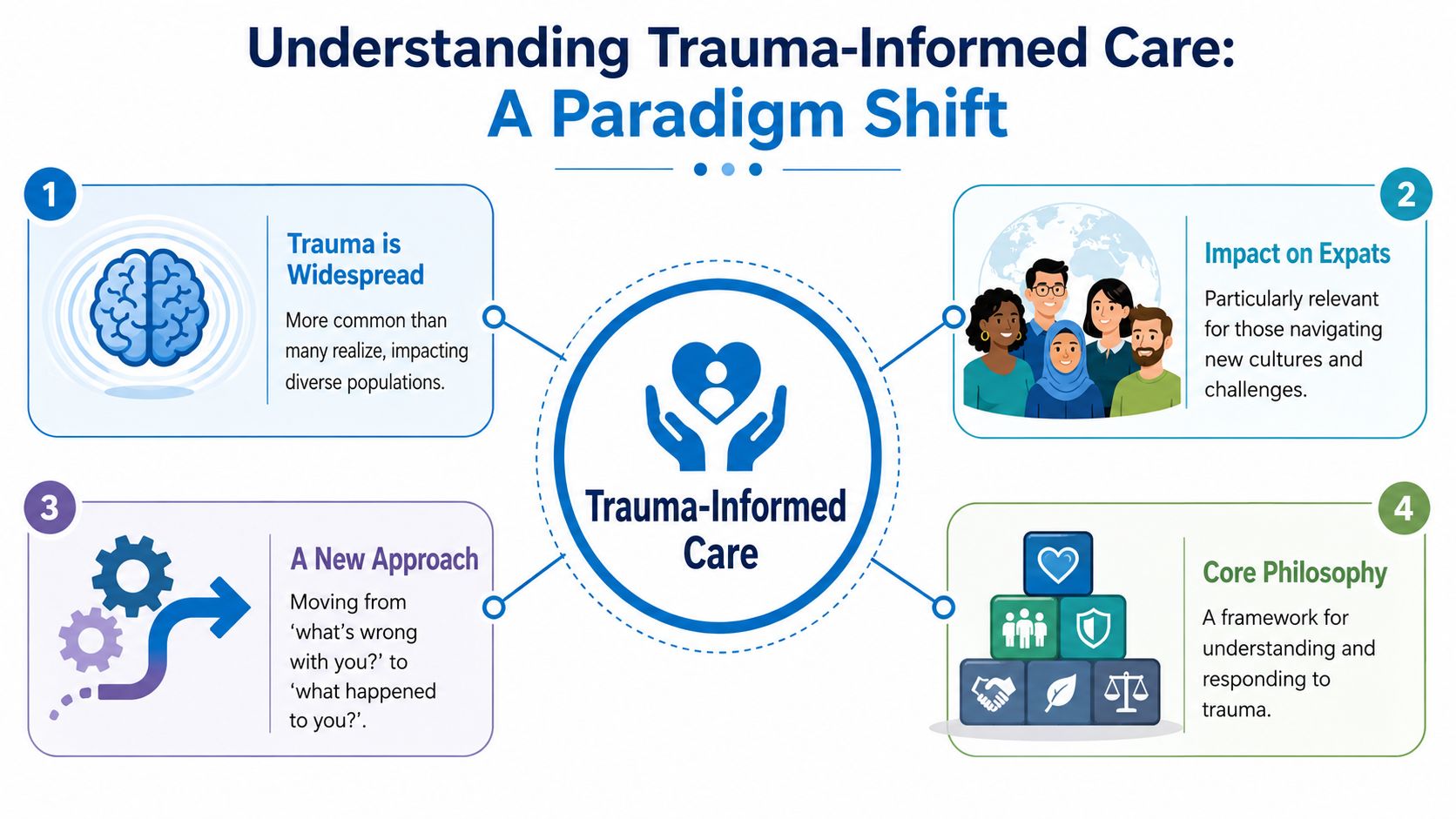
What trauma-informed care actually is
The University at Buffalo describes Trauma-Informed Care as an organisational change process based on a “universal precaution” approach for trauma, similar to how health professionals use gloves for pathogens, with the aim of preventing re-traumatisation and guided by the five values of safety, trustworthiness, choice, collaboration, and autonomy, alongside DEIAJ at every level of care in their overview of trauma-informed care.
That idea of universal precaution is useful. A therapist doesn't need proof that you've been through trauma before behaving carefully, respectfully, and transparently. They don't wait until you disclose something painful to start protecting your sense of safety.
A trauma-informed therapist doesn't ask for your deepest story first. They build the conditions that make telling any part of it feel possible.
This is one reason trauma-informed care often overlaps with broader ideas about integrated care for better outcomes. Mental health doesn't happen in isolation. Housing stress, visa uncertainty, discrimination, family conflict, physical symptoms, and nervous system overload can all affect how distress shows up.
Why this shift matters for expats in Italy
For many expats, trauma isn't only about one dramatic event. It can also involve cumulative strain. Repeated disorientation. Loss of familiar support. A sense that you're functioning outwardly while feeling increasingly unsafe inwardly.
In expat life, people often say, “I should be coping better.” Trauma-informed care replaces that with a more useful question. What has your system had to do in order to survive, adapt, and keep going?
That question can change treatment completely. A panic response may no longer be treated as irrationality. Emotional numbness may no longer be read as indifference. A missed session may no longer be framed as resistance. The clinician starts by asking what function the response serves.
If you want a deeper look at how trauma can linger in complex ways, this guide to complex PTSD recovery therapy can help clarify why ordinary stress-management advice often isn't enough.
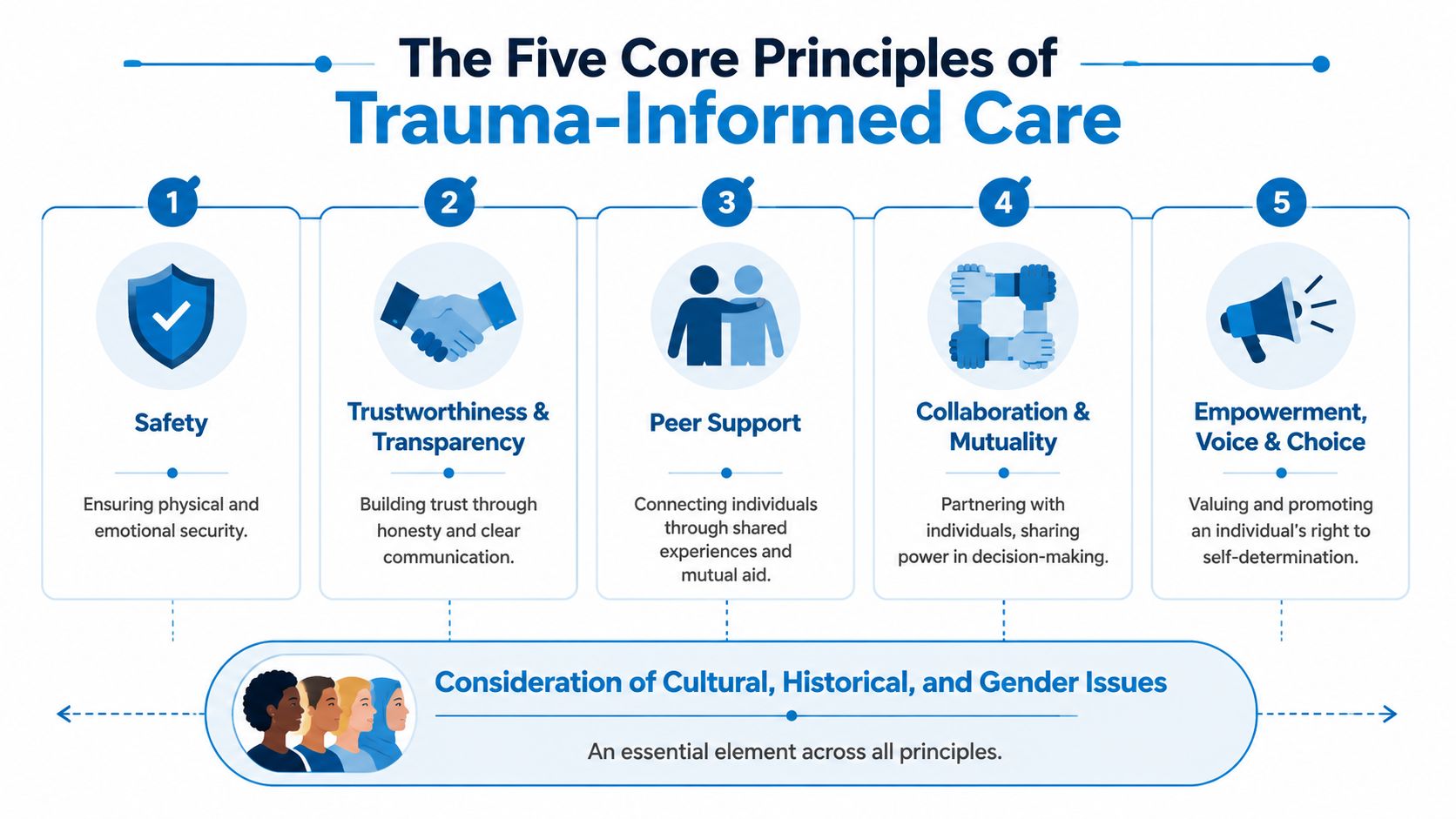
The Five Core Principles of Trauma-Informed Care
The five foundational values often used to define Trauma-Informed Care are safety, trustworthiness, choice, collaboration, and self-determination.
These principles sound simple. In practice, they're demanding. They require a therapist or service to slow down, communicate clearly, and give up the fantasy that expertise alone creates healing.
Safety
Safety is both physical and emotional. The room, the pace, the tone, and the structure of the session all matter.
A trauma-informed therapist pays attention to whether you feel pressured, cornered, rushed, or exposed. They don't assume that a calm voice alone creates safety. They check whether what they're doing is landing that way for you.
Examples of safety in practice include:
- Clear beginnings: Explaining what a first session is for, and what it isn't.
- Predictable pacing: Letting you know when sensitive topics may come up.
- Permission-based work: Asking before going deeper into painful material.
- Grounding support: Helping you regulate before, during, and after difficult conversations.
If your stress lives strongly in the body, support focused on nervous system regulation therapy may be especially relevant.
Trustworthiness
Trustworthiness means the therapist is reliable, consistent, and transparent. They explain confidentiality. They explain limits. They explain how they work.
Trauma often teaches people that authority can be confusing, unpredictable, or unsafe. Therefore, in therapy, vagueness can feel threatening even when the clinician means well.
A trustworthy therapist usually does the following:
- Names the process clearly so you know what to expect.
- Explains clinical choices instead of acting mysteriously.
- Keeps boundaries consistent so the relationship feels dependable.
Choice
Choice is not a decorative extra. It's part of repair. Trauma often involves a loss of control, so therapy shouldn't recreate that pattern.
Choice can look very ordinary. You can pause. You can say no. You can decide not to answer a question. You can ask to stay with the present instead of discussing the past.
If therapy feels like something being done to you, something important is missing.
Choice also includes language choice and cultural choice. For expats, that can mean deciding whether you want therapy in English, Italian, or your native language, and whether you want a therapist who understands migration, bicultural identity, or gendered expectations across cultures.
Collaboration
Collaboration means the therapist works with you rather than positioning themselves as the sole interpreter of your life. They bring training. You bring lived knowledge.
That partnership matters because trauma can leave people doubting their own perceptions. Collaborative therapy helps restore confidence in your own signals.
A simple way to tell whether collaboration is present is to notice whose agenda dominates the session.
- Collaborative care sounds like: “Does this fit for you?” “Would you like to try this?” “What feels most urgent today?”
- Non-collaborative care sounds like: “This is what you need to do.” “You're avoiding the issue.” “We need to push through.”
For readers who want a plain-language companion on emotional attunement, this guide to emotional responses for well-being is a useful supplement.
Empowerment
Self-determination doesn't mean forced positivity. It means the therapist recognises strengths, coping efforts, and resilience without minimising pain.
In trauma-informed work, fostering agency often sounds like this:
- “Your response makes sense.”
- “You don't have to tell the whole story today.”
- “Let's notice what helps you feel more grounded.”
A sense of autonomy is also where DEIAJ becomes clinically real. A person cannot feel autonomous in care that ignores racism, migration trauma, homophobia, ableism, religious identity, or the stress of living between cultures.
How Trauma-Informed Care Differs From Standard Care
Trauma-informed care is not just kinder standard care. It changes how symptoms are interpreted, how relationships are structured, and how goals are set.
Standard care vs Trauma-Informed Care
| Aspect of Care | Standard Care Approach | Trauma-Informed Care Approach |
|---|---|---|
| First conversation | Focuses quickly on symptoms, diagnosis, and problem lists | Starts by creating safety and understanding context |
| View of distress | “What is the symptom?” | “What might this response mean in your life?” |
| Missed appointments | May be seen as non-compliance or low motivation | Explored as possible overwhelm, fear, shame, or practical strain |
| Goal setting | Therapist-led goals based on symptom reduction | Shared goals based on safety, stability, and what matters to the person |
| Pace of disclosure | Assumes talking about trauma is always helpful | Respects readiness and doesn't force detail too soon |
| Role of relationship | Useful, but secondary to technique | Central to recovery and trust-building |
| Interpretation of coping | May label behaviours as avoidance, difficult, dramatic | Understands behaviours as adaptive responses that may once have protected the person |
| Cultural context | Can be treated as background information | Considered essential to understanding meaning, safety, and care |
What works better in real life
A standard approach may unintentionally reproduce the dynamics that made someone feel unsafe in the first place. Fast questioning, little explanation, and pressure to “open up” can all backfire.
Trauma-informed care usually works better because it doesn't confuse urgency with effectiveness. It recognises that people process difficult material more effectively when they feel oriented, respected, and in control.
Good trauma-informed work doesn't remove challenge. It places challenge inside a safe enough relationship.
This is especially important for women navigating trauma in a foreign country, where vulnerability can already feel amplified. Support from a clinician trained in trauma-informed therapy for women can make the difference between a therapy process that feels exposing and one that feels steadier.
Trauma-Informed Care in Practice Examples
Abstract principles become easier to trust when you can see how they work in ordinary life. Trauma-informed care often looks subtle from the outside. Inside the experience, the difference is profound.
In a therapy room
A client arrives for a session because a memory has been intruding all week. She wants help processing it, but she's also afraid of being overwhelmed.
A trauma-informed therapist doesn't begin by asking for every detail. First, they check the client's present state. Can she notice the room? Her breathing? Her feet on the floor? Does she know she can stop at any point?
Only then does the clinician begin structured work. If the client's distress rises too quickly, they slow down. If she says, “I don't want to continue this part today,” the therapist doesn't frame that as failure. They honour it as information.
This is one reason body-based approaches can complement trauma therapy so well. If trauma is showing up as tension, shutdown, shakiness, or disconnection, somatic therapy in English in Italy can offer a gentler entry point.
In a university or community setting
An international student in Italy goes to an academic office after weeks of isolation, poor sleep, and mounting stress. In a non-trauma-informed setting, the conversation may focus only on attendance, deadlines, and performance.
In a trauma-informed setting, the advisor notices signs of overload and responds differently. They speak slowly. They avoid judgment. They ask what support would help the student feel more stable right now.
The practical response might include:
- Reducing immediate pressure: Breaking tasks into manageable next steps.
- Restoring choice: Offering options instead of issuing commands.
- Connecting support: Suggesting counselling, peer support, or trusted contacts.
- Protecting dignity: Avoiding language that shames the student for struggling.
Neither example is dramatic. That's the point. Trauma-informed care often changes outcomes through tone, timing, pacing, and respect. People don't usually remember a session because the clinician said something brilliant. They remember that they didn't feel pushed, judged, or left alone with too much too quickly.
How to Recognize a Trauma-Informed Therapist in Italy
In Italy, finding a trauma-informed therapist can take more effort than it should. The term is used loosely, and not every clinician who works with trauma practices in a trauma-informed way.
The most helpful question isn't “Does this therapist treat trauma?” It's “How do they create safety, choice, and trust from the first contact onward?”
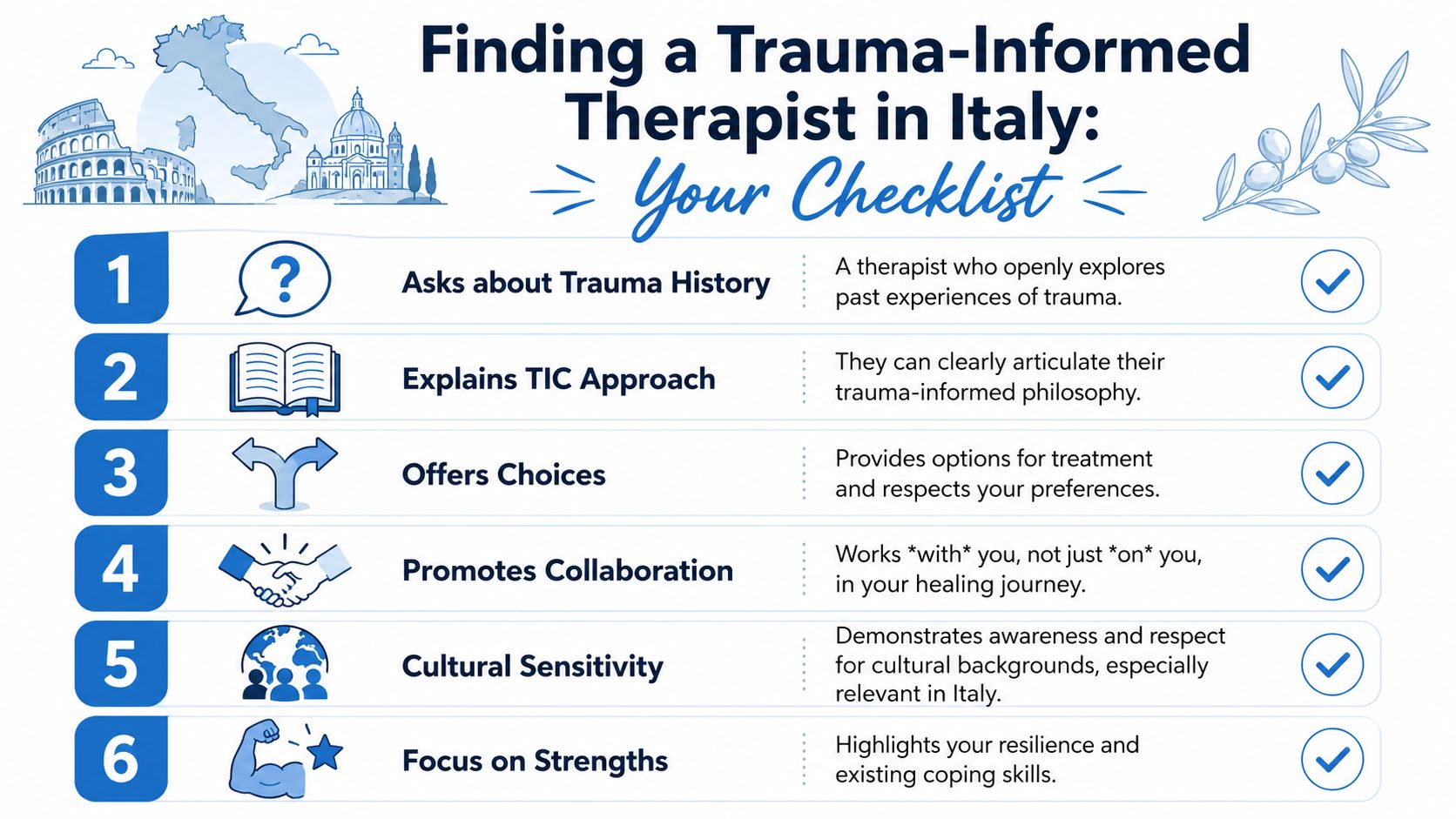
Green flags to look for
A trauma-informed therapist usually gives you signals before the first full session.
- They explain their approach clearly: You shouldn't have to guess how they work.
- They respect pacing: They don't pressure you to disclose painful material immediately.
- They speak collaboratively: The language sounds like partnership, not authority from above.
- They welcome questions: A good clinician won't become defensive if you ask how they handle trauma.
- They understand cultural context: They recognise that migration, language, discrimination, and identity all affect safety.
- They notice strengths: They don't define you only by symptoms.
For English speakers, this directory page for a trauma therapist English speaking in Italy can assist in identifying what to ask and what to expect.
Red flags that deserve attention
You don't need to wait for a disastrous experience to decide a therapist isn't the right fit.
Watch for patterns like these:
- Pressure to tell everything immediately
- Dismissive responses to overwhelm
- Rigid, one-size-fits-all advice
- Little attention to language or culture
- Explanations that are vague when you ask basic process questions
A therapist doesn't need to be perfect. But if you consistently leave feeling confused, blamed, or emotionally flooded without support for regulation, that's important information.
A therapist can be highly trained and still be the wrong fit for your nervous system.
Questions you can ask before starting
Many expats feel awkward interviewing a therapist. You don't need to. This is your care.
Useful questions include:
- How do you create a sense of safety in sessions?
- How do you work if a client becomes overwhelmed?
- What's your experience with trauma and intercultural clients?
- Can therapy proceed without discussing painful memories right away?
- How do you integrate language and cultural background into treatment?
- What approaches do you use, such as CBT, EMDR, or Schema Therapy, and how do you decide what fits?
The right therapist won't hear these questions as mistrust. They'll hear them as signs that you're trying to care for yourself responsibly.
The Evidence for Trauma-Informed Therapies like EMDR
Trauma-informed care is a framework. EMDR, CBT, and Schema Therapy are treatment methods. The most effective clinical work often combines both. The framework shapes how therapy is delivered. The method shapes what the therapist and client do together.

Why EMDR fits a trauma-informed approach
EMDR stands for Eye Movement Desensitization and Reprocessing. In plain language, it's a structured therapy that helps the brain process distressing memories so they become less overwhelming in the present.
A trauma-informed EMDR clinician doesn't rush to memory processing. They begin with preparation. That may include stabilisation, grounding, resourcing, and identifying what helps the client feel anchored before any difficult material is activated.
This reflects the core principles directly:
- Safety: Preparation comes before deep processing.
- Choice: The client can pause, slow down, or stop.
- Collaboration: The therapist tracks the client's experience closely.
- Capacity Building: The work builds confidence in the person's capacity to cope.
What good trauma work does not do
It doesn't force catharsis. It doesn't treat intense emotion as proof that therapy is working. And it doesn't assume that revisiting every painful memory in detail is always necessary.
In my clinical experience, expats are often relieved to learn this. Many fear trauma therapy because they imagine being pushed into reliving everything while far from home and without a stable support system. Good trauma-informed work is more careful than that.
Other modalities can also support trauma recovery:
- CBT: Helps identify threat patterns, beliefs, and avoidance cycles.
- Schema Therapy: Useful when trauma has shaped deep patterns around abandonment, mistrust, shame, or emotional deprivation.
- Body-oriented approaches: Helpful when distress is carried physically rather than verbally.
Healing from trauma isn't only about remembering. It's also about learning that the present can become safer than the past.
The method matters, but the fit matters just as much. A strong therapist chooses technique based on readiness, symptoms, culture, language, and the person's wider life situation.
How Expats Can Access Multilingual Trauma-Informed Care in Italy
Many expats experience a similar difficulty. They understand they need support, but the path to finding it feels opaque.
For expats, the challenge is often even sharper because language barriers and cultural mismatch can make ordinary clinical encounters feel less safe, less precise, and less humane.
Why finding the right fit can be hard
You may run into one or more of these problems:
- Language mismatch: You can function in Italian socially but still need emotional nuance in your native language.
- Cultural mismatch: A therapist may be competent, yet not understand migration stress, bicultural tension, or how homesickness affects identity.
- System complexity: Booking, referrals, waiting, and understanding credentials can feel tiring when you're already depleted.
- Fear of re-explaining yourself: Many expats delay therapy because they don't want to spend precious energy educating the clinician about their context.
This is why multilingual, culturally responsive care isn't a luxury. In trauma work, it can be part of safety itself.
What to look for in practical terms
A better path usually includes a few concrete features.
- A therapist or service that offers sessions in the language you think and feel in most naturally
- A clinician who can explain their trauma approach in plain English
- A structure for careful matching rather than random assignment
- Flexibility between online and in-person care
- Experience with expats, students, intercultural couples, and relocation stress
If you're evaluating options, ask how matching happens. Ask whether trauma modalities like EMDR are available. Ask whether rematching is possible if the fit isn't right.
One practical option for expats in Italy
One option is Therapsy, a multilingual psychotherapy service in Italy offering 14 languages, 50+ therapists, online and in-person sessions across 24 Italian cities and 90+ physical locations, with a free first assessment call, human matching by the Clinical Director, and approaches including CBT, EMDR, Schema Therapy, TMI, systemic-relational therapy, humanistic/bioenergetic psychotherapy, and ethnopsychotherapy. Services are available for young adults, expats, international students, intercultural couples, and underserved language communities, with individual therapy from €70/session, couple therapy from €100/session, psychiatric consultation from €110/session, and psychodiagnostic assessment from €255 for 3 sessions.
Those details matter because trauma-informed access isn't only about the session itself. It's also about the entry into care. A free initial assessment call reduces pressure. Human matching can help you avoid retelling your story to multiple providers. Options for online and in-person sessions make continuity more realistic if you travel, relocate within Italy, or live outside major centres.
A simple way to start if you feel overwhelmed
If you're not sure where to begin, keep it small.
- Write down your main need: safety, panic, relationship strain, intrusive memories, burnout, or culture shock.
- Choose your language first: this often clarifies your options immediately.
- Ask one or two key questions: “How do you work with trauma?” and “How do you create safety in sessions?”
- Notice your body in the first contact: Do you feel rushed, confused, or pressured? Or more settled and understood?
You don't need to arrive fully articulate. You don't need a perfect explanation of what's wrong. Often the most honest first sentence is, “I'm not doing well, and I don't want therapy to make me feel worse.”
That is enough to start.
When you're far from home, the relationship matters even more
For expats, therapy often becomes more than symptom treatment. It can be one of the few places where your language, identity, grief, fear, and adaptation efforts are all held together rather than split apart.
That is why trauma-informed care matters so much in Italy. Not because it is a trend. Because when life already feels disorienting, care should not add more disorientation.
FAQ
What is the difference between trauma therapy and trauma-informed care
Trauma-informed care is the overall framework, while trauma therapy is a specific treatment method. Trauma-informed care shapes how a therapist creates safety, trust, choice, and collaboration. Trauma therapy refers to focused treatments such as EMDR, CBT, or Schema Therapy that directly address trauma-related symptoms.
Is trauma-informed care only for people with PTSD
No, trauma-informed care is not only for people with PTSD. It works as a universal precaution approach, which means care is organised as if anyone seeking support may have a trauma history. That makes therapy safer and more respectful for many people, including those dealing with anxiety, burnout, relationship strain, or culture shock.
Can I find trauma-informed therapy in English in Italy
Yes, you can find trauma-informed therapy in English in Italy, but quality and fit vary. The most important factors are whether the clinician works collaboratively, understands intercultural stress, and can explain their trauma approach clearly. For many expats, language and cultural understanding are part of what makes care feel safe enough to be useful.
How much does trauma-informed therapy cost in Italy
The cost depends on the provider, setting, and type of support. With Therapsy, individual therapy is available from €70/session, couple therapy from €100/session, psychiatric consultation from €110/session, and psychodiagnostic assessment from €255 for 3 sessions. The first assessment call is free, which allows you to explore fit before committing.
What if I don't speak English or Italian well enough for therapy
You can still access therapy, and your native language may be the best place to begin. Trauma work often depends on nuance, emotional precision, and a felt sense of being understood. If possible, look for a therapist who can work in your strongest language and who understands your cultural background as part of the clinical picture.
How do I know if a therapist is trauma-informed
A trauma-informed therapist usually shows it through process, not slogans. They explain how they work, avoid pushing you to disclose too much too soon, welcome your questions, and give you real choices about pace and direction. You should feel more respected and more oriented, not more confused or pressured.
Book your first free assessment call with THERAPSY if you'd like a calm, no-commitment conversation with our Clinical Director. You'll be heard, supported, and matched with the therapist who fits your language, needs, and pace.
Dr. Francesca Adriana Boccalari, Clinical Director at Therapsy