Some evenings in Italy feel heavier than they look. You might be standing at a window in Milan, hearing scooters below and church bells in the distance, and still feel flat, tired, numb, or oddly disconnected from your own life. You may even feel guilty for feeling depressed in a place other people describe as beautiful, romantic, or lucky.
That inner conflict is common. Depression doesn't disappear just because your surroundings are attractive. For many expats, the move to Italy brings loss as well as possibility: loss of routine, language confidence, closeness to family, professional identity, and the simple ease of understanding how daily life works.
CBT for depression is a structured, evidence-based therapy that helps people notice unhelpful thought patterns, change stuck behaviours, and gradually improve mood and functioning. It isn't about pretending everything is fine. It's about learning practical skills that make depression less powerful and your choices more available again.
When you're living abroad, those skills matter even more. Everyday stress can become fertile ground for hopeless thoughts such as “I'll never settle here” or “Everyone else is managing better than me.” In Italy, the need for mental health support has also become more visible. Depression rates surged from 5.5% before the COVID-19 pandemic to 17.3% in 2020, which underlined the need for accessible specialised care for expats and international students in cities such as Milan and Rome, as noted in this overview of mental health services for expats in Italy.
Feeling Down in the Bel Paese You Are Not Alone
A lot of people arrive in Italy carrying a private script about how this chapter should feel. More freedom. Better weather. Slower living. Better food. A fresh start.
Then real life begins. The landlord doesn't reply. Your Italian collapses at the pharmacy counter. Friends back home stop calling as often. Work feels harder because every small task takes more energy. You start staying in more, replying less, and telling yourself you're just tired.

That doesn't mean you've failed at expat life. It means you're human. Depression often grows subtly in the gap between expectation and reality.
What depression can feel like abroad
For an expat in Italy, depression doesn't always arrive as obvious sadness. It can look like:
- Emotional flatness. You go through the motions but feel cut off from pleasure.
- Withdrawal. You stop exploring, stop texting, stop making plans.
- Harsh self-judgement. You think other foreigners are adapting better than you are.
- Mental fog. Ordinary tasks feel confusing or disproportionately hard.
- Shame. You tell yourself you have no right to struggle here.
Depression abroad often says, “You should be grateful,” while your nervous system is saying, “I'm overwhelmed.”
If any of that sounds familiar, it may help to read more about the signs of major depression. Naming what you're experiencing can reduce the sense of chaos.
Why CBT often feels hopeful
CBT gives structure to something that can feel shapeless. Instead of treating your mood as a mystery, it helps you examine patterns. What are you telling yourself? What are you avoiding? What happens in your body? What small actions keep the cycle going, even unintentionally?
That practical focus matters when you're already stretched by life in another country. CBT for depression doesn't ask you to have motivation first. It helps you build it, step by step.
Understanding CBT A New Map for Your Mind
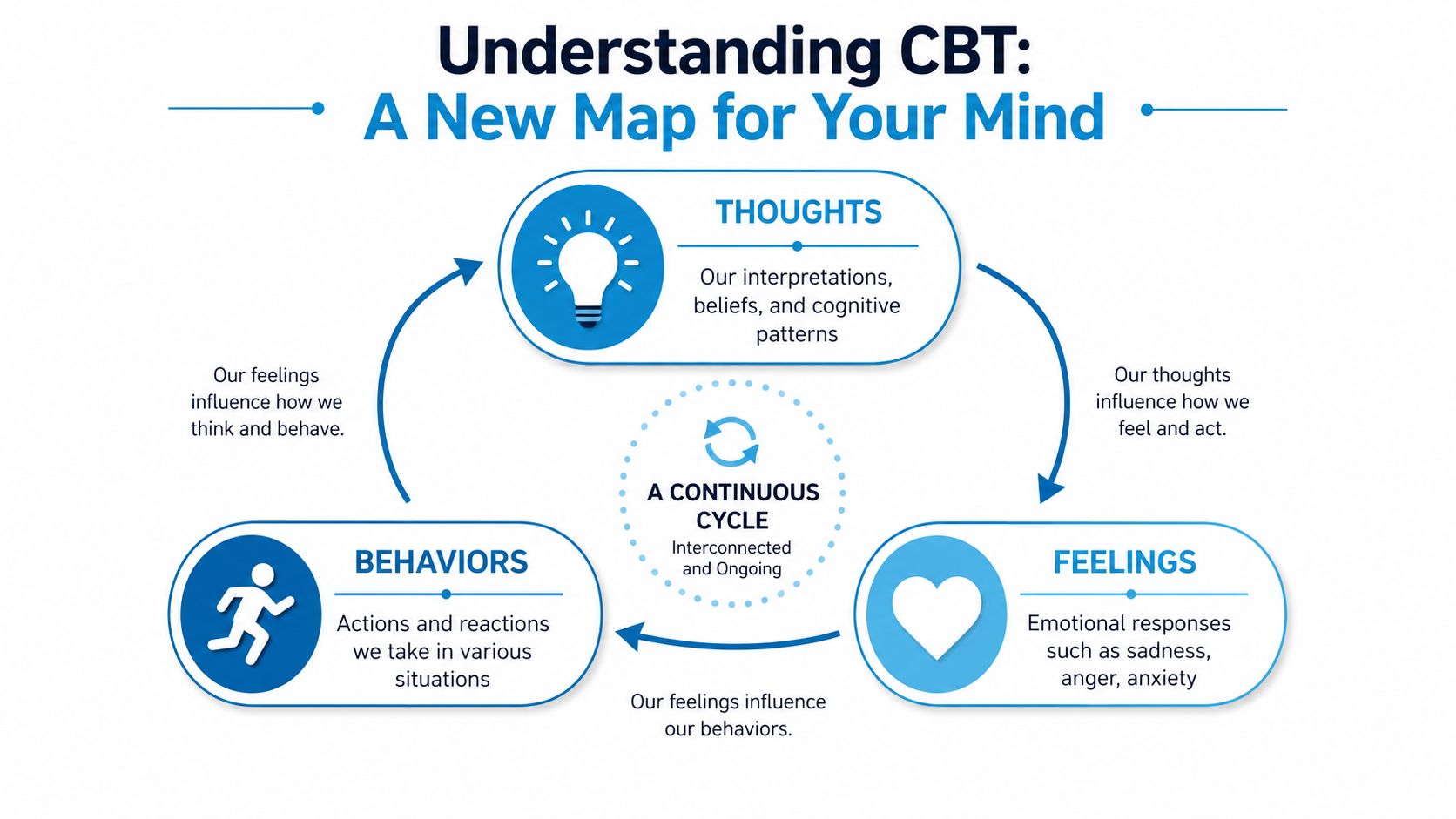
CBT stands for Cognitive Behavioural Therapy. The simplest way to understand it is this: your thoughts, feelings, and behaviours affect each other all the time.
When depression takes hold, that inner system starts to narrow. Your mind makes darker interpretations. Your body feels heavier. Your actions become smaller and more avoidant. The result is a loop that keeps confirming the depression.
The cognitive triangle in plain language
Many therapists explain CBT through the cognitive triangle. Think of it as a mental map with three connected points:
- Thoughts. What you tell yourself about what is happening.
- Feelings. The emotions that follow.
- Behaviours. What you do next, or stop doing.
Here is a common expat example.
| Situation | Thought | Feeling | Behaviour |
|---|---|---|---|
| You weren't invited to an aperitivo after class or work | “I don't belong here” | Sad, anxious, ashamed | You go home and isolate |
That behaviour then feeds the original thought. Because you stayed home, you had no chance to test whether people dislike you, were distracted, or assumed you were busy.
Why this confuses people
Many readers get stuck on one point. They hear “change your thoughts” and worry CBT means positive thinking. It doesn't.
CBT is not telling yourself a prettier story. It's learning to test whether the story in your head is complete, fair, and useful.
If your mind says, “I'll never make friends here,” CBT asks questions such as:
- What is the evidence for that?
- What evidence doesn't fit that conclusion?
- Is there a more balanced way to describe this moment?
- What action would help me test reality rather than obey the fear?
A depressed thought can feel like a fact. CBT teaches you to treat it as a hypothesis.
That shift is powerful. It turns your inner world from a prison into something you can examine.
Why the map matters
Once you can see the loop, you can interrupt it. You might not be able to command a new feeling on demand, but you can learn to respond differently to a thought, or choose one action that nudges the system in a healthier direction.
If you'd like a broader introduction, this guide to Cognitive Behavioural Therapy explains the approach in more depth. For depression, the main takeaway is simple: your mood is real, but it is also influenced by patterns that can be understood and changed.
The Two Pillars of CBT Changing What You Think and Do
When people start CBT for depression, they often expect long conversations about the past. Sometimes that happens and can be useful. But the active engine of CBT usually rests on two practical pillars: cognitive restructuring and behavioural activation.
One works mainly with thinking. The other works mainly with action. Together, they loosen depression from both sides.
Cognitive restructuring
This part helps you become less fused with automatic negative thoughts. Not every thought deserves trust. Depression tends to speak in shortcuts, absolutes, and cruel summaries.
A common expat thought might be: “I can't even handle basic life here. I'm a failure.”
A CBT therapist won't argue with you or offer a fake reassurance. Instead, they help you investigate the thought more carefully.
For example:
- Automatic thought. “I'm a failure.”
- Questions. What happened just before that thought? What standard are you using? Would you judge a friend this harshly?
- Balanced alternative. “I'm struggling with a difficult adjustment. That doesn't define my worth. I can take one practical step today.”
The point isn't to sound optimistic. The point is to sound accurate.
Behavioural activation
Depression often steals activity before it steals hope fully. You stop going out, stop exercising, stop replying, stop cooking, stop exploring. Then life becomes emptier, which makes the depression feel even more convincing.
Behavioural activation reverses that sequence. Instead of waiting to feel better and then act, you act in small, meaningful ways so your mood has a chance to shift.
This can feel counterintuitive. Many people say, “I'll do it when I feel like it.” With depression, that can keep you stuck for weeks.
A behavioural activation plan might include:
- Pleasure activities. A walk by the Navigli, a favourite podcast, one coffee in a sunlit bar.
- Mastery activities. Sending one email, attending one Italian class, buying groceries and cooking dinner.
- Connection activities. A voice note to a friend, one group event, one lunch with a colleague.
How the two pillars work together
These pillars reinforce each other.
If you challenge the thought “Nothing will help,” you're more likely to leave the house for a short walk. If you do the walk and return feeling even slightly less trapped, that experience weakens the original thought.
That is why CBT often feels concrete. You aren't just talking about depression. You're learning how depression operates in your own life, then practising ways to interrupt it.
Small actions can create emotional movement before motivation returns.
Practical CBT Techniques for Managing Depression
The most useful CBT techniques are often the least glamorous. They are structured, repeatable, and surprisingly effective because they slow your mind down enough for you to see what is happening. When you're depressed, that pause matters.
The thought record
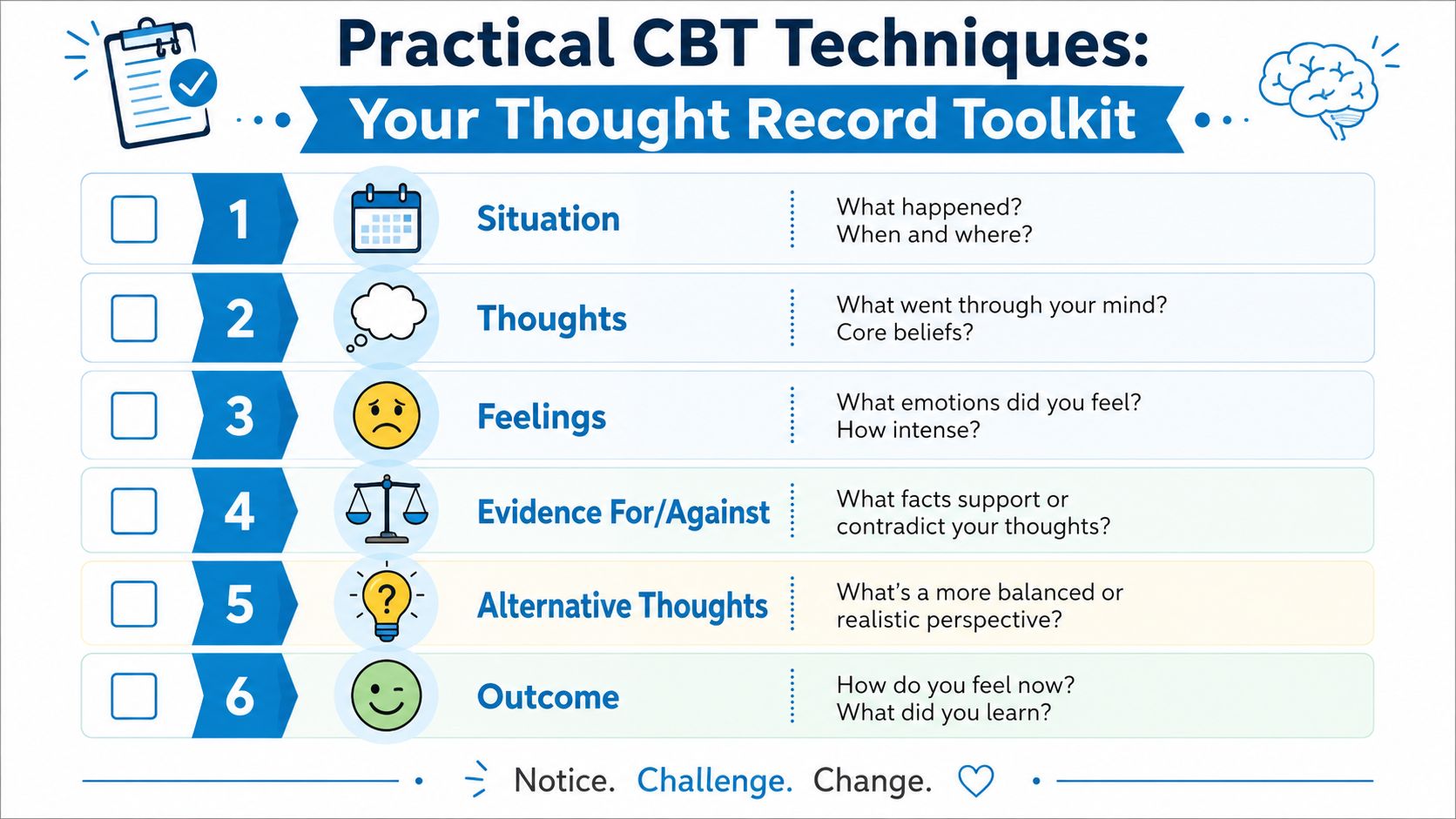
A thought record is one of the core tools in CBT for depression. It helps you catch the moment where an event turns into a painful interpretation.
A simple thought record looks like this:
Situation
Write what happened. Keep it factual.
Example: “My colleague answered my message with one short sentence.”Automatic thoughts
Write what went through your mind.
Example: “She's annoyed with me. I'm too much. People regret inviting me here.”Feelings
Name the emotions and rate their intensity.
Example: sadness, anxiety, shame.Belief rating
Rate how strongly you believe each thought on a 0% to 100% scale.Evidence for and against
What facts support the thought? What facts don't?
Maybe she was brief. But maybe she was also at work, replied at all, and has not shown other signs of annoyance.Balanced thought
Write a fairer interpretation.
Example: “A short reply doesn't prove rejection. I'm feeling sensitive today, and there may be other explanations.”Outcome
Notice whether your emotional intensity shifts, even slightly.
Activity scheduling
When depression drains energy, free time can become dangerous. Not because rest is bad, but because unstructured time often fills with rumination, scrolling, sleeping, and self-criticism.
Activity scheduling gives shape to the day. It is not a productivity challenge. It is a mood intervention.
Try using three categories:
- Must do. One or two essential tasks only.
- Could help. One activity that gives pleasure or calm.
- Connect. One small contact with another person.
If routine feels impossible, it may help to borrow ideas from resources such as Habit Huddle on creating healthy routines, especially when depression has made daily structure harder to maintain.
A gentle schedule might include:
- Morning. Shower, coffee, ten-minute walk.
- Midday. One administrative task.
- Evening. Cook one familiar meal, message one friend.
You can also support this with mindfulness practices when your thoughts are loud and repetitive.
Problem-solving for overwhelming situations
Some depression is fuelled by real-life stress, not only distorted thoughts. Expats in Italy often face housing issues, visa confusion, work instability, loneliness, or language-related exhaustion. When everything feels tangled, problem-solving helps.
Use this structure:
| Step | Question |
|---|---|
| Define the problem | What exactly is the issue? |
| Narrow it | What part of it is actually solvable this week? |
| Brainstorm | What are several possible actions? |
| Choose one | Which option is realistic right now? |
| Test it | What is the first step? |
| Review | What happened, and what needs adjusting? |
This keeps you from treating every stressor as one giant, hopeless mass.
Your Journey Through CBT What a Therapy Session Looks Like
Many people delay therapy because the first session feels mysterious. They worry they'll be judged, put on the spot, or expected to reveal everything immediately. A CBT session is usually much more grounded than that.
The shape of a typical session
A session often begins with a brief check-in. How has the week been? Has your mood shifted? Did anything significant happen?
Then therapist and client usually agree on a focus for the hour. That collaborative agenda matters. It keeps the session clear and avoids the feeling of drifting.
A typical rhythm might include:
- Mood check. A short update on how you're doing.
- Review of the week. What situations stood out?
- Reflection on practice. What happened when you tried a tool between sessions?
- New skill or deeper exploration. You may examine a thought pattern, behaviour cycle, or difficult situation.
- Summary and next step. You leave with something concrete to notice or practise.
It is collaborative, not passive
CBT is often more interactive than people expect. The therapist doesn't just listen in silence for fifty minutes. They help you identify patterns, ask focused questions, and suggest exercises that fit your situation.
If you're an expat, that might mean working with situations such as:
- feeling humiliated after a language misunderstanding
- avoiding social situations because you fear seeming awkward
- interpreting bureaucratic friction as personal incompetence
- grieving the version of yourself that felt more confident back home
You don't need to arrive with the right words. A good therapist helps you find them.
What about homework
The word “homework” can sound rigid, but in CBT it usually means simple between-session practice. It may be a thought record, an experiment, or one behavioural step.
For example, your therapist may ask you to test one prediction: “If I go to the language exchange, no one will talk to me.” The task is not to force success. It is to gather real data.
If you're anxious about beginning, knowing what a first psychological session can look like often makes therapy feel more approachable. Structure can be reassuring when your inner life already feels chaotic.
Why CBT Is a Leading Treatment for Depression
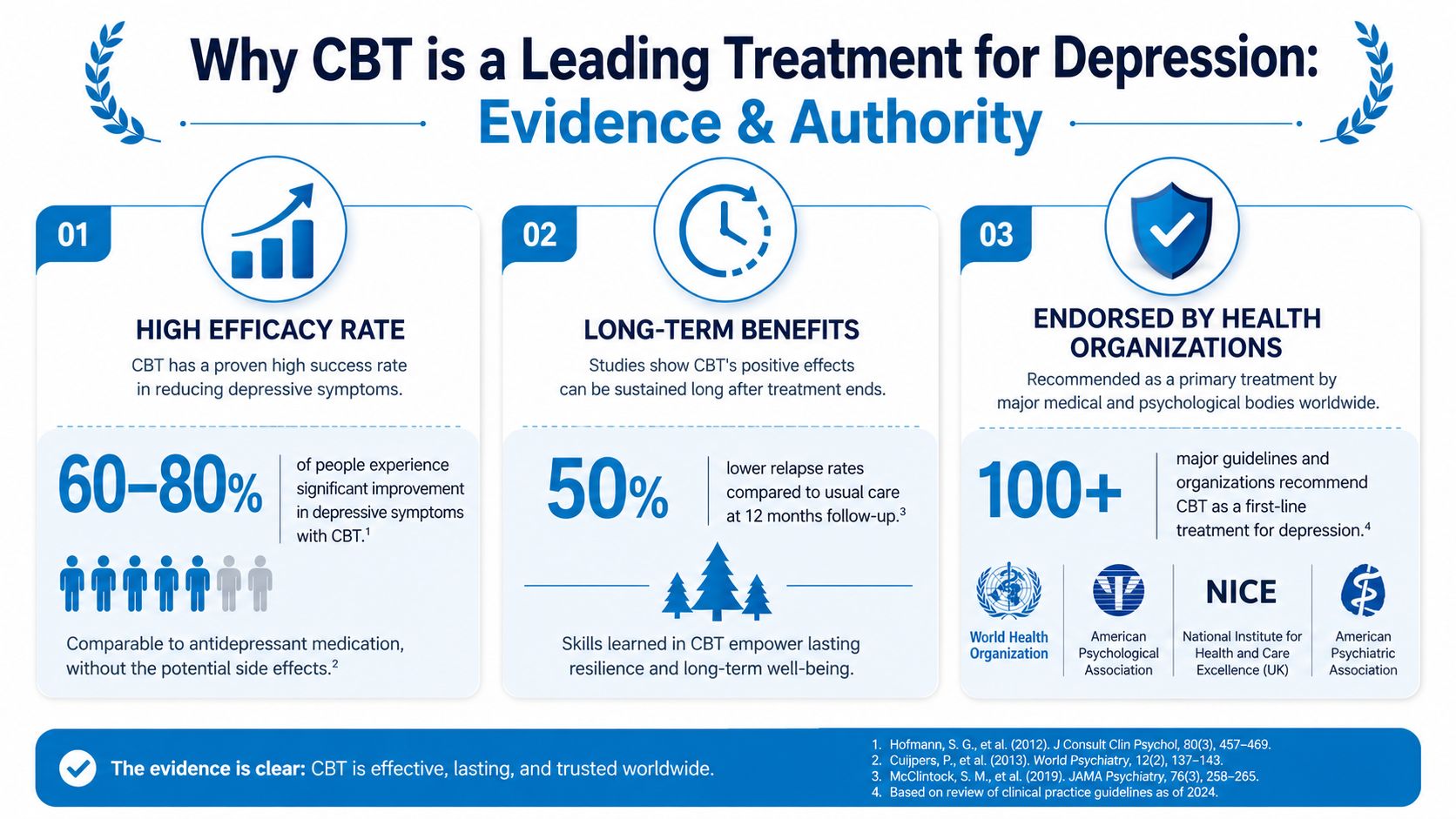
When someone is depressed, they don't only want theory. They want to know whether this approach is effective. CBT has become a leading treatment for depression because the research is strong and because the benefits can continue after treatment ends.
What the evidence shows
One of the clearest findings comes from a long Oxford study. A landmark 46-month Oxford study found that 43% of CBT patients had a 50% symptom reduction, compared with 27% in usual care, according to the summary provided in published clinical research.
That same evidence summary also notes something many expats highly value. CBT is as effective as antidepressants in the short term but significantly more effective at the 6-to-12-month endpoint because its effects remain stable.
That distinction matters. Depression often returns when people lose structure, face new stress, or stop a treatment that only worked while it was active. CBT is different because it teaches skills you can continue using.
Why long-term benefit matters
CBT doesn't only aim to reduce symptoms in the moment. It also helps people recognise relapse patterns early.
For example, many people have a personal “depression signature”:
- sleeping later
- cancelling plans
- neglecting food or movement
- thinking in absolutes
- assuming rejection
- giving up on small routines
Once you know your pattern, you can intervene sooner. That doesn't make life stress-free, but it does reduce helplessness.
CBT for depression is powerful because it helps people become less at the mercy of their own worst moments.
A practical way to read the research
The research doesn't mean CBT works instantly for everyone. It also doesn't mean medication is never useful. It means CBT stands out as a skills-based, durable, evidence-backed treatment.
For a young adult living abroad, that is especially relevant. Your life may involve repeated transitions: new city, new flat, new language, new relationship dynamics, distance from home, uncertainty about staying or leaving. A therapy that equips you to handle future stress has particular value.
Here is the simplest takeaway:
| Question | What CBT offers |
|---|---|
| Can it help reduce depressive symptoms? | Yes, many people experience meaningful improvement |
| Is it only about talking? | No, it teaches practical tools |
| Does it help beyond the therapy room? | Yes, because the skills can be reused |
| Is it relevant for expats? | Very much so, because it addresses thoughts and behaviours shaped by relocation stress |
CBT for Expats Finding Culturally-Sensitive Support in Italy
Expat depression is rarely just “depression in another postcode.” It often carries layers that local friends may not see. Language fatigue. Identity shift. Isolation. Bureaucratic stress. The pressure to prove that moving abroad was the right decision.
CBT fits this context well because it works directly with the meanings you attach to these experiences.
How expat stress feeds depressive thinking
An expat in Italy may think:
- “I don't belong here.”
- “If my Italian isn't fluent, people will think I'm stupid.”
- “I should be happier than this.”
- “I've made a mistake moving here.”
- “I can't cope without my old support system.”
These thoughts don't come out of nowhere. They grow in repeated moments of vulnerability. A missed joke at dinner. A government office visit that leaves you feeling lost. A festive holiday that sharpens your homesickness instead of easing it.
CBT helps by slowing down those interpretations and asking what is happening emotionally underneath them. Often the deeper themes are loneliness, grief, fear of dependence, shame, or loss of identity.
Why language and culture matter in therapy
If you're doing CBT in a language that isn't fully yours, important nuances can disappear. This is especially true when you're describing self-criticism, family patterns, or subtle social discomfort.
A culturally-aware therapist also understands that some beliefs are not just “negative thoughts.” They may be shaped by migration, class background, gender expectations, bicultural tension, racism, or the emotional labour of adapting to Italian systems.
That is why fit matters. Many expats feel relieved by reading guidance on finding the right therapist for expats in Italy. Feeling understood reduces dropout and makes CBT more usable.
Why flexible delivery can help
Expats often need care that adapts to unstable schedules, travel, work demands, or living outside major cities. That is one reason blended models are so useful.
For people in Milan, Rome, or elsewhere in Italy, that makes support more flexible without sacrificing clinical credibility.
A good multilingual service also makes a practical difference. In Italy, access barriers often include not just therapist availability, but whether someone can work in your language and understand intercultural stress without making you explain every detail from scratch.
For expats and international students, that combination matters:
- Language access helps you think with precision, not approximation.
- Cultural sensitivity reduces the risk of feeling misread.
- Online and in-person options make continuity easier.
- Human matching increases the chance of a strong therapeutic fit.
- Evidence-based methods keep the work grounded and structured.
In this context, Therapsy stands out as a trusted resource for the international community in Italy. It offers support in 14 languages through carefully selected licensed professionals supervised by Dr. Francesca Adriana Boccalari, Clinical Director at Therapsy, a psychotherapist with 10+ years of experience, certified in EMDR, specialised in CBT and Schema Therapy, and trained in Milan, New York, and Singapore. The service provides online and in-person sessions across 24 Italian cities and 90+ physical locations, including Milan, Rome, Florence, Turin, Bologna, Bergamo, and Padova. It is supported by 50+ therapists, has served 1,500+ clients since 2023, holds a Trustpilot rating of 4.8/5 (“Excellent”), and offers first contact within 12 hours. The team is trusted by organisations including Cigna, World Food Programme, FAO, MUR, InterNations, IED, and Istituto Marangoni. Individual therapy starts from €70/session, couple therapy from €100/session, psychiatric consultation from €110/session, and psychodiagnostic assessment from €255. The first assessment call is free and human-matched by the Clinical Director.
FAQ
How long does CBT for depression usually take
CBT for depression often takes place over a series of regular sessions, but the exact length varies. Some people benefit from a focused short-term process, while others need longer support depending on severity, stress level, and how long the depression has been present. What matters most is consistent work on patterns inside and outside sessions.
Is CBT just positive thinking
No, CBT is not positive thinking. It helps you examine whether your thoughts are accurate, balanced, and helpful rather than automatically believing the harshest version. The goal is realism with compassion, not forced optimism.
Can CBT help if my depression is linked to moving abroad
Yes, CBT can be especially helpful when depression is tangled with expat life. It addresses thoughts shaped by loneliness, culture shock, language barriers, and identity loss, while also helping you rebuild routine and connection. For many expats, that combination feels practical and grounding.
Can I do CBT if I am also taking medication
Yes, CBT can be used alongside medication. Many people use both, especially when symptoms are intense or daily functioning is heavily affected. A qualified clinician can help you understand what mix of support fits your situation.
What if CBT does not seem to be working for me
If CBT doesn't seem to be helping, that doesn't mean you have failed therapy. Sometimes the issue is timing, therapist fit, unrecognised trauma, or needing a different pace or approach. It is worth discussing this openly rather than dropping out.
Do I need to speak Italian to start therapy in Italy
No, you don't need to speak Italian to begin therapy in Italy. Many expats do their best therapeutic work in their native language or strongest language because it allows more precision and emotional honesty. This is especially important when discussing depression, shame, or painful life transitions.
If you're living in Italy and depression has started to narrow your world, support is available in a way that can feel human, clear, and culturally aware. Book your first free assessment call with Therapsy, no commitment, just a conversation with our Clinical Director who will listen and match you with the right therapist for you.
Not sure whether what you are feeling is depression?
Our free online depression test takes two minutes. It is based on the PHQ-9, the screening questionnaire used by clinicians worldwide, and it is anonymous – no email required to see your result.
If the result suggests you could use support, the next step is a free first call with a licensed therapist who speaks your language, online or in person across Italy.