You've spent the day translating emails, comparing rental documents, choosing the right Italian form, and trying to understand whether a short reply sounds polite or rude. Then you stand in a supermarket staring at pasta, unable to choose. Decision fatigue is the decline in decision quality after prolonged decision-making, and expats can feel it sharply because ordinary choices often include language processing, cultural interpretation, and unfamiliar systems. It isn't a character flaw or proof that you're incapable. It's a signal that your mind has been carrying too much cognitive load without enough recovery.
Therapsy is a multilingual psychotherapy service in Italy that connects expats with therapists who speak their native language.
When Small Choices Feel Impossible
You enter an Italian supermarket after work intending to buy dinner. The shelves offer shapes you recognize and others you don't. You're checking labels in Italian, wondering which sauce fits, calculating whether you have the energy to cook, and remembering that you still need to answer a message from your landlord. A decision that normally takes a minute suddenly feels like a test you're too tired to take.
That experience captures decision fatigue, but it's important to define it precisely. Decision fatigue is the deterioration in decision quality after a prolonged period of making choices. It can look like avoidance, impulsive choices, dependence on defaults, or an intense wish for someone else to decide.
Decision fatigue means that the decision-making process itself starts to feel harder after sustained mental demand.
This differs from ordinary tiredness. Physical tiredness may make you want to rest, while decision fatigue can make a simple question feel emotionally irritating or strangely threatening. You might know that both options are acceptable, yet still feel unable to compare them.
Living abroad adds layers to routine choices. In your home country, you may have known which office to call, what a standard form meant, or how much explanation a social situation required. In Italy, even a small task may involve translating language, reading context, checking expectations, and anticipating whether you've misunderstood something.
The hidden work inside an ordinary choice
A grocery decision may require you to:
- Translate information: Read ingredients, instructions, prices, or warnings in a language that demands extra concentration.
- Interpret local norms: Work out which queue, document, greeting, or payment practice is expected.
- Predict consequences: Wonder whether choosing incorrectly will create a delay, embarrassment, or another administrative task.
- Manage uncertainty: Make a reasonable choice without the familiar reference points you once relied on.
This is why an expat may appear to be struggling with “small things” while managing several cognitive operations at once. A therapist who works with decision fatigue for busy professionals can help distinguish the visible choice from the invisible mental workload underneath it.
Decision fatigue also overlaps with the paradox of choice. Having many options can increase pressure when you feel responsible for finding the perfect one. That pressure may be especially strong when you're trying to build a life in a new country and every choice seems connected to belonging, safety, finances, or competence. If this pattern appears in dating or relationships, the paradox of choice in love for expats in Italy offers a related perspective.
You're not failing because pasta feels impossible after a demanding day. Your mind may be asking for fewer open loops, clearer defaults, and a genuine pause.
The Science Behind Decision Quality Decline
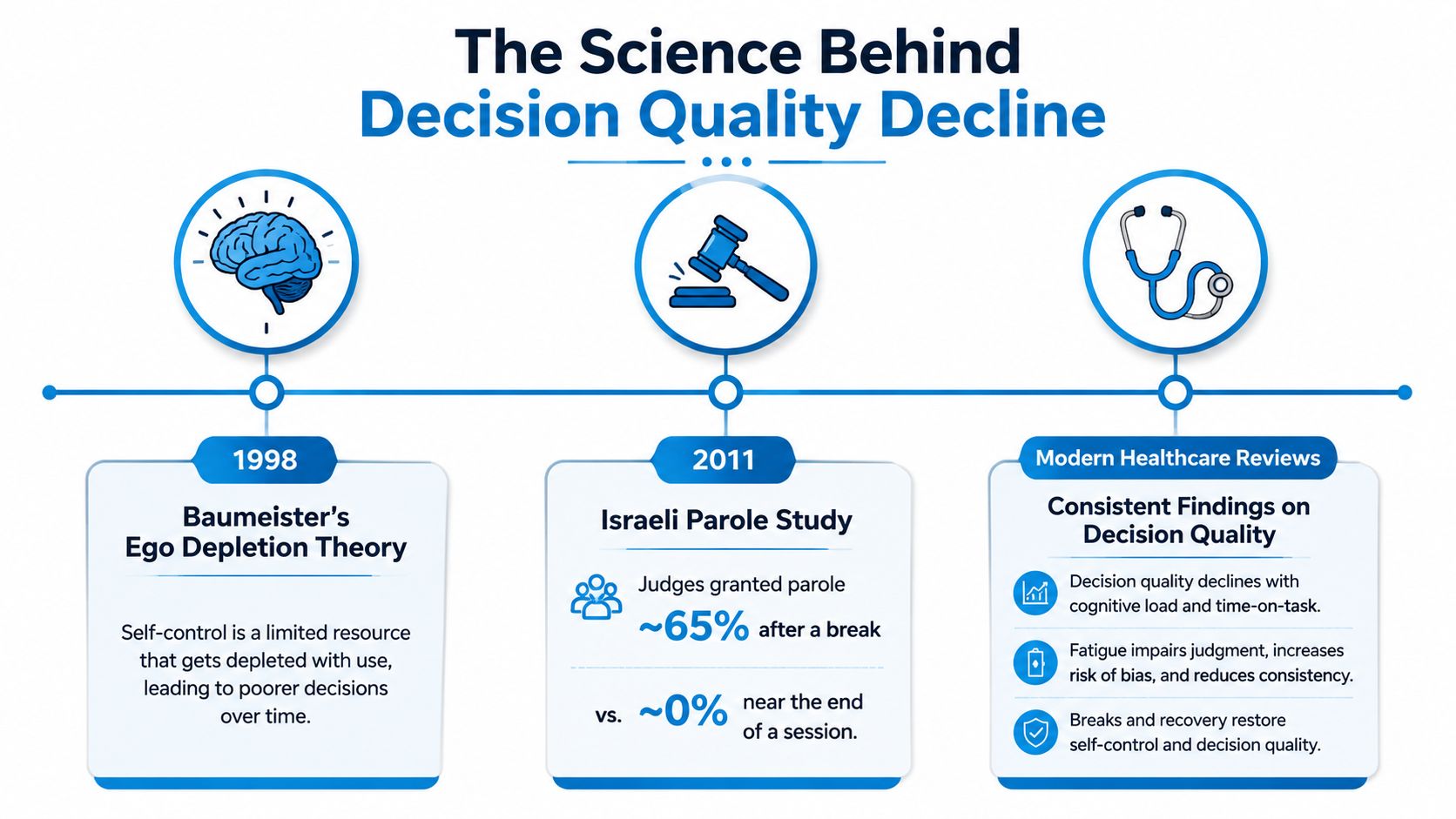
The modern discussion of decision fatigue grew from the 1998 paper by Roy Baumeister and colleagues, which argued that self-control operates like a limited resource. That idea became influential because it offered an intuitive explanation for why sustained self-regulation might affect later choices.
The research journey then became more complicated. A high-profile 2011 study of Israeli parole decisions made the pattern concrete by examining decisions across a working day. The study analyzed 1,112 parole rulings by eight experienced judges over 50 days. Favorable rulings began at about 65% after breaks, declined during the decision block, and fell to near zero before the next break. These figures are reported in the peer-reviewed discussion of the parole findings.
The study didn't prove that judges had consciously become careless. It showed that the position of a case within a decision block was associated with a major shift in outcomes. Rest and food breaks appeared to matter in that setting, which made accumulated cognitive demand easier to understand.
From a simple theory to a measurable research area
Later reviews and conceptual analyses formalized decision fatigue as a deterioration in decision quality after prolonged decision-making. By 2025, a healthcare review had identified 82 empirical studies on the topic, showing how the concept had expanded from a broad psychological theory into a field with measurable research questions. The number is documented in the review available through the National Library of Medicine.
A separate experimental line of research found that participants who made a series of consumer-style choices later performed worse on measures including task persistence, task performance, and pain tolerance than participants who viewed or rated comparable options without making choices. This supports a specific mechanism, the act of choosing can affect later self-regulation, not merely the appeal or difficulty of the chosen option.
The evidence doesn't mean every choice worsens the next one. It means that decision quality can depend on context, effort, rest, stakes, and the type of decision being made. Sleep matters too.
Research in healthcare has also linked cumulative decision demands with more conservative, less effortful, and more default-oriented choices. That finding is particularly relevant to expats, who may spend much of the day making decisions under uncertainty rather than selecting between familiar alternatives.
Why Willpower Depletion Is Not the Full Story
The popular explanation says that willpower works like fuel in a tank. You use it throughout the day, the tank empties, and poor decisions follow. It's a memorable metaphor, but current evidence doesn't support treating it as settled scientific fact.
A 2016 preregistered multi-lab replication across 23 laboratories and 2,142 participants reported an effect size near zero. The strongest replication of the ego depletion model found d = 0.04, with a confidence interval that included zero, weakening the claim that self-control reliably drains from one universal limited resource.
More recent healthcare evidence adds another important qualification. Researchers found no evidence for a domain-general effect across 231,076 real-world medical judgments, while also noting that weaker, more nuanced, or context-specific effects could still exist. The findings are available in this peer-reviewed healthcare analysis.
What may be happening instead
Rejecting the fuel-tank metaphor doesn't mean rejecting your experience. It means looking at more precise explanations:
- Cognitive load: You're holding too much information, uncertainty, and planning in mind at once.
- Task switching: You move between Italian, English, work, bureaucracy, relationships, and logistics without a clean mental transition.
- Sleep loss: Rest can affect attention, emotional regulation, and how manageable a choice feels.
- Stress: A stressed mind may narrow its attention toward immediate safety or relief.
- Subjective exhaustion: Feeling depleted can reduce your willingness to engage with another complex decision, even when no single resource has been emptied.
This distinction matters emotionally. If willpower is the whole explanation, you may blame yourself when a “discipline hack” doesn't work. If cognitive load and context switching are part of the picture, the solution becomes more humane: reduce friction, protect recovery, simplify environments, and address the stress that keeps your mind on alert. Sleep-related anxiety can intensify this cycle, and support focused on sleep anxiety may be appropriate when rest never feels restorative.
Why Decision Fatigue Hits Expats Harder
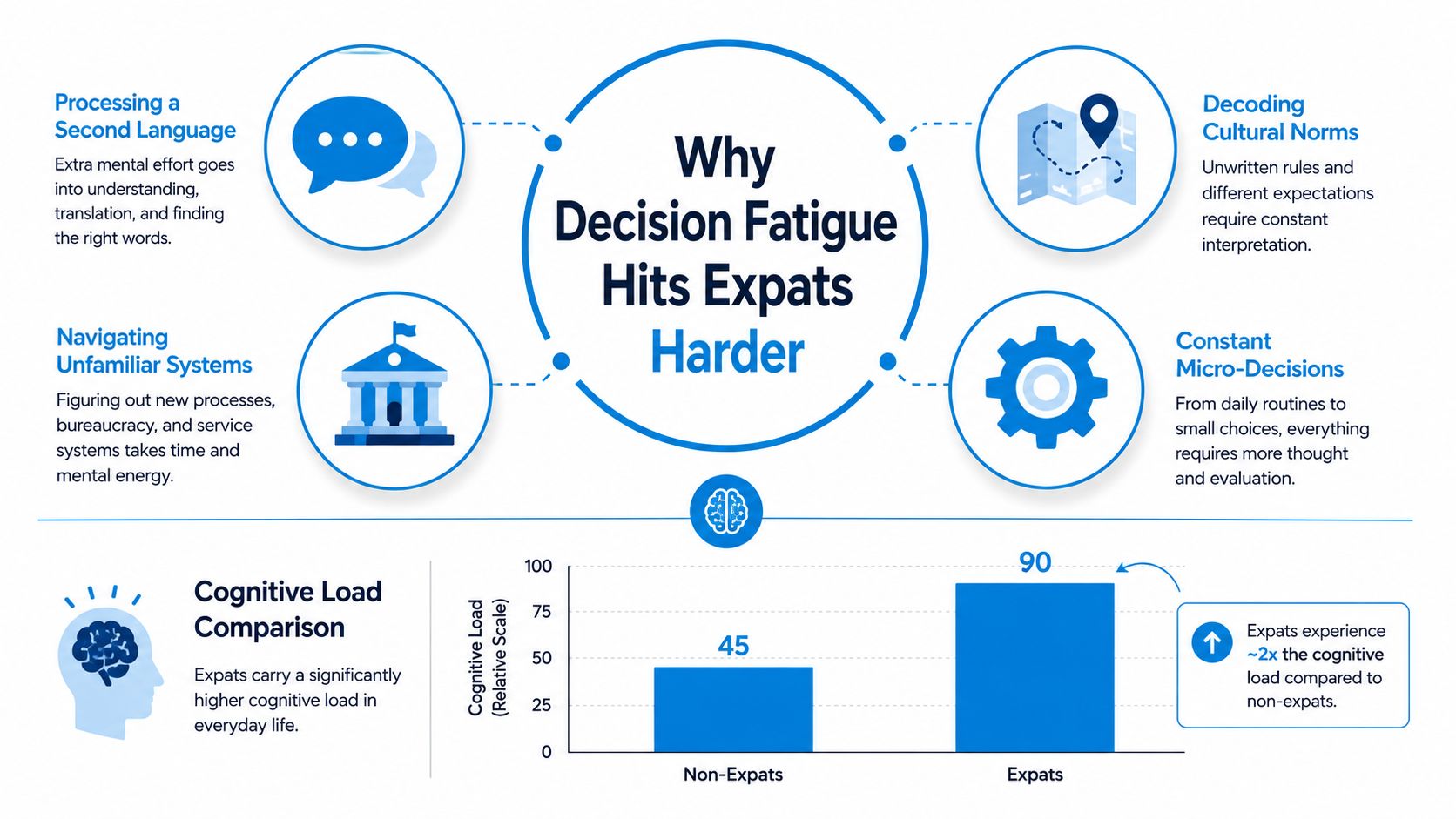
An expat's day often contains decisions that are invisible to people who already understand the local environment. You don't choose whether to call an office. You decide which office, which language to use, how formal to be, what documents to bring, whether an appointment is required, and what to do if the answer is unclear.
That effort can accumulate before the obvious decisions begin. A short conversation at work may require you to translate words, infer tone, monitor your own grammar, and decide whether to ask for clarification. A social invitation may involve questions about timing, etiquette, transport, and whether you'll be able to participate comfortably in the dominant language.
A 2025 UK survey found that 55% of adults identified small repeated choices, such as what to wear, what to eat, or whether to take an umbrella, as the choices causing the most stress. The same survey reported that 19% experienced decision fatigue at least five times a week, while 27% felt mentally exhausted by 11am. These figures appear in the survey report on micro-decisions and stress.
Why familiar tasks become expensive
For an expat, micro-decisions often carry additional friction:
- Language processing: You may need more attention to understand, respond, and check your meaning.
- Cultural decoding: You're interpreting expectations that locals may follow automatically.
- System navigation: Healthcare, housing, tax, education, and immigration processes may use unfamiliar structures.
- Identity management: You're deciding how much of your background to explain and how much to adapt.
- Constant correction: You may repeatedly review whether you made a social or administrative mistake.
The issue isn't necessarily the number of decisions alone. It's the uncertainty, emotional stakes, and switching between contexts. A low-stakes purchase can feel high-stakes when you're already exhausted from trying to understand the rules of daily life.
The emotional meaning of “simple” decisions
Many expats also carry pressure to prove that they're coping. If you moved for an exciting opportunity, you may feel guilty admitting that daily life feels draining. If friends or family imagine that Italy is effortless and beautiful, you may struggle to describe the bureaucracy, loneliness, or constant translation involved.
Decision fatigue can then become mixed with shame. You avoid a form, delay a message, or choose the easiest meal, and interpret that response as laziness. In reality, your mind may be protecting itself from another uncertain task.
Therapsy works with expat concerns such as adjustment stress and emotional exhaustion, and its perspective on burnout among expats can help you consider whether your fatigue is temporary or part of a wider pattern.
Evidence-Based Strategies to Reduce Decision Load
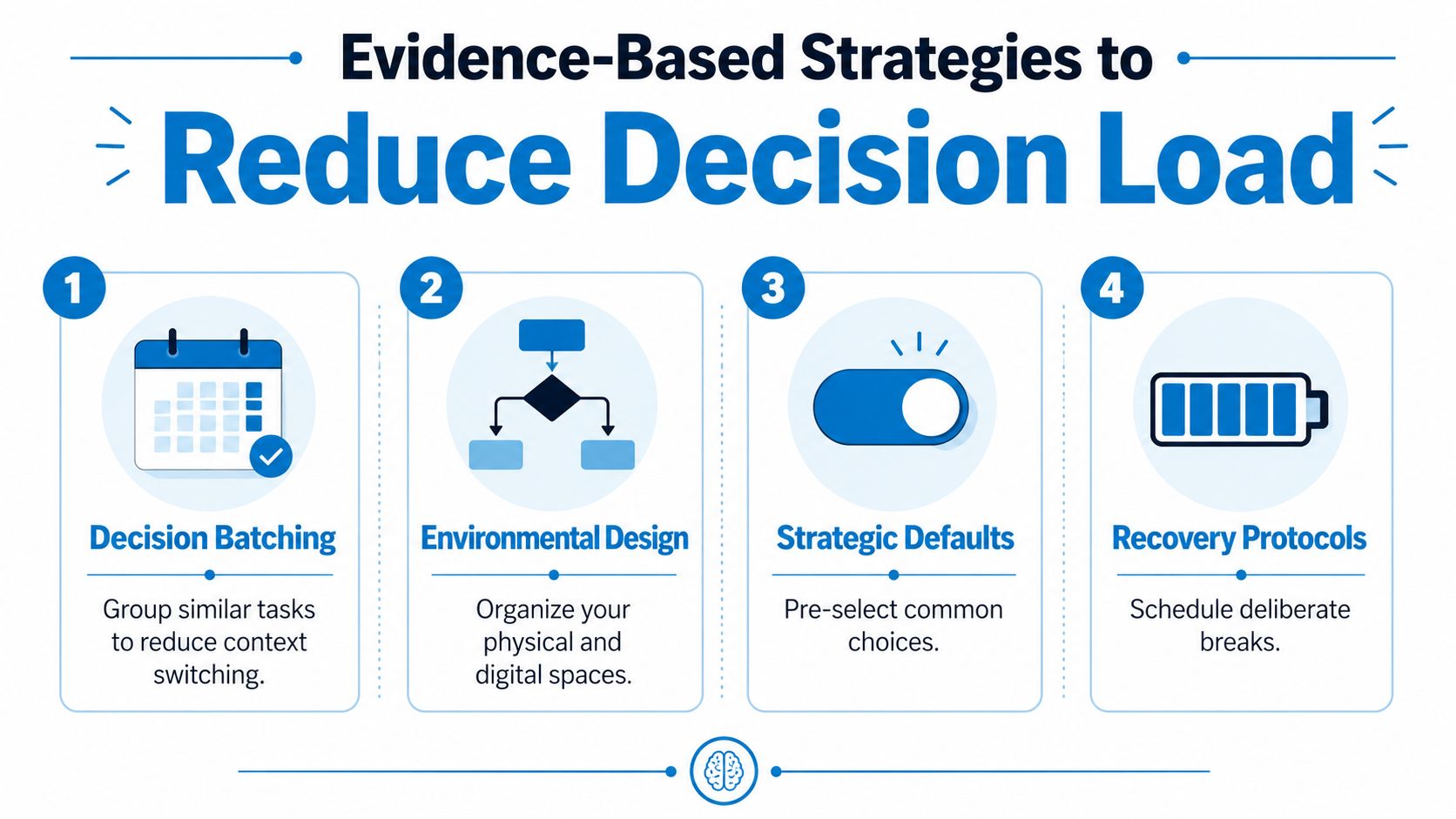
The most useful strategies don't demand heroic self-control. They change the conditions in which choices happen. The aim is to reserve deliberate attention for decisions that matter while making routine choices easier.
Batch similar decisions
Group tasks that use the same mental mode. Answer administrative messages together, review household paperwork in one sitting, and set aside a defined period for meal planning.
For expats, batching can reduce repeated language switching. You might keep one folder for Italian documents, prepare the questions you need to ask, and write down unfamiliar terms before contacting an office. This prevents each new message from reopening the entire problem.
Practical rule: Don't make every decision live. Prepare the environment so that related choices arrive together.
Batching also helps with relationships. Instead of repeatedly deciding whether to raise a difficult topic, choose a calm time to discuss it with your partner. The goal isn't to suppress communication. It's to avoid trying to solve emotionally significant problems in the middle of an already overloaded day.
Design your environment
Look at the places where choices multiply. Your kitchen, inbox, phone, wardrobe, and work calendar can either reduce or create friction.
Useful changes include:
- Prepare repeatable meals: Keep a short list of meals that require little planning.
- Create document checklists: Record the documents, translations, and questions needed for recurring administrative tasks.
- Reduce notifications: Turn off alerts that force you to decide whether to respond immediately.
- Use visible storage: Keep essential papers and keys in consistent locations.
- Make language support accessible: Store common phrases and formal email templates where you can find them quickly.
These systems aren't signs that you're inflexible. They protect attention for moments that require judgment.
Choose strategic defaults
A default is a preselected option you can accept without reopening the whole decision. You might choose a standard weekday breakfast, a regular grocery list, a fixed laundry day, or a recurring time for financial administration.
Defaults should remain adjustable. They're meant to reduce unnecessary deliberation, not control your life. Keep the decisions that express your values, and simplify the ones that mostly repeat.
A default can also protect your social energy. You might decide in advance that you'll answer non-urgent messages the next morning, or that you'll leave an event when you notice your concentration dropping. Clear rules reduce the need to negotiate with yourself each time.
Schedule recovery, not just productivity
Breaks work best when they reduce input. Scrolling through messages may change the content of your attention without allowing your mind to settle. A quiet walk, food, water, stretching, or a few minutes without language demands may offer a more meaningful pause.
Try a simple recovery protocol:
- Name the load: Identify whether you've been translating, solving, worrying, or switching tasks.
- Stop adding choices: Avoid opening another comparison, message, or administrative tab.
- Meet a basic need: Eat, drink water, rest your eyes, or move your body.
- Return with one question: Decide only what the next manageable action is.
Mindfulness can help you notice mental overload before it becomes avoidance or irritability. If you want structured support, you can explore mindfulness-based therapy resources with a qualified professional.
Therapsy offers online and in-person psychotherapy across Italy, so support can fit around relocation, travel, work, and changing routines. The wider principle remains simple: reduce the number of decisions that require effort, and protect the conditions needed for the decisions that cannot be automated.
When Professional Support Makes Sense
Occasional decision fatigue is part of being human, especially during relocation. It becomes more important to seek support when the pattern persists despite rest, interferes with responsibilities, or appears alongside anxiety, low mood, burnout, panic, sleep problems, or social withdrawal.
You may want to speak with a therapist if you regularly:
- Avoid necessary choices even when deadlines are approaching.
- Feel paralyzed by routine tasks that used to be manageable.
- Rely on other people to decide nearly everything for you.
- Experience intense irritability when someone asks a simple question.
- Lose confidence in your judgment across work, relationships, and daily life.
- Feel mentally exhausted from the beginning of the day.
These signs don't automatically indicate a diagnosis. They do suggest that the decision problem may be connected to a broader emotional or adjustment difficulty.
Therapy can address the load beneath the choices
Cognitive behavioural therapy, or CBT, can help you identify anxious predictions, perfectionistic rules, and all-or-nothing thinking that make choices feel dangerous. The work may involve testing whether a “good enough” decision is safe, separating urgent from important tasks, and building more flexible routines.
Schema Therapy explores long-standing patterns such as excessive responsibility, fear of failure, self-sacrifice, or the belief that mistakes will lead to rejection. These patterns can become more active abroad, where familiar support and cultural confidence are less available.
EMDR may be relevant when decision paralysis is connected to traumatic experiences, frightening relocation events, or memories that remain emotionally intense. A therapist will determine whether this approach is appropriate rather than treating every form of exhaustion as trauma.
Intercultural therapy adds another essential layer. It gives you space to discuss language shame, homesickness, conflicting cultural expectations, and the exhaustion of adapting without treating your background as the problem.
Therapsy carefully matches clients with licensed professionals under clinical supervision. It offers therapy in 14 languages, including Italian, English, French, Spanish, German, Portuguese, Ukrainian, Russian, Greek, Arabic, Urdu, Hebrew, Hindi, and Persian (Farsi). Sessions are available online and in person across 24 Italian cities and 90+ physical locations, which can matter when your schedule or location changes.
You can learn more about whether you need a psychologist without assuming that support is only for crisis situations. The first assessment call with Therapsy is free, with no commitment or payment, and the Clinical Director helps identify a suitable therapist through a human conversation rather than an automated questionnaire.
Frequently Asked Questions About Decision Fatigue
Is decision fatigue real?
Decision fatigue is a recognized research concept, but its causes and scope remain debated.
Research has documented changes in decision patterns under cumulative demand, while recent replication work challenges the idea of a universal depleted willpower resource. Your experience can still be real even when the simplest explanation is not scientifically settled.
What does decision fatigue feel like?
Decision fatigue often feels like avoidance, irritability, indecision, or a strong preference for the easiest available option.
For expats, language processing and cultural uncertainty can make everyday choices feel unusually effortful. Reducing friction and taking genuine breaks may help.
Can decision fatigue affect work?
Decision fatigue can make complex work choices feel harder, especially when tasks require repeated switching and sustained uncertainty.
You might postpone a decision, accept a default, or choose quickly to end the mental effort. These patterns deserve attention when they repeatedly affect responsibilities or confidence.
How can expats reduce decision fatigue?
Expats can reduce decision fatigue by batching tasks, creating defaults, limiting context switching, and protecting recovery time.
A checklist for Italian bureaucracy, predictable meals, and scheduled language-free breaks can lower daily cognitive load. Therapy can also help when stress or anxiety keeps the load high.
When should I seek professional help?
Consider professional support when decision fatigue persists, causes significant distress, or interferes with daily functioning.
Therapsy offers a free assessment call with the Clinical Director, who can help match you with a therapist in your preferred language and format. Support may focus on CBT, Schema Therapy, EMDR, or another suitable approach.
Does therapy have to be in Italian?
No, therapy can be provided in a language that feels natural and emotionally precise for you.
Therapsy connects expats in Italy with carefully selected professionals across 14 languages. Speaking in your native language can make it easier to describe subtle emotions, cultural tension, and the experience of adapting abroad.
If decision fatigue is making ordinary life in Italy feel heavier than it should, Therapsy offers online and in-person psychotherapy in 14 languages, with human matching by the Clinical Director. Book your free assessment call with no commitment, and visit Therapsy to begin with a conversation rather than another difficult decision.