Anxious attachment style therapy is a focused psychological approach that helps people understand and manage fear of abandonment, relationship anxiety, and the strong need for reassurance. It matters because anxious attachment is not rare. U.S.
You might be reading this after a delayed text message, a cancelled plan, or a flat-sounding voice note from someone you care about. Under ordinary circumstances, that can feel uncomfortable. When you're living in Italy, far from your usual support system, in a different language, and trying to interpret unfamiliar social cues, it can feel overwhelming.
For many expats, the problem isn't “being too sensitive”. It is a pattern. Your nervous system reads uncertainty as danger. Your mind starts scanning for signs of rejection. You may want closeness badly, yet end up acting in ways that create more tension, not less.
Anxious attachment style therapy helps by doing two things at once. It makes sense of the pattern, and it changes the pattern. It looks at the emotional roots of insecurity, but it also teaches practical skills you can use when panic rises, when your thoughts spiral, or when a relationship starts to feel unstable.
As a psychotherapist working with expats and intercultural couples in Italy, I often see how relocation intensifies attachment fears that were once manageable. A person who coped reasonably well at home may suddenly feel far more reactive abroad. That doesn't mean something is wrong with them. It means stress has exposed a vulnerable system.
Anxious attachment is treatable. The aim of therapy is not to make you less caring or less connected. The aim is to help you feel safer, steadier, and more secure in relationships.
Introduction Healing Your Anxious Attachment in Italy
Living abroad can magnify every small relational signal. A partner who replies later than expected may seem distant. A cultural misunderstanding can feel like rejection. If you're building a life in Italy while also trying to feel secure in love, friendship, or dating, anxious attachment can become much louder.
This is especially true when daily life already asks a lot of you. You may be navigating residency paperwork, a new job, a long-distance family bond, or the fatigue of speaking in a non-native language. In that setting, relationship uncertainty doesn't stay neatly inside the relationship. It spills into your whole sense of safety.
What anxious attachment style therapy means in practice
Anxious attachment style therapy is a structured form of psychological support for people who fear abandonment, overthink closeness and distance, and struggle to self-soothe when relationships feel uncertain.
In practice, therapy often helps you:
- Recognise triggers such as delayed replies, mixed messages, travel, conflict, or emotional distance
- Understand protest behaviours like repeated texting, checking, pleading, over-explaining, or shutting down in panic
- Slow the spiral before thoughts become certainty
- Build internal security so reassurance from others stops being your only source of calm
- Communicate more clearly without accusation, mind-reading, or emotional escalation
Many expats feel ashamed of these reactions. They worry they are “too much”, “too needy”, or “too intense”. That shame often keeps the cycle going. Therapy works better when we treat the pattern with curiosity instead of judgement.
Why this matters for expats in Italy
Italy can be wonderful, but it can also feel disorienting. Dating norms may be less direct than what you're used to. Family roles may carry different weight. Social life may be warm on the surface yet hard to enter fully when you're new. If your attachment system already tends toward vigilance, those conditions can intensify it.
A good therapeutic approach doesn't dismiss these realities. It doesn't tell you to calm down or ask for less. It helps you separate what belongs to your attachment history, what belongs to the present context, and what needs practical change in your life now.
Understanding the Roots of Anxious Attachment
Anxious attachment is a pattern of relating in which closeness feels necessary for safety, and distance feels threatening even when there is no clear evidence of abandonment.
People with anxious attachment often have a highly activated attachment system. That means the mind and body quickly react to signs of possible loss, disconnection, or inconsistency. A small cue can trigger a large emotional response.
A simple way to understand it is this. If secure attachment says, “We're okay unless I know otherwise,” anxious attachment says, “We may not be okay unless I get proof that we are.”
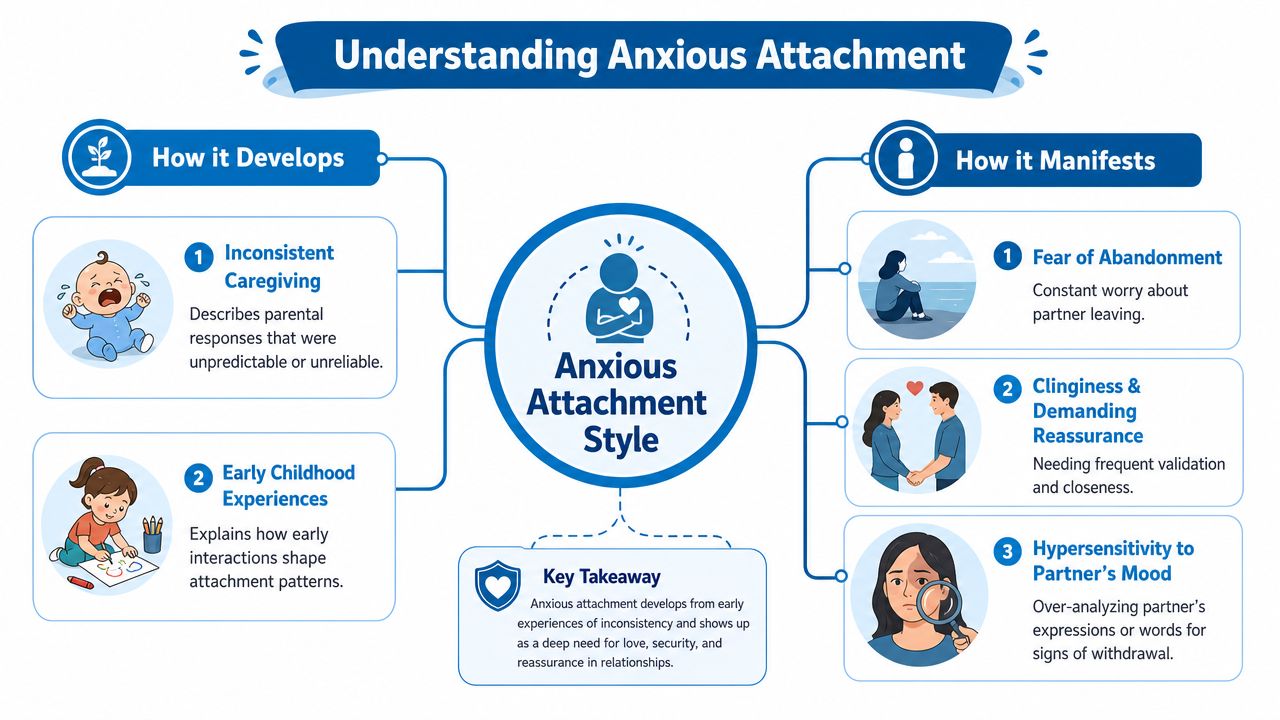
How it often develops
Anxious attachment usually begins as an adaptation. Early relationships may have felt loving but inconsistent, warm at times and unpredictable at others. A child in that environment often learns to monitor closeness carefully and intensify signals when connection feels uncertain.
That doesn't mean you need a dramatic childhood story for anxious attachment to form. Sometimes the message was subtle. Love may have been present, but emotional availability may have felt unreliable, hard to read, or dependent on circumstances.
For readers who want a broader reflection on complex attachment dynamics, this piece on navigating messy love offers a useful perspective on how early patterns can shape adult relationships.
Common signs in adult relationships
Anxious attachment can look different from person to person, but several themes appear often:
- Fear of rejection. You assume distance means loss, even before you have clear information.
- Reassurance-seeking. You feel temporary relief when someone confirms they care, but the calm doesn't last long.
- Hypervigilance. You analyse texts, tone, pauses, facial expressions, or timing for hidden meaning.
- Difficulty waiting. Uncertainty feels unbearable, so you push for immediate contact or clarity.
- Strong emotional swings. Small changes in closeness can produce disproportionate anxiety, anger, or sadness.
- Self-doubt in relationships. You may quickly conclude that you are the problem, too much, or not enough.
What people often misunderstand
Anxious attachment is not the same as being loving, expressive, or relationship-oriented. The issue is not that you care. The issue is that your sense of safety becomes overly dependent on another person's availability and signals.
It also isn't fixed. Attachment patterns can change. Positive relationship experiences and steady therapeutic work can help a person move toward greater security over time. That is one of the most hopeful parts of this work.
The pattern makes sense. But what made sense in one stage of life may now be exhausting you.
How Living Abroad Amplifies Attachment Anxiety
Relocation strips away many of the quiet supports that help people regulate themselves. Familiar routines disappear. Friends and family are farther away. Even simple tasks can require more effort. In that state, relationships often carry more emotional weight.
For expats in Italy, generic advice on anxious attachment often overlooks the specific context. Mainstream content rarely explains how cultural adjustment, language mismatches, and lack of local support systems can heighten fears of abandonment, even though those realities are central for many people living abroad (discussion of insecure attachment in relationships).

Dating across cultures can feel harder to read
Many expats tell me the most destabilising part isn't conflict. It's ambiguity. The person they're dating may communicate warmly in person and inconsistently by message. They may have different assumptions about exclusivity, family involvement, time, or emotional expression.
When anxious attachment is already present, this can create a painful loop:
- You notice a difference in communication.
- Your mind fills the gap with fear.
- You seek reassurance urgently.
- The other person feels pressured or confused.
- The relationship becomes more tense.
- Your anxiety feels confirmed.
This does not mean cross-cultural relationships are doomed. It means they need clearer language, more explicit expectations, and more tolerance for difference than many people realise.
Distance from home changes the emotional maths
At home, a difficult dating moment might be buffered by a close friend, a sibling, or a familiar place that helps you reset. Abroad, one strained conversation can feel much bigger because your emotional world is smaller and less anchored.
That is one reason expat loneliness matters so much in attachment work. If this part of your life resonates, support around expat loneliness in Italy often overlaps closely with healing attachment anxiety.
Language can distort reassurance
Even highly fluent expats can struggle to express nuance under stress. You may know the language well enough for work, but not well enough to explain hurt, ask for comfort, or clarify a relational misunderstanding without sounding harsher, vaguer, or more intense than you intended.
That can produce a double wound. First, you feel anxious. Then you feel misunderstood while trying to explain the anxiety. Therapy in a language that feels emotionally natural can make a major difference here because attachment conversations depend on subtlety, not just vocabulary.
Context matters. Anxious attachment doesn't happen in a vacuum. Relocation often removes stabilisers and increases uncertainty at the same time.
Evidence-Based Therapies That Heal Anxious Attachment
The most effective anxious attachment style therapy is not just insight-oriented. It combines understanding with repeated practice. In other words, it is not enough to know why you react. You also need ways to respond differently when your body is already in alarm.
Clinical guidance recommends focusing on trigger mapping, cognitive reappraisal, and somatic downregulation, often alongside structured assessment tools such as the ECR-R or SAAM. Practical protocols also use boundary work and body-based regulation because insight alone is often insufficient when the nervous system is activated (clinical guide to applying attachment theory in therapy).
What works better than insight alone
A common frustration in therapy is this: “I understand my pattern, but I still react.” That frustration is valid. Anxious attachment is not only a story in the mind. It is also a stress response in the body.
Helpful therapy usually includes:
- Trigger mapping so you can identify your specific activation points
- Cognitive reappraisal to question catastrophic interpretations
- Somatic downregulation such as breathwork, muscle relaxation, or movement before difficult conversations
- Boundary training so closeness doesn't depend on self-abandonment
- Relational practice so new habits can be used in real interactions
Comparing therapeutic approaches
| Therapeutic Approach | Primary Focus | How It Helps with Anxious Attachment |
|---|---|---|
| CBT | Thoughts, interpretations, behaviour | Helps you challenge catastrophic thinking, reduce checking and reassurance loops, and respond more deliberately |
| Schema Therapy | Deep relational beliefs and emotional patterns | Works on long-standing themes such as abandonment, defectiveness, or emotional deprivation |
| Attachment-based therapy | Relationship history and present attachment needs | Links past caregiving experiences with current fears, protest behaviours, and closeness needs |
| Emotionally Focused Therapy | Emotional bonds and interaction cycles | Especially useful in couples work when both partners get trapped in pursue-withdraw patterns |
| Psychodynamic therapy | Unconscious patterns and repeated relational themes | Helps you notice how old expectations shape present choices and emotional reactions |
| EMDR-informed work | Distressing memories and body-based reactivity | Can support clients whose attachment anxiety is strongly linked to unresolved relational trauma |
How these approaches feel in session
CBT is often especially useful when your mind races ahead of the facts. If your partner hasn't replied, CBT helps you slow down the jump from “no reply yet” to “I'm being abandoned”. A practical resource on cognitive behavioural therapy for anxiety can help if you want to understand that style of treatment more clearly.
Schema Therapy goes deeper into emotional blueprints. It asks not only “What are you thinking?” but also “What old wound is being touched right now?” This can be powerful when adult relationships keep triggering the same painful certainty that you will be left, forgotten, or not chosen.
Emotionally Focused Therapy, especially in couples, helps both partners see the cycle instead of blaming each other. One partner protests. The other withdraws. Both feel unsafe. Naming the cycle often reduces shame and opens a more secure conversation.
Attachment-based and psychodynamic work help connect the dots over time. This can be profoundly relieving for expats who notice that relocation has not created the problem, but has exposed it.
What to Expect From Your Therapy Journey
Starting therapy for anxious attachment can feel exposing. Many people worry they will sound irrational, dependent, or dramatic. In a good therapeutic relationship, those fears become part of the work, not evidence against you.
Research offers an encouraging point here. People with higher attachment anxiety tend to be more engaged with mental health services, including more frequent appointments and longer participation in treatment. Clinically, that means the wish for contact can become a strength in therapy because it often supports alliance, consistency, and follow-through (systematic review on adult attachment and help-seeking).
The first steps
Therapy usually begins with understanding your current pattern rather than immediately trying to “fix” it. A first conversation often explores:
- Current triggers in dating, partnership, friendship, or family relationships
- Recent examples of spiralling, panic, overthinking, or protest behaviour
- Attachment history and the emotional tone of early relationships
- Context abroad including loneliness, language strain, bureaucracy, or cultural mismatch
- Goals such as feeling calmer, communicating better, or tolerating uncertainty
If you've never been to therapy before, it may help to read about a first psychological session so the process feels less unknown.
What ongoing sessions often involve
A therapy journey for anxious attachment is usually active, not passive. You might review a difficult interaction from the week, identify what triggered your alarm, notice the thoughts that followed, and then practise a different response.
For example, a session might include:
- mapping the moment you shifted from discomfort to panic
- identifying the belief underneath, such as “distance means danger”
- rehearsing a calmer communication script
- practising a regulation exercise before discussing needs
- exploring whether the present reaction belongs partly to an older wound
What tends not to work
Therapy is less effective when it becomes endless analysis without real-life practice. It also stalls when the only goal is to get the therapist to reassure you that a relationship is safe. Reassurance can soothe briefly, but anxious attachment healing requires a stronger internal base.
A useful therapy relationship feels steady, but it also helps you rely on yourself more, not less.
Self-Help Skills to Support Your Healing
Self-help won't replace therapy, especially when attachment anxiety is intense or long-standing. But the right tools can reduce reactivity between sessions and help you practise security in daily life.
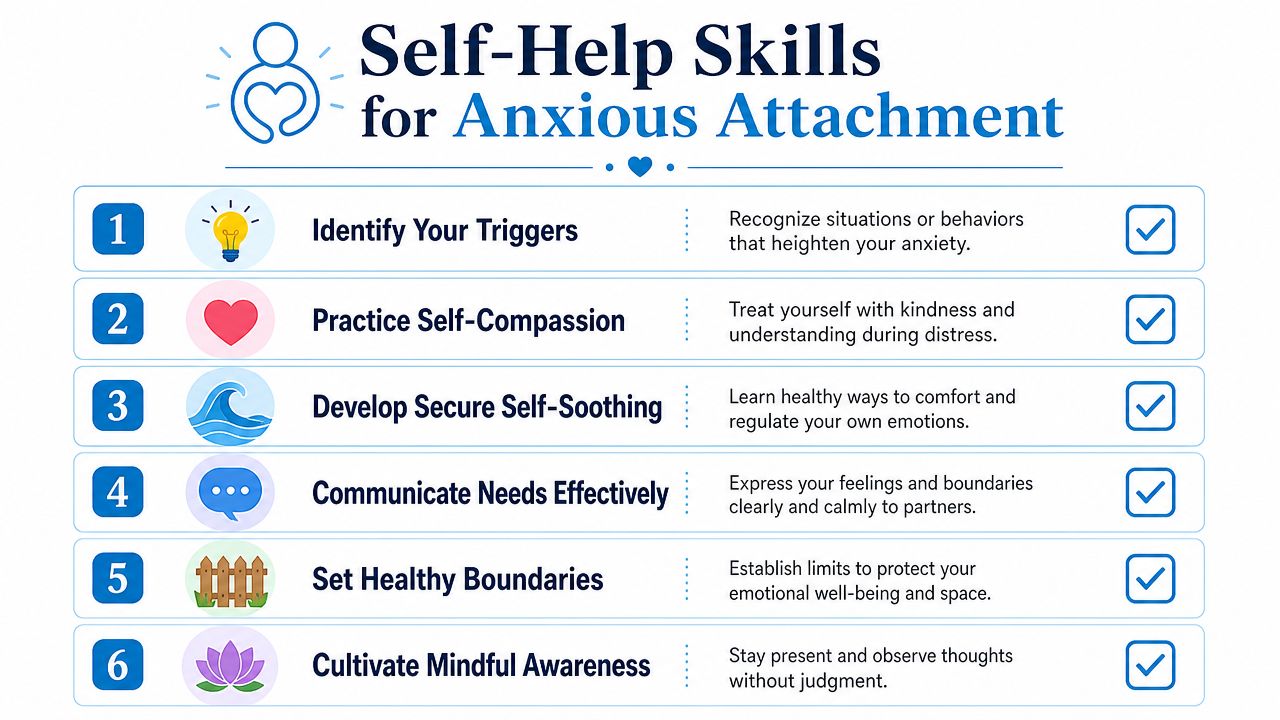
Six practical exercises
Track your triggers in writing
Keep a short note on your phone or in a journal. Record what happened, what you felt in your body, what story your mind created, and what you wanted to do next. Over time, patterns become easier to spot.Delay the first reaction
When activated, give yourself a brief pause before sending the message, making the call, or asking for reassurance. The pause is not suppression. It is regulation.Use a body-first reset
Attachment anxiety is physical. Before analysing, calm the system. Breathwork, progressive muscle relaxation, a brisk walk, stretching, or a grounding exercise can all help. If you want to build this habit, learning more about mindfulness can give you a useful starting point.Reality-test your interpretation
Ask yourself, “What do I know, what am I assuming, and what else could be true?” This question helps separate facts from fear.Practise one secure sentence
Prepare a simple script for moments of uncertainty. For example: “I noticed I'm feeling unsettled, and I'd like clarity when you have space.” This is usually more effective than protest, accusation, or repeated checking.Build life outside the relationship
Attachment healing is easier when your whole emotional world does not depend on one person. Routines, friendships, local community, exercise, rest, and meaningful work all strengthen internal security.
What helps most with consistency
The key is repetition, not perfection. A single calm conversation won't undo years of anxious responding. But repeated small moments of doing something different begin to teach the brain and body a new pattern.
How to Choose the Right Therapist in Italy
For expats, therapist fit matters twice. You need clinical competence, and you need cultural understanding. A therapist may be highly trained yet still miss how relocation, multilingual stress, or cross-cultural dating shape your anxiety.
Look for a therapist who can offer the following:
- Attachment knowledge. They should understand abandonment fears, reassurance-seeking, protest behaviour, and nervous-system activation.
- Intercultural sensitivity. They should recognise that not every misunderstanding is pathology. Sometimes it is culture, migration stress, or language.
- Language comfort. You should be able to speak in the language that feels emotionally precise, especially when discussing conflict, shame, or vulnerability.
- A practical style. Good anxious attachment work usually needs more than insight. It should include skills, structure, and real-life application.
If you're trying to decide what fit looks like, this guide to finding the right therapist for expats in Italy can help you ask better questions before you start.
As Clinical Director at Therapsy, I believe expats do best when therapy respects both psychology and context. Therapsy offers support in 14 languages, with carefully selected licensed professionals, online and in person across 24 Italian cities and 90+ physical locations. We use a human matching process led by the Clinical Director, not algorithms or chatbots, because the right therapeutic relationship matters.
For many people, a free first assessment call is the easiest place to begin. No pressure. Just a thoughtful conversation about what is happening, what kind of support would help, and who feels like the right fit.
FAQ
Can anxious attachment be healed in individual therapy
Yes, anxious attachment can be worked on effectively in individual therapy. Individual therapy helps you understand your triggers, regulate your nervous system, and change the thoughts and behaviours that keep the cycle going. If you're in a relationship, individual work can still create meaningful change because it shifts how you interpret and respond to closeness and distance.
Is couples therapy better than individual therapy for anxious attachment
It depends on where the problem is showing up most clearly. Individual therapy is often best when your anxiety follows you across relationships or feels rooted in older patterns. Couples therapy can help when both partners are stuck in a painful cycle and need support communicating more safely.
How long does anxious attachment style therapy take
There is no single timeline, because progress depends on your history, current stress, and the kind of support you have around you. Some people notice early relief when they learn regulation and communication skills. Deeper change usually takes repeated practice, especially when attachment anxiety is linked to longstanding wounds.
Is this just normal expat stress or something deeper
It can be both. Relocation often increases uncertainty, loneliness, and sensitivity, but if the same fear of abandonment, reassurance-seeking, or overthinking appears across relationships, there may be a deeper attachment pattern underneath. Therapy helps sort out what belongs to context and what belongs to an older relational template.
Can medication help with anxious attachment
Medication does not directly change attachment style, but psychiatric support can sometimes help if anxiety, panic, sleep problems, or depression are making it hard to function. In those cases, medication may support stability while therapy addresses the underlying relational pattern. A qualified clinician can help you decide whether that combination makes sense for you.
Do I need therapy in my native language
Not always, but many people find it easier to discuss attachment pain in the language that feels most natural emotionally. This matters even more when you are trying to express subtle feelings, boundaries, or fear without being misunderstood. If language itself becomes part of the stress, therapy in your preferred language can make the work more effective.
Book your first free assessment call with THERAPSY if you'd like support that understands both attachment and expat life in Italy. There is no commitment and no payment, just a conversation with our Clinical Director who will listen carefully and help match you with the right therapist for you.