You may be waking up in Milan with a tight chest, answering messages from home at the wrong hour, trying to function in Italian all day, and wondering why even simple tasks suddenly feel heavy. Or you may be in Florence, Rome, or a smaller city, feeling oddly alone in a place that was supposed to feel exciting. Anxiety often becomes louder when life is unfamiliar, support is far away, and your nervous system never fully gets a break.
Online therapy for anxiety is structured psychological support delivered through secure video sessions, designed to help you understand anxious patterns, reduce symptoms, and build practical coping tools without needing to attend a clinic in person. For many expats and multilingual people in Italy, that matters because access, language, and privacy are not small details. They are part of whether help feels possible at all.
Dr. Francesca Adriana Boccalari, Clinical Director at Therapsy, writes from the perspective of expat mental health and intercultural psychology, with training in CBT, EMDR, and Schema Therapy across Milan, New York, and Singapore. This is a practical guide for people who feel overwhelmed and want a clear starting point.
Starting Your Journey with Online Therapy for Anxiety
When anxiety appears in a new country
Italy can be beautiful and disorienting at the same time. Many people arrive with hope, curiosity, and a strong plan, then find themselves dealing with sleep problems, overthinking, irritability, panic, or a constant sense of being on edge. That reaction isn't a personal failure. It often reflects a nervous system trying to adapt under pressure.

Online therapy for anxiety can lower the threshold for asking for help. You don't need to attend a clinic in a foreign language, cross a city while already activated, or wait until things become unbearable.
A useful first step between sessions is learning how to calm your nervous system in simple, body-based ways. Therapy works best when insight and daily regulation support each other.
Why this format has become so relevant in Italy
Interest in remote mental health support grew sharply in Italy during and after the pandemic. A 2022 study found that 34% of Italians expressed significant interest in online therapy as an alternative to in-person care for anxiety and stress-related conditions, and online therapy platforms saw a 58% increase in user registrations in 2020 to 2021, with anxiety reported in 42% of cases (Italian study on online psychological support).
Online therapy didn't become popular only because it was convenient. It became important because many people needed care that could actually fit real life.
For expats, international students, and multilingual residents, online care can be especially practical. It allows continuity during travel, access to a therapist who speaks your language, and a more discreet way to begin if you feel hesitant.
If you're looking into remote support, online psychotherapy in Italy can feel much more straightforward once you know what the process involves.
What online therapy for anxiety can help with
Anxiety doesn't always look dramatic. Sometimes it shows up as:
- Constant anticipation: You keep scanning for what could go wrong.
- Physical activation: Heart racing, jaw tension, stomach problems, restlessness.
- Avoidance: You postpone calls, paperwork, transport, social events, or medical appointments.
- Mental overload: Your mind doesn't switch off, even when you're exhausted.
When these patterns start shaping your days, therapy can help you understand them rather than fight them.
Why Anxiety Is Common for Expats in Italy
The pressure isn't only external
Living abroad places stress on multiple psychological systems at once. You may be adjusting to bureaucracy, different social rules, unstable routines, financial pressure, or the loss of familiar support. But the deeper strain often comes from something less visible. Your sense of competence can suddenly drop.
People who were organised, articulate, and independent in their home country may feel unsure in a pharmacy, at the post office, in a work meeting, or during a landlord conversation. That gap can trigger shame, self-doubt, and hypervigilance.
Anxiety in expat life often comes from reduced predictability, reduced belonging, and reduced control.
Culture shock is more than discomfort
Cross-cultural psychology treats culture shock as a real adjustment process, not just a travel inconvenience. The mind has to constantly decode new signals. Is this direct or rude? Warm or intrusive? Efficient or chaotic? Temporary uncertainty is manageable. Chronic uncertainty is draining.
This is one reason anxiety can feel stronger abroad than it did at home. Your brain is using more energy to interpret everyday life, and anxious thinking tends to grow in that kind of environment.
A helpful clinical distinction is this:
| Experience | Common stress reaction | Anxiety pattern |
|---|---|---|
| Trigger | Specific challenge | Multiple areas of life |
| Duration | Usually settles after the situation | Keeps returning or spreading |
| Effect | Unpleasant but manageable | Starts shaping sleep, mood, work, or relationships |
If you're noticing that anxiety is becoming persistent, support for anxiety in Italy can be easier to access than many expats expect.
Identity loss often sits underneath the anxiety
This is especially important for women who relocated for work, love, or family life. Expat women relocating to Italy for work or family experience a 40% higher rate of anxiety and culture shock compared to international students, largely due to loss of professional identity and isolation from U.S. family support.
That makes psychological sense. When your role changes quickly, the mind often fills the gap with questions such as:
- Who am I here, if I can't do things the way I used to?
- Am I dependent in ways that don't feel like me?
- Why does everyone else seem to adapt better?
CBT helps identify the thought patterns that intensify anxiety. Schema Therapy goes deeper into long-standing beliefs, such as “I have to cope alone” or “If I'm struggling, I'm failing.” Both can be very useful in intercultural transitions.
Language fatigue is real
Even if you speak Italian well, functioning in a second language all day can be tiring. If you don't speak it well yet, the strain is higher. Many expats describe a constant background tension from needing to translate, monitor, and self-edit.
That doesn't just create frustration. It can maintain anxiety, because the body stays braced for misunderstanding.
How an Online Therapy Session for Anxiety Works
What usually happens first
The beginning is often much simpler than people fear. Online therapy for anxiety usually starts with a first conversation focused on three things:
- What feels hardest right now
- How anxiety is affecting daily life
- What kind of support would feel useful and realistic
You won't be expected to tell your whole life story in perfect order. A good first session creates enough structure for the therapist to understand your current pattern and enough safety for you to feel less alone with it.
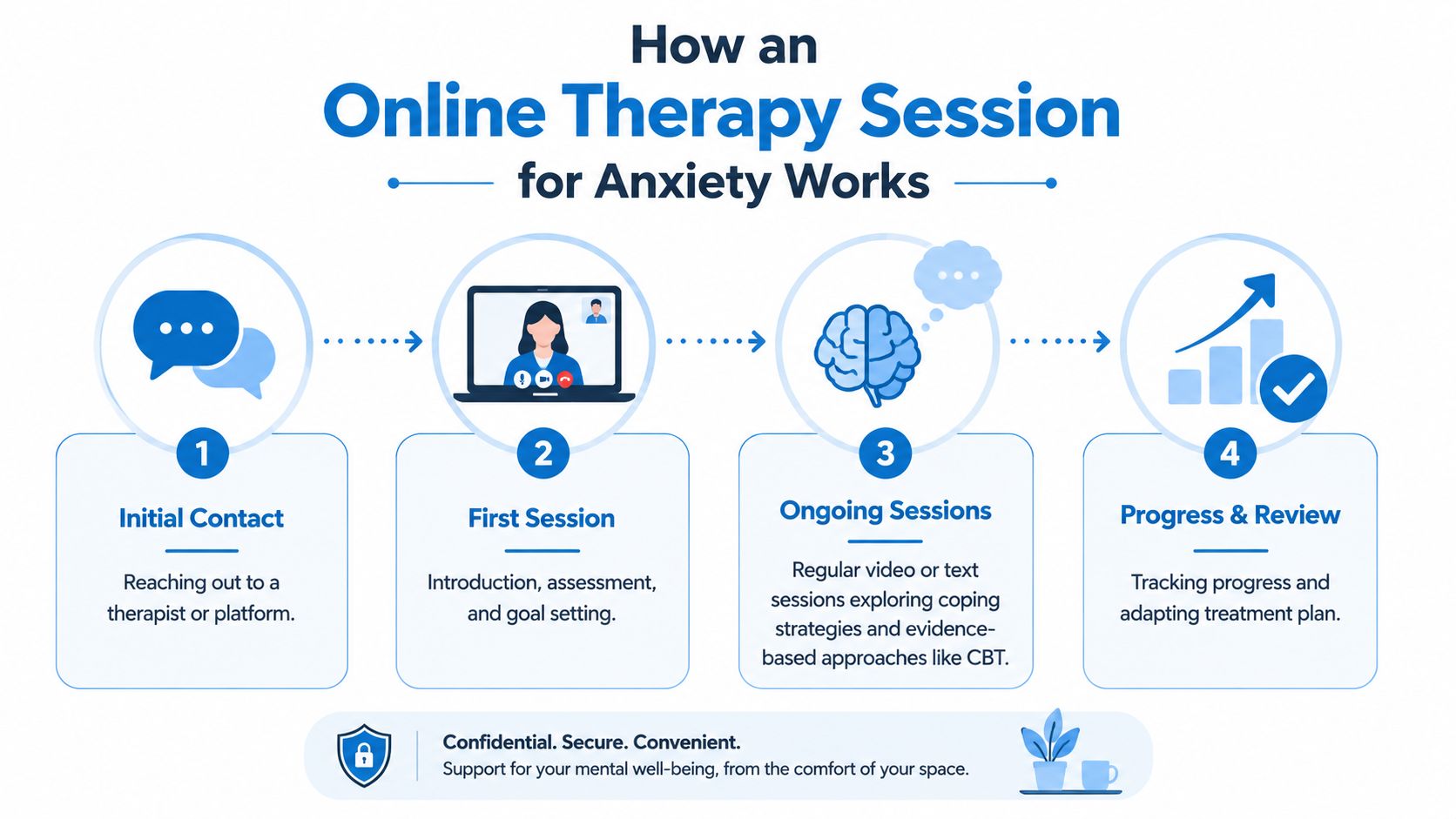
Some people arrive worried that they won't know what to say. That's common. The therapist guides the process, asks focused questions, and helps organise what may currently feel like mental noise.
What evidence-based treatment looks like online
Online therapy is not a diluted version of real therapy. When it's done well, it is structured clinical work.
A 2023 Italian consensus conference found that online therapy for anxiety is as effective as in-person care. The meta-analysis reported a 76% success rate in reducing anxiety symptoms using CBT delivered via video platforms, and anxiety severity scores dropped by an average of 3.2 points on the GAD-7 scale after 12 sessions (Italian consensus conference on psychological therapies).
That matters because many anxious clients worry that a screen will make treatment superficial. The research doesn't support that fear.
The effectiveness of therapy depends less on the room and more on the quality of the method, the therapeutic relationship, and the consistency of the work.
How CBT works in online therapy
Cognitive Behavioural Therapy, or CBT, helps you identify the links between thoughts, emotions, body sensations, and behaviour. For anxiety, this is useful because the mind often creates a convincing but unhelpful alarm system.
A simple example:
- Situation: Your boss asks to talk tomorrow.
- Automatic thought: “I've done something wrong.”
- Body response: Tight chest, nausea, racing mind.
- Behaviour: Re-reading messages, sleeping badly, avoiding dinner plans.
CBT doesn't ask you to “think positive”. It helps you test the anxious prediction, notice the pattern, and respond differently. Over time, that reduces the power of the spiral.
In online sessions, this may include:
- Thought mapping: Seeing the sequence more clearly.
- Behavioural experiments: Testing feared assumptions in manageable ways.
- Exposure work: Approaching avoided situations gradually and safely.
- Coping tools: Breathing, grounding, planning, and realistic self-talk.
How EMDR can help when anxiety is linked to past experiences
EMDR stands for Eye Movement Desensitisation and Reprocessing. In plain language, it helps the brain process distressing experiences that remain emotionally “stuck”. For some people, anxiety isn't only about current stress. It is amplified by earlier experiences of humiliation, instability, medical fear, panic, loss, or relational trauma.
Online EMDR can be adapted carefully in a secure format when clinically appropriate. The focus is not merely recounting painful memories. The focus is helping the nervous system stop reacting as if the old danger is still present.
What ongoing sessions usually involve
After the assessment phase, therapy becomes more focused. Sessions often include:
| Phase | What happens |
|---|---|
| Early work | Clarifying triggers, patterns, goals, and immediate coping tools |
| Middle work | Addressing avoidance, beliefs, emotional habits, and relational stress |
| Review | Looking at progress, adjusting the plan, and strengthening independence |
Some weeks are practical. Others go deeper. Both matter.
Online vs In-Person Therapy A Comparison for Expats
The honest answer is that both can work
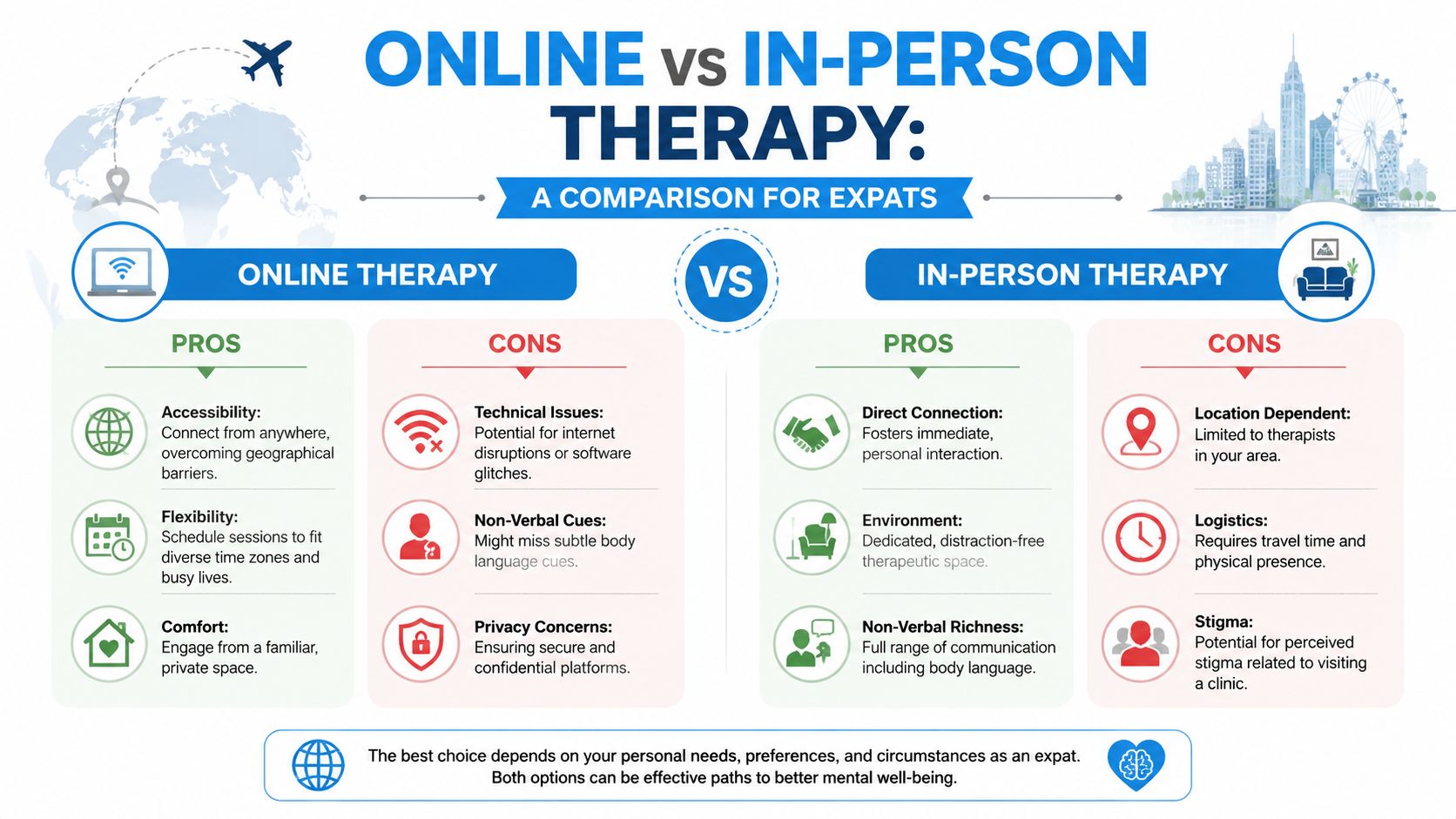
For expats in Italy, the best format isn't the one that sounds ideal in theory. It's the one you can realistically attend, emotionally tolerate, and sustain. Online therapy for anxiety often makes that easier, but in-person therapy still has real strengths.
Where online therapy often helps most
For many internationals, online sessions remove barriers that would otherwise delay care.
- Geographic flexibility: You can continue therapy if you move city, travel for work, or live somewhere with few multilingual clinicians.
- Lower activation: Joining from home can feel easier when you're already anxious.
- Language access: You may be able to find a therapist in your preferred language rather than defaulting to whoever is nearby.
- Discretion: Some people feel more comfortable starting privately.
A detailed look at online vs in-person therapy in Italy for expats can help if you're weighing both options.
Where in-person therapy may feel stronger
In-person sessions can be especially valuable if you find embodied presence regulating, struggle to create privacy at home, or feel distracted by screens. Some clients also like having a dedicated physical place where therapy happens, separate from the rest of life.
This can matter when home feels crowded, unstable, or emotionally charged.
Some people open up more easily online. Others feel safer in a shared room. The right format is the one that supports honesty and continuity.
A practical comparison
| Format | Often works well when | Trade-offs to consider |
|---|---|---|
| Online therapy | You need flexibility, multilingual access, or lower logistical stress | Internet issues, privacy at home, screen fatigue |
| In-person therapy | You want a dedicated setting and full non-verbal presence | Travel time, location limits, less scheduling flexibility |
What doesn't work well in either format
Certain habits can weaken therapy regardless of setting:
- Irregular attendance: Anxiety often improves through repetition and consistency.
- Therapist mismatch: Good technique matters, but so does feeling understood.
- Pure venting with no structure: Relief matters, but anxiety treatment also needs a plan.
- Forcing a format that doesn't fit your life: If attending becomes too hard, progress often stalls.
A balanced decision is better than an idealised one.
How to Choose the Right Online Therapist in Italy
Qualification matters, but it isn't enough
A therapist should be licensed and experienced with anxiety. That's the baseline. For expats and multilingual clients in Italy, two more factors often determine whether therapy works well: language fit and cultural fit.
If you have to translate your emotional life in session, therapy becomes harder. If the therapist misses the social meaning of migration, bicultural relationships, family expectations, or identity loss, important parts of the problem can remain invisible.
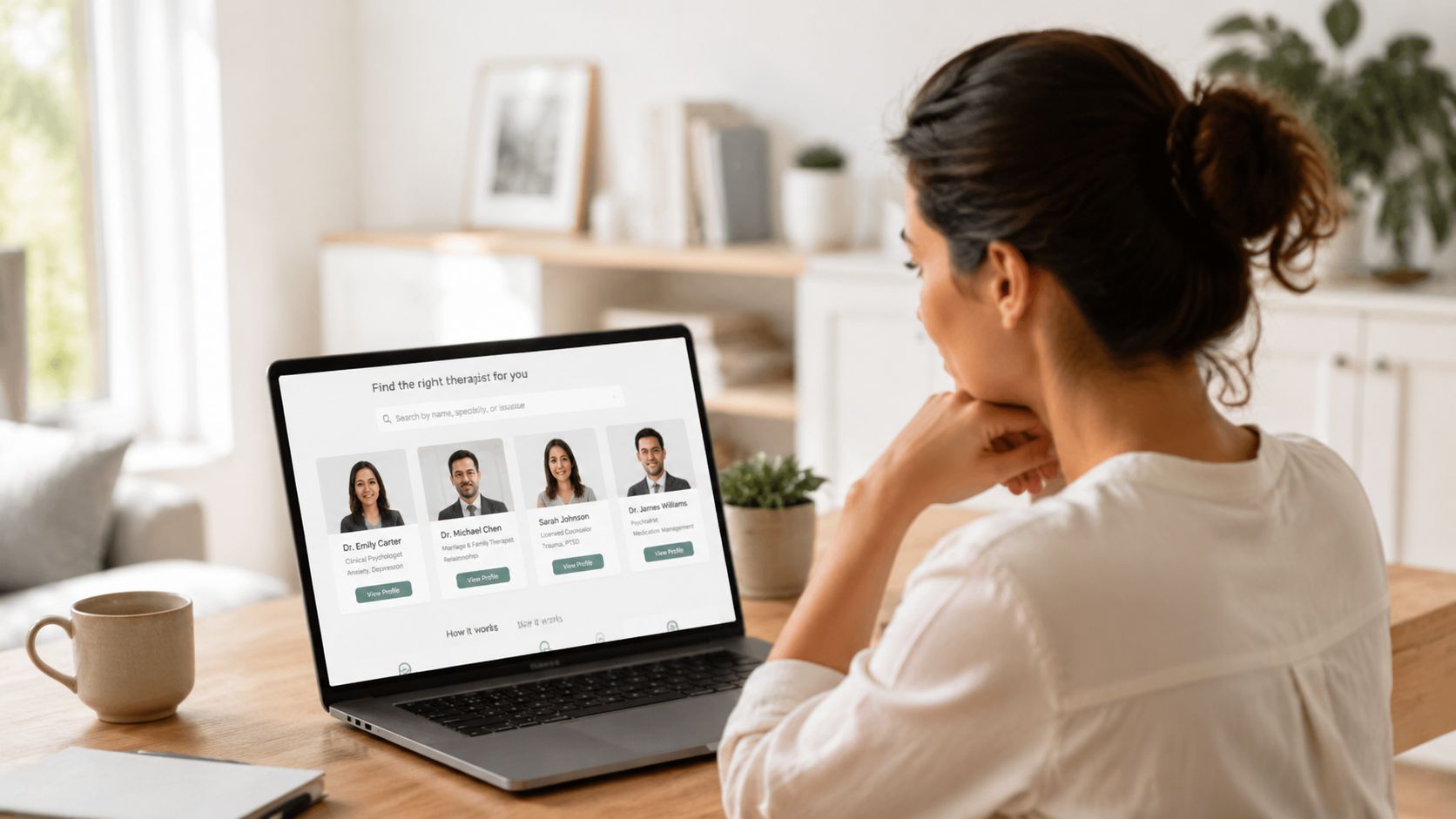
The multilingual gap is bigger than many people realise
This is one of the most neglected issues in online therapy for anxiety in Italy. Data from the Italian Ministry of Health in 2025 shows that 68% of non-English-speaking expats in Milan report anxiety due to language barriers in therapy access, while 95% of UK and US competitors offer only English. The same source notes that when the therapist is matched by language and cultural background, clients report 50% faster symptom reduction for anxiety and panic attacks (research on multilingual and culturally matched therapy access).
That finding fits what clinicians see every day. People often speak their “functional” language at work, but they access grief, fear, shame, anger, and attachment needs more directly in their native language.
What to look for when choosing
A strong choice usually includes several layers.
Specific experience with anxiety
Ask whether the therapist works regularly with panic, generalised anxiety, health anxiety, social anxiety, or adjustment-related anxiety.A method that fits the problem
CBT is often useful for anxious spirals and avoidance. EMDR can help when anxiety is tied to unresolved distress. Schema Therapy can be powerful when anxiety is linked to identity, self-worth, or relationship patterns.Language comfort
Your “best therapy language” may not be the one you use in meetings. It may be the language you cry in, dream in, or argue in.Cultural understanding
A therapist doesn't need your exact biography. They do need sensitivity to migration stress, foreign systems, mixed identities, and the emotional labour of living between cultures.A human matching process
Questionnaires can be efficient, but they often miss nuance. Human matching tends to work better when a person's anxiety is mixed with cultural, relational, or identity complexity.
If you're weighing these factors, finding the right therapist for expats in Italy can help you clarify what matters most.
The therapeutic alliance is not a soft extra. It is one of the foundations of effective anxiety treatment.
Red flags worth noticing
Be cautious if a service feels generic, rushed, or linguistically inflexible. Common warning signs include:
- One-language-only care when your emotional reality is more complex
- No clear clinical orientation for anxiety treatment
- Automated matching with little human review
- A therapist who minimises migration stress as if it were just ordinary homesickness
Being understood shouldn't be treated as a luxury. In therapy, it's part of the work.
Costs and Logistics of Starting Online Therapy
What therapy usually costs in Italy
Cost matters because anxiety often worsens when the process of getting help feels financially unclear.
If you're comparing options, it's helpful to look beyond the fee alone. Consider language fit, therapist expertise, continuity, and whether the service understands expat life in Italy.
For a clearer overview, therapy costs in Italy are easier to evaluate when you compare format, specialisation, and what the first contact includes.
What the first steps usually look like
Starting online therapy for anxiety is often more straightforward than anxious thinking predicts.
- First contact: You reach out and briefly describe what brings you in.
- Initial assessment: A first conversation helps clarify your needs, symptoms, and preferences.
- Matching and scheduling: You agree on a therapist, format, and time that are realistic.
- Ongoing work: Sessions begin with a plan that can be adjusted as therapy develops.
At Therapsy, the first assessment call is free, with no commitment or payment required. Individual therapy starts from €70/session, couple therapy from €100/session, psychiatric consultation from €110/session, and psychodiagnostic assessment from €255.
If medication costs are also on your mind
Some people exploring therapy are also reviewing medication with a doctor, especially if anxiety has become persistent or physically exhausting. Medication decisions should always be discussed with a qualified medical professional.
Small logistics that make a big difference
Before your first online session, try to prepare:
- A private space: Even a parked car or quiet room can work better than a shared kitchen.
- Headphones: They improve privacy and focus.
- A glass of water and a few minutes before the call: Rushing straight in can keep your body activated.
- A simple note of your main concerns: You don't need a perfect summary. Just a few points can help you begin.
The first step doesn't need to be dramatic. It just needs to be possible.
FAQ Online Therapy for Anxiety
FAQ
Is online therapy for anxiety really effective?
Yes, online therapy for anxiety can be highly effective when it uses structured, evidence-based methods and there is a good therapeutic fit. Many people do very meaningful work through video sessions, especially when treatment includes approaches such as CBT or EMDR and sessions are attended consistently.
Is online therapy confidential?
Yes, online therapy should be confidential when it is provided through secure professional systems and conducted in a private setting. It's also important that you choose a space where you can speak freely without being overheard, because privacy is created by both the therapist and the client.
Do I need to speak Italian to start therapy in Italy?
No, you don't need to speak Italian to start therapy in Italy if you choose a therapist or service that works in your preferred language. For many expats, therapy is more effective when they don't have to translate emotional experiences or explain cultural context from scratch.
What if I don't feel comfortable with the first therapist?
That can happen, and it doesn't mean therapy isn't for you. The relationship with the therapist is central to progress, so if the fit feels off, it's appropriate to ask for a different clinician rather than forcing yourself to continue uncomfortably.
How many sessions does anxiety therapy usually take?
It varies, because anxiety has different causes, patterns, and levels of severity. Some people benefit from focused short-term work, while others need longer support to address deeper relational patterns, trauma, or repeated life transitions.
Do I need a doctor's referral?
No, you usually don't need a doctor's referral to begin psychotherapy. It's typical to start by contacting a therapist or clinic directly, then deciding after an initial conversation what kind of support is most appropriate.
Can online therapy help if my anxiety is linked to moving abroad?
Yes, online therapy can be especially helpful when anxiety is tied to relocation, culture shock, or feeling ungrounded in a foreign system. In those cases, it helps to work with someone who understands cross-cultural adjustment and can address both symptoms and the deeper identity stress underneath them.
What if I'm anxious about starting therapy itself?
That's very common, and you don't need to solve that anxiety before reaching out. A good first contact should feel simple, respectful, and low pressure, helping you take one manageable step rather than asking you to feel ready for everything at once.
If you're looking for warm, evidence-based support in your own language, book your first free assessment call with THERAPSY. It's free, with no commitment, just a conversation with our Clinical Director who will listen carefully and help match you with the right therapist for you.
Dr. Francesca Adriana Boccalari, Clinical Director at Therapsy