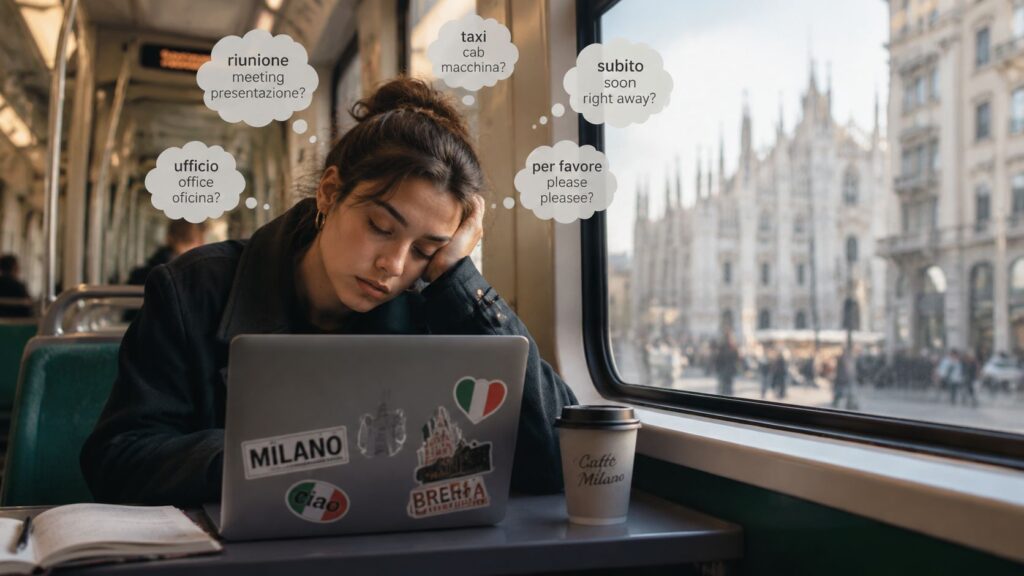
You land in the US, open the front door, open the fridge, hear familiar accents, and still feel off. The roads seem wider. Conversations feel quicker and thinner. Friends want the highlights reel of Italy, but not the part where you're grieving the life you built there. Home is supposed to feel automatic. Instead, it feels slightly unreal.
That experience has a name. Reverse culture shock americans returning home describes the emotional disorientation that can happen when a familiar place no longer feels fully familiar after life abroad. It isn't a character flaw, and it doesn't mean you made a mistake by leaving or by coming back. It means your mind is trying to integrate two versions of reality at once.
For Americans returning from Italy, this can be especially sharp. Italy often changes daily rhythm, relationships, identity, and expectations around time, food, work, and connection. When you come back, the US hasn't just stayed the same. You've changed as well.
As a psychotherapist, I often see how confusing this phase can be. People tell themselves they should be grateful, relieved, or “back to normal” by now. That pressure usually makes the adjustment harder, not easier.
What helps is understanding that re-entry is a psychological transition, not just a travel logistics problem. When you can name what's happening, you stop fighting yourself quite so much. You can start responding with skill instead of shame.
Introduction You're Home But You Feel More Lost Than Ever
Coming home can feel lonelier than leaving. Abroad, you expect difference. Back in the US, you expect ease. That gap between expectation and lived experience often becomes the most painful part.
Many returnees say some version of this:
I thought I would feel settled the minute I got back, but I feel more out of place here than I did in Italy at the beginning.
That sentence captures the core wound of reverse culture shock. It's not only about missing a city, a language, or a way of life. It's about the sudden loss of fit. The routines that used to organise you no longer hold you in the same way.
What reverse culture shock actually is
Reverse culture shock is a normal readjustment response after living abroad. It often includes grief, irritation, numbness, identity confusion, and a sense that other people don't fully understand what changed in you.
It's easy to pathologise this too quickly. Sometimes it does overlap with anxiety, burnout, depression, or adjustment disorder. But the starting point matters. Re-entry distress is often a human response to transition, not immediate evidence that something is wrong with you.
Why this article matters for Americans returning from Italy
Americans returning from Italy often face a specific kind of conflict. Italian life can be more relational and more tolerant of slowness, ambiguity, and presence. The US often asks for speed, clarity, productivity, and self-sufficiency very quickly. That doesn't make one culture better than the other. It does mean your nervous system may need time to adapt.
If you feel ungrateful, irritable, detached, or oddly fragile, you're not failing at coming home. You're in a transition that deserves language, structure, and support.
The Psychology of Re-Entry Why Coming Home Is So Hard
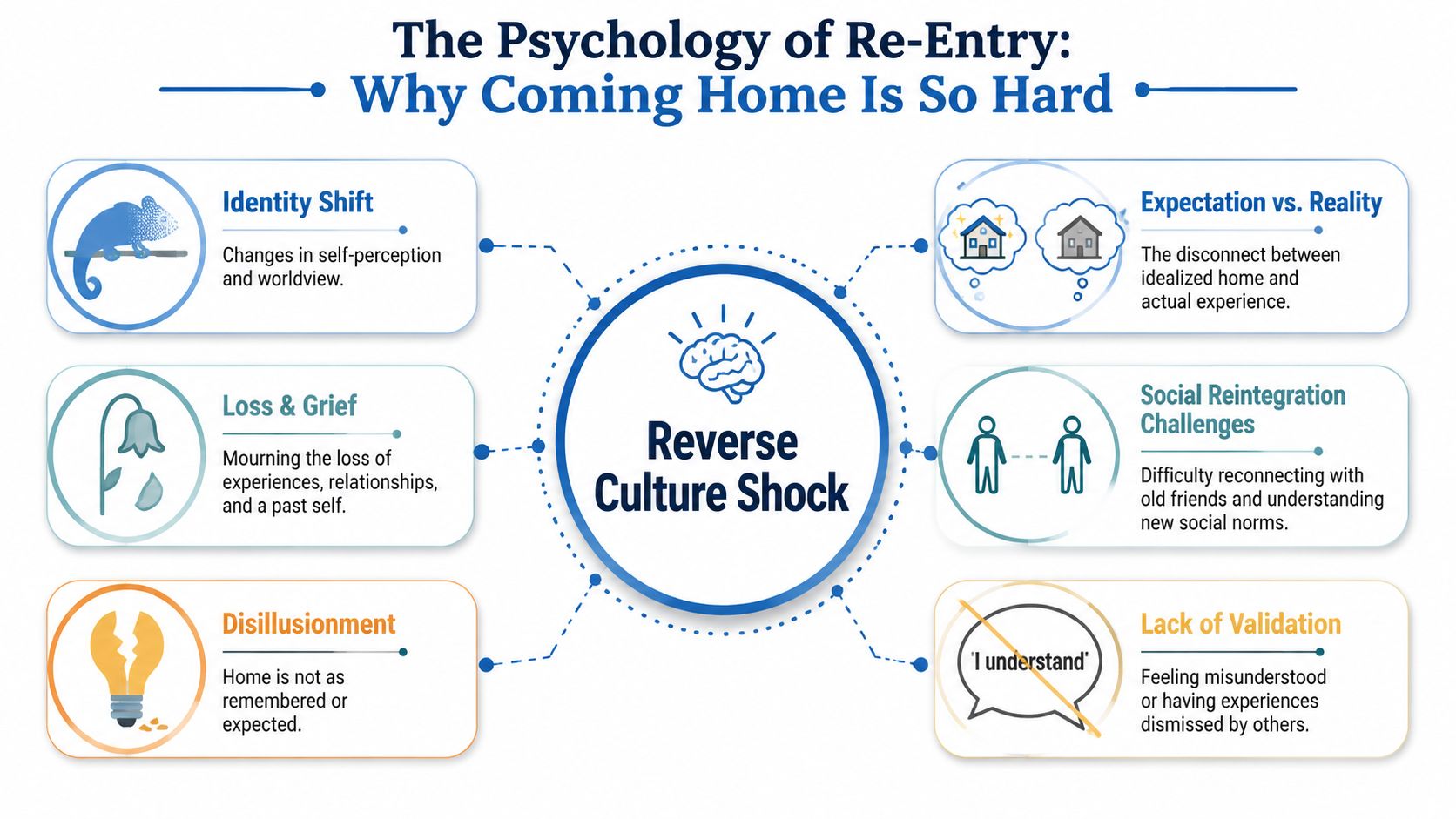
You land in the US, sleep in your old room or unpack in a familiar city, and expect your body to relax. Instead, your chest stays tight in the grocery store, small talk feels oddly thin, and the pace around you feels louder than you remembered. That reaction is common in re-entry work. Home is familiar, but you are not returning as the same person who left.
Reverse culture shock often becomes painful because it stirs several layers at once. It affects identity, attachment, memory, and the nervous system. Americans returning from high-context cultures like Italy often feel this sharply. In Italy, meaning is often carried through tone, relationship, timing, and shared context. Back in the US, interactions can feel more explicit, efficient, and task-driven. Many returnees describe relief and irritation at the same time.
Re-entry puts pressure on identity
Living abroad changes people in durable ways. Students often become less dependent on old peer norms. Professionals may question work habits they once accepted without much thought. Couples can discover that the version of the relationship that worked overseas does not transfer neatly to American routines, family expectations, or career pressure.
That creates identity friction. The current self meets an environment that still relates to an earlier version of you.
In therapy, I usually hear this as confusion rather than clarity. A person says they are glad to be back and also feel restless, guilty, impatient, or emotionally flat. Those reactions make sense. Re-entry asks you to hold two truths at once. You can love home and still grieve what you lost abroad.
CBT helps explain the mental loop that makes re-entry heavier
Cognitive Behavioral Therapy is useful here because re-entry distress is often intensified by interpretation. The event is the move home. The suffering grows when the mind adds conclusions such as:
- “If I feel this bad, I made the wrong choice.”
- “I should be over this by now.”
- “Everyone else can readapt, so something is wrong with me.”
- “If home feels foreign, I must not belong anywhere.”
Those thoughts increase anxiety, shame, and withdrawal. They also push people toward habits that prolong distress, like overworking, isolating, or criticizing themselves for missing Italy. A CBT approach helps identify the thought, test it, and replace it with something more accurate. For example, “I should be over this” becomes “My system is adjusting to a major transition, and that takes time.”
Schema Therapy explains why old roles come back so fast
Returning home can reactivate long-standing schemas, especially in family or work settings. A successful adult can visit parents for one week and suddenly feel eighteen again. A competent professional can return to an American workplace and feel harshly evaluated, even before anyone says much. That shift is not random. Familiar environments tend to trigger familiar roles.
Common schema-driven beliefs during re-entry include:
- I have to fit back in quickly
- My needs are too much
- I should be more productive already
- If I disappoint people, I will lose connection
I often see the punitive, self-critical side of people get louder during re-entry, especially when they compare the relational rhythm they had in Italy with the speed and self-sufficiency expected in the US. If you want a closer look at how international moves can destabilize a sense of self, this guide on expat identity crisis adds useful context.
EMDR can help when re-entry feels bigger than “adjustment”
Some returnees are not only missing a lifestyle. They are having body-based reactions that feel out of proportion to the moment. A crowded airport, a family comment, or a work email can trigger panic, numbness, or a flood of emotion. EMDR can be helpful when re-entry has linked itself to earlier experiences of helplessness, exclusion, or chronic pressure.
That matters for different life stages. Students may feel disoriented after losing independence they fought hard to build. Mid-career professionals may feel trapped between financial reality and a deep mismatch with old work values. Couples may find that one partner readapts faster, while the other feels lonely and ashamed for struggling. The treatment plan should match the stage of life, not force everyone into the same coping advice.
Practical trade-offs during re-entry
Some responses reduce strain. Others create more of it.
What usually helps:
- Name the loss accurately. Missing Italy, missing a slower relational pace, or missing who you became there is a real form of grief.
- Expect a split experience. Relief, gratitude, sadness, and irritation often coexist.
- Protect a few stabilizing routines. Regular sleep, walks, meals, and limited social exposure help the nervous system settle.
- Choose your audience carefully. Talk about the deeper parts of re-entry with people who can tolerate complexity.
What often backfires:
- Forcing gratitude to cancel grief
- Explaining your whole overseas experience to people who only want a quick update
- Making major life decisions in the first wave of disorientation
- Interpreting distress as proof that coming home was a mistake
For military households, foreign service families, and others facing a logistical move on top of the emotional one, practical stress can magnify psychological stress. Sorting details like housing, school transitions, and transport matters. Resources on auto transport for military families can reduce one concrete burden so re-entry distress is not carrying the full load.
Common Symptoms and The Four Phases of Readjustment
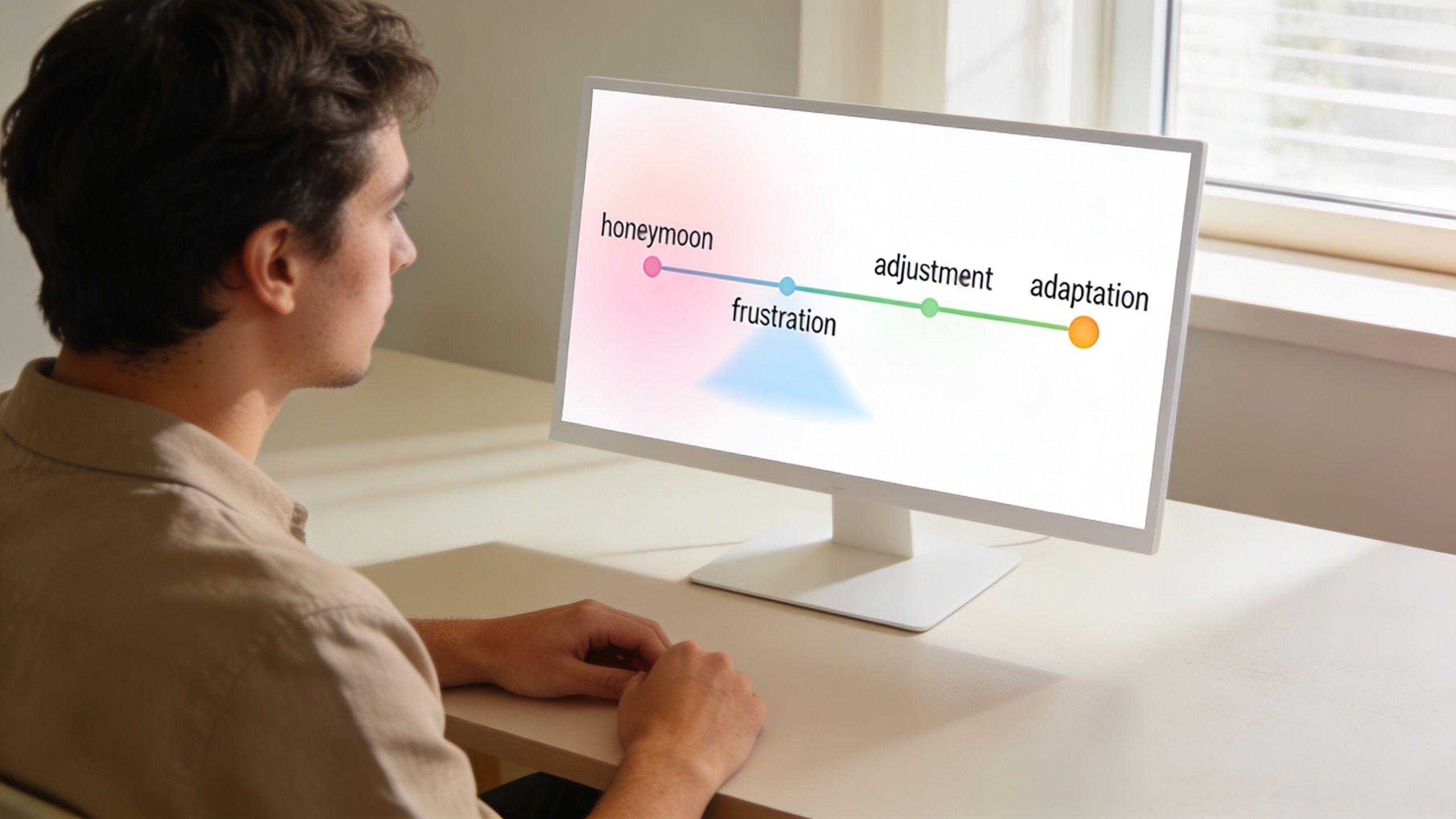
You may be back in your old bedroom, your old office, or your parents' kitchen and still feel strangely off. That reaction follows a recognizable clinical pattern. Seeing the pattern matters because people usually calm down once they understand that their distress has a shape.
As noted earlier, re-entry distress is common among Americans returning after extended time abroad. In therapy, I often see the same cluster of reactions in people returning from high-context cultures such as Italy, where daily life depends more on relational cues, rhythm, and shared social expectations than many parts of the US. Home can feel familiar on the surface and emotionally wrong underneath.
What symptoms often look like in daily life
Reverse culture shock rarely shows up as one clean feeling. It tends to affect mood, attention, relationships, and identity all at once.
Common symptoms include:
- Emotional strain. Grief, irritability, guilt about missing Italy, numbness, or sudden drops in mood after the first reunion period passes.
- Cognitive strain. Idealising life abroad, feeling harshly critical of American habits, overthinking where you belong, or getting stuck in indecision.
- Social strain. Feeling detached from friends, dreading casual conversations, or noticing that other people want a short summary when your experience changed you in deeper ways.
- Identity strain. Feeling older than your peers in some ways and less sure of yourself in others. Many returnees feel split between the self who left and the self who came back.
These symptoms can resemble depression, but context matters. A transition-related slump often improves with structure, emotional processing, and time. Clinical depression usually becomes more global and persistent. If you are trying to sort out that difference, this guide on homesickness vs depression in expats in Italy gives a useful framework.
The four phases of readjustment
The re-entry curve is not a rulebook. It is a working map. Some people move through it quickly. Others cycle back through parts of it after a job change, a visit from old friends abroad, or a disappointing attempt to reconnect at home.
| Phase | What it often feels like | Typical timing |
|---|---|---|
| Honeymoon | Relief, reunion energy, comfort foods, familiar jokes, a burst of certainty that home is simple again | 1 to 2 weeks |
| Crisis | Irritability, grief, boredom, alienation, disappointment, self-criticism, or feeling emotionally out of step with everyone around you | 1 to 3 months |
| Adjustment | More predictable routines, less emotional volatility, clearer language for what you miss and what you want to keep | 3 to 6 months |
| Mastery | A more integrated identity, steadier mood, and a broader definition of home that makes room for both places | 6 to 12 months |
Why the crisis phase often feels the worst
The early days back are full of stimulation. People want to see you. There are errands to run, stories to tell, forms to complete, things to buy. Then normal American life resumes. The drop in intensity can feel like something is wrong, when in fact the nervous system is only now catching up.
This is usually the phase where CBT helps people notice distorted thoughts such as "I should be grateful, so I shouldn't feel upset" or "If I miss Italy this much, I must have made the wrong decision." Schema Therapy is useful here too, especially when re-entry activates older patterns around not belonging, defectiveness, or emotional deprivation. For returnees who had a highly stressful ending abroad, or who carry unresolved earlier trauma, EMDR can help reduce the charge attached to certain memories and make the present feel less threatening.
A practical example helps. A college student returning from Florence may hit the crisis phase and assume she has become antisocial because campus life now feels loud and thin. A mid-career professional may interpret his irritability at work as poor motivation, when the actual issue is that he is grieving a slower, more relational style of daily contact. A couple may fight over whether to "just move on" because one partner is readjusting faster. The symptom is conflict, but the underlying problem is mismatched timing.
What helps at this stage
Start with observation before judgment.
Keep a simple record for two weeks. Track mood, sleep, overstimulation, social contact, and the moments when you feel most out of place. That gives you usable information. In CBT terms, it helps separate the trigger from the story you tell yourself about the trigger.
Then make one small intervention at a time:
- Reduce unnecessary overstimulation for a short period.
- Keep one or two habits from Italy that still support you, such as walking after dinner, slower meals, or protected social time.
- Name the specific loss instead of calling it "just a weird mood."
- Build contact with people who can tolerate complexity, including others who have lived abroad or people already adjusting to Canadian workplace culture and other cross-cultural transitions.
- Delay major identity decisions until your nervous system is less activated.
The goal is not to erase what changed you. The goal is to help your mind and body catch up to the fact that you are home, and changed, at the same time.
Real-World Examples Why Your American Home Feels Foreign
Sometimes reverse culture shock becomes visible in small, almost absurd moments. You walk outside and realise there's nowhere to go on foot. You sit down at a restaurant and remember you now need to calculate a tip. You enter a supermarket and feel overwhelmed by choice, packaging, and scale.
These reactions are not petty. They are nervous-system responses to changed norms.
A 2024 analysis of social media trends reported by Business Insider found that common reverse shocks for Americans returning from Europe included driving dependency, with returnees struggling after walking 50% more abroad.
The everyday frictions that carry emotional weight
After Italy, many Americans notice:
- Car dependence feels draining. In Rome or Milan, movement can be embodied and social. Back in the US, a short errand may require a car, parking, traffic, and planning.
- Tipping creates immediate tension. You know the rule, but it still feels jarring to re-enter it.
- Food environments feel louder. Portion size, abundance, and speed can feel excessive rather than comforting.
- Conversation can feel more transactional. You may miss lingering, layered exchanges that don't rush toward efficiency.
These details sound minor until they accumulate. Then they start shaping mood. A person may think they are “just annoyed,” when in fact they are grieving a way of living in time and space.
Why these examples matter clinically
The concrete shocks are often the doorway into deeper feelings. A complaint about parking may be a complaint about lost spontaneity. Irritation about tipping may hold a bigger frustration about constant performance and social rules. Missing a walkable city may mean missing the version of yourself that felt calmer, healthier, or more connected there.
This is why generic advice can miss the point. Re-entry isn't solved by telling yourself to stop comparing. Comparison is often how the mind measures change.
For many returnees, that perspective reduces shame.
A similar process happens socially. You may be surrounded by familiar people yet still feel emotionally alone. That pattern is close to what many expats describe in expat loneliness in Italy, except now the loneliness is happening at home.
Practical Coping Strategies Tailored to Your Life

You unpack, answer messages, go back to work or school, and look functional. Then something small knocks you off balance. A rushed conversation. A packed highway. Lunch at your desk again. Re-entry often improves when coping matches the actual pressure points in your life, not a generic idea of “adjusting.”
The most effective strategies do two things at once. They reduce overload in the present, and they help your mind make sense of what changed while you were away. That matters for Americans returning from high-context cultures such as Italy, where connection, time, and communication often carry more implied meaning than they do in the US. If you came back feeling less efficient but more human, that tension deserves a serious response.
For students returning home after Italy
Students often come back to an old role that no longer fits. Family members may expect the same version of you. Friends may want the quick recap, not the complicated one. Internally, though, many students feel more mature, less impressed by old routines, or unsure where they belong.
Start with coherence. Write one private page answering three questions: What did Italy give me? What did it cost me? What feels hard to explain now? This is a CBT-informed exercise because it organizes experience before the mind turns it into confusion or self-criticism.
Then protect continuity. Keep one habit from your life abroad that carries meaning, not just nostalgia. A weekly Italian meal, a language exchange, a long evening walk, a slower Sunday. Small repeated actions tell the nervous system, “I did not lose everything.”
Selective sharing also helps. Choose one or two people who can tolerate a fuller conversation. Trying to get everyone to understand usually leaves returnees feeling flatter and more alone.
For young professionals
Work is where reverse culture shock often becomes visible. I see this often with people returning from Italy. They are not “bad at work” back in the US. They are reacting to a sharper pace, more compressed communication, and less room for relational warmth.
Use a practical review of your week. Track where you get activated, not only what you need to finish. Notice the meetings that leave you wired, the commute that drains you, the nights when you never mentally leave the office. That pattern gives you something concrete to change.
A few adjustments help quickly:
- Protect one transition ritual at the end of the workday.
- Put one humane limit on availability, such as no email during dinner.
- Translate your time abroad into work language. Name intercultural communication, ambiguity tolerance, language growth, and adaptation under stress.
If you are job hunting after returning, keep the search structured so it does not merge with identity panic. Tools can help with efficiency, especially if you are reframing an international background for US employers.
If your body still feels sped up or scattered, a mindfulness practice for daily regulation can help you slow attention, notice activation earlier, and reset before irritability turns into burnout.
For intercultural couples
Couples face a more layered version of re-entry. One partner may be coming “home” while the other loses their footing completely. Even strong couples can start arguing about errands, housing, paperwork, or social plans when the deeper issue is grief or unequal belonging.
Name the asymmetry directly. Who has more language access? Whose family is nearby? Who knows the hidden rules? Who is carrying the visible stress, and who is carrying the quieter loss?
Schema Therapy can be useful in these situations. Re-entry often reactivates old positions inside a relationship. One partner becomes the competent one, the needy one, the guilty one, the invisible one. Once that pattern hardens, practical decisions start carrying too much emotional weight.
A helpful weekly check-in includes four questions:
- What felt easy for you this week?
- What felt exposing or lonely?
- What do you miss that I may not see?
- What part of our old life do we want to keep on purpose?
Couples usually do better when they treat preservation as part of the move. Keep one shared ritual from Italy alive inside American life.
For Americans returning specifically from Italy
Italy often leaves a strong sensory and relational imprint. People miss the evening passeggiata, meals that take time, conversations with subtext, and the feeling that social life is woven into the day instead of squeezed around productivity. Losing that can feel less like preference and more like a nervous system protest.
Build a re-entry plan around what your body and mind are responding to.
- Recreate rhythm before mood drops further. Schedule walking, slower meals, and one recurring social ritual each week.
- Catch all-or-nothing thoughts early. CBT helps with thoughts such as “I will never feel right here” or “The best version of me only existed in Italy.”
- Use EMDR when the return feels like a rupture that your system has not processed. This can help when the move home brought panic, numbness, or a persistent sense of unreality.
- Consider Schema Therapy if home quickly pulls you into old family roles, guilt, over-functioning, or emotional shutdown.
The goal is not to recreate Italy in the US. The goal is to keep the parts of yourself that became more alive there, and build an American life that has room for them.
When to Seek Professional Support for Reverse Culture Shock
Reverse culture shock doesn't need to become a crisis before you ask for help. Therapy is often most effective when it's used early, while the transition is still taking shape.
Signs that support would likely help
Consider professional support if:
- Your distress is lasting and not easing with routine, rest, and connection
- Work or study is slipping because focus, motivation, or emotional regulation are consistently low
- Your relationships are straining because you feel detached, irritable, or impossible to understand
- You feel hopeless or persistently numb
- You keep functioning externally but feel internally collapsed
The question isn't “Is this serious enough?” The better question is, “Is this costing me too much to manage alone?”
What therapy can do that advice cannot
Friends may care immensely and still not know how to hold the complexity of re-entry. Therapy provides a place where you don't have to simplify your feelings to make them digestible.
Different approaches help in different ways:
- CBT helps identify thought patterns that intensify distress, such as catastrophising home or idealising the past.
- EMDR can help process loss, rupture, and the shock of abrupt transitions.
- Schema Therapy helps when family, work, or old environments reactivate painful self-beliefs.
- TMI and relational approaches can support meaning-making, identity integration, and emotional flexibility.
For some returnees, the practical strain is tied to career uncertainty as well. Emotional support and practical support often need to happen together.
If you're uncertain whether therapy is warranted, this guide on how to tell if you need a psychologist can help you think through the threshold with more clarity and less self-doubt.
How Therapsy Supports Repatriating Americans
Dr. Francesca Adriana Boccalari, Clinical Director at Therapsy, approaches reverse culture shock as an identity and nervous-system transition, not just a temporary inconvenience. That distinction matters. It allows care to address grief, anxiety, burnout, self-criticism, and bicultural identity in an integrated way.
What specialised support looks like
Therapsy offers therapy for expats and international clients with 11 multilingual therapists across Italian, English, French, Spanish, German, Portuguese, Ukrainian, Russian, Greek, Arabic, and Hebrew. Sessions are available online and in person across 20+ Italian cities and 50+ physical locations, which makes continuity of care possible before departure from Italy and after arrival in the US.
This continuity matters for repatriation. Many people don't need to start from zero with a therapist after moving. They need a stable clinical relationship that already understands the cultural context of their life in Italy.
Why the matching process matters
Therapsy uses human matching by the Clinical Director, not automated questionnaires or chatbots. For reverse culture shock, that's especially relevant because the right fit often depends on more than symptoms alone. It may involve language, migration history, intercultural relationships, trauma history, work stress, or family dynamics.
Therapsy also draws from multiple evidence-based models, including:
- CBT for anxiety, thought spirals, and behaviour change
- EMDR for distress linked to rupture, grief, and overwhelming transitions
- Schema Therapy for entrenched self-criticism and old relational patterns
- TMI
- Systemic-relational therapy
- Humanistic and Bioenergetic approaches
- Ethnopsychotherapy
A trusted resource for international life in Italy
Therapsy has served 1,000+ clients since 2023 and works with the international community in Italy, including partnerships and trust relationships involving Cigna, World Food Programme, FAO, MUR, InterNations, IED, Istituto Marangoni, and EAP providers. The team includes 50+ therapists, and services begin with a free first assessment call.
For repatriating Americans, that means support can be proactive rather than last-minute. You can start before your return, continue during the difficult first months, and work on integrating both versions of home without having to flatten either one.
Dr. Francesca Adriana Boccalari: “Healing begins when we feel truly seen and supported.”
FAQ
Is reverse culture shock normal for Americans returning home from Italy
Yes, it's a normal response to a major cultural transition. Returning home can trigger grief, irritability, confusion, and identity strain because the US feels familiar but your inner frame of reference has changed.
How long does reverse culture shock last
It often unfolds in phases rather than resolving all at once. The classic re-entry pattern includes an initial honeymoon period, a harder crisis phase, then adjustment and eventual mastery, although each person moves through that at a different pace.
Why do I feel more emotional after a few weeks home than on the first day back
That delayed drop is common. The first days are often filled with reunions and novelty, while the deeper emotional reality tends to appear once normal routines return and the pressure to “be back to normal” increases.
Can reverse culture shock look like anxiety or depression
Yes, it can overlap with both. Some returnees mainly feel worried, agitated, and overstimulated, while others feel flat, withdrawn, and unmotivated, which is why persistent or impairing symptoms deserve proper clinical attention.
Is missing Italy a sign that I made the wrong decision by coming home
No, missing Italy usually means that your life there held significant importance. Grief after return does not automatically mean the move home was wrong. It often means you are attached to a meaningful chapter and need time to integrate it.
What therapy works best for reverse culture shock
The best therapy depends on what is driving the distress. CBT can help with negative thought loops, EMDR can help with rupture and cultural grief, and Schema Therapy can help when returning home reactivates old self-critical or emotionally painful patterns.
Does reverse culture shock affect couples differently
Yes, especially when only one partner feels “at home” in the new setting. Couples often need to address unequal grief, hidden resentment, role changes, and differing expectations about what should be preserved from life abroad.
When should I get help instead of waiting it out
Get help when the transition is disrupting daily life or when you feel stuck, isolated, or increasingly hopeless. You don't need to wait until things become severe. Early support often makes re-entry gentler and more coherent.
If you're navigating re-entry and want thoughtful, culturally informed support, you can book your first free assessment call with THERAPSY. There's no commitment, just a conversation with our Clinical Director, Dr. Francesca Adriana Boccalari, who will listen carefully and match you with the right therapist for you.