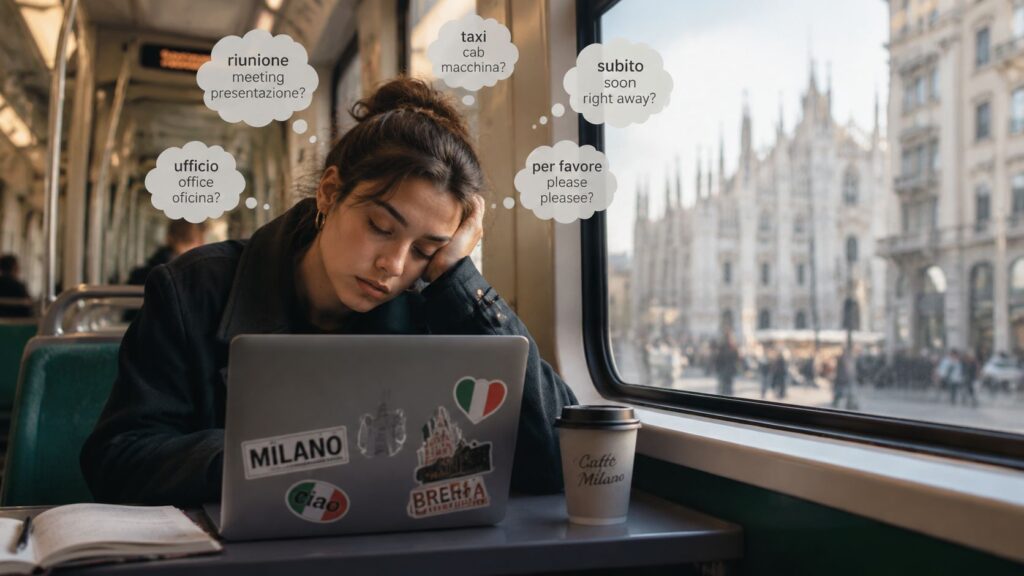
You're getting things done. You answer messages quickly, remember deadlines, keep the household or job moving, and from the outside your life in Italy may even look enviable. But inside, your mind rarely lands. You replay conversations in two languages, overprepare for simple tasks, feel guilty when you rest, and end the day exhausted in a way that sleep doesn't fully fix.
High functioning anxiety in women often looks exactly like this. It isn't a formal diagnosis. It's a clinically recognised pattern in which anxiety hides behind competence, reliability, perfectionism, and constant motion. Many women dismiss it because they're still functioning. They're working, studying, parenting, partnering, and showing up. That can make the problem harder to name, and easier for other people to miss.
This pattern is especially important to recognise in women because anxiety symptoms are more common in women than men. In a large CDC/NCHS analysis, women were more likely than men to experience any anxiety symptoms, 21.4% vs. 14.8% (CDC/NCHS analysis). That doesn't mean every high-achieving woman has anxiety. It does mean the polished exterior should never be used as proof that someone is coping well.
If your anxiety tends to hide inside productivity, control, and high standards, it may also overlap with patterns discussed in perfectionism in psychotherapy. The common thread is not ambition itself. It's the fear, tension, and self-pressure driving it.
The Hidden Struggle Behind a Perfect Facade
High-functioning anxiety often gets mistaken for a personality style. People may describe you as organised, proactive, thoughtful, dependable, or “just someone who likes to stay on top of things.” Those traits can be real strengths. But in clinical work, I pay close attention to what fuels them.
When the engine is anxiety, competence stops feeling satisfying. It starts feeling compulsory.
A useful definition: High-functioning anxiety is a pattern where a person maintains outward performance while carrying significant internal worry, tension, self-monitoring, and difficulty relaxing.
For many women, especially expat women in Italy, this creates a painful split. One part of life looks beautiful or successful. Another part feels like a constant inner sprint. You may be living in Milan, Rome, Florence, or a smaller town people dream of visiting, yet your nervous system still acts as if something is about to go wrong.
That doesn't mean you're ungrateful. It means your body and mind are stuck in overdrive.
Stress is not the same as high-functioning anxiety
Ordinary stress usually rises around a clear demand and settles when that demand passes. High-functioning anxiety tends to linger. It attaches itself to everyday life.
It can sound like:
- Before work: “I need to be completely prepared.”
- After work: “I should have done more.”
- At rest: “Why can't I switch off?”
- In relationships: “Did I say the wrong thing?”
The pattern isn't just pressure. It's pressure plus vigilance, plus self-judgement, plus difficulty feeling safe when nothing is wrong.
What High-Functioning Anxiety Looks Like in Women
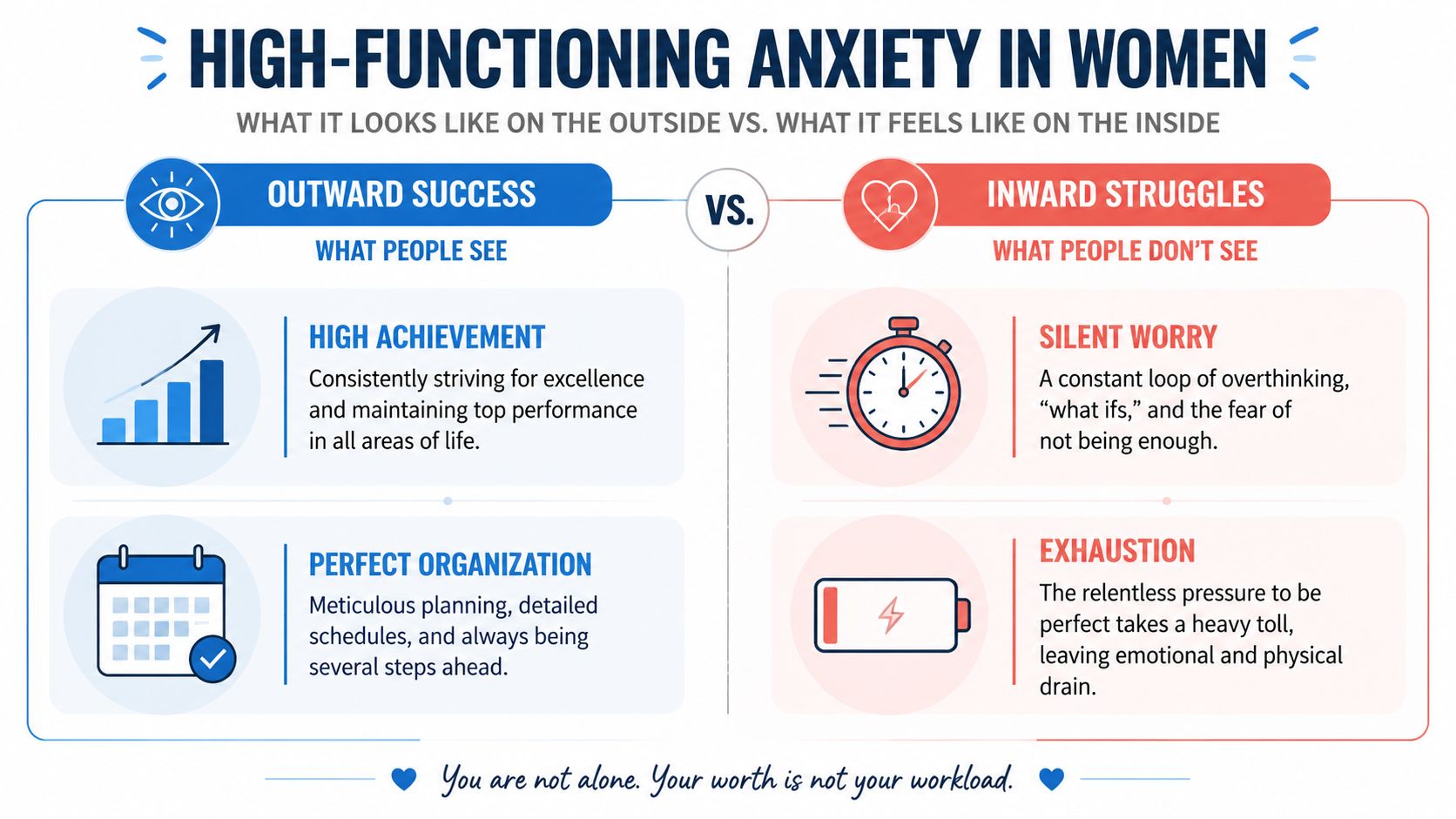
A woman with high-functioning anxiety may not look overwhelmed at all. She may look unusually capable. She remembers the details, anticipates problems early, replies promptly, keeps standards high, and often becomes the person others rely on.
That's why this pattern can be socially rewarded long before it is recognised as emotionally costly.
What people often see
Outwardly, many women with this pattern appear:
- Highly organised. Lists, calendars, backup plans, reminders.
- Reliable under pressure. They perform well even when tired.
- Detail-oriented. Small errors feel unacceptable, so little gets missed.
- Caring and responsive. They anticipate other people's needs quickly.
- Driven and ambitious. They don't wait to be chased.
None of these qualities are problems on their own. The clinical question is whether they come with inner freedom or inner fear.
What it often feels like inside
Internally, the experience is very different:
- Racing thoughts that don't quiet down at night
- Rumination after meetings, texts, dinners, or social events
- Catastrophic thinking about mistakes, rejection, or disappointing others
- Compulsive over-preparation because “good enough” never feels safe
- Guilt during rest because stopping feels irresponsible
- A harsh inner critic that keeps moving the standard
Many women say some version of the same thing: “I'm coping, but it feels like coping is taking everything.”
For a fuller description of overlapping signs, anxiety symptoms in adults can help you distinguish ordinary stress from a broader anxiety pattern.
High-functioning anxiety versus healthy ambition
Confusion often arises here. Healthy ambition is energising, flexible, and values-based. Anxiety-driven striving is rigid, fear-based, and never quite lets you exhale.
| High-Functioning Anxiety: The Outward Appearance vs. The Internal Reality |
|---|
| Outward Trait (What Others See) | Internal Driver (What You Feel) |
|---|---|
| Prepared and efficient | “If I'm not fully ready, something bad will happen.” |
| Successful and productive | “I can't relax until everything is done.” |
| Helpful and considerate | “If I disappoint someone, I'll feel unbearable guilt.” |
| Calm and composed | “I'm monitoring everything so I don't fall apart.” |
| High standards | “Mistakes feel dangerous, not just disappointing.” |
What matters clinically is not how polished the behaviour looks. It's whether the behaviour brings relief, or whether it briefly reduces anxiety and then starts the cycle again.
When it crosses into impairment
The line isn't “you function” versus “you don't function.” The line is whether the pattern is costing you sleep, peace, health, relationships, or freedom.
Clinicians flag several signs that ambition may have crossed into clinically significant impairment, including persistent sleep disruption, chronic muscle tension, compulsive over-preparation that brings no real relief, and increasing social or professional avoidance (Mayo Clinic Health System on managing high-functioning anxiety).
Some women avoid obvious avoidance. They still go to the event, take the meeting, host the dinner, submit the work. But internally they rely on overcontrol to get through it. That still counts as a cost.
The Gender-Specific Drivers of Anxiety

Women are not merely “more emotional” or “worse at coping.” That explanation is shallow and clinically unhelpful. High functioning anxiety in women makes more sense when you look at the interaction between biology, psychology, and social pressure.
Large epidemiological research has repeatedly found a substantial gender gap in anxiety disorders. A peer-reviewed review reported male:female prevalence ratios for any anxiety disorder of 1:1.7 over the lifetime and 1:1.79 over 12 months (Gender Differences in Anxiety Disorders). That doesn't tell us why any one woman is struggling. It does tell us that this is a patterned reality, not a personal failure.
Why the presentation is often missed
In clinical settings, women's anxiety is often easier to notice when it is visible as panic, crying, or clear withdrawal. It is easier to miss when it looks like control, effort, politeness, and competence.
In the Italian context, health-system guidance notes that women often carry multiple roles, and high-functioning anxiety may be missed because symptoms can present as overcontrol and compensatory overachievement rather than obvious panic, within a broader gender gap in anxiety diagnoses across Europe (Italian context and gender gap guidance).
That matters because many women don't seek help until the cost becomes severe. By then, they may be describing burnout, relationship strain, insomnia, or exhaustion rather than recognising anxiety itself.
If this resonates with the pressures of your thirties, especially around work, fertility decisions, identity, and caregiving, therapy for women in their 30s speaks directly to that life stage.
The social rules many women internalise
Many women grow up absorbing unspoken messages such as:
- Be competent, but not difficult
- Be caring, but don't need too much
- Be accomplished, but stay agreeable
- Hold everything together
- Don't make other people uncomfortable with your distress
These rules can become schemas. In Schema Therapy, a schema is a deep pattern of belief about yourself, other people, and what you must do to stay safe, loved, or acceptable. Common examples include:
- Unrelenting standards. “I must do more, better, faster.”
- Self-sacrifice. “Other people's needs come first.”
- Approval-seeking. “I need reassurance that I'm doing this right.”
- Defectiveness or shame. “If people really see my struggle, they'll think less of me.”
These patterns can coexist with success for years. In fact, success can help hide them.
Clinical insight: Many women don't need help becoming less capable. They need help separating self-worth from performance and safety from overcontrol.
The people-pleasing trap
People-pleasing is often misunderstood as kindness. Sometimes it is kindness. Sometimes it is anxiety management.
If saying no triggers fear, guilt, or the sense that you're failing someone, your nervous system may treat boundaries as a threat. Then overfunctioning becomes a way to prevent conflict, disapproval, or shame.
That is one reason high-functioning anxiety can look so “good” from the outside while feeling so costly from the inside.
The Expat Magnifier How Moving to Italy Intensifies Anxiety
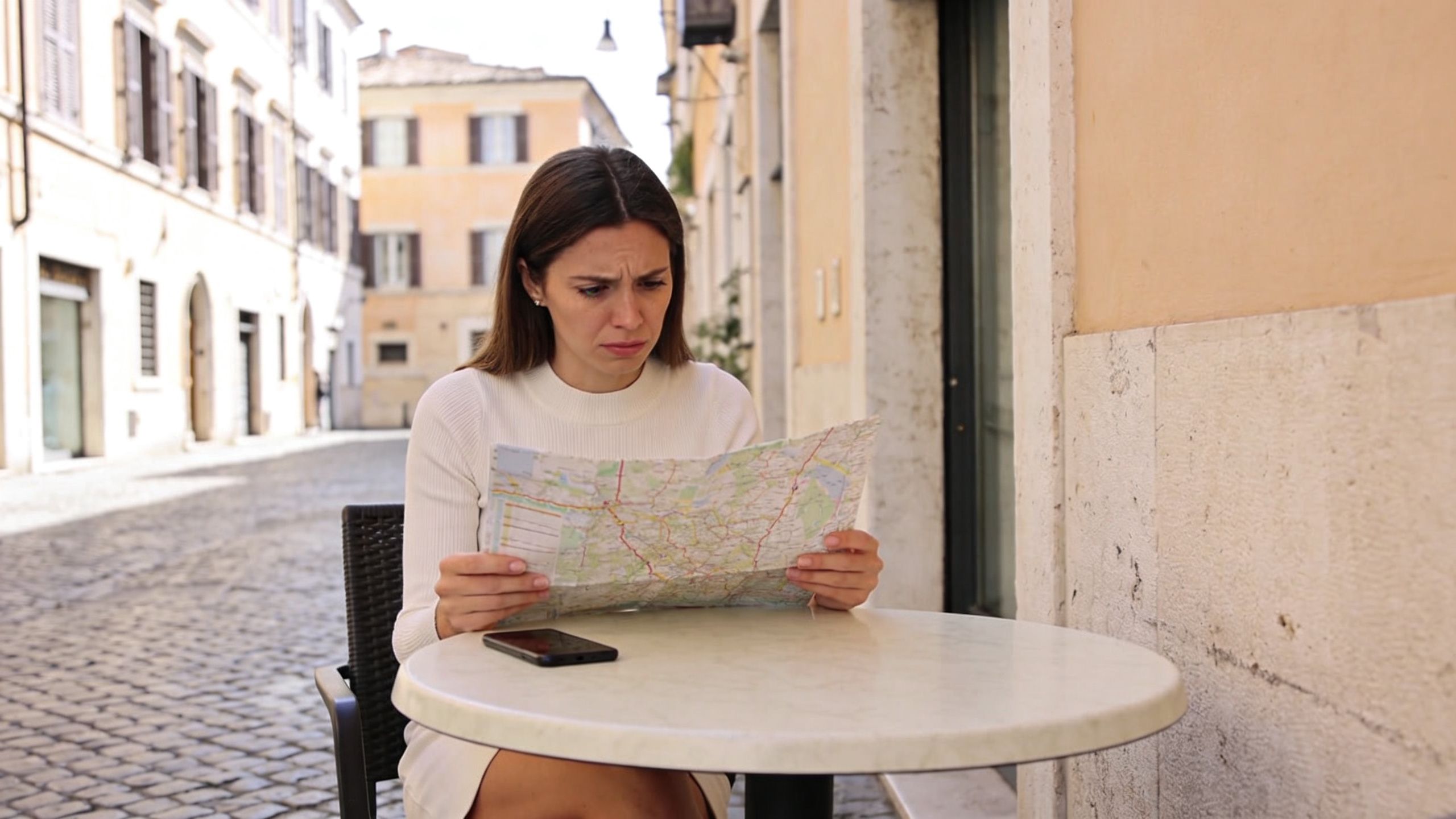
Moving to Italy doesn't create high-functioning anxiety from nothing. But it can magnify every part of it. A nervous system already shaped by pressure and vigilance now has to manage uncertainty, language shifts, cultural difference, and the loss of familiar routines.
For expat women, this is often where the pattern sharpens. You may be functioning beautifully on paper while your internal workload doubles.
The practical realities matter. There's bureaucracy. There's housing stress. There's the effort of speaking Italian when tired. There's building a social network from scratch. There's missing the version of yourself who felt more fluent, more spontaneous, more established.
For some women, the stress also includes major financial and logistical decisions linked to relocation, family planning, or settling long term. If housing and financing questions are part of that picture, a specialised guide to prêt immobilier expatrié can at least reduce uncertainty in one practical area.
The hidden strain of migration stress
Migration stress is not only about dramatic culture shock. It often shows up as low-level, repeated friction:
- Language switching that makes ordinary tasks more effortful
- Invisible labour such as researching documents, schools, doctors, or permits
- Social isolation even when daily life looks busy
- Identity strain when your professional or personal confidence changes in a new context
- Pressure to perform so you don't seem weak, foreign, or unprepared
A UCLA Health overview highlights that for expat women in Italy, high-functioning anxiety can intersect with invisible labor, social isolation, and pressure to perform in a new culture, while unmet need for mental health support remains significant, especially for non-native speakers (UCLA Health on what high-functioning anxiety can look like).
That combination matters. It means your anxiety may worsen not because you're doing something wrong, but because your environment is asking more of your coping system every day.
Why Italy can feel particularly complex
Italy is full of beauty and friction at the same time. That duality can be disorienting.
You might love the slower meals, the walkable streets, the sense of place. You might also feel drained by systems that seem less predictable than what you were used to. If you already lean toward overpreparing, the uncertainty of expat life can become fuel for compulsive planning.
A woman may start to think:
- “If I stay ahead of everything, I'll be fine.”
- “If I miss something, it will all unravel.”
- “I shouldn't complain. I chose this life.”
- “Other people seem to manage better than I do.”
That inner dialogue is common. It is also lonely.
If you're early in the move or still adjusting, a moving to Italy mental health checklist can help you normalise the strain and spot warning signs before anxiety hardens into burnout.
The expat version of high-functioning anxiety often sounds like this: “I'm handling it, but everything takes more out of me than it should.”
The Psychological and Physical Toll of Constant Overdrive
High-functioning anxiety is not harmless because you're still productive. The body keeps score even when the calendar stays full.
A key clinical feature is chronic activation of the threat-response system.
That matters because women often come to therapy saying, “I'm tired all the time,” without realising the tiredness is not only about workload. It is also about nervous system load.
What the body often signals first
The body often notices before the mind fully admits what's happening.
Common signs include:
- Jaw, neck, and shoulder tension
- Restless or broken sleep
- Difficulty settling in the evening
- Fatigue after ordinary tasks
- Digestive discomfort
- A sense of always being “on”
These symptoms can become normalised. Many women assume this is adulthood, parenting, leadership, or expat life. It isn't something you should ignore just because you can still push through it.
The relational cost
High-functioning anxiety also affects relationships. Not always dramatically. Often subtly.
It can lead to:
- Control-seeking when uncertainty feels unbearable
- Reassurance-seeking that briefly calms fear but keeps dependence alive
- Irritability because your system is overloaded
- Emotional unavailability because all energy is going into functioning
- Difficulty receiving support because being the competent one feels safer
At work, this may show up as overresponsibility and weak boundaries. At home, it can look like doing too much, resenting it, then feeling guilty for resenting it. If work stress is a major driver, practical strategies for work boundaries can be a helpful complement to therapy, especially when anxiety turns every request into an emergency.
Anxiety that hides inside productivity is still anxiety. Your body does not care whether the overdrive looks impressive from the outside.
Why waiting can backfire
Many women delay support because they think help is only warranted if they stop functioning. In practice, earlier support is often more effective because the pattern is easier to loosen before it hardens into burnout, depression, or a more entrenched anxiety disorder.
You do not need a collapse to justify care.
Pathways to Balance Evidence-Based Therapy and Coping
Relief usually does not come from trying harder. It comes from changing the mechanisms that keep the cycle going. For high functioning anxiety in women, that means working with both the mind and the nervous system.
Insight helps, but insight alone is rarely enough. Most women already understand, intellectually, that they are too hard on themselves. The deeper task is learning how to respond differently when anxiety starts making the rules.
What tends to work better than generic self-help
Helpful strategies are usually simple, but they need to be specific and repeatable.
A useful starting set includes:
Scheduled decompression
Put recovery into the calendar before the week fills up. If rest is only allowed after everything is done, rest never arrives.
Worry containment
Give anxious thinking a defined place. Some women do better when they write concerns down and return to them at a set time, rather than negotiating with every thought all day.
Body-based downshifting
Stretching, walking, slower breathing, regular meals, and sleep routines matter because high-functioning anxiety is not only cognitive. It is physiological.
Boundary rehearsal
Practice saying, “Let me get back to you,” instead of answering immediately from guilt or fear.
Reduce reassurance loops
If you repeatedly check, ask, or reread to feel safe, notice whether relief lasts. Usually it doesn't.
What usually doesn't work well
These responses often keep the pattern alive:
- Using productivity as your only coping tool
- Waiting until you're already depleted to rest
- Treating every anxious thought as a problem to solve
- Calling perfectionism “just how I am”
- Relying on wellness routines without addressing the underlying beliefs
That's where therapy becomes more precise.
Evidence-based approaches that help
For many women, the most effective treatment combines practical tools with deeper pattern work.
CBT, or Cognitive Behavioural Therapy, helps identify the thought patterns and behaviours that maintain anxiety. That includes catastrophising, black-and-white thinking, overestimation of threat, and safety behaviours such as compulsive over-preparation. If you'd like a clearer sense of how that works, cognitive behavioral therapy for anxiety offers a good overview.
Schema Therapy goes deeper into longstanding patterns such as unrelenting standards, self-sacrifice, approval-seeking, and defectiveness. This is often especially helpful for women who say, “I know where this comes from, but I still react the same way.”
EMDR, which stands for Eye Movement Desensitisation and Reprocessing, can be useful when anxiety is tied to earlier stressful experiences, chronic invalidation, or relational wounds that still keep the nervous system on alert.
What good therapy should feel like
Good therapy for high-functioning anxiety should not shame you for being capable. It should help you understand why capability became fused with safety.
It should also help you build:
- More flexible standards
- A stronger capacity to rest without guilt
- Clearer emotional boundaries
- Better recognition of body cues
- A less punishing relationship with yourself
Healing does not require giving up ambition. It requires building a life where achievement is not the only place you feel secure.
FAQ
Is high-functioning anxiety a real diagnosis
No. High-functioning anxiety is not a formal diagnosis, but it is a real and clinically recognised pattern of anxiety-related functioning. The phrase is useful because it captures something many women experience: they keep performing well while living with constant worry, tension, and overcontrol. In therapy, clinicians usually assess for recognised conditions such as generalized anxiety, OCD traits, trauma-related symptoms, or burnout rather than treating “high-functioning anxiety” as a diagnosis on its own.
How do I know if it is anxiety and not just stress or perfectionism
A good rule is this. If your drive is fuelled by fear, and it's costing you sleep, peace, health, or relationships, it may be anxiety rather than ordinary stress or healthy ambition. Stress usually rises around a demand and settles. High-functioning anxiety tends to linger, follow you into downtime, and push behaviours like rumination, compulsive preparation, reassurance-seeking, or guilt when resting.
Why does high-functioning anxiety seem so common in women
It appears common in women for both epidemiological and social reasons. Women consistently show a higher anxiety burden, and many women are also socialised into patterns of overresponsibility, people-pleasing, and self-monitoring that can hide anxiety behind competence. In practice, many women learn early that being organised, helpful, and high-achieving keeps life smoother, so anxiety can become wrapped around identity rather than standing out as a problem.
Can moving to Italy make my anxiety worse even if I wanted this move
Yes. A wanted move can still strain your nervous system. Expat life adds language effort, bureaucracy, identity shifts, social isolation, and pressure to adapt quickly, all of which can intensify existing anxiety patterns. You can be grateful for your life in Italy and still be struggling psychologically at the same time.
Why do I feel more anxious in one language than another
This is common. Different languages can activate different levels of confidence, nuance, control, and emotional access. In a second language, you may feel less precise, slower, or more exposed, which can heighten self-monitoring and social anxiety. In your native language, emotions may also feel more immediate, which can make some conversations feel more intense.
What are the main red flags that I should seek professional support
The clearest red flags are persistent ones. If you're dealing with ongoing sleep disruption, chronic muscle tension, compulsive over-preparation that never really calms you, avoidance, or growing burnout, it's a good time to seek support. You do not need to wait until you stop functioning. Early support often helps you change the pattern before it becomes more entrenched.
What kind of therapy helps with high-functioning anxiety in women
Several approaches can help. CBT is often effective for anxious thought patterns and safety behaviours, Schema Therapy helps with deeper lifelong patterns, and EMDR can support women whose anxiety is linked to unresolved stress or earlier experiences. The best therapy is usually practical, validating, and adapted to the specific mechanisms driving your anxiety rather than offering only generic stress-management advice.
I'm high-achieving and people rely on me. Will therapy make me lose my edge
No. Effective therapy does not remove your strengths. It helps you stop paying for those strengths with constant inner strain. The goal is not to make you less motivated or less competent. The goal is to help you stay capable without needing fear, overcontrol, and exhaustion to keep everything going.
If you recognised yourself in this article, support is available in a way that feels human, practical, and culturally aware. Book your first free assessment call with THERAPSY, no commitment, just a conversation with our Clinical Director who will listen carefully and match you with the right therapist for you. Written by Dr. Francesca Adriana Boccalari, Clinical Director at Therapsy.