You moved to Italy for love, work, study, adventure, or some combination of all four. On paper, it may look like the life you wanted. In reality, you may be functioning in a language that isn't fully yours, missing the people who knew you before this version of your life began, and carrying questions that have become louder in your 30s.
Therapy for women in their 30s is not only for crisis. It is a structured, confidential space to understand stress, identity shifts, burnout, relationship strain, loneliness, and the pressure to make the “right” decisions about career, partnership, family, and home. For an American woman living in Italy, those pressures often become more layered because everyday life itself asks more of you.
Many women arrive in therapy saying some version of the same thing: “Nothing is exactly wrong, but I don't feel like myself.” That sentence matters. It often points to overload, emotional isolation, or a life transition that your nervous system hasn't had time to process.
Seeking support in this decade is also increasingly common. The CDC reported that among women in the United States aged 18 to 44, the share who had received any mental health treatment rose from 23.8% to 28.6% from 2019 to 2021, which means that by 2021, nearly 3 in 10 women in this broad life stage had accessed care (CDC data brief).
If you're trying to understand whether what you're feeling is “serious enough,” start here: distress doesn't need to become a collapse before it deserves care. A well-matched therapist can help you make sense of what is happening now, not only after things become unmanageable. If you want to understand how support is structured locally, the Therapsy therapy centre in Italy offers a clear overview of online and in-person care pathways for international clients.
An Introduction to Therapy for Women in Their 30s in Italy
Your 30s often bring a different kind of psychological pressure than your 20s. The questions are less abstract. Work becomes more consequential. Relationships feel less experimental. Decisions about children, fertility, commitment, and home start to carry a different emotional weight.
Living in Italy can make this decade feel both beautiful and disorienting. You may love parts of your life here and still feel unsettled. Those two realities can exist together.
Why this decade feels so charged
In clinical practice, this life stage often includes several overlapping tasks:
- Career consolidation: You may be trying to grow professionally while adjusting to a new work culture.
- Relationship clarity: Dating, partnership, marriage, separation, or intercultural conflict can all come into sharper focus.
- Family questions: Even if you don't want children, the topic can still bring pressure, grief, relief, confusion, or conflict.
- Identity revision: The person you were at 25 may no longer fit the life you're living now.
Therapy in your 30s is often less about “fixing” a problem and more about building a life that feels psychologically sustainable.
Why Italy changes the picture
An American woman in Italy rarely deals with one challenge at a time. She may be coping with homesickness, administrative stress, language fatigue, a change in social role, and the private grief of feeling less fluent, less spontaneous, or less recognised than she once was.
That's why therapy for women in their 30s in Italy works best when it is both developmentally informed and culturally attuned. It should make room for anxiety, but also for identity, migration, and mourning.
The Universal Crossroads of a Decade
Many women in their 30s feel confused by one central fact: they are functioning, but exhausted. They are meeting deadlines, answering messages, showing up for people, and managing logistics. Yet underneath that competence, they often feel chronically stretched.
That experience is not random. This decade tends to compress multiple adult roles into the same period of life.
The pressure points that often converge
A woman in her 30s may be dealing with several of these at once:
- Work intensity: Promotion pressure, unstable contracts, a demanding manager, or the sense that this is the moment to “prove” yourself.
- Relationship strain: Dating fatigue, ambivalence about commitment, intercultural misunderstandings, or the emotional residue of past relationships.
- Caregiving roles: Looking after a partner, children, or ageing parents while still trying to protect your own functioning.
- Body and fertility concerns: Questions about timing, desire, medical uncertainty, or the emotional charge of other people's expectations.
- Friendship changes: Peer groups can become less available just when you most need emotional reciprocity.
Some women experience one dominant stressor. More often, it is the pile-up that hurts.
The emotional labour no one sees
One of the most useful frameworks for understanding this stage is invisible emotional labor.
This matters clinically because chronic emotional labor does not always look dramatic. It often looks like:
- Irritability that seems out of character
- Decision fatigue
- Resentment followed by guilt
- Difficulty resting without feeling lazy
- A constant feeling of being “behind”
- The belief that everyone else needs something from you
When exhaustion comes from invisible emotional labor, generic advice to “reduce stress” usually doesn't work. You need boundaries, clearer roles, and a more honest map of where your energy is going.
What tends not to work
Some coping strategies bring short-term relief but keep the cycle going:
- Over-functioning harder: becoming even more organised, helpful, available, and self-sacrificing
- Waiting for a perfect break: assuming you'll rest once the next work deadline, trip, visa issue, or family decision passes
- Calling it normal: minimising distress because “everyone is busy”
- Treating burnout like poor time management: when the deeper issue is role overload, grief, perfectionism, or relational imbalance
For women navigating pregnancy decisions, postpartum strain, or reproductive uncertainty, broader care can also matter. If that part of your life feels relevant, perinatal support services from Venus Health Co. can be a useful adjunct resource alongside psychotherapy.
What does help
Therapy becomes useful when it names the underlying problem. Not just anxiety. Not just stress. Often the core issue is that your inner life has been crowded out by responsibility.
In that setting, effective work usually includes:
- identifying the roles you are unconsciously carrying
- noticing the beliefs that keep you over-responsible
- learning to tolerate other people's disappointment without collapsing into guilt
- rebuilding time, rest, and privacy as legitimate psychological needs
How Living in Italy Amplifies These Challenges
The same pressures that make your 30s demanding can become sharper after relocation. Italy may offer beauty, pleasure, culture, and a slower public rhythm, but expat life often contains a private intensity that outsiders don't see.

The hidden cost of starting over
Moving countries can disrupt the ordinary structures that usually protect mental health. In the U.S., you may have known how to make appointments, read social cues, build friendships, advocate for yourself at work, or explain your feelings quickly. In Italy, even competent adults can feel suddenly less competent.
That loss often touches several domains at once:
- Professional identity: You may feel less articulate, less influential, or less recognised than you were before.
- Social ease: Casual friendship can take longer to build, especially if your language skills fluctuate with fatigue or stress.
- Daily autonomy: Bureaucracy, healthcare systems, and practical administration can create ongoing background strain.
- Emotional regulation: Small tasks can require more effort, which leaves less capacity for larger life questions.
For many American women, the hardest part is not one dramatic problem. It is the accumulation of minor frictions that never fully stop.
Multilingual identity fragmentation is real
A particularly important concept for expat women is multilingual identity fragmentation. As described in this discussion of therapy for emerging adults and identity transitions, the need is often not only anxiety management. It is identity reconstruction.
You may notice that:
- you sound less funny in Italian than in English
- you become more cautious in professional settings
- your confidence changes depending on the language being used
- your relationships feel different across cultures
- you miss the version of yourself who felt fast, fluent, and fully known
This is not superficial. Language carries memory, humour, attachment, authority, and spontaneity. When your primary environment no longer reflects your first-language self, grief can appear even when the move was chosen freely.
Some expat women say, “I feel split.” That often reflects a real psychological burden, not oversensitivity.
Why standard advice often misses the point
Generic mental health advice for women in their 30s tends to assume one stable cultural setting. It may focus on confidence, boundaries, or time management without accounting for migration stress, bicultural relationships, or the exhaustion of constant translation.
That is why therapy for expats needs more than symptom management. It needs room for:
- cultural mourning
- identity revision
- ambivalence about belonging
- anger at the fantasy of the move
- shame about struggling in a place you chose
If you're looking for care that explicitly addresses relocation stress, mental health support for expats in Italy can help clarify what culturally informed therapy should include.
Relationships can carry extra strain abroad
Partners do not always understand the internal load of adaptation. If your partner is Italian, they may underestimate how much effort ordinary tasks require for you. If your partner is also foreign, both of you may be depleted. If you are single, dating may involve cultural codes that leave you uncertain, self-conscious, or misread.
In all of these situations, the core issue is similar. You are not only building a life. You are building it without your original map.
Evidence-Based Therapy Approaches That Truly Help
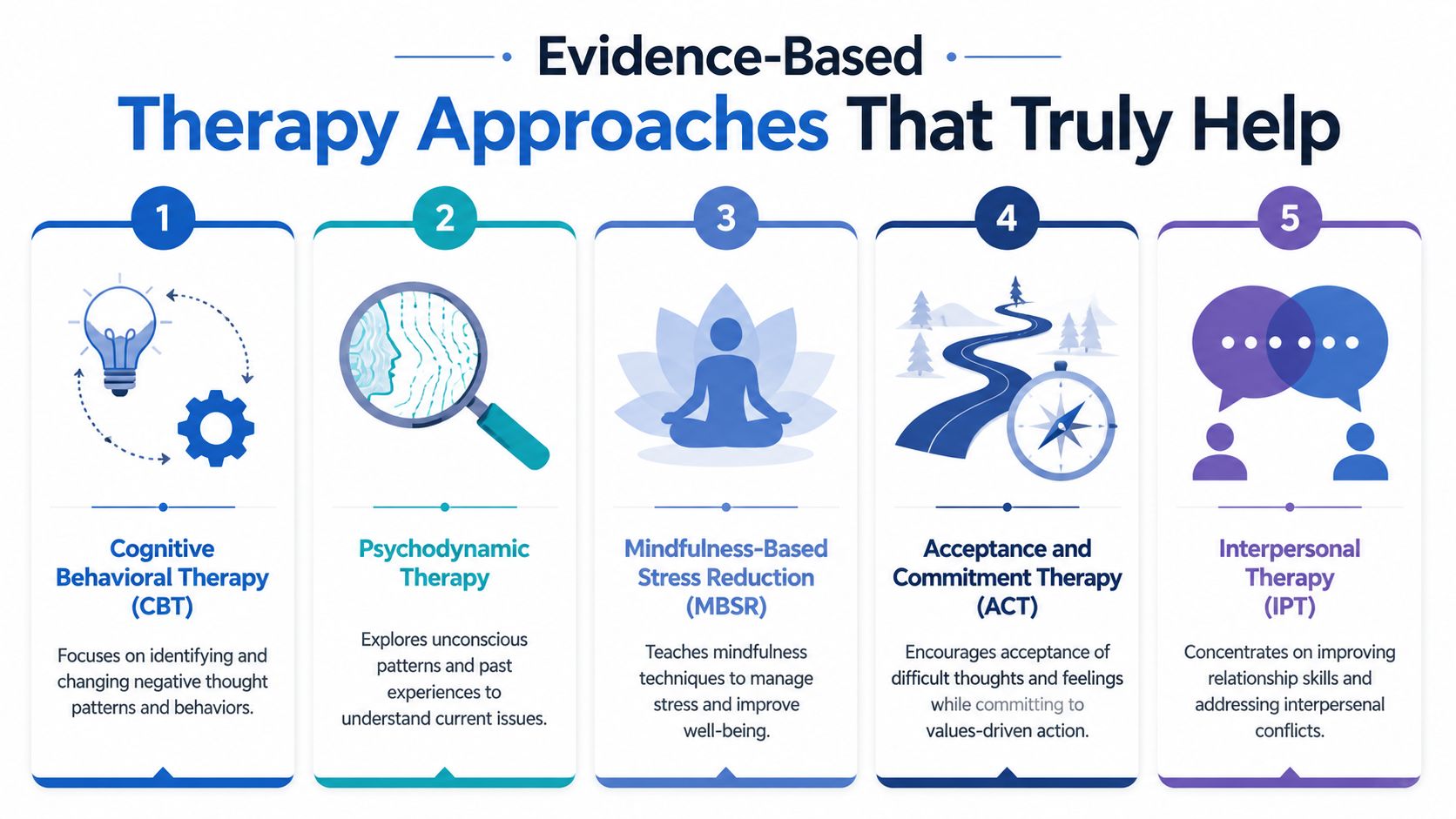
Good therapy is not a generic conversation. It works best when the method fits the mechanism of distress. In Italy, where high-performance work cultures can shape life in cities such as Milan and Rome, early therapy can work as a form of secondary prevention, and the most effective psychotherapy tends to target the maintaining patterns beneath symptoms, such as avoidance or perfectionism. One practical clinical formulation is this: CBT for anxiety and perfectionism, EMDR for trauma-related symptoms, and schema-focused work for long-standing relational patterns (clinical overview).
A practical comparison
| Approach | Often helps with | What it focuses on | What sessions often feel like |
|---|---|---|---|
| CBT | anxiety, perfectionism, burnout patterns | links between thoughts, feelings, behaviour | structured, practical, skill-based |
| ACT | overwhelm, avoidance, harsh self-judgment | making space for emotion while acting on values | reflective, behavioural, grounding |
| Psychodynamic therapy | recurring relationship patterns, identity confusion | how past experience shapes present reactions | exploratory, insight-oriented |
| EMDR | trauma, distressing memories, persistent emotional activation | reprocessing experiences that remain “stuck” | focused, paced, trauma-informed |
| Interpersonal therapy | conflict, grief, role transitions, loneliness | communication patterns and relational stress | collaborative and relational |
CBT when your mind is always “on”
Cognitive Behavioural Therapy is often useful for women who look capable from the outside but feel trapped in loops of worry, self-pressure, and mental overdrive. It helps identify the thought patterns that keep anxiety active.
Examples include:
- “If I slow down, everything will fall apart.”
- “If I ask for help, I'm failing.”
- “If I say no, people will think I'm selfish.”
CBT is effective when the problem is maintained by habits of thinking and behaviour. That often includes perfectionism, over-planning, over-accommodation, and avoidance. If you want a more detailed overview, this guide to cognitive behavioural therapy in Italy explains how the approach is used in practice.
ACT when control has become exhausting
Acceptance and Commitment Therapy can be especially helpful if your main struggle is not a single fear, but the exhausting effort to control every internal state. ACT teaches a different stance. The goal is not to eliminate discomfort. The goal is to stop organising your life around escaping it.
This approach often fits women who say:
- “I analyse everything.”
- “I know what matters to me, but I'm frozen.”
- “I keep waiting to feel certain before I act.”
Psychodynamic work when the same pattern keeps returning
If you repeatedly find yourself in familiar emotional positions, over-giving, fearing abandonment, choosing unavailable partners, doubting your needs, then insight-oriented therapy may be more useful than symptom-only work.
Psychodynamic and schema-informed therapy help answer questions such as:
- Why do I feel guilty when I protect my time?
- Why do I become the “responsible one” in every relationship?
- Why does success make me more anxious, not less?
EMDR when distress has a deeper root
Some women in their 30s are not only stressed. They are carrying unresolved experiences that still organise their nervous system. That might include a traumatic breakup, medical events, family instability, coercive relationships, grief, or migration-related shock.
EMDR can be especially relevant when you understand your pattern intellectually but your body still reacts as if the threat is current.
What works is fit. The right therapy is the one that matches the pattern keeping your distress alive.
How to Choose the Right Therapist For You in Italy
Finding a therapist in your home country can feel vulnerable. Finding one abroad can feel overwhelming. The challenge is not only credentials. It is fit.
Start with the real issue, not the label
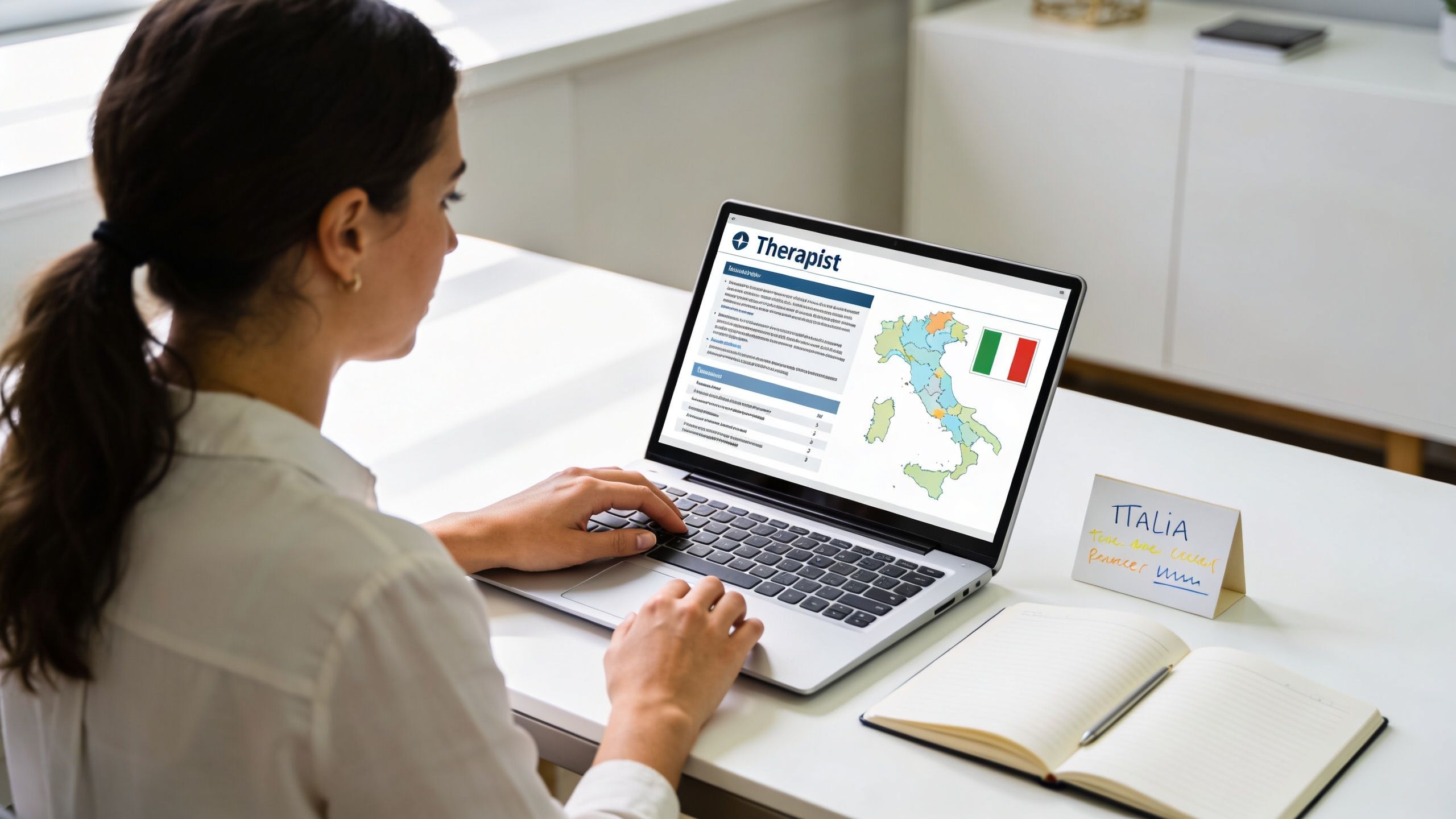
Many women search for a therapist using broad terms such as anxiety, stress, or burnout. Those can be useful starting points, but they are often incomplete. In your 30s, symptoms should also be understood in relation to hormonal shifts, fertility pressure, perinatal history, sleep, trauma, and identity strain connected to motherhood decisions. Cedars-Sinai also notes that access in a second language can be a significant barrier for discussing these topics well, and that an English-speaking or multilingual service can reduce delays to treatment by improving symptom disclosure and adherence to the therapeutic plan (Cedars-Sinai overview).
That means the “right” therapist is not just someone available. It is someone who can hear the full picture.
A useful decision checklist
When choosing a therapist in Italy, look for these factors:
Language fit
If your emotional life is most nuanced in English, don't minimise that. Discussing grief, sexuality, ambivalence, fertility, resentment, or trauma in a second language can flatten important details.Cultural literacy
A therapist does not need to be American to help an American client. But she should understand migration stress, intercultural relationships, and the psychological cost of navigating systems that don't feel intuitive.Clinical method
If you want practical tools, a CBT-oriented clinician may fit better. If you keep repeating relational patterns, schema or psychodynamic work may be more appropriate. If trauma remains active, EMDR training matters.Format and consistency
Online therapy is often the most realistic way to maintain continuity, especially if you travel, relocate within Italy, or split time between countries.
Questions worth asking before you begin
You do not need to interview a therapist aggressively, but a few direct questions can save time:
- Have you worked with expat or intercultural clients?
- Do you offer therapy in English?
- What is your main approach for anxiety, burnout, or relationship patterns?
- How do you structure the first sessions?
- What happens if it doesn't feel like a good fit?
A good therapist should be able to answer clearly, without jargon or defensiveness.
One model that reduces the guesswork
For expats, matching matters. A multilingual service such as Therapsy's guide to finding the right therapist for expats in Italy can be helpful because it explains how language, modality, and cultural fit shape the outcome of therapy. Therapsy works with licensed professionals across multiple languages and uses a human matching process led by Dr. Francesca Adriana Boccalari rather than automated questionnaires, which can be especially useful when your needs don't fit a simple category.
What usually matters most
Credentials matter. Approach matters. But in practice, many women stay in therapy when they feel three things:
- understood without needing to over-explain
- challenged without being pushed too fast
- emotionally safe without feeling passive
If those are present, therapy can become a place where your life starts to feel more coherent again.
What to Expect From Your First Therapy Sessions
Starting therapy often feels bigger before the first appointment than after it. Many women worry they won't know what to say, that they'll cry too much, or that they need a perfectly organised explanation of their life before they begin.

In reality, the first sessions are usually simpler and more collaborative than people expect.
The first contact
The beginning often includes a consultation or assessment conversation. This is not an exam. It is a way to understand what is bringing you in, what kind of support you want, and whether the therapist seems clinically and personally suitable.
You might discuss:
- what feels hardest right now
- how long it has been going on
- major transitions, losses, or stressors
- your relationship history
- previous therapy experiences
- what you hope will feel different
The first one to three sessions
Early sessions often focus on three tasks.
First, understanding the map.
Your therapist listens for patterns, not only events. She may ask about work, family, migration, sleep, mood, health, relationships, and how you cope when distressed.
Second, building goals.
Good goals are specific enough to guide the work but flexible enough to evolve. “I want to feel less stuck” may turn into “I want to stop panicking before difficult conversations” or “I want to understand why I disappear inside relationships.”
Third, building trust.
Therapy works through technique, but also through relationship. You are learning whether this person feels thoughtful, grounded, and able to stay with difficult material.
The first sessions are not about proving that your pain is serious enough. They are about finding language for what has been hard to carry alone.
A note on normalisation
Many women still assume therapy is something other people do, or something they should only pursue once life becomes unmanageable. That assumption no longer reflects reality. According to the CDC's mental health treatment data brief, the share of U.S. women aged 18 to 44 receiving any mental health treatment rose from 23.8% to 28.6% between 2019 and 2021.
That matters because it places help-seeking in the mainstream of women's health, not at its margins.
If you are beginning therapy in Italy
Practical clarity helps. If you are unsure how the process usually works for international residents, this guide on how to start therapy in Italy can make the first step feel more concrete.
You do not need the perfect reason to begin. You need enough honesty to say that what you're carrying deserves attention.
Practical Coping Strategies You Can Start Using Today
Therapy is valuable, but you also need tools for the days in between. The most useful coping strategies are not dramatic. They are repeatable, specific, and realistic for a busy expat life.
Reduce overload at the point where it begins
Try these interventions where stress enters your day:
- Name one invisible job each evening: Write down one thing you managed that no one saw. This helps convert vague exhaustion into visible labour.
- Use a two-list boundary check: One list for tasks only you can do. One list for tasks you are doing by habit, guilt, or over-responsibility.
- Create one language refuge: Protect at least one regular space where you can think, speak, write, or rest in English without having to perform competence.
- Lower the bar for contact: Instead of waiting until you have energy for a long call home, send one honest voice note to someone who knows you well.
Use journalling for identity, not just venting
When expat women journal, they often record events. It can help more to track identity shifts.
Prompts that tend to be useful include:
- Where do I feel most like myself right now?
- In which situations do I become smaller, quieter, or more apologetic?
- What version of me am I grieving?
- What do I keep calling “stress” that is in truth sadness, anger, or loneliness?
If reflective writing helps you regulate anxiety, some people also find structured resources such as shadow work journaling prompts for anxiety useful as a complement to therapy.
Regulate your nervous system before solving the whole life problem
When you feel overwhelmed, resist the urge to analyse everything at once. Start smaller.
- Exhale longer than you inhale for a few rounds.
- Place both feet on the ground and name five things you can see.
- Delay major decisions when you are flooded, exhausted, or freshly triggered.
- Ask one clean question: “What hurts most today?” Not “What am I doing with my life?”
Rebuild support in a realistic way
Expat loneliness does not improve through self-criticism. It improves through repeated, tolerable contact.
You do not need an instant community. You need a few reliable points of connection. If work-life pressure is swallowing all your social and emotional space, practical planning around boundaries can help, and resources on how to balance work and personal life may offer useful ideas alongside clinical support.
Frequently Asked Questions
Is therapy for women in their 30s only for severe problems
No. Therapy is often most useful before distress becomes severe. Many women start because they feel stuck, overextended, disconnected from themselves, or caught in repeating patterns they want to understand.
How do I know if I need an English-speaking therapist in Italy
If your inner life is easier to express in English, that is reason enough. Language affects nuance, emotional precision, and the ability to speak freely about difficult topics such as grief, sex, resentment, trauma, motherhood, and identity.
Can therapy help if my main problem is loneliness after moving abroad
Yes. Loneliness is a legitimate clinical concern, especially when it interacts with culture shock, identity shifts, and the loss of familiar support. Therapy can help you process grief, understand your relational patterns abroad, and build a more stable sense of connection.
What if I'm not sure which therapy approach is right for me
You do not need to decide that alone. A well-trained clinician or intake professional can help match the method to the issue, whether that is anxiety, burnout, trauma, relationship conflict, or identity confusion.
How soon should therapy feel helpful
Some people feel relief quickly because they finally feel understood. Deeper change usually takes longer because therapy is not only about insight. It also involves new emotional experiences, different choices, and repetition over time.
Is online therapy a good option if I live in Italy
Yes. Online therapy can be an excellent option for expats because it supports continuity, privacy, and access to the right language and specialisation, even if you live outside a major city or travel often.
What if I start and the therapist doesn't feel right
That can happen, and it does not mean therapy is not for you. Fit matters, and changing therapist can be a healthy decision if the relationship, method, or communication style does not feel clinically helpful.
If you're an American woman in Italy and you're carrying more than you can comfortably hold on your own, support is available. Book your first free assessment call with THERAPSY, no commitment, just a conversation with our Clinical Director who will listen carefully and help match you with the right therapist for you.
Dr. Francesca Adriana Boccalari, Clinical Director at Therapsy