You're sitting at a family lunch that started late, will end even later, and somehow became a debate about where you should live, when you should have children, and why you still don't “relax” into Italian life. Your spouse seems perfectly at ease. You feel exposed, tired, and vaguely guilty for even struggling.
That gap is at the heart of many married to an Italian challenges. The issue usually isn't a lack of love. It's that marriage activates deeper layers of culture, attachment, loyalty, and identity than dating ever did. What looked charming at the beginning can feel suffocating under pressure. What felt warm and expressive can start to feel intrusive, indirect, or emotionally overwhelming.
As an intercultural psychologist, I see this often with cross-cultural couples in Italy. The foreign partner starts to wonder, “Is this normal, or is something wrong in our marriage?” The Italian partner often feels misunderstood, criticised, or pulled between spouse and family. Both people end up protecting themselves instead of understanding each other.
The hardest part of marrying across cultures is not difference itself. It is the meaning each person gives to that difference.
If you're living this now, your reaction makes sense. Intercultural marriages don't fail because one culture is better than the other. They struggle when unspoken expectations harden into resentment. If Italy feels more difficult than you imagined, that doesn't mean you made the wrong choice. It means you're meeting the psychological work of partnership, culture, and adaptation. That's also why many people find it helpful to understand culture shock in Italy and how to cope alongside the relationship itself.
Introduction From Italian Dream to Daily Reality
When romance meets the real system
Many people arrive in Italy with a powerful fantasy. The food will be meaningful. Family life will feel close. The relationship will be passionate and emotionally rich. Some of that is true. But marriage doesn't happen in a postcard. It happens inside routines, bureaucracy, family loyalties, gender scripts, and stress.
That's where the daily reality begins. Your partner may still be loving, generous, and committed. Yet the marriage may now include unannounced visits from relatives, intense expectations around holidays, conflict styles that feel dramatic, and practical dependence you never anticipated.
For some couples, this shift feels especially sharp because the surrounding culture still places strong weight on kinship and relational belonging. Research on Italian family structures notes that non-marital unions have expanded unevenly, mainly in Northern and Central urban areas, while cohabitation remains socially constrained by Catholic norms, economic pressure, and close kin ties, which can leave one partner expecting a nuclear-couple model while the other is shaped by dense family involvement and slower transitions to independent adulthood, as discussed in this study on Italian family structures.
Why this feels so personal
The conflict usually lands in very old emotional places.
A foreign spouse may feel:
- Excluded when decisions are made in rapid Italian or within family networks
- Controlled when family opinions carry too much weight
- Alone when their own support system is far away
- Invisible when practical struggles are minimised
The Italian spouse may feel:
- Torn between marital loyalty and family loyalty
- Ashamed that their culture is being criticised
- Misread as immature, dependent, or overly attached
- Defensive because what feels “normal” to them now feels like a problem
In Schema Therapy terms, marriage often activates old schemas such as abandonment, subjugation, mistrust, emotional deprivation, or unrelenting standards. Cultural dynamics don't create these wounds from nothing. They trigger them.
The Italian Family System and In-Law Dynamics
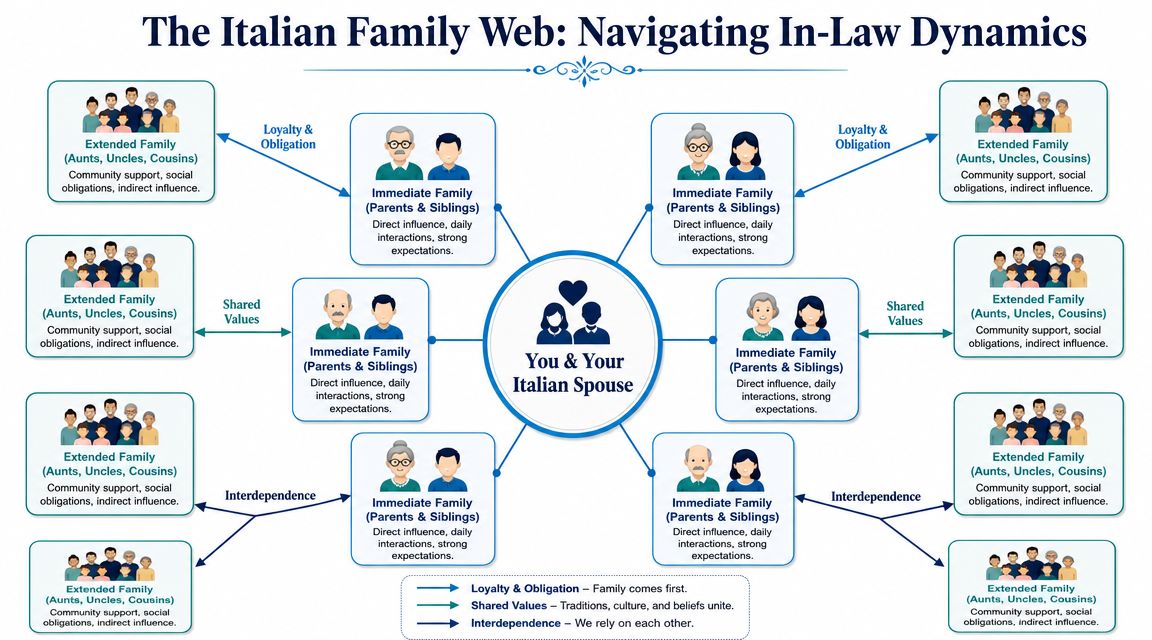
For many international spouses, the biggest shock isn't their partner. It's the web around their partner.
Why family involvement feels so intense
In many Italian contexts, family is not just background. It is the central emotional and social unit. Advice, practical support, emotional closeness, and frequent contact are often treated as expressions of care, not boundary violations. That's why your spouse may not understand why you're upset.
If you come from a more individualistic culture, adulthood may mean privacy, autonomy, and making decisions primarily as a couple. In a more interdependent family culture, adulthood can still include strong obligations upward and sideways. Parents remain influential. Siblings remain involved. Extended family remains part of the rhythm of life.
This doesn't mean all Italian families are intrusive. It means many couples underestimate how differently “healthy closeness” is defined.
The hidden loyalty bind
The most painful conflicts often involve a loyalty bind. Your spouse may hear a simple request for boundaries as a demand to reject their family. You may hear their reluctance to set limits as proof that you come second.
Neither interpretation is fully accurate, but both are emotionally real.
Common friction points include:
- Drop-in contact when relatives assume access to the home
- Holiday expectations that leave little room for your own rituals
- Decision commentary on money, housing, parenting, or work
- Language exclusion when family conversations move too fast for you to follow
- The mother-in-law dynamic when maternal authority carries emotional weight
Boundary conflict in intercultural marriage is rarely just about logistics. It is about belonging, guilt, and identity.
What works and what doesn't
What doesn't work:
- Criticising the family as a whole
- Forcing your spouse to choose “me or them”
- Raising boundary issues in the middle of family events
- Assuming your partner's calm means agreement
What works better:
Name one concrete behaviour
Say, “I need us to agree before inviting family over,” not “Your family is too much.”Link the boundary to the marriage
Try, “I want us to feel like a team first.”Ask your spouse what makes boundaries hard
You may hear guilt, fear of conflict, or fear of disappointing a parent.Create a joint script
For example, “We love seeing everyone. We also need some weekends for ourselves.”
A useful clinical lens
From an attachment perspective, family intensity can activate opposite coping strategies. One partner pursues more reassurance and closeness. The other withdraws to protect space. Then both feel abandoned.
A practical question helps here: Is this family contact supporting our marriage, or disorganising it? That single shift moves the discussion away from blame and towards function.
Navigating Gender Roles and Cultural Expectations
Marriage often exposes gender expectations that were easier to ignore while dating. This becomes even more visible after moving in together, getting married, or becoming parents.
The modern and traditional split
Many international spouses are surprised by the dual message in Italy. On the surface, both partners may value equality, careers, and modern partnership. Inside the home, older scripts can reappear quickly. One person starts carrying the invisible work. The other assumes certain roles without naming them.
This is especially important when children arrive.
That matters psychologically. It means a couple may believe they are making neutral, practical choices but are stepping into a culturally reinforced division of labour.
How this lands in a cross-cultural marriage
The foreign spouse may think:
- “Why am I carrying the planning, remembering, and emotional management?”
- “Why is my career suddenly more negotiable than yours?”
- “Why do I feel judged for not doing womanhood or motherhood the Italian way?”
The Italian spouse may think:
- “I'm doing what seems responsible.”
- “This is how families function.”
- “Why does every practical decision become a political issue?”
If you want a broader view of how these tensions show up for expats, this guide on cultural differences in Italy for expats can help put the pattern into context.
A better way to talk about roles
Don't argue about ideology first. Audit behaviour.
Use a weekly check-in and ask:
- Who notices what needs doing?
- Who initiates chores?
- Who keeps track of appointments?
- Who manages emotional labour with children or relatives?
- Whose work gets treated as more fixed?
Then name the trade-off clearly. For example:
“I'm not upset only because I cooked again. I'm upset because I feel I have become the default manager of our home, and that creates resentment.”
That sentence is more useful than “You never help.” It identifies the pattern, not just the latest incident.
Decoding Italian Communication Styles
Many mixed couples don't only speak different languages. They argue in different communication systems.
Why the same conversation feels different to each of you
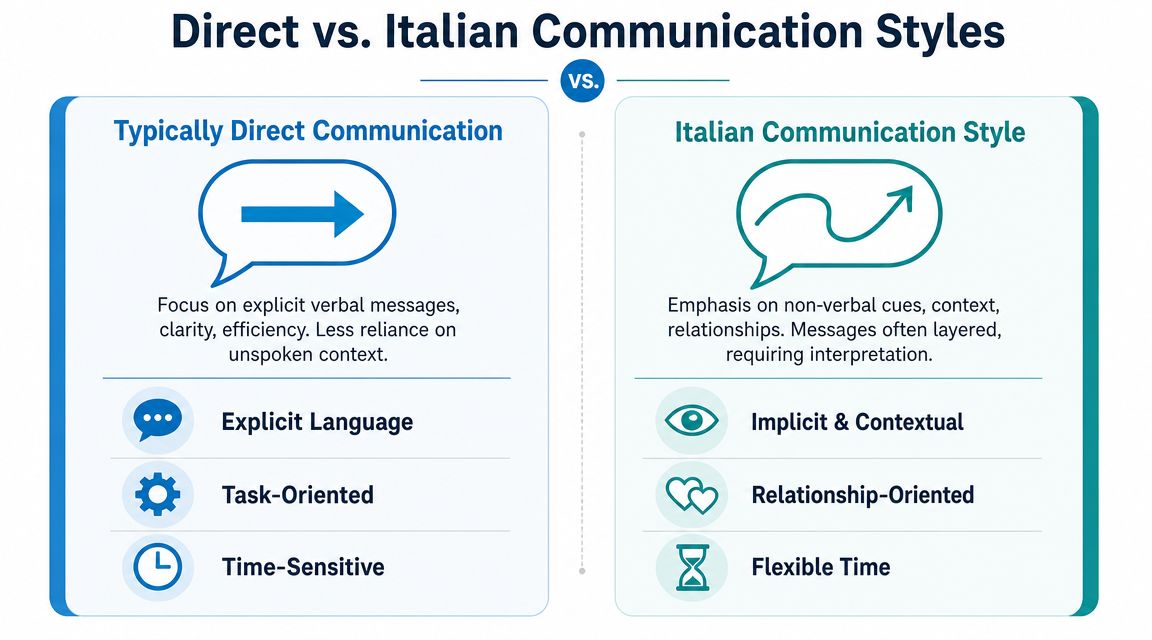
If you were raised in a more direct, low-context culture, clarity may equal respect. You say what you mean, address the issue, and move forward. If your spouse is used to a more contextual, emotionally expressive style, directness may sound cold, blunt, or relationally harsh.
Italian communication can carry more tone, implication, gesture, timing, and emotional layering. Meaning often sits partly in how something is said, who says it, and in what relational context. That can be beautiful. It can also be confusing.
A common mismatch looks like this:
| Pattern | One partner hears | The other partner means |
|---|---|---|
| Raised voice | “We are losing control” | “I am engaged and being honest” |
| Indirect wording | “You're avoiding the point” | “I am trying to be relational” |
| Fast interruption | “You're not listening” | “I'm involved in the conversation” |
| Delayed clarity | “You hid this from me” | “I needed the right moment” |
Conflict scripts that often backfire
If you want less escalation, watch for these pairings:
- Direct criticism plus defensiveness
One person pushes for clarity. The other protects dignity and shuts down. - Emotional expression plus withdrawal
One person gets louder to feel heard. The other retreats to stay regulated. - Mind-reading plus silence
Both assume the other “should know” what's wrong.
What helps is translating style into intention before reacting to content.
Try saying:
- “When the conversation gets loud, I interpret it as danger. Is that what you mean?”
- “When you hint instead of saying it directly, I miss the message. Can you make it explicit?”
- “I need ten minutes to calm down, but I will come back.”
Use the CBT model in real time
CBT is useful here because it slows the leap from event to interpretation.
A simple structure:
- Event
“Your mother called during dinner and you answered.” - Thought
“I'm not important.” - Emotion
Hurt, anger, humiliation. - Alternative view
“In your family, answering may signal care, not disrespect.” - Request
“Can we agree to screen non-urgent calls during dinner?”
Good intercultural communication is not mind-reading. It is repeated translation.
The Unspoken Challenge of Italian Bureaucracy
Some of the hardest married to an Italian challenges have nothing to do with romance. They come from paperwork, waiting, and dependence.
Why bureaucracy hits the relationship so hard
Administrative stress easily becomes marital stress because it creates unequal power. One partner knows the language, the offices, the shortcuts, and the unwritten rules. The other partner becomes dependent, even when they are competent and highly educated.
That dependence can stir up shame, anger, and helplessness. The Italian spouse may minimise the problem because the system feels familiar. The foreign spouse may feel trapped inside a life they cannot fully access alone.
One practical bottleneck is especially important. For a non-Italian spouse, obtaining a residence permit requires the Italian partner to be registered as a resident and the marriage to be officially recorded in the Italian civil registry. Delays in this registration can block the residency process and access to local administration, as explained in this overview of the Italian spouse residency process.
How to stop paperwork from poisoning the marriage
A calmer approach is to treat bureaucracy as a joint project, not a rescue mission.
Use this structure:
- Make a document map
List what has been submitted, what is missing, what needs translation or apostille, and who is responsible for each task. - Separate practical frustration from relational meaning
“I'm overwhelmed by the process” is different from “You don't care about me.” - Set administration meetings
Don't let bureaucracy invade every evening. Choose a time, review tasks, then stop. - Protect the non-Italian spouse's agency
Even if one partner handles Italian better, both should understand the steps.
If relocation stress is building underneath the paperwork, this moving to Italy mental health checklist can help you stabilise the bigger picture.
Rituals of Daily Life Food Holidays and Social Life
Sometimes the strain comes from things that look harmless from the outside. Lunch. August holidays. Family birthdays. Hospitality. Food.
Why daily rituals carry so much weight
In Italy, rituals often do emotional work. Meals are not only meals. They are continuity, belonging, and identity. Opting out may feel minor to you and rejecting to others.
Sunday lunch is a good example. To one partner, it may feel repetitive, obligatory, and socially draining. To the other, it may feel like the basic fabric of family life. The same goes for long summer gatherings, late dinners, expectations around hosting, and strong opinions about “proper” food traditions.
Later marriage means stronger pre-existing habits
That matters in marriage because couples often arrive with more established careers, routines, tastes, and identities than previous generations did.
In practical terms, both of you may feel that your habits are not just preferences. They are part of who you are. One partner guards personal space. The other protects tradition. One wants flexible holidays. The other wants family continuity.
How to negotiate rituals without contempt
Ask three questions about any ritual:
- What does this mean to you emotionally?
- What part is fixed?
- What part is flexible?
That opens much more useful conversations than “Do we have to do this again?”
A couple might discover:
- The family lunch matters, but not every week
- Christmas Eve feels sacred, but Easter can rotate
- Meals matter, but arrival times can be discussed
- Summer with relatives matters, but not for the full holiday period
Some intercultural marriages improve not when they reject tradition, but when they convert obligation into conscious choice.
Actionable Strategies for a Stronger Intercultural Marriage
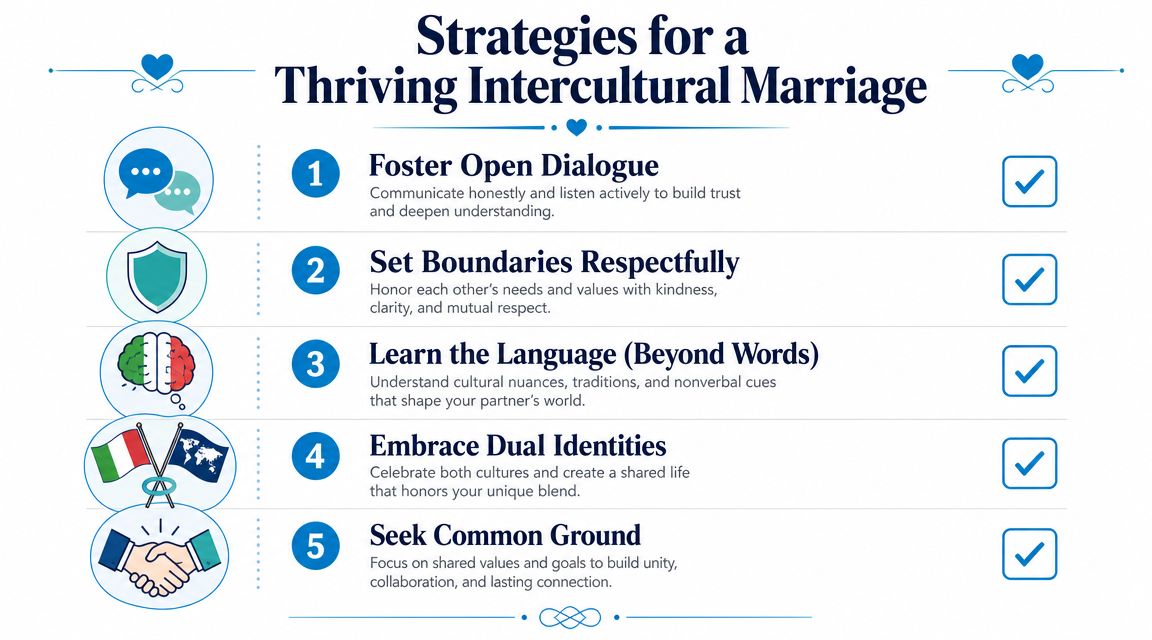
Insight matters, but couples need tools they can use on a Tuesday evening when everyone is tired.
Start with triggers, not accusations
Schema Therapy is especially useful in intercultural marriage because it helps identify what gets activated underneath the argument.
Ask yourself:
- What does this situation remind me of emotionally?
- When my spouse does this, what story does my mind tell?
- Do I feel controlled, abandoned, ignored, judged, or unsafe?
Then speak from the trigger instead of from blame.
Instead of:
- “You always choose your family over me.”
Try:
- “When plans are changed around your family without discussing it with me, I feel unimportant and pushed aside.”
That is clearer, calmer, and harder to dismiss.
Use scripts that lower defensiveness
These phrases work because they combine clarity with respect:
- For in-laws
“I want a good relationship with your family. I also need us to decide together what works for our marriage.” - For communication
“I think we are arguing about tone and meaning at the same time. Can we slow down and clarify one point?” - For household roles
“I don't want help as a favour. I want shared responsibility.” - For emotional overwhelm
“I'm flooded right now. I need twenty minutes, and I will come back.”
Build a couple culture
The strongest intercultural marriages don't copy one culture and suppress the other. They create a third space.
Try a monthly “couple culture” conversation:
- Which rituals from each background do we want to keep?
- Which expectations don't fit us?
- What language do we want to use for emotional conversations?
- What traditions do we want if we have children?
- What are our rules for family access, money, and holidays?
Write the answers down. Couples often assume agreement until stress proves otherwise.
Protect resilience individually and together
No communication tool works well when one or both partners are chronically depleted. Emotional regulation is not optional. Sleep, rest, friendship, movement, alone time, and self-soothing all affect how culture is experienced.
A few grounding practices help:
- Name the state
“I am overstimulated,” “I am homesick,” “I am feeling cornered.” - Delay interpretation
Regulate first. Analyse second. - Protect outside support
Don't make your spouse your only emotional base in a foreign country.
When support from a therapist helps
If the same arguments repeat and neither of you can translate the other well anymore, a structured space helps. Some couples choose intercultural couples therapy to work specifically on attachment triggers, conflict patterns, in-law boundaries, and bicultural decision-making. That kind of work is often less about deciding who is right and more about creating a shared system that both partners can live in.
When and How Professional Support Can Help Your Marriage
Some couples need skills. Others need a safer container because the relationship has become too reactive to repair alone.
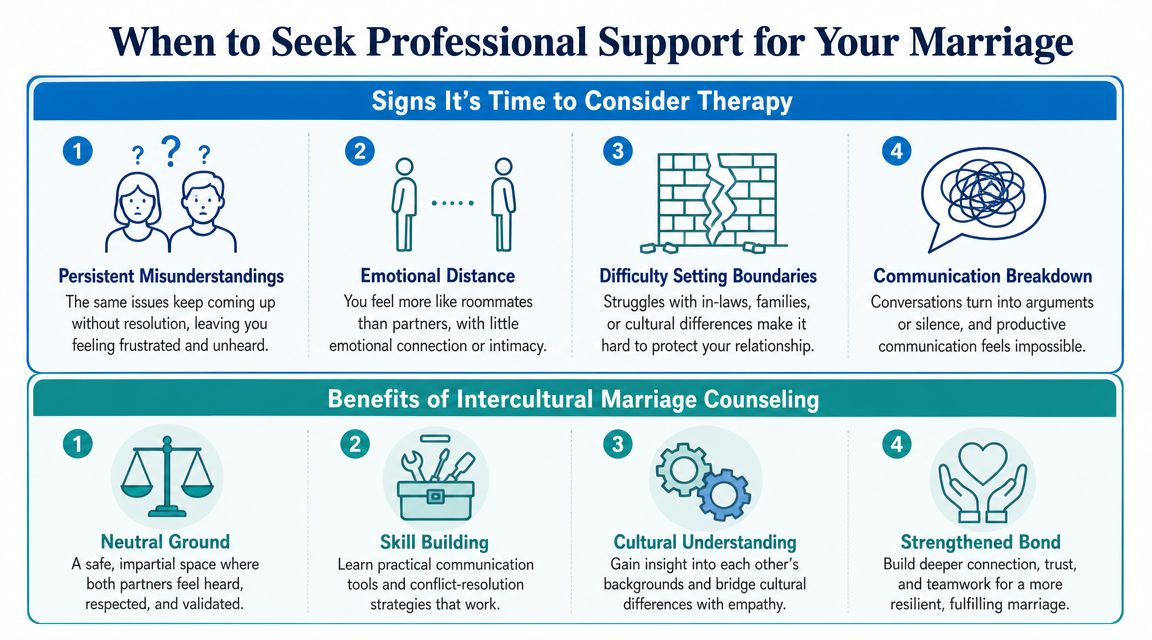
Signs that support would be useful now
Consider professional help if:
- You keep having the same argument with different details
- One of you is emotionally withdrawing
- Family conflict dominates the marriage
- Practical stress has turned into chronic resentment
- You no longer feel interpreted accurately by each other
- Repair after conflict takes too long or doesn't happen
This is especially relevant because mixed-nationality marriages can carry specific long-term stressors. A CEPR analysis of Italian marriage data found that inter-ethnic marriages in Italy historically lasted about 6.5 years less than co-ethnic ones after accounting for other factors, although newer marriages show signs of convergence, as noted in this CEPR analysis of inter-ethnic marriages in Italy. That doesn't mean your relationship is doomed. It means proactive support makes sense.
What therapy can do that private effort can't
A good therapist helps each partner do three things at once:
- Slow reactivity
- Translate cultural meaning
- Identify the deeper pattern underneath the current fight
Individual therapy can help the foreign spouse process isolation, identity strain, and culture shock. It can also help the Italian spouse examine loyalty conflicts, family guilt, and inherited relational scripts. Couples therapy can then turn those insights into concrete agreements.
If you're looking for support in English, this page on finding an English-speaking couples therapist in Italy can help clarify what to look for in a therapist who understands intercultural dynamics, language issues, and Italian family context.
Why multilingual and culturally informed support matters
In cross-cultural marriages, language is not a small detail. People need to speak from their emotional centre, not only from their second-best vocabulary. A therapist who understands both intercultural psychology and the Italian relational environment can help both partners feel less caricatured and more accurately seen.
That is often the turning point. Not perfect agreement. Accurate understanding.
FAQ
Is it normal to struggle after marrying an Italian even if the relationship was easy before?
Yes, it's very normal. Dating often protects couples from deeper cultural friction because family roles, bureaucracy, money, parenting, and long-term routines haven't fully activated yet. Marriage brings those hidden systems to the surface.
What are the most common married to an Italian challenges?
The most common challenges usually involve family boundaries, communication style, gender expectations, bureaucracy, and conflicting ideas about independence. Many couples also struggle with loneliness, language exclusion, and the pressure of adapting to Italian social rituals.
How do I set boundaries with Italian in-laws without causing a major conflict?
The best approach is respectful clarity. Focus on specific behaviours, agree on boundaries privately with your spouse first, and present decisions as couple decisions rather than personal rejection of the family.
Why does every disagreement feel bigger in an intercultural marriage?
Because the argument is often carrying more than the immediate issue. It may involve attachment fears, old schemas, identity threats, homesickness, or loyalty conflicts, so the emotional charge becomes stronger than the topic alone would suggest.
Can couples therapy help if the problem is mainly cultural difference?
Yes, it can help a great deal. Therapy won't erase cultural difference, but it can help you translate it, reduce defensive reactions, and build practical agreements that fit your actual marriage rather than inherited expectations.
Should I get individual therapy or couples therapy?
It depends on the pattern. If you feel isolated, overwhelmed, or emotionally flooded, individual therapy may help stabilise you first. If the main issue is recurring conflict or disconnection between you and your spouse, couples therapy is often the better starting point.
If this article felt uncomfortably familiar, you don't have to keep carrying it alone. Book your first free assessment call with Therapsy if you'd like a supportive conversation with our Clinical Director, who will listen carefully and match you with the right therapist for you, with no commitment and no payment required.