If you're searching for grief therapy in English in Italy, you may already be carrying two burdens at once. One is the loss itself. The other is trying to grieve while living in a country where the language, systems, and social rituals may not feel like your own.
For many expats, international students, and young professionals in Italy, bereavement doesn't unfold inside the usual circle of family, lifelong friends, familiar funerals, or shared cultural expectations. It happens across borders, across time zones, and often in a language that doesn't fully hold what you feel. That experience is real. It has a name in practice, even if not always in formal diagnosis: transnational grief.
Grief therapy can help by giving you a place where nothing needs to be translated first. It offers structure when life feels disorganised, emotional permission when you feel out of sync with people around you, and practical support when loss is tangled up with distance, paperwork, interrupted rituals, or traumatic circumstances.
This guide is written for young adults living in Italy, especially those grieving far from home and looking for English-speaking support that understands both bereavement and expat life.
Navigating Loss While Living Abroad in Italy
One common scenario looks like this. You wake up in Milan, Rome, Florence, or Bologna to a message from home. Someone you love has died. While relatives gather, call one another, arrange food, sit together, and move through the first shock as a group, you're trying to book a flight, answer work messages, understand funeral timing, and decide whether you can even get there in time.
That first layer of grief is painful enough. The second layer is displacement.

Why grief abroad can feel different
For expats who lose someone while living in Italy, grief is often compounded by transnational challenges like time-zone separation from support networks, managing funerals across countries, and the emotional strain of mourning in a second language, as outlined in NHS guidance on grief, bereavement and loss.
That means you may notice experiences such as:
- Delayed emotional impact because logistics take over first
- A strange emotional split between your life in Italy and your life back home
- Guilt about not being physically present
- Difficulty receiving support from local friends who care, but don't fully understand your cultural mourning references
- Exhaustion from constant explaining of both the loss and your practical situation
Practical rule: If your grief feels “wrong” because it is mixed with numbness, bureaucracy, anger, or disconnection, that doesn't mean you're grieving badly. It often means you're grieving under strain.
There can also be a quieter pain. You may feel culturally out of sync. The rituals around death in Italy may be meaningful, but not yours. Or they may remind you that your own customs, language, humour, faith, or family style are elsewhere.
Why human connection matters so much after loss
Grief often narrows life. People stop knowing what to say. You may stop knowing how to answer. During that period, the value of human connection becomes more than a nice idea. It becomes stabilising.
For many expats, bereavement also intensifies loneliness that was already there before the loss. If that sounds familiar, this guide on expat loneliness in Italy may help you recognise how grief and isolation can reinforce each other.
What grief therapy in English in Italy makes possible
The point of grief therapy in English in Italy isn't to erase sadness. It's to create a space where your loss can be spoken in the language of your attachment, your memories, your family dynamics, and your inner world.
That often matters more than people expect.
What Grief Therapy Is and How It Can Help
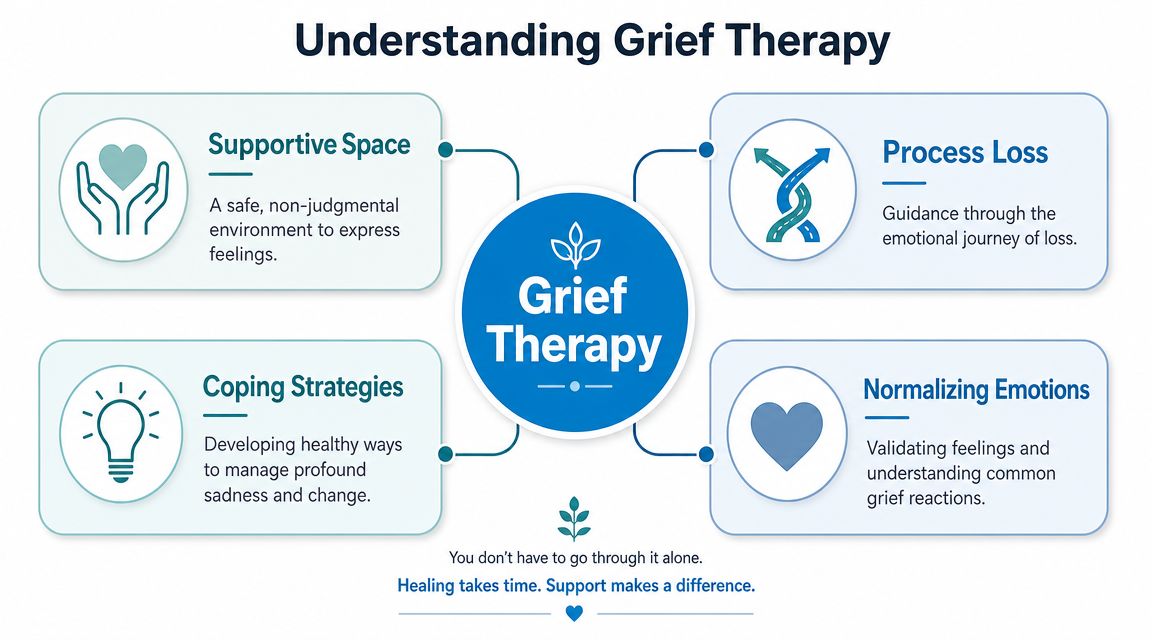
Grief therapy is a structured, compassionate form of psychotherapy that helps a person adapt to life after loss. It doesn't ask you to “move on” quickly. It helps you process what happened, understand your reactions, and find ways to live alongside the grief without being dominated by it.
For many people, the biggest relief is simple. Therapy gives grief somewhere to go.
What happens in grief therapy
A good grief therapist won't force a single model onto every bereaved person. Some clients need language for overwhelming feelings. Others need help with traumatic images, disrupted sleep, panic, guilt, family conflict, or loss of meaning.
In practice, therapy may include:
Making sense of your reactions
You might be tearful one day and emotionally flat the next. That variation is common.Working with painful thoughts
Thoughts such as “I should have been there” or “I'm failing everyone” can intensify grief.Rebuilding daily functioning
Eating, sleeping, working, concentrating, and staying connected often become harder after loss.Protecting the bond without getting stuck
Healthy grieving does not require forgetting the person who died.
Grief therapy is not about removing love from loss. It's about helping love take a form your nervous system can bear.
How CBT and EMDR can help after bereavement
Two evidence-based approaches are especially useful when grief becomes overwhelming in specific ways.
CBT for grief
Cognitive Behavioural Therapy (CBT) helps identify patterns between thoughts, emotions, body reactions, and behaviour. In grief work, CBT can help when you're caught in loops of guilt, self-blame, catastrophic thinking, or avoidance.
Examples include:
- avoiding places, photos, or conversations because they trigger distress
- feeling trapped by harsh internal rules about how you “should” grieve
- struggling to re-enter daily life because functioning feels like betrayal
EMDR for traumatic loss
EMDR, or Eye Movement Desensitisation and Reprocessing, can be useful when a death was sudden, shocking, medicalised, or associated with distressing images and memories. The aim isn't to delete memory. It is to reduce the intensity and stuckness around the most painful parts of it.
For readers who notice that grief also lives strongly in the body, this page on nervous system regulation therapy can clarify why bereavement can feel physical as well as emotional.
Why local cultural understanding matters
In Italy, it helps when therapists use tools that have been validated for the local context. The Italian-language validation of the Grief and Meaning Reconstruction Inventory identified five clearly interpretable factors in bereavement processing: Continuing Bonds, Personal Growth, Sense of Peace, Valuing Life, and Emptiness, as described in the Italian GMRI validation study.
That matters clinically because grief isn't just one thing called “sadness.” A person may feel deep emptiness while also maintaining a meaningful bond with the person who died. Therapy needs room for that complexity.
Finding English-Language Grief Therapy in Italy
Looking for support after loss can feel harder than it should. In Italy, there is a significant mismatch between the need for bilingual grief support among expats and the scarcity of easily accessible resources. National research also found widespread misconceptions about grief among informal support providers, which helps explain why many English-speaking mourners struggle to find clear pathways into appropriate care through the Italian study on grief misconceptions and support access.
That's often why people searching for grief therapy in English in Italy end up with generic wellbeing articles instead of concrete help.
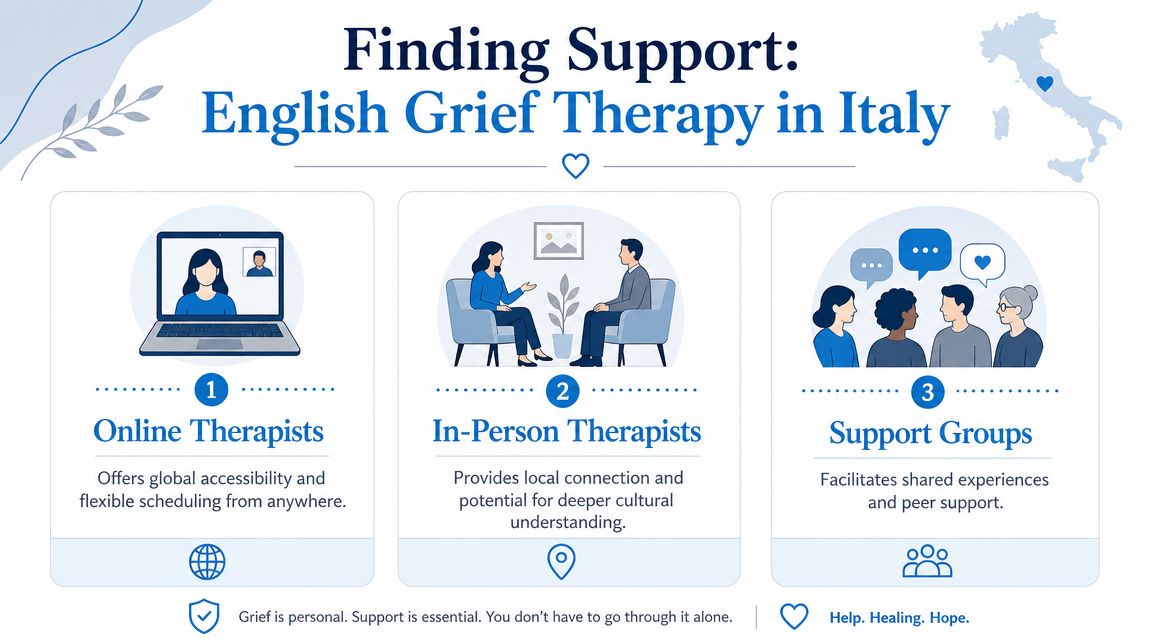
Comparing your main options
| Option | What it offers | Main trade-off |
|---|---|---|
| Online therapy | Flexible access from anywhere in Italy, easier scheduling, continuity during travel | Less useful if you strongly need a separate physical space |
| In-person therapy | A contained room, embodied presence, local routine | Harder to find in English outside larger cities |
| Support groups | Shared experience and reduced isolation | Not a substitute for individual clinical work when grief is complex or traumatic |
When online therapy works well
Online grief therapy can be a strong fit if:
- You travel often for work, study, or family obligations
- You live outside a major city and options in English are limited
- You want privacy without navigating local services in Italian
- Your grief is transnational and your schedule is shaped by calls, flights, or family abroad
For many expats, online work isn't a second-best option. It's the format that makes therapy possible.
When in-person therapy may be better
In-person sessions can be especially helpful if:
- Home doesn't feel emotionally safe enough for deep sessions
- You feel dissociated or detached and need grounded human presence
- You want a local ritual of care, such as physically going to therapy each week
For readers looking specifically for an English-speaking therapist in Italy, it's worth checking whether a service offers both formats rather than forcing one model.
One practical route to consider
One option designed for the international community is Therapsy, which offers online and in-person psychotherapy in multiple languages across Italy, including English, with human-led therapist matching rather than automated questionnaires. That can be useful when grief is mixed with intercultural stress, trauma, or relocation issues, because the fit between therapist and client matters more than a generic directory search suggests.
How to Choose the Right Grief Therapist for You
Not every English-speaking therapist is the right therapist for grief. Fluency matters, but it isn't enough on its own. You need someone who can hold bereavement clinically, understand expat life, and work at a pace that respects both your attachment and your nervous system.
What to check first
Start with the basics. A grief therapist in Italy should be a licensed psychologist or psychotherapist, and they should be able to explain their approach in plain language.
Use this shortlist when screening options:
Professional registration and training
Ask whether they are licensed and what kind of psychotherapy they practise.Actual experience with grief
General therapy experience is useful, but bereavement work has its own rhythm and risks.Comfort with traumatic loss
If the death involved shock, ICU scenes, accident, suicide, complicated family dynamics, or interrupted farewells, ask whether they also work with trauma.Cultural sensitivity
A strong therapist won't treat your expat context as background noise. They'll understand that migration, language, identity, and family distance shape grief.Clear communication in English
You shouldn't have to simplify your emotional life to be understood.
The right therapist doesn't rush your grief or turn it into a checklist. They help you feel safer inside it.
Questions worth asking in a first call
Some readers worry that asking questions will sound demanding. It won't. It's sensible.
You might ask:
- Do you work regularly with bereavement and loss?
- Have you supported clients living abroad or between cultures?
- How do you work when grief is mixed with trauma, guilt, or panic?
- Do you offer online, in-person, or both?
- What happens if the first match doesn't feel right?
Human matching matters more than people think
Many therapy platforms rely on forms, keywords, or automated matching. That can work for straightforward concerns, but grief often isn't straightforward. A person may say they need bereavement support, when the underlying issue is traumatic loss, attachment rupture, depression, family estrangement, or all of them at once.
That's why a human clinical conversation at the start is often more reliable than an algorithm. It allows for nuance.
If your loss has left you with intrusive memories, intense body reactions, or a sense that the bereavement has become traumatic, a specialist in trauma therapy in English in Italy may be a better fit than a generalist grief provider.
Green flags and warning signs
A few signs usually point in the right direction.
Green flags
- the therapist answers clearly and without jargon
- they don't minimise the complexity of grieving abroad
- they can describe a treatment approach, but remain flexible
- they welcome discussion about fit
Warning signs
- they push quick closure
- they treat grief as identical for everyone
- they dismiss the role of language or migration
- they become vague when you ask about qualifications or experience
Your First Session Expectations and Pricing
The first session is usually quieter and more human than people fear. It's not an interrogation. You won't be expected to tell the whole story perfectly, remember every detail, or arrive with clear goals.
What usually happens in the first meeting
A first grief session often includes:
Your reason for coming now
Why this loss, or this phase of the loss, feels too heavy to carry alone.The context of the death
Only at a pace that feels manageable.Your current symptoms and pressures
Sleep, appetite, work, panic, numbness, guilt, concentration, isolation.A sense of what support should look like
Some people need stabilisation first. Others need a place to speak freely. Others need trauma-focused work.
You do not need to be “ready” in a polished way. You only need to arrive as you are.
The therapist will also notice practical realities. Are you trying to function at work while grieving? Are you alone in Italy? Are you considering travel? Are family expectations adding pressure? These details help shape the pace and style of care.
How long grief therapy takes
There's no fixed timeline. Some people need short-term support around an acute loss. Others need longer work because the grief is tied to trauma, earlier attachment wounds, depression, or a major identity rupture.
Therapy should be collaborative. You shouldn't feel trapped in an open-ended process with no shared direction.
Pricing in Italy
If cost is part of your decision, transparency helps. At Therapsy, individual therapy starts from €70 per session, and pricing depends on the therapist's experience and specialisation. If you want a clearer overview of typical fees and formats, this page on therapy costs in Italy is a useful starting point.
When to Seek Integrated Psychiatric Care
Most grief is not a psychiatric emergency. It is a painful human response to losing someone significant. But sometimes bereavement becomes so intense, prolonged, or functionally disruptive that psychotherapy alone may not be enough at that moment.
That doesn't mean something is “wrong” with you. It means your level of suffering may need broader support.
Why this matters in Italy
Italy saw a sharp rise in deaths during the first COVID-19 wave. The national statistical system reported 746,146 deaths in 2020 compared with 635,570 in 2019, an increase of about 17.4%, with many losses occurring under conditions of suddenness, isolation, limited family contact, and disrupted funerals, as discussed in this analysis of bereavement and support in Italy. That same source notes that bereavement also became a policy issue, including the introduction by INPS of a dedicated Indennità una tantum of €2,400 for certain surviving family members of workers who died from COVID-19.
Those conditions matter clinically because sudden, isolated, or traumatic loss can complicate mourning.
Signs that extra support may be needed
Consider a psychiatric assessment, alongside therapy, if you notice any of the following:
Daily functioning has collapsed
You can't reliably sleep, eat, work, study, or manage basic tasks.The distress feels unremitting and extreme
There is no flexibility in the pain, only constant overwhelm or shutdown.You're experiencing persistent hopelessness or self-harm thoughts
This needs prompt professional attention.You feel severely agitated, dissociated, or physically unsafe
Particularly if trauma symptoms are prominent.
What integrated care actually means
Integrated care means a psychotherapist and psychiatrist may work in parallel. The therapist supports emotional processing, meaning-making, trauma work, and daily adaptation. The psychiatrist evaluates whether a diagnostic assessment, medical monitoring, or medication might help stabilise symptoms.
This is not a failure of therapy. It is good clinical care when the situation requires more than one level of support.
If you are having thoughts of harming yourself or you feel you may be in immediate danger, seek urgent local emergency support now.
Your Next Step Towards Healing in Italy
Grieving far from home can make everything feel harder than it already is. You may be missing the person who died, missing the version of yourself that existed before the loss, and missing the familiar social world that would normally hold you.
Still, support is possible. Grief therapy in English in Italy can give you a place where your loss makes sense in context, not just in symptoms. That context includes migration, language, distance, disrupted rituals, and the very practical demands of life abroad.
Reaching out doesn't mean you're weak or incapable of coping. It means you're allowing this loss to be held with care instead of carried in isolation.
Who works with grief at Therapsy
Grief far from home is its own problem: the people who knew the person you lost are somewhere else, and the rituals are not yours.
Dr. Thieny Ribeiro works in palliative psychology, supporting people and families facing life-limiting illness, and with grief and existential distress. She offers sessions in Portuguese and Spanish as well as English.
Dr. Lucia Focella has volunteered at the De Leo Fund supporting people through bereavement after traumatic loss, which is a distinct clinical territory from grief in general.
Dr. Anna Valfredi works with grief and trauma alongside her main focus on identity, cultural transitions and the psychological impact of migration.
You do not have to work out who fits on your own. You tell Therapsy what you are looking for, a member of our clinical team reads your request, and they introduce you. The first call is free.
FAQ
Can I do grief therapy in English if I live outside Milan or Rome?
Yes, you can access grief therapy in English from anywhere in Italy through online sessions. This is often the most practical option for expats, students, and professionals living outside major cities or travelling frequently.
Is grief therapy only for recent bereavement?
No, grief therapy can also help with losses that happened months or years ago. Many people seek support later, especially when an old loss becomes more painful during relocation, life transitions, anniversaries, or new family stress.
How do I know if I need grief therapy or trauma therapy?
You may need grief-focused therapy, trauma-focused therapy, or both, depending on what feels most dominant. If the loss involved shock, disturbing images, panic, dissociation, or intrusive memories, ask for a therapist who can assess both bereavement and trauma.
Can therapy help if I couldn't attend the funeral?
Yes, therapy can help process the guilt, anger, and incompleteness that often follow being absent from a funeral or farewell. It can also support you in creating personal rituals of mourning when the original goodbye was disrupted.
What if I want support in English but also need someone who understands Italy?
That combination is often important for expats. The most useful therapist is usually someone who can work fluently in English while also understanding the realities of Italian systems, local culture, and the emotional strain of living between countries.
Is it normal for grief to feel physical?
Yes, grief often shows up in the body as fatigue, tightness, nausea, agitation, poor concentration, or sleep disruption. These reactions can be part of bereavement, especially when the nervous system is under strain.
Do I need medication for grief?
Not everyone needs medication for grief. A psychiatric consultation may be helpful when symptoms are severe, functioning is collapsing, or grief is accompanied by depression, trauma symptoms, or safety concerns.
If you'd like support, you can book your first free assessment call with THERAPSY. It's a no-commitment conversation with the Clinical Director, who will listen carefully and match you with the right therapist for your needs.