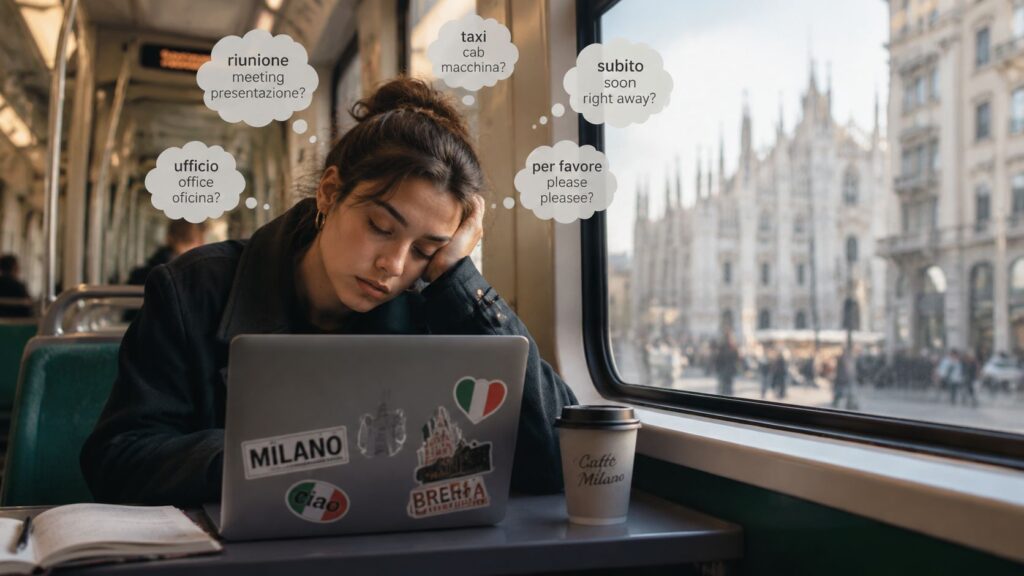
You might be functioning well on the outside. You work in English and maybe another language. You adapt quickly. You know how to enter a new room, read the mood, and fit in. Yet privately, something feels unsteady. Home is hard to define. Intimacy can feel harder than it looks for other people. Even after a successful move to Italy, you may still feel oddly unplaced.
Third culture adult therapy is therapy for adults whose inner world has been shaped by growing up across cultures, countries, and repeated transitions. It addresses more than adjustment stress. It works with identity fragmentation, cumulative loss, attachment patterns, and the unsettling experience of belonging in many places but not fully in one.
For many adults, this doesn't become fully visible in childhood. It often becomes sharper later, when life asks for steadiness: long-term relationships, career decisions, marriage, parenthood, staying in one place, or returning to a country that is meant to feel like home but doesn't. That is why this work matters so much for expats and internationally mobile adults living in Italy. The issue often isn't whether you can adapt. It's whether you can feel rooted while adapting.
An Introduction to Third Culture Adult Therapy
A Third Culture Adult is often someone whose development was shaped by living between cultures. In clinical practice, this usually includes adults who grew up moving across countries, languages, school systems, and social norms during formative years. Their identity was not built in one stable cultural container.
Third culture adult therapy begins with a simple recognition. Many of the struggles these adults bring to therapy make sense in context. Restlessness, emotional distance, over-adaptation, difficulty answering “where are you from?”, and a complicated relationship with home are not random symptoms.
Why adulthood often brings the old pattern into focus
A major transition often exposes what mobility has hidden. Gaw estimated that 37,000 third culture kids return to the United States every year to attend college in a counselling context that highlights how the long tail of mobility often becomes acute in late adolescence and early adulthood. The same source also notes that counselling is often most effective when work is broken into “manageable facets” of wellness such as cultural identity, emotional awareness, coping, and stress management (counselling guidance on working with adult third culture kids).
That framework remains clinically useful well beyond university age. Many adults in Italy arrive for study, work, love, or family reasons and discover that the move doesn't only create stress. It activates earlier layers of identity and loss that were never fully metabolised.
A mobile childhood can create a highly capable adult who still feels internally unhomed.
What this kind of therapy actually focuses on
Generic therapy can help with anxiety or low mood. But third culture adult therapy asks different questions:
- Identity: Who are you when you're not adapting to the room?
- Attachment: What did repeated arrivals and departures teach you about closeness?
- Loss: Which goodbyes were never named properly?
- Belonging: What does home mean when no single place fully fits?
This is not about pathologising multicultural identity. Many adults from this background are insightful, linguistically agile, and unusually skilled at navigating complexity. Therapy works best when it honours both realities. The strengths and the wounds often come from the same developmental story.
Understanding the Third Culture Adult Experience
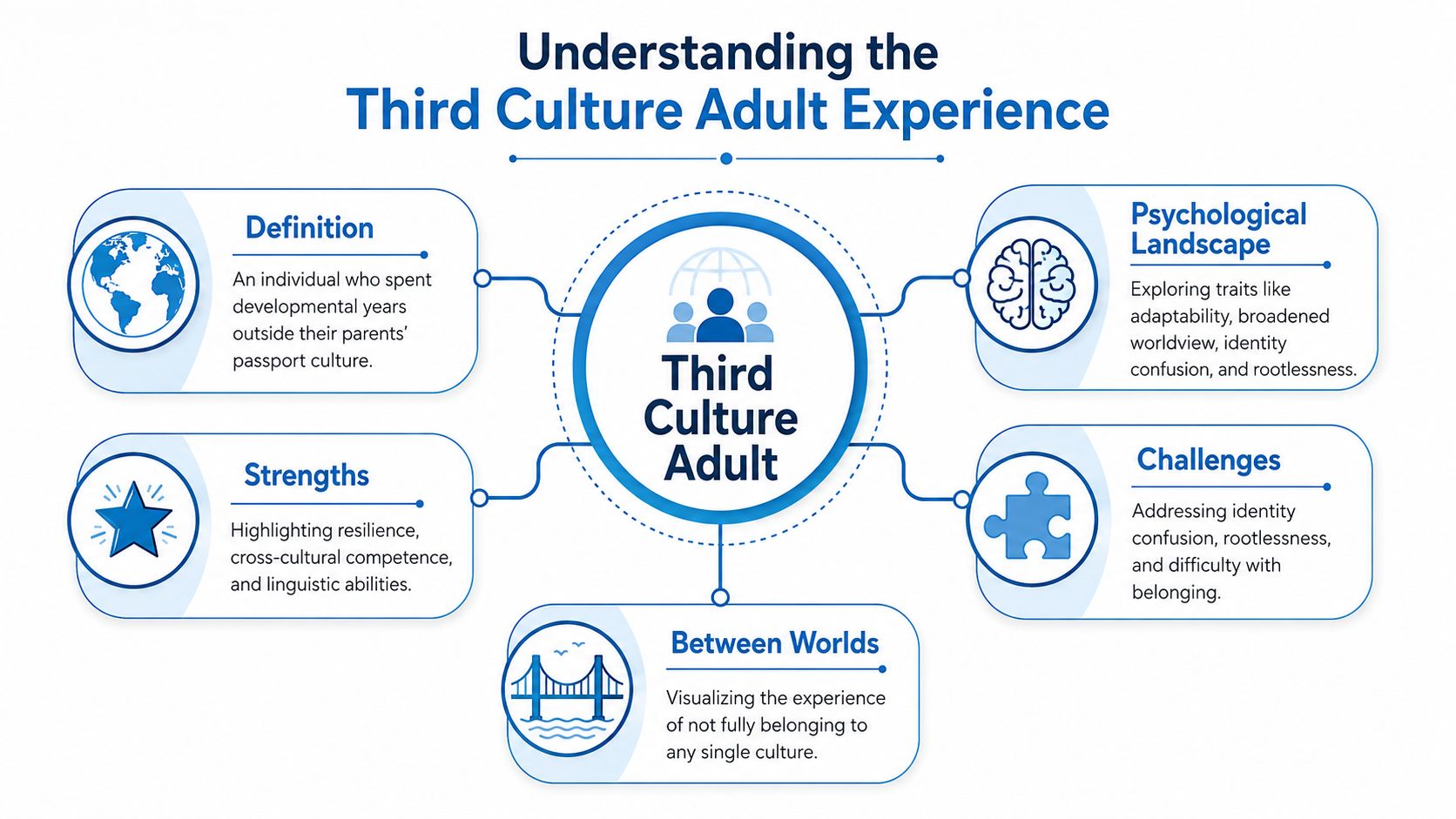
Some adults grew up with several versions of normal. Different countries. Different school systems. Different friendship codes. Different rules about emotion, status, conflict, family, and achievement. That creates a rich inner life, but it can also make identity feel distributed across many places.
A useful resource for practical context is this overview of international schools in Europe, because many third culture adults were shaped in exactly those kinds of educational environments. The school setting often offered continuity on paper while personal identity remained in constant negotiation.
The feeling between worlds
One clinical description captures the experience clearly. Adults who grew up between cultures often report feeling like they belong “everywhere and nowhere at the same time,” and may present with anxiety, depression, OCD, perfectionism, relationship challenges, family conflict, grief or loss, trauma, and identity questions. The same overview also stresses that early multilingual and multicultural exposure can foster strengths such as easier language acquisition and cross-cultural navigation skills (clinical overview of the third culture kid experience).
That sentence, “everywhere and nowhere”, often lands with immediate relief. Many adults have spent years feeling difficult to explain. They aren't necessarily alienated from every culture. They can usually connect. But deep belonging may still feel elusive.
Strengths that are real
Third culture adults often bring genuine assets into adulthood:
- Adaptability: They can read environments quickly and adjust with sophistication.
- Cross-cultural empathy: They usually notice nuance that others miss.
- Linguistic flexibility: Multiple languages often shaped how they think and relate.
- Perspective: They can hold contradictions without panicking.
These are not cosmetic strengths. They matter in relationships, leadership, creative work, and international life.
What those strengths can hide
The same capacities can become protective patterns.
- A person who adapts quickly may lose touch with what they feel.
- Someone skilled at reading others may become hyper-attuned and under-defined.
- A broad worldview may coexist with chronic difficulty committing to one path.
- Social confidence may mask a fear that nobody will ever fully know them.
Specialised work becomes useful. The task is not to reduce complexity. It is to help complexity become coherent.
For adults living in Italy, this often overlaps with an expat identity crisis. The new country doesn't create the whole problem. It often reveals an older one. When daily life slows enough for deeper questions to surface, many people realise they've spent years being globally competent and personally unanchored.
Third culture adulthood is not an identity failure. It is often an identity assembled under conditions of movement.
The Hidden Grief of a Mobile Childhood
Many third culture adults don't initially think of grief as their main issue. They come to therapy describing anxiety, numbness, low self-worth, restlessness, burnout, or difficulty staying emotionally present. Yet under those symptoms, grief is often central.

Why this grief is easy to miss
This is rarely one obvious bereavement. It is cumulative loss.
A mobile childhood can involve repeated departures from:
- Friends
- Schools
- Neighbourhoods
- Languages
- Pets
- Caregivers or mentors
- Family roles
- A sense of social competence
- Future plans linked to a place
When those losses happen repeatedly, children often learn to move on fast. Adults later carry the emotional cost of that speed.
How unresolved grief shows up in adult life
Unprocessed grief rarely introduces itself politely. It tends to appear sideways.
One person may struggle to commit because leaving always felt inevitable. Another may feel detached just when a relationship becomes secure. Someone else may overperform, as if achievement can compensate for rootlessness. Others feel chronically empty after reaching goals they thought would finally create home.
When losses were normalised in childhood, adults often minimise them even while still living inside their effects.
A common therapeutic turning point is naming what was lost without immediately trying to make it meaningful, mature, or positive. That matters because many internationally mobile adults were praised for resilience before anyone helped them mourn.
What helps and what usually doesn't
What tends to help:
-
Naming losses specifically
Not “we moved a lot”, but “I lost my best friend, my room, my language confidence, and the version of myself who knew how to belong there.” -
Separating grief from weakness
Missing people, places, and former selves does not mean you failed to adapt. -
Linking present reactions to earlier patterns
A strong response to endings, holidays, or relocation decisions often has a history. -
Creating continuity in support
For mobile adults, therapeutic continuity matters. That is one reason many people value structured ongoing care and, where useful, online continuity. Reflections on endings can also be important, especially in work around closure in therapy.
What usually doesn't help is premature reframing. Telling yourself that every loss “made you stronger” may sound mature, but in the consulting room it often keeps grief frozen. Real integration begins when loss is allowed to be loss.
Common Mental Health Challenges for Third Culture Adults
In therapy, third culture adults rarely arrive saying, “I have identity fragmentation from a mobile childhood.” They say, “I'm exhausted and I don't know why,” or “I keep sabotaging good relationships,” or “I've moved to Italy and I still don't feel settled anywhere.”
The presenting issue may look ordinary. The pattern underneath often isn't.
Anxiety that comes from constant adaptation
Many adults from this background learned to scan every new environment quickly. As children, that skill was useful. It helped them decode social rules, accents, humour, and power dynamics. In adulthood, the same skill can become chronic vigilance.
The result may look like high-functioning anxiety:
- reading every room before speaking
- worrying about saying the wrong thing culturally
- feeling safe only when highly prepared
- finding true relaxation strangely hard
Low mood that is tied to disconnection
Depression in third culture adults often carries a particular flavour. It may involve loss of meaning, emotional flatness, or a quiet sense that life is happening without full internal participation. Externally, the person may still be productive and articulate.
The painful part is often this: they can function in many places, but they don't feel claimed by any of them.
Perfectionism as a survival strategy
Perfectionism frequently develops as an adaptation to instability. If you had to keep entering new systems, being impressive, polished, and easy to place may have felt protective. You learn to perform belonging before you feel it.
In adults, this can become:
- relentless self-monitoring
- fear of being misunderstood
- harsh inner criticism
- difficulty letting others see confusion or need
Relationship strain shaped by repeated goodbyes
Attachment patterns often reflect mobility. Some adults become intensely attached and fear abandonment. Others keep one foot out of the door even in loving relationships. Both patterns can come from the same history.
A person who experienced many endings may unconsciously assume:
- closeness won't last
- people leave when life changes
- staying emotionally guarded is safer than grieving again
This is one reason many readers also recognise themselves in experiences of expat loneliness in Italy. Loneliness here is not always a lack of social contact. Sometimes it is the ache of being known only partially.
Repatriation and the shock of the supposed home country
For many third culture kids, later transition points bring everything into sharper focus.
That pattern matters even outside the United States. The deeper issue is what happens when an adult enters a place that is meant to feel like home and discovers they are still partially foreign there.
Modern mobility can intensify old patterns
Digital work and international careers can make movement look glamorous while fostering an underlying instability. For some adults, resources on work-life balance for digital nomads are useful because they speak to the practical strain of mobile living. But practical balance alone won't resolve a deeper belonging conflict if the original wound is developmental.
Success at moving through the world doesn't automatically create peace inside it.
Why Specialised Third Culture Adult Therapy Is Effective
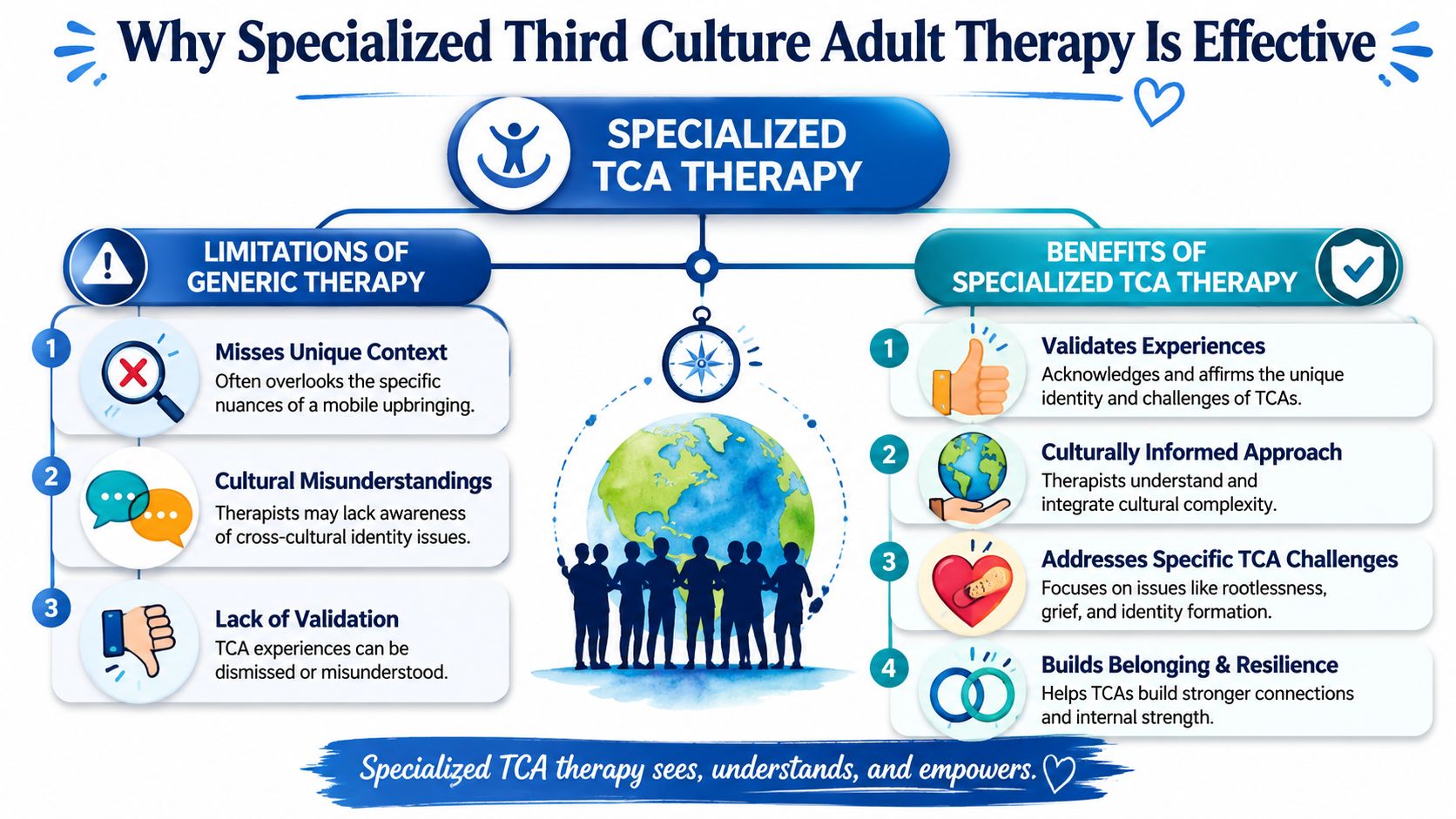
Specialised therapy is effective because it doesn't mistake the surface problem for the core one. If an adult third culture client presents with anxiety, a generic approach may help them manage anxious thoughts. That can be useful. But if the anxiety is tied to identity confusion, repeated rupture, and the expectation of future loss, symptom management alone won't go far enough.
The central task is integration. Not becoming less multicultural. Not choosing one “real” identity. Integration means building an internal sense of self that can hold multiple places, loyalties, memories, and languages without splitting.
Where generic counselling often falls short
A key clinical point from the literature is that therapy for Adult Third Culture Kids differs from generic expat counselling because the core issue is a fragmented identity shaped by repeated mobility and loss. Effective work goes beyond “culture shock” and addresses unresolved grief, identity integration, and “belonging after arrival” (research on adult TCK psychotherapy themes).
When that wider context is missed, a client may leave sessions feeling partially understood but not fully met. The therapist may focus on the current city, the current partner, or the current stressor, while the client is carrying a much older architecture of dislocation.
What specialised work actually looks like
Specialised third culture adult therapy tends to do several things at once.
It builds a coherent life narrative
Many adults from mobile backgrounds tell their story in fragments. Country. School. Another move. Another language. Another version of self. Narrative work helps link these chapters into one life rather than a set of disconnected selves.
A good therapist listens for continuity:
- recurring losses
- repeated roles
- hidden loyalties
- versions of self built for different settings
It works with attachment, not just communication
Relationship struggles are often treated as present-day compatibility problems. Sometimes they are. But third culture adults may also carry a learned expectation that closeness is temporary. Attachment-focused work helps identify how distance, over-independence, or fear of engulfment developed.
This is especially important when someone says, “I want intimacy, but when I get it, I feel trapped or unsafe.”
It addresses the nervous system
Repeated transitions can leave the body accustomed to activation. New schools, airports, farewells, social reinvention, language switching, and uncertainty all train the nervous system. Therapy often becomes more effective when insight is paired with regulation work, especially for clients who feel permanently braced. Practical support around nervous system regulation therapy can be relevant here.
It respects grief without turning everything into trauma
Not every move was traumatic. Not every goodbye was catastrophic. But repeated disruption still has consequences. Good therapy doesn't force dramatic labels. It helps clients recognise cumulative impact accurately.
Which approaches tend to fit well
Several evidence-based models can be especially helpful when adapted thoughtfully:
- CBT helps identify patterns in thought, self-criticism, and anticipatory anxiety.
- Schema Therapy is useful for deep beliefs such as “I don't fully belong”, “I must adapt to be accepted”, or “closeness ends”.
- EMDR can support processing emotionally charged memories, especially around ruptures, transitions, or relational pain.
- Attachment-informed therapy helps adults understand how movement shaped intimacy and dependence.
- Narrative work supports identity integration across countries, languages, and roles.
The most effective therapy for third culture adults does not ask them to simplify their history. It helps them organise it.
Finding Your Therapist in Italy with Therapsy
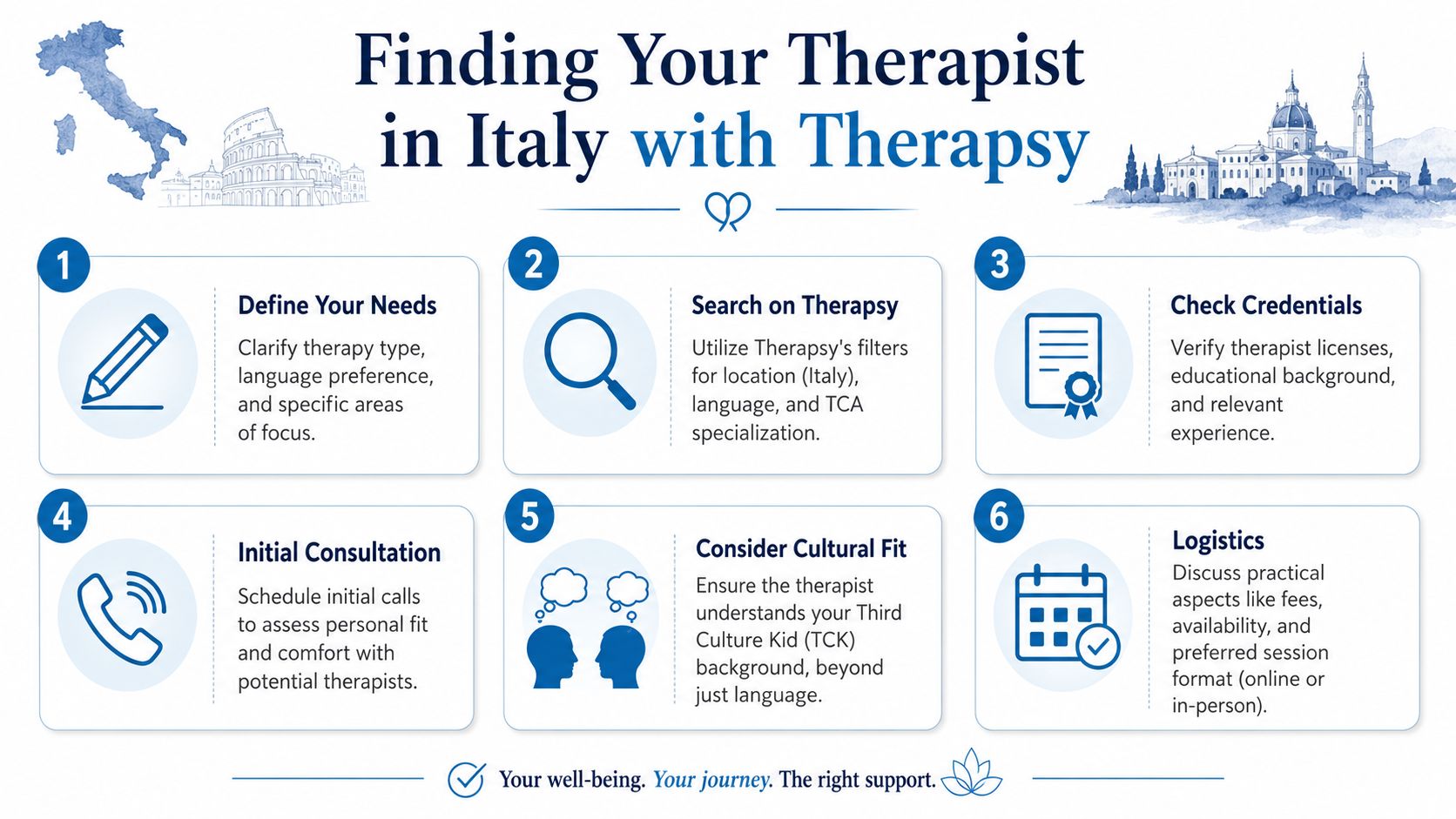
Finding the right therapist in Italy is not only about finding someone who speaks English. For third culture adults, language matters, but cultural attunement matters just as much. You need someone who won't reduce your experience to generic relocation stress or assume that being adaptable means you're fine.
What to look for first
Use these criteria before you book.
-
Clinical depth
Look for a therapist who can work beyond adjustment advice. Third culture adult therapy often requires comfort with identity work, grief, attachment, trauma-informed care, and multicultural complexity. -
Language fit
The best language is the one in which you can think, feel, and remember with the least friction. For some clients this is English. For others it may be Italian, French, Spanish, German, Portuguese, Ukrainian, Russian, Greek, Arabic, or Hebrew. -
Continuity options
If you travel often or may relocate again, check whether online sessions are possible. Continuity matters more than many people realise.
Questions worth asking a potential therapist
A brief consultation should help you assess fit, not just availability.
You can ask:
- Have you worked with adults who grew up across cultures?
- How do you think about identity and belonging in therapy?
- How do you approach cumulative grief and repeated transitions?
- Do you work in a structured way, or is the process more exploratory?
- If I move within Italy or abroad, can the work continue online?
The answers matter. A therapist doesn't need to share your biography. They do need to understand the psychology of your background.
Why many international clients want a human matching process
Most directories ask you to choose from profiles alone. That can work, but for intercultural clients it often puts too much pressure on guesswork. Matching works better when a clinician helps identify what you need. Some people think they need anxiety therapy and later realise they need grief and identity work. Others ask for someone “international” but would benefit more from a specific modality such as CBT, EMDR, or Schema Therapy.
Therapsy is often relevant here because it offers a clinician-led matching process rather than an algorithmic one. The service is supervised by Dr. Francesca Adriana Boccalari, Clinical Director at Therapsy, a psychotherapist with 10+ years of experience, certified in EMDR, specialised in CBT and Schema Therapy, and trained in Milan, New York, and Singapore. For a population that often feels misread, that human layer matters.
Practical options that matter in Italy
For international clients, logistics are not secondary. They shape whether therapy is sustainable.
Therapsy provides:
- Online and in-person sessions
- 23 Italian cities
- 80+ physical locations
- 50+ therapists
- 1,500+ clients served since 2023
- first contact within 12 hours
- individual therapy from €70/session
- couple therapy from €100/session
- psychiatric consultation from €110/session
- psychodiagnostic assessment from €255
For many expats and internationally mobile adults, that combination matters because life in Italy can be geographically spread out. You may live in Milan and travel. You may study in Florence and return home during breaks. You may be in Rome now and uncertain next year. Hybrid care allows therapy to stay continuous when life doesn't.
A useful starting point if you want to compare criteria is this guide to finding the right therapist for expats in Italy.
What a good match feels like
A good therapist won't be impressed only by how adaptable you are. They will be curious about the cost of that adaptability.
They won't rush to define your “real culture”. They'll help you explore how multiple cultural influences live inside you now. They'll understand that your issue may not be where you live, but how your sense of self learned to survive repeated change.
What to Expect From Your Therapy Journey
The first step is usually simpler than people fear. A first conversation often focuses on your current difficulty, your history of movement, and what you want to understand or change. You do not need to arrive with a polished story.
Early sessions usually involve careful mapping. Which moves mattered most. Where you felt most like yourself. Where relationships became difficult. Which losses still carry emotional charge. Therapy starts to work when scattered experiences begin to form a pattern you can recognise.
Progress in this kind of work is rarely dramatic at the beginning. It often looks quieter. More precise language for what you feel. Less shame around your complexity. Better recognition of your triggers. More choice in relationships. A deeper ability to stay present in one life without feeling that you must betray all the others you have lived.
Some clients benefit from structured approaches such as CBT, EMDR, or Schema Therapy. Others need a more exploratory rhythm. Sometimes both are useful at different stages. If symptoms such as severe anxiety, depression, sleep disturbance, or trauma responses are prominent, integrated psychiatric support can also be part of care when needed.
Healing in third culture adult therapy often means building an internal home, not choosing a single external one.
You do not have to be in crisis to begin. Many adults start therapy because they are tired of being highly functional and privately unmoored.
FAQ
What is third culture adult therapy
Third culture adult therapy is psychotherapy for adults whose identity and emotional life were shaped by growing up across cultures and repeated moves. It focuses on issues such as belonging, unresolved grief, attachment patterns, and identity integration, rather than only current adjustment stress.
Is being a third culture adult a mental health problem
No, being a third culture adult is not a disorder. It is a developmental and cultural experience that can bring both strengths and vulnerabilities. Therapy is useful when the costs of that background begin to affect relationships, mood, self-worth, or stability.
Why do I feel rootless even when my life looks successful
Rootlessness often comes from unresolved loss and a self that was built through adaptation. You may be competent, multilingual, and socially effective while still lacking an internal sense of home. Therapy helps link achievement with identity, rather than treating success as proof that nothing hurts.
Can third culture adult therapy help with relationships
Yes, it often helps people understand why closeness feels complicated. Repeated departures, reinventions, and disrupted attachment can shape how you trust, depend, commit, or withdraw. Therapy can make those patterns more visible and more flexible.
Is online therapy a good option for third culture adults
Yes, online therapy can be especially useful for internationally mobile adults. Continuity is often more important than location, especially if work, study, or family life involves travel or future moves. A stable therapeutic relationship can remain intact even when geography changes.
How do I know if I need a therapist who understands intercultural psychology
You probably do if generic advice has felt too shallow or slightly off-target. If your difficulties are tied to identity, multilingual life, repeated moves, or feeling “everywhere and nowhere,” a therapist with intercultural understanding is more likely to grasp the full picture.
If this article felt uncomfortably accurate, that often means you've been carrying something real for a long time. Book your first free assessment call with Therapsy. There's no commitment and no payment, just a conversation with our Clinical Director who will listen carefully and match you with the right therapist for you.