You're in a meeting in Milan. Your slides are ready. You know your material. Then someone says, “Why don't you present this part?” and your body reacts before your mind can catch up. Your chest tightens. Your mouth goes dry. You start worrying about your English, your Italian, your accent, your grammar, and whether the room has already decided you don't belong.
That experience is public speaking anxiety. For expats in Italy, it often feels sharper because the fear isn't only about speaking. It's also about being evaluated across language, culture, status, and identity.
The good news is that this fear is understandable, treatable, and not a sign that something is wrong with you. In therapy, public speaking anxiety is not seen as a character flaw. It's seen as a learned fear response that can be understood and changed with evidence-based tools such as CBT, exposure work, and culturally sensitive support.
What Is Public Speaking Anxiety Really
A common fear with a clinical name
Public speaking anxiety, also called glossophobia, is the fear or intense distress that appears when you have to speak in front of other people. That can mean a formal presentation, a meeting update, a university seminar, a wedding toast, or even introducing yourself in a group.
Public speaking anxiety is one of the most common human fears, not a rare personal weakness.
That matters because shame tends to shrink when you realize how many other people are dealing with the same thing.
For some people, the fear is mild. They feel nervous, then settle once they begin. For others, the fear becomes so intense that they avoid speaking opportunities, over-prepare for days, lose sleep beforehand, or replay every perceived mistake afterward.
Normal nerves and debilitating anxiety are not the same
A little activation before speaking is normal. Your body is preparing for performance. The problem starts when the fear becomes so strong that it changes your choices, your career, or your quality of life.
You might recognize public speaking anxiety if you:
- Avoid opportunities that involve presenting, asking questions, or leading discussions
- Obsess over mistakes long before and long after the event
- Focus more on how you seem than on what you want to say
- Assume harsh judgment from the audience even without clear evidence
- Feel trapped between wanting to speak well and wanting to disappear
For expats, that pattern can blend with social anxiety, perfectionism, and the strain of operating in a second language. If that sounds familiar, support for related fears can also begin with understanding how social anxiety develops and what helps.
Why the label helps
Some people hesitate to name the problem because they worry it sounds dramatic. In practice, naming it often reduces fear.
When you call it public speaking anxiety, you stop treating it as a mystery. You can separate:
- The situation – speaking in front of others
- The threat interpretation – “They'll think I'm incompetent”
- The response – panic, avoidance, self-criticism
That separation is powerful. It means the fear is something you can work with, not something you are.
Many people don't fear speaking itself. They fear exposure, judgment, and the possibility of looking inadequate in front of others.
The Science Behind Your Fear of Speaking

Your brain reads social evaluation as danger
When public speaking anxiety hits, your body isn't being dramatic. It's doing what brains do when they detect threat.
Public speaking anxiety is neurobiologically rooted in the brain's threat network. Social evaluation activates the same brain region that processes physical pain, making perceived audience scrutiny biologically equivalent to bodily danger.
That's why people often say, “I knew what I wanted to say, and then my mind went blank.” The part of your brain that helps you organize language and think flexibly doesn't work as smoothly when the threat system takes over.
A smoke detector that reacts too fast
A useful way to understand this is to picture a smoke detector. A smoke detector is designed to react quickly. It would rather make a false alarm than miss a real fire.
Public speaking anxiety works in a similar way. Your brain detects social exposure and sounds the alarm before it has properly checked whether you're unsafe.
That alarm can create:
- Body changes – shaking, sweating, dry mouth, nausea
- Voice changes – tighter throat, less steady breathing, higher pitch
- Thinking changes – blank mind, racing thoughts, trouble concentrating
- Attention changes – hyperfocus on faces, silence, or tiny signs of disapproval
If you also struggle with impossible standards, it can help to look at how perfectionism intensifies anxiety, because many speakers aren't just afraid of speaking. They're afraid of not being flawless.
Why symptoms feel bigger than they look
One of the most painful parts of public speaking anxiety is how visible it feels from the inside. You may think, “Everyone can tell I'm panicking.”
Usually, your internal experience is much louder than your external appearance. From the audience's perspective, you may look serious, focused, or slightly nervous. From your perspective, it can feel like a total collapse.
Your nervous system may be overestimating both the danger in the room and the visibility of your distress.
This is one reason reassurance alone doesn't solve the problem. The fear is not just a thought. It's a whole-body pattern involving prediction, sensation, and meaning. Effective treatment has to address all three.
The Vicious Cycle of Public Speaking Anxiety
How fear keeps proving itself
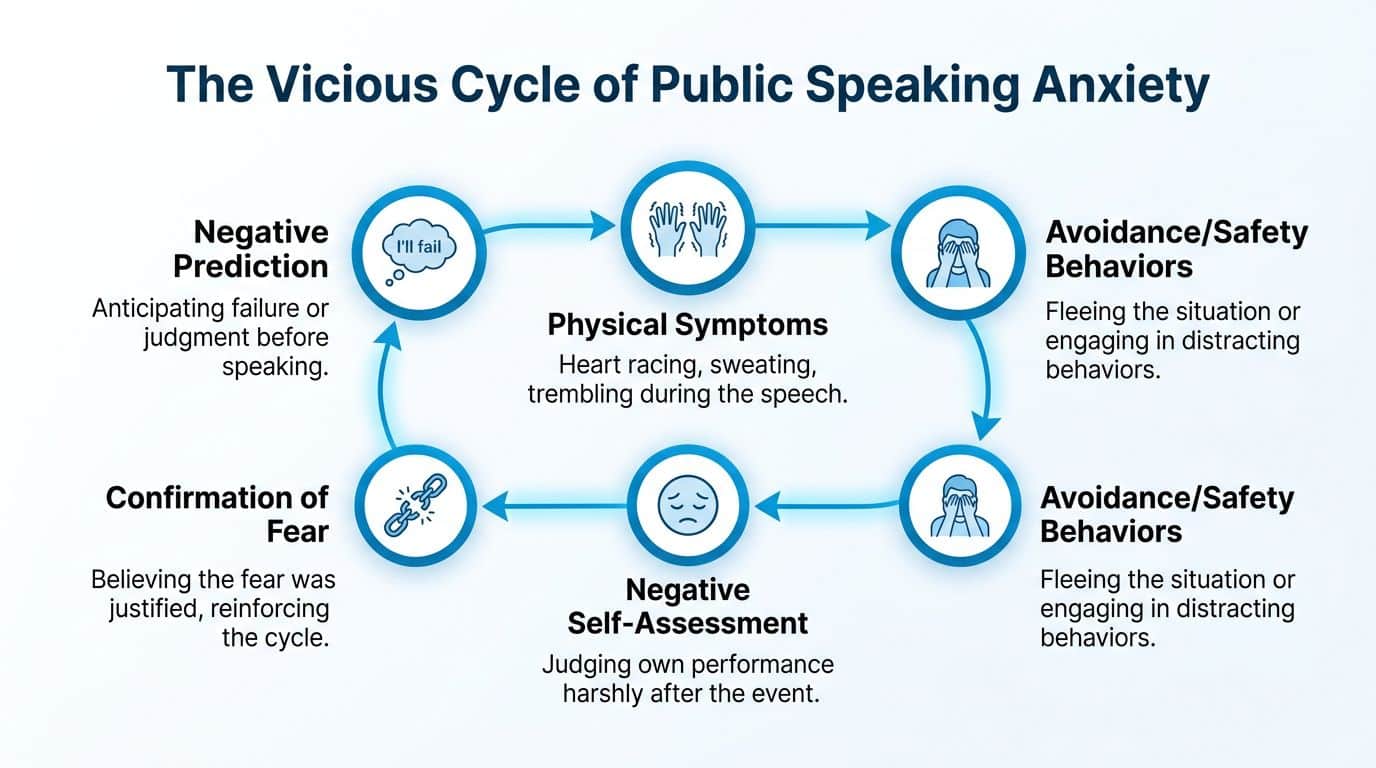
Public speaking anxiety often survives because it creates its own evidence. You predict disaster, your body reacts, you notice the reaction, and then you treat that reaction as proof that disaster is happening.
The same body of research also shows that self-reported anxiety predicts avoidance behavior, such as giving shorter presentations.
A typical cycle looks like this:
Negative prediction
“I'll mess this up.”Threat response
Your body speeds up and prepares for danger.Self-monitoring
You start scanning for signs that you're failing.Safety behaviors
You rush, avoid eye contact, read directly from notes, or speak as little as possible.Harsh review
Afterward, you replay the event and focus only on what felt wrong.Confirmation of fear
You conclude, “That was awful. I knew it.”
What symptoms usually look like
Not everyone experiences the same pattern. It helps to group symptoms into three areas.
Cognitive symptoms
Catastrophic thoughts: “I'll freeze.”
Mind reading: “They think I sound stupid.”
Perfectionistic rules: “If I hesitate once, I've failed.”Physical symptoms
Autonomic arousal: racing heart, sweating, flushing
Tension: shaky hands, tight jaw, trembling voice
Cognitive overload: mental blankness, trouble remembering pointsBehavioral symptoms
Avoidance: declining speaking opportunities
Escape strategies: speaking too quickly just to finish
Safety habits: over-reading notes, apologizing, hiding behind slides
The hidden trap of fearing the symptoms
A lot of people assume the main problem is the physical reaction. Often, the more damaging part is the interpretation of that reaction.
You notice your heart, throat, or hands. Then you think, “This means I'm losing control.” That thought increases alarm, and the cycle tightens.
Practical rule: The goal isn't to have zero anxiety. The goal is to stop treating anxiety as proof of failure.
That shift is central in CBT. You learn to interrupt the loop at the level of thought, attention, and behavior rather than waiting to magically feel calm first.
Why Public Speaking Feels Harder for Expats in Italy

Speaking is harder when language carries identity
For expats in Italy, public speaking anxiety rarely happens in isolation. It usually sits on top of acculturation stress, language fatigue, and the pressure to be competent in unfamiliar settings.
A native speaker can focus on content. An expat may have to focus on content, pronunciation, vocabulary retrieval, social hierarchy, and local communication style all at once. That extra mental load leaves less room for spontaneity.
Common thoughts include:
- “If I make a language mistake, they'll think I'm less intelligent.”
- “I can't sound like myself in this language.”
- “If I don't understand a reaction, I'll lose my place.”
- “I have to prove I deserve to be here.”
These are not superficial concerns. They touch belonging, competence, and identity.
Silence doesn't always mean rejection
Research discussed in this study on audience response and speaker stress highlights an overlooked problem for international professionals. An unresponsive or silent audience is often perceived by the speaker as disinterest, which significantly increases stress. For expats in Italy, that can be especially confusing when cultural norms around eye contact, interruption, warmth, or visible feedback differ from what they expect.
In some settings, an audience may look quiet and serious because they are listening carefully. An anxious speaker may interpret the same silence as boredom or criticism.
That misunderstanding can trigger a rapid spiral:
- Silence happens
- You read it as rejection
- Your threat system activates
- You lose flexibility and natural rhythm
- The presentation feels worse from the inside
- You leave believing the audience disliked you
If communication in a new culture already feels effortful, building stronger intercultural communication skills can reduce some of that strain.
Expat anxiety often includes role strain
Many expats in Italy are also navigating a role transition. You may have been articulate, persuasive, and confident at home. Abroad, you might feel reduced to a simpler version of yourself.
That gap can be painful. It's not just “I'm nervous about this presentation.” It can become, “I'm no longer the person I was when I spoke with ease.”
Public speaking anxiety in an expat context often reflects two fears at once. Fear of speaking badly, and fear of being misread as less capable than you really are.
This is why generic speaking advice often misses the mark. It may tell you to practice more, smile more, or imagine the audience in casual clothes. But if your fear is tied to identity, belonging, and cultural misinterpretation, you need a more psychologically informed approach.
Evidence-Based Strategies to Manage Speaking Anxiety
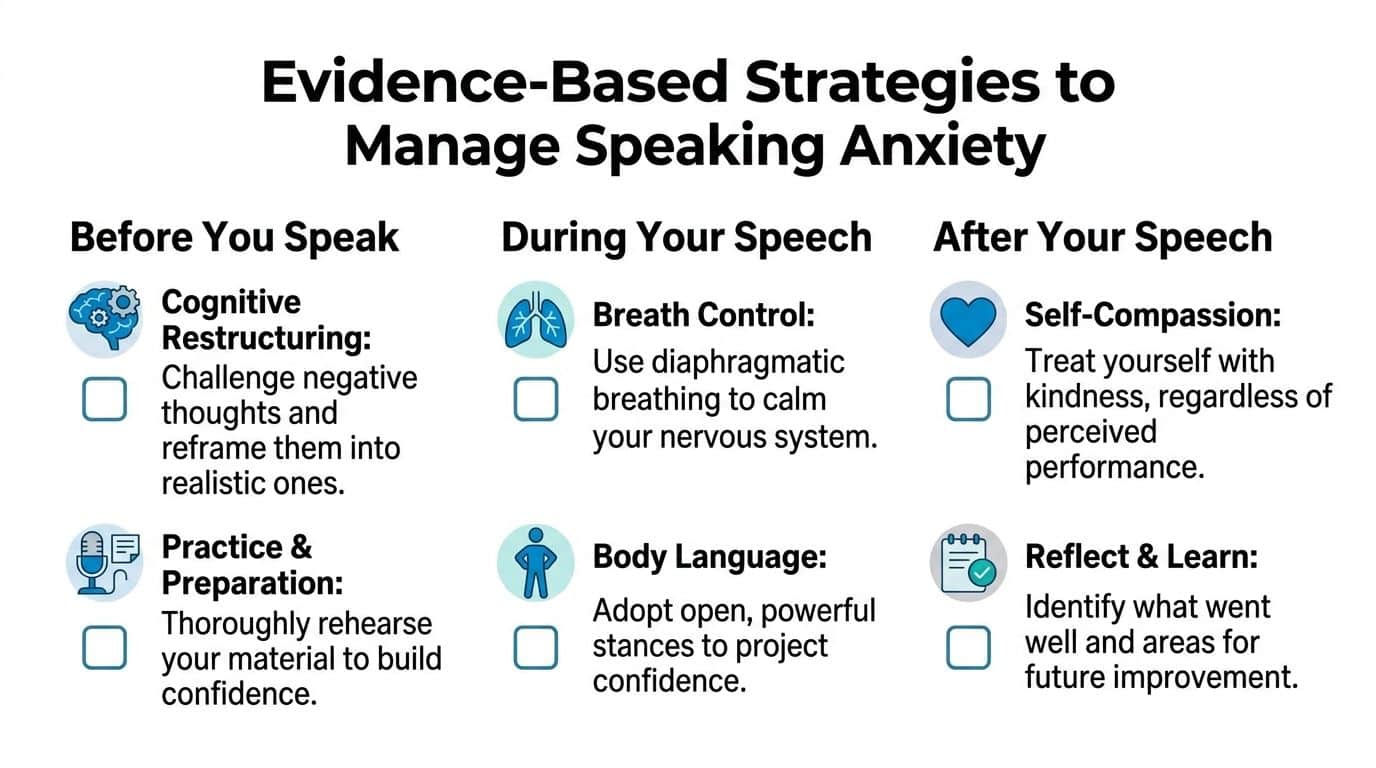
Use CBT to challenge the story your mind tells
Cognitive Behavioral Therapy, or CBT, is a proven, structured approach for overcoming glossophobia. It works by identifying and reshaping negative thoughts through Cognitive Restructuring, gradually facing fears via Exposure Therapy, and building confidence with Skills Training.
A simple CBT exercise starts with one anxious prediction. Write it down exactly as your mind says it.
Then ask:
What am I predicting?
“I will forget everything.”What evidence am I using?
“I felt blank once before.”What is a more accurate thought?
“I may feel anxious, but I can use notes and recover.”What would I tell a friend in this situation?
Usually something much kinder and more realistic.
CBT doesn't ask you to force positive thinking. It asks for balanced thinking.
If you want structured support with that process, CBT for anxiety is often one of the most practical starting points.
Practice exposure in small, planned steps
Avoidance keeps anxiety believable. Exposure weakens it. The key is to do it gradually and on purpose.
A realistic exposure ladder might look like this:
Low intensity
Record yourself speaking for two minutes on your phoneModerate intensity
Explain an idea aloud to one friend or colleagueHigher intensity
Ask a question in a group settingMore demanding
Deliver a short update in a meetingStretch goal
Give a formal presentation with time for questions
Stay with each step long enough for your brain to learn, “I can survive this.” Don't rush from zero to maximum difficulty.
Regulate your body without fighting it
When anxiety rises, many people try to suppress symptoms. That usually adds pressure. A better approach is to steady the nervous system.
Try this before speaking:
Lengthen the exhale
Breathe in gently, then make the out-breath slower than the in-breath.Drop your shoulders
Tension in the upper body can make your voice tighter.Plant your feet
Physical grounding sends your attention out of your head and back into the room.Pause on purpose
A short pause feels long to you. To the audience, it often feels clear and confident.
Some performers also benefit from practical rehearsal habits borrowed from stage work. If you want an additional non-clinical resource, this guide to practical strategies for performers offers ideas that can complement therapy.
Rehearse for flexibility, not perfection
Many anxious speakers rehearse in a way that makes fear worse. They try to memorize every sentence, then panic when one word doesn't come out right.
A more effective method is to prepare in layers:
| Focus | Helpful approach |
|---|---|
| Core message | Know the three points you want people to remember |
| Opening | Practice the first few lines until they feel familiar |
| Structure | Use keywords, not a full script |
| Recovery | Prepare one sentence for when you lose your place |
| Questions | Practice saying, “Let me think about that for a moment” |
“Confidence doesn't come from guaranteeing a perfect performance. It comes from trusting that you can recover.”
Review the event fairly afterward
After a speech, anxiety wants to run a biased audit. It highlights every hesitation and ignores everything that went well.
Try a three-part reflection:
- What worked
- What felt difficult
- What I want to practice next time
That kind of review builds skill. Rumination only builds dread.
When to Seek Professional Help for Public Speaking Fear
Signs that self-help may not be enough
Public speaking anxiety deserves professional support when it starts limiting your life in meaningful ways. You don't have to wait until it becomes unbearable.
Consider reaching out if:
- Your work is affected because you avoid presentations, meetings, or leadership opportunities
- Your studies are suffering because seminars, oral exams, or class participation feel unmanageable
- You experience intense distress long before and after speaking events
- You organize your life around avoidance
- The fear connects with broader anxiety, panic, trauma, perfectionism, or low self-worth
For some people, the issue is mainly situational. For others, public speaking fear is part of a larger pattern of social threat and self-criticism. Therapy helps clarify which one you're dealing with.
What professional support can help with
A therapist can help you do more than “be brave.” Good treatment targets the mechanisms maintaining the fear.
Depending on your needs, therapy may focus on:
- CBT to identify distortions, reduce catastrophic thinking, and test feared predictions
- Exposure work to rebuild confidence through repeated, manageable practice
- Schema Therapy to address deeper beliefs such as “I'm inadequate” or “I'll be humiliated”
- EMDR when speaking fear is linked to past experiences of embarrassment, criticism, or trauma
- Cross-cultural psychology to untangle what is anxiety and what is cultural misunderstanding
This matters for expats because treatment works best when the therapist also understands migration stress, identity shifts, and multilingual life. Therapy in your own language can make a major difference when the fear itself already involves self-expression.
If the problem is beginning to shape your choices, getting support through online therapy for anxiety can be a practical first step, especially if you travel often or live outside a major city.
Support is not a last resort
Many people wait too long because they think therapy should only be for severe cases. That idea keeps people stuck.
Professional help can be a proactive decision. It can help you speak with more steadiness, think more clearly under pressure, and stop measuring your worth by one performance.
FAQ
Is public speaking anxiety a form of social anxiety
Yes, it can be, but it isn't always. Public speaking anxiety may exist on its own, or it may be part of a broader pattern of social anxiety involving fear of judgment in many situations. The difference usually depends on whether the fear appears only during speaking tasks or across daily social interactions.
Can I overcome public speaking anxiety without becoming completely fearless
Yes, individuals often improve by learning to function well with some anxiety rather than waiting for fear to disappear. The aim is usually confidence, flexibility, and recovery, not emotional perfection. Many strong speakers still feel activated before they begin.
Why do I blank out even when I know my material
Blanking out is often a stress response, not a sign that you're unprepared. When your threat system activates, attention narrows and working memory becomes less reliable. That's why grounding, slower breathing, and a simple speaking structure help.
Is public speaking anxiety worse in a second language
Yes, it often feels worse in a second language because speaking also involves translation, self-monitoring, and fear of being judged for mistakes. Expats may also misread audience reactions when communication norms differ. That makes the task heavier both cognitively and emotionally.
What kind of therapy helps most with public speaking anxiety
CBT is one of the most established approaches for public speaking anxiety. It helps you challenge catastrophic thoughts, reduce avoidance, and practice speaking in manageable steps. For some people, deeper work such as EMDR or Schema Therapy is also useful, especially when the fear is tied to earlier painful experiences.
When should I get professional help instead of trying more tips
You should consider professional help when the fear starts limiting work, study, relationships, or everyday functioning. Therapy is also worth considering if you keep avoiding opportunities despite strong preparation. If the same cycle repeats, more tips alone usually won't solve it.
If public speaking anxiety is making life in Italy feel smaller than it should, you don't have to handle it alone. Book your first free assessment call with THERAPSY – no commitment, just a conversation with the Clinical Director who will listen carefully and match you with the right therapist for you.