Verona can look calm on the outside and feel disorienting on the inside. You might have a beautiful walk along the Adige, a job or degree that seems meaningful, and still find yourself crying more than usual, feeling flat, waking up tense, or wondering why everyday tasks suddenly feel heavier in Italy than they did at home.
An English speaking therapist in Verona is a licensed mental health professional who can work with you fully in English while understanding the extra layers of expat life, including culture shock, isolation, identity strain, relationship stress, and the difficulty of navigating support in a smaller Italian city. For many expats and international students, that combination matters more than people realize. Therapy isn't only about language. It's about feeling understood without having to translate your inner world first.
Many people start searching when things have already built up. A relocation. A breakup. Burnout. Panic on Sunday nights. Loneliness that doesn't fit the postcard version of Italy. If that's where you are, you're not behind. You're responding to something real.
Living in Verona and Needing Support
A lot of expats arrive in Verona expecting a softer version of Italian life. Smaller than Milan. Less frantic than Rome. More manageable. In some ways, that's true. The city can feel elegant, walkable, and eminently livable.
But emotional difficulty often gets sharper in places that are quieter.
A young adult who moved for a master's program, a relationship, or a new role can suddenly notice that their support system is gone. Friends are back home. Family is far away. Small daily misunderstandings in another language start to pile up. Even ordering paperwork, booking appointments, or explaining a symptom can become draining.

That doesn't mean something is wrong with you. It means your nervous system is adapting to change without its usual anchors.
A common expat mistake is to treat distress abroad as a personal weakness instead of a context problem.
Italy has a large mental health workforce, but access for foreigners is another matter. Italy has over 130,000 registered psychologists, yet the vast majority list services only in Italian, which creates a real access gap for expats who can't easily interact with the healthcare system according to this overview of finding an English-speaking therapist in Italy.
In practice, that means your search for support in Verona may feel strangely confusing. There may be professionals nearby, but not professionals you can confidently contact, assess, and work with in English. That gap is exactly why many people begin with a more focused local option such as therapy support in Verona.
What often brings people to therapy in Verona
The emotional themes are usually familiar, even when the city is new:
- Culture shock – You function well in one environment and feel unexpectedly fragile in another.
- Isolation – You miss effortless belonging, not just social plans.
- Relationship strain – Cross-cultural dating or family life can expose different expectations fast.
- Identity loss – You may feel less competent, less spontaneous, or less like yourself in a second language.
- Anxiety and burnout – The stress of adaptation can look like insomnia, overthinking, irritability, or shutdown.
These are common reasons to seek support. They also respond well to thoughtful therapy, especially when the therapist understands both psychology and intercultural transition.
Why Finding a Therapist in Verona Is Uniquely Challenging
Verona has many strengths as a place to live. Mental health access in English usually isn't one of them.
The first problem is supply. Public therapist directories for Verona require manual language filtering, and the available pool suggests that most listed clinicians are Italian-speaking professionals who have learned English rather than native English-speaking or expat-specialized therapists according to Verona therapist listings.
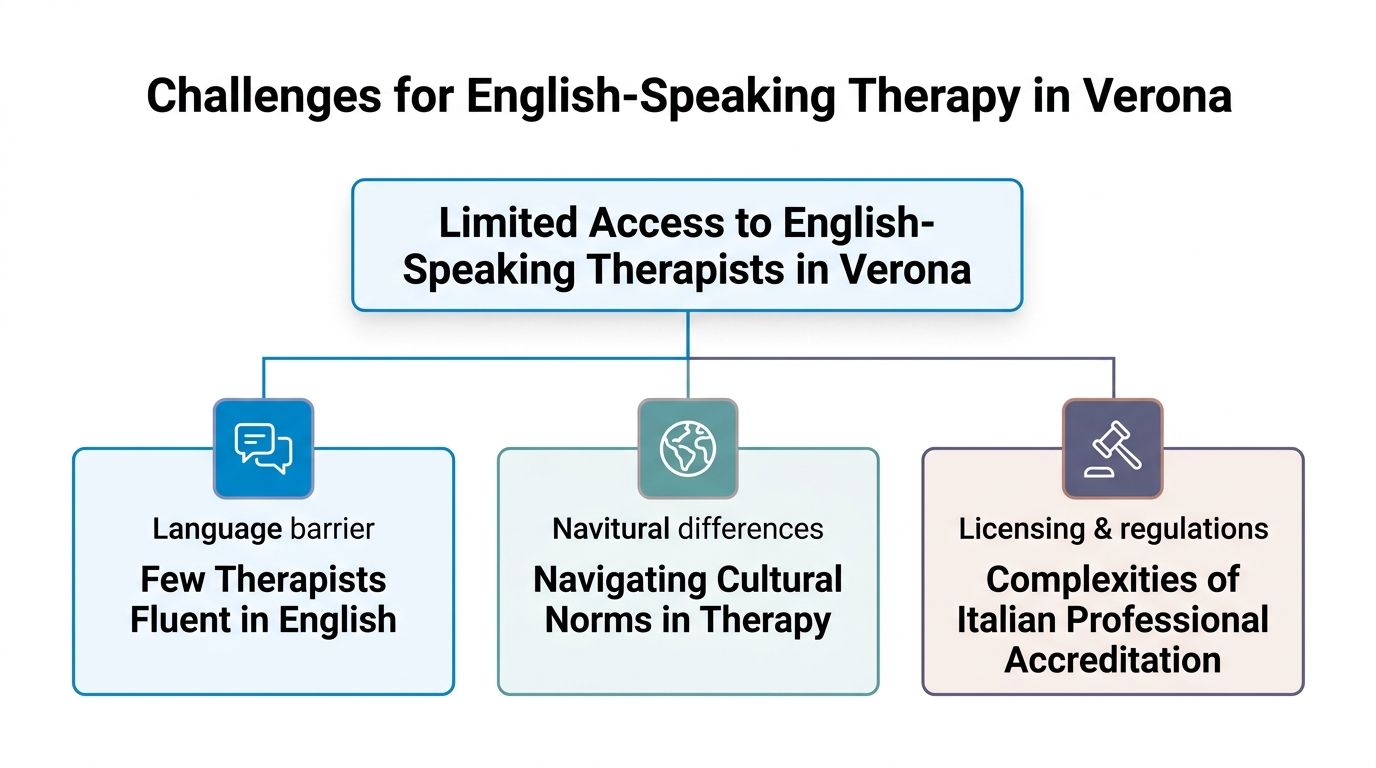
That difference matters more than it sounds.
Speaking English isn't the same as practicing therapy interculturally
A therapist may be perfectly competent and still not be the right fit for an expat client. Good intercultural therapy requires more than conversational fluency.
A useful distinction is this:
| What you need | Why it matters |
|---|---|
| Clinical fluency in English | You need to describe nuance, memory, shame, grief, and conflict without searching for words. |
| Intercultural awareness | Your therapist should understand migration stress, identity shifts, and adaptation fatigue. |
| Local knowledge | Verona has its own pace, social codes, and practical barriers that affect mental health. |
If a therapist speaks English well but doesn't really work with relocation, mixed-language relationships, or bicultural identity, sessions can feel oddly flat. You may spend half the hour explaining your context.
Therapy works better when you don't have to defend why your experience abroad feels hard.
Smaller cities create a verification problem
In Milan or Rome, people often assume there are more visible options. In Verona, the harder part is often verification. Is the therapist local? Do they work in English? Is in-person care really available, or is the listing just broad enough to catch searches?
That uncertainty creates a second barrier. Expats often end up on generic platforms where the process feels efficient but impersonal. A profile can look polished and still tell you very little about clinical fit.
Some people do fine with a broad directory. Others don't. The trade-off is simple:
- Large listing platforms give breadth – You can browse many profiles quickly.
- Human-led matching gives depth – Someone considers your symptoms, language, personality, and context before suggesting a therapist.
For expat mental health, depth usually matters more. If you're dealing with trauma, panic, burnout, or a fragile relationship, a poor match can make you feel therapy isn't for you, when the underlying issue was fit.
A more grounded approach is to start with guidance on finding the right therapist as an expat in Italy, then narrow your search based on language, modality, and your actual problem rather than convenience alone.
In-Person vs Online Therapy Options for Verona Residents
If you're looking for an English speaking therapist in Verona, one of the first real decisions is whether you want in-person sessions, online sessions, or both as options. Many people treat this as a simple preference. In reality, it's often a strategic choice.
For expats in smaller Italian cities, online therapy is often the most practical way to reach a therapist who is clinically qualified, culturally aware, and comfortable working in English. That doesn't make it second-best. It makes it realistic.
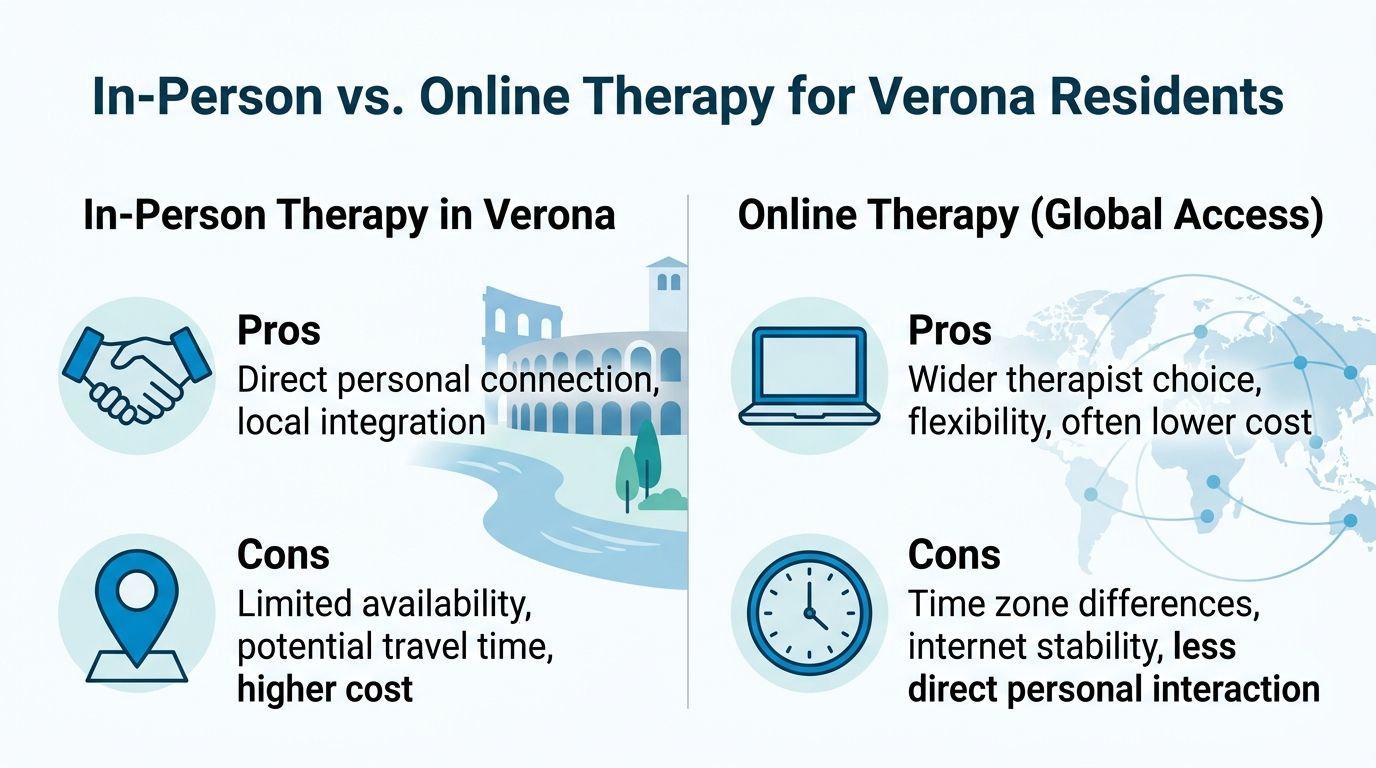
A local challenge often goes unaddressed in generic search content. Many Verona searches lead to directories or pages that mention therapists in bigger cities without clearly confirming whether in-person care is available in Verona as shown in this Verona counseling result.
When in-person therapy makes sense
In-person sessions can be especially helpful if you:
- Feel disconnected from your body – Being physically in the room can support grounding.
- Need a local anchor – Walking to a regular appointment can create routine and containment.
- Want Verona-based integration – A therapist who understands local rhythms, neighborhoods, and social life can make the work feel more rooted.
Some clients also feel safer face to face. That's a valid reason. Therapy doesn't need to be optimized like a calendar problem. It needs to feel usable.
When online therapy is the smarter option
Online therapy often works well if you:
Need better therapist choice
You can widen the pool beyond whoever happens to be nearest.Have a demanding schedule
This matters for students, commuters, shift workers, and parents.Need continuity
If you travel, relocate, or spend time between cities, online care is easier to maintain.Want a specialist
Trauma, intercultural couples work, or burnout often require more than general counseling.
A lot of international readers now expect healthcare to be easy to access digitally. That's different from therapy itself, but it shows why convenience and access now shape help-seeking behavior.
Practical rule: Choose the format that increases the chance you'll actually start and continue.
The best setup is often flexibility
For many Verona residents, the strongest option is a service that offers both. You might begin online because it's faster and gives you access to a better match, then move to in-person sessions if that becomes available or helpful. Or you might do the reverse.
That kind of flexibility is especially useful when life in Italy is still settling. Work contracts change. University schedules shift. Relationships evolve. A rigid therapy format can become one more obstacle.
If you're weighing the two carefully, this guide on online vs in-person therapy in Italy for expats is a practical place to compare what each format offers in daily life, not just in theory.
Key Questions to Ask a Potential Therapist
When you're overwhelmed, it's easy to treat the first available appointment as good enough. Sometimes that's fine. Often it isn't.
A short consultation can tell you a lot if you ask the right questions. You're not being difficult. You're checking whether this person can hold your story in a way that helps.
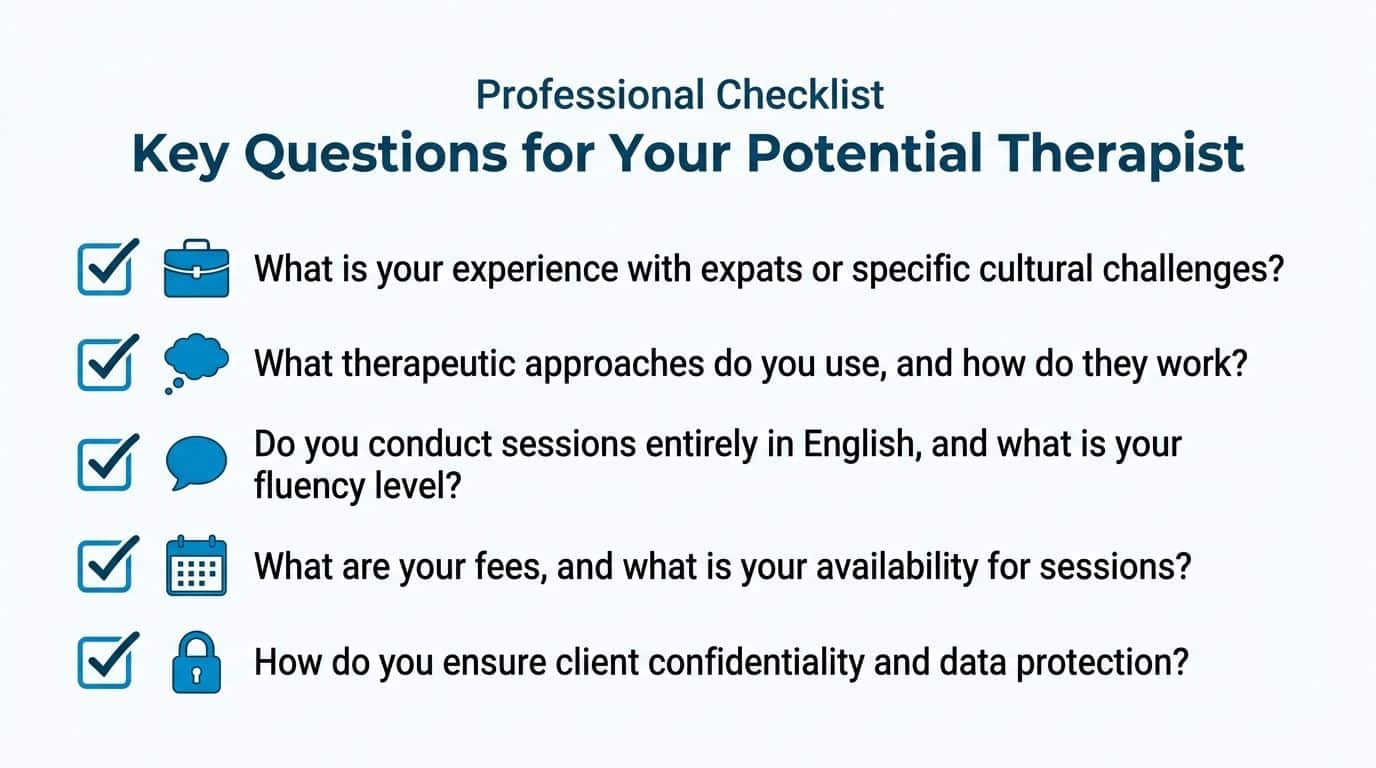
Questions that actually help you choose well
What experience do you have with expats, international students, or cross-cultural couples?
You want to hear more than "I speak English." Listen for whether they understand homesickness, migration stress, identity shifts, and belonging.Do you work fully in English, including emotionally complex sessions?
This matters if you need American or British English nuance, or if you know you'll struggle to discuss trauma, shame, or grief in Italian.What therapeutic approach do you use?
A good therapist should explain their method in plain language, not hide behind jargon.How do you decide whether we're a good fit?
Their answer tells you a lot about how thoughtful their process is.What happens if I don't feel matched after the first sessions?
Good care includes room for adjustment.
What to listen for in the answer
You don't need perfect wording. You need signs of clarity.
Look for:
- Specificity – They can explain how they work with anxiety, trauma, burnout, or adjustment.
- Comfort with complexity – They don't reduce expat distress to simple homesickness.
- Transparency – They explain fees, availability, confidentiality, and format clearly.
- Humility – They can say when another therapist or modality may suit you better.
A good consultation usually leaves you feeling clearer, not more confused.
Questions about safety and process
These are easy to skip when you're nervous, but they're worth asking:
- Are you licensed, and what is your clinical qualification?
- How do you protect confidentiality and client data?
- Do you offer online, in-person, or both?
- What is your availability if I need regular weekly sessions?
A practical conversation about these basics can lower anxiety quickly. If you freeze during calls, write your questions down first. This guide on how to talk to a therapist can help you prepare without overthinking every sentence.
Understanding Therapeutic Approaches and Session Costs
Therapy often feels mysterious before the first session. The words can sound technical. The price structure can feel vague. Both are easier to understand than they seem.
Common approaches that expats often find useful
CBT, or cognitive behavioral therapy, helps you notice patterns between thoughts, emotions, behaviors, and physical reactions. It's often useful for anxiety, panic, perfectionism, low mood, and adjustment stress. In plain terms, CBT helps you catch the loop that keeps distress going.
EMDR is often used for trauma, distressing memories, and experiences that still feel emotionally "stuck." It doesn't erase memory. It helps the brain process experiences that still trigger strong emotional or bodily reactions.
Schema Therapy looks at deeper patterns that often start earlier in life and become more visible under stress. Relocation can activate old themes fast, such as abandonment, failure, over-responsibility, or not belonging. That's why some expats say, "Moving to Italy brought up things I thought I'd already dealt with."
Other approaches can also be useful, including systemic-relational work for couples, humanistic therapy for identity and self-worth, and ethnopsychotherapy when cultural context is central to the work.
What these approaches look like in real life
| Approach | Often helpful for | What sessions may focus on |
|---|---|---|
| CBT | Anxiety, overthinking, burnout | Thoughts, habits, triggers, coping patterns |
| EMDR | Trauma, intrusive memories, panic after specific events | Processing unhealed experiences |
| Schema Therapy | Repeating relational patterns, identity strain, chronic self-criticism | Deep emotional themes and life patterns |
You don't need to choose the model alone. A good therapist helps translate your symptoms into an approach that fits.
What session costs usually mean
Private therapy in Italy is often priced according to training, specialization, language, and format. What matters most is clarity before you begin.
Current pricing for this type of care is commonly presented as:
- Individual therapy from €70/session
- Couple therapy from €100/session
- Psychiatric consultation from €110/session
- Psychodiagnostic assessment from €255 for 3 sessions
Those are starting points, not guarantees for every clinician or case. Higher specialization, certain modalities, and couple work often affect the final fee. If cost is a concern, it helps to ask not only "How much is one session?" but also "What pace of therapy do you recommend?" Weekly, biweekly, and structured short-term work can feel very different financially.
A practical overview of pricing expectations is available in this guide on how much therapy costs in Italy.
A Trusted Path to Finding Support in and Around Verona
By the time someone searches for an English speaking therapist in Verona, they usually don't need more generic advice. They need a path that reduces uncertainty.
That path should answer four questions clearly:
- Can I speak in my own language?
- Is the therapist clinically qualified?
- Can I access care from Verona without endless searching?
- If the first match isn't right, what happens next?
One established option in this space is Therapsy. Founded in 2023, it works with 50+ licensed therapists across 20+ Italian cities, including Verona, offers online and in-person sessions, has served over 1,000 international clients, and holds a Trustpilot rating of 4.8/5 marked "Excellent" as described on its page for therapy in Italy for expats.
Why this model fits secondary cities better
For a city like Verona, the main issue isn't only finding a therapist. It's finding a therapist with verified credentials, the right language, and enough intercultural sensitivity to understand your life without making you educate them first.
A human-matched model helps with that because it doesn't rely only on browsing profiles. It starts from your actual situation:
- Adjustment difficulty after moving
- Relationship tension in a bicultural context
- Anxiety or panic that worsened abroad
- Trauma work that requires EMDR or a similar approach
- Burnout while functioning well on the surface
That matters because good therapy is less about picking the nicest bio and more about finding fit.
What usually works better than endless browsing
People often spend days comparing profiles and still feel uncertain. A simpler route is usually:
- Clarify the problem you're bringing.
- State the language and format you need.
- Ask for a qualified match.
- Use the first conversation to assess fit, not to force a decision.
The free first assessment call is useful here because it lowers pressure. You don't need to commit before you've spoken to someone. You don't need to explain everything perfectly either. You just need enough space to say what's been hard and what kind of support would help.
The right first step in therapy is often not certainty. It's a safe conversation with the right person.
The English-speaking therapists we work with near Verona
Therapsy works with therapists in Padua, Bergamo and Milan, and all of them also see patients online, wherever in Italy you live.
Dr. Thieny Ribeiro receives in Padua and offers sessions in Portuguese and Spanish. A distinct part of her practice is palliative psychology and work with grief.
Dr. Svetlana Loginova receives in Bergamo and Milan and offers sessions in Russian. She specialises in eating disorders and body image and in international couples.
Dr. Lucia Focella receives in Padua and works on cognitive rehabilitation, ADHD and learning differences, with a background in clinical neuropsychology.
You tell Therapsy what you are looking for, a member of our clinical team reads your request, and they introduce you to whoever fits, in person where possible and online where it works better. The first call is free.
FAQ
Can I really find an English speaking therapist in Verona
Yes, but the search is usually narrower and less transparent than people expect. Verona has fewer clearly visible English-speaking options than larger cities, so it helps to look for verified services or clinicians who can clearly confirm language, credentials, and whether they offer in-person or online sessions.
Is online therapy a good option if I live in Verona
Yes, online therapy can be an excellent option for Verona residents. It often gives you access to a wider pool of therapists with expat experience, stronger language fit, and more scheduling flexibility than a purely local search.
What should I ask in a first consultation
Ask directly about licensing, experience with expats, language fluency, therapeutic approach, confidentiality, and session format. The point isn't to interview the therapist aggressively. It's to understand whether they can meet you in the kind of problem you're living.
How much does English-language therapy in Verona cost
Private therapy costs vary, so it's best to expect a starting range rather than a single fixed fee. A common unanswered concern for expats is how pricing and insurance coverage in Verona compare with Milan, and whether there are local Servizio Sanitario Nazionale pathways for English-speaking care, which is noted in this overview of therapist access questions in Italy. Asking about starting fees, insurance documents, and session frequency early can prevent confusion later.
Can I use the Italian public health system for therapy in English
Sometimes, but it can be difficult to confirm English-language availability in practice. Many expats find the main obstacles are language, bureaucracy, and uncertainty about referral pathways, so private therapy is often the more straightforward route when timely English-speaking care is needed.
What's the difference between a therapist who speaks English and one who understands expat issues
The difference is usually depth of understanding. A therapist may speak English competently, but an expat-informed therapist also understands migration stress, cultural adjustment, identity shifts, mixed-language relationships, and the emotional effect of living far from your support system.
What happens in a free assessment call
A free assessment call is usually a short conversation to understand what you're struggling with, what language and format you need, and whether the match feels right. It isn't a commitment and it isn't a test. It's a low-pressure way to begin.
If you're feeling lost, overwhelmed, or tired of searching without knowing who to trust, book your first free assessment call with THERAPSY. There's no commitment and no payment for that first conversation, just a chance to speak with the Clinical Director and be matched with the therapist who fits you best.