When your child leaves home in Italy, the silence can feel sharper than expected. The kitchen is tidy for once. The hallway stays quiet. Your phone becomes the place where you wait for family life to happen. For many expat parents, empty nest syndrome doesn't feel like a simple adjustment. It feels like losing the emotional centre of daily life.
Empty nest syndrome is the distress and mixed emotional response some parents experience when their children leave home. In expat life, that transition can feel especially intense because the family unit abroad often carries far more emotional weight than it would back home. If your child was your closest companion, your anchor in a foreign culture, or the person around whom your routine was organised, their departure can bring grief, anxiety, loneliness, and a painful loss of purpose.
As a psychotherapist working with international families in Italy, I often see how this transition is misunderstood. People minimise it. They tell themselves they should be grateful, proud, busy, or “used to it by now”. But grief doesn't respond well to self-criticism. It responds better to language, structure, and support. This is particularly true for expat parents navigating not only separation, but also intercultural distance, changes in identity, and a very different rhythm of family life abroad.
What Empty Nest Syndrome Feels Like for Expats in Italy
You may be living in Milan, Florence, Rome, or a smaller Italian town where you built family life from scratch. For years, your home may have revolved around school calendars, bilingual conversations, travel plans, paperwork, meals, and emotional caretaking. Then your child leaves. Sometimes for university. Sometimes for work. Sometimes to move across borders again.
The practical change is obvious. The emotional one is harder to name.
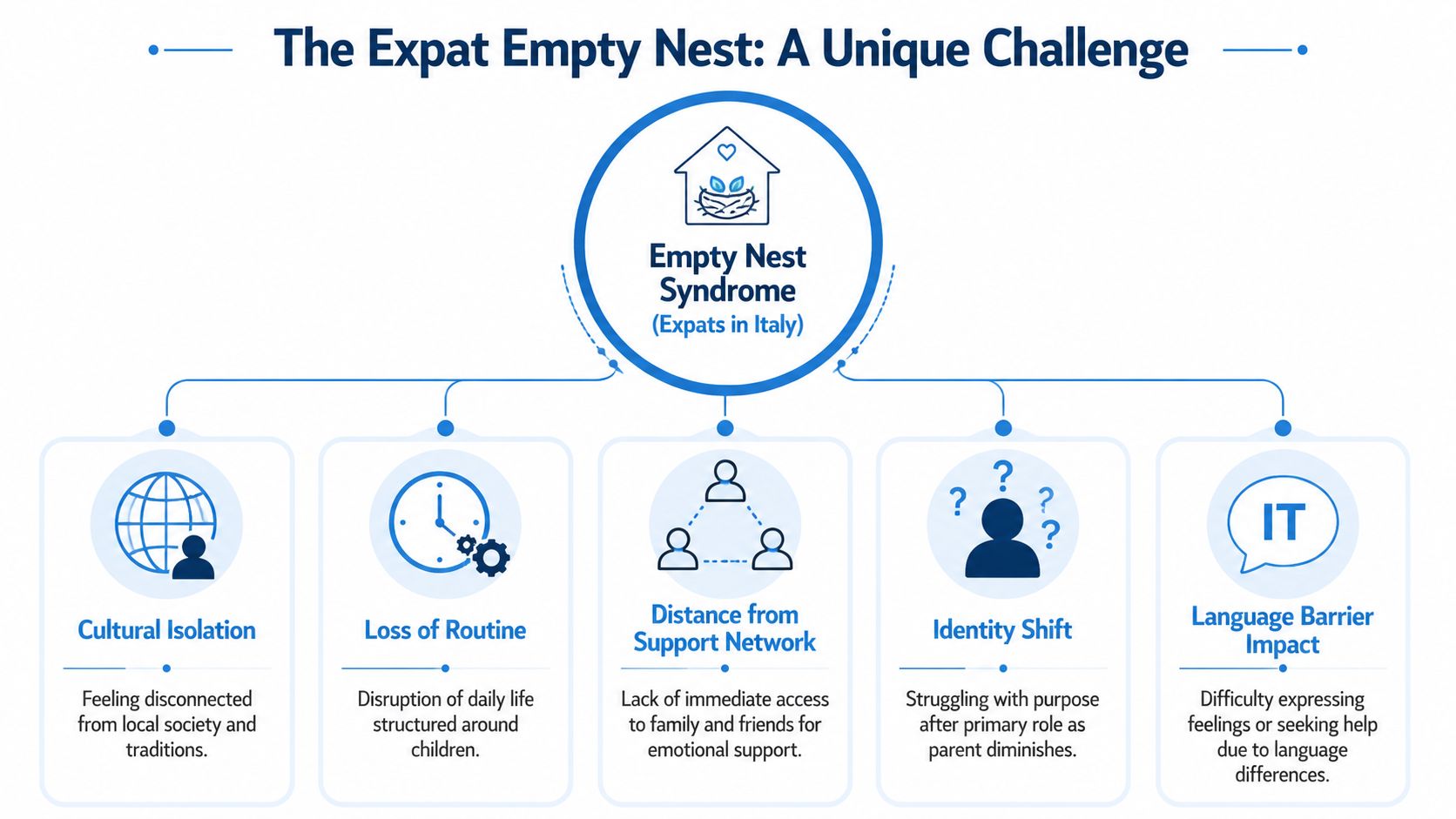
Empty nest syndrome is often more severe for expat parents because, abroad, the family may be the main source of emotional and social connection. When a child leaves, the loss can feel wider than the departure itself. This dynamic is described in this discussion of expat family dependency and grief.
Why the expat version often hits harder
In many domestic situations, parents still have old friends nearby, familiar routines, siblings, extended family, and a shared cultural script for this life stage. Expats often don't.
When the child leaves, several losses can happen at once:
- Loss of daily role. Parenting had organised your hours, attention, and emotional energy.
- Loss of witness. Your child may have been the person who shared your life in Italy most closely.
- Loss of belonging. Without the active family unit, your link to local routines can weaken.
- Loss of language comfort. You may struggle to express vulnerability in Italian, especially under stress.
- Loss of structure. Meals, weekends, holidays, and even errands can suddenly feel strangely empty.
The same source also outlines common symptoms such as sadness, loss, depression, loneliness, anxiety about a child's wellbeing, loss of meaning, and marital tension.
What parents usually describe in the consulting room
The feeling isn't always dramatic. Often it's diffuse.
You may notice:
- A quiet ache in the house. Rooms feel changed, not just empty.
- Persistent mental checking. You watch your phone, track replies, and worry when messages are short.
- A reduced sense of purpose. Tasks that once felt necessary now feel optional or flat.
- Irritability with your partner. The relationship has more space, but not always more ease.
- Withdrawal from local life. Going out in Italy can feel harder when your main companion is gone.
Some parents also realise that loneliness abroad was already present, but parenting kept it covered. Once the caregiving routine falls away, the underlying isolation becomes more visible. If that part resonates, support around expat loneliness in Italy can help name what is grief and what is longstanding disconnection.
If you're trying to rebuild a wider support system, practical communities matter. Some parents find a useful starting point in curated digital nomad resources that point toward events, meetups, and expat-oriented ways of reconnecting with life outside the family bubble.
The Four Psychological Stages of the Empty Nest
Parents often feel alarmed by how changeable this experience is. One week you are tearful and exhausted. The next, you feel strangely numb. Then you throw yourself into projects, travel planning, or constant contact with your child. This fluctuation isn't random.
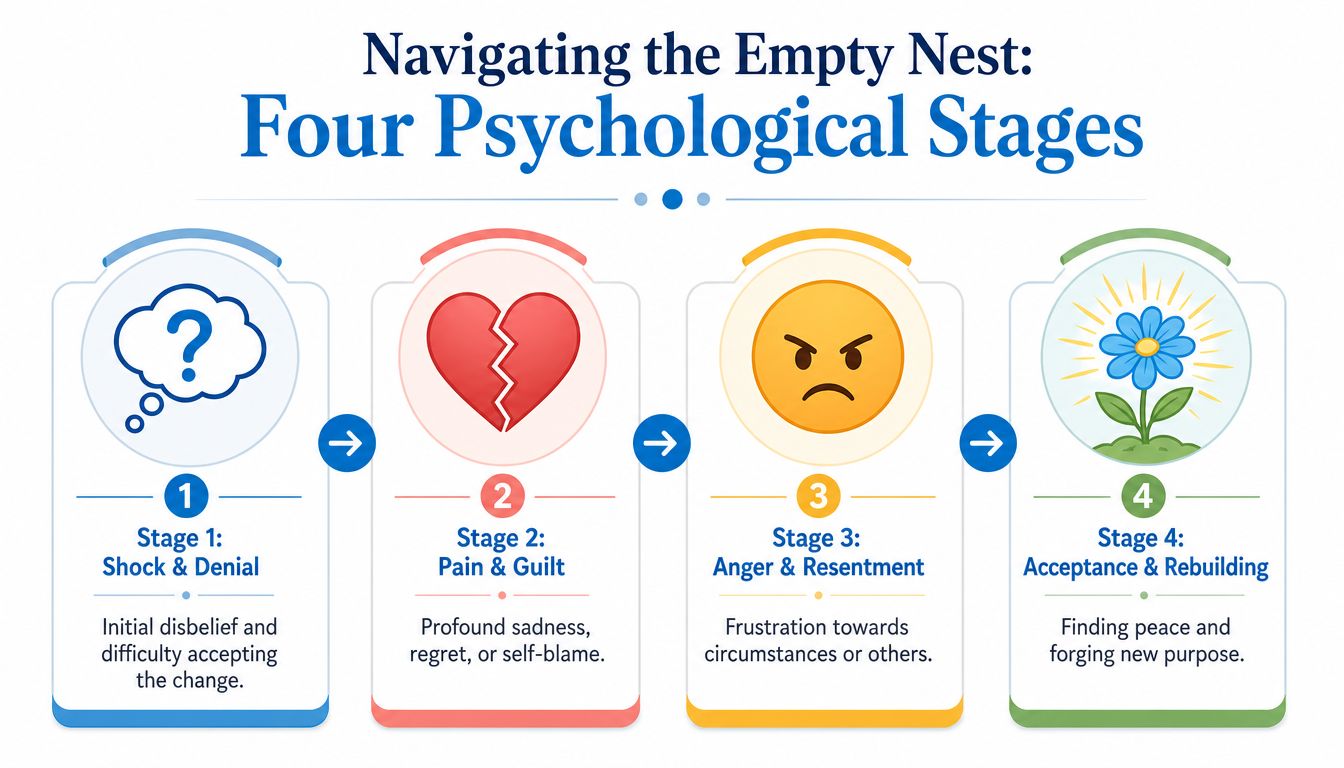
The psychological process of empty nest syndrome follows a documented four-stage trajectory that can span up to two years, moving from mourning or resistance, to passivity and loss of purpose, then impulsive or sublimation behaviours, and finally adaptation and relief, as described in this clinical review.
Mourning and resistance
This first period often includes crying, anxiety, mood swings, poor concentration, and a wish to reverse the change. In expat families, resistance can show up as frequent calling, over-monitoring, or an urgent need to stay indispensable.
This stage often sounds like:
- “I know this is normal, but I can't settle.”
- “I keep thinking of reasons they should come home.”
- “I don't know who I am when nobody needs me in the same way.”
Passive behaviours and loss of purpose
After the initial emotional surge, some parents go flat. They stop reaching outward. They move through the day, but without vitality. In CBT terms, this often looks like behavioural withdrawal, where the person does less and feels worse, then does even less.
For expat parents in Italy, this phase can become very quiet. You may stop going to language class. You may avoid local friends. You may spend more time indoors because there is no school run, no family lunch to plan, no one to organise life around.
If you've ever thought, “I've been living through my role, not through myself”, losing yourself as an expat can feel painfully familiar here.
Impulsive or sublimation behaviours
This is the stage people often misread. From the outside, you may look “better” because you suddenly get busy. But busyness isn't always healing.
Some parents:
- Start projects they don't really want.
- Push for constant travel or social plans to avoid being at home.
- Become intrusive with their adult child under the banner of closeness.
- Overfocus on food, shopping, scrolling, or productivity.
The function is usually the same. It creates movement so you don't have to feel the depth of the void.
Adaptation and relief
Adaptation doesn't mean you stop missing your child. It means the missing no longer controls the whole emotional climate of your day.
Relief begins when parenting stops being your only active identity.
Parents in this stage usually start to:
- Rebuild self-care with more consistency
- Invest in adult relationships with less resentment
- Accept changed contact patterns without panic
- Develop a self beyond the caregiving role
The timeline is different for everyone. What matters clinically is not speed, but movement.
Distinguishing Grief from Clinical Depression
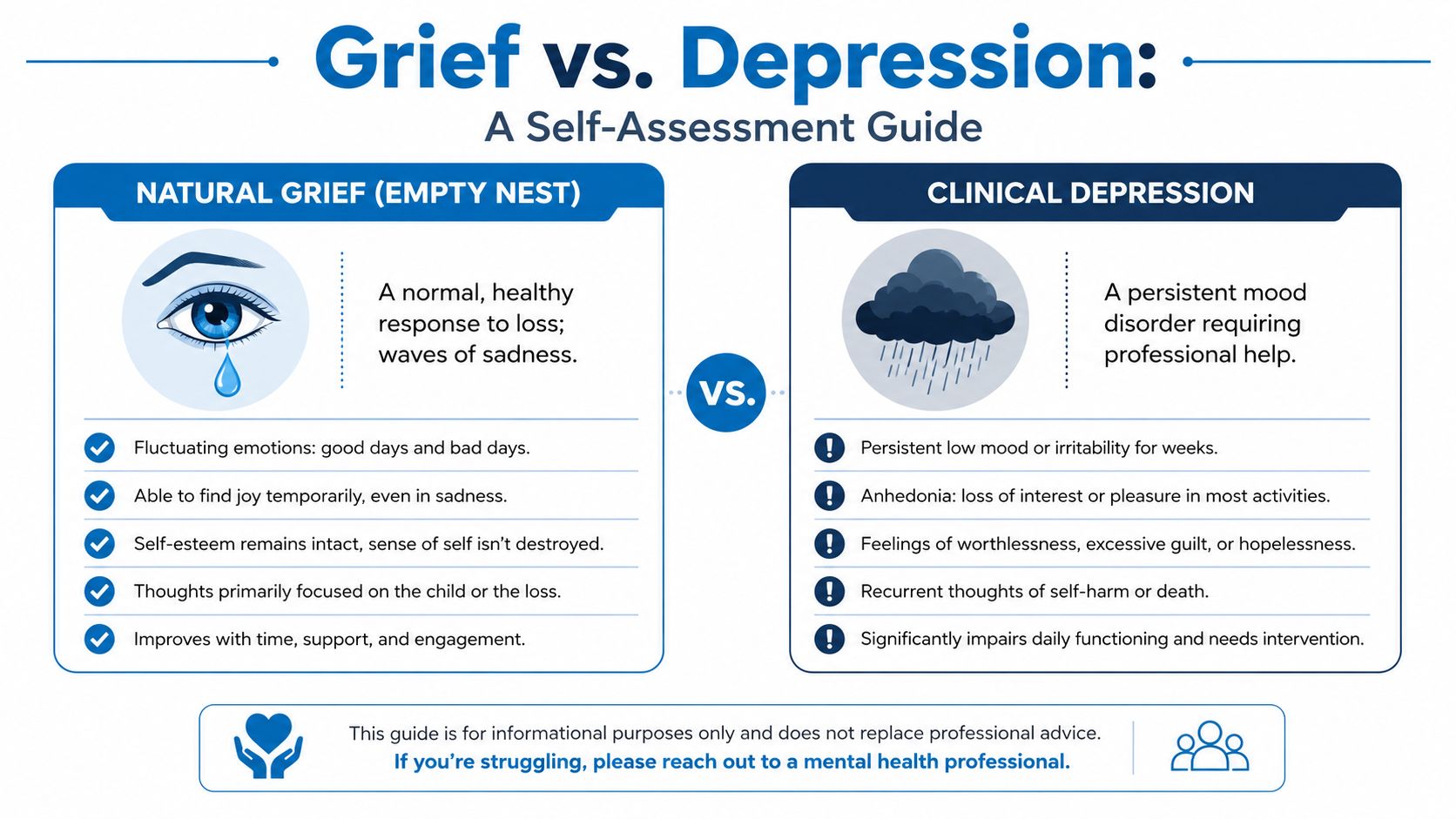
Grief after a child leaves home is real. It can be intense, disorganising, and painful. But grief is not automatically the same thing as clinical depression.
This distinction matters because the right response depends on what is happening. A parent in grief usually needs validation, structure, and careful reconnection. A parent in depression may need a more focused clinical assessment and stronger support.
Clinical assessments of adults aged 50 to 75 in the empty nest stage found a mean loneliness scale score of 61.7 (SD 10.23), indicating severe loneliness, along with lower perceived social support and higher rates of depression compared with non-empty nesters, according to this study summary.
What grief usually looks like
Grief tends to move in waves. You may have painful mornings and lighter afternoons. A song, meal, or empty room may trigger tears, but you can still feel pleasure, connection, or interest at other moments.
Grief often includes:
- Sadness linked to the separation
- Thoughts centred on the child and the changed family life
- Preserved self-worth, even if you feel lost
- A gradual softening when you stay connected to life
What depression usually looks like
Depression is more pervasive. The low mood becomes less tied to one trigger and more like the atmosphere of the whole day. Pleasure drops across many areas, not only family-related ones.
Warning features include:
- Persistent low mood or emotional numbness
- Loss of interest in most activities
- Hopelessness or excessive guilt
- Strong impairment in sleep, motivation, concentration, or daily functioning
- Thoughts of self-harm or death
If you or someone near you is in immediate danger, call 112, the emergency number in Italy and across the EU. Therapy is not an emergency service.
If your suffering is no longer mainly about missing your child, and has become a general collapse in how you feel, think, sleep, or function, treat it as a mental health concern rather than “just a phase”.
Empty Nest Syndrome vs. Depression Key Differences
| Symptom Area | Empty Nest Syndrome (Grief) | Clinical Depression |
|---|---|---|
| Emotional pattern | Comes in waves, often linked to reminders | More persistent and generalised |
| Focus of thoughts | Mainly about the child, distance, changed role | Broad hopelessness or negative view of self and life |
| Capacity for pleasure | Joy is still possible at times | Pleasure is markedly reduced across life |
| Self-esteem | Usually remains intact | Often drops into worthlessness or excessive guilt |
| Daily functioning | Strained but often partly preserved | More significantly impaired |
If you're unsure whether your symptoms fit grief or something more serious, it helps to review recognised major depression symptoms and seek professional input rather than trying to diagnose yourself from exhaustion.
Practical Steps to Rebuild Your Life and Purpose
Relief rarely comes from waiting to “feel ready”. It usually starts when you create small structures that support a new identity. This is especially important for parents whose role was highly caregiving, including stay-at-home and single parents.

Start with routine before meaning
Many parents try to solve the existential question first. “Who am I now?” is important, but it is often too large to answer when your nervous system is dysregulated.
Start smaller:
- Anchor your mornings. Wake, wash, eat, and step outside at a regular time.
- Put one social contact in the week. Not five. One reliable point of contact.
- Choose one place in Italy that becomes yours. A café, market, walking route, library, church, studio, or class.
Purpose grows more easily when your days have shape.
Rebuild identity through action
Identity isn't found only through insight. It is also rebuilt through repeated behaviour.
Useful examples include:
- Language-based belonging. Join a conversation exchange if speaking Italian still makes you feel on the edge of local life.
- Adult learning. Short courses in art, history, cooking, writing, or design can reactivate curiosity.
- Mentoring and service. Some parents regain vitality when their care becomes outward-facing rather than child-focused.
Protect against unhelpful coping
Be honest about your coping:
- If you drink more in the evening, ask what feeling the alcohol is covering.
- If you scroll for hours, notice whether you are avoiding grief, envy, or fear.
- If you isolate, don't mistake withdrawal for rest.
- If you become overinvolved in your child's life, ask whether contact is soothing or escalating your anxiety.
Strengthen self-worth outside the parent role
For many expat parents, the deepest wound is not only loss. It is the fear that their value has shrunk.
A stable self-esteem says, “I am still meaningful, even when I am not needed in the old way.”
That belief usually needs practice, not just reassurance. Work that supports how to build self-esteem can be especially important when parenting was the main source of identity, competence, and emotional reward.
How Therapy Supports Parents Through This Transition
Some parents adjust with time, structure, and support from friends. Others remain stuck in grief, anxiety, resentment, or chronic overattachment. Therapy becomes useful when insight alone isn't changing the pattern.
A common concern among parents is how to stay emotionally connected without becoming intrusive. One frequently asked question is how to maintain a healthy relationship with a child who has moved abroad to Italy without becoming emotionally burdensome. Generic advice often says “communicate openly”, but that misses the nuance of cross-cultural communication, especially when Italian family expectations and expat norms of independence collide, as discussed in this reflection on empty nest and moving to Italy.
What CBT can help with
Cognitive Behavioural Therapy (CBT) helps identify thoughts that intensify suffering and replace them with more grounded alternatives. In empty nest work, these thoughts often sound like:
- “If they need me less, I matter less.”
- “Good mothers don't feel angry about this.”
- “If I don't check in, something will go wrong.”
- “My best years are over.”
CBT doesn't ask you to become artificially positive. It helps you test whether a thought is accurate, useful, and fair.
What Schema Therapy can uncover
Schema Therapy is often helpful when empty nest syndrome activates older emotional patterns. Some parents discover that the child's departure awakens abandonment fears, self-sacrificing habits, or a lifelong tendency to gain worth by being needed.
That matters because the pain isn't only about this transition. It is also about the deeper story your mind attaches to it.
What EMDR and relational work can support
EMDR can be useful when the transition connects to unresolved losses, migration trauma, or earlier family ruptures. The body may react to your child's departure as if it confirms an older wound. EMDR helps process distressing memories so present-day separations feel less overwhelming.
When the strain is affecting the couple or the wider family system, relational approaches can help too. Parents often don't suffer in the same way or at the same pace. One partner may be grieving openly, while the other becomes practical, distant, or irritable.
Therapy can also help with the communication shift itself. If you are mourning the loss of closeness and also struggling with timing, boundaries, or emotional tone, focused support around grief therapy in English in Italy can provide a space to mourn without turning your child into your only regulator.
FAQ
Is empty nest syndrome worse for expat parents in Italy?
Yes, it often can be. Expat parents may rely more heavily on the family unit for companionship, identity, and stability, so a child's departure can create a larger emotional gap. The absence of nearby relatives, familiar community, and cultural ease can intensify the experience.
How long does empty nest syndrome usually last?
It varies, but the psychological process has been described as a four-stage trajectory that can span up to two years. That doesn't mean you will feel equally distressed for all that time. Individuals typically move through periods of grief, adjustment, and rebuilding rather than staying in one fixed emotional state.
How do I stay close to my child without overwhelming them?
Aim for warm, respectful contact rather than anxious contact. Agreeing on a communication rhythm can help, especially when your expectations about family closeness differ from your child's current lifestyle or cultural environment. The goal is connection without turning every message into a test of reassurance.
When should I worry that this is depression, not grief?
You should pay attention when low mood becomes persistent, broad, and impairing. If you lose interest in most activities, feel hopeless or worthless, or struggle significantly with sleep, functioning, or thoughts of self-harm, seek professional help promptly.
What helps most if my identity was centred on parenting?
Rebuilding identity works best when you combine emotional processing with action. New routines, adult learning, volunteering, friendships, and self-esteem work all help create a life that feels meaningful beyond caregiving. Insight matters, but behaviour often leads the way.
Can this affect my relationship with my partner?
Yes, very often. Empty nest transitions can expose differences in coping, communication, intimacy, and expectations about what this next chapter should look like. Couples benefit when they name the transition openly instead of blaming each other for reacting differently.
If this transition feels heavier than you expected, you don't have to carry it alone. Book your first free assessment call with THERAPSY, no commitment, just a conversation with our Clinical Director who will listen carefully and match you with the right therapist for you. Signed by Dr. Francesca Adriana Boccalari, Clinical Director at Therapsy.