You may be sitting in a beautiful Italian apartment with a newborn asleep on your chest, looking out at a street that once felt romantic, and wondering why you feel so flat, scared, irritable, or alone. You might miss your mother. You might be trying to decode pediatric appointments in Italian. You might be smiling in photos and then crying in the bathroom five minutes later.
This is one of the most painful parts of becoming a mother abroad. The setting can look idyllic from the outside, while your inner world feels frighteningly unfamiliar. For those seeking postpartum depression help in Italy, the first thing to know is simple: this is not a character flaw, and it is not proof that you aren't grateful enough, strong enough, or maternal enough.
Postpartum depression is a treatable mental health condition. For American women in Italy, it often gets tangled up with culture shock, homesickness, identity loss, sleep deprivation, and the bureaucratic stress of living in a system that doesn't yet feel like yours. That mix can make it harder to recognize, harder to talk about, and harder to get support for quickly.
The Unspoken Challenge of New Motherhood in Italy
You may have moved to Italy for love, work, or family, expecting that motherhood would feel supported by the rhythm of Italian family life. Sometimes it does. Sometimes it doesn't.
Many American women are stunned by how isolating the early postpartum months can feel in a foreign country. Your partner may be loving but busy. Your friends back home are in another time zone. Everyday tasks suddenly carry more weight because they happen in a language you may not fully trust yourself to use when you're tired, overwhelmed, or scared.
When the Italian dream meets postpartum reality
A common pattern looks like this:
- You feel guilty for struggling because your life seems enviable from the outside.
- You miss your old competence because even basic health appointments can feel bureaucratic and unclear.
- You lose your support network overnight because the people who would normally notice you're not okay live thousands of miles away.
- You start doubting your feelings and tell yourself this is just normal adjustment, exhaustion, or being "too sensitive."
Postpartum depression in expat life often hides behind practical stress. It can sound like "I'm just tired," "I'm just overwhelmed," or "I just need to get organized."
That doesn't make it less real.
Postpartum depression affects many women globally, and research on immigrant and expatriate mothers consistently reports higher rates, linked to language barriers, cultural isolation, and reduced family support networks.
Why the expat context can intensify symptoms
Cross-cultural psychology gives us a useful lens here. Major life transitions already strain the mind's normal coping systems. Add relocation, identity adjustment, and a reduced village, and the load gets heavier.
In practice, I often see several pressures colliding at once:
- Attachment needs rise after birth. You want safety, familiarity, and reliable support.
- Expat life reduces those buffers. Family isn't nearby. Trusted routines are gone.
- Motherhood narrows bandwidth. You have less energy to translate, organize, advocate, and socialize.
- Shame fills the gap. You think you should be happy because this baby was wanted.
If you're also trying to return to work or hold onto a professional identity, practical childcare planning matters. Some mothers find it helpful to pair emotional support with realistic realistic childcare strategies so daily pressure doesn't keep compounding.
If the loneliness of motherhood abroad feels bigger than you expected, this reflection on motherhood isolation as an expat may also feel familiar.
Recognizing Postpartum Depression Far From Home
Postpartum depression can be missed because some of its symptoms overlap with normal new-parent exhaustion and with culture shock. A tired, weepy, overwhelmed mother in a foreign country can easily tell herself that she only needs sleep, better planning, or more resilience.
That isn't always true.
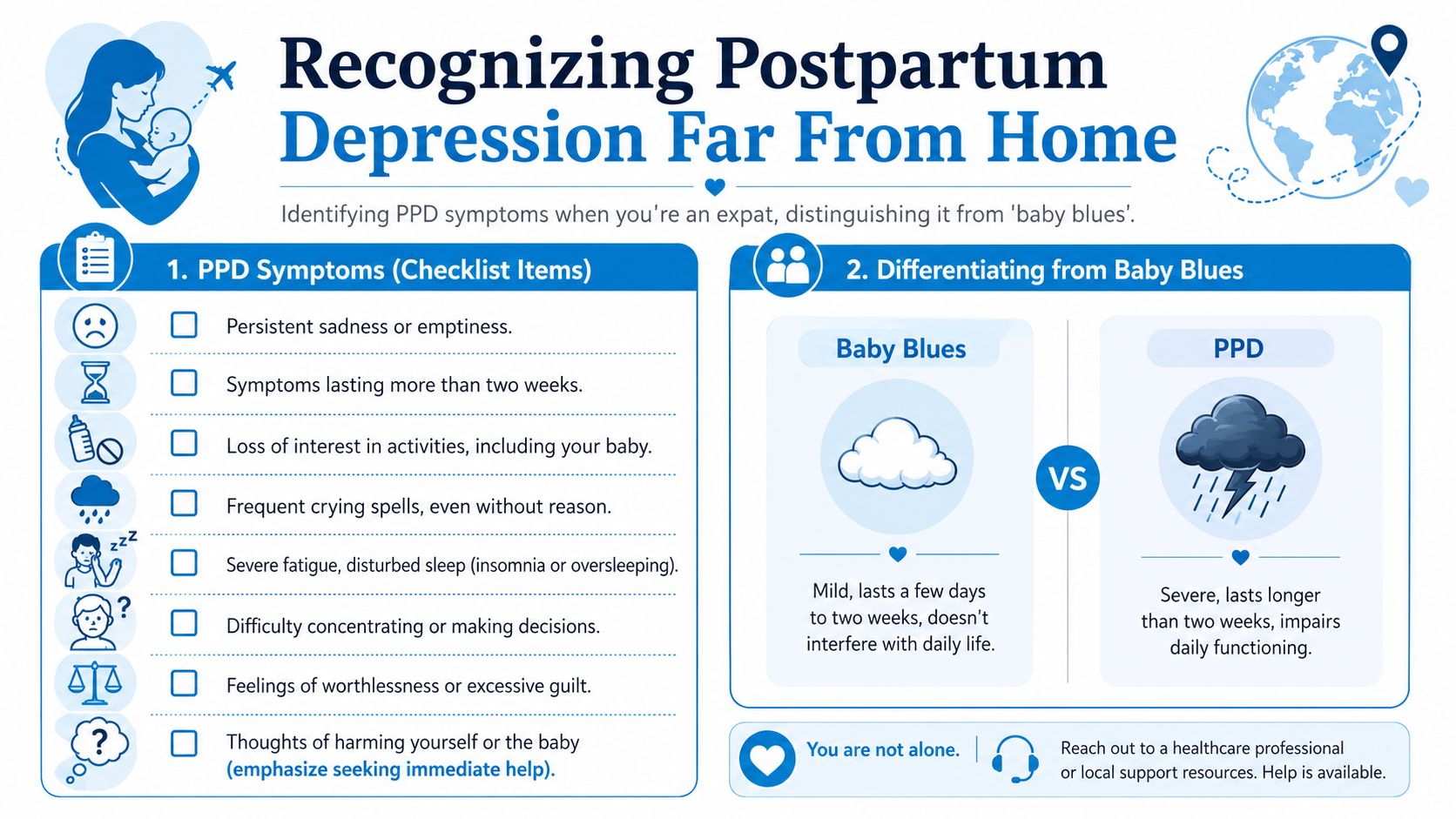
What postpartum depression often looks like
Postpartum depression help starts with recognition. The symptoms are often emotional, cognitive, physical, and relational at the same time.
Look for patterns like these:
- Persistent sadness or emptiness that doesn't lift when the baby sleeps or when someone tries to reassure you
- Loss of interest or emotional disconnection from activities you normally enjoy, and sometimes from the baby
- Frequent crying that feels hard to control or doesn't match what is happening
- Severe anxiety or dread especially at night, during feeding, or when left alone with the baby
- Sleep disruption that goes beyond newborn life such as being unable to sleep even when the baby sleeps
- Poor concentration including trouble making simple decisions, following instructions, or remembering basic tasks
- Worthlessness, guilt, or shame that feels intense and repetitive
- Thoughts of self-harm or harm coming to the baby which require immediate professional attention
A practical rule: if symptoms are intense, last beyond two weeks, or impair daily functioning, don't dismiss them as "just hormones" or "just moving abroad."
Globally, postpartum depression is one of the most common complications of childbirth, and a large share of cases are never formally diagnosed or treated.
Baby blues, culture shock, or postpartum depression
These experiences can overlap, but they aren't the same.
| Experience | What it usually feels like | What stands out |
|---|---|---|
| Baby blues | Tearful, emotionally sensitive, easily overwhelmed | Milder and short-lived |
| Culture shock after birth | Lonely, frustrated, disoriented, homesick | Strongly tied to relocation stress and daily adjustment |
| Postpartum depression | Sadness, numbness, anxiety, guilt, disconnection, hopelessness | More persistent and more impairing |
A useful question is not "Do I have a good reason to feel this way?" You probably do. The better question is: "Is this affecting my ability to function, bond, rest, think clearly, or feel safe?"
Signs that deserve faster action
Some signs mean you shouldn't wait and see:
- You feel detached from reality
- You can't care for yourself or the baby safely
- You have recurring thoughts of disappearing, dying, or hurting yourself
- You feel terrified by intrusive thoughts and don't know whether you can stay in control
Those are not signs to handle alone.
Immediate Steps for Safety and Support
When you're overwhelmed, the goal is not to solve everything. The goal is to reduce immediate risk, get another adult involved, and create enough stability for the next safe step.
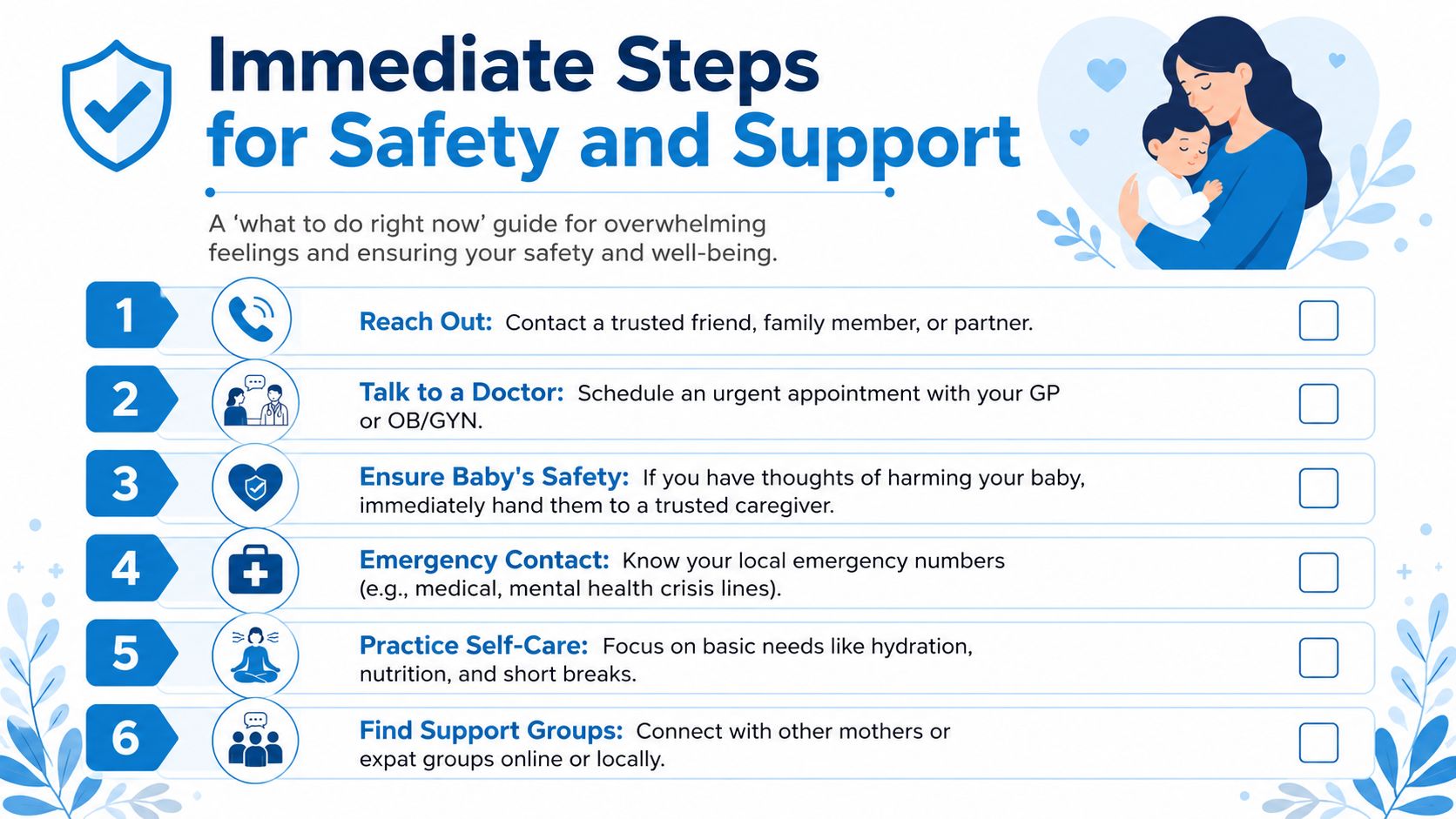
What to do right now
If you're scared by your thoughts, feel out of control, or worry you may not be safe with the baby, do these things in this order:
- Get another adult involved now. Call your partner, a friend, a neighbor, or a family member on video. Don't stay alone with escalating fear.
- Put the baby somewhere safe. A crib or bassinet is enough. Safety matters more than soothing perfectly in that moment.
- Use the European emergency number if risk is immediate. In Italy, call 112.
- Say the simplest sentence possible. Try: "I am not feeling safe and I need help now."
- Do not negotiate with shame. You do not need to sound calm or have a perfect explanation.
If you're having thoughts of harming yourself or your baby, treat that as an emergency. Immediate help is the right response.
Grounding when panic is surging
These won't treat depression, but they can help lower the temperature enough to ask for support:
- Feet on the floor – press both feet down and name five things you can see
- Cold water – hold something cool or splash your face
- One task only – drink water, sit down, wake up your phone, send one message
- Borrow regulation – stay on the phone with someone while you breathe more slowly than you want to
If sleep loss is making everything feel sharper, be cautious with online advice and stick to current, practical information. Always discuss any supplement or sleep question with a doctor who knows your postpartum and breastfeeding context.
Ask for medical follow-up quickly
If you are not in immediate danger but know something is wrong, contact one of these people as soon as possible:
- Your GP or family doctor
- Your OB-GYN or midwife
- Your baby's pediatrician, who may help point you toward local maternal mental health pathways
- A licensed therapist
If you need a place to start emotionally, this practical piece on how to deal with depression can help you put words around what you're experiencing before you speak to a professional.
How to Find English-Speaking Therapy in Italy
For many American mothers, the hardest part isn't deciding they need help. It's figuring out how to access it in a system that feels foreign while functioning on very little sleep.
The obstacles are usually concrete:
- You don't know whether to start with a doctor, psychologist, psychiatrist, clinic, or public service.
- You worry that your Italian isn't good enough for sensitive conversations.
- You want someone who understands not only postpartum symptoms, but also intercultural stress, homesickness, and the emotional whiplash of raising a baby far from home.
What makes therapy effective for expats
Language fluency matters, but cultural fluency matters too.
A therapist can technically speak English and still miss the deeper context: the grief of missing your family rituals, the strain of being the foreign parent in a bicultural household, or the shame of feeling miserable in a country other people romanticize. For postpartum depression help, those details aren't extra. They're often central.
Here is what to look for:
- Licensed clinical training
- Comfort working in English at a nuanced level
- Experience with expat adjustment and intercultural identity
- Ability to coordinate with medical care if needed
- Flexible access, especially online, if leaving the house feels hard
This is what finding care can feel like in practice:
Practical routes to care in Italy
You generally have a few possible paths:
Public pathway
You may begin with your doctor, OB-GYN, or local maternal care service. This can be valuable, especially for screening and referrals, but many expats find the process confusing if they don't already know the local system.
Private therapy
This is often the fastest route when you want direct access in English and more flexibility around scheduling.
Psychiatric support when symptoms are more severe
If depression is moderate to severe, medication assessment may be part of care. A therapist can help you think clearly, but medication decisions belong with a physician or psychiatrist.
A practical starting point for many women is an English-speaking therapist in Italy who understands both the psychological side and the expat context.
What to ask before booking
Not every therapist is the right fit for postpartum work. Ask direct questions:
- Do you work with postpartum depression and anxiety?
- Do you support expat or intercultural clients?
- Can you coordinate with a doctor or psychiatrist if needed?
- Do you offer online sessions if childcare is unpredictable?
- Are you comfortable discussing breastfeeding fears, intrusive thoughts, and relationship strain without judgment?
The best early therapy match is not the most impressive profile. It's the person who can understand your symptoms, your cultural context, and your current practical limits.
Understanding Your Treatment Options
Many new mothers feel relief once they know there are established, evidence-based treatments for postpartum depression. The right treatment plan depends on severity, safety, breastfeeding questions, prior mental health history, and what support is realistically available around you.
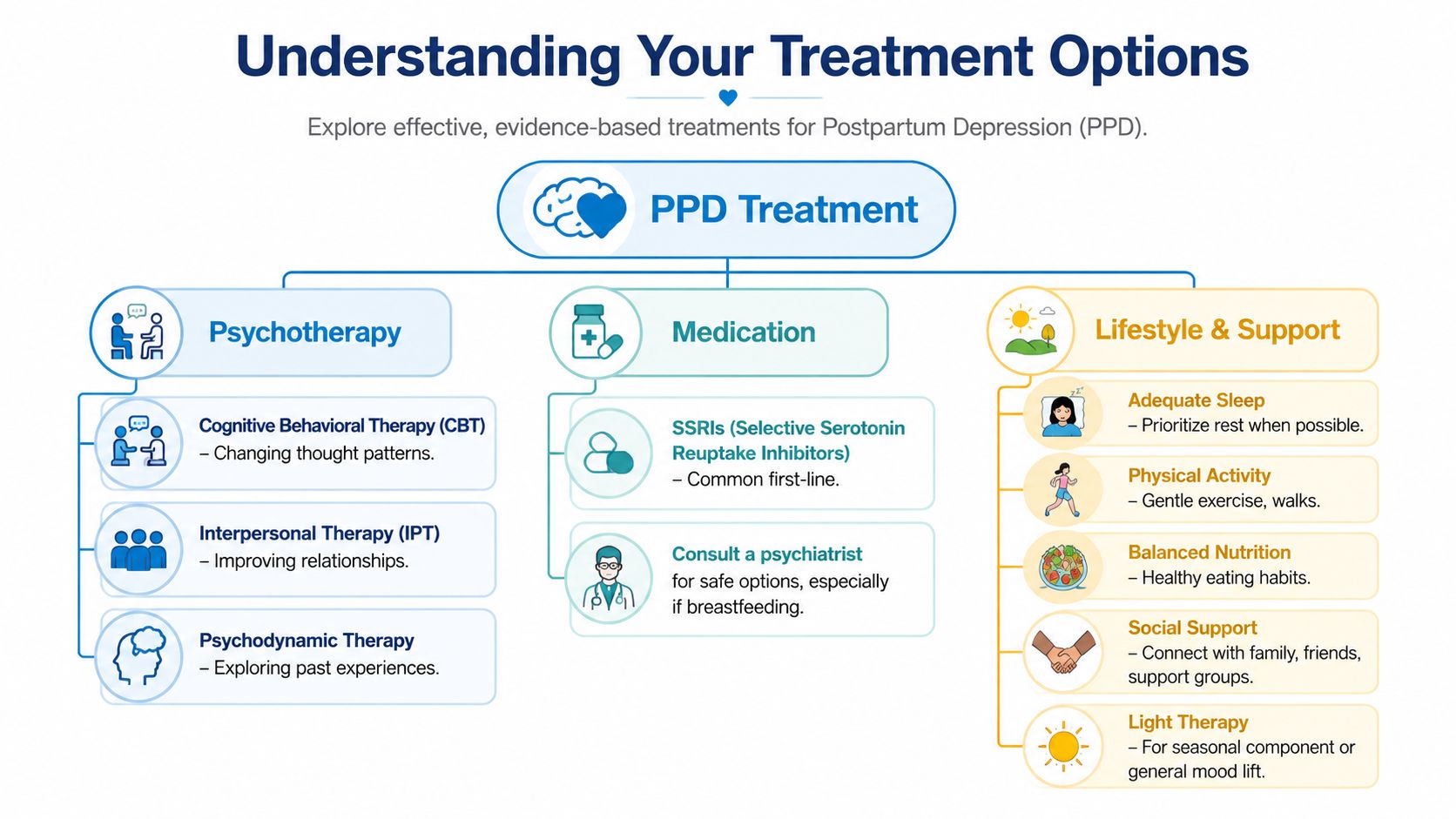
Psychotherapy is a core part of care
Two of the most established approaches for perinatal and postpartum depression are CBT and IPT.
CBT, or Cognitive Behavioral Therapy
CBT helps you identify thought patterns that deepen depression or anxiety. In postpartum life, that often includes beliefs like "I'm failing," "I should cope better," or "If I need help, I'm a bad mother." Therapy works on the link between thoughts, emotions, and behaviors so you can interrupt the cycle.
IPT, or Interpersonal Therapy
IPT focuses on relationships, role changes, grief, and conflict. That makes it especially relevant when you're adjusting to motherhood, relying more heavily on a partner, grieving distance from family, or feeling isolated in a new culture.
Counseling interventions using CBT or IPT can reduce the likelihood of developing perinatal depression, with a pooled relative risk reduction of 39%, according to the US Preventive Services Task Force recommendation on perinatal depression preventive interventions.
If you'd like a plain-language view of how structured therapy works for low mood, this page on CBT for depression is a helpful starting point.
When medication may be part of treatment
For moderate-to-severe postpartum major depression, the benchmark clinical standard is a combination of psychotherapy, specifically IPT or CBT, and SSRIs, because psychotherapy alone is often insufficient for severe cases, according to the AAFP review on postpartum major depression.
That doesn't mean everyone needs medication. It does mean that if symptoms are severe, persistent, or disabling, medication deserves a real conversation rather than a fear-based one.
Important trade-offs often include:
- Breastfeeding concerns
- Sensitivity to side effects
- Past experiences with antidepressants
- How quickly functioning needs to improve
- Whether anxiety, panic, or suicidal thinking is also present
What helps and what doesn't
Some interventions have stronger evidence than others.
More likely to help
- Structured psychotherapy such as CBT or IPT
- Medication assessment for moderate to severe symptoms
- Consistent follow-up rather than stop-start care
- Practical support for sleep, meals, and reducing overload
Not enough on their own for major depression
- Being told to "rest when the baby rests"
- Occasional self-care without treatment
- General wellness advice without clinical support
The same AAFP review notes that light therapy has been proven ineffective for postpartum depression. Exercise and morning light can still support overall wellbeing, but they are not standalone treatment for major postpartum depression.
Evidence-based care is usually layered care. Therapy helps with thoughts, relationships, and coping. Medical care helps assess severity and medication options. Daily support reduces the strain that keeps symptoms going.
Breastfeeding and treatment decisions
This is one of the most emotionally loaded parts of postpartum depression help for expats. Mothers often feel trapped between wanting symptom relief and fearing they will harm the baby or lose an important part of their feeding plan.
Those decisions should be made with a qualified doctor or psychiatrist who can review your specific situation in Italy. Good care is nuanced. It doesn't reduce you to "medication yes" or "medication no."
A Partner's Guide to Providing Support
Postpartum depression doesn't happen in isolation. It affects the couple, the household, and the baby's environment. A supportive partner can't cure it, but a partner can absolutely lower risk, reduce shame, and help treatment happen sooner.
What support actually looks like
Partners often want to help but move too quickly into problem-solving. That can leave a struggling mother feeling more alone.
Try this instead:
- Listen before fixing – say "I'm here" before "Have you tried…"
- Name what you see – "You seem overwhelmed and not like yourself lately"
- Take over logistics – book appointments, handle calls, manage paperwork
- Protect rest – create blocks of uninterrupted sleep whenever possible
- Reduce the invisible load – meals, laundry, pharmacy runs, baby supplies
Less helpful responses tend to sound like:
- "But the baby is healthy."
- "You just need to get out more."
- "Everyone is tired with a newborn."
- "Don't think like that."
Those statements usually increase shame.
A good partner response is simple and steady: "I believe you. You're not failing. We need support, and I'll help you get it."
Support the relationship, not just the symptoms
Postpartum depression often inflames existing intercultural tensions. One partner may want more family involvement. The other may feel intruded upon. One may normalize suffering. The other may want immediate professional care.
When communication starts to break down, intercultural couples therapy can help partners understand how stress, family culture, gender expectations, and different languages are shaping the conflict.
Partners can struggle too
Approximately 10% of new fathers experience depression during the postpartum period, and a father's risk increases significantly if their partner is also experiencing PPD, according to research on paternal postpartum depression.
That matters for two reasons:
- A depressed partner has less emotional capacity to support recovery well.
- Many fathers or co-parents hide their distress because they think all attention should stay on the mother and baby.
Family-centered care works better than pretending only one person is affected.
FAQ
How do I know if I need postpartum depression help or if I'm just overwhelmed
If your symptoms are persistent, distressing, or interfering with daily functioning, it's time to seek help. Normal overwhelm can be intense, but postpartum depression usually brings a deeper pattern of sadness, anxiety, numbness, guilt, or disconnection that doesn't reliably lift with rest or reassurance. If you're unsure, speak to a professional rather than trying to self-diagnose in isolation.
What postpartum screening is available in Italy
Italy uses structured postpartum screening in maternal care settings. According to this overview of postpartum depression screening in Italy, the Ministry of Health mandates universal screening with the Edinburgh Postnatal Depression Scale at 1 month, 3 months, and 6 months postpartum. If nobody has offered this to you, you can ask directly about EPDS screening at your follow-up appointments.
Can I get therapy in English while living in a smaller Italian city
Yes, English-speaking support is available even if your local area has limited options. Online therapy can be especially useful when travel, childcare, or a language barrier makes in-person care hard to sustain. Many expat mothers do better when they can speak in their native language from home, especially during the first months postpartum.
What if I'm breastfeeding and scared of medication
That fear is common, and you don't have to solve it alone. A doctor or psychiatrist should help you weigh symptom severity, feeding goals, prior medication history, and current risks so the decision is informed rather than reactive. Therapy can support you emotionally while that medical conversation happens.
Should my partner come to some sessions
Sometimes yes, especially when communication, household strain, or intercultural misunderstandings are making recovery harder. Individual therapy gives you private space, while selected couple sessions can help your partner learn how to respond more effectively. It's often useful when both people care but are missing each other under stress.
What if I don't understand the Italian healthcare system at all
Start with the simplest available door rather than waiting to understand everything perfectly. That may be your doctor, OB-GYN, pediatrician, or an English-speaking therapist who can help you think through next steps. You do not need to master the whole system before asking for support.
Is online therapy enough for postpartum depression
Online therapy can be very effective, especially when leaving home feels difficult or support is urgently needed. It works best when symptoms are mild to moderate, when you can engage consistently, and when there is a clear safety plan. If symptoms are severe or you feel unsafe, online care may need to be combined with urgent medical or psychiatric support.
Book your first free assessment call – no commitment, just a conversation with our Clinical Director who will listen and match you with the right therapist for you. Visit THERAPSY.
Not sure whether what you are feeling is depression?
Our free online depression test takes two minutes. It is based on the PHQ-9, the screening questionnaire used by clinicians worldwide, and it is anonymous – no email required to see your result.
If the result suggests you could use support, the next step is a free first call with a licensed therapist who speaks your language, online or in person across Italy.