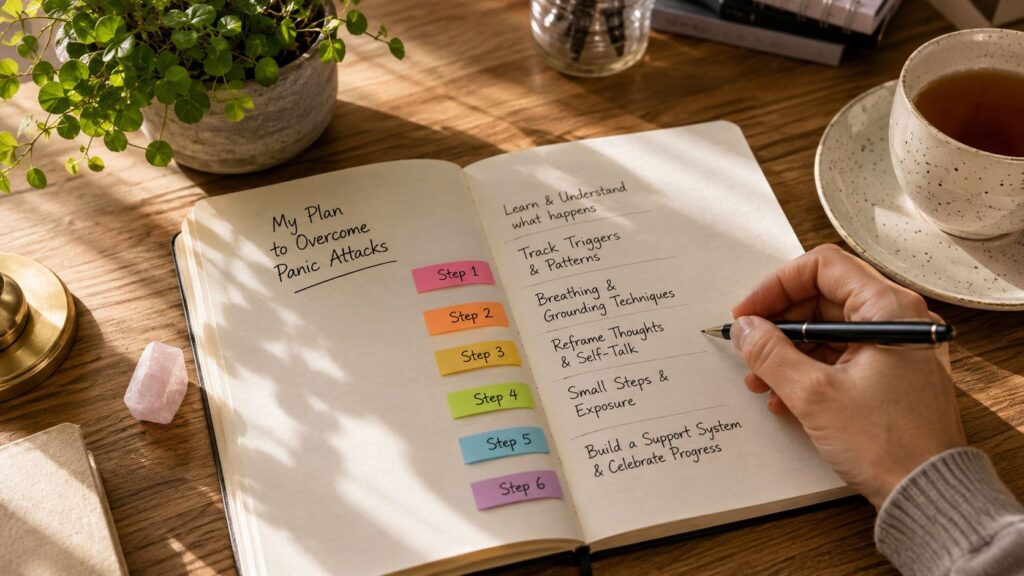
Back to work anxiety after vacation is usually a normal stress response linked to anticipated workload and incomplete recovery, not a personal weakness. In the 2024 Glassdoor poll reported by HR Dive, 77% of 3,000 professionals said they felt anxious about their post-vacation workload, and what helps most is a planned return, restored sleep and routine, CBT-informed grounding, and a gradual first week.
You may be in a Milan apartment with a half-unpacked suitcase, a cooling espresso, and a laptop blinking beside you with messages that arrived before your flight home. Perhaps you spent the holiday visiting family abroad, switching between languages, time zones, and emotional roles. Now Monday feels less like a fresh start and more like a cliff.
That reaction deserves attention, but not self-criticism. Back to work anxiety after vacation often signals workload anticipation and recovery loss. Time away may have ended, while your nervous system hasn't fully recovered from travel, social demands, or the pressure that existed before you left.
Therapsy is a multilingual psychotherapy service in Italy that connects expats with therapists who speak their native language.
This guide is written for international professionals, students, and young adults living in Italy. It offers a practical route through the first week back, from a pre-return reset and desk-side CBT tools to manager conversations, gradual re-entry, and the point at which therapy becomes sensible.
What Back to Work Anxiety After Vacation Actually Feels Like
Sunday evening often reveals the problem before Monday does. You open your work laptop “just to check one thing,” see a crowded inbox, and notice your body reacting before you've formed a clear thought.
Common signs include:
- Restless sleep, especially difficulty falling asleep before the first workday.
- Chest tightness or a racing body, without an immediate external threat.
- Dread scrolling, where you repeatedly check messages while feeling unable to act.
- Irritability, including a shorter temper with a partner, flatmate, or family member.
- Brain fog, indecision, and trouble remembering what mattered before the holiday.
- Sunday-night insomnia, even when you're physically tired.
This pattern is commonly called post-vacation anxiety or post-holiday blues. It isn't a formal diagnosis by itself. It describes a time-linked stress response that appears when rest, travel, and novelty give way to deadlines, decisions, and perceived loss of control.
Back-to-work anxiety is a stress response to re-entry. It isn't evidence that you're lazy, ungrateful, or incapable.
The difference between ordinary adjustment and a more serious mental health concern usually lies in intensity, duration, and impairment. You might feel disappointed that the holiday ended and still experience genuine excitement about colleagues, projects, or living in Italy. Anxiety becomes more concerning when it dominates your thoughts, disrupts sleep, causes avoidance, or continues after the initial return period.
Depression can also involve low motivation, exhaustion, and loss of pleasure, but post-vacation anxiety is more specifically tied to anticipation and work re-entry. If you're unsure where your experience fits, review the signs described in this guide to anxiety symptoms in adults, and consider speaking with a qualified professional.
The practical response isn't to force enthusiasm. It's to reduce uncertainty, restore basic rhythms, and give your attention smaller tasks. The next steps cover the psychological causes, a pre-return plan, first-week routines, coping tools, workplace communication, and professional support.
Why the Return Feels So Heavy
The first mechanism is anticipation stress. Your mind tries to predict every email, meeting, and possible mistake before you have the information needed to solve any of them. A vague workload becomes a mental threat, and the body responds to the imagined volume as though it were already happening.
The second mechanism is contrast. A holiday may contain novelty, movement, family contact, sunlight, food, or freedom from constant work decisions. Returning to a repetitive schedule can feel emotionally flat by comparison. That doesn't mean your everyday life is wrong, but the difference can make ordinary demands feel unusually heavy.
The deeper issue is recovery failure. Time off doesn't always restore you. Visiting family may involve long travel and unresolved tensions. An expat may spend the break translating, hosting, navigating airports, answering questions from home, or managing practical responsibilities in two countries. You can return from vacation without being refreshed because the break replaced one set of demands with another.
A 2011 Reuters-reported TripAdvisor survey of 1,400 Americans found that 34% struggled with melancholy after returning from summer holiday, while 64% said the blues began before the trip had ended. The survey also reported that 34% mainly resisted going home because of returning to work, 19% felt strain on the first day back, and 43% felt it within the first week. Read the Reuters report on post-vacation blues for the historical context.
The more recent workplace marker is even clearer. The HR Dive report on the 2024 poll found 77% of professionals anticipated post-vacation workload anxiety, with 84% of women and 71% of men reporting it. Anxiety was particularly high in law at 83%, advertising at 80%, and accounting at 78%. These figures don't predict your personal experience, but they do challenge the idea that your reaction is unusual.
| Statistic | What it shows |
|---|---|
| 34% felt post-holiday melancholy in the Reuters-reported survey | The emotional drop after returning has been visible in mainstream workplace and travel data for years. |
| 64% felt the blues before the holiday ended | Anticipation can begin before the physical return. |
| 77% anticipated post-vacation workload anxiety in the 2024 poll | Re-entry stress is a mainstream workplace issue, not merely a travel aftershock. |
| 84% of women and 71% of men reported anxiety in that poll | Workplace expectations and workload exposure may not affect all groups equally. |
For expats, the return can add culture-switch fatigue. You may have spent days speaking your first language, then suddenly need to operate in Italian, English, or another professional language. You may also lose small recovery rituals, such as an unhurried walk, a long lunch, or dolce far niente, when the workday resumes.
The best interruption is preparation. A short protocol limits the number of decisions your future self must make while tired. If perfectionism turns preparation into another performance test, review these ideas about perfectionism and anxiety.
Your 72-Hour Pre-Return Reset
Start 72 hours before work, not on Sunday night. The aim isn't to complete your entire workload early. It's to create enough structure that your first morning doesn't begin with a flood of unknowns.
Seventy-two hours before returning
Spend 20 minutes on inbox triage. Use your out-of-office message or a short holding note that says you'll be back on the relevant date. Sort messages into three practical groups:
- Needs action, something you must address after returning.
- Needs context, something you can understand once you review the project.
- Can wait, something that doesn't belong in your first week.
Don't answer everything. Triage is successful when it creates a map, not when it empties the inbox.
Write a short message for your manager if priorities are unclear. Ask for the most important outcomes of the week rather than requesting reassurance. A concrete question gives your mind something more useful than general worry.
Forty-eight hours before returning
Move your bedtime and wake time toward workday hours. Use gradual 30-minute shifts rather than expecting your body to change overnight. Avoid turning the final evening into another late night of streaming, especially if you're already carrying travel fatigue.
Keep caffeine to earlier in the day, with a 14:00 cutoff. This isn't a test of discipline. It's a simple way to avoid adding stimulation to a nervous system that's already anticipating Monday.
Twenty-four hours before returning
Use an Italian-style Sunday reset. Do the laundry, buy groceries, prepare light meals, and lay out clothes. Then take a phone-free passeggiata, even if it's short. The point is to make Monday physically easier and mentally less crowded.
Prepare a list of three priorities only for Monday morning. If you have more than three tasks, place the rest in a second list labelled “later.” This separates planning from panic.
On Monday, create a first-hour ritual: coffee, a slow walk, and a brief review of your three priorities before opening the inbox. A short mindfulness practice can also help you notice anxious predictions without automatically obeying them. Therapsy explains this approach through practical mindfulness support.
Save this checklist:
- Confirm the return date: Make sure your manager and key colleagues know when you'll be available.
- Triage the inbox: Do it 72 hours before returning, not at midnight on Sunday.
- Shift sleep gradually: Adjust bedtime and wake time by 30 minutes.
- Set three priorities: Keep Monday's list deliberately small.
- Prepare the environment: Complete laundry, groceries, meals, and clothing.
- Protect the first hour: Don't begin with reactive email checking.
- Keep caffeine earlier: Stop at 14:00 to support sleep.
- Take a phone-free walk: Let your attention move without another stream of information.
Designing a Calmer First Week Back
Treat the first week as a ramp, not a sprint. Your aim is to regain orientation, not prove that the holiday had no effect on you.
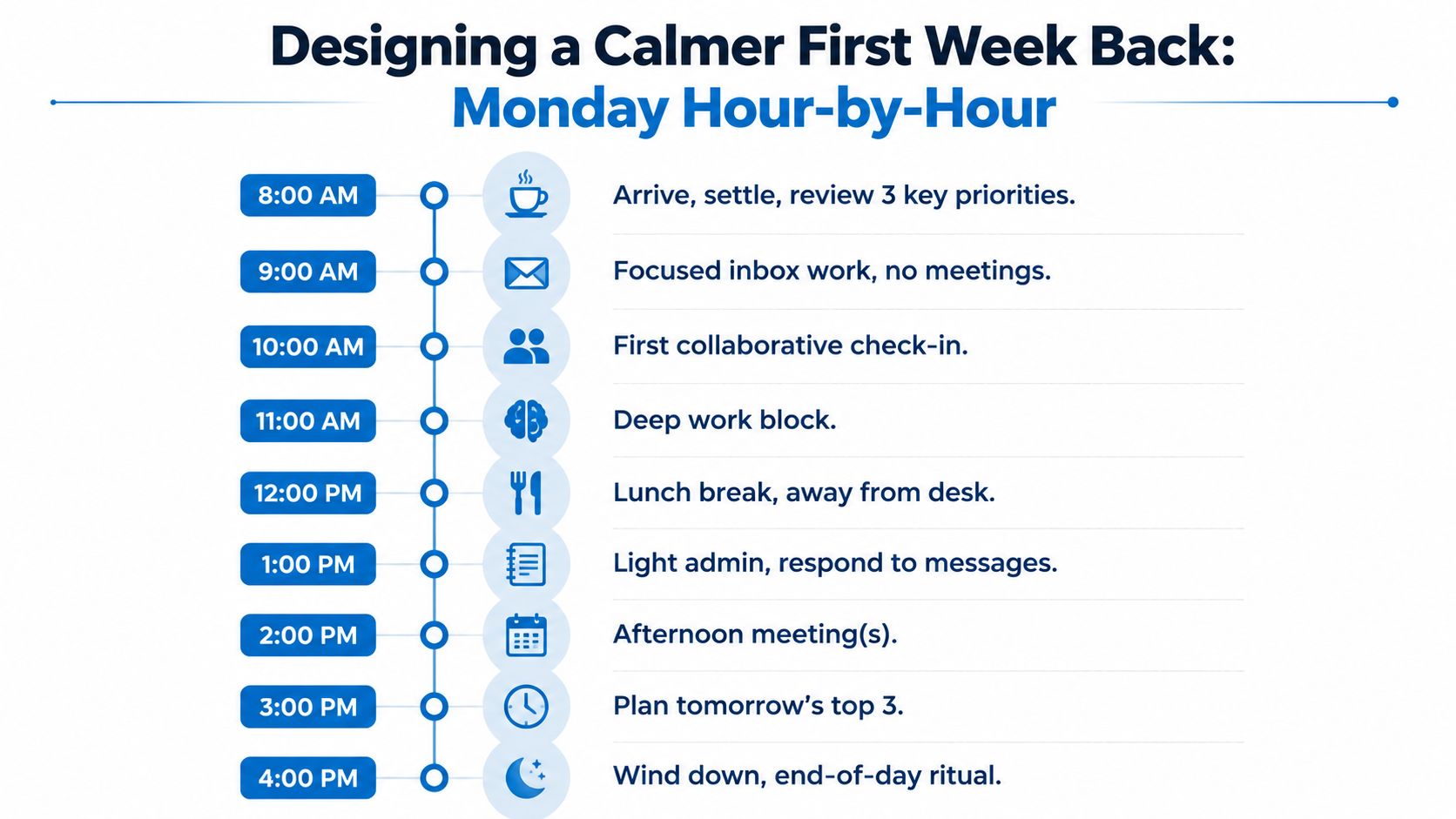
A workable Monday might look like this:
- 08:00: Arrive, settle with an espresso, and review the three priorities.
- 10:30: Triage the inbox for a maximum of 45 minutes.
- 13:00: Have a proper pranzo away from the desk.
- 15:00: Complete one focused deep-work block.
- 17:30: Write a handover to tomorrow's self and close work.
- 18:00: Record a short list of what went adequately or well.
The written handover matters because anxious minds often treat unfinished work as proof of failure. A note such as “waiting for approval,” “next action is draft,” or “ask for context tomorrow” turns an open loop into a defined next step.
Use small CBT-informed interventions between tasks. Before opening email, try 5-4-3-2-1 grounding. Name five things you see, four things you feel, three things you hear, two things you smell, and one thing you taste. This shifts attention from predicted workload to present sensory information.
After a difficult meeting, use a 90-second box-breathing reset. Inhale, hold, exhale, and hold for equal counts. If breath retention feels uncomfortable, return to a natural rhythm and focus on a longer, gentle exhale.
A calmer first week comes from reducing task-switching, not from demanding perfect concentration.
Tuesday should include priority review, one protected focus block, and a normal lunch. Wednesday is a good day for a low-pressure coffee with an Italian colleague, especially if you've been isolated during the holiday. Thursday can hold more external meetings if your attention is settling. Friday should include a review of unfinished tasks, a realistic plan for the following week, and a clear shutdown.
The rhythm should remain predictable. Plan in the morning, focus in defined blocks, recover during lunch, and close the day deliberately. This structure is especially useful when you're working across languages or returning to a team whose expectations feel culturally unfamiliar.
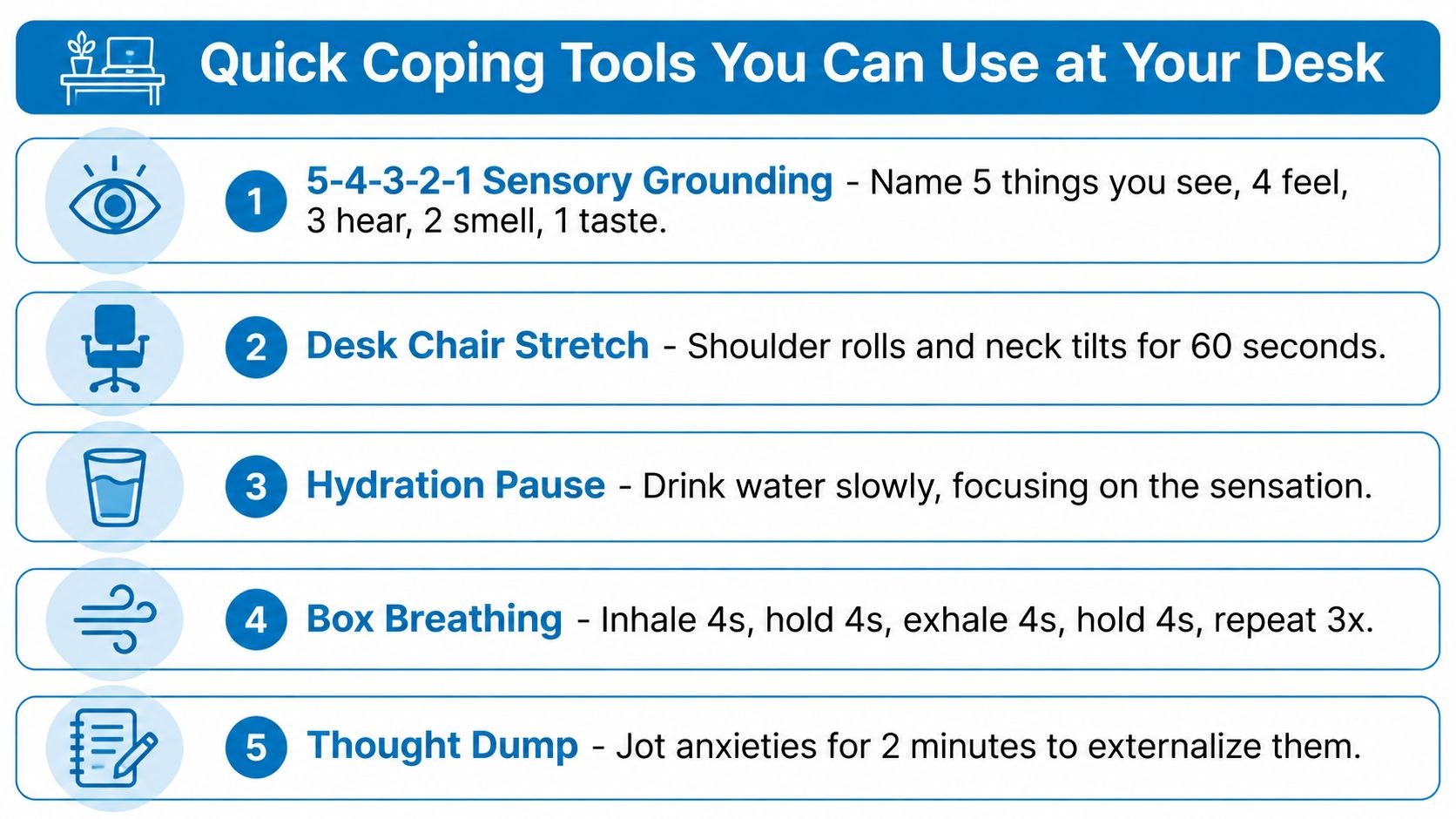
Quick Coping Tools You Can Use at Your Desk
Keep your tools short enough to use before anxiety becomes overwhelming. Each technique works best when you connect it to a specific trigger.
When the inbox creates dread
Use 5-4-3-2-1 sensory grounding before reading the first message. Look around your desk and name what you can see, feel, hear, smell, and taste. The expected effect isn't instant happiness. It's a return from imagined consequences to the room you're in.
When your body spikes during a meeting
Try box breathing. Inhale for four counts, hold for four, exhale for four, and hold for four. Repeat the cycle three times if comfortable. If counting makes you more tense, breathe normally and place both feet on the floor while relaxing your jaw.
When your mind says you'll never catch up
Use cognitive reframing. Write the thought exactly as it appears, then replace it with a bounded statement:
- Anxious thought: “I'll never catch up.”
- More accurate response: “I have one priority today, and I can identify the next action.”
CBT doesn't ask you to pretend everything is fine. It asks you to test whether a thought is a fact, a prediction, or an old threat story.
When Sunday-night rumination starts
Protect sleep with a cool, dark room, a fixed wake time, and no doomscrolling in bed. Put tomorrow's tasks on paper before turning off the light. If your mind returns to them, remind yourself that the list already has a place outside your head.
When your body has been still too long
Take two slow neck rolls, relax your shoulders, drink water slowly, and walk to the macchinetta or outside the building. Movement creates a physical boundary between tasks. It also gives you a brief sensory change without requiring a long break.
You can make these tools easier to use by keeping a note on your phone with the trigger and response.
For persistent anxiety that keeps returning despite practical adjustments, nervous system regulation therapy can help you understand the body-based part of the response alongside the thoughts and behaviours.
Talking to Your Manager and Team
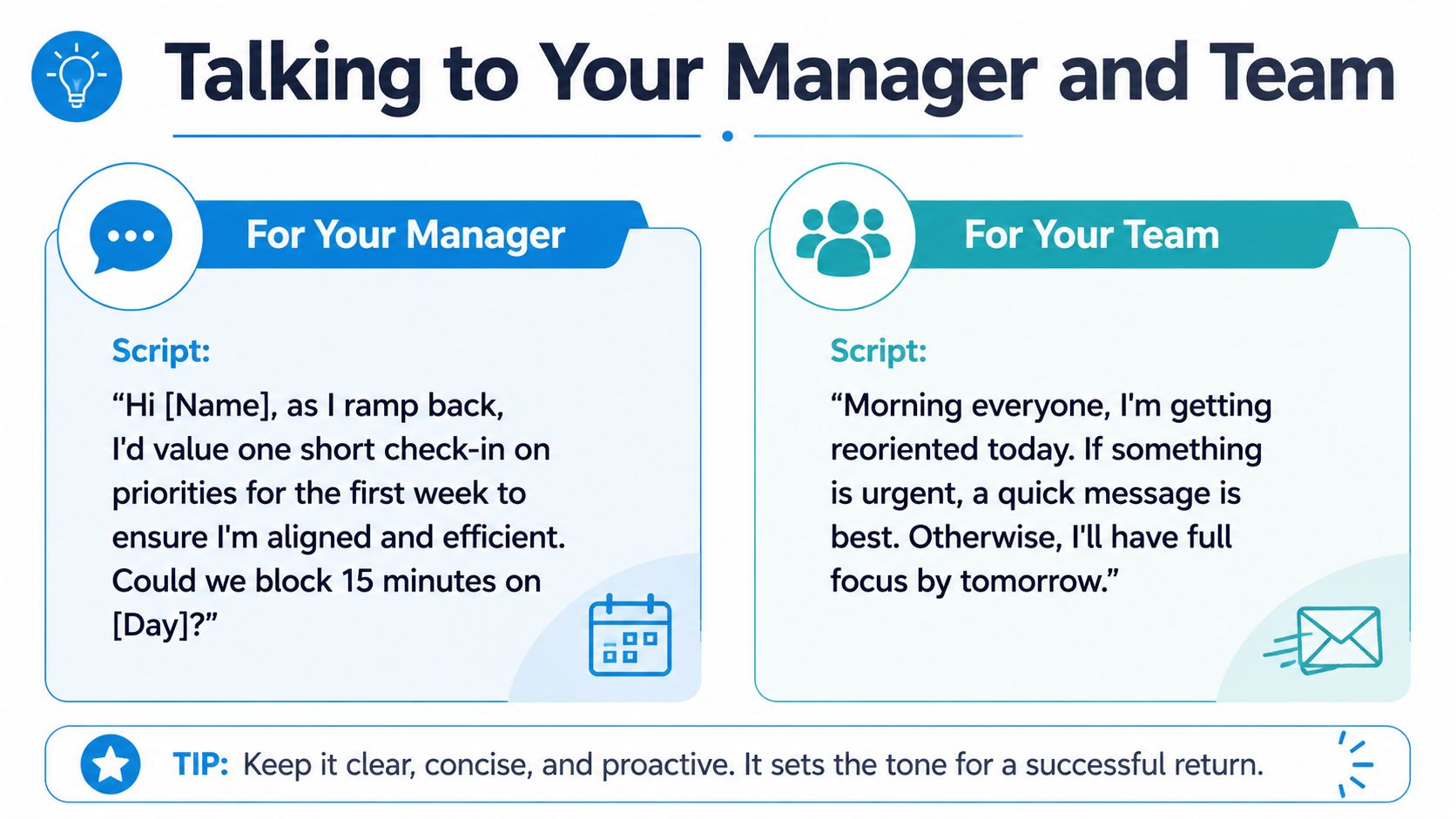
Naming the problem early usually works better than hiding it until anxiety affects your performance. You don't need to disclose your entire mental health history. Ask for a specific form of structure, a defined priority, or a temporary adjustment.
A short message on Friday afternoon is often the lowest-friction option. It gives your manager time to respond before Monday and lets you arrive with fewer unanswered questions.
Asking for a lighter first day
English: “Hi [Name], as I return, could we keep the first day focused on reorientation and priority-setting? I can review urgent items and confirm the week's plan by the afternoon.”
Italian: “Ciao [Nome], al rientro potremmo dedicare il primo giorno alla riorganizzazione e alla definizione delle priorità? Posso verificare le urgenze e confermare il piano della settimana nel pomeriggio.”
The CBT frame is straightforward. You're not avoiding work. You're designing a manageable exposure to it, beginning with orientation before higher-pressure demands.
Requesting a gradual re-entry
English: “I'd like to ramp up gradually this week. Could we avoid external meetings before Thursday so I can review the current projects and prepare properly?”
Italian: “Vorrei riprendere gradualmente questa settimana. Possiamo evitare gli incontri esterni prima di giovedì, così posso rivedere i progetti in corso e prepararmi bene?”
If the request isn't possible, ask for the next-best version. Perhaps one meeting can move, or you can receive the agenda and desired outcome in advance. Specific alternatives keep the conversation practical.
Asking for a written handover
English: “Could you send me a short written summary of the most important changes while I was away? I want to make sure I'm working from the current priorities.”
Italian: “Potresti mandarmi un breve riepilogo scritto delle modifiche più importanti avvenute durante la mia assenza? Vorrei assicurarmi di lavorare sulle priorità aggiornate.”
For an expat, written information reduces the extra load of processing fast spoken Italian or English after travel. It also creates a reference point when cultural expectations are implicit rather than stated.
Signalling a deadline pile-up
English: “I see several deadlines converging. Could we agree which one is the priority if they compete for the same time?”
Italian: “Vedo che diverse scadenze si stanno concentrando nello stesso periodo. Possiamo stabilire quale abbia la priorità se richiedono lo stesso tempo?”
This is a behavioural activation step. You're moving from rumination to an observable action. You're also asking the person with authority to help sequence competing demands.
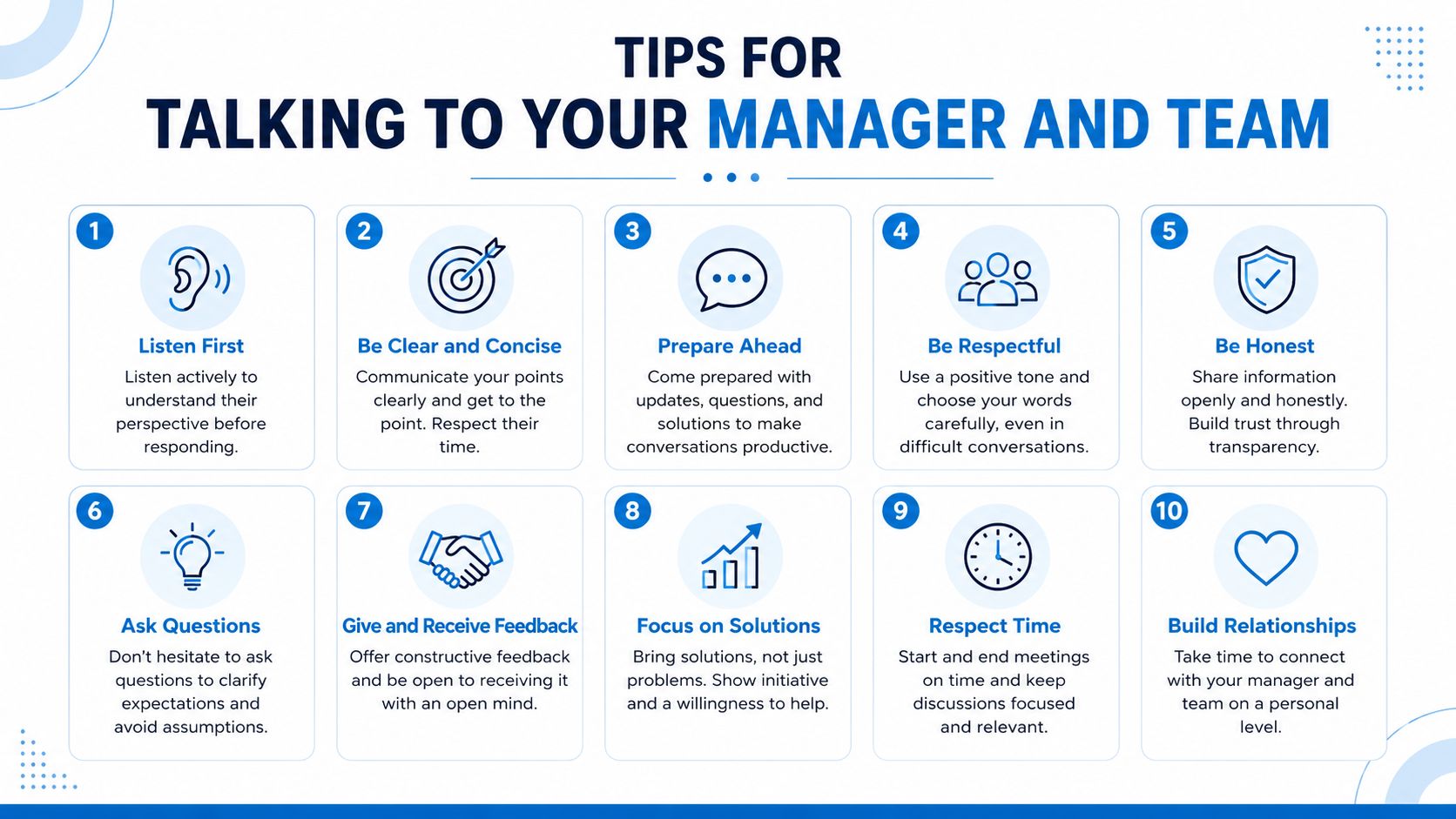
Setting expectations with your team
English: “Morning everyone, I'm getting reoriented today. If something is urgent, a quick message is best. Otherwise, I'll have full focus by tomorrow.”
Italian: “Buongiorno a tutti, oggi mi sto riorientando. Se qualcosa è urgente, mandatemi un messaggio breve. Altrimenti sarò pienamente operativo da domani.”
Keep your message calm and factual. You're telling colleagues how to help you distinguish urgent work from ordinary noise.
If a manager dismisses every reasonable request, refuses to clarify priorities, or treats rest as a character flaw, the issue may be larger than first-week coping. Boundary-setting then becomes a workplace-fit question. Document the requests you made, identify what support is available internally, and consider whether the environment repeatedly prevents recovery.
When adjustment becomes a clinical concern
Normal re-entry stress should begin to ease as your routine and orientation return. Seek professional guidance when symptoms persist or impair daily functioning, particularly if you notice:
- Ongoing Sunday-night dread that continues beyond the initial adjustment period.
- Sleep disruption that doesn't improve with basic sleep hygiene.
- Physical symptoms, such as chest tightness or gastrointestinal distress.
- Avoidance of work communication, including messages you need to answer.
- Irritability at home, with anxiety spilling into your relationship or family life.
- Rumination that interrupts concentration and prevents ordinary tasks.
The broader picture may involve clinical anxiety, an adjustment disorder, burnout, depression, or a medical condition. A holiday can expose the problem without causing it. If exhaustion, irritability, and low motivation continue beyond the first days back, the issue may be an unresolved recovery deficit rather than simple sadness that the break ended. A 2025 meta-analysis on vacation effects and post-vacation recovery supports this recovery-focused interpretation.
Expat life can intensify the pressure. Visa concerns, language fatigue, distance from family support, and the Italian expectation of presenteismo can make you appear functional while your internal resources decline. Track your symptoms for two weeks, arrange a medical check with your medico di base to rule out physical causes, and consider therapy when anxiety is impairing functioning rather than merely causing discomfort.
Therapsy offers multilingual psychotherapy for people living in Italy, including CBT and adjustment-focused work. Its therapists can work online or in person, and a free assessment conversation can help determine whether structured support is appropriate without requiring you to make a long-term decision immediately.
Your Return Plan and Where to Find More Support
Save this checklist before your next holiday:
- Confirm the return date with your manager and key colleagues.
- Triage the inbox 72 hours early and separate urgent work from information gathering.
- Shift sleep by 30 minutes toward workday hours.
- Protect Monday morning for low-stakes orientation and priority-setting.
- Arrange one colleague coffee for the middle of the week.
- Practise one grounding technique daily, before anxiety peaks.
- Reassess at two weeks, looking at sleep, dread, physical symptoms, and functioning.
A gradual return doesn't have to be informal. Adapt any plan to your contract, manager, health needs, and local workplace procedures.
Back to work anxiety after vacation is a predictable and treatable stress response. Small structural changes usually help more than willpower because they reduce uncertainty, restore recovery, and make the first tasks visible.
If the anxiety remains intense, online therapy for anxiety can offer a practical way to speak with a therapist while living in Italy, travelling, or managing a demanding schedule. Reaching out isn't surrender. It's a skill for recognising when the load needs more support than self-management can provide.
Returning to work is a transition to manage, not a cliff to survive. Give your body a rhythm, your mind a smaller task, and your workplace a clear request.
Frequently asked questions about back to work anxiety after vacation
Is back to work anxiety after vacation normal?
Yes, short-term anxiety after vacation is a common stress response to anticipated workload, disrupted routines, and incomplete recovery. It often improves as you regain orientation and sleep. If it continues to impair functioning, consider professional support through a service such as Therapsy.
Why do I feel anxious before returning to work?
You may be reacting to imagined workload, unclear priorities, loss of holiday novelty, or the contrast between rest and workplace demands. Expats can also experience language fatigue, travel stress, and distance from familiar support.
How long does post-vacation anxiety last?
There is no universal timeline, but ordinary re-entry stress should gradually ease as routine returns. Persistent exhaustion, irritability, sleep disruption, or avoidance deserves closer attention rather than being dismissed as a normal holiday slump.
What can I do on Sunday night before returning to work?
Prepare three priorities, complete basic household tasks, stop work checking, and use a grounding or breathing exercise before bed. A fixed wake time and a phone-free period can make the next morning less reactive.
Should I tell my manager that I feel anxious after vacation?
You don't need to share private details, but a specific request for priorities, written context, or a gradual schedule can prevent avoidable overload. Therapsy can help you rehearse the conversation if workplace anxiety makes boundary-setting difficult.
Can therapy help with anxiety about returning to work?
Yes, therapy can help you identify anxious predictions, rebuild routines, set boundaries, and address burnout or adjustment difficulties. Therapsy offers CBT, Schema Therapy, and other evidence-informed approaches in multiple languages for people living in Italy.
When should I seek professional help for post-vacation anxiety?
Seek help when anxiety persists, disrupts sleep, causes physical symptoms, affects relationships, or leads you to avoid essential work communication. Start by speaking with your medico di base about physical symptoms and consider a therapist for the psychological pattern.
Book a free assessment call with Therapsy to discuss your back-to-work anxiety after vacation and find a culturally aware, multilingual therapist who fits your needs. There's no commitment or payment for the initial conversation with the Clinical Director, so visit THERAPSY when you're ready.