Moving to Italy for university means managing two transitions at once: entering a new academic system and building a life in an unfamiliar culture. The process starts before departure with programme selection, admission documents, and visa planning, then continues through housing, residence paperwork, university registration, language adjustment, and emotional support. A successful move treats wellbeing as part of the relocation plan, not as an emergency measure.
Therapsy is a multilingual psychotherapy service in Italy that connects expats with therapists who speak their native language.
Planning Your Move to Italy for University
You may be standing on a platform in Bologna or Rome with a suitcase, a university acceptance letter, and no clear idea where to buy a SIM card. That moment feels exciting, but it also exposes the difference between visiting Italy and living there as a student. Your first months will involve academic decisions, housing, immigration paperwork, unfamiliar routines, and the emotional work of becoming independent far from home.
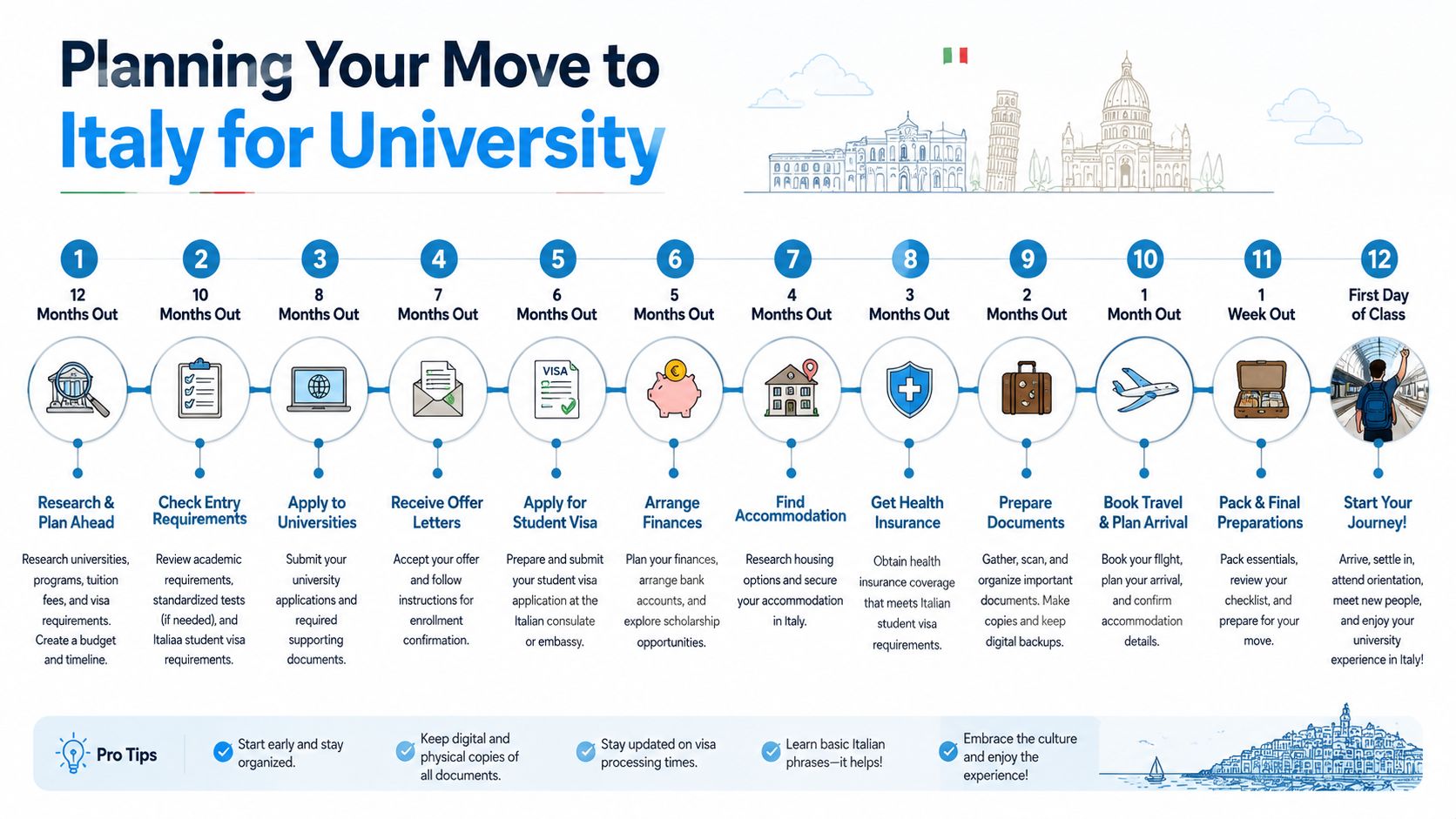
Start with a master timeline. Put every university, visa, housing, travel, and health task into one document, then add the responsible office and the latest realistic deadline.
Twelve to nine months before departure
Begin by choosing the programme and checking its entry conditions. Confirm whether the degree is taught in English or Italian, whether it requires a language certificate, and whether admission involves an entrance examination or portfolio. Ask the university's international office which academic documents must be translated, legalized, or validated.
Italy is becoming a more international university destination. Students holding a foreign upper secondary qualification increased from 52,493 to 111,566 over six years, reaching 5.4% of total enrolments in the 2026 higher-education report. The share was 8.5% in private universities, 6.0% in public universities, and 1.1% in online universities according to the 2026 higher-education report. That growth can mean stronger international services, but support still varies considerably between institutions.
Six to four months before departure
Build a realistic budget around tuition, rent, transport, food, health coverage, deposits, and one-off arrival costs. Don't rely only on the university's headline estimate. Your city, housing arrangement, and ability to cook will shape daily spending.
At this stage, shortlist accommodation and learn the difference between a university residence, a shared flat, and a private rental. Ask for written terms before transferring money, and keep a reserve for the period before your banking and residence arrangements are fully active.
Two months before departure
Prepare a digital folder and a physical folder containing your passport, acceptance documents, academic records, visa paperwork, accommodation evidence, insurance documents, and emergency contacts. If you're under 18, check whether you need a power of attorney or additional parental documentation.
Practical rule: Paperwork handled before arrival protects your first weeks for orientation, rest, and learning your new routine.
Use the mental health checklist for moving to Italy alongside your logistics timeline. Write down who you'll contact if homesickness, panic, sleep problems, or isolation become difficult to manage.
Documents, Visas and Pre-Departure Paperwork
For non-EU students, moving to Italy for university is also a formal immigration process. If you'll study for more than 90 days, you need a national Type D study visa before arrival, followed by a study residence permit after entering Italy, as explained by the European Commission's student guidance for Italy.
The exact consular checklist can vary by country, so follow the instructions of the Italian consulate responsible for your legal residence. Don't treat a checklist from another consulate as definitive.
Start with university pre-enrolment
Non-EU applicants generally complete pre-enrolment on the Universitaly portal before the consulate accepts the student-visa file. The chosen institution must validate the application. The visa process can proceed only after that validation, according to the Italian university visa guidance.
Prepare your passport, admission letter, academic qualifications, transcripts, required translations, and any document proving the university has reviewed your education. Some programmes may ask for additional evidence, such as a declaration concerning the value of your qualification or a comparability document.
Build the visa file carefully
Keep originals available and create clear copies. Check passport validity against the consulate's requirements, arrange accommodation evidence, prepare financial documentation, and obtain suitable health insurance.
Don't assume that an acceptance letter alone guarantees a visa. Missing translations, inconsistent names across documents, unclear financial evidence, or an incomplete Universitaly file can all create delays or require clarification.
Health coverage also matters after arrival. Before choosing a policy, understand what it covers for medical care and psychological support. Therapsy explains practical questions students can ask in its guide to health insurance and therapy in Italy.
Know the arrival deadline
The European Commission states that non-EU students must declare their presence at the Questura within 8 days of arrival and apply for a residence permit. Italian consular guidance also describes the Type D student visa as a long-stay visa that can be issued for up to 365 days with multiple entries. Keep your visa, passport, admission evidence, and accommodation information accessible while travelling.
The visa isn't the final step. It authorizes your entry for study, while the residence permit confirms your right to remain under the relevant conditions once you're in Italy.
Settling In During Your First Week in Italy
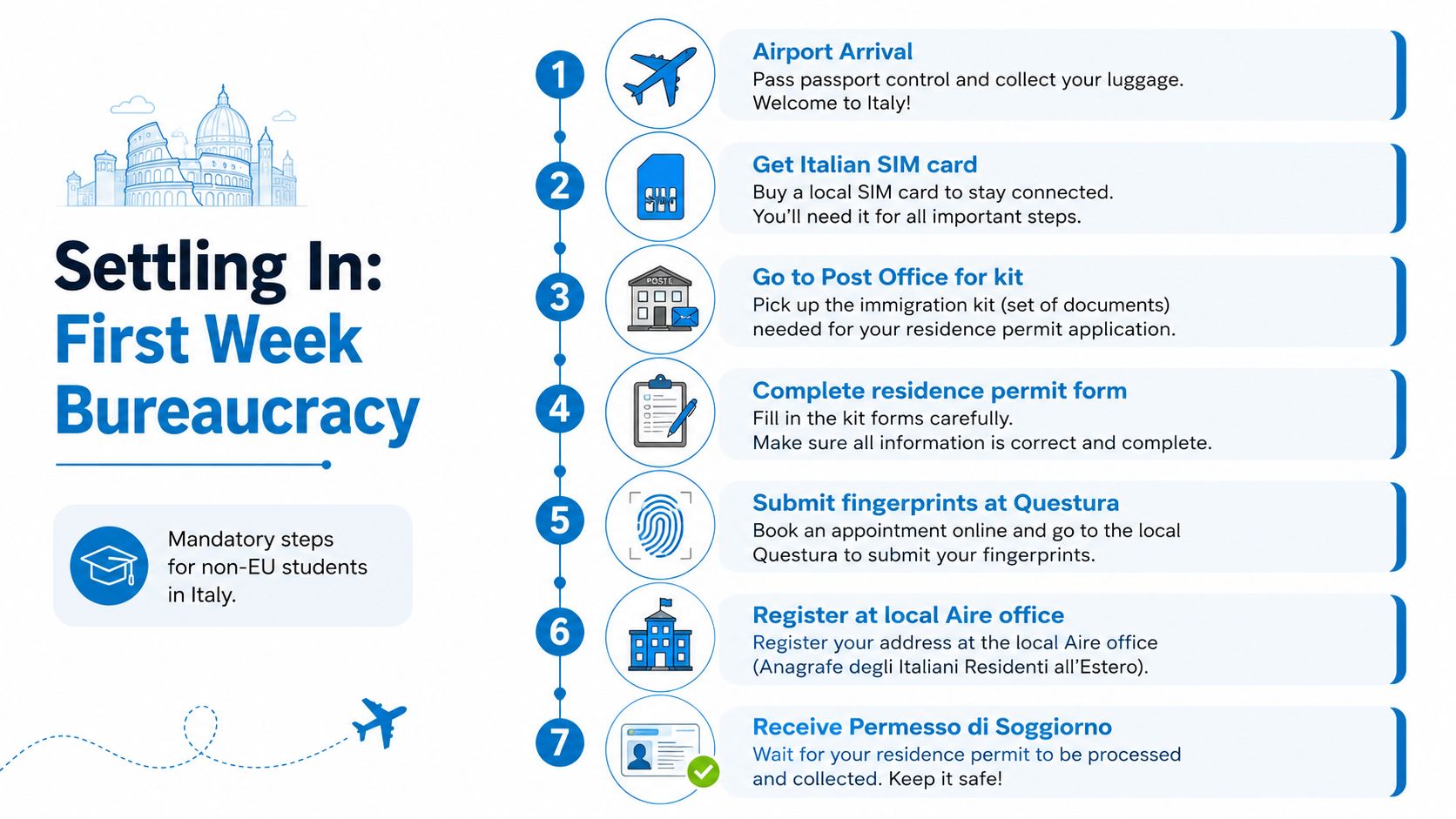
You arrive with luggage, a temporary address, and more tasks than your first-week schedule can comfortably hold. Give those tasks an order: submit residence paperwork, arrange identification and healthcare, set up practical services, then learn the routes and places that will support daily life.
The residence permit comes first
Non-EU students must request the permesso di soggiorno per studio within 8 working days of arrival. The requirement is explained by the European Commission's immigration portal. For the current procedure, confirm the required documents and submission route with your university's international office, the relevant Questura, or another qualified local adviser. Requirements can vary by location, so avoid relying on guidance intended only for a different region.
Ask where to obtain and submit the postal kit, and keep the receipt after filing. It records your application and may be needed while you wait for the appointment or permit. Store photographs or scans of the receipt and submitted documents separately from the originals.
Secure the essentials
The codice fiscale is a tax identification code used for many practical agreements. Ask the Agenzia delle Entrate about the application process and keep the document with your passport records.
Arrange healthcare before you need treatment. Confirm whether your status allows access to the Italian public system or requires private insurance, then identify a nearby clinic, pharmacy, and emergency service. Knowing where to go reduces stress when you are ill or exhausted.
A local bank account can simplify rent and recurring payments, although an existing account or digital banking arrangement may work at first. Check identification requirements, fees, and suitability before choosing an option.
For your phone, check coverage and contract terms before signing. If you are deciding between physical and digital options, use this guide to compare Italy prepaid eSIM options.
Make the city feel navigable
Collect your student ID, find the international office, walk the route to campus, locate a grocery shop, and identify a pharmacy. These small landmarks work like pins on a personal map. They turn an unfamiliar city into a set of manageable routines.
Culture shock may appear after the urgent paperwork ends. Homesickness, irritability, fatigue, or confusion can be normal adjustment reactions, not evidence that you chose incorrectly. The guide to coping with culture shock in Italy offers practical support, while Therapsy can provide a mental health resource as you adapt.
Finding the Right Place to Live
Housing affects more than your budget. It determines how much privacy you have, how often you meet people, how long your commute takes, and whether you feel anchored during the first difficult weeks.
University residences can offer community and convenient access to campus, but places may be limited. Shared flats are often a practical compromise because they reduce isolation and give you everyday exposure to Italian routines. A private studio offers control and quiet, but usually requires more financial capacity and administrative confidence.
Compare the main housing choices
| Housing Type | Average Monthly Cost (€) | Pros | Cons | Best For |
|---|---|---|---|---|
| University residence | Varies by institution | Campus community, possible services, easier social contact | Limited availability, shared facilities, fixed rules | Students who want structure and built-in connections |
| Shared flat | Varies by city and room | Lower individual cost, social support, common household | Different habits, shared responsibilities, possible language friction | Students seeking community and flexibility |
| Private rental | Varies by city and property | Privacy, independence, control over routine | Higher total cost, deposits, contracts, utilities | Students with a stable budget who value autonomy |
Italy's major university cities don't offer the same housing experience. Milan tends to have a higher baseline cost, while Bologna's dense student population can make rooms difficult to secure. Rome, Florence, Turin, and Padua each bring different trade-offs between location, transport, university concentration, and availability.
Read the contract before paying
A contratto transitorio is designed for temporary housing, while a longer residential contract may follow a different structure. Ask the landlord or agency to explain the duration, renewal terms, deposit, notice period, utilities, registration, and rules concerning guests.
Never send money solely because a listing looks attractive. Request a viewing, verify the person offering the room, insist on a written contract, and keep payment records. A price far below comparable homes deserves careful checking rather than immediate excitement.
Housing decision: A slightly longer commute may be manageable. An unstable or deceptive rental arrangement can undermine your sleep, finances, and academic focus.
Start looking well before arrival, while keeping a temporary option available if you can't verify a long-term room remotely. Once you arrive, compare the daily commute with the rent. The cheapest room may become expensive in time, transport, and exhaustion.
University Enrollment and Academic Setup
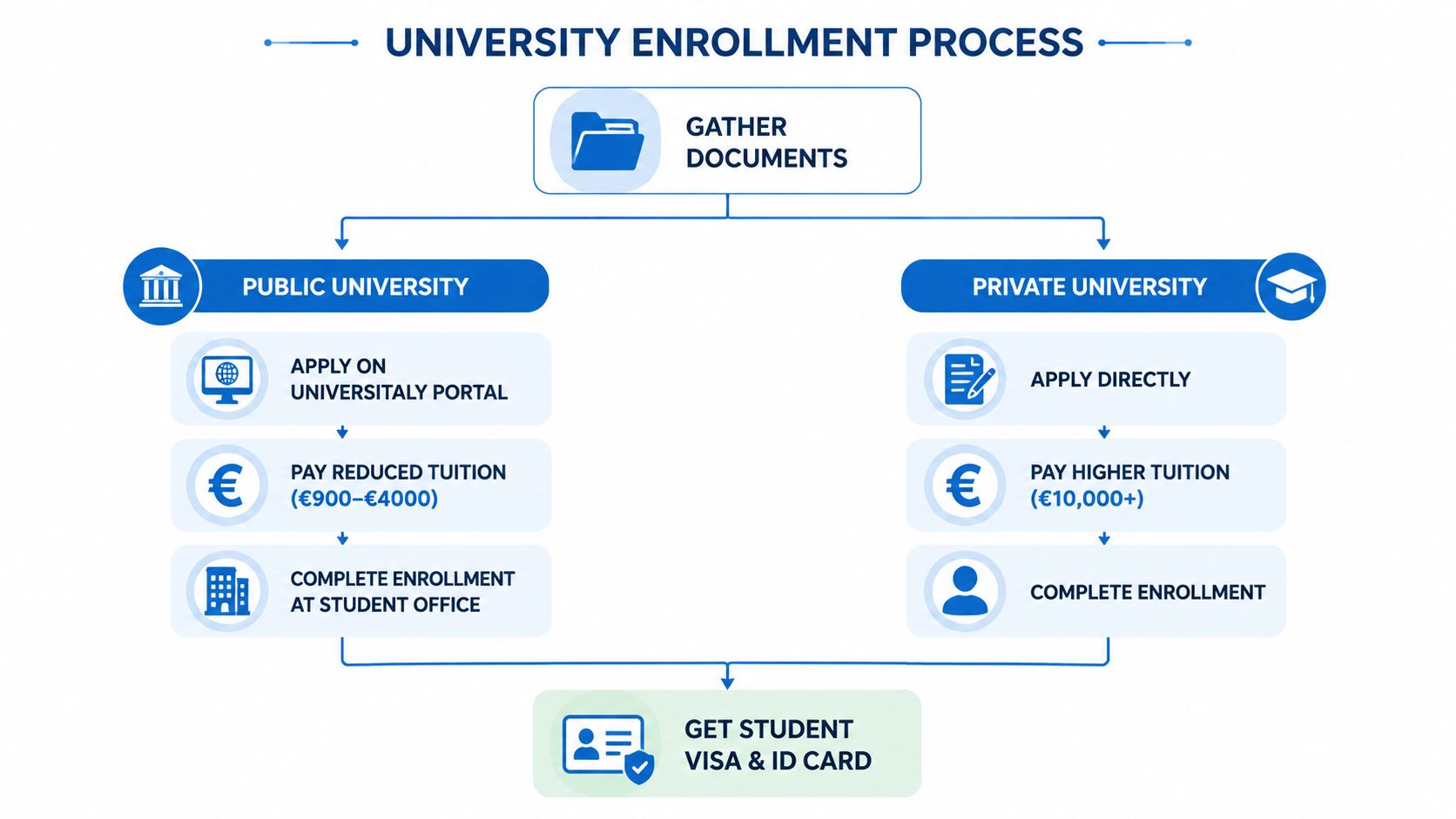
到達義式錄取不等於完成註冊。大學確認錄取後,你可能仍須提交經認證的文件、付款、身分證明,並親自到 Segreteria Studenti 辦理正式註冊。把錄取通知看成入場許可,註冊則是完成入場程序。
義大利公立與私立大學的學費和申請方式不同。依據 European Commission's Italy country profile,公立大學常見學費為每年 €900 至 €4,000,私立大學則為 €6,000 至 €20,000 或以上。實際金額仍須向校方確認,因為學費可能取決於課程、收入證明及校方規定。
Follow the university's sequence
對許多非歐盟申請者而言,Universitaly 預註冊檔案是簽證流程的一部分。大學會先審查並確認資料,之後才進入領事館程序。私立大學也可能要求你透過自己的招生系統另行申請。
學歷文件可能需要合法化、認證翻譯、Dichiarazione di Valore,或 CIMEA Statement of Comparability。要求會因大學與學歷而異,因此先向校方確認接受哪一種文件,再開始辦理,避免花費時間和費用準備不適用的證明。
受限制的課程可能設有入學考試、試演、面試或作品集審查。把這些要求獨立列入時間表,不要只盯著簽證期限。
Understand the academic rhythm
義大利學位採用 CFU,代表已完成學習工作的大學學分。考試可能是筆試、口試,或兩者並用。即使你熟悉科目內容,評量方式仍可能需要適應。
註冊後,立即啟用大學電子郵件、學生入口網站、圖書館權限、課表系統與數位學習平台。確認考試登記位置,也詢問你的課程是否要求出席。若你仍在比較城市,可先find European student cities this spring,再從氣候、交通、校園生活和讀書習慣是否相符來評估。
不熟悉學術規範,或因害怕問錯而保持沉默,會讓壓力逐漸增加。除了向系辦尋求說明,也可參考義大利國際學生考試壓力資源,在處理註冊與課業要求時,同時留意自己的心理狀態。
Language, Culture and Mental Wellbeing
A student can be academically capable and still struggle after moving to Italy. The difficulty often comes from managing several demanding changes at once: a new language, different classroom expectations, administrative uncertainty, unfamiliar social codes, and separation from family.
Research on Italian university students has reported distress across several measures. One overview found anxiety levels of up to 65%, depression of up to 73%, stress of up to 89%, and sleep disturbances of up to 65%, with suicidal ideation around 7%. A more recent study reported stress in 72.6%, anxiety in 61.8%, depression in 41.6%, sleep disorders in 63.9%, and overall mental distress in 56%, as summarized in the peer-reviewed overview of mental health among Italian university students. These findings concern Italian university students generally, so they shouldn't be treated as a precise forecast for every international student.
Culture shock follows a pattern
Cross-cultural psychology often describes adjustment as a changing process rather than one fixed experience.
- Honeymoon: New food, streets, friendships, and academic possibilities feel energizing.
- Negotiation: Practical frustrations become more visible. You may miss familiar services, humour, food, or communication styles.
- Adjustment: You develop strategies for language, transport, studying, and social contact.
- Adaptation: Italian and home-country habits begin to coexist without requiring constant comparison.
The negotiation phase can feel like failure because it follows excitement. It isn't. Your nervous system is responding to sustained uncertainty, and ordinary tasks require more attention when you can't rely on automatic routines.
Psychological insight: Culture shock becomes harder when students interpret normal adjustment stress as evidence that they chose the wrong country or aren't capable of coping.
Language affects emotional safety
Classroom fluency doesn't guarantee comfort with bureaucratic Italian, regional accents, medical vocabulary, flatmate negotiations, or the speed of casual conversation. Small misunderstandings can accumulate, especially when you're already tired or worried about money and grades.
CBT can help you identify anxious predictions and test them through manageable actions. Schema Therapy can explore older beliefs that become activated by rejection or dependence. EMDR may be relevant for trauma-related symptoms, but it should be assessed and delivered by a qualified professional rather than self-directed.
Therapsy offers therapy in 14 languages, including Italian, American and British English, French, Spanish, German, Portuguese, Ukrainian, Russian, Greek, Arabic, Urdu, Hebrew, and Hindi. Its service includes online and in-person sessions across 20+ Italian cities and 50+ physical locations, with human matching by the Clinical Director rather than automated questionnaires.
For study organization, students who manage attention difficulties may also find practical ideas in Kohru's ADHD study strategies. Social support matters just as much. Try the Erasmus Student Network, university sports clubs, buddy programmes, language exchanges, or a regular study group.
If distress becomes intense, persistent, or unsafe, contact a qualified mental-health professional or local emergency service. Therapy can support adjustment, but it doesn't replace urgent medical or crisis care.

Therapsy's multilingual psychotherapy for expats in Italy can be useful when explaining your experience in Italian would make support harder. Speaking in your strongest language can give you more room to describe homesickness, identity changes, family expectations, anxiety, or loneliness accurately.
Your Moving to Italy Checklist and Final Tips
A move becomes easier to manage when you divide it into phases. Keep the timeline visible, review it each week, and ask your university or consulate to confirm any detail that could affect your visa or enrollment. The checklist below covers administration, daily setup, and the emotional adjustment that often begins after the practical work seems finished.
Before departure
Twelve to three months before leaving:
- Accept the university offer and confirm the programme requirements.
- Gather your passport, diplomas, transcripts, translations, and validation documents.
- Check whether you need Universitaly pre-enrolment and a Type D visa.
- Build a budget covering tuition, housing, transport, food, insurance, and deposits.
- Start researching housing and keep a record of every application and contact.
Do not rely on memory for paperwork. Keep one physical folder and one secure digital folder, using clear file names so you can find documents quickly during a stressful appointment.
Final preparations
Three months to departure:
- Confirm your visa appointment and the consulate's checklist.
- Secure verified accommodation or arrange a safe temporary option.
- Organize suitable health coverage.
- Set up a reliable way to access funds internationally.
- Save encrypted digital copies of every document.
- Share your itinerary and emergency contacts with someone you trust.
Keep your arrival plan practical. Know how you will reach your accommodation, where you can buy food, and how to contact your university if your travel schedule changes.
Arrival week
During your first days:
- Apply for the study residence permit within the required deadline.
- Keep the postal receipt and appointment information.
- Request the codice fiscale.
- Complete university registration and collect your student credentials.
- Locate the international office, local health information, a pharmacy, a supermarket, and your campus route.
- Buy a SIM or activate your chosen mobile arrangement.
The first week can feel like assembling furniture without having all the instructions. Complete the time-sensitive administrative tasks first, then add one familiar routine each day. A regular breakfast, a short walk, or a call home can give the day a stable starting point while everything else is unfamiliar.
First semester
During your first months:
- Attend orientation and join a student society, sports activity, buddy programme, or language exchange.
- Create a weekly routine for classes, meals, sleep, exercise, and social contact.
- Notice changes in mood, concentration, appetite, and sleep.
- Ask for support early if anxiety, low mood, isolation, or academic pressure begins affecting daily life.
- Register with your embassy or consular service if appropriate for your circumstances.
Culture shock does not always look dramatic. It may appear as tiredness, irritability, difficulty concentrating, avoiding messages, or feeling disappointed that the experience is not matching your expectations. These reactions can follow ordinary pressures, such as speaking another language all day, interpreting unfamiliar academic rules, or rebuilding friendships from the beginning.
Mental-health care can be part of the structure that supports study, relationships, and recovery after setbacks. A multilingual service may help when describing homesickness, identity changes, family expectations, anxiety, or loneliness in a second language feels limiting. Therapsy offers online and in-person psychotherapy for expats in Italy, with support available in multiple languages.
Frequently asked questions about moving to Italy for university
Do I need a visa for university in Italy?
Non-EU students studying in Italy for more than 90 days generally need a national Type D study visa before arrival. After entering Italy, they must apply for a study residence permit within the required timeframe.
EU students follow a different process. Check current requirements with your university and the relevant Italian authorities. Keep immigration and enrollment documents together because both processes affect your legal and academic status.
How does Universitaly work for international students?
Universitaly is the pre-enrolment portal used by many non-EU students applying to Italian universities from abroad. The chosen institution validates the application before the consulate can process the related visa file.
Your university remains the main source for programme-specific instructions. Ask whether further admissions steps, translations, or qualification documents are required.
How much does public university cost in Italy?
Typical public university tuition ranges from €900 to €4,000 per year, while private tuition can range from €6,000 to €20,000 or more, according to the European Commission's Italy country profile. Exact fees depend on the institution, programme, and applicable income assessment.
Check scholarship, fee-waiver, and regional support options directly with your university. Build your budget around the confirmed fee rather than a general estimate, and leave room for deposits and first-month expenses.
What should I do if I feel lonely after moving to Italy?
Start with regular contact, predictable routines, and one low-pressure social activity connected to your university or local community. Loneliness often grows when students wait to feel confident before reaching out.
Choose activities that create repeated contact, such as a study group, sports session, buddy programme, or language exchange. Familiarity develops through attendance, even if the first meeting feels awkward.
Can I have therapy in English or another language in Italy?
Multilingual therapy is available in Italy, although language availability differs between services and locations. Speaking in your strongest language can make it easier to describe emotions, family dynamics, identity concerns, and experiences that are difficult to translate.
Before starting, ask about professional qualifications, confidentiality, session format, availability, and the process for changing therapists if the match does not feel suitable.
When should I seek mental-health support as a student?
Seek professional support when distress persists, interferes with study or daily functioning, or makes you feel unsafe. You do not have to wait until a problem becomes severe to ask for help.
If immediate danger or thoughts of self-harm are involved, contact local emergency services or an urgent healthcare provider immediately. Therapy can support adjustment, but it does not replace urgent medical or crisis care.
Is online therapy suitable after moving to Italy?
Online therapy can suit students who move between cities, have demanding timetables, or feel more comfortable speaking from a private, familiar space. Confirm that your setting is confidential and that the therapist is appropriately qualified for your circumstances.
Before a session, check your connection, headphones, privacy, and the local procedure for urgent support. These small preparations make it easier to speak openly and keep appointments consistent.
What is the first practical step after arriving in Italy?
For non-EU students, the first urgent administrative task is starting the study residence-permit process within the required deadline. Then organize your codice fiscale, university registration, healthcare arrangements, communication access, and daily route.
Emotionally, choose one reliable point of contact before a crisis occurs. This might be a university adviser, trusted friend, family member, or qualified mental-health professional. A clear contact plan gives you somewhere to turn while you establish your new life.