Therapy for social isolation works best when it targets the thoughts, emotions, and habits that keep a person withdrawn, not when it offers generic reassurance. The evidence also shows that structured, time-limited intervention can reduce loneliness, especially when it addresses rejection sensitivity, low social confidence, and avoidance.
Therapsy is a multilingual psychotherapy service in Italy that connects expats with therapists who speak their native language.
Social isolation is more than being alone. It can mean having too few real connections, feeling disconnected even around other people, or both, and those two experiences often need different kinds of help. For expats, international students, and young adults in Italy, that distinction matters because language, culture, and relocation stress can turn everyday social friction into a lasting sense of disconnection.
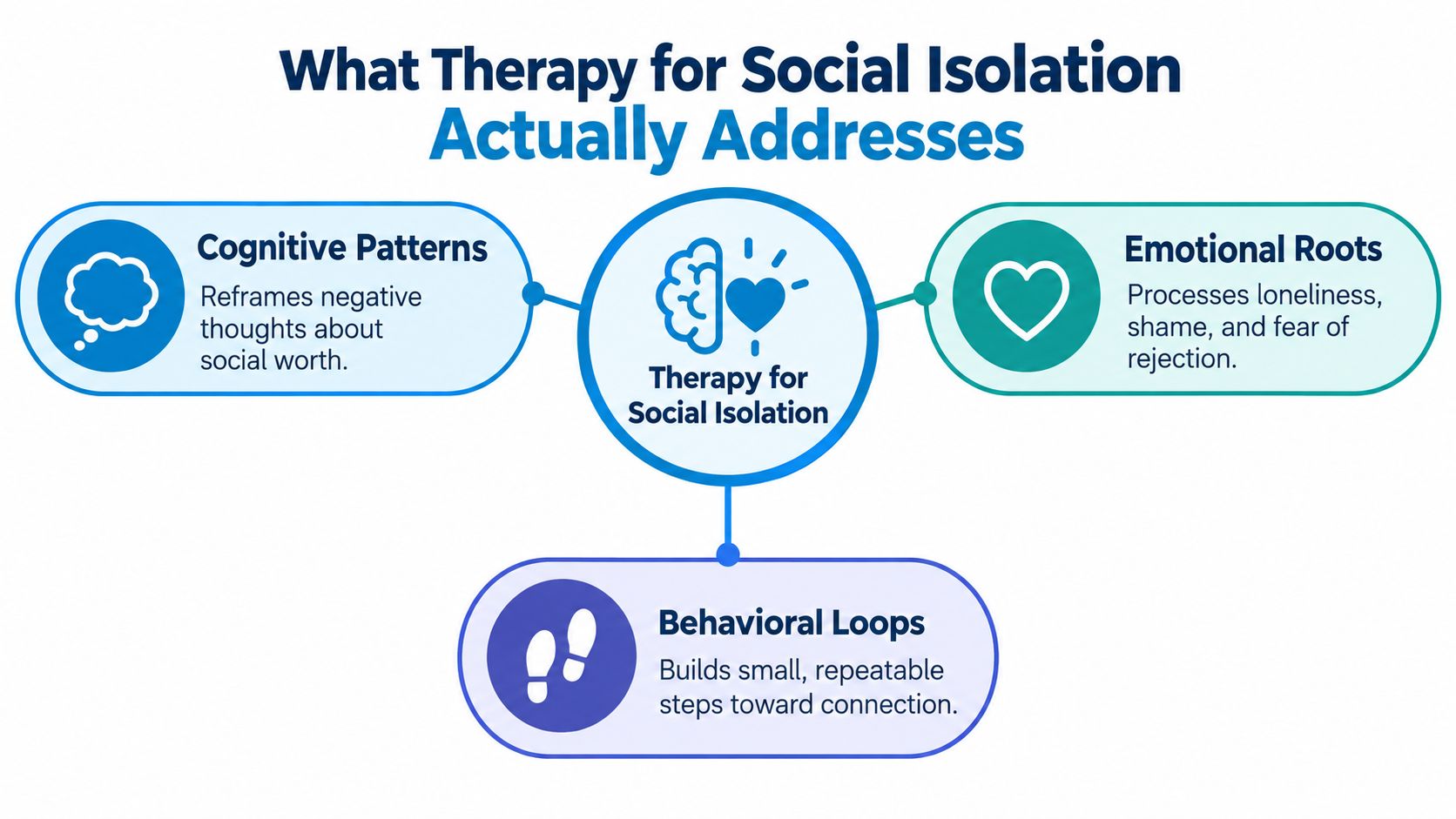
What Therapy for Social Isolation Actually Addresses
Therapy for social isolation targets the mechanisms that maintain withdrawal, not just the loneliness itself. In practice, that means working on thoughts, emotions, and behaviors that keep someone stuck in a loop of avoiding contact and then feeling more alone.
Why the difference between loneliness and isolation matters?
Loneliness is the painful feeling of a gap between desired and actual connection, while social isolation is the objective lack of enough social ties. The distinction matters because someone can have friends and still feel alone, or have very few contacts and feel relatively okay.
The WHO defines social isolation as a lack of sufficient social connections, and it treats loneliness as a subjective experience rather than a simple count of contacts. That is why a therapist at Therapsy may first ask whether the main issue is emotional disconnection, a small network, or both, because the treatment plan changes depending on the answer.
Practical rule: If the problem is mainly internal, therapy leans toward changing beliefs and reactions. If the problem is mainly external, it leans toward rebuilding contact and support.
For subjective loneliness, structured psychological work tends to focus on beliefs like “people will reject me,” “I'm not socially competent,” or “it's safer not to try.” For objective isolation, the work often needs real-world reconnection, because insight alone does not create contact. That is why therapy for social isolation is most useful when it is specific, not vague.
What changes in therapy?
The strongest mechanisms are often CBT-style cognitive restructuring, behavioral activation, and graded social exposure. Those methods interrupt the pattern where loneliness increases avoidance, and avoidance further reduces contact. A large umbrella review found psychological interventions produced a small-to-moderate short-term improvement in loneliness, with pooled effects around SMD = −0.50 across 122 randomized controlled trials and similar estimates in cohort studies, especially when the work was targeted and time-limited (umbrella review in American Psychologist).
Therapy clinicians often frame this in intercultural terms, because expats may not only be isolated, they may also be navigating identity loss, language fatigue, and a smaller sense of social belonging. The emotional pattern can look like distance from others, but the actual barrier may be shame, distrust, or fear of getting it wrong in a new culture.
Which Therapy Approaches Work Best for Different Types of Isolation?
Different approaches help different mechanisms, and no single model fits every case. Someone who feels alone in a crowd needs a different kind of help from someone who only has too few contacts.
How do the main modalities compare?
Cognitive behavioral therapy tends to fit subjective loneliness well because it challenges negative beliefs and avoidance. Interpersonal therapy focuses on current relationship patterns and role changes, which can suit expats whose social world shifted after relocation. EMDR may help when withdrawal is tied to trauma, while schema therapy addresses deeper patterns such as mistrust or emotional deprivation.
Metacognitive interpersonal therapy adds another layer by combining insight into thought patterns with social skills work. For objective isolation, group formats and supported socialization often make more sense than individual reflection alone, because they create actual contact, not only emotional insight.
| Therapy Approach | Best For | How It Helps | Evidence Strength |
|---|---|---|---|
| CBT | Subjective loneliness, avoidance, rejection sensitivity | Reframes negative beliefs, reduces avoidance, builds social confidence | Strongest signal among loneliness interventions |
| Interpersonal therapy | Relocation stress, role changes, relationship strain | Works on current relationships and communication patterns | Promising, especially for adjustment issues |
| EMDR | Trauma-linked withdrawal | Helps process experiences that make closeness feel unsafe | Useful when isolation follows distressing events |
| Schema therapy | Deep mistrust, emotional deprivation, outsider feelings | Targets long-standing patterns that shape belonging | Clinically relevant for entrenched patterns |
| Metacognitive interpersonal therapy | Mixed thought and behavior loops | Combines insight, attention shifting, and social practice | Emerging, practical for social functioning |
| Group or supported socialization | Objective isolation | Creates real contact and peer connection | Better fit when the main problem is low contact |
A recent umbrella review found that interventions aimed at social contact and social support worked better for objective isolation, while psychological interventions were more promising for subjective loneliness. The same review also reported a moderate effect size for social isolation outcomes, with g = 0.43 and moderate heterogeneity (I² = 46%) across 10 RCTs (umbrella review on social isolation interventions).
The most useful question is not “Which therapy is strongest?” It is “What is driving the isolation, and what kind of connection is missing?”
A policy-oriented review found CBT had the largest effect size among loneliness interventions, g = 0.73, and higher baseline loneliness predicted larger gains. For people who feel the problem has become entrenched, that suggests early, skills-based treatment may work better than waiting until isolation hardens into a wider withdrawal pattern.
For readers who prefer a more humanistic frame, the basic idea is simple. Therapy is not there to force extroversion. It is there to reduce the pain and fear that make connection feel risky, then support a more workable social life. That logic also appears in what humanistic psychotherapy looks like in practice.
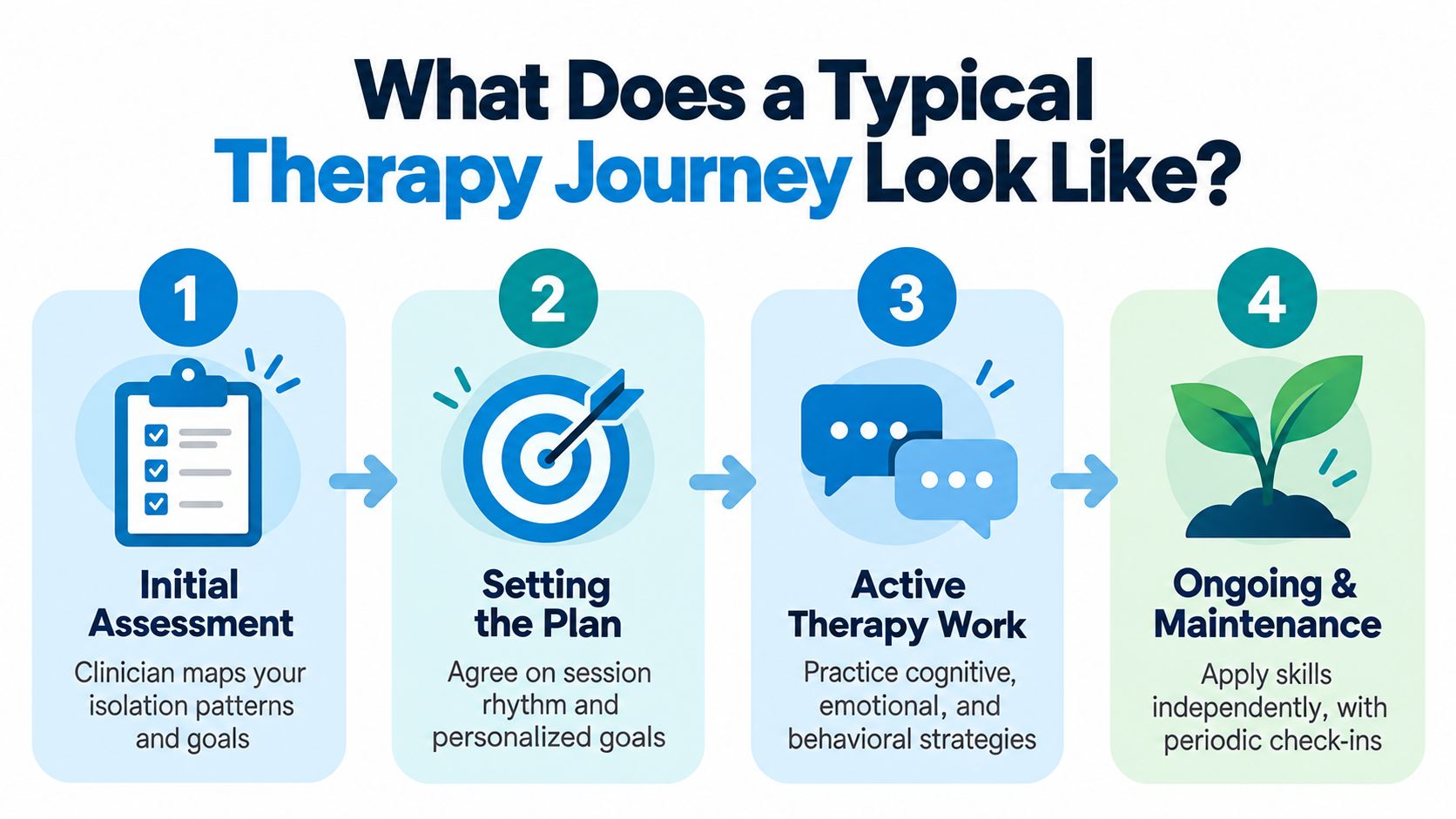
What Does a Typical Therapy Journey Look Like?
A therapy journey for social isolation usually starts with a clear assessment, then moves into practical goals, then into repeated practice. The process is meant to make connection feel more manageable, not to overwhelm someone with vague advice.
What happens in the first phase?
The first meeting usually maps out what kind of isolation is present, what triggered it, and what keeps it in place. A therapist may ask about relocation, grief, family distance, language stress, dating, workplace fit, and previous experiences of rejection.
At Therapsy, the first call is free and is used to match the client with the therapist chosen for that person. That matters because a multilingual, intercultural fit can lower the pressure of having to explain basic context before any deeper work even starts.
Why does structure matter so much?
Structure reduces uncertainty. When sessions are organized around one or two goals, clients can see whether the work is changing actual behavior, not just mood on the day of session.
For many expats, that structure can include reducing avoidance, practicing communication, processing rejection memories, or rehearsing social situations that feel intimidating. The session rhythm can be adjusted over time, and in some cases group work is added when the problem is less about inner distress and more about rebuilding a social network.
The article how long therapy takes can help readers understand why this pace is often gradual. The point is not instant social confidence, it is repeated exposure to manageable social steps until the nervous system stops treating every interaction like a threat.
Practical Strategies to Reduce Isolation Beyond Therapy
Therapy works best when the person also starts rebuilding contact in small, realistic ways. The goal is not to become highly social overnight, it is to create enough repeated contact that the brain starts expecting connection again.
What can help outside the therapy room?
Joining an interest-based group can help because the activity gives the interaction a shared purpose. Language classes, volunteering, and recurring community events can do the same thing, because they create low-pressure repetition instead of forcing instant intimacy.
For nomads and mobile professionals, a guide to peer support for nomads can be useful as a reminder that belonging often grows through shared routines, not through perfectly planned conversations. The same principle applies in Italy, where many expats find that a familiar weekly setting feels safer than trying to “network” socially from scratch.
Why do small steps work better than big social overhauls?
Big social goals can backfire when the person already feels exposed or self-conscious. Small, repeatable steps work better because they give the nervous system proof that contact can be tolerated.
Useful pattern: one repeated setting, one familiar face, one concrete role. That combination often matters more than a crowded calendar.
This is especially important for people with avoidance, social anxiety, or a strong fear of saying the wrong thing in another language. In those cases, the barrier is not laziness or lack of willpower, it is a learned expectation that contact will lead to discomfort or rejection.
Therapsy often frames these strategies as part of an intercultural adjustment process, not as a personality fix. The emphasis stays on practical connection, not on forcing someone to become a different kind of person.
How to Find a Therapist in Italy Who Speaks Your Language
Language mismatch can make isolation feel worse, because it forces a person to translate feelings before they can even name them. For expats, the right therapist is often the one who can understand emotional nuance in the client's own language and cultural frame.
What should people look for first?
The first filter is language. In Italy, some services offer therapy across 14 languages, including Italian, English, French, Spanish, German, Portuguese, Ukrainian, Russian, Greek, Arabic, Urdu, Hebrew, Hindi, and Persian (Farsi), so it makes sense to start with that fit rather than treat English as the only option.
The next filter is cultural understanding. A therapist who knows cross-cultural adjustment, homesickness, identity strain, or the social effects of relocation is often better placed to distinguish between ordinary loneliness and a deeper pattern of withdrawal.
What makes a good match in practice?
A good match is usually one where the clinician can explain how they work with isolation, whether through CBT, interpersonal work, schema therapy, or another method that fits the mechanism. It also helps to ask whether the service can support online sessions, in-person visits, or both, because logistics affect follow-through as much as motivation does.
At Therapsy, the matching process is human, not algorithmic, and it is handled by the Clinical Director rather than by a questionnaire. The service connects expats with therapists who speak their native language across 14 languages, with sessions available online or in person across 23 Italian cities and 83 physical locations. The first assessment call is free, and each client is matched personally by the Clinical Director.
A good first call should lower uncertainty, not raise it.
For people comparing options, the Therapsy page for English-speaking therapy in Italy is one place to start, especially if the main question is how to get help without having to struggle in Italian from the first conversation.
Frequently Asked Questions About Therapy for Social Isolation
Does therapy help with social isolation for everyone?
Therapy can help when isolation is driven by avoidance, shame, fear of rejection, or unclear relationship patterns. It is less useful as a standalone solution when the main issue is purely logistical, such as having no accessible community nearby, although it can still help the person build a plan.
Is online therapy enough for social isolation?
Online therapy can be a strong fit when the barrier is language, shame, or access, especially for expats who feel stuck before they even start. It works best when the work includes real-world steps outside the session, because the goal is not just emotional relief, it is reconnection.
What happens in the first session?
The first session usually focuses on context, not pressure. A therapist will ask what isolation feels like, when it started, what changed after the move, and what the person wants to be different.
Can apps or chatbots replace therapy?
The evidence does not support treating digital self-help or chatbot-style support as equivalent to therapist-led care for entrenched isolation. They may be helpful for some people, but they are not a full substitute when the problem involves deep avoidance, grief, trauma, or a long-standing sense of not belonging.
How do people know whether they need help?
When isolation starts affecting sleep, mood, work, study, or the ability to make contact, it is a good time to speak with a professional. The finding the right therapist for expats in Italy guide can help clarify what to look for without making the decision feel heavy.
Does therapy replace medical care?
No. Therapy can support emotional recovery and social reconnection, but it does not replace medical care when depression, severe anxiety, or physical symptoms need a doctor's evaluation.
Therapsy helps expats and international students in Italy find therapy in their own language, with human matching, online or in-person sessions, and a first call that's free and with no obligation to continue. For anyone who feels socially cut off, THERAPSY offers a low-pressure way to start with a therapist chosen for that person, not a generic directory.