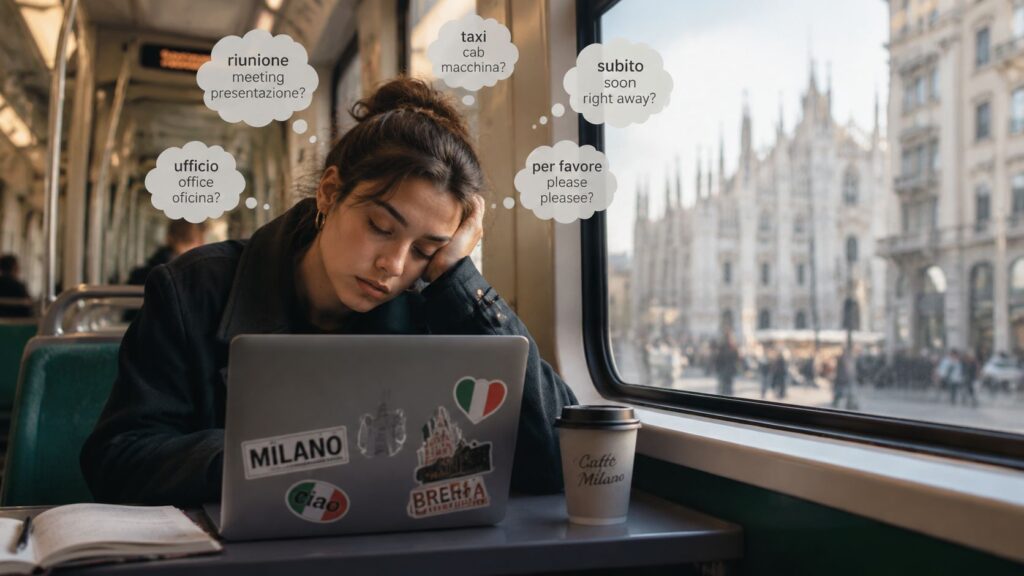
You moved to Italy for something meaningful. A relationship. A degree. A role that looked like progress. Then, somewhere between the paperwork, the language fatigue, the LinkedIn scrolling, and the Sunday-evening dread, another question appeared. What if I don't want this career any more?
That question can feel heavier abroad than it ever did at home. It isn't only about work. It touches rent, visas, identity, belonging, and the fear of “wasting” a move that cost you so much emotionally. Career change anxiety living abroad is the emotional strain that appears when professional uncertainty collides with the stress of adapting to a new country. In practice, I see this often among expats in Italy, especially young adults trying to build a life while also rebuilding a sense of self.
If that's where you are, your anxiety is not a sign that you're weak, ungrateful, or incapable. It often means your nervous system is carrying too many competing demands at once. You're trying to make a high-stakes career decision without the familiar structures that once helped you think clearly.

I'm Dr. Francesca Adriana Boccalari, Clinical Director at Therapsy, and this guide is written for expats in Italy who feel stuck between professional change and psychological overload. There are ways to understand this anxiety more clearly, reduce its intensity, and make decisions from a steadier place.
Introduction
What Is Career Change Anxiety and Why Is It More Intense for Expats
Career change anxiety is the persistent worry, self-doubt, and internal pressure that can arise when you're considering leaving, redefining, or rebuilding your professional path.
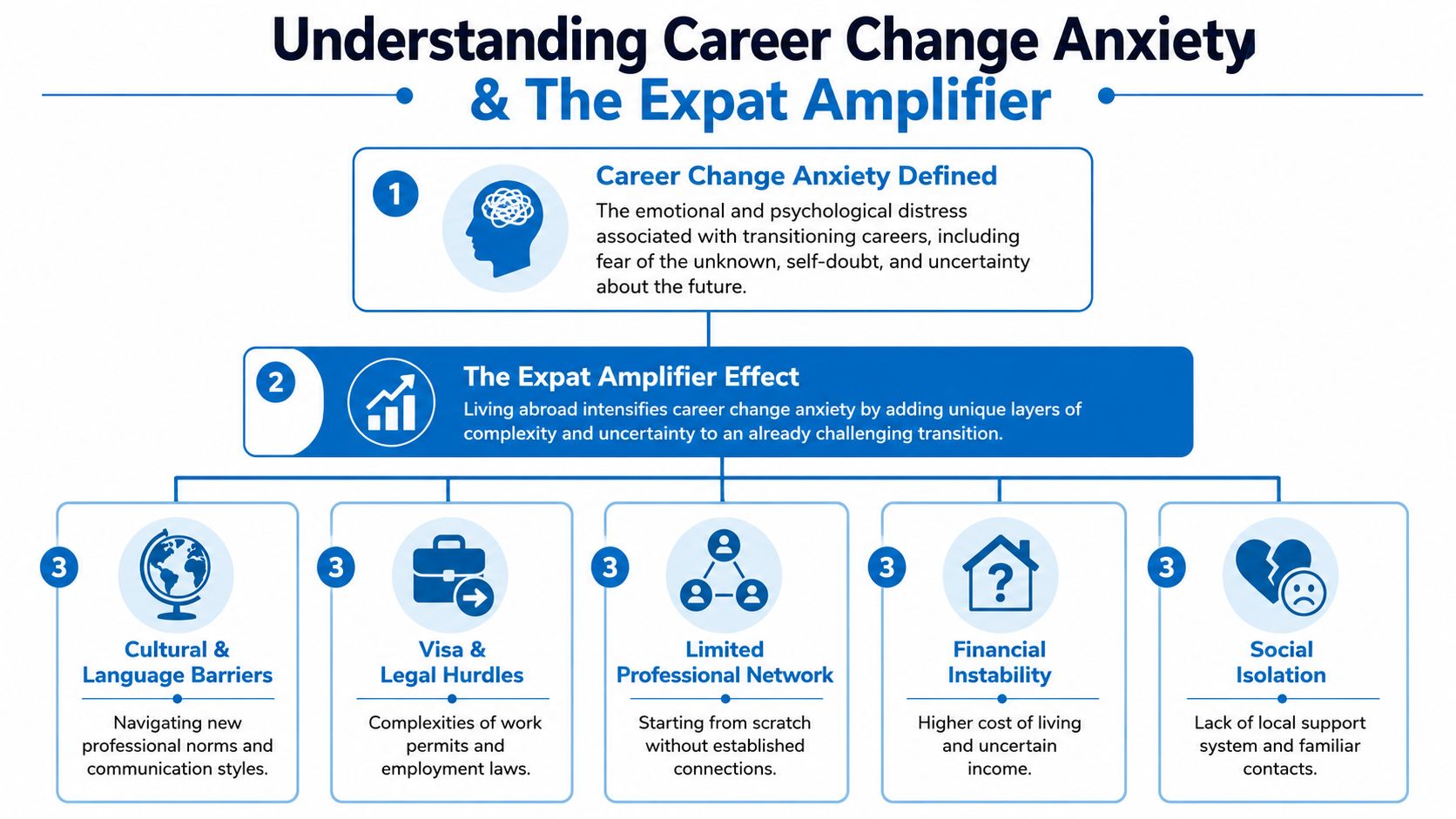
For expats, that anxiety rarely stays “just” about work. It spreads into practical survival and emotional stability. The result is what I often think of as an expat amplifier effect. A normal career crossroads starts to feel like a threat to your whole life structure.
Why the same career doubt feels bigger abroad
At home, career uncertainty is often buffered by familiarity. You usually know how the system works. You know who to call. You know how your qualifications are read. You may even know the emotional script for starting over.
Abroad, those buffers weaken.
That matters clinically because many people relocate around a professional decision first, then only later realise the emotional cost of tying identity, income, and migration to the same choice.
The expat amplifier effect in daily life
This intensification usually comes from several layers interacting at once:
- Professional identity becomes fragile. You may have been competent and established before, but now you're translating your CV, explaining your background, or accepting work below your level.
- Decision-making gets distorted by stress. When your brain is busy adapting to a foreign environment, it has less capacity for clear long-term planning.
- Support shrinks. Friends and family may care very much, but they're not physically present in your day-to-day reality.
- Every option looks expensive. Staying put feels costly. Changing careers feels risky. Going home can feel like failure.
A career pivot abroad often feels intense because it is carrying more than one psychological task at the same time. It is a work decision, an identity decision, and an adaptation decision.
For many expats in Italy, this also overlaps with questions of belonging. Am I building a real future here, or just surviving? Am I changing because I'm growing, or because I'm overwhelmed? These are not superficial doubts. They sit close to the core issues involved in expat identity crisis, where self-definition becomes unstable after relocation.
Unique Triggers for Career Anxiety When Living Abroad
In Italy, career anxiety often gets sharpened by very concrete realities. These realities make the emotional experience stop being abstract and start showing up in paperwork, interviews, language mistakes, and private shame.
A systematic review on stress among foreign-born workers found that expatriates and other workers abroad face a distinct stress profile shaped by communication barriers, cultural differences, relationships, financial pressure, and social inequality. The review also noted that about 75% of business travellers and their families reported high stress levels, and linked communication barriers and social isolation with anxiety and depressive symptoms in this review on stress among foreign-born workers.
Your old professional self may not transfer cleanly
Many expats are startled by how quickly confidence drops when context changes.
- Qualifications may lose clarity. Your degree or previous title may be respected, but not immediately understood.
- Your network may disappear overnight. At home, opportunities often came through accumulated trust. Abroad, you may feel professionally invisible.
- Status can drop without warning. People who led teams, ran projects, or worked in specialised fields often find themselves starting from a more junior or uncertain position.
This can trigger a painful internal story: “If I was capable before, why does everything feel so hard now?”
Language stress changes your sense of competence
Even highly educated, capable professionals can feel psychologically reduced in a second language.
You may know what you want to say and still not be able to say it with nuance. In Italy, that can affect interviews, office dynamics, salary discussions, and networking. The problem isn't only communication. It's dignity. People often feel they are presenting a thinner, flatter version of themselves.
That creates a specific kind of anxiety. Not “Can I do this job?” but “Can I still be recognised as myself while doing it?”
Bureaucracy and legal uncertainty stay in the background
Visa issues, residency rules, and employment structures create a constant low-grade threat. Even when nothing is actively wrong, uncertainty itself consumes attention.
You might hesitate to leave a job you dislike because it anchors your legal status. You might delay exploring a new path because the administrative consequences feel opaque. That isn't avoidance in the lazy sense. It is often a nervous system trying to avoid further instability.
Work culture can feel readable and unreadable at the same time
Italy has rich professional environments, but also strong unspoken codes. Meetings, hierarchy, timing, relationship-building, and communication style may work differently from what you learned elsewhere.
Some expats adapt well on the surface while still feeling profoundly unsure underneath. They over-monitor themselves. They replay conversations. They worry they've missed a cue.
If this sounds familiar, the wider pattern may overlap with culture shock in Italy and how to cope, especially when work stress and adjustment stress start feeding each other.
The move can start to feel like a test you must justify
This is one of the most emotionally loaded triggers.
People often tell themselves:
- “I need to make this move worth it.”
- “I can't change direction now.”
- “If I go backwards professionally, what was the point of coming?”
That pressure narrows your thinking. Instead of asking, “What fits me now?” you start asking, “What choice would prove I didn't make a mistake?” Those are very different questions.
When anxiety is organised around proving the move was worth it, people stop listening to themselves and start performing survival.
Recognizing the Signs of Career Change Anxiety
Career change anxiety living abroad often hides in plain sight. Many expats assume they're tired, disorganised, or “bad at uncertainty”. In reality, the body and mind are often signalling overload.
Emotional signs
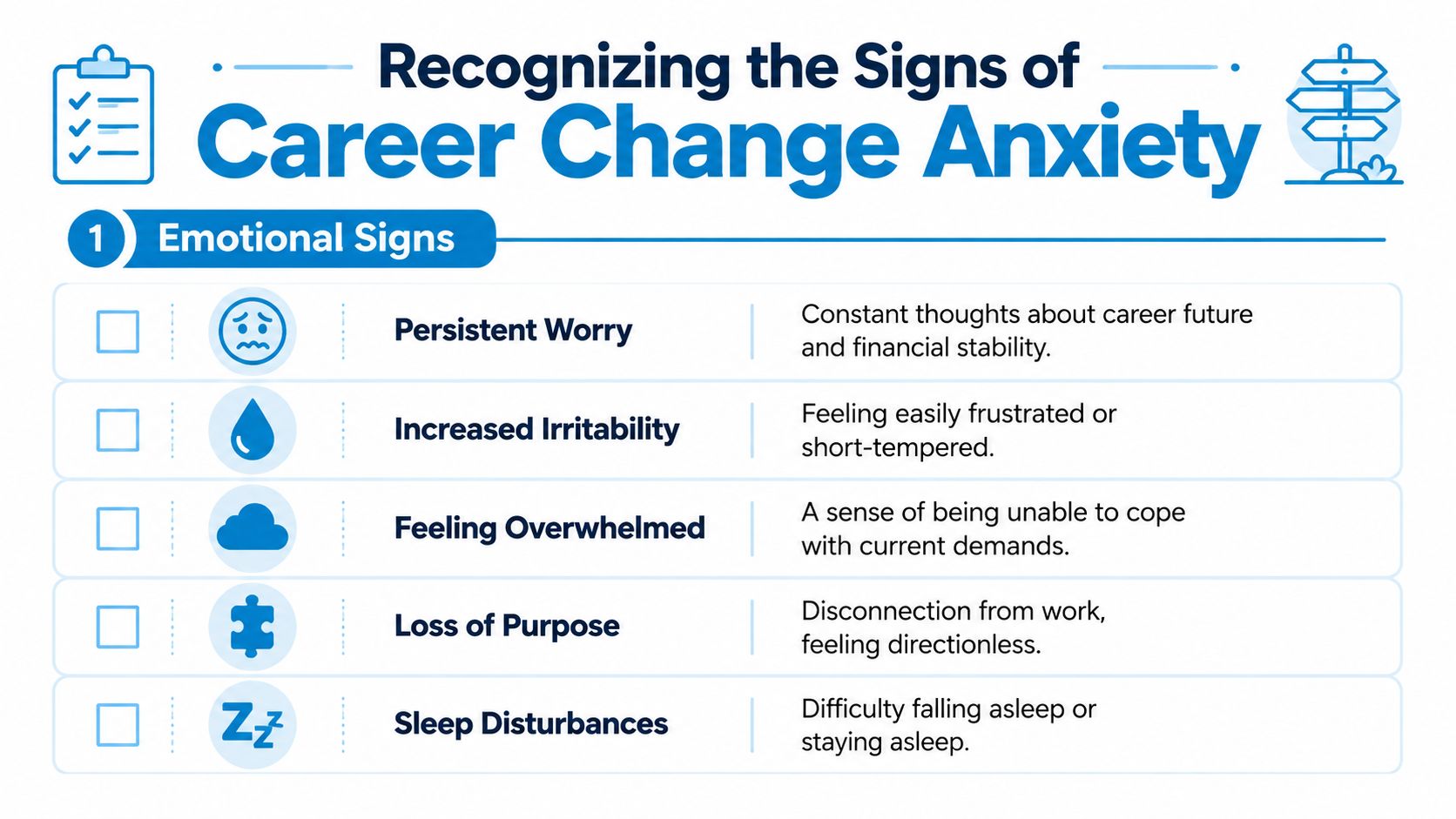
You may notice:
- Persistent worry: Your mind returns to work questions even during rest.
- Irritability: Small admin tasks, emails, or delays feel disproportionately upsetting.
- Feeling trapped: Every option seems wrong, late, or dangerous.
- Shame: You compare yourself harshly with peers back home or other expats.
- Loss of purpose: Work no longer feels meaningful, but leaving it doesn't feel safe.
If your emotional reaction seems “too big” for the decision in front of you, the issue is often cumulative stress, not personal weakness.
Cognitive signs
Anxiety changes thinking patterns. Common signs include:
- Obsessive mental looping: You rehearse the same career scenarios without reaching clarity.
- All-or-nothing thinking: “If this next move isn't perfect, I'll ruin everything.”
- Imposter thoughts: “They'll realise I'm not as capable as I seemed.”
- Poor concentration: Reading job posts or writing applications feels oddly difficult.
- Catastrophic forecasting: A normal setback becomes evidence of collapse.
Some readers recognise these patterns immediately when they read about anxiety symptoms in adults. The content changes, but the mechanism is often the same.
Behavioural signs
Career anxiety also shows up in what you do, or stop doing.
- Procrastination on applications or decisions
- Compulsive researching without action
- Avoiding networking or conversations about work
- Withdrawing socially
- Sleep disruption or changes in appetite
- Checking finances repeatedly without making a plan
A useful rule is this. If you are thinking constantly about career change but acting very little, anxiety may be driving the process more than reflection is.
The Risks of Ignoring This Anxiety
Untreated career anxiety abroad doesn't usually stay neatly contained. It spills outward.
At first, people often try to manage it by pushing harder. They stay in the wrong role, over-function, or keep telling themselves that once their Italian improves, once the next contract comes through, once they settle more, everything will calm down. Sometimes that happens. Often it doesn't.
What tends to happen when anxiety runs the show
Ignoring this anxiety can lead to patterns such as:
- Burnout: You spend large amounts of energy forcing yourself through a life that no longer fits.
- Impulsive decisions: Quitting suddenly, moving home abruptly, or accepting roles from panic rather than judgement.
- Relationship strain: Partners and friends may start receiving the fear you haven't processed.
- Narrowed identity: You reduce yourself to survival tasks and lose touch with curiosity, pleasure, and direction.
- Worsening mood: Ongoing anxiety can slide into hopelessness, numbness, or depressive symptoms.
Anxiety that goes unaddressed often stops being a signal and starts becoming a system. It begins to organise your days, your choices, and your relationships.
One of the most painful outcomes is misreading the situation. People conclude that the country is the problem, or that they are the problem, when in fact they are living inside an unresolved collision between adaptation stress and professional uncertainty.
Evidence-Based Strategies for Coping and Gaining Clarity
You do not need to solve your whole career at once. In fact, that approach usually makes anxiety worse. The most effective work starts by reducing cognitive overload, then rebuilding decision-making capacity.
A useful clinical question is whether what you're feeling is a normal adjustment reaction or a sign that you need more support. That matters because financial pressure often intensifies identity stress. In one survey, 40% of respondents in the 2024 YouGov/WISE survey said the cost of living in their country made them consider changing career or looking for a better-paid job, as discussed in this article on the psychological challenges of moving abroad.
Start with thought patterns, not life overhaul
CBT helps by identifying the distorted thoughts that turn uncertainty into panic.
Try writing down one fear in simple language. Then ask:
- What am I predicting?
- What evidence do I have?
- What am I leaving out?
- What would be a more balanced statement?
Example:
- Automatic thought: “If I leave this job, I'll fail in Italy.”
- More balanced thought: “Leaving this job would be difficult, but it wouldn't define my value or erase other options.”
This is not positive thinking. It is more accurate thinking. If you want a structured overview of this style of work, cognitive behavioral therapy for anxiety is often especially effective for career-related spirals.
Shrink the decision window
Anxious minds try to answer every future question immediately. That rarely works.
Instead, reduce the timeframe. Ask, “What is the next useful step in the next two weeks?”
That might be:
- Updating one section of your CV
- Speaking to one trusted person in your field
- Researching one training course
- Listing three essential requirements for your next role
- Checking the practical implications of a contract change
Clarity often follows movement. It doesn't always precede it.
Separate identity from job title
Schema Therapy is useful here because many expats carry deep beliefs such as:
- “My worth depends on achievement.”
- “If I struggle, I'm failing.”
- “I must adapt perfectly to be accepted.”
When these beliefs are active, a career shift feels like an attack on the self. The work is not only career planning. It is also loosening old rules about value, success, and belonging.
A job transition is easier to tolerate when it stops being treated as a verdict on who you are.
Use behavioural activation when you feel frozen
When anxiety produces avoidance, do the opposite of waiting to “feel ready”. Choose small, scheduled actions.
A simple structure works well:
| When | Action | Time limit |
|---|---|---|
| Tuesday morning | Review one job description | 20 minutes |
| Thursday lunch break | Send one message for an informational chat | 15 minutes |
| Saturday | Journal on what you want more of at work | 20 minutes |
Short actions protect you from perfectionism. They also give your brain evidence that movement is still possible.
Reduce overload from comparison and information excess
Many expats consume too much advice when they are anxious. They read career stories, compare salaries, search visa forums, and watch other people's reinventions online. The result is often paralysis.
Create boundaries:
- Limit career research to a set window
- Mute accounts that trigger shame
- Keep one notebook for your own thoughts
- Distinguish inspiration from pressure
When and How to Seek Professional Support in Italy
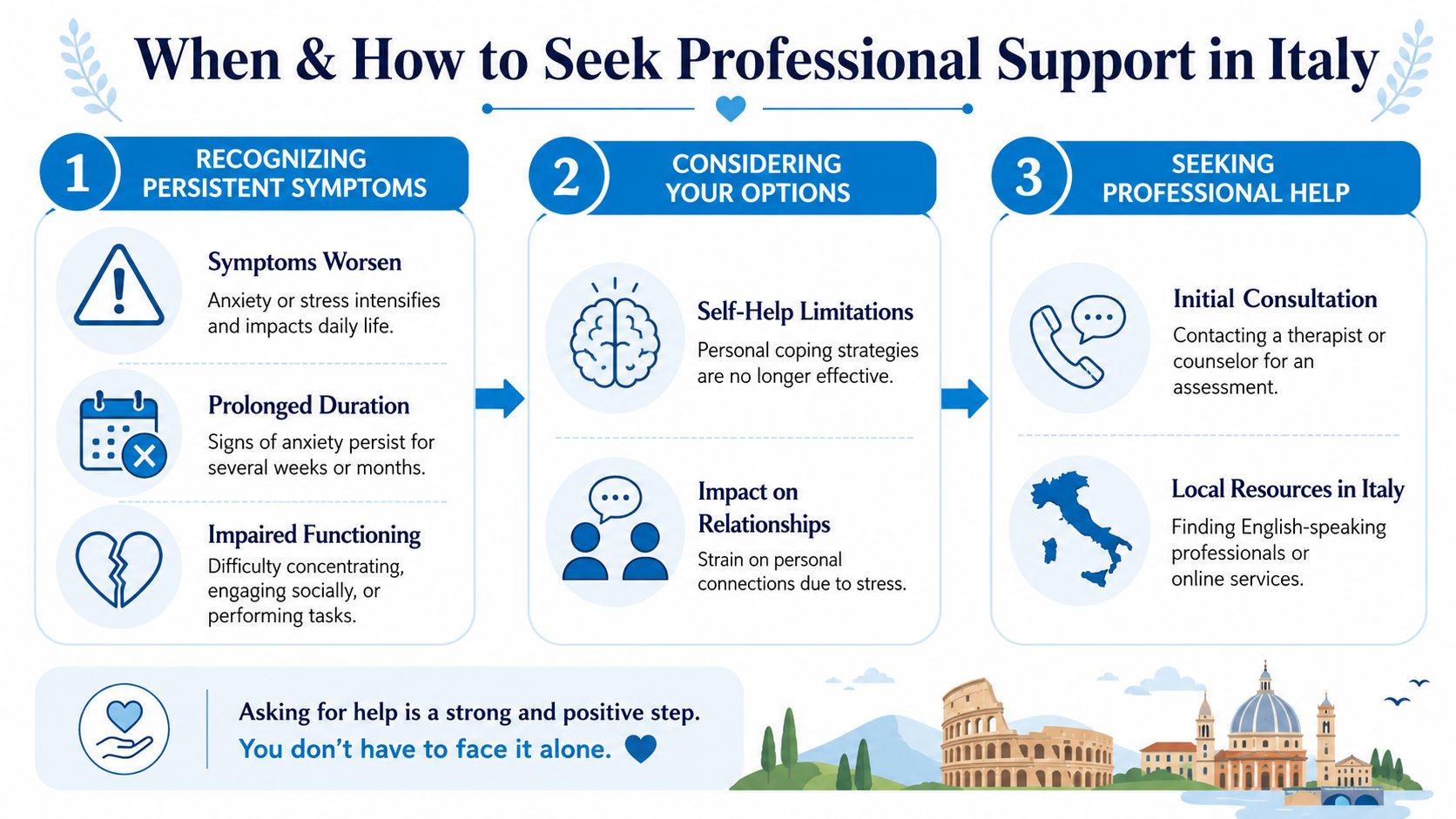
Sometimes self-help tools are enough to stabilise a transition. Sometimes they aren't. The difference usually shows up in persistence, intensity, and impact.
Signs it's time to speak with a therapist
Consider professional support if:
- Your anxiety is present most days
- Sleep, concentration, or appetite are being affected
- You feel stuck in repetitive loops without movement
- Work stress is damaging your relationship or social life
- You've started to feel hopeless, detached, or chronically ashamed
- You can't tell whether the problem is the job, the country, or your own exhaustion
Therapy is especially helpful when the decision itself isn't the only issue. Often the deeper problem is how your nervous system is processing uncertainty, loss of status, loneliness, and accumulated adaptation stress.
What good therapy can help with
Different approaches support different parts of this experience:
- CBT: Helps challenge catastrophic thinking and rebuild practical coping.
- Schema Therapy: Helps uncover long-standing patterns around perfectionism, approval, and self-worth.
- EMDR: Can be useful when relocation, workplace events, or previous failures have become emotionally stuck and continue to trigger strong reactions.
For many expats, the first relief comes from being able to explain the full picture without translating themselves culturally. That includes the emotional reality of permits, housing, foreign workplaces, and family expectations.
Practical support matters too
Therapy does not replace practical career work. It helps you do that work from a steadier place.
For example, once anxiety reduces a little, people often find it easier to take concrete actions such as rewriting their CV around strengths rather than panic.
Finding the right clinician also matters. Expats often do better when they work with someone who understands migration stress rather than treating it as background noise. If you're unsure what to look for, this guide to finding the right therapist for expats in Italy can help you choose more carefully.
Professional support in Italy should feel accessible
A good first conversation should help you feel less alone, not more analysed. You should come away with a clearer map of what is happening psychologically, what your options are, and what kind of support fits your situation.
At Therapsy, I oversee a team of carefully selected licensed professionals and the matching process personally. We offer therapy in 14 languages, online and in person across 24 Italian cities and 90+ physical locations, with evidence-based approaches including CBT, EMDR, Schema Therapy, TMI, systemic-relational therapy, humanistic approaches, and ethnopsychotherapy. Therapsy supports 1,500+ clients served since 2023, works with 50+ therapists, and is trusted by organisations including Cigna, World Food Programme, FAO, MUR, InterNations, IED, and Istituto Marangoni. Individual therapy starts from €70/session, couple therapy from €100/session, psychiatric consultation from €110/session, and psychodiagnostic assessment from €255. The first assessment call is free, with human matching rather than algorithms or chatbots.
FAQ
Is career change anxiety living abroad normal
Yes, it can be a normal adjustment response. It becomes more understandable when professional uncertainty is happening at the same time as migration stress, language strain, and reduced support. Normal does not mean easy, and it doesn't mean you have to manage it alone.
How do I know if I need therapy or just career advice
The short answer is to look at how much of the problem is emotional rather than practical. If you already know the next steps but feel frozen, panicked, ashamed, or unable to act, therapy may help more than more advice. Career guidance and therapy can also work well together.
Can moving to Italy make an existing career problem feel worse
Yes, very often it can. Relocation reduces familiarity and increases pressure, so older doubts about work can become sharper and harder to ignore. What once felt manageable may suddenly feel urgent abroad.
What therapy approach helps most with career anxiety
It depends on what is driving the anxiety. CBT is often helpful for worry, overthinking, and avoidance, while Schema Therapy is useful when the issue touches deeper beliefs about failure, worth, or belonging. EMDR can help when distressing past experiences are still shaping present reactions.
Should I make a big career decision while I feel overwhelmed
Usually, it's better to stabilise first. You do not need perfect calm to make a decision, but you do need enough internal steadiness to think clearly rather than react defensively. The first goal is often reducing pressure, not forcing a final answer.
Can therapy help if I'm not sure whether the problem is my job or my life abroad
Yes. That uncertainty is one of the most common reasons expats seek support. Therapy can help separate situational stress from deeper misalignment, so you can see whether you need a work change, better adaptation support, or both.
If career change anxiety living abroad is making daily life feel heavy, you don't have to untangle it by yourself. Book your first free assessment call with THERAPSY, no commitment, just a conversation with our Clinical Director who will listen carefully and match you with the right therapist for you.