You wake up tired before the day has even started. Your inbox already feels hostile. You're doing well on paper, maybe even better than expected for this stage of life, yet your inner life feels flat, brittle, and strangely far away from the person you thought you were becoming. Work that once mattered now feels heavy. Small requests feel enormous. Rest doesn't restore you.
Many women in their 30s describe this with shame before they describe it with clarity. They say, “I should be grateful.” They say, “Other people are managing more.” They say, “Maybe I'm just not resilient enough.” In my clinical work with expat women in Italy, I see how often that self-blame hides a more accurate truth. You may be dealing with burnout, not a personal failure.
Burnout is a syndrome caused by chronic workplace stress that has not been successfully managed. In real life, it often shows up as exhaustion, growing cynicism or detachment, and a reduced sense of effectiveness. For women in their 30s, it rarely stays neatly inside work. It spills into relationships, sleep, self-worth, and the ability to feel present in your own life.
If you're living abroad, the picture can become even more confusing. You may be carrying professional pressure, cultural adaptation, and loneliness all at once. You may also be grieving a version of yourself that felt more capable before the move. That combination often makes burnout in women 30s career concerns feel harder to name and harder to recover from.
I want to say this plainly. If your life looks functional from the outside and unmanageable on the inside, your distress is still real. Many high-functioning women minimise burnout for months because they're still meeting deadlines, replying to messages, and showing up for others.
Support starts with accurate language. If this resonates, it may help to read more about therapy for expats dealing with rest guilt, anxiety, and burnout.
Introduction You're Not Alone in Feeling This Way
What burnout often looks like in real life
A woman in her 30s can appear successful and still be depleted. She may be leading projects, caring for family, adapting to life in Italy, keeping friendships alive across time zones, and wondering why even simple tasks now feel like friction.
That's one reason burnout is missed so often. It doesn't always arrive as collapse. Sometimes it arrives as irritability, mental fog, crying in private, resentment towards work, numbness during moments that should feel meaningful, or the growing fantasy of disappearing for a week and telling no one.
Clinical reality: Burnout often starts with over-functioning, not under-functioning.
For expat women, there is another layer. The move to Italy may have been chosen with love, ambition, curiosity, or hope. But a chosen move can still create loss. You can be grateful for your life here and still feel emotionally overextended by it.
Why naming it matters
When women don't call this burnout, they often call it weakness. Then they respond with the wrong tools. They push harder. They optimise harder. They become stricter with themselves.
That usually backfires.
Burnout doesn't respond well to self-criticism. It responds to understanding the load you are carrying, reducing what is unsustainable, and rebuilding recovery capacity in a deliberate way.
Why Your 30s Are a Perfect Storm for Burnout
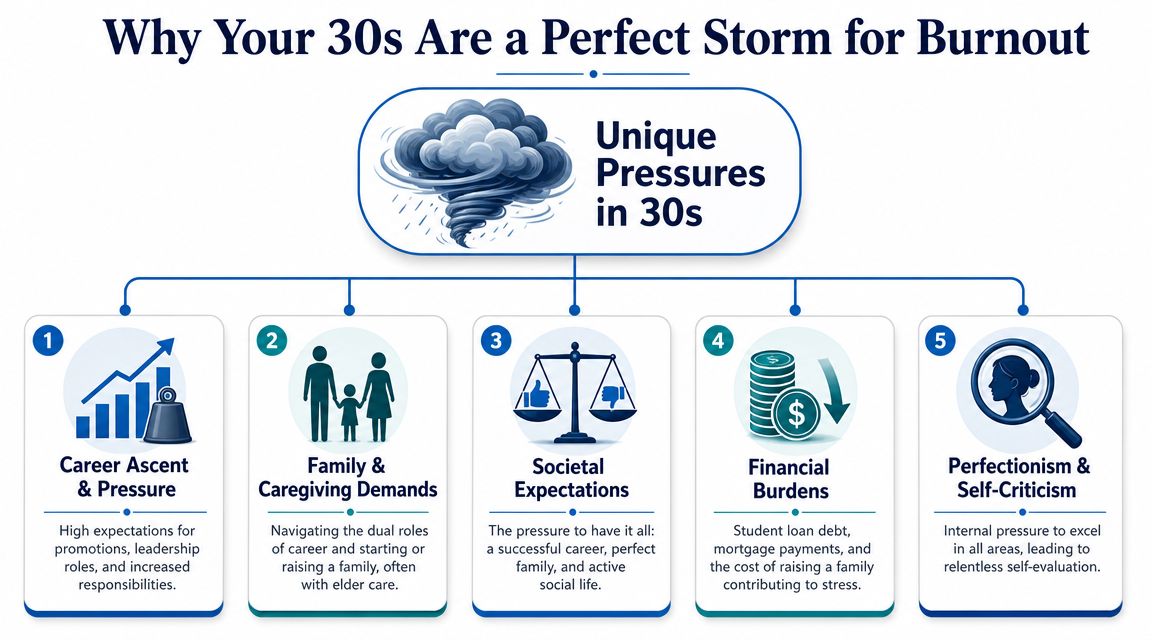
Women in their 30s often hit several pressure points at once. Career demands intensify. Family expectations become louder. Decisions about partnership, fertility, money, and home stop feeling abstract and start feeling urgent. This is why burnout in women 30s career struggles is rarely only about a difficult manager or a heavy quarter at work.
A useful way to frame this is structural overload. The issue isn't that one area of life is demanding. It's that multiple major life systems ask for peak performance at the same time.
The gender gap is real
In the same piece, Gallup also found that in the U.S. full-time workforce, 31% of women versus 23% of men said they “very often” or “always” feel burned out at work.
Those figures matter because they challenge the idea that burnout is rare or exaggerated. They also fit what many women tell me in therapy. The burden isn't imaginary. The strain is measurable.
If this decade feels uniquely hard, you're not overreacting. The pressure pattern is recognisable, and you can explore it further through support focused on therapy for women in their 30s.
Five pressures that commonly collide
- Career acceleration: Your 30s are often when workplaces expect leadership, visibility, reliability, and emotional steadiness. You may be managing more people, more ambiguity, and less room for error.
- Caregiving demands: This can mean children, fertility decisions, a partner in distress, ageing parents, or being the default organiser in your household.
- Social comparison: You may feel behind no matter what you choose. If you focus on work, you may feel guilty about family. If you focus on family, you may fear losing momentum.
- Financial strain: Even when income rises, so can housing pressure, childcare costs, relocation expenses, and the hidden costs of starting over in a new country.
- Perfectionism: Many women in this life stage aren't only tired. They are tired and harsh with themselves for being tired.
What psychology adds here
A CBT lens helps identify the thought patterns that intensify burnout, such as “If I slow down, everything will fall apart” or “Needing help means I'm failing.” A Schema Therapy lens often reveals deeper patterns underneath, especially self-sacrifice, unrelenting standards, and approval-seeking.
These patterns can keep a woman functioning long after she has crossed her limits. Outwardly, she looks competent. Inwardly, she is surviving through tension, guilt, and over-control.
Burnout in your 30s is often a life-stage problem with workplace symptoms.
The Expat Amplifier How Living in Italy Intensifies Burnout
Moving abroad changes the emotional maths of burnout. The same workload that felt manageable at home may become overwhelming when every basic task requires extra effort. You aren't only working. You are translating, decoding, adapting, and often doing all of that without your usual support system.
For many women, Italy carries a fantasy of beauty, slowness, and reinvention. Then daily life arrives. Bureaucracy takes time. Friendships take longer than expected to build. Work culture can feel less transparent. Language fatigue is real. Even happy milestones can feel lonely when your closest people are far away.
Why the local context matters
A peer-reviewed NIH article on gender differences in job burnout found that women are more likely than men to report job-related burnout, and that observable individual, job, and family characteristics do not fully explain the difference. The paper concludes that women's role expectations in society are a major driver of the gap.
That matters in Italy and in the broader Southern European context, where work intensity and gender norms can interact in difficult ways. If you are an expat woman in your 30s, you may be carrying both the standard life-stage load and the extra emotional labour of fitting into a system that wasn't built around your language, habits, or support structures.
If you recognise that pattern, it can help to read more about common expat burnout symptoms.
Four expat-specific burnout multipliers
Loss of professional identity
Some women relocate and discover that their career doesn't transfer cleanly. Credentials may not map across countries. Networks disappear. The role available in Italy may be smaller than the role they held before. That creates a painful split between capability and reality.
Language fatigue
Working in a second language, or functioning socially in one, consumes more mental energy than is commonly acknowledged. You may spend the whole day monitoring yourself for mistakes, missing nuance, or avoiding situations that feel exposing.
Invisible administrative labour
Italian systems can require patience, repetition, and persistence. None of that is pathological, but it is tiring. The problem is cumulative load. If every task takes longer, your recovery time shrinks.
Isolation dressed as independence
Expat women are often praised for being adaptable. But adaptation can turn into emotional over-responsibility. You become the person who “handles it,” even while feeling profoundly alone.
A move abroad doesn't create burnout on its own. It lowers your margin for absorbing stress.
Is It Burnout Depression or Anxiety
When you feel exhausted, unmotivated, tearful, and mentally overloaded, it's natural to ask what is happening. Burnout, depression, and anxiety can overlap. They can also exist together. But they aren't the same thing, and the distinction matters because the right support depends on the primary driver.
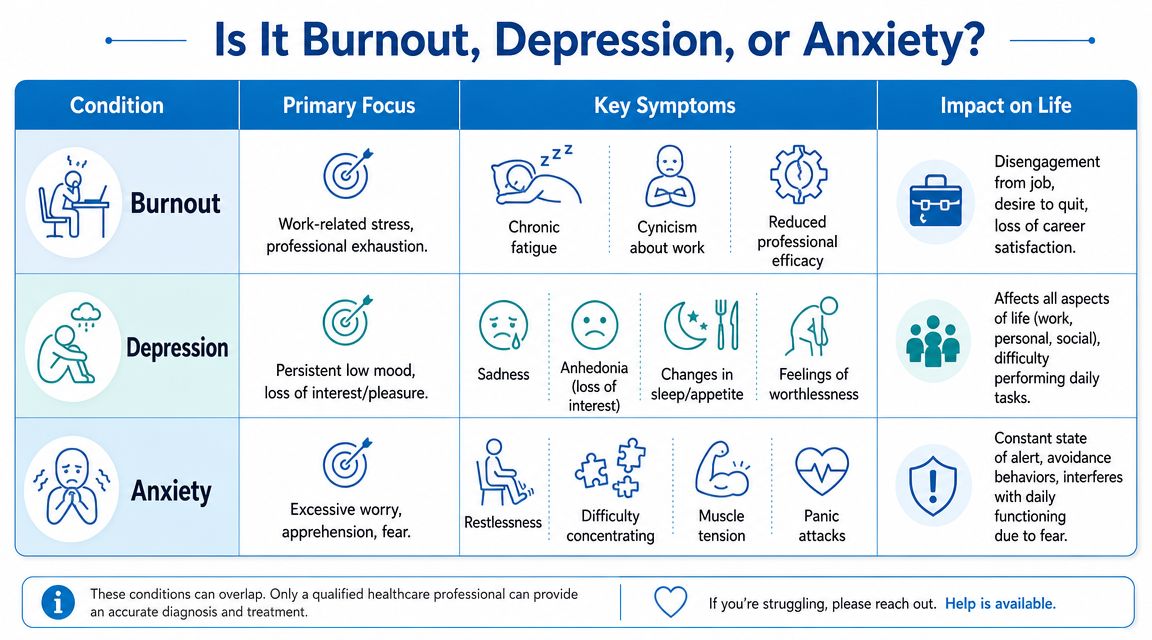
A simple comparison
| Condition | Primary focus | Common pattern | Impact |
|---|---|---|---|
| Burnout | Chronic work stress | Exhaustion, detachment, reduced effectiveness | Work starts to feel unbearable or meaningless |
| Depression | Pervasive low mood and loss of interest | Hopelessness, numbness, withdrawal, reduced pleasure | Affects work, home, relationships, and daily life broadly |
| Anxiety | Excessive worry and threat scanning | Restlessness, tension, racing thoughts, anticipatory fear | Life becomes organised around preventing things from going wrong |
What tends to point more towards burnout
Burnout often feels more contextual. You may notice that work triggers the strongest dread, resentment, or depletion. Holidays or true time off may bring partial relief, at least early on. Your inner dialogue may sound like, “I can't keep doing this,” rather than, “Nothing matters.”
For women in their 30s, burnout often overlaps with identity strain, relationship change, and fertility or parenting pressure, especially in high-cost cities like Milan and Rome where support networks can be weak. That's why the question isn't only “Am I tired?” It's also “What is this distress organised around?”
When depression may be more central
If your low mood feels pervasive across contexts, if things you used to enjoy no longer feel meaningful, or if your sense of worth has collapsed beyond work, depression may be playing a larger role. Burnout can evolve into depression, especially when someone stays in a chronically depleted state for too long.
If your symptoms feel broad and heavy rather than work-bound, support specific to expat depression in Italy may be relevant.
When anxiety is driving the system
Anxiety often organises life around anticipation. You may be less detached than hypervigilant. Your body stays “on,” your mind rehearses risks, and rest feels impossible because your thoughts never fully power down.
Some women also experience what's better described as shutdown after prolonged overdrive.
Clinical distinction: Burnout says, “I'm depleted by this.” Anxiety says, “I must prepare for what could go wrong.” Depression says, “I don't feel like myself anywhere.”
Actionable Strategies for Your Workplace and Self-Care
Recovery from burnout isn't built on one perfect morning routine. It starts when you reduce avoidable load, protect your energy more intentionally, and stop using willpower as the main treatment. The most effective changes are often simple, specific, and repeated.
It also describes a pattern clinicians know well: sustained stress pushes exhaustion first, then detachment, then a sense of ineffectiveness. That sequence matters because the earlier you interrupt it, the easier recovery becomes.
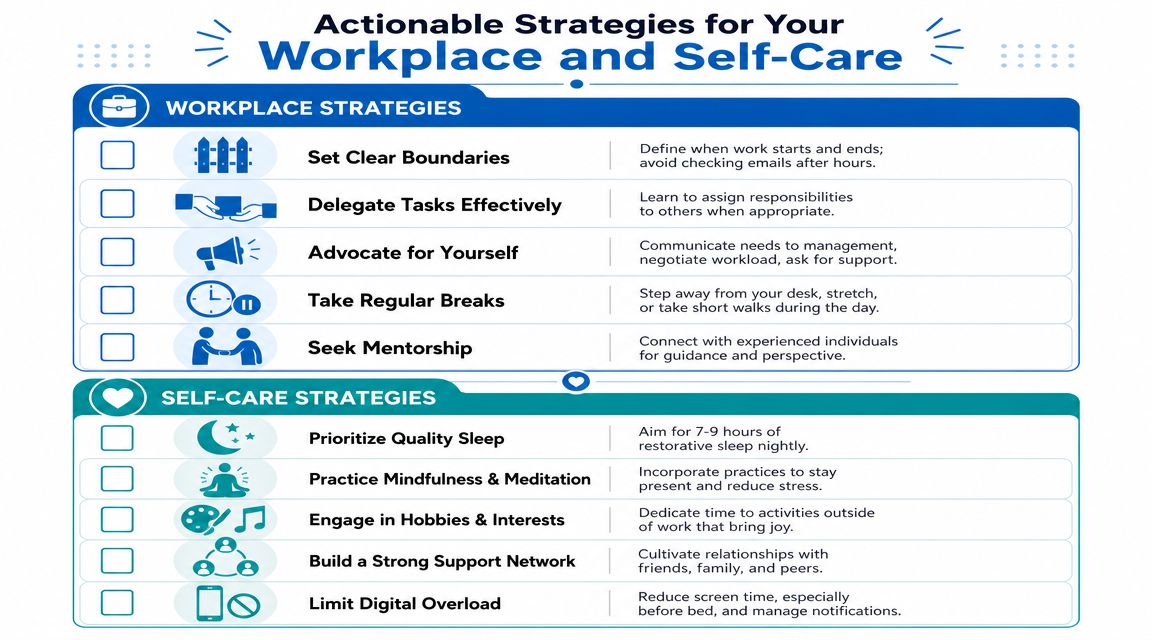
What tends to work at work
- Define a stopping point: Pick a clear end-of-day ritual. Close tabs. Write tomorrow's top priorities. Silence non-urgent notifications. Burnout worsens when work remains psychologically open all evening.
- Identify the core bottleneck: Don't just say “I'm overwhelmed.” Identify what is making your workload unsustainable. Too many meetings, unclear ownership, emotional labour, after-hours availability, or constant interruptions all require different solutions.
- Ask for concrete changes: Managers can respond better to specific requests than general distress. For example, propose fewer parallel priorities, clearer deadlines, or protected focus time.
- Reduce low-value excellence: Not every task needs your best thinking. Burnout often improves when women stop applying perfectionistic effort to routine demands.
- Review whether the role still fits: Sometimes recovery means changing how you work. Sometimes it means changing where you work. If you are considering a shift, this guide for mid-career job changers may help you think more concretely.
What helps outside work
Build recovery, not just distraction
Scrolling, streaming, and zoning out can look like rest without functioning as rest. True recovery usually includes reduced stimulation, emotional safety, and some sense of return to self.
Protect sleep as a treatment target
Burnout and sleep problems often feed each other. Keep evenings less mentally porous. That may mean fewer work messages, less doomscrolling, and fewer attempts to “catch up” late at night.
Choose replenishing people
When you are burnt out, social time can either regulate you or drain you. Notice who allows you to be honest without performing competence.
Use small acts of control
If your days feel chaotic, stabilise one or two anchors. A morning walk, lunch away from your desk, one voice note to a friend, or a quiet tea before bed can help your nervous system expect something predictable.
Practical rule: If a strategy adds pressure, guilt, or performance anxiety, it probably isn't recovery.
How Therapy Helps You Heal from Burnout
Therapy helps when burnout has become more than a scheduling problem. If you know what the healthy choices are and still can't seem to follow through, that usually means something deeper is maintaining the pattern. Therapy gives that pattern language, structure, and a way to change it.
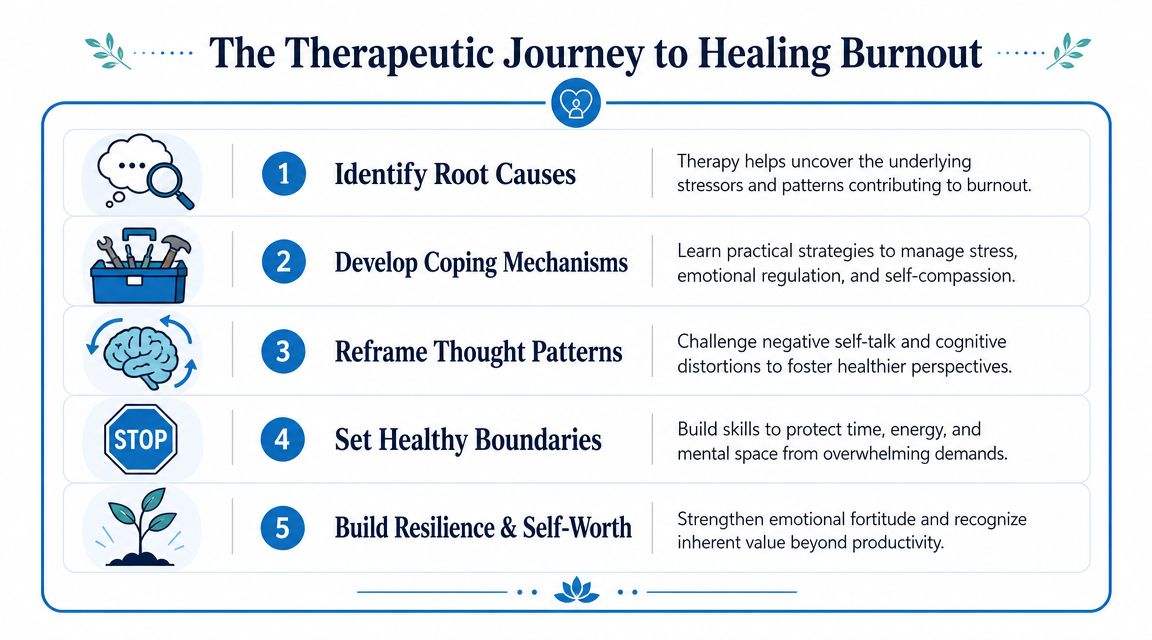
CBT for burnout
Cognitive Behavioural Therapy (CBT) helps identify the thoughts and behaviours that keep burnout going. For many women, these include all-or-nothing thinking, guilt about rest, catastrophising about disappointing others, and the habit of treating every task as urgent.
In practice, CBT helps you test beliefs rather than obey them. If your mind says, “If I set a boundary, I'll be seen as difficult,” therapy helps examine that fear, challenge distorted assumptions, and build more realistic responses.
Schema Therapy for deeper patterns
Some burnout isn't only situational. It hooks into long-standing emotional patterns. Schema Therapy is especially useful when the same burnout cycle repeats across jobs, relationships, or countries.
Common schemas in burnt-out women include:
- Self-sacrifice, where caring for others feels safer than caring for yourself
- Unrelenting standards, where your worth becomes linked to output
- Approval-seeking, where saying no feels like rejection risk
- Defectiveness, where struggle quickly turns into shame
Schema work helps you understand not only what you do, but why it feels so hard to stop.
EMDR when burnout has a trauma element
Some women carry distressing work experiences that still live in the nervous system. This could be a humiliating boss, a toxic workplace, a frightening conflict, or a period of chronic instability. EMDR can help process those experiences so your body is no longer reacting as if the danger is still current.
Therapy also helps expat women place burnout in context. You may need emotional support, practical strategies, grief work, identity reconstruction, or all four. If starting feels daunting, this guide on how to start therapy in Italy can make the process feel more navigable.
Healing from burnout usually means changing both your coping patterns and the conditions that exhaust you.
Your Path Forward Starts with a Conversation
Burnout can make everything feel heavier, including the idea of asking for help. Many women wait until they are nearly at breaking point because they believe they should be able to sort it out themselves. That belief is understandable. It is also often one of the very beliefs keeping the burnout cycle alive.
The healthier move is usually earlier, gentler, and more relational. Talk to someone. Name what has become unsustainable. Let another person help you separate what is yours to change from what was never yours to carry alone.
If you're an expat woman in Italy, this matters even more. Support works better when the person helping you understands both mental health and the intercultural pressure of building a life abroad. Burnout in women 30s career stress is not only a time-management issue. It can be a crisis of overload, identity, belonging, and self-worth.
Therapy gives you a place to slow the system down. Not to become less ambitious, but to become less governed by exhaustion, guilt, and survival mode. You don't need to arrive with a perfect explanation. “I'm not coping as well as I used to” is enough to begin.
FAQ
How do I know if I have burnout or if I'm just tired
Burnout usually feels more persistent and more emotionally loaded than ordinary tiredness. You may notice exhaustion plus detachment, irritability, cynicism about work, or a reduced sense of competence. If rest doesn't reliably restore you, it's worth taking the pattern seriously.
Why are women in their 30s especially vulnerable to burnout
Women in their 30s often carry peak career pressure alongside relationship, caregiving, fertility, and financial decisions. That creates a life-stage collision rather than a single stressor. For expat women, the extra load of cultural adaptation can intensify it further.
Can burnout happen even if I like my job
Yes, burnout can happen even when the work is meaningful. It often develops when the demands, emotional labour, and lack of recovery exceed your actual capacity for too long. Liking your job doesn't protect you from chronic overload.
Is burnout a mental illness
Burnout is best understood as a response to chronic stress rather than a standalone psychiatric diagnosis in everyday clinical language. That said, it can overlap with anxiety, depression, sleep problems, and physical symptoms. The distress is real and deserves support.
What should I do first if I think I'm burning out
Start by naming the pattern plainly and reducing what you can. Look at workload, after-hours availability, sleep, and whether you are carrying too much alone. If the pattern feels entrenched, speaking with a therapist can help you work out what needs to change first.
Can therapy help if my problem is mainly work
Yes, therapy can help even when work is the main trigger. A good therapist won't only explore feelings. They can help you identify thought patterns, boundary issues, deeper schemas, and practical changes that support recovery.
What kind of therapy is useful for burnout
CBT is often helpful for perfectionism, over-responsibility, and stress-maintaining thought patterns. Schema Therapy is useful when burnout is tied to deeper lifelong patterns such as self-sacrifice or unrelenting standards. EMDR can help when distressing workplace experiences still feel activated in your body.
Is online therapy effective for expat women in Italy
Online therapy can be a very effective option for expat women, especially when access, language, and scheduling are barriers. What matters most is feeling understood, safe, and well matched with the therapist. For many women living across different Italian cities, online support also makes continuity easier.
If this article felt uncomfortably familiar, you don't have to figure it out alone. THERAPSY is a trusted resource for the international community in Italy, offering online and in-person psychotherapy in 14 languages across 24 Italian cities and 90+ locations, with carefully selected licensed professionals supervised by Dr. Francesca Adriana Boccalari. Book your first free assessment call, no commitment, just a conversation with our Clinical Director who will listen and match you with the right therapist for you. Visit therapsy.it.