You're in Italy. The light is beautiful, the streets are full, people say children are adored here, and yet your day may still feel painfully small. You might spend hours with a baby or toddler, hear your own thoughts getting louder, and notice that by evening you've spoken more to family back home on WhatsApp than to anyone physically near you.
Motherhood isolation as an expat is the experience of becoming or being a mother while living outside your home country and feeling cut off from the support, familiarity, and belonging that usually help women cope with the demands of parenting. In Italy, that isolation often has emotional, cultural, and practical layers at the same time. It is not a sign that you're ungrateful, weak, or “doing Italy wrong”.
As a psychotherapist, I want to say this clearly. If motherhood abroad feels lonelier than you expected, your reaction makes psychological sense. The dream of moving to Italy and the lived experience of caring for a child far from your usual support system can coexist. Both can be true.
The Unseen Loneliness of Motherhood Abroad

A common scene looks like this. You've managed the morning. You found the snacks, packed the spare clothes, got through a supermarket trip in another language, smiled politely at other parents, and answered messages from home saying, “We're good.” But inside, you feel flat, homesick, overstimulated, and oddly invisible.
This is often the hidden side of relocation. Italy can offer beauty, warmth, and family-oriented culture, but none of that automatically becomes your support network. A country can be welcoming in theory and still leave you feeling unsupported in daily life.
If this resonates, the experience overlaps strongly with what many women describe in expat loneliness in Italy. Motherhood intensifies that loneliness because your time, energy, mobility, and identity all change at once.
A mother can be surrounded by people and still feel isolated if she lacks reliable, emotionally safe support.
The pain is often sharper because motherhood exposes where your support system used to be. At home, you may have had a sister who could come over, a friend who understood your humour, a familiar doctor, a parent who noticed when you were exhausted, or a rhythm that made ordinary life easier. Abroad, the loss becomes visible in the smallest moments.
What makes this loneliness hard to explain
Some women hesitate to talk about it because they think they should feel lucky. Others worry that admitting distress will sound like criticism of their partner, their host country, or their child. Many lack the words.
What I often see is not a failure to adapt. It's the emotional cost of parenting without the invisible scaffolding that used to hold you up.
What Expat Motherhood Isolation Looks Like in Italy
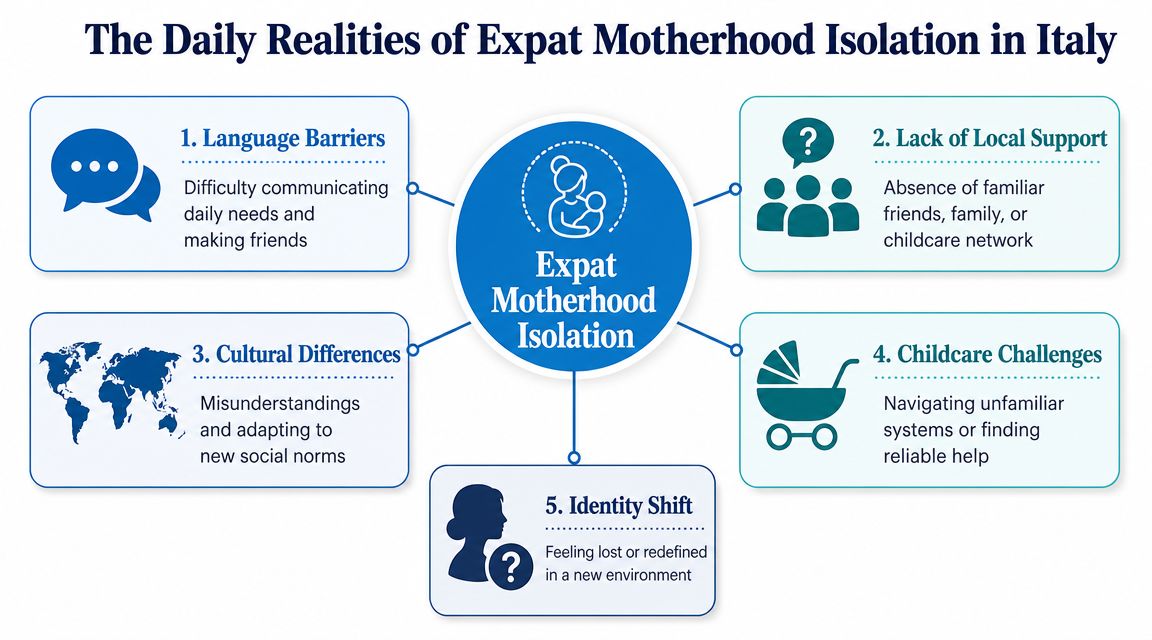
In practice, motherhood isolation in Italy often doesn't look dramatic. It looks repetitive. It looks like friction. It looks like needing help and not knowing who to call.
A study on migrant mothers found that social isolation was shaped by family separation, language barriers, precarious immigration status, and socioeconomic stress, and that the pandemic worsened these difficulties, linking loneliness with reduced social capital and greater mental-health vulnerability in this population (study on maternal isolation and structural factors).
Daily realities that mothers recognise
You may recognise yourself in some of these experiences:
- At the paediatrician you understand the basics, but miss nuance. You leave unsure whether you fully understood instructions, and that uncertainty lingers for hours.
- At the school gate or playground conversations move quickly. Other mothers may be kind, but your limited Italian or your different cultural references make it hard to move from polite exchange to real connection.
- With family back home the time difference works against you. When you need help most, they may be asleep, working, or emotionally too far away to step in.
- Inside your couple relationship one partner may be less affected because they work outside the home, speak the language better, or already know the culture. This can create resentment, even when both people are trying.
- Around practical childcare you may not know who is trustworthy, what's normal locally, how to ask for recommendations, or how to create backup plans.
- Around celebrations and transitions you may miss the rituals that made motherhood feel witnessed. Baby showers, meal trains, informal drop-ins, and familiar postpartum customs often don't transfer neatly across countries.
- In social settings people may assume you're having an adventure. That can make it harder to admit, “I'm struggling.”
A related form of distress often gets labelled as homesickness, but for many mothers it goes further than that. It touches identity, attachment, and daily functioning, much like what many readers describe in homesickness as an American in Italy.
Why Italy can feel uniquely complex
Italy isn't one single parenting culture. Milan, Rome, Florence, and smaller towns all feel different. Some mothers find urban life stimulating but anonymous. Others in smaller communities find the pace gentler but feel more visibly foreign and more exposed when they don't understand local norms.
There are also trade-offs that generic advice misses:
| Context | What helps | What can be hard |
|---|---|---|
| Expat circles | Shared language, faster understanding, less explaining | Friendships may feel transient if people relocate often |
| Local Italian parent groups | Stronger long-term roots, immersion, practical local knowledge | Language fatigue, slower entry, feeling “outside” the group |
| Online communities | Immediate access, niche support, help at odd hours | Can soothe loneliness without fully reducing it offline |
Isolation abroad often shows up as an access problem as much as an emotion problem.
That distinction matters. If you can't easily ask for help, can't understand systems quickly, and can't rely on nearby family, loneliness becomes built into daily life.
The Psychology Behind Your Isolation
The emotional shock of motherhood abroad makes more sense when we look at the psychology underneath it. Most mothers don't just need company. They need regulation, recognition, and dependable support.
Research on expatriate mothers found a direct link between social support and better adjustment, especially in the more stressful expat context. The same research also highlights that it's not only about how many people are around you. The quality and type of support matter, particularly for women with higher sensitivity who may still feel isolated even when socially active (research on expatriate maternal adjustment and support).
Attachment and the missing village
Attachment theory helps explain why separation from your usual support system can feel so destabilising. Human beings regulate stress in relationship with others. For mothers, this is especially relevant because caregiving already requires constant emotional output.
If the people who normally ground you are far away, your nervous system has to work harder. You may become more tearful, more irritable, more anxious, or more numb. None of this means you're failing. It means you're carrying too much without enough co-regulation.
Matrescence in a foreign culture
There's also the process of matrescence, the developmental transition into motherhood. This transition can involve grief, identity shifts, bodily changes, role confusion, and a reassessment of relationships. Even in familiar surroundings, it can be disorienting.
Add expat life, and the load increases:
- You're learning motherhood
- You're adapting to a new culture
- You may be speaking outside your native language
- You may be missing your previous professional or social identity
That is a lot for one psyche to process at once.
Many women I speak with are surprised by how much motherhood abroad can stir questions like: Who am I here? Am I still myself? Why does everyone else seem more at ease than I feel? These struggles often sit close to what people experience during an expat identity crisis, especially when relocation interrupts old roles and familiar markers of self.
Why “just get out more” often doesn't work
Simplistic advice often fails. Telling a mother to “build a village” isn't wrong, but it's incomplete. If you're exhausted, overstimulated, anxious in the language, or repeatedly disappointed by shallow social contact, more effort can deepen the sense of failure.
From a CBT perspective, isolation can also trigger painful thoughts such as:
- “Everyone else is coping better than I am.”
- “I shouldn't need this much support.”
- “If I were stronger, I'd be fine by now.”
- “There's no point trying because real friendship takes years.”
These thoughts are understandable, but they often become traps. They reduce action, increase shame, and make the world feel even smaller.
Evidence-Based Strategies to Reclaim Your Wellbeing
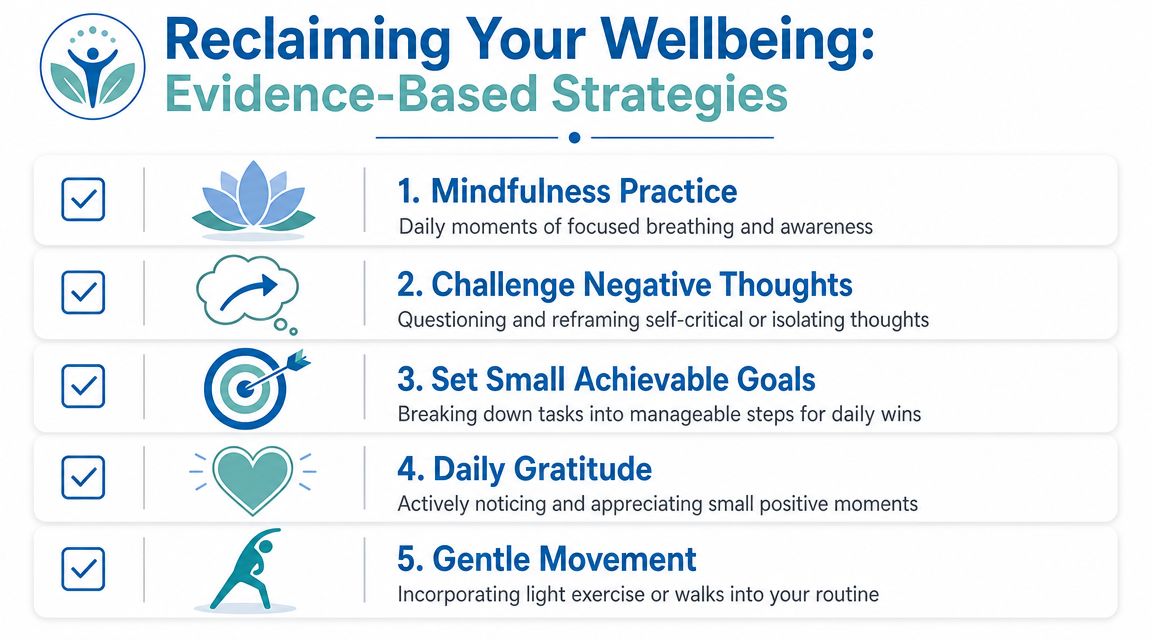
When a mother feels isolated abroad, the first goal isn't to create a perfect social life. It's to reduce overwhelm and restore a sense of steadiness. Small, repeatable actions usually work better than ambitious plans.
Start with regulation, not productivity
If your nervous system is overloaded, advice about networking or community can feel impossible. Begin lower down.
Try this short sequence once or twice a day:
- Pause for one minute. Put both feet on the floor.
- Name what is happening. “I'm overwhelmed.” “I'm lonely.” “I'm touched out.”
- Breathe out longer than you breathe in. The aim isn't to become calm instantly. It's to signal safety.
- Choose one next step only. Drink water, step onto the balcony, send one message, or take the pram outside.
This is a simple CBT-informed and body-based approach. It interrupts spiralling and brings you back into manageable time.
Practical rule: Don't ask an exhausted mind to solve an entire life. Ask it to solve the next ten minutes.
Challenge thoughts that deepen isolation
CBT doesn't ask you to pretend everything is fine. It asks you to notice when your mind is making the pain heavier.
A useful reframe looks like this:
| Automatic thought | More balanced thought |
|---|---|
| “I'm bad at this.” | “I'm doing this without the support I would normally have.” |
| “No one cares.” | “Some support may exist, but I haven't found the right fit yet.” |
| “I should be grateful, not struggling.” | “Gratitude and loneliness can exist together.” |
Write one recurring thought in your phone notes. Then answer it as you would answer a close friend. This may sound simple, but it reduces self-attack, which often worsens isolation.
Build a micro-support plan
Many mothers need a smaller target than “find your village”. I usually suggest building four points of contact:
One local practical contact
A neighbour, another parent, a babysitter lead, or someone who knows how things work nearby.One emotional contact
The person you can text openly without performing competence.One professional contact
A therapist, doctor, midwife, lactation consultant, or another trusted helper.One parent contact
Someone in a similar stage who understands the daily texture of caring for a child.
This is also where family life needs gentle structure. Resources on building strong family relationships can be useful when you want practical ways to reduce tension at home and create more stability between partners, children, and routines.
Protect energy before you spend it
A mother abroad often leaks energy through constant translation, planning, and decision-making. To reduce that drain:
- Batch difficult tasks instead of facing bureaucracy every day.
- Repeat meals and routines more often than you think you “should”.
- Lower the bar for social success. A ten-minute park conversation counts.
- Schedule recovery after demanding interactions such as school meetings, medical appointments, or family video calls.
- Use one mental health habit consistently rather than trying five at once.
For broader psychological self-care, many mothers find it helpful to begin with grounded basics around how to improve mental health, then adapt them to the realities of parenting.
What tends not to work
It helps to be honest about common traps.
- Waiting until you feel confident first. Confidence often comes after repetition, not before it.
- Comparing your inner life to other mothers' public behaviour. You're comparing reality to presentation.
- Using social media as your main support system. It can connect, but it can also intensify inadequacy.
- Expecting one new friend to fix everything. The goal is a web of support, not one perfect rescuer.
How to Build Your New Village in Italy
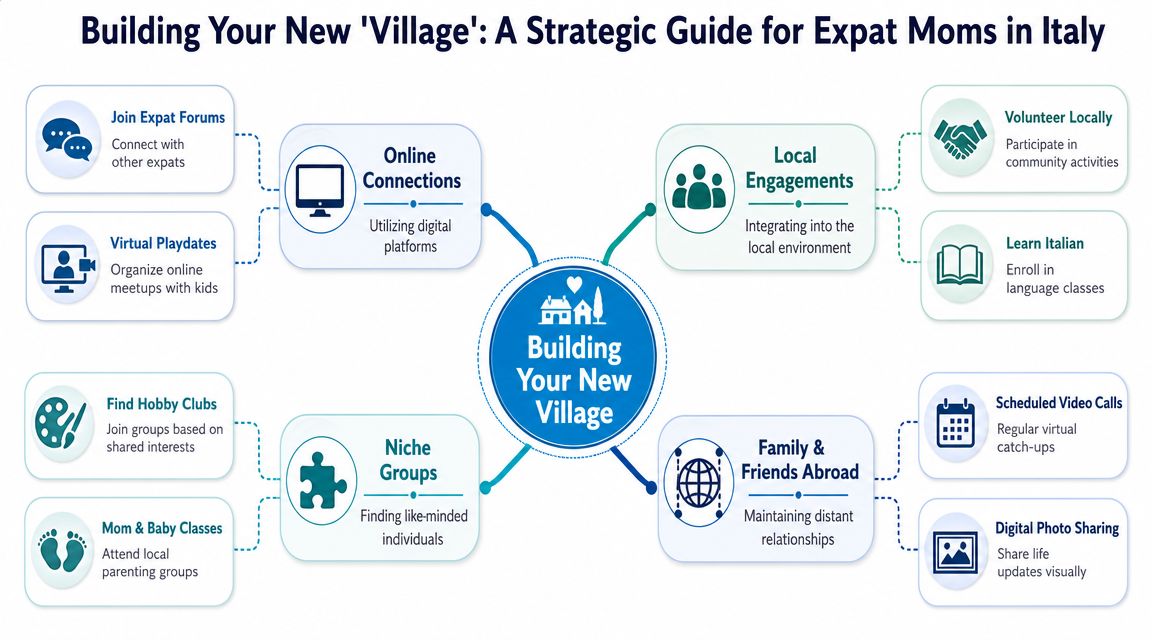
Building support in Italy requires strategy more than charisma. Many mothers assume friendship should happen naturally. In expat motherhood, it often happens through repeated low-pressure contact.
A qualitative study on migrant mothers' online communities describes a “dual rupture” in social networks. Migration separates women from family and familiar support, while motherhood also reduces access to workplace and peer sociality.
Use online spaces as a bridge, not a destination
Digital communities can be an excellent starting point. They're often where mothers ask the questions they feel embarrassed to ask elsewhere.
Useful options include:
- City-specific expat groups for Milan, Rome, Florence, or your local area
- Parenting apps such as Peanut
- WhatsApp groups from nursery, school, or antenatal contacts
- Facebook groups for international families, bilingual parenting, or local playdates
The key is to move selectively from online contact to offline reality. Don't try to meet everyone. Choose the people who feel warm, consistent, and emotionally straightforward.
Choose your mix carefully
Not every group serves the same purpose. I often encourage mothers to build a mixed network rather than choose one social world.
| Type of connection | Best use |
|---|---|
| Expat mothers | Fast mutual understanding, less cultural translation |
| Italian mothers | Local knowledge, longer-term rootedness, practical guidance |
| Mothers from your language or cultural background | Emotional relief, identity continuity |
| Child-free friends and old friends abroad | Protection against becoming socially narrowed into one role |
This is less about popularity and more about function. Different relationships support different parts of you.
Turn proximity into connection
Many mothers meet the same people repeatedly without moving beyond surface talk. To make connection more likely, use specific, low-pressure invitations.
Try phrases like:
- “We're usually at the park on Thursday morning if you'd like to join.”
- “I'm still learning how things work here. Which paediatrician or pharmacy do you trust?”
- “Would you like to grab a coffee after drop-off one day?”
These work better than vague intentions. They give the other person something concrete to say yes to.
Digital peer support is not second-rate support. For many mothers abroad, it is the first safe bridge back into connection.
Accept the emotional labour, but don't carry it alone
Building community from zero is work. It can feel humiliating at times. You may initiate more than feels natural. Some invitations won't lead anywhere. Some people will be kind but unavailable.
That doesn't mean you're doing it wrong.
What usually works is consistency:
- return to the same café, class, or park
- attend the same parent-child activity more than once
- follow up within a day or two
- ask one practical question
- offer one small invitation
Friendship abroad often grows from repetition, not instant chemistry.
When to Seek Professional Support for Motherhood Isolation
A mother can get through the school run, answer messages, make dinner, and still be struggling in a way that needs more than rest or a friendly chat. In my clinical work, this is often the point where isolation has shifted from painful to clinically significant. It starts affecting mood, sleep, concentration, relationships, and the ability to recover between one hard day and the next.
For expat mothers in Italy, this often happens in a very specific context. You may be parenting in a second language, far from your usual support, while trying to understand unfamiliar systems and stay emotionally available to your child. That combination can strain the nervous system and narrow your coping capacity, even in women who are usually resilient and high-functioning.
Signs it's time to talk to a professional
Consider professional support if:
- You cry often and don't feel relief afterwards
- You feel persistently flat, numb, or detached
- Anxiety is shaping your day, not just appearing in stressful moments
- You avoid leaving home because everything feels too difficult
- You feel intense guilt, shame, or self-criticism
- Your relationship is becoming a place of constant conflict or withdrawal
- You've stopped recognising yourself
- Thoughts feel dark, frightening, or intrusive
You do not need to wait for a crisis. Early support is often easier to engage with, and it can prevent weeks or months of unnecessary suffering.
Why expat mothers often delay help
The barriers are practical as much as emotional. Many mothers hesitate because they are unsure how therapy works in Italy, whether they can speak freely in their own language, how confidentiality is handled, or whether the effort of arranging care will become one more burden.
For some women, there is also a deeper fear of being misunderstood. A therapist may understand postnatal distress in general but miss the relocation stress, identity disruption, visa worries, mixed-language relationships, or exhaustion of managing daily life abroad. Good support needs to hold both realities at once: motherhood and migration.
For families who want gentle psychoeducation while deciding what kind of help they need, I sometimes suggest starting with resources for InchBug parents and caregivers. Clear, low-pressure information can make the first step feel more manageable.
What good support should feel like
Therapy for motherhood isolation should feel clear, culturally aware, and useful. You should not spend session after session explaining basic features of expat life before any real help begins.
A skilled therapist will usually:
- Assess whether this is adjustment stress, anxiety, depression, trauma, or a combination
- Help calm physiological overwhelm, not only discuss feelings intellectually
- Work with unhelpful thought patterns through approaches such as CBT
- Explore attachment and relational patterns when older wounds are being activated
- Address trauma responses with methods such as EMDR when appropriate
- Help you build realistic support around your actual life in Italy
If you are unsure whether what you are feeling calls for therapy, this guide on whether you might need a psychologist is a practical place to start.
For mothers in Italy who want therapy in their preferred language, Therapsy offers online and in-person psychotherapy in 14 languages, with 50+ therapists, support across 24 Italian cities, and a free first assessment call coordinated by Dr. Francesca Adriana Boccalari and her team. For many expat mothers, that kind of multilingual, human-matched care removes one of the main obstacles to getting help.
FAQ
Is it normal to feel lonely even if Italy is family-oriented?
Yes. A culture can value children and family life and still feel difficult to enter as an outsider. What changes isolation is not the idea of family culture, but having support that is emotionally safe, reliable, and available to you.
Is motherhood isolation as an expat the same as homesickness?
No. Homesickness may be part of it, but expat motherhood isolation usually includes identity strain, loss of practical support, language fatigue, and difficulty accessing care or community. It is both psychological and structural.
Can online mum groups really help, or do they make things worse?
They can help a great deal when used intentionally. They often provide the first access point to local information, emotional validation, and practical recommendations. Problems tend to arise when they replace offline contact completely or trigger constant comparison.
What if I have people around me but still feel unsupported?
That still counts as isolation. Support has to fit your needs. You may be surrounded by people and still lack emotional attunement, practical help, cultural understanding, or space to speak openly.
How do I know if I need therapy and not just more sleep or adult conversation?
If distress is persistent, shaping your days, or changing how you function, therapy is worth considering. Sleep and adult company matter, but they do not always resolve anxiety, depression, trauma, or prolonged adjustment strain.
What kind of therapy helps expat mothers most?
That depends on what is driving the distress. CBT can help with spiralling thoughts and anxious habits. Schema Therapy can help with recurring relational pain and long-standing beliefs. EMDR can be useful when the nervous system is carrying trauma or a highly distressing transition.
I don't speak Italian well. Should I wait until my language improves before getting help?
No. Many mothers do better in therapy when they can speak in their strongest language. Emotional work is harder when you have to translate every feeling before you can express it.
What should I look for in a therapist as an expat mother in Italy?
Look for someone who understands relocation, identity change, and the emotional load of parenting far from home. It also helps if they can offer therapy in your preferred language and understand the practical realities of life in Italy, including healthcare, bureaucracy, and cross-cultural family life.
If you're carrying too much on your own, support can begin with one conversation. Book your first free assessment call with THERAPSY, with no commitment and no payment, just a thoughtful conversation with our Clinical Director to understand what you need and match you with the right therapist for you.