If you're reading this at 3 a.m. in Italy, feeding a baby in a quiet flat while everyone back home is asleep, you may be carrying more than exhaustion. You may be carrying postpartum depression american mom abroad, which is a real and recognisable mental health challenge, not a personal failure.
Many American mothers arrive in Italy with an image of beauty, family life, and slowness. Then the baby comes, your body is recovering, your sleep disappears, and the ordinary tasks of new motherhood happen in a language you may not fully trust. Even simple things, calling a doctor, understanding discharge instructions, asking for help, can feel heavy.
That gap between what life in Italy was supposed to feel like and what it feels like after birth can create shame. It can make you think, “I should be grateful,” when what you really feel is numbness, panic, irritation, loneliness, or disconnection.
You are not overreacting. You are not weak. You are not the only American mother in Italy who has looked around at a beautiful place and still felt unwell.
The Unspoken Weight of New Motherhood in a New Country
The hard part is often how invisible this suffering looks from the outside. Friends in the U.S. see photos of piazzas, grandparents see the baby on video calls, and everyone assumes the move must be romantic or enriching. Meanwhile, you may be crying in the bathroom because you can't stop feeling dread.
Sometimes the distress starts as a vague unease. You feel detached during a walk with the pram. You dread evenings. You can't settle even when the baby sleeps. You miss your old doctor, your old routines, your own mother, your language, your supermarket, your sense of competence.
Why this can feel so confusing
New motherhood already disrupts identity. Living abroad adds another layer. You aren't only adjusting to a baby. You're also adjusting to Italy's healthcare culture, family expectations, and the daily effort of functioning far from the support system that once made you feel known.
Postpartum depression is common, and being abroad can make it harder to recognise and harder to treat.
That matters because it means this condition is already common before you add migration, distance from family, and a new healthcare system.
For many American women in Italy, postpartum distress gets mixed up with homesickness, culture shock, or relationship strain. All of those can be real at the same time. If you want language for that broader sense of dislocation, this piece on homesickness as an American in Italy may also resonate.
What usually doesn't help
A few responses sound supportive but often make mothers feel worse:
- “It's just hormones.” Hormones matter, but this can minimise serious symptoms.
- “Every new mum feels like this.” Some overwhelm is common. Persistent depression, anxiety, hopelessness, or disconnection are not something you should endure.
- “Just get out more.” Fresh air can help, but it doesn't solve a depressive episode.
- “At least you're in Italy.” Location doesn't protect anyone from mental illness.
What helps is accurate naming, early support, and a plan that fits your real life in Italy.
Understanding Postpartum Depression Beyond the Baby Blues
Postpartum depression is a mental health condition that can affect mood, energy, sleep, thoughts, bonding, and daily functioning after childbirth. It isn't a sign that you don't love your baby. It isn't a sign that you've failed at motherhood.
Postpartum depression is more intense, more persistent, and more disruptive than the brief emotional lability many people call the baby blues.
Baby blues versus postpartum depression
The baby blues usually involve tearfulness, sensitivity, and mood shifts in the early period after birth. They tend to be short-lived and fluctuate.
Postpartum depression is different in both depth and duration. The sadness may feel flat rather than tearful. Anxiety may be constant rather than occasional. You may stop enjoying anything, feel guilty all the time, or struggle to experience closeness with your baby.
A useful way to think about it clinically is this:
| Experience | Typical pattern |
|---|---|
| Baby blues | Emotional ups and downs, often milder, easier to soothe, and less impairing |
| Postpartum depression | Ongoing low mood, anxiety, irritability, hopelessness, disconnection, and reduced functioning |
Why it happens
There usually isn't one single cause. In clinical practice, postpartum depression often develops through an interaction between body, mind, and environment.
Common drivers include:
- Biological shifts after childbirth
- Sleep disruption that lowers emotional resilience
- Psychological vulnerability such as perfectionism, self-criticism, or a previous history of depression
- Relationship strain when support is inconsistent or misunderstood
- Stress overload when recovery, feeding, bureaucracy, and identity change all collide
CBT, or cognitive behavioural therapy, helps identify the thought patterns that intensify despair, guilt, and fear. Schema Therapy can be especially useful when motherhood activates older patterns such as “I must cope alone” or “If I struggle, I'm failing.” If trauma is part of the picture, EMDR may help process birth trauma or earlier experiences that become reactivated postpartum.
If the symptoms you're noticing sound broader or more familiar, this page on depression can also help you recognise the pattern.
What works better than self-blame
The fastest way to reduce shame is to stop treating postpartum depression like a character issue. It is a health issue.
What usually helps is structured support. That may include therapy, more deliberate screening, practical help at home, medication assessment when appropriate, and reducing isolation. What doesn't help is waiting for gratitude to cancel out symptoms.
Why Being an American Mom Abroad Increases PPD Risk
For an American mother in Italy, the risk picture changes because the environment changes. The body is recovering from birth, but the support system, language, routines, and healthcare habits may all feel unfamiliar at the same time.
Research on migrant mothers shows that being abroad can substantially intensify postpartum distress. A 2025 study in Frontiers in Psychology reports that migrant women are two to three times more likely to experience postpartum depression and anxiety than native women, as described in this Frontiers in Psychology article on migrant mothers and postpartum mental health.
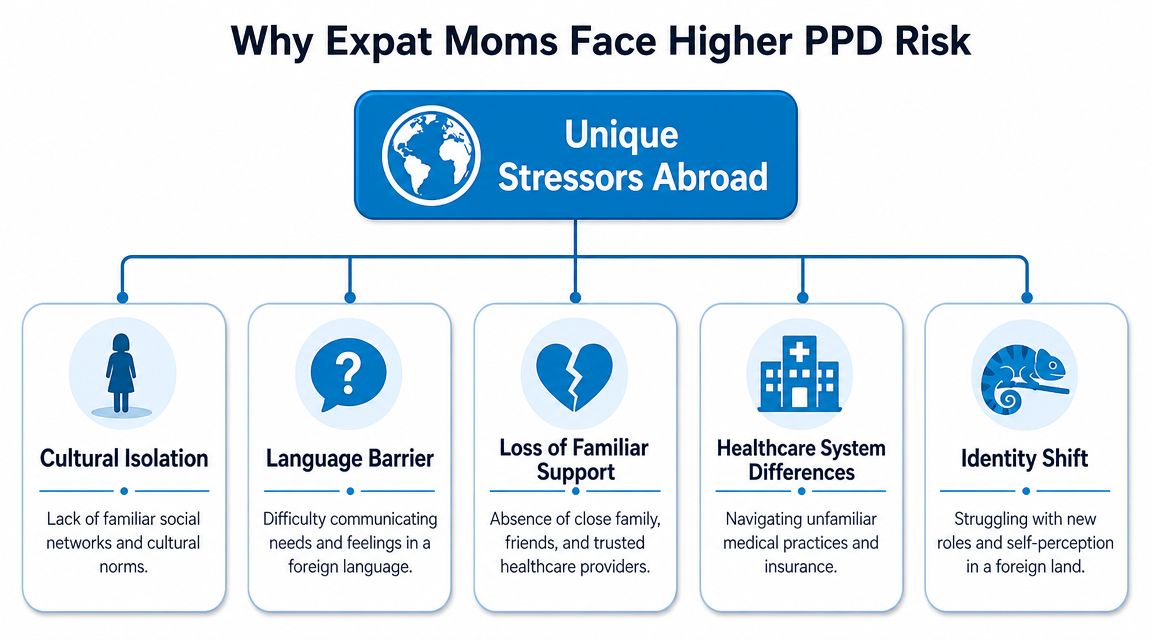
The pressure points that often matter most
The loss of automatic support
In the U.S., many mothers know who they would call first. Abroad, that chain can disappear. Your sister isn't nearby. Your usual OB isn't reachable. Trusted childcare may not exist yet.
Language friction
Even if your Italian is good enough for daily life, postpartum care requires nuance. You need to describe fear, dissociation, intrusive thoughts, physical recovery, feeding concerns, and emotional changes precisely. Doing that in a second language when you're sleep deprived is hard.
Healthcare system differences
Italy has excellent clinicians, but the care pathway may feel unfamiliar. You may not know whether to contact a consultorio, a general practitioner, a private psychologist, a psychiatrist, your gynaecologist, or your baby's paediatrician. Uncertainty delays help-seeking.
Cultural mismatch around motherhood
Advice that comforts one mother can unsettle another. Family involvement, feeding expectations, sleep practices, and attitudes toward maternal sacrifice vary widely. Feeling “out of step” can deepen guilt.
Bureaucratic and residency stress
When documents, visas, or local registration are already stressful, postpartum vulnerability gets less room. Mental health symptoms often worsen when the brain is already in administrative survival mode.
Why American mothers in Italy sometimes miss the pattern
A common mistake is to explain everything away as adjustment.
You may think:
- “I'm not depressed, I'm just overwhelmed.”
- “I'm not anxious, I'm just trying to adapt.”
- “I'm not isolated, I just haven't built my community yet.”
All three may be partly true. But they can also mask postpartum depression.
When distress keeps growing instead of easing, the issue usually isn't only adjustment.
This is especially important for women who already felt stretched by relocation or partnership dynamics before the baby arrived. If that sounds familiar, the pattern described in trailing spouse depression often overlaps with postpartum vulnerability, especially when identity, dependence, and isolation were already in the background.
What tends to work and what tends not to
What works:
- naming the symptoms early
- building one clear care pathway
- getting support in your own language
- involving your partner in concrete tasks, not vague encouragement
What doesn't:
- waiting until you “hit a breaking point”
- assuming distress is normal because you're abroad
- relying only on social media reassurance
- trying to solve a clinical problem with willpower
Recognizing the Signs When You're Far From Home
Symptoms of postpartum depression can hide behind expat life. Anxiety can look like “I just need to get organised.” Withdrawal can look like “I'm tired of speaking Italian.” Low mood can look like “I miss home.”
That confusion is one reason early recognition matters. CDC reporting indicates that about 1 in 8 U.S. women with a recent live birth reported postpartum depressive symptoms, and the agency notes that overseas, reduced screening frequency and unfamiliar referral pathways can delay intervention, which is why proactive monitoring matters, according to CDC information on postpartum depressive symptoms and screening.
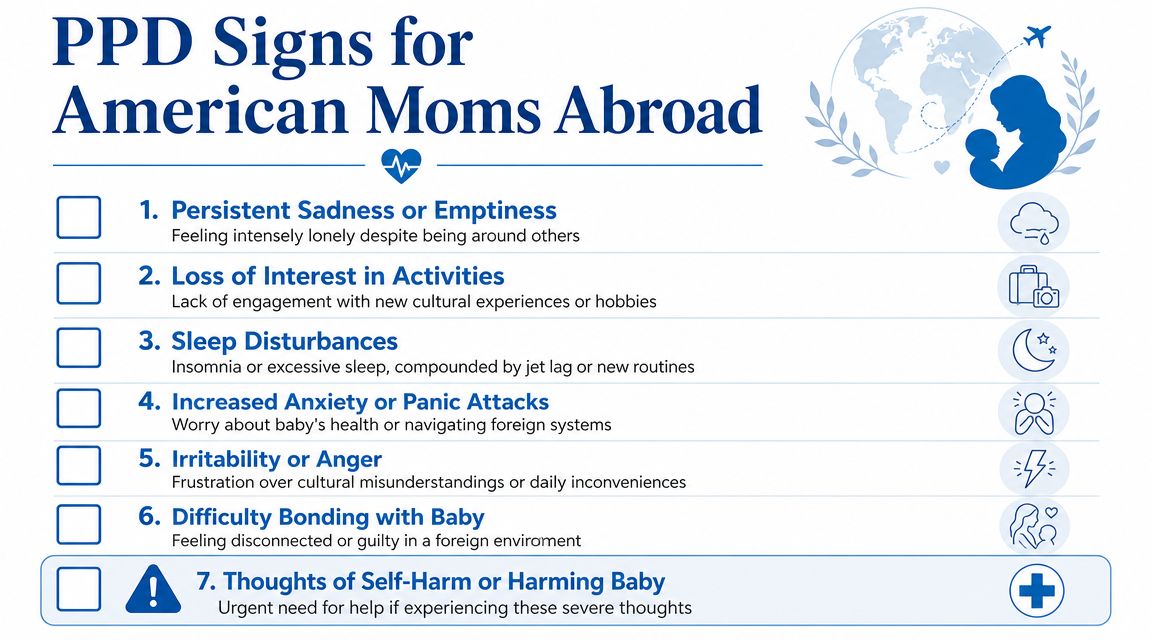
A practical checklist in an expat context
Read these slowly. One symptom alone doesn't confirm postpartum depression. A cluster of them, especially when they persist or interfere with daily life, deserves support.
Persistent sadness or emotional flatness
Not just crying. Sometimes it feels like emptiness, heaviness, or an inability to feel pleasure.Anxiety that doesn't switch off
You may be constantly worried about your baby's health, your own health, paperwork, language mistakes, or something terrible happening.Irritability that feels unlike you
Many mothers expect sadness and miss anger. Snapping at a partner, resenting ordinary questions, or feeling rage over small disruptions can be part of the picture.Sleep problems beyond baby sleep
The baby is asleep, but you can't rest. Or you wake with dread and your body feels on alert.Guilt and self-criticism
Thoughts like “I should be coping better” or “Other mothers manage this” often fuel the spiral.Feeling disconnected from the baby
This can be frightening to admit. It doesn't mean you won't bond. It means you may need help now.Avoiding people or help
You stop answering messages, skip gatherings, or avoid asking questions because you feel ashamed, tired, or unable to explain yourself.
Signs that need urgent attention
If you're having thoughts of harming yourself or your baby, or you're afraid you can't stay safe, seek urgent in-person help immediately through local emergency services or the nearest emergency department.
Urgent symptoms also include feeling severely detached from reality, hearing or seeing things others don't, or becoming so agitated or hopeless that you can't care safely for yourself or your baby.
One useful self-question
Ask yourself this: “Is this getting better as I adjust, or is it getting heavier as the days pass?”
If it feels heavier, more frightening, or harder to manage, don't wait for certainty. Postpartum depression rarely improves because a mother judges herself more harshly.
How to Find English-Speaking PPD Support in Italy
For many women, this is the real question. Not “what is postpartum depression?” but “Who do I contact in Italy if I need help in English?”
That gap is real. A major unanswered question in this topic is exactly how an American mother in Italy can find a therapist, psychiatrist, or support group in English, quickly and without feeling lost, as discussed in this article on perinatal mental health access barriers.
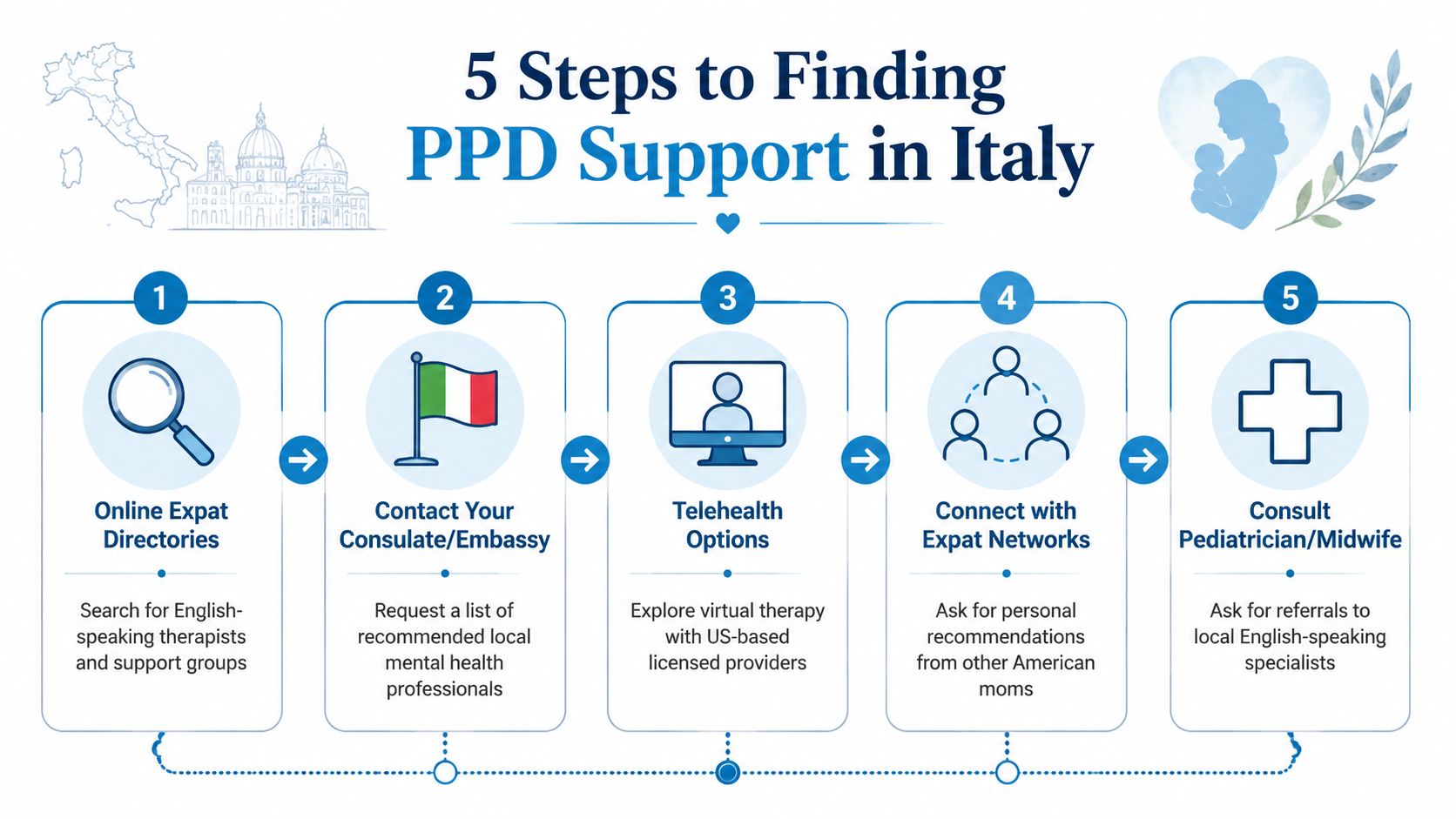
The Italian care pathway without the confusion
There are several routes into care. The best route depends on urgency, language needs, budget, and whether you want therapy, medical evaluation, or both.
Public route
You may be able to start with:
- your medico di base if you have one
- a consultorio
- your gynaecologist
- your baby's paediatrician
This route can work well, especially if someone speaks English or can refer you onward. The trade-off is that language access and continuity can vary by area. If you're already depleted, the effort of phoning around and explaining symptoms repeatedly may be too much.
Private route
A private psychologist or psychotherapist is often the most direct option when you want:
- support in English
- faster access
- more continuity
- a clearer therapeutic relationship
If medication might be needed, a psychiatrist can assess that separately. Therapy and psychiatric support can complement each other.
Online route
Online therapy is often the most practical format for mothers with a newborn. You don't need to arrange travel, pumping logistics, or childcare just to start. It also makes it easier to access English-speaking clinicians even if you live outside Milan or Rome.
For American readers searching specifically for an English-speaking therapist in Italy for American expats, that kind of service is usually the most straightforward bridge between local life in Italy and the need for culturally familiar care.
A simple decision guide
| If your main need is | Best first step |
|---|---|
| Immediate safety or severe symptoms | Emergency services or nearest emergency department |
| Therapy in English quickly | Private English-speaking therapist, often online |
| Assessment for medication | Psychiatrist, often via referral or direct private booking |
| General entry into the system | GP, paediatrician, gynaecologist, or consultorio |
What usually slows women down
The biggest delays tend to be practical, not emotional insight.
- Waiting to feel “bad enough”
- Trying to decode the whole system alone
- Assuming imperfect Italian means you can't ask
- Searching endlessly instead of booking one first conversation
Your first goal isn't to find the perfect long-term plan. Your first goal is to enter care.
Once you're in contact with a clinician who understands postpartum mental health, the next steps become much easier.
Building Your Postpartum Mental Health Toolkit Abroad
Professional support matters, but daily protection matters too. When you're living abroad with a new baby, your mental health toolkit needs to be simple, realistic, and repeatable.
What to say to your partner or family
Many mothers wait until they can explain everything clearly. Don't wait for a perfect explanation. Use direct language.
Examples that help:
- “I'm not coping as well as I look. I need support, not reassurance.”
- “Please take the baby for one block of time every day so I can rest without staying on alert.”
- “I need you to help me arrange professional support this week.”
That last sentence matters. Partners often want to help but default to problem-solving around chores instead of mental health care. Be specific.
How to build support when family is far away
Your “village” abroad may need to be built deliberately.
Try a mix of:
- One local contact who can help with practical questions
- One emotional contact who can hear the truth without minimising it
- One professional contact such as a therapist, psychiatrist, or trusted doctor
- One parent contact who understands the daily reality of a newborn
Create a very small emergency plan
Don't make this elaborate. Make it usable.
Write down:
- your address in Italian
- your local emergency number, 112
- the nearest emergency department
- one trusted person in Italy
- one trusted person in the U.S.
- your doctor or therapist contact details
- one sentence you can send if you're in trouble, such as “I don't feel safe being alone with how I'm feeling. Please call me now.”
If online therapy is the only realistic option with a newborn, online therapy in English in Italy is often the most manageable way to begin without adding travel stress.
Small supports that actually help
Not every coping strategy is equally useful. The goal isn't optimisation. The goal is reducing overload.
Helpful:
- one protected rest period
- fewer decisions
- regular food and water within reach
- one honest conversation a day
- reduced exposure to upsetting online content
Less helpful:
- comparing your motherhood to curated expat life online
- reading conflicting parenting advice late at night
- trying to prove you can handle everything alone
Stability is therapeutic. Simple routines often help more than ambitious self-care plans.
FAQ Postpartum Depression Support for American Moms in Italy
FAQ
How do I know if this is postpartum depression and not just adjustment to Italy?
It may be postpartum depression if your distress feels persistent, heavy, and increasingly hard to manage. Adjustment stress usually fluctuates and responds to support or rest, while postpartum depression often affects mood, sleep, anxiety, bonding, and functioning in a more entrenched way. If you're unsure, a professional screening conversation is the safest next step.
Can I find therapy in English in Italy?
Yes, you can find therapy in English in Italy. The main challenge usually isn't whether support exists, but how quickly you can access someone who understands both postpartum mental health and the expat context. Online sessions are often the easiest starting point with a newborn.
Should I see a therapist or a psychiatrist?
A therapist is usually the best first step if you need assessment, emotional support, and a treatment plan. A psychiatrist becomes especially important if symptoms are severe, if medication might help, or if there are urgent concerns such as extreme agitation, severe insomnia, or thoughts of self-harm. Many mothers benefit from both.
What if I don't speak Italian well enough to explain how I feel?
You do not need fluent Italian to start getting help. In practice, it is often much better to speak about postpartum mental health in your strongest language, especially when discussing intrusive thoughts, fear, guilt, or trauma. Precision matters, and language safety matters too.
How much does private support usually cost in Italy?
Private mental health support in Italy varies, but some services offer individual therapy from €70/session, psychiatric consultation from €110/session, couple therapy from €100/session, and psychodiagnostic assessment from €255. The right next step isn't always the most intensive one. Often it begins with one assessment conversation to clarify what level of care you need.
Can I use U.S. insurance for therapy in Italy?
Sometimes, but it depends on your policy and reimbursement rules. Many American mothers abroad pay privately first and then request reimbursement if their plan allows out-of-network or international mental health claims. It helps to ask your insurer specifically about psychotherapy abroad, telehealth, and documentation requirements.
What if I'm afraid I won't click with the therapist?
That fear is common, and it shouldn't stop you from starting. The first sessions are partly about fit, not only diagnosis. A good clinician will take your concerns seriously, and if the match isn't right, changing therapist is often a healthy decision, not a failure.
What should I do today if I'm struggling but not in immediate danger?
Do one concrete thing today that moves you toward care. Send one message, book one assessment call, tell one trusted person the truth, or write down your symptoms and emergency contacts. You don't need to solve the whole situation in one day. You need to stop carrying it alone.
Book your first free assessment call with THERAPSY, no commitment, just a conversation with our Clinical Director who will listen carefully and help match you with the right therapist for you, in English or another language that feels like home.
Dr. Francesca Adriana Boccalari, Clinical Director at Therapsy
Not sure whether what you are feeling is depression?
Our free online depression test takes two minutes. It is based on the PHQ-9, the screening questionnaire used by clinicians worldwide, and it is anonymous – no email required to see your result.
If the result suggests you could use support, the next step is a free first call with a licensed therapist who speaks your language, online or in person across Italy.