A disagreement that would feel manageable at home can feel much heavier when you're living in Italy. It might start with a landlord who seems evasive, a colleague who sounds offended when you thought you were being clear, or a partner whose family expectations leave you feeling cornered. In expat life, conflict rarely stays limited to the surface issue. It quickly touches identity, belonging, language, and stress.
Conflict resolution skills are the practical and emotional abilities that help people move from tension to understanding without collapsing into blame, avoidance, or escalation. In an intercultural setting, those skills matter even more because the conflict is often not only about what happened, but about how each person interprets tone, respect, timing, and emotional expression.
This gap is real. A 2024 survey in Italy found that 85.7% of professionals see conflict management training as urgently important, while only 27.6% rate their own skills as satisfactory.
For expats, that doesn't mean you're bad at relationships or work. It often means you're trying to resolve conflict while also managing culture shock, homesickness, uncertainty, and fatigue. If that sounds familiar, many of the emotional reactions you're having make sense. They often overlap with the wider adjustment strain described in this guide to culture shock in Italy.
Conflict becomes harder abroad because your usual social instincts stop feeling reliable.
Signed by Dr. Francesca Adriana Boccalari, Clinical Director at Therapsy
Understanding Conflict as an Expat in Italy
Why ordinary disagreements feel more intense abroad
When you live in your home culture, you usually know the hidden rules. You can tell when someone is annoyed, joking, being polite, or expecting compromise. As an expat in Italy, those rules may be less obvious.
Italian communication can feel warmer, more emotionally expressive, and more relational than what some expats are used to. That doesn't automatically mean people are angry, intrusive, or dramatic. It means emotion may be communicated more openly, and if you misread that intensity as danger, your nervous system can react before your thinking brain catches up.
Common expat triggers include:
- Language ambiguity. You miss nuance, sarcasm, or softening phrases.
- Different ideas of respect. Directness may seem honest to you but rude to someone else.
- Family and social expectations. Boundaries can feel different in Italian family systems.
- Chronic adaptation stress. Small disagreements hit harder when you're already stretched.
What conflict resolution really means psychologically
From a clinical perspective, conflict resolution isn't about winning. It's about staying regulated enough to understand what is happening in you, what is happening in the other person, and what is needed next.
That usually involves three layers:
Internal regulation
Noticing your own thoughts, emotions, and body reactions.Interpersonal understanding
Listening for the other person's meaning, not just their words.Collaborative repair
Moving the conversation towards a workable next step.
If one layer is missing, conflict often loops. You may keep explaining but not connect. Or you may understand the other person well but never state your needs. Or you may communicate clearly but do it while flooded with anger.
A useful definition: Conflict resolution skills are not one talent. They are a set of learnable micro-skills that help people stay connected to themselves while staying in dialogue with someone else.
The Five Pillars of Effective Conflict Resolution
Conflict resolution works better when you stop treating it like a personality trait and start treating it like a structure. Most effective conversations rest on a small number of repeatable skills.
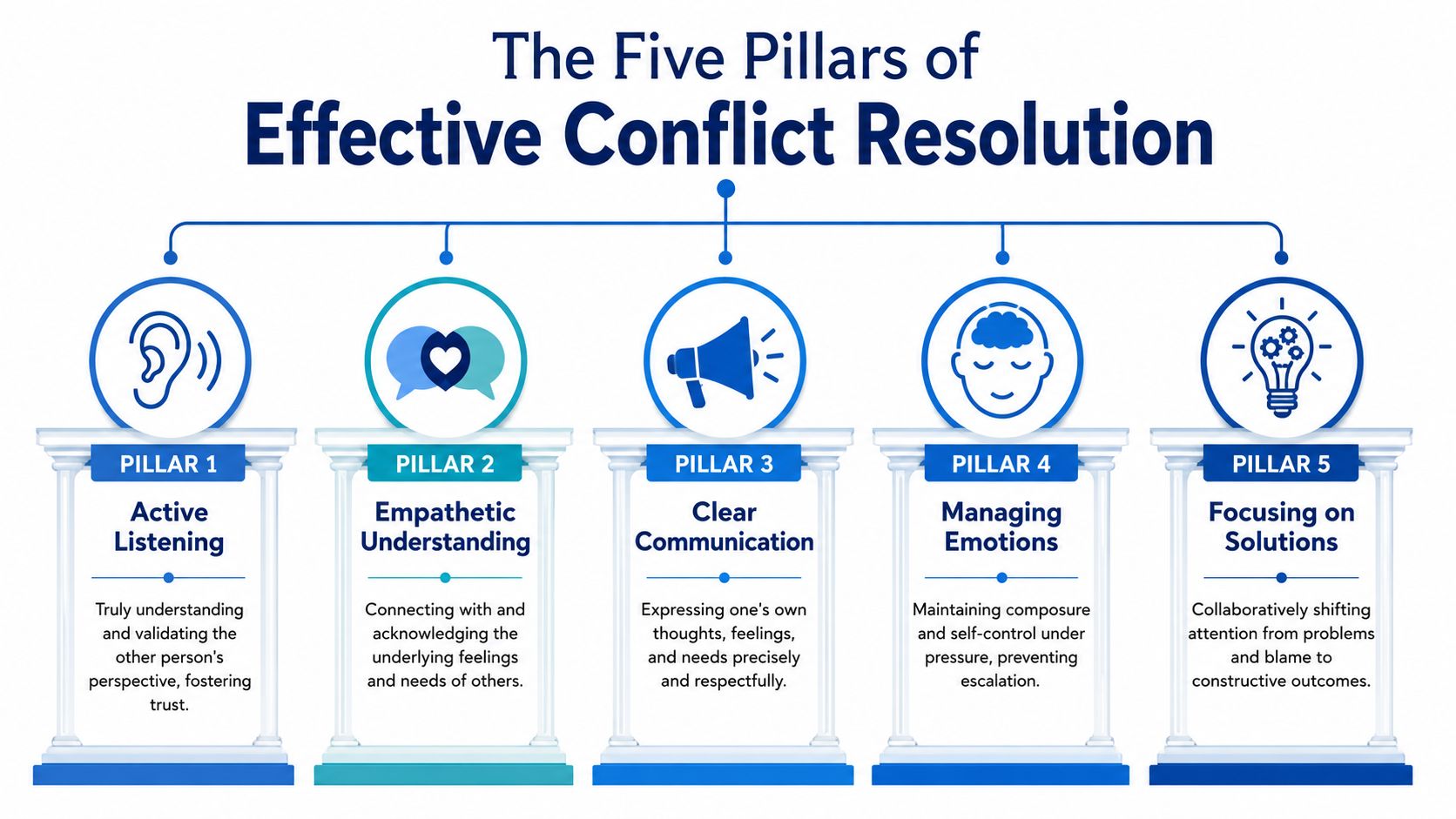
Active listening
Active listening means you are trying to understand the other person accurately before defending yourself. That sounds simple. In practice, it's one of the hardest parts of conflict.
In intercultural disagreements, listening also means checking your assumptions about tone, volume, and emotional style. If you want to strengthen this area in close relationships, the habits described in emotional intelligence in relationships can help.
A simple exercise:
- Pause your rebuttal. Wait until the other person finishes.
- Paraphrase. Say, “What I'm hearing is…”
- Check accuracy. Ask, “Did I get that right?”
Empathetic understanding
Empathy is not agreement. It's the ability to recognise the emotional logic of the other person's position.
Someone may be arguing about lateness, but the emotional issue may be feeling unimportant. Another person may seem rigid, but underneath they may be anxious and trying to create predictability.
Clinical rule: If you respond only to the complaint and not to the feeling underneath it, the conflict usually returns.
A quick practice:
- Name one likely feeling.
- Name one likely need.
- Test it gently rather than assuming you're right.
Clear communication
Clarity matters more than eloquence. The goal is not to sound perfect. The goal is to be understandable without attacking.
Useful communication is:
- Specific
- Respectful
- Focused on the present issue
- Free of mind-reading
Avoid global statements like “You always” or “You never”. They trigger defence fast.
Managing emotions
Emotional regulation is what keeps the rest of the pillars available. Without it, listening becomes impossible and problem-solving turns into threat detection.
This doesn't mean suppressing feelings. It means noticing them early enough that they don't run the whole conversation.
Focusing on solutions
A conflict isn't resolved when both people have spoken. It's resolved when both people can identify a next step that feels workable and fair enough.
Try this sequence:
- Define the issue in one sentence.
- Identify the need on each side.
- Generate two or three realistic options.
- Agree on one small experiment.
- Revisit it later.
That structure matters. People often try to negotiate solutions before they've clarified the actual problem.
Mastering Active Listening Across Cultures
Active listening is often described as “hearing the other person out”. That's too shallow to be useful. In therapy and mediation, active listening means tracking words, emotional tone, body language, and context at the same time.
In cross-cultural conflict, this becomes even more important because the literal message and the social meaning may not match. A raised voice may signal hostility in one culture and involvement in another. Silence may mean respect, discomfort, or withdrawal.
What good listening actually sounds like
Good listening is concrete. It includes phrases like:
Paraphrasing
“So you're saying the issue isn't only the rent increase. It's that you felt informed too late.”Reflecting emotion
“It sounds like you felt dismissed.”Open questions
“What part of this felt most difficult for you?”Meaning checks
“When you said that, did you mean you need more notice, or more involvement in the decision?”
These skills reduce the risk of arguing with a version of the problem that isn't the actual one.
For day-to-day practice, it can help to build the basics first through communication skills exercises for difficult conversations.
The cross-cultural traps expats often fall into
Many listening failures are not about bad intentions. They are about speed. You hear something uncomfortable, your body tightens, and your mind fills in the rest.
Common pitfalls include:
- Preparing your defence while the other person is still speaking
- Assuming emotional intensity means aggression
- Missing non-verbal cues because you're focused on translating words
- Treating different communication styles as personal attacks
- Interrupting to correct details before the emotional issue is understood
When someone says, “You never listen,” they usually don't mean you missed a fact. They mean they don't feel received.
A practical listening drill for expat conflicts
Use this in a disagreement with a partner, friend, manager, or landlord.
| Step | What to do | Why it helps |
|---|---|---|
| 1 | Let the person speak without interruption for a short stretch | It lowers defensiveness |
| 2 | Summarise their point in one or two sentences | It tests understanding |
| 3 | Name the emotion you think is present | It helps the person feel seen |
| 4 | Ask what matters most to them now | It moves towards needs |
| 5 | Only then share your side | It improves the odds of mutual listening |
This is close to what many practitioners call scoping. You map each person's perspective, underlying needs, and possible pathways before rushing into solutions.
Regulating Your Emotions When Tensions Are High
Individuals don't lose conflict resolution skills because they forgot the right script. They lose access to those skills because their nervous system has moved into protection mode.
For expats, this can happen faster than expected. You may already be carrying homesickness, bureaucracy stress, financial uncertainty, loneliness, or relationship strain. Then a disagreement arrives, and your brain treats it as a larger threat than it really is.

A CBT view of escalation
Cognitive Behavioural Therapy, or CBT, looks at the loop between thoughts, feelings, body sensations, and actions.
A common conflict loop looks like this:
Trigger
Your colleague says, “This isn't how we usually do it.”Interpretation
“They think I'm incompetent.”Body reaction
Tight chest, heat, rapid speech, urge to withdraw or attack.Behaviour
Snapping, overexplaining, shutting down, or sending a defensive message.Outcome
The conflict deepens and seems to confirm the original fear.
The intervention point is often earlier than people think. You don't need to wait until you are calm. You need to notice the moment your system is speeding up.
Fast regulation tools that work in the moment
If you feel flooded, use one of these before trying to resolve anything.
Box breathing
Inhale, hold, exhale, hold, each for the same count. Keep it simple and steady.5 4 3 2 1 grounding
Identify five things you see, four you feel, three you hear, two you smell, one you taste. This helps anchor attention in the present.Name the emotion accurately
“I'm not only angry. I'm embarrassed and overwhelmed.” Precise naming often reduces intensity.Delay the response
Say, “I want to respond properly. I need a short pause.”Soften the body first
Unclench your jaw, lower your shoulders, uncross your arms.
If your body stays highly activated, more structured support focused on nervous system regulation in therapy can be useful.
Important distinction: Calm is not the absence of emotion. Calm is enough steadiness to choose your next move.
What doesn't work when you're flooded
Some strategies feel productive but usually make conflict worse:
- Explaining too much when your voice is shaking
- Texting during peak emotion because it feels safer than speaking
- Using logic to outrun hurt
- Pretending you're fine and then becoming passive-aggressive later
- Forcing immediate closure when your body is still in fight, flight, or freeze
When people say, “I know what to do, I just can't do it in the moment,” this is usually the missing piece.
How to Communicate Assertively Without Aggression
Assertiveness is the middle path between collapsing and attacking. It means you respect your own needs without trying to dominate the other person.
That balance can be difficult in intercultural relationships. Some expats come from communication cultures where directness signals honesty. In other settings, especially where family loyalty, emotional expressiveness, and indirect cues matter more, the same style can land as cold or harsh. At the same time, trying to adapt too much can leave you silent, resentful, and misunderstood.
A useful anchor is the I statement. It helps you describe your experience without turning the other person into the villain.
The formula that keeps conversations grounded
Use this structure:
I feel [emotion] when [behaviour or situation] because [impact], and I need [clear request].
Examples:
- “I feel overwhelmed when plans change at the last minute because I need time to adjust, and I need more notice.”
- “I feel excluded when family decisions are discussed in Italian without translation because I want to participate, and I need a brief summary in English.”
These statements work because they reduce blame and increase clarity.
Three mini-scenarios that show the difference
Scenario one. Partner and family expectations
Your Italian partner's family assumes every Sunday belongs to them. You feel guilty saying no.
Passive response
“It's fine.”
You go along with it, then become distant later.Aggressive response
“Your family controls everything and nobody respects me.”Assertive response
“I feel drained when every Sunday is automatically planned because I also need downtime. I'd like us to agree together which Sundays are for family and which are for ourselves.”
Scenario two. Flatmate noise and boundaries
Your flatmate often hosts late dinners without warning.
Passive response
You say nothing and start avoiding the kitchen.Aggressive response
“You're unbelievably inconsiderate.”Assertive response
“I feel stressed when guests arrive late without notice because I need predictability at home. I'd like a message earlier in the day when people are coming over.”
Scenario three. Work tension
A manager gives feedback in a very indirect way, and you leave meetings confused.
Passive response
You guess what they meant and worry privately.Aggressive response
“Can you just be direct for once?”Assertive response
“I want to make sure I'm understanding expectations clearly. When feedback is general, I'm not always sure what action you want from me. Could you tell me the two main priorities for this week?”
Assertiveness is not louder speech. It is clearer speech with emotional responsibility.
A cross-cultural layer matters here.
How to stay assertive when emotions rise
Try these boundary rules:
- Use one issue at a time. Don't stack five months of frustration into one conversation.
- Ask for behaviour change, not character change. Request actions the other person can do.
- Keep the request realistic. “Never do that again” rarely works.
- Protect timing. Don't start a difficult conversation when either of you is exhausted.
Applying Your Skills in Real-Life Expat Scenarios
Theory helps. Repetition changes outcomes. The easiest way to build conflict resolution skills is to apply them to familiar situations with a simple sequence.
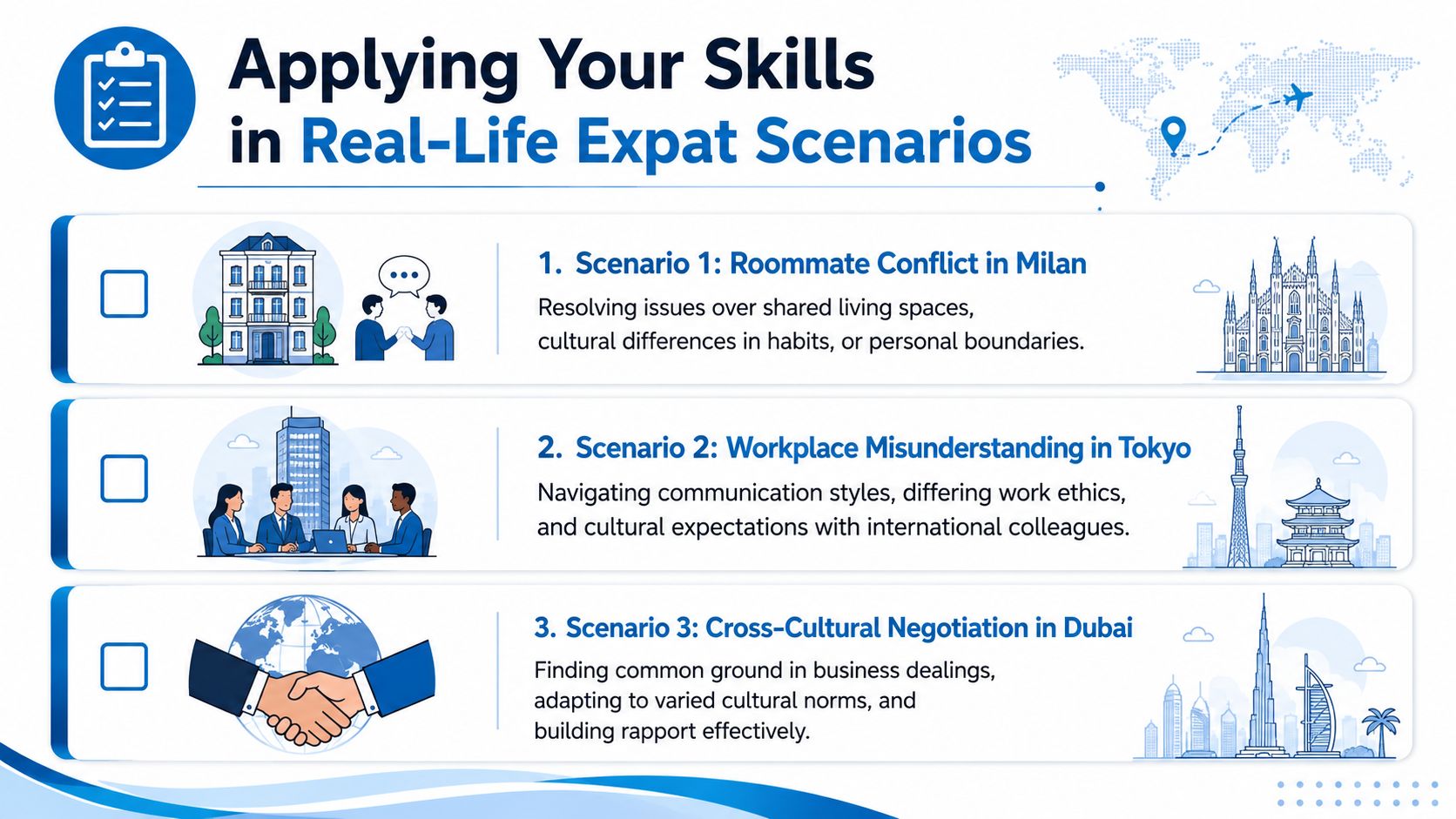
Scenario one with a roommate in Milan
The issue is shared expenses and different standards of cleanliness.
Use this sequence:
Regulate first
Don't begin while irritated by the dirty kitchen.Describe the pattern clearly
“I've noticed the utility bills and cleaning tasks feel unclear.”Listen before proposing
Ask how they see the arrangement.State your needs specifically
“I need a clearer system for bills and shared spaces.”Create a practical agreement
Decide who pays what, by when, and what “clean enough” means.
The key is turning moral language into operational language. “Respect” is vague. “Kitchen cleaned by the same evening” is workable.
Scenario two with a romantic partner
The issue is balancing your individual needs with family obligations in Italy.
This often becomes painful because neither person feels fully understood. One partner may experience family involvement as love and loyalty. The other may experience it as pressure and lack of privacy.
A more productive script is:
- Name the shared goal.
- Validate both emotional realities.
- Negotiate rituals, not identities.
For example:
- Shared goal. “We both want closeness with your family and enough time for our relationship.”
- Validation. “I can see family contact is very important to you. I also need some protected space to recharge.”
- Rituals. Decide on frequency, duration, and what gets discussed privately first as a couple.
Scenario three at work
The issue is a misunderstanding with a manager because expectations were implied rather than spoken.
This is also where burnout can hide inside conflict.
If the conflict is “silent”, look for signs such as:
- shorter replies
- missed follow-up
- avoidance of meetings
- irritability that appears out of proportion
- feeling numb rather than openly angry
Standard negotiation often fails here because the person doesn't need a sharper argument first. They may need rest, emotional processing, and support that addresses stress patterns more thoroughly.
Some conflicts are not powered by disagreement. They are powered by depletion.
When Self-Help Is Not Enough The Role of Therapy
Some conflicts respond well to better listening, clearer boundaries, and calmer timing. Others keep repeating because the true issue sits underneath the conversation itself.
Therapy becomes especially useful when you notice patterns like:
- Recurring arguments with no real repair
- Panic, shutdown, or intense anger during ordinary disagreements
- Relationship conflict tied to trauma, attachment fear, or identity strain
- Workplace tension that is mixed with burnout or emotional numbness
- Feeling isolated because no one around you fully understands the intercultural layer
In these cases, therapy is not a last resort. It's a structured place to understand what conflict activates in you and how to respond differently.
What professional support can add
CBT can help you identify the thoughts and interpretations that accelerate conflict. EMDR can be helpful when present-day disagreements trigger older memories or body-based fear responses. Schema Therapy helps uncover long-standing patterns such as abandonment, self-sacrifice, mistrust, or defectiveness. TMI, or Territorial Metacognitive Interpersonal Therapy, can support people in recognising recurring interpersonal cycles more clearly.
In Italy, integrating TMI with conflict resolution skills in cross-cultural couples and expat groups has achieved an 83% long-term harmony rate, as reported in this peer-reviewed article on metacognitive interpersonal therapy.
For many expats, the challenge is not only the argument itself but the weight it places on an already strained mental health system and support network.
Finding the right clinician matters. Intercultural sensitivity, language fluency, and a good relational fit can shape whether therapy feels safe enough to be useful. If you're looking for that fit, this guide on finding the right therapist for expats in Italy can help you think through what to ask.
FAQ
How do I handle a conflict when there is a language barrier?
Use simple language and slow the conversation down. Focus on short sentences, confirm understanding by paraphrasing, and pay attention to tone and body language. If the issue is important, it can help to involve a bilingual person or a professional mediator so that neither side relies only on guesswork.
Are these conflict resolution skills effective for online disagreements?
Yes, they can work well online if you become more explicit. Because text removes facial expression and tone, it's important to state your intention clearly, use I statements, and avoid writing while emotionally flooded. If messages start to feel tense or confusing, switching to a video or voice conversation is often wiser.
What if the other person is unwilling to resolve the conflict?
You can still act in a healthy and effective way even if the other person won't meet you there. Focus on clear boundaries, calm language, and realistic expectations about what you can control. If the other person remains hostile, avoid chasing resolution at any cost and protect your emotional safety first.
How can I practice these skills if I don't have a conflict right now?
Practice in low-stakes situations. Paraphrase a friend's story before giving your opinion, notice your body during small frustrations, and use I statements for ordinary requests. Rehearsing with a therapist or a trusted friend can also make the skills much easier to access when emotions are high.
Can conflict resolution skills help with burnout-related withdrawal?
Yes, but only if you recognise that withdrawal is part of the problem. When someone is depleted, the first step is often regulation and emotional recognition rather than immediate negotiation. If exhaustion is driving the pattern, therapy can help address the underlying stress response instead of treating everything as a communication flaw.
Is therapy useful even if the conflict seems practical rather than emotional?
Yes, because practical conflicts often become stuck for emotional reasons. You may be discussing chores, work feedback, money, or family visits, but the deeper issue may be fear, shame, resentment, or feeling unseen. Therapy helps separate the practical problem from the emotional pattern that keeps inflaming it.
Book your first free assessment call with Therapsy if you'd like support from a multilingual therapist who understands expat life in Italy. There's no commitment and no payment for that first conversation, just a thoughtful discussion with our Clinical Director to listen carefully and match you with the right therapist for you.