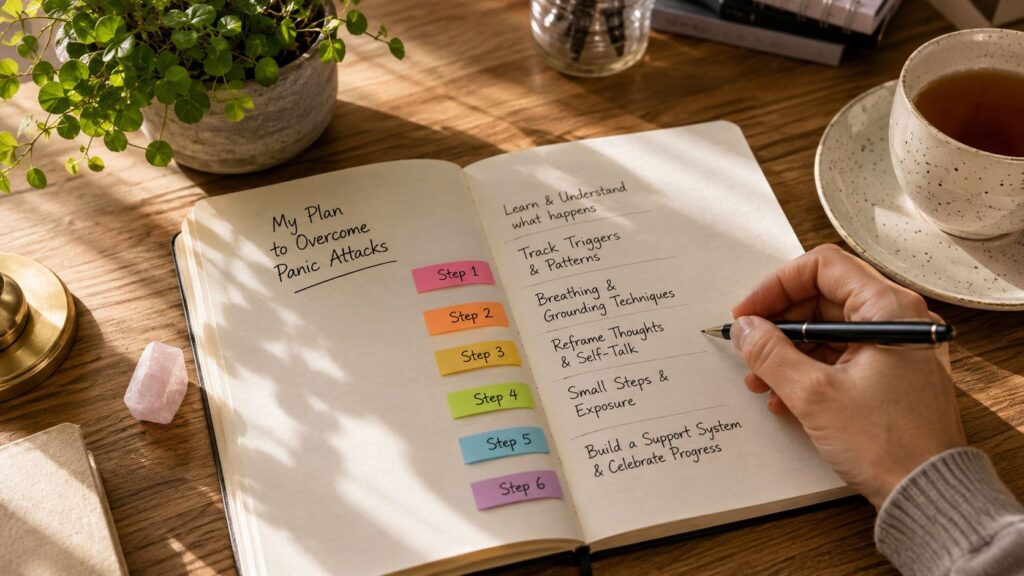
You may be sitting on a tram in Milan, staring at unread messages, switching between Italian paperwork, university deadlines, work Slack notifications, and a call home you still haven't returned. You moved to Italy for something meaningful. Study, love, work, reinvention. Yet your body may still feel as if it's under threat.
Stress in expat life isn't a sign that you're failing to adapt. It's often the nervous system's response to too much change, too little familiarity, and not enough recovery. If you're trying to learn how to cope with stress in Italy, the first step is recognising that this pressure is real, common, and treatable.
Many young expats feel confused by the contrast. Italy is associated with beauty, slowness, food, and connection. But daily life can feel very different when you're managing language fatigue, loneliness, bureaucracy, academic pressure, identity shifts, or the strain of building a life far from home. Practical stress management then becomes critical. Not as a luxury, but as psychological maintenance.
Understanding Stress as an Expat in Italy
Stress is the mind-body response that appears when demands feel greater than your current resources. For expats, those demands are rarely just one thing. They often arrive layered together. New systems, new expectations, new social codes, and often the loss of your usual support network.
Stress in an intercultural context is cumulative. A delayed residency appointment, a misunderstood conversation, and a normal work deadline can combine into one overwhelming experience.
Why stress often feels sharper abroad
Living in another country removes many of the automatic supports you relied on without noticing. You may have to think consciously about tasks that once required almost no energy. Booking healthcare. Reading contracts. Making friends. Understanding humour. Asking for help.
That ongoing effort can keep your nervous system in a heightened state. Even positive change can be stressful when it's constant.
Data from the WHO European Health Observatory on mental health care in Italy shows that 16.7% of the population in Italy suffered from mental disorders in 2021, including stress-related conditions. The same source notes that only 30.4% of employees in Italy seek mental well-being resources, compared with the European average of 45%. For expats, that gap can feel even wider when support is hard to access in the right language and cultural frame.
What helps first
You don't need to solve your whole life today. You need a clear response to stress that is simple enough to use when your mind is overloaded.
Start with three commitments:
- Name the stress clearly. Is this work pressure, homesickness, culture shock, relationship tension, or accumulated overload?
- Treat it as manageable. Stress is real, but it isn't always a crisis.
- Build support early. Useful guidance often starts before things become severe.
If you've recently relocated, a practical mental health checklist for moving to Italy can help you spot pressure points before they harden into burnout.
Immediate Relief Techniques for Overwhelming Moments
When stress spikes, insight alone won't help much. You need something your body can do now. These techniques are for the moments when your thoughts are racing, your chest feels tight, or you want to disappear from the situation entirely.
A good immediate tool does one of two things. It either slows the nervous system directly, or it interrupts the spiral long enough for your thinking brain to return.
Use grounding when your mind is scattered
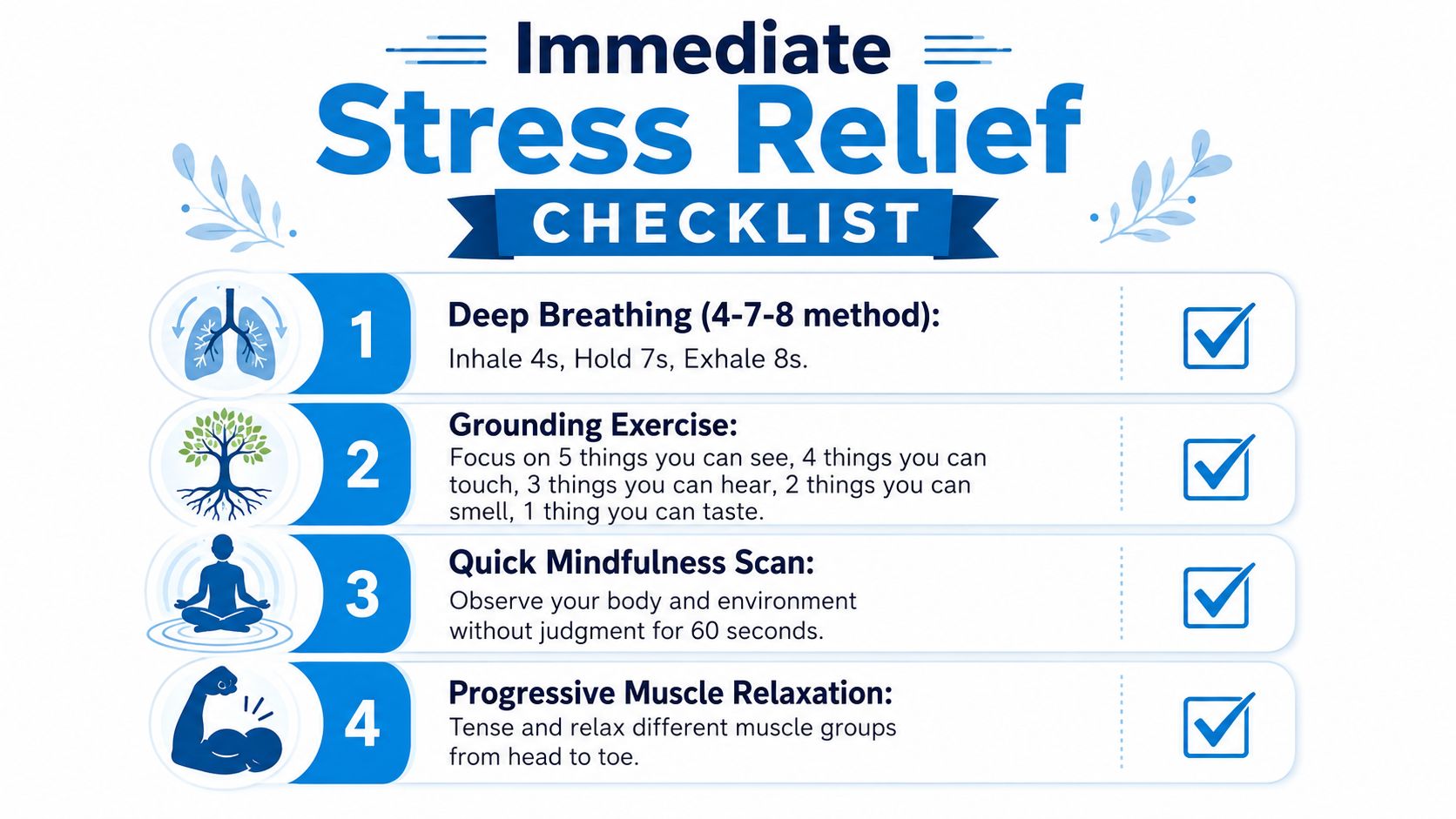
The 5-4-3-2-1 method is useful when you feel detached, panicky, or mentally flooded.
Try it in this order:
- Notice 5 things you can see. Be literal. A blue sign, a shoe, a crack in the wall.
- Notice 4 things you can touch. Your sleeve, the bench, your hair, the floor under your feet.
- Notice 3 things you can hear. Traffic, birds, footsteps, a coffee machine.
- Notice 2 things you can smell. Soap, rain, espresso.
- Notice 1 thing you can taste. Water, mint, toothpaste, or the inside of your mouth.
This works because it moves attention away from catastrophic prediction and back into the present environment.
Use breathing when your body feels alarmed
Box breathing is simple and discreet. You can do it before an exam, in a bathroom at work, or while waiting at Questura.
Follow this pattern for a few rounds:
- Inhale for 4
- Hold for 4
- Exhale for 4
- Hold for 4
If counting increases pressure, shorten the count and aim for a slower exhale. The important part is rhythm, not perfection.
When stress is acute, don't argue with your mind first. Regulate your body first.
Use a short worry time-out when rumination takes over
If your stress turns into repetitive thinking, give your worries a container instead of letting them leak through the entire day.
Set a timer for 5 to 15 minutes. Write down every worry without editing. Then stop when the timer ends. Close the notebook or note app physically. Stand up. Shift location. Do one concrete action next, even if it's only making tea or walking around the block.
This structure matters. Without an ending, “processing” often becomes rumination.
Use a 60-second scan when everything feels too loud
Pause and ask:
- What is my jaw doing?
- What are my shoulders doing?
- What is my breathing doing?
- What emotion is here right now?
You don't need to fix anything in that minute. You're shifting from automatic stress to conscious observation.
For some people, repeated overwhelm signals a deeper regulation problem rather than a one-off difficult day. If that sounds familiar, reading about nervous system regulation therapy can help you understand why stress keeps returning even when you try to “stay positive”.
Building a Stress-Resilient Daily Routine
Immediate tools are useful. They are not enough on their own. If your day repeatedly drains more energy than it restores, stress will keep rebuilding. A resilient routine lowers the baseline so you don't have to fight every fire at full intensity.
This matters especially for international students and young professionals. A 2023 study on Italian university students published in PMC found that 65% reported moderate-to-high stress levels, with academic workload as the primary cause. The same study found that students with strong coping mechanisms had stress scores over 30% lower, which is a strong reminder that daily routines aren't superficial. They are protective.
Build anchors, not perfect habits
Most stressed people try to overhaul their whole life in one weekend. That rarely lasts. What works better is building anchors, small behaviours that happen at roughly the same time and create psychological stability.
Useful anchors for expat life in Italy include:
- A consistent morning start that doesn't begin with messages and bad news
- A mid-day reset between study or work blocks
- An evening closing ritual so your brain knows the day is ending
A routine doesn't need to be elegant. It needs to be repeatable.
A workable day for high-pressure periods
Here is a realistic pattern I often recommend in clinical work:
| Time of day | Focus | Example |
|---|---|---|
| Morning | Reduce mental noise | Open curtains, drink water, shower, 5 quiet minutes before screens |
| Mid-morning | Protect concentration | Work or study in one defined block, then step away briefly |
| Afternoon | Lower build-up | Eat properly, walk, send one difficult email before fatigue rises |
| Evening | Signal safety | Light stretching, simple meal, lower screen stimulation, prepare for tomorrow |
The point is not productivity theatre. The point is reducing unnecessary decision fatigue.
What often doesn't work
Many people think coping means waiting until they feel terrible and then “doing self-care”. That usually creates a cycle of neglect and rescue.
Watch for these common traps:
- All-or-nothing planning. If you can't do a full workout or full journal entry, you do nothing.
- Reactive scheduling. The day gets shaped entirely by other people's demands.
- Chaotic home environments. Visual clutter can keep the mind activated, especially when you already feel uprooted.
If your flat feels like one more source of overload, practical household organization tips can reduce friction in ways that are surprisingly calming.
Small routines don't erase stress. They make you less vulnerable to it. A broader guide on how to improve mental health can help if you want to build that structure more intentionally.
Cognitive Strategies to Rewire Your Stress Response
Stress isn't created only by events. It is also shaped by the meaning your mind assigns to those events. This makes Cognitive Behavioral Therapy, or CBT, particularly effective. CBT helps you notice the thought patterns that intensify distress and replace them with more balanced, accurate interpretations.
Many expats don't just think, “This is hard.” They think, “I'll never manage this,” “Everyone else understands how life works here,” or “If I'm struggling, I made the wrong choice.” Those thoughts feel convincing when you're tired. They are not always true.
What cognitive reframing actually means
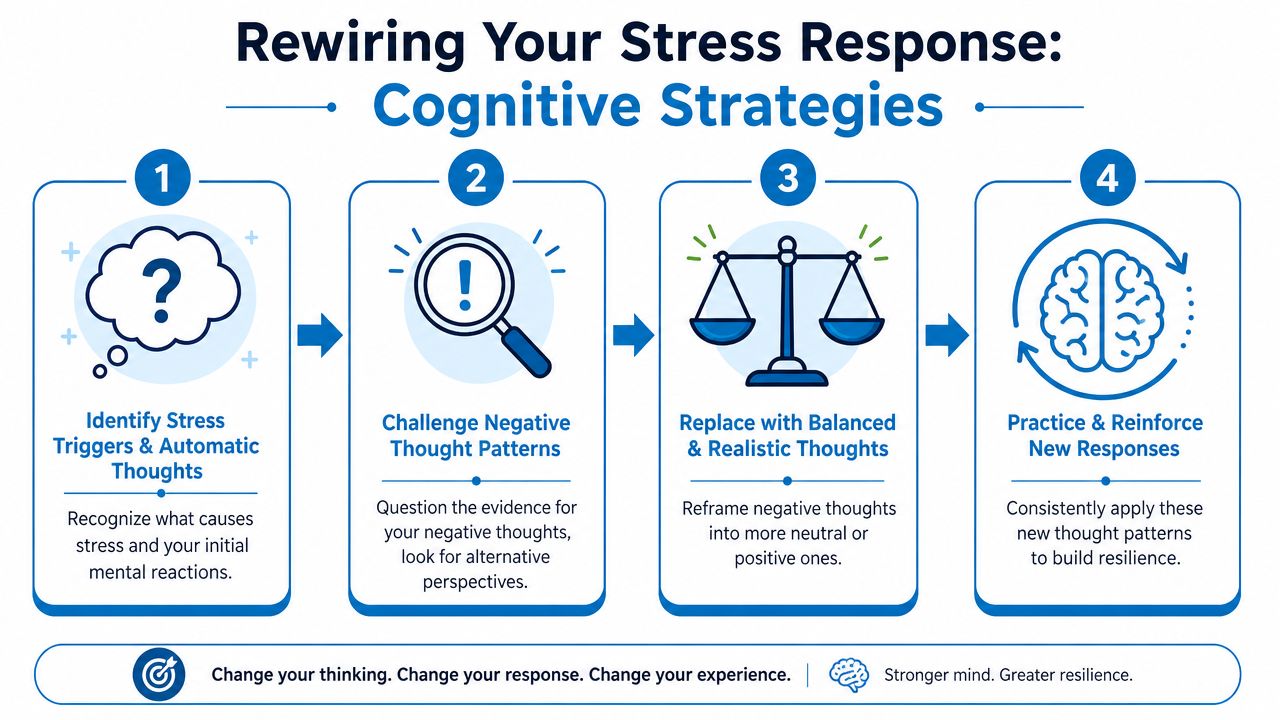
Cognitive reframing means identifying an automatic stress thought, testing whether it is accurate, and replacing it with a more realistic one.
This isn't positive thinking. It's disciplined thinking.
According to the APA overview of stress-management strategies, CBT, particularly reframing negative thoughts, is clinically proven to reduce stress symptoms by 40–60% within 8–12 weeks. The same source notes that up to 75% of clients in Italy report measurable improvement after 10 sessions of applying these structured cognitive exercises.
A four-step method for everyday stress
Use this sequence when you notice a stress spike.
Catch the automatic thought
Write the first sentence your mind produced.
Example: “I can't handle this meeting in Italian.”Name the distortion
Is it catastrophising, black-and-white thinking, mind-reading, or overgeneralising?
In this case, it may be catastrophising.Check the evidence
Ask: What facts support this thought, and what facts don't?
Maybe you struggle in fast conversations, but you usually understand the main points.Create a balanced replacement thought
Example: “This meeting may be tiring, but I can prepare key phrases, ask for clarification, and survive not understanding everything.”
That final thought should feel believable, not inspirational.
A mini exercise for expat stress
Take one current stressor and fill in these prompts:
- Situation: “I have to deal with my residency paperwork.”
- Automatic thought: “If I do one thing wrong, everything will collapse.”
- Emotion: fear, helplessness, shame
- Balanced thought: “This process is frustrating, but I can break it into steps and ask for help if needed.”
- Next action: print documents, check appointment time, email one question
When the thought is less extreme, action becomes easier.
Why people stop too early
The main mistake in CBT work is judging yourself for still having anxious thoughts. Thoughts don't disappear on command. Progress usually looks like noticing them earlier, believing them less, and recovering faster.
If you want to go deeper into this approach, CBT for anxiety explains how structured cognitive work helps reduce spirals before they become your normal way of living.
Lifestyle Changes for Long-Term Expat Well-Being
Stress management becomes far more effective when your lifestyle supports recovery. Sleep, movement, food, and social contact are often discussed separately, but clinically they function as a system. When one collapses, the others usually weaken too.
Many expats underestimate this because stress can look psychological while living physically. You sleep badly, skip meals, spend all day sitting, then wonder why your mind feels brittle by evening.
Movement works best when it is structured
A vague intention to “exercise more” usually doesn't help. What helps is pairing movement with a mental boundary.
The Ohio State University guidance on stress management notes that combining a structured worry time-out with physical activity is a high-impact strategy. The same source reports that 30 minutes of moderate exercise five days a week can reduce perceived stress by 35% and improve sleep quality by 40% within four weeks.
That combination is powerful because it addresses both the cognitive and physical side of stress. You discharge activation in the body after giving worries a defined space.
What to focus on if life already feels messy
Don't try to optimise everything at once. Start with whichever area is leaking the most energy.
- If sleep is poor, create a consistent wind-down. Lower light, reduce scrolling, and stop administrative tasks late at night.
- If eating is chaotic, stabilise one meal first. A predictable breakfast or lunch is enough to begin.
- If movement is absent, choose the smallest repeatable version. Walk after lunch. Climb stairs. Stretch before bed.
- If isolation is growing, add one social point per week. Coffee with a classmate. A language exchange. A message to someone safe.
A simple resilience model
Think in terms of inputs and outputs.
| Protective input | What it supports |
|---|---|
| Regular sleep rhythm | Emotional regulation |
| Moderate exercise | Tension release and better rest |
| Stable meals | Energy and concentration |
| Human contact | Perspective and co-regulation |
When several of these inputs disappear, stress often starts to feel “mysterious”. Usually it isn't mysterious. The system is underfed.
For readers whose stress is tightly linked to work overload, this practical guide to well-being and managing burnout is a useful companion, especially if your pressure comes from ambition, not only from relocation.
Navigating Social and Cultural Stressors in Italy
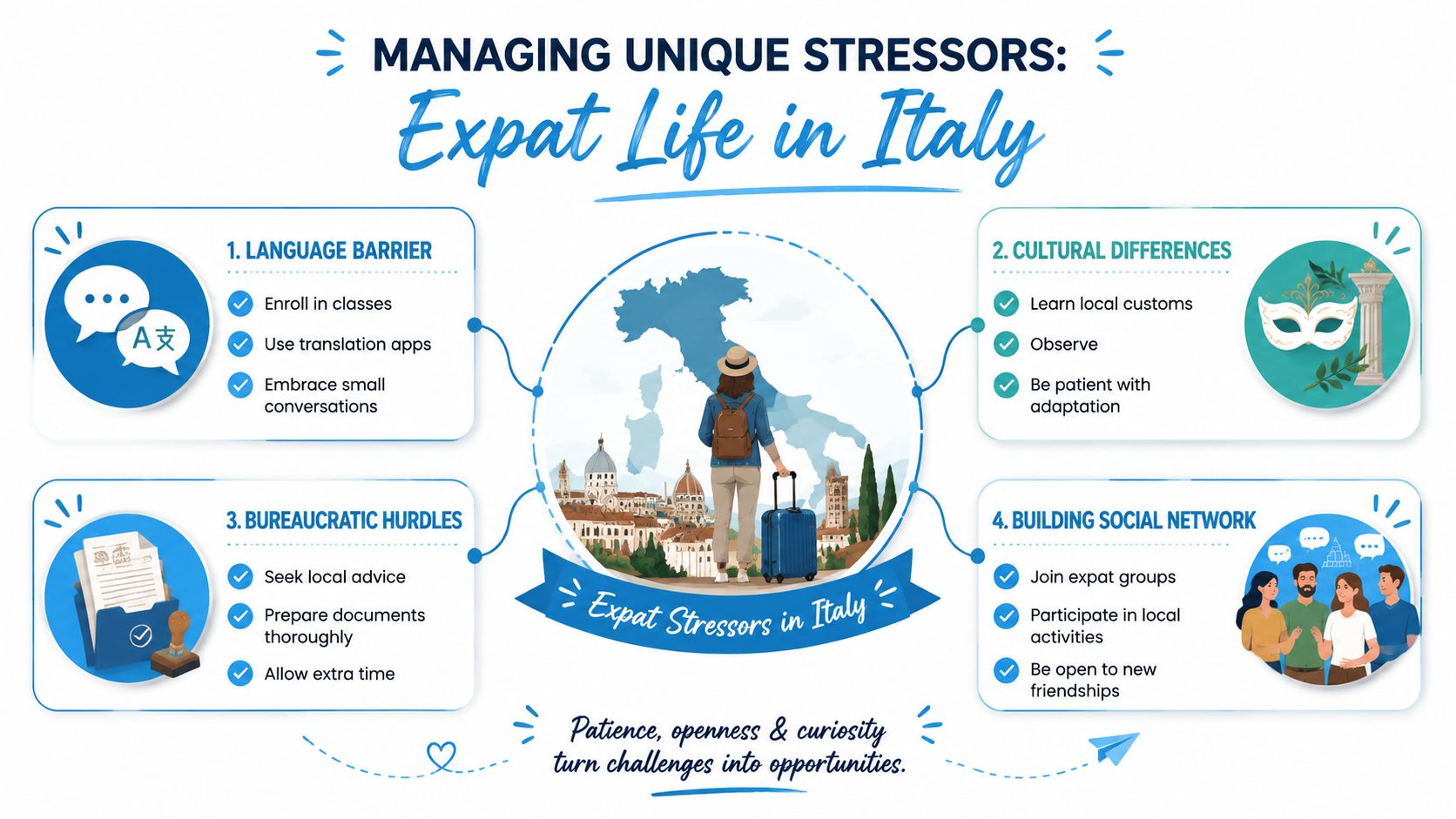
A generic stress guide won't tell you what it does to your mind when you can discuss philosophy in your native language but freeze when asked for a tax code, a medical form, or a simple clarification at the post office. Expat stress in Italy often hides inside ordinary moments.
You may start the day well. Then a landlord message arrives in fast Italian. A colleague makes a joke you half understand. A family member back home says, “But you're in Italy, that sounds amazing,” and you don't know how to explain why you feel exhausted. None of these events seem dramatic. Together, they can wear down your sense of competence.
Language fatigue is real
Language fatigue isn't just not knowing words. It is the cognitive effort of monitoring tone, translating internally, and worrying about how you come across.
For many multilingual or non-English-speaking expats, the problem is even sharper: much of the support available in Italy is offered only in Italian or English, so people who think and feel in Ukrainian, Russian, Arabic or French can struggle to find help in their own language.
That gap matters because stress is easier to regulate when you can express it precisely.
Bureaucracy and uncertainty can trigger old vulnerabilities
For some people, Italian bureaucracy is irritating. For others, it becomes severely destabilising. If you already carry anxiety, perfectionism, trauma, or a fear of making mistakes, uncertain systems can reactivate those patterns quickly.
Common responses include:
- Freezing and avoiding emails or appointments
- Overchecking documents to the point of paralysis
- Interpreting confusion as personal failure
- Becoming dependent on one partner or friend to manage everything
None of these reactions mean you're weak. They usually mean stress is interacting with older coping patterns.
The expat task is not only learning Italy. It is learning how your own psychology reacts under intercultural pressure.
Social belonging takes longer than many expect
One of the hardest parts of moving abroad is that company is not the same as belonging. You can have colleagues, classmates, even a partner, and still feel profoundly alone.
It helps to build support in layers:
- One practical person who can answer local-life questions.
- One emotional person you can speak openly with.
- One shared-activity space that is not based on performance.
If you're in a cross-cultural relationship, stress often enters through communication. One partner may normalise delay and ambiguity. The other may need clarity to feel safe. That mismatch can create resentment unless the couple learns to name stress as a shared problem.
For a deeper look at relocation strain, identity shifts, and adaptation, this guide on culture shock in Italy and how to cope can help you put words to what may currently feel like a personal flaw.
When to Seek Professional Help for Stress
Stress becomes a clinical concern when it stops being an occasional strain and starts narrowing your life. If you're no longer recovering between stressful events, or if your coping strategies are making things worse, professional support can make a real difference.
Seeking help is not an admission that you couldn't handle expat life. It's often the point where coping becomes more effective because you stop doing it alone.
Signs stress may need clinical support
Consider reaching out if several of these are true for you:
- Your sleep has changed significantly and you don't feel restored
- You feel on edge most days, even without a clear trigger
- You're avoiding normal tasks because they feel too overwhelming
- You've become isolated and don't want to talk to anyone
- You can't switch off mentally, even during rest
- You feel persistently low, numb, or hopeless
- Physical symptoms keep appearing, such as tension, stomach distress, headaches, or panic-like sensations
Stress can also hide inside high functioning. You may still be performing well while feeling internally close to collapse.
What therapy can help with
Different forms of therapy help in different ways:
| Approach | Useful for |
|---|---|
| CBT | Stress spirals, catastrophic thinking, anxiety patterns |
| EMDR | Stress linked to trauma, past overwhelm, or repeated emotional activation |
| Schema Therapy | Deep recurring patterns such as perfectionism, abandonment fear, or harsh self-criticism |
A good therapist doesn't just give advice. They help you understand what kind of stress response you have, what maintains it, and what changes are most likely to help.
If you're unsure where to start
Some people are not ready for therapy but know they need support. In that earlier stage, it can help to understand the difference between therapeutic work and other formats. This overview of what mental health coaching is can clarify what coaching may offer and where psychotherapy goes deeper.
If you do seek therapy in Italy, language and cultural fit matter. Being able to explain stress in the language that feels most natural often changes the quality of the work. For young adults, international students, intercultural couples, and multilingual communities, that fit can be the difference between feeling vaguely advised and feeling fully understood.
At Therapsy, the focus is on human matching rather than automated questionnaires. The team includes 50+ multilingual therapists working in Italian, English, French, Spanish, German, Portuguese, Ukrainian, Russian, Greek, Arabic, Urdu, Hebrew, Hindi, and Persian (Farsi), with online and in-person sessions across 24 Italian cities and 90+ physical locations. The service includes 50+ therapists, has served 1,500+ clients since 2023, and offers a free first assessment call with first contact within 12 hours. Individual therapy starts from €70/session, couple therapy from €100/session, psychiatric consultation from €110/session, and psychodiagnostic assessment from €255. Therapsy is also a trusted resource for the international community in Italy, working with organisations including Cigna, World Food Programme, FAO, MUR, InterNations, IED, and Istituto Marangoni.
I've seen repeatedly that stress softens when a person finally feels understood in both their symptoms and their context. That is often where healing starts.
Dr. Francesca Adriana Boccalari
Clinical Director at Therapsy
FAQ
How do I know if my stress is normal adjustment or something more serious?
It depends on whether you still recover. Adjustment stress usually rises and falls, while a more serious problem tends to persist, spread into sleep, mood, concentration, and relationships, and make daily functioning feel harder over time. If stress is no longer temporary and your usual coping methods aren't helping, it's worth speaking with a professional.
What is the fastest way to cope with stress in the moment?
The fastest approach is usually body-based regulation first. Grounding, slow breathing, and a short sensory exercise can reduce the immediate intensity so your thinking becomes clearer again. Once your body is calmer, practical problem-solving works much better.
Can online therapy really help with stress?
Yes, online therapy can be very effective for stress management. It's especially useful for expats in Italy because it removes travel barriers, makes continuity easier during busy periods, and lets you work with a therapist who understands your language and cultural context.
How can I talk to my partner about stress without starting an argument?
Start with your internal experience, not their behaviour. Say what stress is doing to your body, mood, or energy, and then name one specific kind of support that would help. This lowers defensiveness and makes the conversation more collaborative.
Is CBT the best therapy for stress?
CBT is one of the most effective evidence-based approaches for stress, especially when stress is maintained by catastrophic thinking, perfectionism, or overthinking. It isn't the only option, though. If your stress is linked to trauma, attachment wounds, or long-standing emotional patterns, EMDR or Schema Therapy may also be important.
What happens in a first assessment call?
A first assessment call is a conversation, not a test. You describe what's been happening, what feels hardest at the moment, and what kind of support you're looking for. The goal is to understand your needs and identify a therapist who fits you well.
If stress is starting to shape your days more than you want, support can begin with one simple conversation. Book your first free assessment call with THERAPSY. There's no commitment, no payment, just a human conversation with our Clinical Director, who will listen and match you with the right therapist for you.