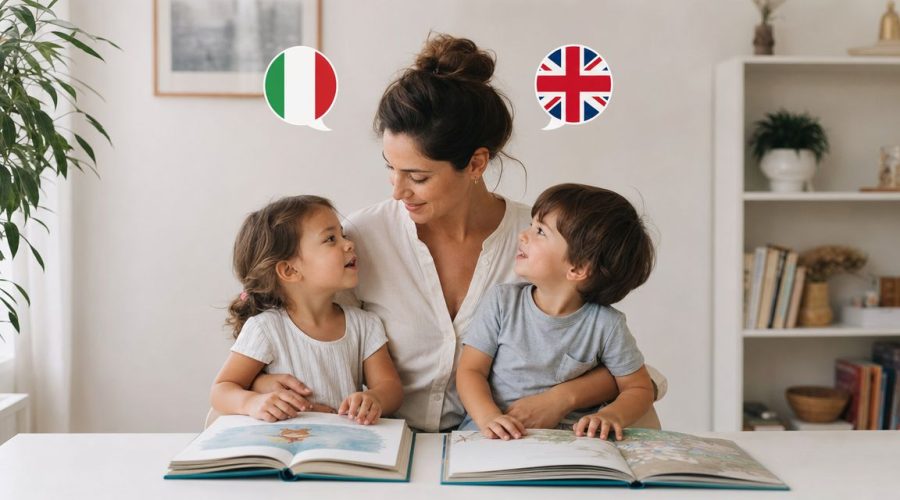
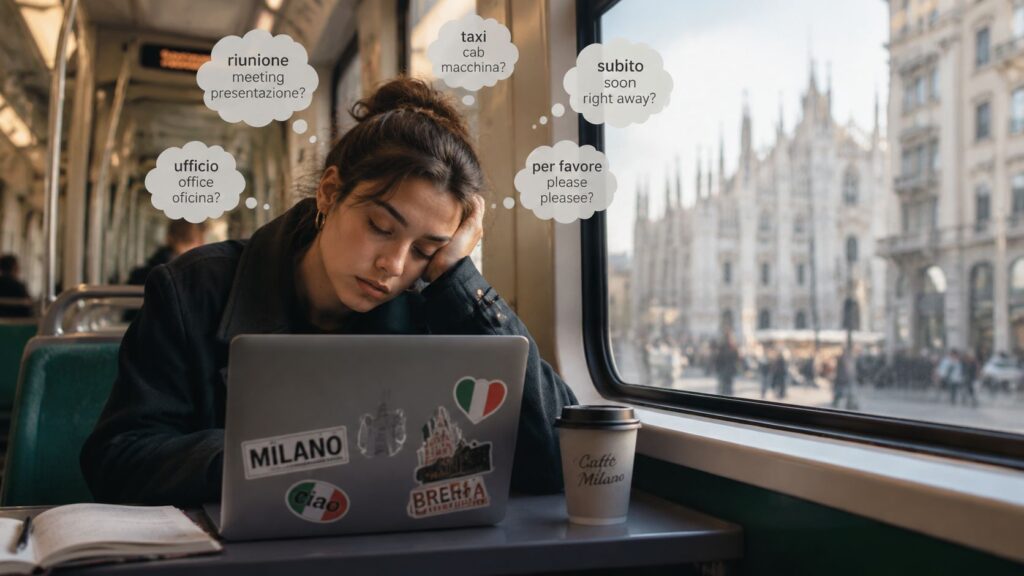
Some parents notice the raising bilingual children mental load long before they have words for it. It shows up when you're answering a teacher in Italian, reading bedtime stories in English, reminding your partner which language to use at dinner, and inwardly wondering whether your child is becoming more fluent in a world you only partly understand.
If you're an expat parent in Italy, that pressure can feel constant. Not dramatic, not always visible, but always running in the background. You may be managing school communication, family expectations abroad, your child's growing social life, and the fear that if you loosen your grip, one language, or one part of your bond, will slip away.
As a clinical psychologist, I want to say this plainly. This is a real form of mental load. It isn't overreacting. It isn't a sign that you're ungrateful for the gift of bilingualism. It's the psychological weight of holding together a multilingual family life while trying to stay emotionally present inside it.
The Unseen Weight of a Bilingual Household
A typical day in an expat family in Italy can contain more invisible decisions than one might initially realise. You wake your child in one language. The school WhatsApp group is in Italian. A grandparent calls from abroad and wants the child to answer in the heritage language. By late afternoon, you're not just parenting. You're coordinating a small language ecosystem.
That effort often blends into other expat pressures. Isolation, lack of extended family support, and the sense that daily life requires more interpretation than it used to. For many mothers especially, this overlaps with the loneliness described in motherhood isolation as an expat, where practical strain and emotional isolation feed each other.
The hard part is that much of this work has no obvious endpoint. You don't finish it and feel done. You keep track of it.
Raising bilingual children mental load is the ongoing cognitive and emotional effort of planning, monitoring, protecting, and emotionally carrying a child's relationship with more than one language.
Defining the Invisible Work of Bilingual Parenting
When parents say bilingual parenting feels exhausting, they usually aren't talking only about speaking two languages at home. They're describing the hidden labour behind it.
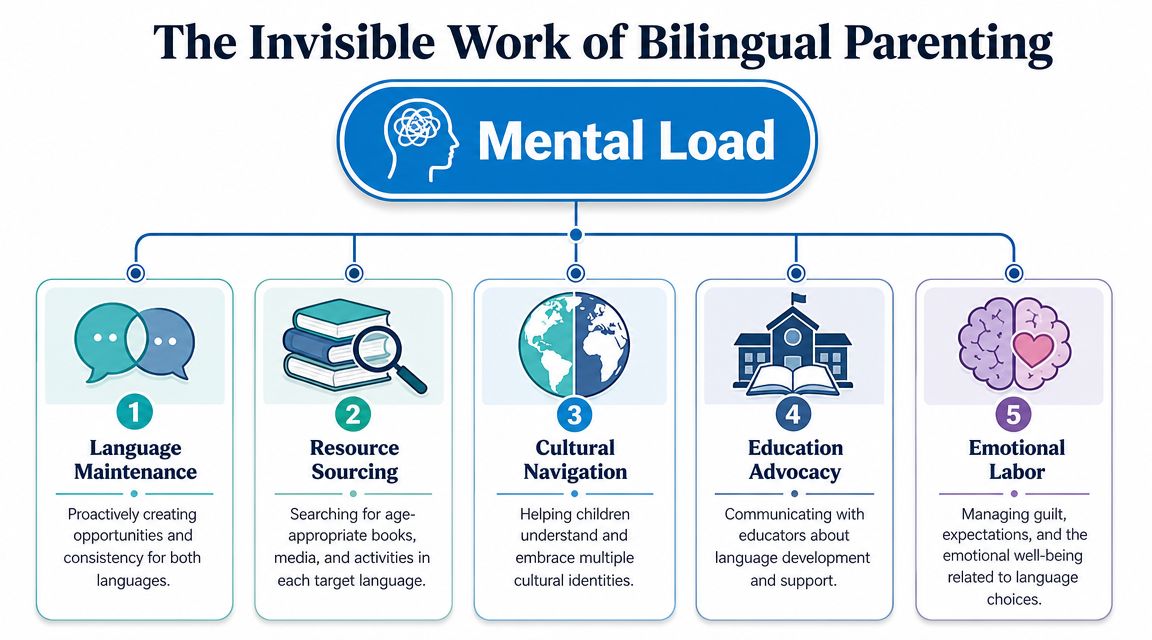
The five layers most parents are carrying
Mental load in bilingual parenting means doing the invisible management work that keeps both languages alive, emotionally meaningful, and usable in daily life.
Planning exposure
You have to think ahead. Who speaks which language with the child. What happens after school. Whether one language is becoming passive because the child hears it but rarely uses it.
Making decisions repeatedly
Families often get stuck on rules such as one-parent-one-language or minority-language-at-home. Research suggests one-person-one-language can work, but it is neither necessary nor sufficient on its own, and relatively balanced exposure is more likely to support both languages in this research review.
Monitoring what is happening
Parents often discover that the plan and reality are not the same. School, friends, and media can pull hard toward Italian. Home language can slowly become the language the child understands but doesn't choose.
Sourcing resources
Books, cartoons, songs, playgroups, family trips, community events. Someone usually has to find them, evaluate them, and keep them in rotation.
Carrying the emotional meaning
This is the least discussed part. When a language represents family history, belonging, or your child's connection to relatives abroad, every language choice can start to feel loaded.
Why this differs from ordinary parenting stress
All parents juggle routines and decisions. Bilingual parents are also building conditions for language use on purpose. They intentionally guide development. They are shaping an environment.
That is why the mental load feels so specific. You are not only asking, "What does my child need?" You are also asking, "Which language should this happen in, who should provide it, and what happens if one side wins?"
The Psychological Roots of Bilingual Parenting Stress

The to-do list is only part of the strain. The heavier burden often comes from what the bilingual project means to you emotionally.
Perfectionism makes every choice feel high stakes
In CBT, we often look at the beliefs sitting underneath stress. A common one in bilingual parenting is this: "If I don't do this properly, I will fail my child." Once that belief takes hold, small decisions start to feel morally charged.
A missed story in the heritage language doesn't feel like one tired evening. It feels like evidence that you're getting it wrong. The child answering in Italian doesn't feel developmentally normal. It feels personal.
The overlap with high-functioning anxiety in women becomes relevant. Many capable parents look organised on the outside while internally running on fear, over-responsibility, and constant self-monitoring.
Identity strain can be sharper in expat life
Schema Therapy helps name another piece of the puzzle. Parenting activates deep themes around adequacy, belonging, and attachment. In an intercultural family, those themes often become more intense.
You may wonder:
- Am I still the primary emotional home if school, friends, and culture pull my child toward Italian?
- If my child jokes, argues, or dreams more easily in another language, what does that mean for us?
- If I adapt to Italy, what part of me am I preserving for them?
These are not superficial worries. They go to identity.
Sometimes the stress isn't about vocabulary at all. It's about fearing distance from your child in the place where closeness used to feel effortless.
Expat context increases the pressure
Living in Italy can be very enriching, but it also means your family is navigating one dominant social language around the clock. The school system, peer culture, neighbourhood life, birthday parties, local bureaucracy, and children's media all tend to reward the majority language.
That can create anticipatory anxiety. Parents begin to scan for loss before loss has happened. They fear future disconnection, school misunderstandings, or the slow fading of a heritage language that carries memory, humour, and family intimacy.
Child's Gain vs Parent's Strain The Research
Parents often feel guilty admitting that bilingual parenting is draining. They know the child may benefit, so they assume they should be grateful. Psychologically, that creates a painful split. You value the goal, but you're tired from carrying it.
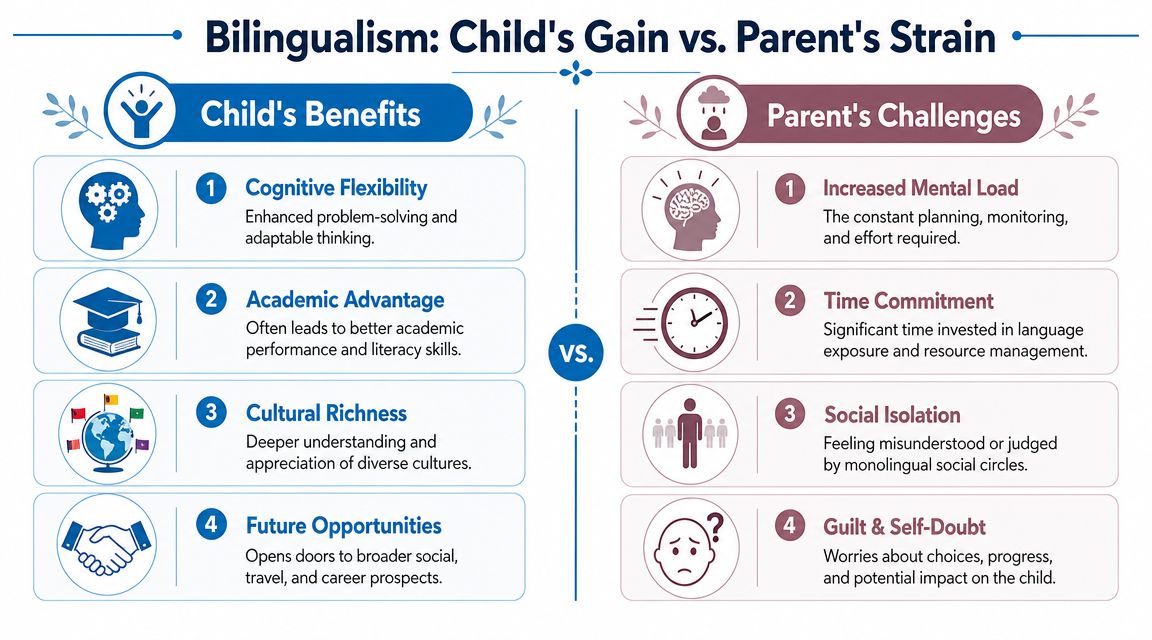
What the evidence actually says about children
That sentence matters because many overwhelmed parents still carry an old fear that two languages might somehow harm development. The evidence does not support that fear.
A broader historical review also describes how research moved away from the outdated idea that two languages create "confusion" or "intellectual fatigue." It summarises evidence that bilingual children showed earlier or stronger development in some control skills, including inhibition, attentional control, and working memory, while also noting that not every study found a universal advantage, as discussed in this PMC review of bilingualism research.
Where the real burden sits
The research-based picture is reassuring for the child and honest about the parent. The problem usually isn't that bilingualism is hurting your child. The problem is that maintaining two active languages requires sustained adult coordination.
That is why many parents end up near the edge of depletion described in expat burnout symptoms. They are doing developmental planning, emotional regulation, scheduling, school advocacy, and identity work all at once.
A useful reframe is this:
| Child side | Parent side |
|---|---|
| Learning in more than one language can be healthy and workable | Supporting that process can feel administratively heavy |
| Mixed-language environments are not inherently harmful | Inconsistent routines can create more stress for adults |
| Language development unfolds over time | Parents often expect themselves to manage it perfectly from the start |
You are allowed to acknowledge the strain without treating bilingualism as a mistake. Those two truths can coexist.
Practical Strategies to Lighten Your Mental Load
The most helpful strategies reduce decision fatigue. They don't require perfect consistency. They make family life more sustainable.
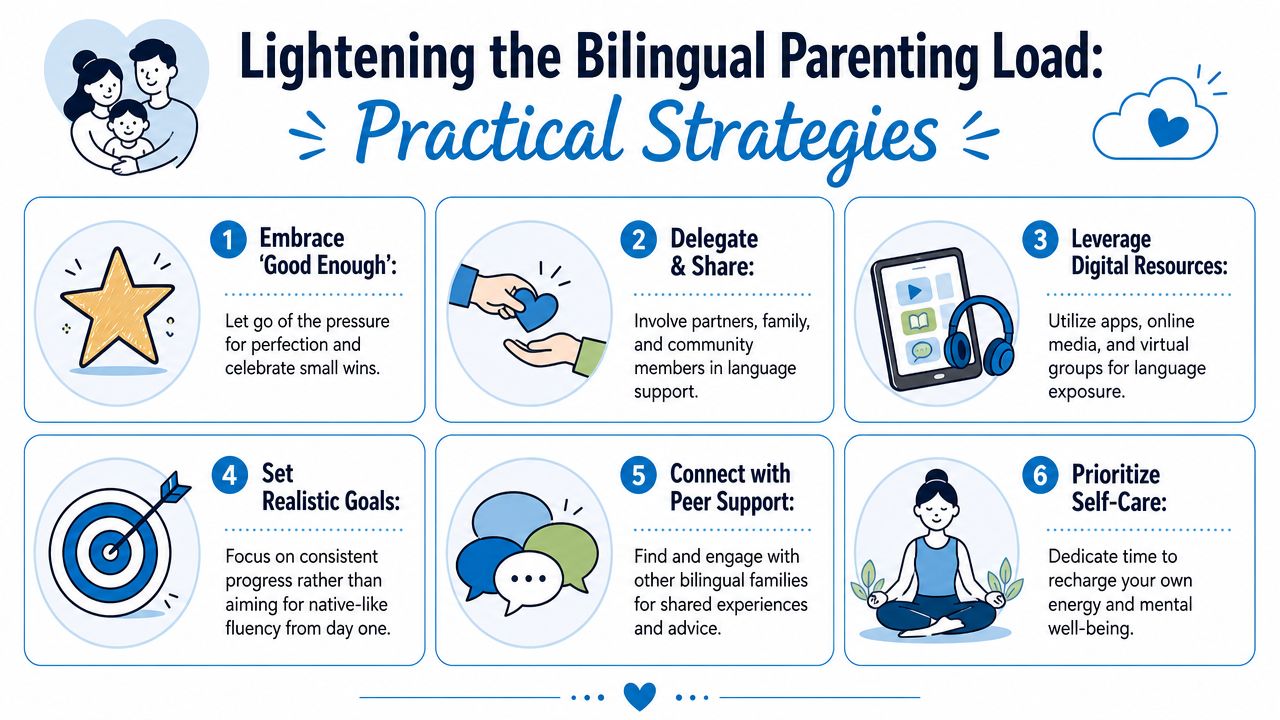
Build a good-enough language plan
Research indicates that the cognitive cost of bilingual parenting is often a tracking and scheduling problem, not a child-development problem. It also notes that children need ample opportunities to speak both languages, not just hear them, which shifts the parent's task toward sustaining high-quality exposure over time in this review on bilingual development.
That means your plan doesn't need to be elegant. It needs to be usable.
Try a simple family language plan with these questions:
- Home language rule. What language is the default at home, if any?
- Caregiver map. Who naturally uses which language?
- Speaking moments. When does your child actively speak each language?
- Pressure points. Where is Italian taking over without you meaning it to?
- Minimum baseline. What is the smallest routine you can maintain even in stressful weeks?
Reduce the number of daily decisions
Some families do well with one-parent-one-language. Others don't. What matters more is reducing constant negotiation.
A few examples that often work better than ambitious rules:
- Anchor one routine. Breakfast in one language, bedtime in another, or Sunday lunch with grandparents in the heritage language.
- Use repeatable media intentionally. Keep a small set of books, songs, or audiobooks that belong to one language context.
- Create speaking opportunities. A language survives through use, not only exposure.
Practical rule: Choose fewer rules and repeat them more consistently.
If caregiving strain is spilling into irritability or resentment, resources on practical steps for carers can also help you think about delegation and recovery in a more structured way.
Stop carrying the whole project alone
The mental load grows when one parent becomes the sole keeper of the language system. Share it.
You can delegate:
- Resource finding to a partner, relative, or trusted friend
- Teacher communication to the parent who is more comfortable in Italian
- Play opportunities by joining bilingual groups or arranging heritage-language contact
- Admin tasks such as ordering books, setting up video calls, or finding community events
If parenting stress is already high, support around parental stress and how to cope can help you separate what matters from what has become an exhausting standard you never agreed to.
The Unspoken Emotional Toll of a Divided World
The deepest pain in bilingual parenting is often not logistical. It is relational.
A parent may sit through a school meeting in Italian and understand the content but miss the tone. Or listen to their child chatter with friends and realise they cannot fully catch the humour, the slang, the social codes, or the little shifts in personality that emerge in another language.
That feeling deserves language of its own. It can resemble grief. Not because something is wrong, but because your child's world is expanding into spaces where you are less central and sometimes less fluent.
A significant and often overlooked challenge is the parent's emotional labor of not understanding a child's other-language life.
This is especially poignant in Italy, where children can absorb local rhythms quickly. They may become more Italian in gesture, timing, humour, and social reflexes before the parent has fully caught up. The result is a quiet fear: Will there be parts of my child I can witness, but not fully enter?
That fear does not mean you are failing. It means attachment matters to you.
How Multilingual Psychotherapy Supports Expat Families
When this mental load becomes chronic, therapy can help in a very practical way. Not by judging your language choices, but by helping you carry them differently.
What therapy can address
A multilingual or interculturally informed therapist can help you work with:
- Perfectionistic thinking through CBT, especially beliefs like "I must do this perfectly or I am damaging my child"
- Identity strain through deeper exploration of belonging, grief, and role change
- Anxiety and hypervigilance when every school message or language shift feels like a threat
- Couple tension around uneven effort, disagreement, or feeling excluded from family conversations
In therapy, the aim isn't to produce the perfect bilingual system. It is to lower shame, clarify priorities, and restore enough internal calm that parenting becomes more connected and less controlled.
When support may be especially helpful
Consider professional support if:
- you feel persistently guilty whatever you choose
- language decisions regularly trigger conflict with your partner
- you notice resentment toward the bilingual project itself
- you are preoccupied with your child's language use in a way that crowds out enjoyment
- you feel cut off from your child's school or social world and can't stop worrying about it
For expat families, it often helps when the therapist understands both mental health and multilingual life. Support from a service focused on multilingual psychotherapy for expats can make the process feel less like translation and more like being understood in context.
FAQ
Is raising bilingual children supposed to feel mentally exhausting?
Yes, it often can. The exhaustion usually comes less from the child learning two languages and more from the parent's ongoing planning, monitoring, and emotional responsibility for keeping both languages active and meaningful.
Am I harming my child if our bilingual routine is inconsistent?
Probably not. The stronger concern is usually not harm, but whether one language gets less opportunity over time, especially for active speaking, so inconsistency is a management issue rather than evidence of developmental damage.
Does bilingualism cause language delay or confusion?
No. Research summaries cited earlier state that bilingualism itself is not linked to language delay, confusion, or developmental disorder, and bilingual children reach major language milestones at similar times to monolingual children.
Why do I feel sad when my child prefers Italian outside the home?
Because language is emotional, not only functional. A child's preference for the majority language can stir grief, exclusion, or fears of disconnection, especially when that language carries school life, friendships, and a side of their identity you don't fully share.
Is one-parent-one-language the best method?
Not necessarily. It can work for some families, but research suggests it is neither necessary nor sufficient on its own, and what matters more is whether the child has enough meaningful opportunities to hear and speak both languages.
What should I focus on if I can't do everything?
Focus on sustainability. A smaller plan you can repeat is more helpful than an ideal plan that depends on constant energy, and speaking opportunities matter more than trying to control every interaction.
When does the mental load become a mental health concern?
It becomes more clinically important when guilt, anxiety, resentment, or relationship tension start to dominate daily life. If language management is making you feel persistently inadequate, isolated, or emotionally depleted, support can help.
Can therapy help even if the problem looks practical, not clinical?
Yes. Practical problems often carry emotional meanings underneath them. Therapy can reduce perfectionism, clarify values, support couple communication, and help you mourn or adapt to the parts of expat parenting that feel unexpectedly painful.
Book your first free assessment call with THERAPSY. It's free, with no commitment, just a conversation with Dr. Francesca Adriana Boccalari's team to understand what you're carrying and match you with the right therapist in your language, online or in person across Italy.