Italy can look beautiful from the outside while motherhood feels unrecognisable on the inside. You may be feeding a baby in a sunlit flat, hearing church bells, watching other families move through the piazza, and still feel frightened, lonely, angry, numb, or unlike yourself. That contrast is common. It's also one reason matrescence therapy for new mothers matters so much, especially when you're far from home.
Matrescence is not a sign that you're failing. It is the profound transition into motherhood. If you're an American or English-speaking mother in Italy, that transition can feel sharper because you're also translating systems, expectations, and often your own needs into a culture that isn't fully yours yet.
Some mothers tell themselves they should be grateful because they're living in Italy. Gratitude and struggle can exist together. You can love your baby and still grieve your old life. You can want this family and still feel overwhelmed by what motherhood has done to your mind, body, relationship, and sense of self.
This guide is for that moment. It's for the mother who feels alone in a country she chose, followed, or landed in, and now needs language for what's happening and a practical path forward.
An Introduction to Your Journey Through Motherhood in Italy

The early months of motherhood often bring two realities at once. One is visible. The baby clothes drying on the balcony, the pram on cobblestones, the messages from friends back home saying how lucky you are to be raising a child in Italy. The other reality is private. Exhaustion, identity confusion, tears that arrive quickly, resentment you didn't expect, and the ache of not having your usual people nearby.
That is where matrescence therapy for new mothers becomes useful. Not because motherhood is a pathology, but because becoming a mother is a major psychological transition, and transitions need support.
For many expat mothers, the pressure starts early. You may already be trying to track feeding, sleep, milestones, paperwork, family expectations, and your own emotional survival. If you want a practical parenting reference alongside emotional support, this guide to Milestones from birth to age five can be a grounding tool when everything feels blurred together.
A good therapeutic conversation also helps separate what is normal adjustment from what needs closer care. If motherhood abroad has started to feel painfully isolating, this reflection on motherhood isolation as an expat may put words to an experience many women bear unspoken.
You do not need to wait for a crisis to deserve support. You may simply need help making sense of a life that changed all at once.
What Is Matrescence More Than Just the Baby Blues
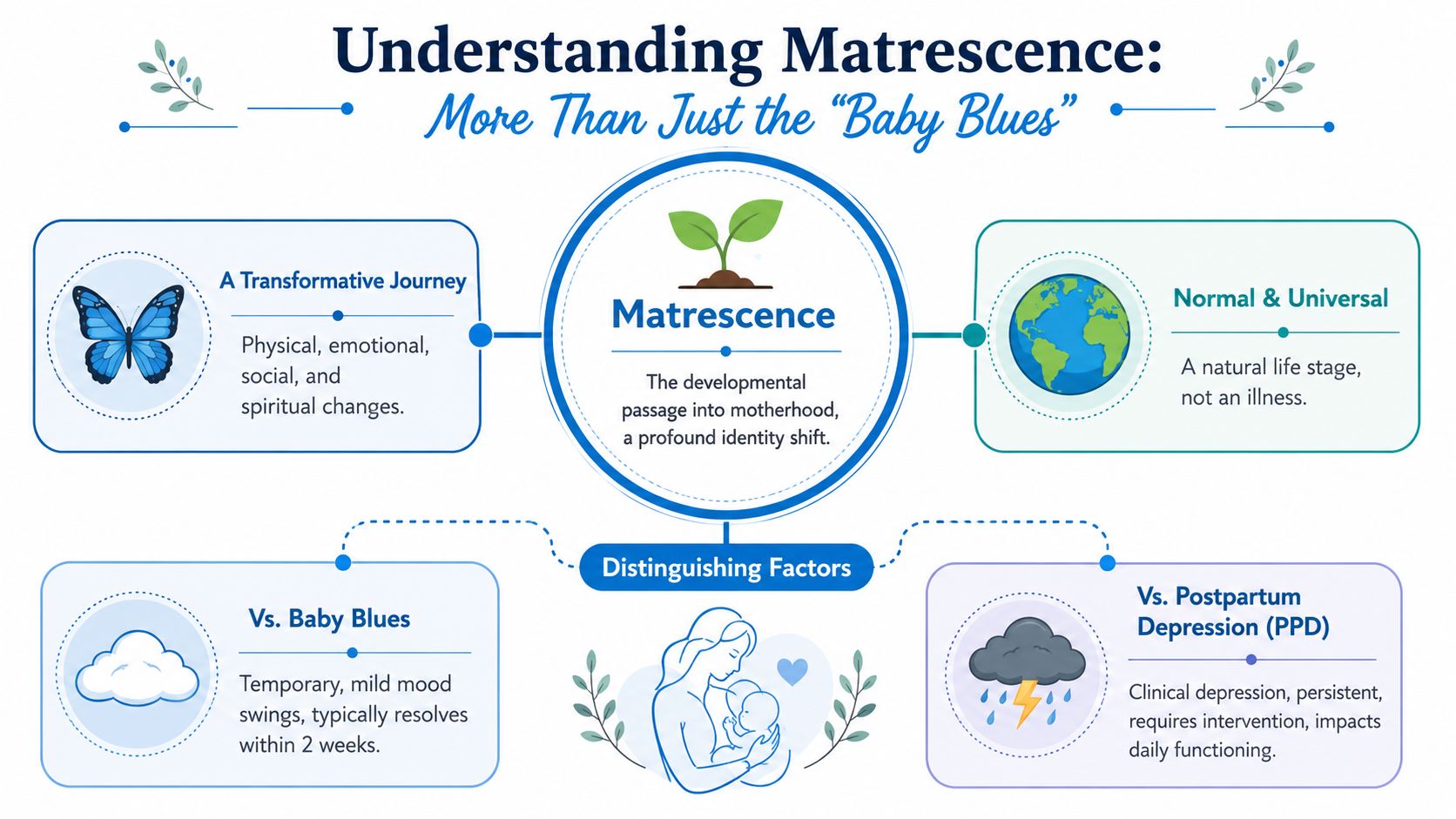
Matrescence is the developmental transition into motherhood. It includes psychological, social, cultural, and existential change, not only mood symptoms, as described in a 2024 review in Frontiers in Psychiatry.
That definition matters because many mothers ask the wrong first question. They ask, “What is wrong with me?” A better question is often, “What am I moving through?”
Why the term matters
When we name matrescence properly, we stop reducing a mother's experience to whether she does or does not meet a diagnosis. That doesn't mean diagnoses are unimportant. Depression and anxiety still need screening and proper treatment. But the broader shift into motherhood also includes:
- Identity disruption. You may not know who you are now.
- Role reorganisation. Your work, partnership, friendships, and daily rhythms all change.
- Meaning-making. Motherhood can stir questions about purpose, family history, sacrifice, and belonging.
- Cultural pressure. You may feel caught between your home culture and Italian expectations of motherhood.
A matrescence-informed therapist looks at the whole picture, not just symptom scores.
Matrescence is not the same as baby blues or postpartum depression
Often, confusion creates guilt.
Baby blues are usually brief and mild. Matrescence is broader. Postpartum depression is a clinical condition. These are related, but they are not interchangeable.
A simple way to think about it:
| Experience | What it usually refers to |
|---|---|
| Baby blues | Temporary emotional ups and downs after birth |
| Matrescence | The wider developmental shift into motherhood |
| Postpartum depression | A depressive condition that affects functioning and needs clinical attention |
A mother can be in matrescence without having postpartum depression. A mother can also be in matrescence and have postpartum depression at the same time.
Why this reframing helps
Once matrescence is understood as a transition, the work in therapy changes. The focus is no longer only “How do we reduce distress fast?” It also becomes:
- What has changed in your sense of self?
- Which pressures are external, and which are internalised?
- What kind of support fits your current life?
- What expectations need adjusting so you can breathe again?
This often brings relief. It turns a vague feeling of personal inadequacy into something understandable and workable.
The Psychological Impact of Matrescence on New Mothers
For expat mothers in Italy, matrescence rarely arrives alone. It often combines with migration stress, language fatigue, homesickness, and the loss of everyday ease. The result can feel more intense than you expected.
The struggles mothers describe most often
Identity loss. You may have been competent, independent, professionally grounded, and socially connected before birth. Now your day can revolve around naps, feeding, and logistics, while your previous self feels distant or inaccessible.
Relationship strain. Even loving couples can start to fight differently after a baby. Resentment often grows around invisible labour, sleep deprivation, or different cultural beliefs about parenting, gender roles, and what “help” should look like.
Body disconnection. Some women feel grief, shock, or alienation in relation to their body after pregnancy and birth. If you're already living away from familiar medical care and family reassurance, that disconnection can feel harder to process.
Mental load overload. The mind of a new mother is often carrying too many open tabs. Appointments, baby supplies, forms, feeding choices, family messages, practical translation, and future planning all compete for attention.
Loneliness. This isn't only missing home. It's raising a baby without your usual witnesses. No sister dropping by. No friend who understands your shorthand. No parent who can take over for two hours while you sleep.
Intrusive thoughts or constant alertness. Some mothers feel always on edge, scanning for danger or imagining worst-case scenarios. That can be part of a stressed nervous system, especially after a difficult birth or prolonged exhaustion.
If this constant alertness sounds familiar, support focused on nervous system regulation therapy can be especially useful when your body no longer feels like a safe place to rest.
Why the expat context changes the experience
An English-speaking mother in Italy often faces an extra layer of friction. You may be doing ordinary new-mother tasks in a language that isn't automatic. You may also be grieving the support system that would have existed if you had given birth in your home country.
Some women expected “la dolce vita” to soften motherhood. Instead, they find that beauty doesn't remove isolation. It can even deepen it when other people assume the setting should make everything easier.
The problem is not that you are ungrateful. The problem is that major life transitions are harder without a familiar support system.
When mothers need additional reading between sessions, practical resources about support for navigating postpartum challenges can help organise the chaos. But information alone usually isn't enough. Most mothers need a place where the emotional meaning of all this can be spoken out loud.
When Therapy Becomes a Lifeline on Your Matrescence Journey
Therapy isn't only for severe breakdowns. It can be the most sensible form of support when life has changed so completely that your usual coping no longer works.
Signs it may be time to reach out
Consider support if any of these feel familiar:
- You feel overwhelmed most days. Not just tired, but emotionally flooded and unable to recover.
- You've lost access to joy. Moments that used to soothe you feel flat or unreachable.
- You're frightened by your own reactions. This may include rage, panic, shutdown, or intense guilt.
- Your relationship feels constantly strained. Every practical issue turns into conflict.
- You feel disconnected. From yourself, from your baby, from your partner, or from life in general.
- You can't stop thinking. Your mind loops through fears, lists, or what-if scenarios.
- You had a difficult birth or postpartum experience. The body and mind may still be reacting to it.
- You keep telling yourself to cope alone. Isolation often gets stronger when shame is in charge.
Some mothers are particularly alarmed by irritability and anger because it doesn't match the image they had of themselves. If that's part of your experience, mom rage therapy may help you understand what sits underneath the anger, rather than judging it.
What therapy can do before things worsen
A good therapist helps you interrupt the pattern before distress hardens into despair. That may mean identifying unrealistic standards, rebuilding rest where possible, naming grief, improving communication at home, or creating a plan for the moments when your system feels overloaded.
Practical rule: If you keep thinking “I should be able to handle this by myself,” that's often the moment to stop carrying it by yourself.
Therapy also gives language to experiences that are easy to misread. A mother may think she is weak when she is depleted. She may think she is failing when she is grieving. She may think she is depressed when part of what she is facing is a profound identity transition that has never been properly named.
What to Expect from Matrescence Therapy Sessions
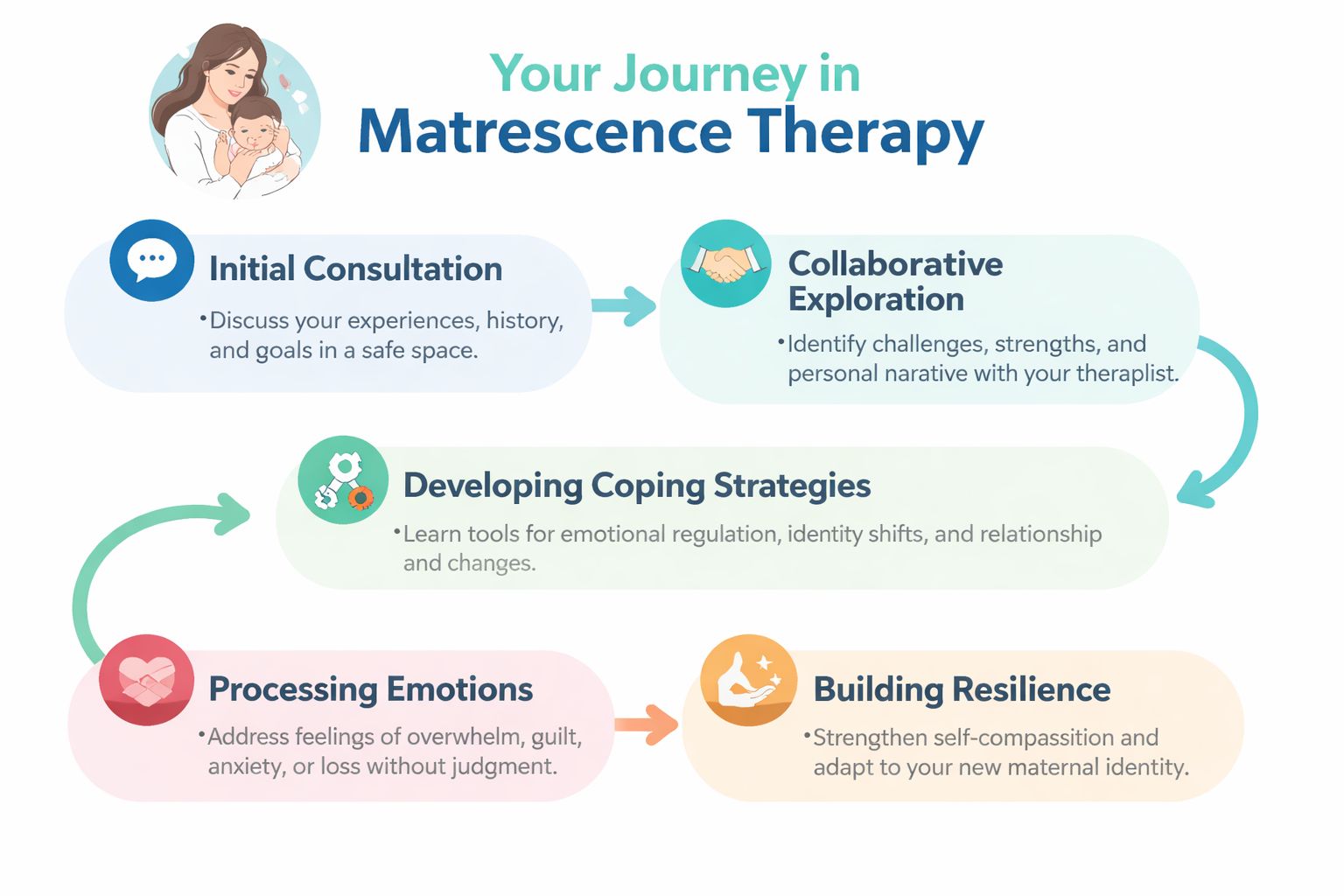
The first thing to expect is relief. Not instant relief from every symptom, but relief from not having to explain why this feels so hard. In a matrescence-informed therapy space, you don't have to prove that motherhood is both meaningful and difficult.
How sessions usually begin
Early sessions often focus on mapping what has changed. That includes your body, sleep, relationship, work questions, family dynamics, fears, and sense of self. A therapist may also ask about birth, feeding experiences, support systems, migration stress, and whether you've had previous anxiety, trauma, or depressive episodes.
If you've never done therapy before, this guide to the first psychological session can make the process feel less uncertain.
A stepped care approach often works best
A practical approach to matrescence often follows stepped care. A review discussing current matrescence-informed practice describes starting with education and normalization, adding skills-based CBT or EMDR when identity threat or high arousal are present, and moving to psychiatric review if symptoms meet clinical thresholds, as outlined in this open-access review.
In plain language, that usually looks like this:
Education and normalization first
Many mothers calm slightly once they understand that their distress has a context. Naming matrescence can reduce shame and help you stop pathologising every difficult feeling.Practical coping tools next
Therapy may then focus on sleep-related stress, anxious thinking, emotional regulation, boundaries, or communication with your partner.Deeper work when needed
If motherhood has activated old wounds, trauma, or harsh internal beliefs, therapy moves beyond coping and into more focused processing.More intensive care if symptoms are severe
If a mother's symptoms suggest depression, anxiety, trauma, or another condition at a clinical level, additional psychiatric or specialised support may be appropriate.
What different therapy approaches can help with
A few examples make this easier to picture:
CBT
Cognitive Behavioural Therapy helps identify thought patterns that amplify distress. For a new mother, that might mean challenging beliefs like “I should be coping better” or “If I need help, I'm not good at this.”EMDR
EMDR can help when birth, medical events, or postpartum moments still feel emotionally charged in a way your body hasn't digested. It is often useful when the distress feels stuck rather than stressful.Schema Therapy
Schema Therapy is helpful when motherhood activates old themes such as abandonment, perfectionism, self-sacrifice, or not feeling good enough. It connects present overwhelm with deeper patterns without blaming you.
What therapy should not feel like
It should not feel like someone giving you generic motherhood advice. It should not reduce everything to hormones. And it should not force gratitude when what you need first is honesty.
A useful session leaves you feeling more oriented. Not fixed. Oriented.
How to Find a Matrescence Therapist in Italy as an Expat

Finding the right therapist in Italy can be harder than people realise. Many mothers are not only looking for clinical support. They are looking for someone they can speak to naturally, without translating every emotional nuance into Italian, and without having to explain why life abroad changes the postpartum experience.
That gap is real. Guidance for new mothers often assumes access to family, local community, or a support group nearby.
What matters more than a generic directory listing
When you search for a therapist, look beyond “English-speaking” as the only criterion. A useful matrescence therapist for an expat mother should be able to work with several layers at once:
Motherhood transition
They should understand that this is not only about symptom reduction.Cross-cultural stress
They should grasp how language, migration, identity, and family distance affect emotional adjustment.Practical flexibility
New mothers often need online options, realistic scheduling, and a format that works around childcare.Evidence-based methods
If anxiety, trauma, intrusive thoughts, or identity distress are present, the therapist should be able to draw from approaches such as CBT, EMDR, or Schema Therapy in a grounded way.
Questions worth asking before you book
You are allowed to interview a therapist. In fact, it often helps.
You might ask:
- Do you work with postpartum adjustment and matrescence, not only postpartum depression?
- Have you worked with expat or cross-cultural mothers living in Italy?
- Can therapy be done in English throughout, including emotionally complex topics?
- How do you approach birth trauma, intrusive thoughts, or identity loss after becoming a mother?
- Do you offer online sessions if getting out of the house is difficult?
- What happens if I start therapy and realise I need a different style of support?
The answers should feel clear, respectful, and specific. If the response is vague or dismissive, keep looking.
A language-sensitive route to care
For English-speaking mothers in Italy, one practical option is finding an English-speaking therapist in Italy. In my work as Clinical Director at Therapsy, I've seen how much easier treatment becomes when a mother does not have to translate her fear, anger, guilt, or grief into a language that feels less intimate. Therapsy offers online and in-person care across Italy, with a network of 50+ multilingual therapists, sessions across 23 Italian cities and 80+ physical locations, and a free first assessment call, based on the service information available on therapsy.it. The matching process is done by a person, not a chatbot or automated questionnaire, which matters when the fit needs to reflect language, culture, and clinical need.
What works and what tends not to work
A few trade-offs are worth naming openly.
| What often helps | What often falls short |
|---|---|
| A therapist who understands expat motherhood | A provider who treats this as generic stress |
| Sessions in your strongest emotional language | Trying to discuss painful material in a language that limits you |
| A clear plan for symptoms and identity changes | Advice-only support with no therapeutic structure |
| Flexible online or nearby care | Support that is too logistically hard to access with a baby |
The right support usually feels both containing and practical. You leave with more understanding, more permission to be human, and a clearer next step.
If you are overwhelmed and alone, the first useful move is not to become tougher. It is to become better supported.
Who supports new mothers at Therapsy
Becoming a parent in a country that is not your own, far from your mother and your friends, is a specific kind of isolation. These clinicians work on it.
Dr. Agathe Scappini supports motherhood and parenthood at every stage, including pregnancy and the postpartum period, and offers sessions in French as well as English and Italian. She is completing a PhD on how responsive therapists actually are to the individual needs of each person.
Dr. Ivano Calaon has specialised knowledge in sleep psychology for parents of newborns. The first months dismantle sleep for both parents, and the exhaustion that follows is usually treated as something to endure rather than something with an evidence base behind it.
Dr. Mariana Colandrea works with perinatal loss, one of the most isolating experiences there is and one of the least served, partly because the people around a couple often do not know how to name it.
You do not have to work out who fits on your own. You tell Therapsy what you are looking for, a member of our clinical team reads your request, and they introduce you. The first call is free.
FAQ
Is matrescence a mental illness
No, matrescence is not a mental illness. It refers to the developmental transition into motherhood, although mental health conditions such as postpartum depression or anxiety can happen during that transition and still need proper care.
How do I know if I need therapy or just more rest
If rest helps but you still feel persistently overwhelmed, disconnected, anxious, or unlike yourself, therapy may help. Many mothers need both practical support and a space to process what motherhood abroad is stirring emotionally.
Can therapy help if I feel guilty for struggling in Italy
Yes, therapy can help with that guilt. Many expat mothers feel they should be happy because their life looks desirable from the outside, but visible beauty doesn't remove loneliness, identity strain, or exhaustion.
What if I don't have family nearby to help with the baby
You can still begin therapy even without a local support system. Online sessions, realistic scheduling, and a therapist who understands isolation can make support possible when family help is limited or absent.
Is it possible to do therapy in English in Italy
Yes, it is possible to do therapy in English in Italy. The key is to look for a therapist or service that works comfortably in English and understands the intercultural side of motherhood, not only the clinical one.
How long does matrescence therapy take
It depends on what you are carrying. Some mothers need short-term support for adjustment and coping, while others benefit from longer work if birth trauma, old wounds, or severe anxiety are part of the picture.
Book your first free assessment call with Therapsy if you'd like a warm, professional conversation about what you're going through. There's no commitment and no pressure, just a chance to speak with our Clinical Director, be heard, and be matched with the right therapist for you. Signed by Dr. Francesca Adriana Boccalari, Clinical Director at Therapsy.