The Hidden Driver Behind Your Anxiety
Perfectionism and anxiety are deeply connected, but not in the way most people think. We often hear perfectionism praised as a healthy drive for excellence. In reality, it’s a fear-driven cycle where the constant, anxious worry of not meeting impossibly high standards fuels distress. This creates a painful loop: the more you strive for flawless outcomes, the more anxious you become about the possibility of failing. This is a core challenge we address at Therapsy, a leading multilingual psychotherapy service in Italy for expats and young adults.
For many high-achieving individuals, this connection is a daily reality. This is especially true for expats and young professionals trying to build a life in competitive Italian cities like Milan or Rome. The pressure to succeed in a new job, master a new language, and build a new life from scratch can feel immense. What often begins as a healthy ambition to adapt and thrive can quickly morph into a relentless, self-critical inner voice that demands flawlessness in every single action.
This isn’t a personal failing; it’s a common psychological pattern. Maladaptive perfectionism creates an internal environment where your self-worth becomes entirely dependent on your achievements. This mindset makes you highly vulnerable to anxiety because any perceived mistake or setback can feel like a catastrophic, personal failure.
“As a psychotherapist working with the international community in Italy, I see this pattern frequently. Perfectionism often operates as a hidden driver behind persistent anxiety, burnout, and social isolation. It convinces you that if you just try harder, you'll finally feel calm and secure, but it's a trap that only deepens the anxiety it promises to solve.” — Dr. Francesca Adriana Boccalari, Clinical Director at Therapsy
The good news is that these are learned patterns. And because they are learned, they can be unlearned with the right support. By understanding the psychological mechanisms at play, you can begin to untangle your worth from your performance and find a healthier, more compassionate way forward. Our article on high-functioning anxiety in women can be a helpful resource for seeing how these pressures often manifest.
To better understand the complex interplay of internal drivers behind anxiety, including its overlap with other conditions and effective coping mechanisms, explore this guide on diagnosing ADHD and anxiety. Recognising these connections is a crucial first step toward finding relief. This article aims to explain why the perfectionism-anxiety cycle happens and provide clear, actionable solutions for reclaiming your balance and peace of mind.
Understanding the Roots of Perfectionism
Let’s be clear: perfectionism isn’t the same as healthy ambition. While ambition pushes you forward, the kind of maladaptive perfectionism that fuels anxiety is all about fear—an intense fear of making mistakes, followed by relentless self-criticism and the crushing pressure to meet impossible standards. The distinction matters because one builds you up, while the other slowly breaks you down.
At its core, this harmful form of perfectionism often comes from deep-seated beliefs we hold about ourselves and the world. In psychotherapy, we refer to these as ‘schemas’.
The Role of Core Beliefs and Schemas
Using frameworks from Cognitive Behavioural Therapy (CBT) and Schema Therapy, we can start to see perfectionism for what it is: a coping mechanism. It’s often a reaction to underlying schemas, which are stubborn, self-defeating patterns of thought and feeling that usually start early in life. These aren't character flaws; they are survival strategies you learned along the way.
Two common schemas that often drive perfectionism are:
- Unrelenting Standards: This is the core belief that you must meet exceptionally high internal standards of performance to avoid being criticised. It creates a constant feeling that you can never rest or be truly satisfied with what you’ve accomplished.
- Defectiveness/Shame: This is that deep, nagging feeling of being fundamentally flawed, inferior, or unlovable. Perfectionism becomes a frantic attempt to overcompensate for this perceived inner flaw—if you can just do everything perfectly, maybe no one will discover the “truth” about you.
These schemas often take root in response to early life experiences. You can learn more about how these early patterns shape adult life by exploring our guide on inner child work in therapy.
This diagram shows how perfectionism and anxiety are connected, especially within the high-pressure context of expat life.
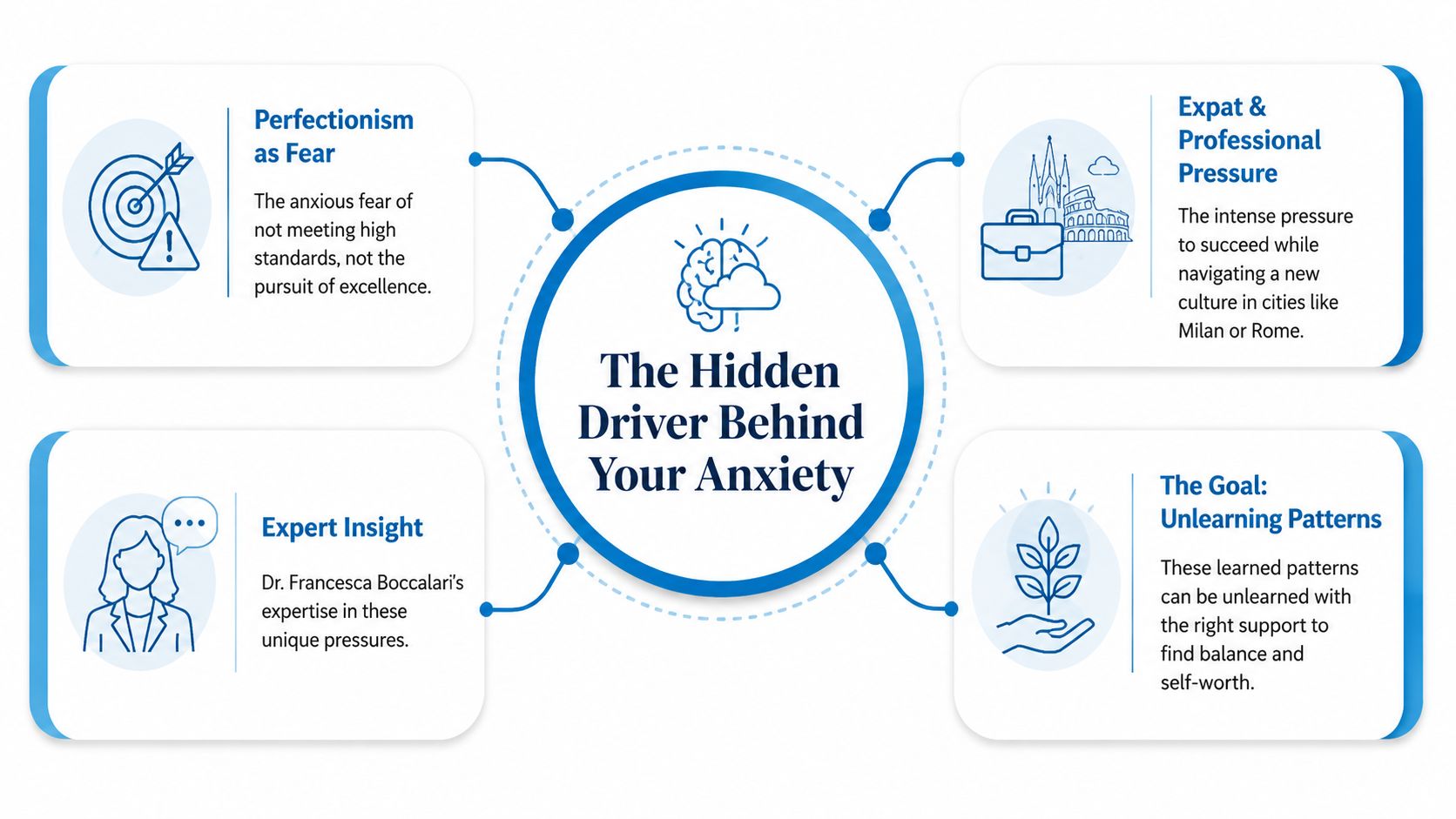
As the visual highlights, perfectionism is fundamentally a fear-based response. It’s often amplified by external pressures, but it can be understood and unlearned with the right expert guidance.
From Core Beliefs to Daily Anxiety
These core beliefs don’t just stay in the background; they trigger specific cognitive distortions—or unhelpful thinking styles—that pave a direct path to anxiety.
Perfectionism is a cognitive trap. It locks you into all-or-nothing thinking, where anything less than flawless is seen as a total failure. It also fuels catastrophising, where one small mistake gets mentally blown up into a disaster.
This isn't just a personality quirk. The American Psychological Association has identified perfectionism as a significant risk factor for anxiety disorders. Research confirms it’s the discrepancy—that painful gap between your impossible standards and your actual performance—that predicts anxiety and stress, not simply having high goals.
By starting to recognise these schemas and thought patterns, you can begin to see that perfectionism and anxiety are understandable responses, not personal failings. They are the logical outcome of a mind trying to protect itself. And with the right tools, these patterns can absolutely be changed.
How Perfectionism Shows Up in Your Daily Life in Italy
The link between perfectionism and anxiety stops being theoretical the moment it starts disrupting your actual life as an expat in Italy. What might look like being conscientious or having high standards on the surface can quickly spiral into a source of deep, personal stress, turning simple daily tasks into high-stakes performances you feel you can’t afford to fail.
Instead of soaking up the novelty and beauty of Italian life, you might find yourself stuck in a loop of worry, self-criticism, and avoidance. This isn't just about wanting to do well; it's about the fear-driven behaviours that kick in when you believe that anything less than flawless is a total failure.
Common Scenarios for Expats
Perfectionism often shows up in ways that are subtle but incredibly corrosive. For many people living abroad, it creates a constant, low-level hum of anxiety that slowly eats away at their confidence and joy.
Here are a few real-world examples of how this pattern might play out in your life in Italy:
- Work Procrastination: You have a big project due, but the fear that it won't be perfect is so overwhelming that you can't even get started. You spend days planning and researching, but you keep putting off the actual work, creating a pressure-cooker of last-minute panic and intense anxiety.
- Social Avoidance: An invitation to an aperitivo with new Italian colleagues arrives. Instead of feeling excited, you’re filled with dread. You worry about saying the wrong thing, not getting the jokes, or being judged for your accent. In the end, you decide it’s just safer to stay home.
- Language Learning Paralysis: You obsessively rehearse simple phrases in your head before daring to go to the local market. Everyday interactions, like ordering food, become sources of major anxiety. You might even find a great resource to help you speak Italian like a local but feel too intimidated to actually practise, terrified you’ll make a mistake and sound foolish.
These scenarios show how perfectionism corners you, effectively blocking the very experiences you need to adapt, connect, and build a life here. This is also a frequent source of friction in intercultural relationships, a topic we explore more in our guide to handling stress with Italian in-laws.

Differentiating Healthy Ambition from Perfectionism
It’s so important to be able to tell the difference between a healthy drive to succeed and the damaging patterns of maladaptive perfectionism. One is a powerful motivator, while the other is a relentless source of chronic anxiety. Understanding which one is driving you is the first step toward figuring out if your ambition is helping or hurting you.
Healthy ambition focuses on growth and progress, celebrating effort and learning from mistakes. Maladaptive perfectionism, however, is fixated on an impossible, flawless outcome and treats any error as a personal catastrophe. This mindset is what fuels the anxiety.
Sometimes, seeing the two side-by-side makes the distinction much clearer.
| Characteristic | Healthy Ambition | Maladaptive Perfectionism |
|---|---|---|
| Motivation | Driven by goals and personal growth | Driven by fear of failure and judgment |
| Mistakes | Seen as learning opportunities | Seen as proof of personal inadequacy |
| Self-Talk | Encouraging and compassionate | Harsh, critical, and unforgiving |
| Focus | On the process and effort | Exclusively on the perfect outcome |
| Satisfaction | Able to enjoy accomplishments | Rarely feels satisfied; always "not enough" |
If you see yourself in the "Maladaptive Perfectionism" column, please don’t use it as another reason to criticise yourself. Think of it instead as a clear, powerful sign that it’s time to find a more compassionate and sustainable way of living.
Why Living Abroad Can Amplify Perfectionism
Moving to Italy is supposed to be an adventure. But for many expats, it can quietly become a high-stakes performance. Living abroad often turns into a pressure cooker for perfectionism and anxiety, making you feel like you have to get everything right, all the time. The beautiful, curated dream of life in Italy you see on social media often clashes with the messy, challenging reality of daily life in a new country.
This creates an intense pressure to ‘make it work.’ Admitting you’re struggling can feel like a monumental failure, not just to yourself, but to everyone back home who sees you as living the dream. We call this the 'Instagram vs. reality' gap, and it can be incredibly isolating.
The Unique Pressures of Expat Life
The expat experience comes with a distinct set of challenges that can trigger or intensify the perfectionism-anxiety cycle. The need to constantly prove yourself in a new environment, both personally and professionally, can be utterly exhausting.
Several key factors feed into this:
- Cultural Adjustments: Navigating unfamiliar social norms and bureaucratic hurdles demands constant mental effort. The fear of making a cultural faux pas can easily lead to social avoidance and anxiety.
- Language Barriers: The struggle to communicate even simple needs can be frustrating and demoralising. It can make you feel incompetent and fuel a harsh inner critic.
- Professional Pressure: Starting a new job in a foreign country often comes with a powerful desire to prove your worth quickly, which is a fast track to overworking and burnout.
- Isolation From Support: Being far from your established network of friends and family means you have fewer emotional safety nets when things inevitably get tough.
You can learn more about navigating these challenges in our article on coping with culture shock in Italy.

Why Young Professionals Are at Risk
This pressure is especially potent for young adults and students. Research shows perfectionism has risen steadily among university students since the late 1980s, tracking closely with increases in anxiety. A recent review highlighted that socially driven concerns—like fear of failure and fear of judgment—have grown much faster than healthy ambition. This helps explain why many early-career professionals feel a constant need to self-monitor, creating chronic stress even when they appear successful on the outside.
“As an intercultural psychologist, I observe how the expat journey forces you to rebuild your identity. This process can trigger a deep-seated need for control, which often manifests as perfectionism. You strive for flawlessness in your new life to feel secure, but this strategy almost always backfires, creating more anxiety than it solves.” — Dr. Francesca Adriana Boccalari, Clinical Director at Therapsy
In short, the expat experience creates a perfect storm where the need to adapt meets the fear of failure. This environment can amplify pre-existing perfectionistic tendencies or even create new ones, locking you into a cycle of impossibly high standards and constant anxiety.
Evidence-Based Strategies to Reclaim Your Peace of Mind
The pressure from perfectionism and anxiety can feel overwhelming, but you don't have to stay stuck in this cycle. Practical, evidence-based strategies can help you loosen perfectionism’s grip and find a sense of calm. The goal isn’t to stop caring about what you do, but to stop tying your entire self-worth to impossible standards.
By borrowing techniques from Cognitive Behavioural Therapy (CBT), you can start to challenge the rigid thoughts that fuel your anxiety. It's about intentionally practising a more flexible, compassionate way of being.
Practise Behavioural Experiments
One of the most powerful ways to dismantle perfectionistic beliefs is to put them to the test in the real world. In CBT, we call these behavioural experiments. They are small, deliberate actions designed to see if your anxious predictions actually come true.
Start with something small and low-stakes. For example:
- Intentionally make a minor mistake: Send an email to a trusted colleague with a deliberate, minor typo. The aim is to see that the catastrophic outcome you fear—judgement, criticism, loss of respect—almost never happens.
- Leave a task 90% finished: Stop working on a non-urgent report when it’s "good enough" instead of pushing yourself to make it "perfect." Notice the anxiety that comes up, but also notice that the world doesn’t fall apart.
- Arrive on time, not early: If you habitually show up 15 minutes early to everything out of anxiety, try arriving exactly on time. This directly challenges the underlying belief that you must over-prepare to prevent a disaster.
Identify and Challenge Your Thoughts
Perfectionism runs on automatic, negative thoughts. The first step is simply learning to notice them. When you feel a surge of anxiety about a task, pause and ask yourself: what story am I telling myself right now?
Once you’ve identified the thought (for example, "If I don't get this perfect, everyone will think I'm incompetent"), you can begin to question it. You can learn more about how to restructure these thoughts in our guide to cognitive behavioural therapy for anxiety.
A core technique is to treat the perfectionistic thought not as a fact, but as a hypothesis. Ask for evidence. Where is the proof that a single mistake will lead to total failure? Is there another, more balanced way to look at this situation?

Cultivate Self-Compassion and Mindfulness
Finally, self-compassion is the direct antidote to the harsh self-criticism that fuels perfectionism. It means treating yourself with the same kindness and understanding you would offer a good friend who is struggling. When you make a mistake, instead of berating yourself, try acknowledging that the situation is difficult and that making mistakes is a universal part of being human.
Mindfulness and grounding techniques are also crucial for managing the physical symptoms of anxiety in the moment. When you feel your heart racing or your thoughts spiralling, simple practices can bring you back to the present. Try focusing on your breath for just one minute, or naming five things you can see in the room. These small acts can break the anxious loop and create space for a calmer response.
How Therapy Helps You Find a Healthier Balance
While self-help strategies are a valuable first step, truly breaking the cycle of perfectionism and anxiety often requires professional support. Therapy gives you a structured, safe space to untangle the deep-rooted patterns that you might not be able to reach on your own. The goal isn’t to get rid of your ambition, but to transform your relationship with it so your drive works for you, not against you.
At Therapsy, our approach is anything but one-size-fits-all. As the Clinical Director, I personally ensure you are matched with a therapist whose expertise fits your specific needs. Our multilingual team of over 50 carefully selected and licensed professionals uses evidence-based methods to help you find a healthier, more sustainable way of living. We have served over 1,000 clients since 2023.
Therapeutic Approaches for Perfectionism
Different therapeutic models offer unique paths to healing, and a skilled therapist will often blend techniques to give you comprehensive support. This means we address not just the symptoms you’re feeling now, but also where they came from.
Three powerful approaches we often use at Therapsy include:
Cognitive Behavioural Therapy (CBT): This is often a great place to start. CBT helps you identify and change the rigid, all-or-nothing thought patterns that fuel anxiety. You'll learn practical skills to challenge that harsh inner critic and reframe how you think about mistakes.
Schema Therapy: For many people, perfectionism is a coping mechanism they’ve had their whole lives. Schema Therapy goes deeper to address the underlying core beliefs, or ‘schemas’—like Unrelenting Standards or Defectiveness—that drive these behaviours. It helps you understand why these patterns started and begin to heal the emotional wounds at their source.
EMDR (Eye Movement Desensitization and Reprocessing): Sometimes, perfectionism is tied to specific past experiences of criticism, shame, or even trauma. EMDR is a highly effective therapy for processing these memories, reducing their emotional power and loosening their grip on how you act today.
Healing from perfectionism is about building self-worth that isn't tied to what you achieve. It’s the process of learning that you are enough, exactly as you are, with or without a flawless performance.
With a team offering therapy in 14 languages, both online and in-person across 20+ Italian cities (including Milan, Rome, and Florence), Therapsy is in a unique position to support the international community. Our human-first matching process ensures you connect with a therapist who not only has the right clinical skills but also gets your cultural context. This kind of personalised support is crucial for finding lasting balance and reclaiming your peace of mind.
FAQ
Is Perfectionism Always a Bad Thing?
No, not all perfectionism is destructive, but it's vital to understand the difference. Healthy ambition is flexible, motivates you to learn from mistakes, and allows you to feel proud of your efforts. In contrast, maladaptive perfectionism is rigid, unforgiving, and driven by a deep fear of failure, making it the type clinically linked to anxiety.
How Do I Know if My Anxiety Is Tied to Perfectionism?
You can see the connection if your anxiety spikes around the possibility of making a mistake or facing judgment. It is not just general worry; it is a specific, intense dread of falling short of an impossible standard you have set for yourself. If you procrastinate to avoid imperfection or relentlessly criticize your own work, it is very likely that perfectionistic thinking is at the root of your anxiety.
What Is the First Step to Getting Therapy for Perfectionism in Italy?
The first step is a simple conversation to understand your situation and find the right support. At Therapsy, this begins with a free first assessment call with our Clinical Director, Dr. Francesca Adriana Boccalari. This is not a commitment to therapy but a confidential space for you to share what you're going through, ask questions, and be carefully matched with a therapist who truly understands the link between perfectionism and anxiety.
Can I Have Therapy in English or My Native Language with Therapsy?
Yes, absolutely. We believe therapy is most effective when you can express yourself in the language that feels most natural to you. Therapsy provides therapy in 14 languages, including English, to serve Italy's international community, with over 50 licensed therapists available for online and in-person sessions in more than 20 Italian cities.
Book your first free assessment call — no commitment, just a conversation with our Clinical Director who will listen and match you with the right therapist for you. Visit therapsy.it.