Inner child work therapy helps adults understand how childhood experiences still shape present emotions, relationships, and coping.
If you're living in Italy and find yourself reacting strongly to something that seems small on the surface, a delayed reply, a critical boss, a partner pulling away, a bureaucratic setback, inner child work therapy can offer a useful explanation. Inner child work therapy is a trauma- and attachment-informed approach that helps people recognise how early experiences shape adult emotions and behaviours, then respond with more self-compassion, boundaries, and healthier coping.
For many expats and international adults, this doesn't feel abstract at all. It feels like crying after a minor conflict, shutting down when you need support, or feeling unusually panicked when plans change. The present problem may be in Milan, Rome, or Florence. The emotional meaning often started much earlier.
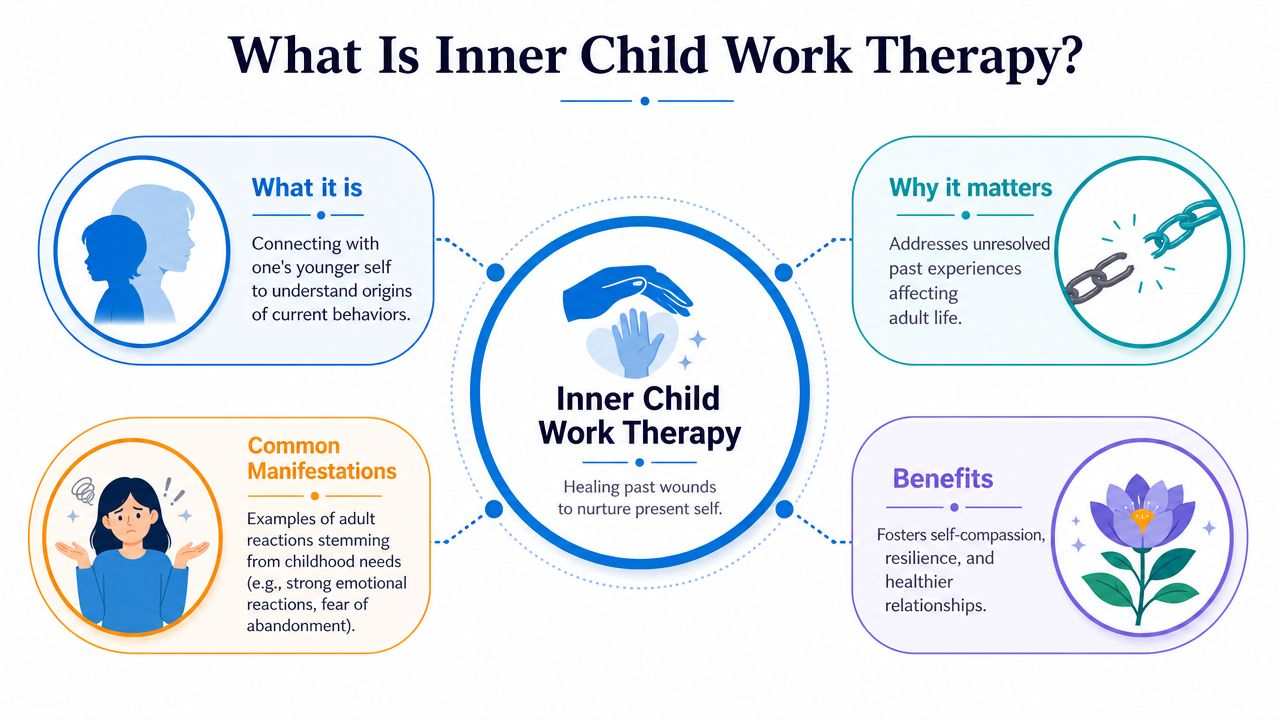
What Is Inner Child Work Therapy
Sometimes an adult response feels bigger than the moment itself. Your colleague sounds dismissive and you feel a wave of shame. Your partner needs space and you suddenly feel abandoned. A landlord ignores your message and you spiral into helplessness.
That's often where inner child work therapy becomes relevant. It doesn't assume you are childish. It asks whether a present-day trigger is touching an older emotional wound.
A clear definition
It's best understood as a framework inside therapy, not a separate diagnosis and not a magical method that fixes everything on its own. The focus is practical:
- Notice the pattern: What keeps happening in relationships, work, or self-talk?
- Trace the emotional logic: When did this feeling first become familiar?
- Respond differently: What does the younger part of you need now that you didn't receive then?
What people usually mean by the inner child
The term “inner child” refers to the younger emotional parts of the self that still carry old needs, fears, beliefs, and memories. That may include feeling unseen, feeling “too much,” expecting rejection, or believing love has to be earned through perfection or pleasing others.
In therapy, the aim isn't to become preoccupied with the past. The aim is to understand why your nervous system reacts the way it does now.
Practical rule: If your reaction feels repetitive, disproportionate, or painfully familiar, there may be an earlier emotional template underneath it.
What reparenting actually means
“Reparenting” can sound vague until you translate it into behaviour. It usually means learning to give yourself what was missing in a more consistent way:
- Validation: “Of course this feels hard.”
- Protection: “I'm allowed to set limits.”
- Soothing: “I can slow down before I react.”
- Permission: “I don't have to earn care.”
- Guidance: “My feelings matter, but they don't have to run the entire situation.”
That's why this approach can improve self-awareness, self-esteem, and relationships. It helps you stop treating today's stress as if you are still trapped in yesterday's emotional world.
The Psychological Roots of Inner Child Work
Inner child work therapy has more clinical structure than many people expect.
The key mechanism is straightforward. A present trigger activates an older emotional schema. You notice the body response, connect it to an earlier experience, and then build a new response instead of repeating the automatic one.
Why attachment matters
Attachment theory helps explain why ordinary adult situations can feel emotionally loaded. Early relationships teach us what to expect from closeness, conflict, reassurance, and separation. If care was inconsistent, critical, intrusive, or emotionally absent, the adult nervous system may still scan for those same threats.
This often shows up as:
- Anxious pursuit: needing reassurance quickly, fearing distance
- Withdrawal: going numb, quiet, or unavailable when upset
- Shame responses: assuming criticism means personal failure
- Hyper-independence: refusing support because dependence feels unsafe
If this sounds familiar, support focused on anxious attachment style therapy can overlap meaningfully with inner child work.
A parts-based view makes the concept less mystical
A useful modern lens is to think in parts. One part of you may be competent and articulate at work. Another part may feel five years old when someone sounds disappointed. Inner child work doesn't force those experiences into one flat story. It helps you recognise that different emotional states carry different histories.
That's why many people say, “I know this reaction doesn't make sense, but it feels real.” It does feel real. The younger part is reacting before the adult part has time to orient.
Inner child work is less about recovering a perfect childhood narrative and more about recognising the emotional rules you learned early, then deciding whether those rules still serve you.
What this looks like in session
A therapist usually doesn't start by asking you to relive childhood scenes in dramatic detail. More often, the work begins with the present:
Trigger identification
What happened just before the emotional shift?Affect labelling
What are you feeling? Fear, shame, grief, anger, loneliness?Body awareness
Where do you feel it? Chest, throat, stomach, jaw?Memory association
Does this feeling seem familiar from another period of life?Reparative response
What would validation, protection, or a boundary look like now?
That sequence is one reason inner child work therapy can feel grounding rather than vague when it's done well.
Why Inner Child Work Resonates with Expats in Italy
Living abroad often activates emotional patterns that were quiet for years. You may have had a stable life before the move, then find yourself unusually sensitive, clingy, self-critical, or lonely in Italy without fully understanding why.
For expats, inner child work can be relevant even when the wound isn't a single trauma.

Why Italy can stir up old emotional material
Italy is beautiful, but beauty doesn't regulate a distressed nervous system. Daily life can still include delayed paperwork, language fatigue, unstable housing arrangements, distance from family, and the ache of not being fully understood.
A few common examples:
- You need help with bureaucracy and suddenly feel small, dependent, or ashamed.
- Your social network is thin and an ordinary weekend feels like proof that no one will come for you.
- Your Italian partner's family is close-knit and you feel both drawn in and subtly excluded.
- You miss home intensely and then judge yourself for “not being grateful enough.”
These reactions often make more sense when you see how present stress is colliding with older emotional themes.
For many international adults, this overlaps with the experience of losing myself as an expat. The outer move can expose an inner fault line.
The expat version of the inner child wound
Not everyone comes to therapy with a clear story of childhood trauma. Some arrive saying, “My childhood was basically fine. So why do I feel so unstable now?”
That question matters. Inner child work can still help when the deeper issue is not obvious abuse, but early experiences of emotional misunderstanding, conditional approval, frequent disruption, loneliness, or needing to adapt too quickly.
Migration stress can reactivate old attachment patterns because living abroad often removes the routines, people, and language that usually help adults feel organised and secure.
In other words, the move didn't create every wound. It may have exposed one.
Why this can feel especially confusing
Expats often compare their inner life to their outward reality. “I chose this move.” “I'm lucky to be here.” “Nothing terrible happened.” Those statements may all be true. They also don't cancel grief, vulnerability, or attachment activation.
Inner child work therapy is useful here because it doesn't pathologise the reaction. It asks what the reaction is trying to protect.
Therapeutic Approaches That Use Inner Child Work
Inner child work therapy is a framework, not a single manualised treatment. That's an important distinction. The phrase describes a way of understanding emotional pain, but the actual treatment may come through Schema Therapy, EMDR, attachment-focused work, psychodynamic therapy, or other evidence-based methods.
It also works best when paired with explicit safety, boundaries, and supervised processing, especially when trauma is involved.
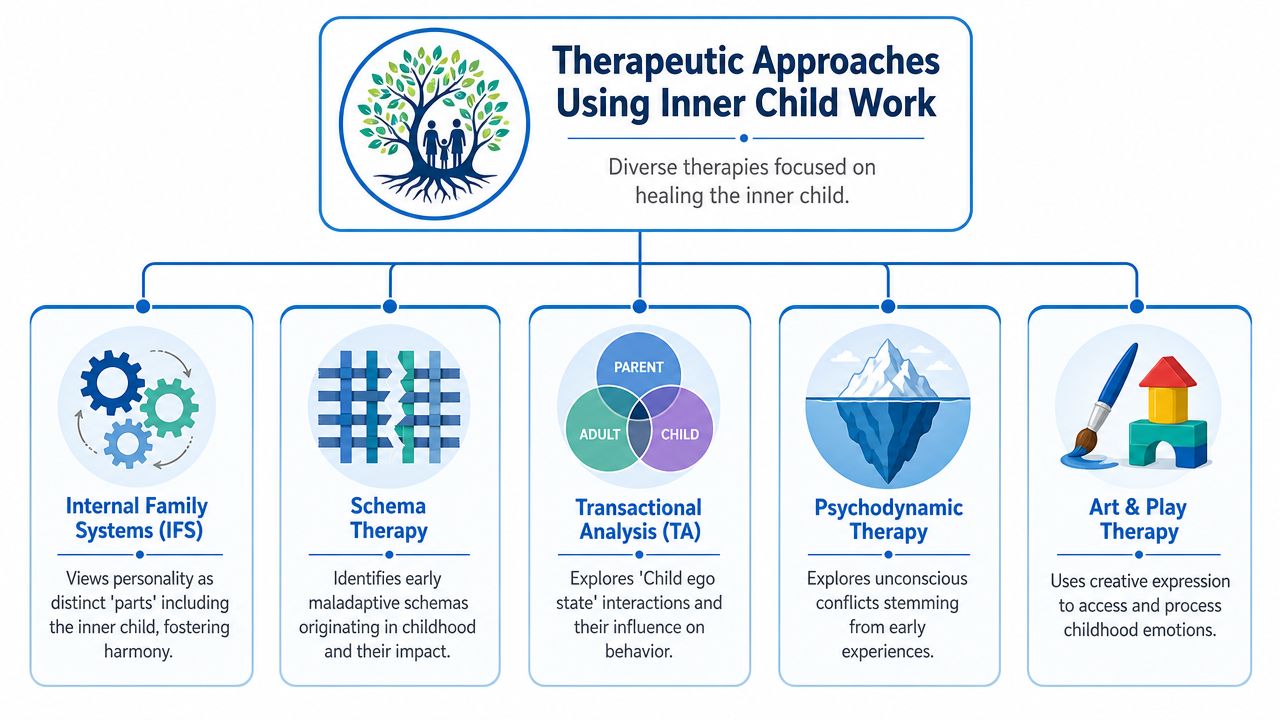
How different therapies use the same core idea
| Approach | How it uses inner child work | Best fit |
|---|---|---|
| Schema Therapy | Works directly with vulnerable child states, unmet needs, and long-standing life patterns | Repeating relationship problems, shame, self-criticism |
| EMDR | Processes distressing memories and the emotional charge linked to them | Trauma, painful childhood memories, strong trigger responses |
| Attachment-based therapy | Focuses on how early bonds shape adult closeness, trust, and regulation | Abandonment fears, conflict patterns, dependency or avoidance |
| Psychodynamic therapy | Explores how early experiences shape present choices, defences, and relationships | Persistent patterns that feel hard to explain rationally |
| Somatically informed therapy | Tracks how unresolved emotion appears in the body and nervous system | Shutdown, overwhelm, body-based anxiety, dissociation |
For some people, EMDR therapy for expats in Italy is especially helpful when the younger emotional part is tied to vivid memories, repeated trauma, or body-level alarm that doesn't respond well to insight alone.
What tends to work
The most effective work is usually structured and paced. It includes emotional access, but not emotional flooding.
What helps:
- A predictable frame: regular sessions, clear boundaries, collaborative pacing
- Present-day tracking: starting with current triggers rather than abstract childhood analysis
- Containment skills: grounding, resourcing, and nervous system regulation before deep processing
- Corrective experience: not only feeling the pain, but receiving validation and building new responses
What doesn't help:
- Going too deep too fast
- Treating every discomfort as hidden trauma
- Using inner child language without clinical structure
- Staying only in insight without changing behaviour
Why boundaries matter so much
Many people assume healing means unlimited softness. In reality, emotional repair also needs steadiness. A younger part may need comfort, but it may also need the adult self to say, “We are not sending ten panicked messages tonight,” or “We are leaving this harmful relationship.”
Validation without containment can bring relief. Validation plus boundaries is what often helps change stick.
That's the difference between expressive work and reparative work.
Safe Starter Exercises for Inner Child Exploration
You can begin exploring inner child themes on your own, but gentle pacing matters. These exercises are for low-intensity self-reflection, not for forcing memory retrieval or processing major trauma alone.
If you already notice dissociation, panic, flashback-like states, or intense destabilisation, it's wiser to work with a therapist. Before going into childhood material, many people benefit from support focused on nervous system regulation therapy.
A gentle journaling practice
Choose one prompt. Write for ten minutes. Stop before you feel flooded.
Helpful prompts include:
- What upset me recently that felt older than the actual situation?
- When I feel rejected, what do I immediately believe about myself?
- What did I need often as a child that I rarely received clearly?
- What came naturally to me when I was younger that I've stopped allowing?
- Which situations make me feel small, invisible, or desperate to be chosen?
Don't aim for perfect memory. Aim for emotional honesty.
A brief visualisation
This exercise should feel calm, not intense.
- Sit somewhere you feel physically safe.
- Notice five things you can see in the room.
- Imagine a younger version of yourself in a peaceful place.
- Don't interrogate them. Just notice their mood.
- Ask one simple question: “What do you need from me right now?”
- End by returning your attention to the room.
A letter to your younger self
This is often more effective than trying to “talk yourself out” of pain.
Write a short note that includes:
- Recognition: “I can see that you felt alone.”
- Validation: “It made sense that you reacted that way.”
- Protection: “You shouldn't have had to manage that alone.”
- Commitment: “I'm learning how to care for you differently now.”
Keep it simple. The purpose isn't literary quality. The purpose is emotional attunement.
If an exercise leaves you more disorganised, ashamed, or numb for hours afterwards, stop. Self-exploration should be titrated. It shouldn't become self-abandonment in therapeutic language.
What not to do alone
Avoid pushing into highly charged memories, prolonged imagery, or repeated “why” questions that leave you spiralling. Inner child work therapy helps most when curiosity is paired with regulation.
A good starting standard is this: you should feel a little more connected after the exercise, not dramatically unravelled.
Finding a Qualified Inner Child Therapist in Italy
You finally book a first session after months of saying you should. Then the therapist starts talking about your "inner child" within ten minutes, without asking much about your current life, your support system, or what it is like to be far from home in Italy. For many expats, that moment brings up the same old feeling. You have to adapt quickly, stay polite, and carry the emotional weight alone.
A good therapist does not rush that process. Inner child work asks you to approach vulnerable parts of yourself that were often shaped in relationships. The quality of the relationship with the therapist matters a great deal. So does their ability to understand what migration can stir up. Loneliness, language fatigue, culture shock, dependency on a partner's visa or income, and repeated goodbyes can reactivate earlier attachment wounds. A clinician who misses that context may misread your distress as only "childhood material" when it is also about the strain of living between worlds.
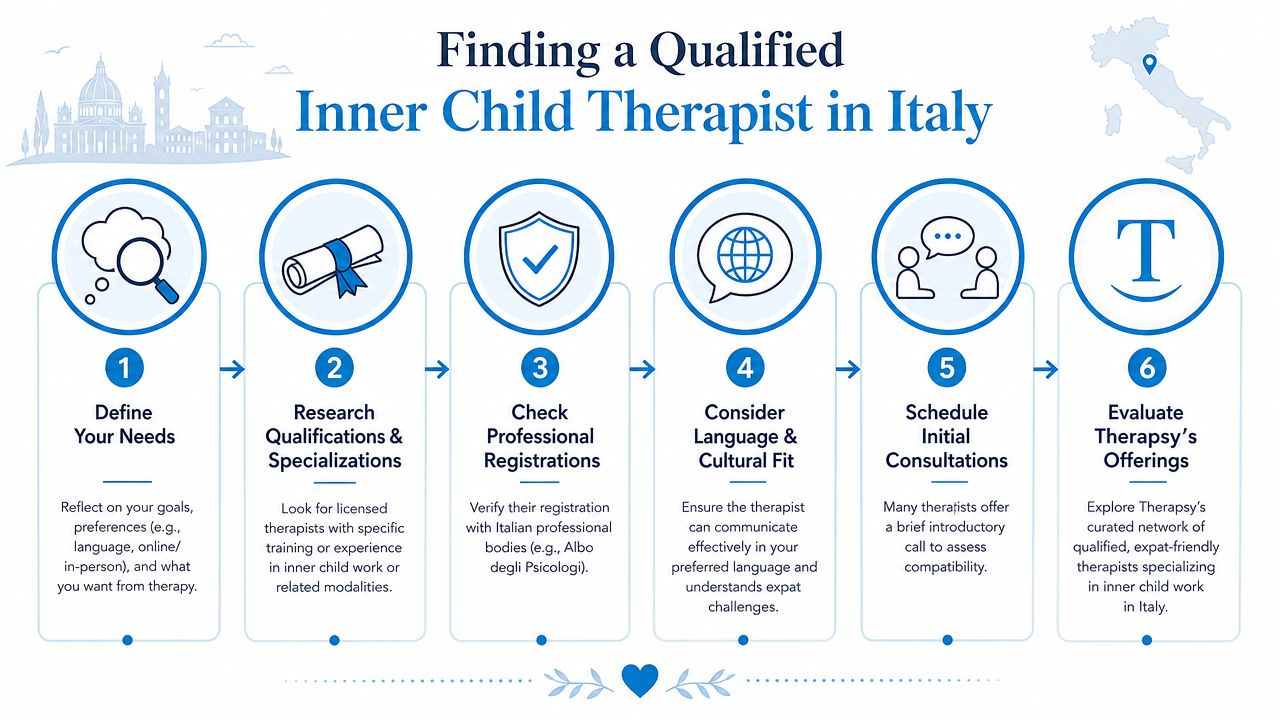
Start with training and method, then assess fit.
A qualified therapist should be able to explain how they use inner child work within a broader treatment plan. That may include Schema Therapy, EMDR, psychodynamic therapy, attachment-focused work, or an integrative trauma approach. The point is not the label alone. The point is whether they can pace the work, notice signs of overwhelm, and help you stay oriented when strong emotions appear.
For expats and international adults in Italy, I would also look for five practical markers:
- Trauma-informed practice: They understand activation, shutdown, dissociation, and shame responses.
- A clear clinical framework: They can explain why they are choosing a method, not just offer a comforting concept.
- Cultural sensitivity: They grasp migration stress, identity shifts, and the pressure of functioning across languages and systems.
- Language fit: Emotional work usually goes better in the language that holds your memories and nuance most accurately.
- Boundaries and steadiness: Sessions feel structured and safe. You are not left managing the therapist's reactions.
If trauma is part of the picture, an English-speaking trauma therapist in Italy may be a better starting point than searching only for the phrase "inner child."
A consultation should also tell you how the therapist thinks. Ask direct questions. Useful ones include: How do you decide whether inner child work fits a client? What happens if emotions intensify between sessions? How do you work with expats, mixed-culture couples, or people who feel different in different languages? What do you do if someone has little memory of childhood? How do you balance insight with practical coping?
The answers matter. A thoughtful therapist speaks plainly, sets expectations, and does not romanticise regression or emotional intensity.
Cost and access matter too, especially if you are paying privately or using online therapy across borders. Fees vary by location, credentials, and format, and inner child work is usually offered as part of standard outpatient psychotherapy rather than as a separate specialist service. That means it is worth asking about frequency, cancellation policy, and whether the therapist offers enough structure between sessions if this work becomes activating.
Some people also benefit from body-based regulation practices alongside therapy. They help with regulation. They do not replace therapy.
Good fit often feels relieving. You do not need to perform insight, prove your trauma, or translate your whole life story into neat clinical language. You should leave with the sense that the therapist can hold complexity, including the part of you that is grieving home, the part trying hard to cope in Italy, and the younger part that still expects to be left alone with too much.
Is Inner Child Work Always the Answer
No.
That nuance matters. Some people arrive convinced that every current problem must be solved by “healing the inner child.” Sometimes that's directionally right. Sometimes it delays the treatment that should come first.
When another approach may need to lead
Inner child work may not be the first step when someone is dealing with:
- Acute panic or severe anxiety that needs immediate stabilisation and skills
- Severe depression where basic functioning has collapsed
- Active addiction patterns that require a more direct treatment plan
- Marked dissociation or destabilisation where memory-focused work could overwhelm the person
- Psychotic symptoms or major reality-testing problems that need psychiatric assessment
In these situations, treatment often works better when safety, sleep, daily functioning, risk, and symptom reduction are addressed first.
What a strong clinician does instead
A responsible therapist doesn't force one model onto every problem. They assess what's happening now, what the person can tolerate, and what order of treatment makes sense.
That may look like:
- beginning with CBT tools for panic management
- using grounding and regulation before any memory work
- choosing EMDR only after adequate preparation
- involving psychiatric consultation when symptoms are severe
- postponing deeper childhood exploration until life feels more stable
The right question isn't “Do I need inner child work?” The better question is “What kind of therapy fits my current nervous system, symptoms, and history?”
The main trade-off
Inner child work can be powerful because it reaches the emotional root. It can also become too vague if it isn't tied to clear clinical goals. Some people need less exploration and more structure. Others need both, but in the right order.
That's why good therapy doesn't romanticise depth. It matches depth to readiness.
FAQ
How long does inner child work therapy take?
It varies widely. Inner child work therapy usually depends on your history, your goals, the complexity of your patterns, and how safely deeper material can be explored. Some people notice early shifts relatively soon, while longer-standing attachment wounds often need a steadier, longer process.
Can I do inner child work on my own?
You can start gently on your own, but deeper work is usually safer with professional guidance. Journalling, simple visualisation, and compassionate self-reflection can be useful first steps. If trauma, neglect, abuse, dissociation, or intense overwhelm are part of your story, working with a qualified therapist is the safer option.
Is inner child work the same as regression therapy?
No, they aren't the same. Inner child work therapy focuses on present-day triggers, emotional patterns, and reparative responses from an adult, grounded perspective. Regression-based approaches aim more directly at re-entering past experiences, which isn't the defining feature of modern trauma-informed inner child work.
What if I don't remember my childhood?
You can still benefit even if your childhood memories are vague. Many people begin with present emotions, body sensations, and repeating relationship patterns rather than detailed autobiographical recall. A skilled therapist can help you work with emotional memory without forcing narrative certainty.
Can inner child work help if my problem is expat loneliness rather than childhood trauma?
Yes, it can. Migration stress, cultural displacement, and loneliness can reactivate older attachment themes even when there wasn't one obvious childhood trauma. The work can help you understand why living abroad feels so emotionally charged and how to respond with more steadiness and self-support.
What should I look for in an inner child therapist in Italy?
Look for someone trauma-informed, structured, and culturally sensitive. It helps if they can explain clearly how they use approaches such as Schema Therapy, EMDR, or attachment-based therapy rather than relying on vague language. For expats, language fit and understanding of intercultural stress are especially important.
If you're looking for thoughtful, multilingual support in Italy, Therapsy is a trusted resource for expats, international students, and young adults who want evidence-based care in a language that feels natural. Book your first free assessment call. No commitment, just a conversation with our Clinical Director who will listen and match you with the right therapist for you. Visit Therapsy.
Dr. Francesca Adriana Boccalari, Clinical Director at Therapsy