Persistent low mood, loss of interest, or hopelessness that lasts most of the day for at least two weeks points more toward depression than ordinary tiredness. Energy that comes back after sleep, rest, or a lighter workload is more likely normal fatigue.
When you're living abroad, that question can feel even harder to answer. If you're in Italy, juggling work, language, and daily life in a system that still feels unfamiliar, exhaustion can start to look like depression, and depression can hide behind “I'm just tired.”
Am I depressed or just tired is a very common question, and it deserves a careful answer. Depression affects about 5.7% of adults worldwide, or roughly 332 million people, according to the World Health Organization, and it's about 1.5 times more common among women than men (WHO depression fact sheet). That's why ongoing low energy, sleep changes, and loss of interest shouldn't be brushed off as simple tiredness.
Why It Can Be So Hard to Tell the Difference
An expat in Milan can sleep a full night, drag themselves through work, skip dinner with friends, and still wonder, “Am I depressed or just tired?” The confusion is real because both states can leave you flat, distracted, and behind on life.
If the low mood, loss of interest, or hopelessness is present most of the day for at least two weeks, depression becomes more likely than ordinary exhaustion. If your energy returns after rest or a lighter schedule, tiredness is the likelier explanation.
Practical rule: if your body is rested but your mood, motivation, or sense of pleasure still hasn't come back, take that seriously.
For readers who feel close to the edge, it's okay to skip ahead to the red flags section. If you're safe enough to keep reading, the goal here is not to label you. It's to help you sort out what kind of support would fit.
A lot of people also notice changes in sleep and dreams when they're depleted, which can add to the uncertainty. If that part resonates, this explanation of insomnia and dreams can help you separate sleep disruption from mood symptoms without jumping to conclusions.
Fatigue, Burnout, and Depression Side by Side
Tiredness, burnout, and depression can all start with “I can't keep doing this,” but they don't mean the same thing. Ordinary tiredness is usually a temporary energy problem. Burnout is more tied to a specific strain, often work or caregiving. Depression reaches further, affecting mood, interest, and functioning across settings.
| Dimension | Ordinary Tiredness | Burnout | Depression |
|---|---|---|---|
| What it feels like | Sleepy, drained, behind on rest | Drained, cynical, worn down by one context | Low, flat, hopeless, or unable to care |
| What helps | Sleep, rest, recovery time | Reduced demands, time off, distance from stressor | Professional support is often needed |
| Where it shows up | Mainly physical energy | Often centered on work or caregiving | Multiple areas of life, including relationships and self-care |
| Core pattern | Energy returns with rest | Relief may come when the stressor eases | Symptoms can continue even when life gets lighter |
Burnout often follows a job, a caregiving load, or a very demanding season. A person may dread opening their laptop, but still enjoy a weekend brunch, a walk, or time with friends once the pressure lifts. Depression is more likely when pleasure itself starts fading, even in parts of life that used to help.
For a deeper look at stress tied to work overload, you may also find this guide to work burnout signs and recovery useful. The point isn't to force yourself into one label. It's to notice whether the problem is mainly tiredness, mainly context-based strain, or something broader and more persistent.
The Three Clinical Cues That Separate Them
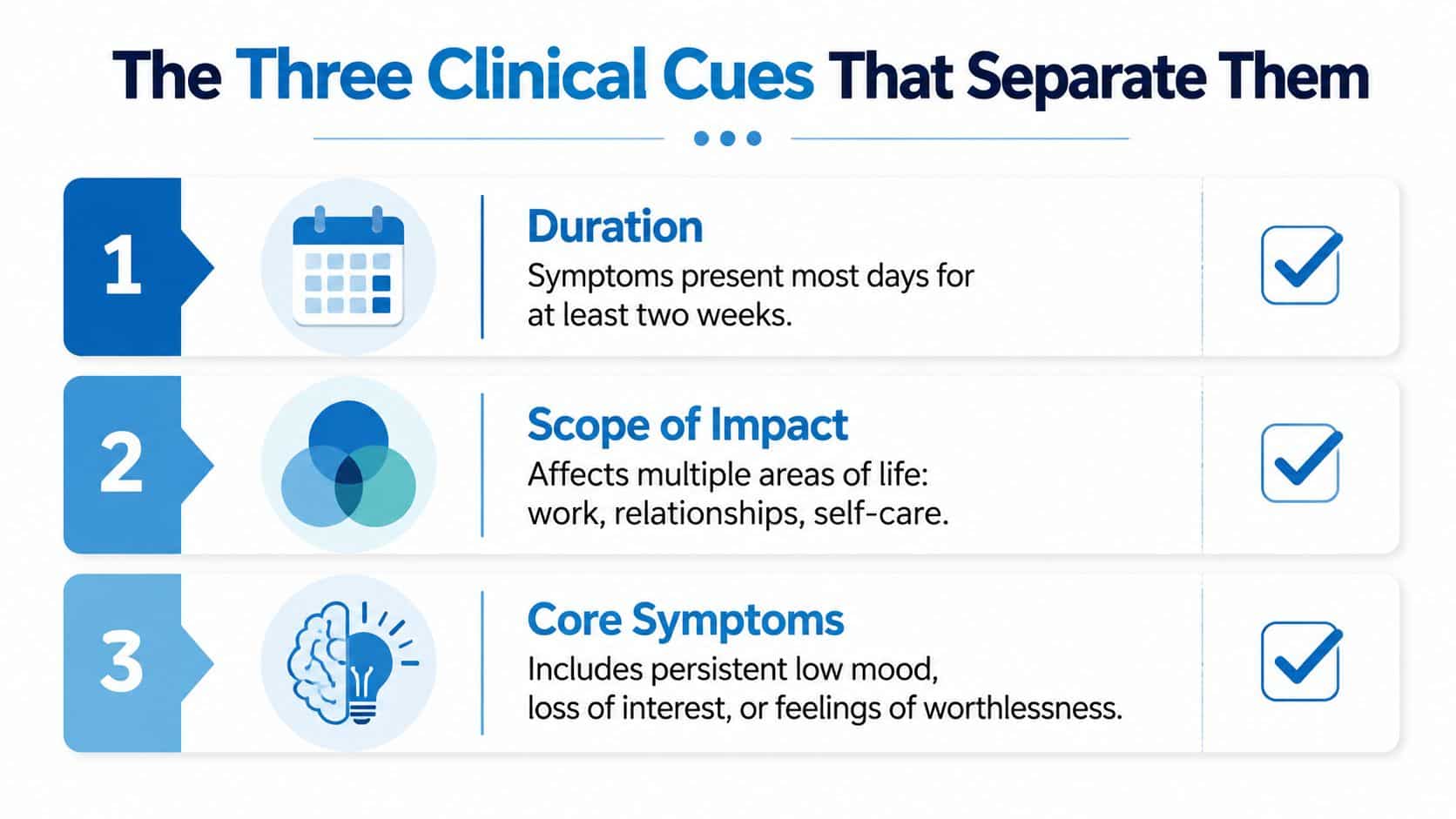
Clinicians usually separate these experiences by looking at duration, scope, and core symptoms. Those three cues are simple enough to use on your own, and careful enough to stop you from dismissing something important.
Duration
Symptoms that show up most days for at least two weeks lean away from short-term exhaustion and toward depression. The CDC's 2019 data showed that 18.5% of U.S. adults had at least some depressive symptoms in the previous two weeks, including 11.5% mild, 4.2% moderate, and 2.8% severe symptoms (CDC brief).
That doesn't mean every two-week slump is depression. It does mean that when the feeling doesn't pass, it's no longer just “a rough week.”
Scope of Impact
Tiredness often affects one main thing, usually energy. Depression is more likely to touch several parts of life at once, like work, relationships, appetite, sleep, motivation, and self-care. The NHS describes major depressive episodes as symptoms that are present most of the day, nearly every day, for at least two weeks, with a pervasive low mood or loss of interest affecting functioning across areas of life (NHS overview).
If you still care about your hobbies, still laugh when a friend texts, and still recover after rest, that leans more toward tiredness. If even the things you normally love feel distant, the pattern deserves attention.
Core Symptoms
Depression is not just “low battery.” It often includes loss of interest or pleasure, persistent sadness, hopelessness, guilt, concentration trouble, and sleep changes. Sleep deprivation can overlap, with daytime sleepiness, irritability, and forgetfulness, but depression more often includes hopelessness or suicidal thoughts as well (Healthline overview of depressed or exhausted).
If you or someone near you is in immediate danger, call 112, the emergency number in Italy and across the EU. Therapy is not an emergency service.
A good test is this. If your mood improves when life eases, burnout or fatigue is more likely. If the mood follows you across settings, even after rest or time away, depression moves higher on the list.
A professional assessment is still the only way to be sure, especially when symptoms are mixed. The clues point you in a direction, but they don't replace care.
A Five Minute Self Assessment You Can Do Tonight
Find five quiet minutes and answer a few honest questions without trying to be “logical” or optimistic. Start with the last two weeks, not just today. What has most days felt like?
Then check these five areas:
- Sleep – Are you sleeping more, less, or waking unrefreshed?
- Interest – Are things you usually enjoy starting to feel flat?
- Energy after rest – Do you wake up restored, or still depleted?
- Concentration – Is it harder to read, decide, or finish simple tasks?
- Hopelessness or self-harm thoughts – Have these shown up at all?
If you want a more structured starting point, you can use Therapsy's free online depression test as a reflection tool. It's not a diagnosis, but it can help you decide whether the pattern is worth discussing with someone trained to listen.
Important: noticing one or more of these signs is not a failure. It's information.
If your answers make you uneasy, write them down. That small note can make it much easier to explain what's going on when you reach out.
When to Seek Professional Help Sooner Rather Than Later
Some signs mean it's better not to wait and see. If symptoms have lasted beyond two weeks, are getting in the way of work or relationships, or are making you withdraw from people and activities, it's time to talk to a professional. Marked changes in sleep or appetite are also a reason to act.
If you've had any thoughts of self-harm or suicide, get help right away. Reaching out in that moment is a protective step, not an overreaction.
Common red flags include:
- Persistent low mood: Feeling down, numb, or hopeless most days.
- Loss of function: Work, study, or relationships are slipping because of how you feel.
- Withdrawal: You're avoiding people, meals, calls, or things that used to ground you.
- Body changes: Sleep or appetite has shifted in a noticeable way.
- Safety concerns: Any self-harm thoughts, even if you're unsure what they mean.
If you're wondering whether you even need a psychologist, this guide can help you think it through. Expat life can make reaching out harder because of language barriers, unfamiliar systems, or worry about cost. Those barriers are real, and they're exactly why support in your own language can matter.
Small Things You Can Try in the Next Few Days
When you're worn down, the goal is not a perfect routine. The goal is to create a little steadiness. Small changes can help you gather information about what your body and mood are doing.

Try these gently:
- Keep one anchor meal and one anchor bedtime: A steadier rhythm can reduce the sense that the whole day is slipping.
- Take a short walk or stretch: Gentle movement is easier to sustain than a hard workout when energy is low.
- Get a little daylight: Even brief time outside can help your day feel less closed in.
- Reduce alcohol for a few days: It can blur sleep and mood, which makes the picture harder to read.
- Message one person: A simple check-in can interrupt the drift into isolation.
These are bridges, not replacements, for care if the symptoms keep going. If your energy is too low for all five, choose one. A small action is still an action.
Why Living Abroad Can Blur the Line Even Further
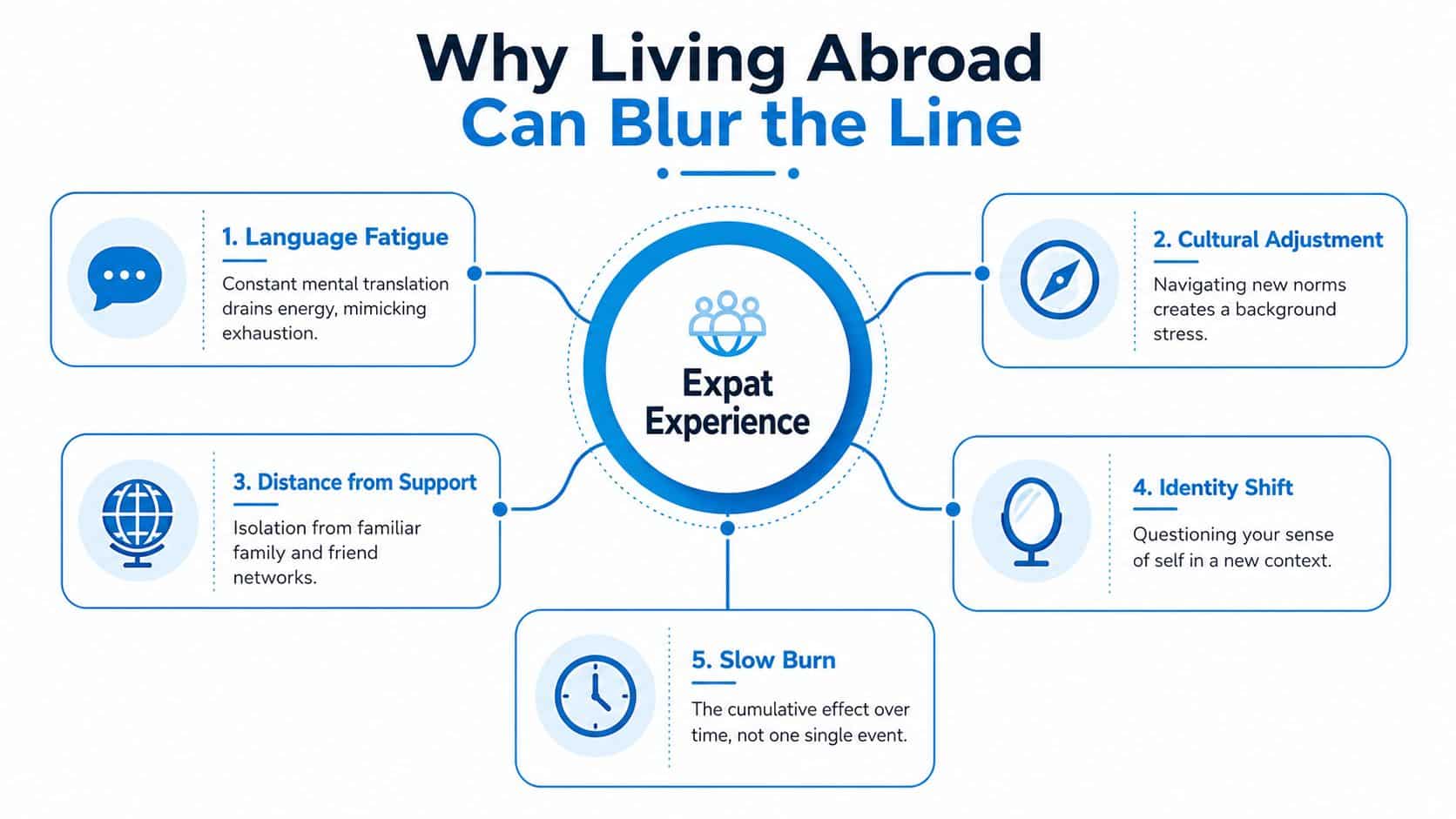
Living abroad can make normal tiredness feel heavier, and it can make depression harder to name. Constant mental translation, cultural adjustment, and the effort of being “on” in another language can drain you before you even get to the day's real demands.
Language Fatigue
Even when you speak well, translating, listening carefully, and choosing words all day takes effort. That can leave you feeling mentally spent in a way that looks like ordinary tiredness but accumulates over time.
Distance from Support
Being far from family or close friends removes a layer of emotional recovery many people rely on without noticing it. When that support is missing, everyday stress can hit harder.
Identity Shift
A new country can shake your sense of who you are. You may feel competent at work and strangely lost in daily life, which is unsettling and exhausting at the same time.
Cross-cultural psychology pays close attention to belonging, identity, and stress in new environments because those pressures affect mood and motivation in real life. Feeling worn down in this context doesn't make your experience less valid. It makes the context part of the story.
Practical Next Steps Including Free Support in Italy
If you're still unsure whether this is depression or tiredness, start with the simplest step that feels doable. Speak with a trusted doctor, especially if sleep, appetite, or physical health might be part of the picture. If there's any immediate safety concern, contact local emergency services or a crisis line right away.
If you want therapy in Italy, Therapsy offers multilingual psychotherapy in 14 languages, with online and in-person sessions across 24 Italian cities and 90+ physical locations, and the first assessment call is free. Matching is done by the Clinical Director, not by an automated questionnaire, and individual therapy starts from €70/session so the cost is clear from the beginning (Therapsy therapists, Therapsy pricing).
For many expats, that combination matters because it lowers the friction of asking for help in the first place. If you want a starting point before you speak to anyone, the free depression self-test can help you organize what you're noticing.
If you're in Italy and this question has been sitting with you for days, you don't have to solve it alone. Therapsy offers a free first assessment call, multilingual support, and human matching so you can talk through whether what you're feeling is tiredness, depression, burnout, or a mix of all three. When you feel ready, visit THERAPSY and book the conversation that gives you a clear next step.
FAQ
How do I know if I'm depressed or just exhausted?
If low mood, loss of interest, or hopelessness lasts most of the day for at least two weeks, depression is more likely than simple tiredness. If rest, sleep, or a lighter schedule brings you back, ordinary fatigue is more likely.
Can burnout look like depression?
Yes, burnout and depression can overlap a lot. Burnout is usually tied more closely to a specific stressor, especially work, while depression tends to affect several areas of life and doesn't lift just because the workload changes.
What if I feel okay in the morning but awful at night?
That can happen with both stress and depression, especially when the day finally gets quiet. The key question is whether the feeling keeps returning across days and settings, not just at one time of day.
Is sleeping a lot a sign of depression or tiredness?
It can be either, depending on what else is happening. Sleep changes matter more when they come with low mood, loss of interest, hopelessness, or trouble functioning.
Should I take a depression self-test?
You can use a self-test as a starting point, but not as a diagnosis. If the result matches what you've been feeling, or if you're worried before you even take it, that's enough reason to talk to a professional.
What should an expat in Italy do if they feel too drained to ask for help?
Start with one small step, like writing down your symptoms or sending one message to a doctor or therapist. If language or logistics feel like a barrier, multilingual support can make the first conversation much easier.