Depression therapy online can work as well as in-person therapy for many adults when it's guided, structured, and tracked carefully. The strongest fit depends on symptom severity, the amount of therapist support, and whether the therapist speaks the client's language and understands the move abroad.
Therapsy is a multilingual psychotherapy service in Italy that connects expats with therapists who speak their native language.
For many expats and international students in Italy, that matters because depression rarely shows up as just sadness. It often mixes with loneliness, cultural fatigue, work pressure, homesickness, and the stress of figuring out care in a new country. Online therapy can be the practical entry point when privacy, timing, or language make in-person sessions hard to start.
Depression Therapy Online Does It Work as Well as In Person?
For many adults, yes. A 2024 systematic review of telehealth for depression found telehealth care to be statistically non-inferior to face-to-face treatment across 12 studies and 1,876 participants, with a pooled effect of SMD = -0.03 and a confidence interval crossing zero.
That answer matters less as a slogan and more as a clinical question: what makes online therapy work well for depression abroad? For expats, the short list usually includes the therapist's language, a clear treatment method, and a format that fits daily life in Italy without adding more strain.
Therapsy is a multilingual psychotherapy service in Italy that matches expats with therapists who speak their native language and offers both online and in-person care.
Why do expats search for this format first?
Living abroad often means that getting help has to feel practical from the start. Travel across cities, time zones, and bureaucracy can turn a simple appointment into another obstacle, especially when someone is already low on energy. Online therapy removes much of that friction, so it often becomes the first step for international students, workers, and couples settling into life in Italy.
The fit also depends on communication. If a person is trying to explain sadness, fatigue, shame, or avoidance in a second language, the work can feel like trying to assemble furniture with the wrong instructions. When the therapist speaks the client's language and understands the move abroad, it is easier to notice what is depression, what is stress, and what is cultural adjustment.
A large 2024 digital psychotherapy meta-analysis found a moderate-to-large benefit for depression across 80 studies and 16,072 participants, with Hedges g = -0.61. Earlier evidence also showed lasting improvement after internet-delivered CBT ended. That is one reason online therapy is now part of mainstream depression care, not just a backup option.
What makes it credible instead of experimental?
The strongest signal is that the evidence comes from controlled studies and meta-analyses, not from one small pilot program. Online depression therapy now sits in the same clinical conversation as traditional care, especially when the program is guided and measured well.
The mechanism matters. CBT online works by helping the person spot the thought and behavior loops that keep depression going, then test small changes in daily life. Interpersonal Therapy online focuses more on relationships, role changes, and conflict, which can be especially relevant during relocation or isolation abroad. In both cases, the therapist is not just offering sympathy. The work is structured, with regular review of symptoms, progress, and what needs to change next.
For someone in Milan, Rome, Florence, or another Italian city, the question is often practical rather than abstract. Explore how online and in-person therapy compare in Italy for expats to see why the same person may prefer remote sessions during one season of life and face-to-face care in another.
What Happens in Online Therapy for Depression?
A session is a structured conversation that helps someone notice patterns, test new responses, and track what changes. It usually feels more focused than a casual conversation and less intimidating than many people expect.
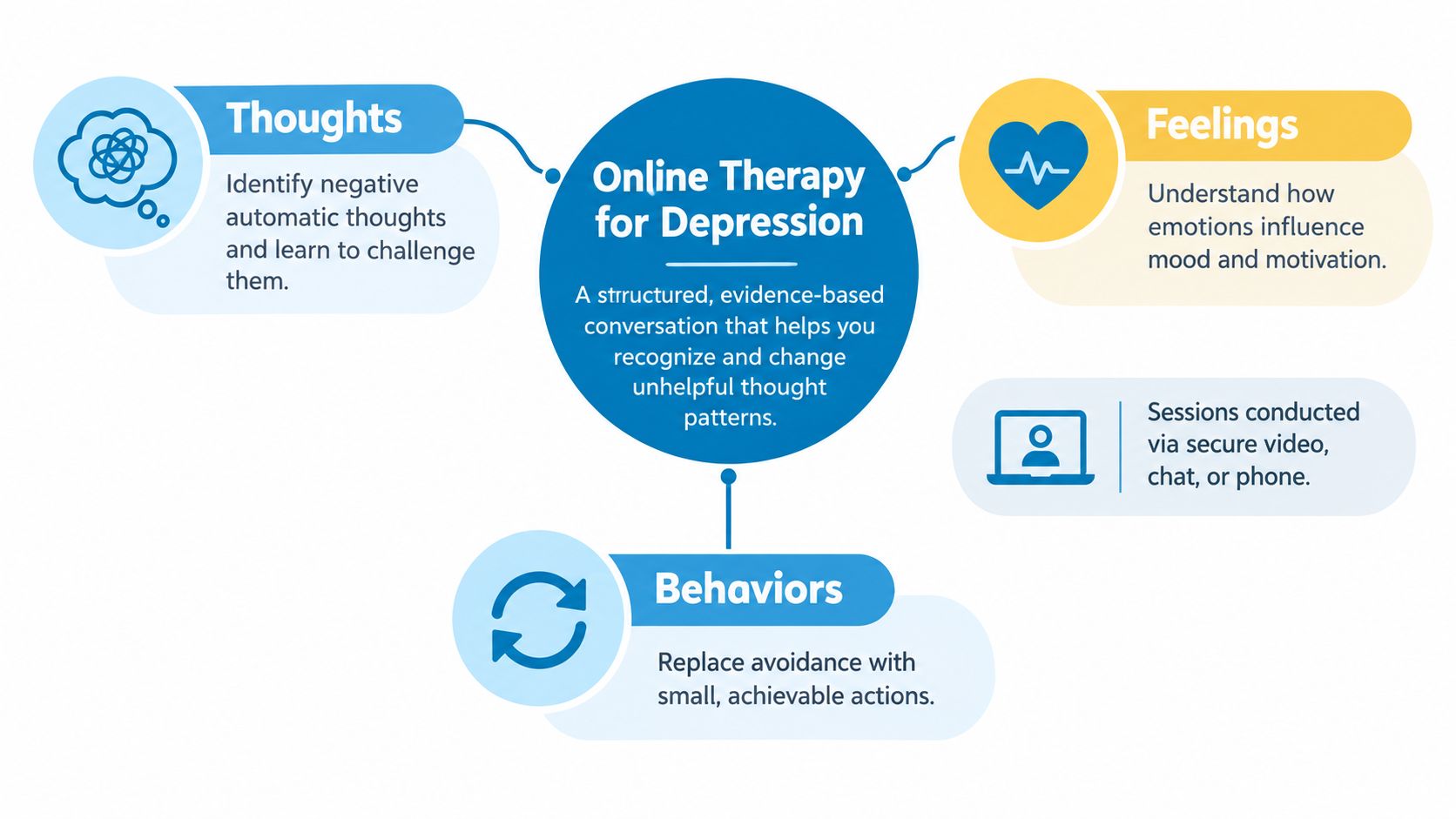
Depression often keeps itself going through a loop of low mood, negative thoughts, and avoidance. Online therapy works by slowing that loop down, helping the therapist and client see what is happening in the moment, then choosing a different response. The process is practical, almost like checking a map while walking, so small detours become visible before they turn into the same blocked route.
What does the first call usually cover?
The first assessment call usually covers goals, history, current symptoms, and what feels hardest in daily life. For an expat, it can also include living situation, distance from family, work stress, comfort with the local culture, and whether sessions should be in English, Italian, or another language.
If you want a clearer sense of the opening step, see what a first psychological session can look like.
That fit matters because therapy works better when the person feels understood, not just scheduled.
Why does the video format help the mechanism work?
Video sessions let the therapist notice how the client speaks, pauses, avoids eye contact, or becomes tearful. Those small cues can reveal patterns that are easy to miss in messages or in a rushed appointment. The session then works like a mirror, reflecting habits that keep depression in place.
For many adults, being at home lowers the effort needed to attend. That does not make the work easier, but it can make it more reachable. The person still has to engage, reflect, and practise between sessions.
Why does language concordance matter so much?
Depression often narrows language. People may know what they feel, but not have the words to explain it well in a second language. Working in a native language can make shame, grief, irritability, and relationship strain easier to describe with nuance.
That is why language matching matters clinically, especially for expats in Italy. If a client can say “numb,” “empty,” “detached,” or “ashamed” in the language that feels closest to the experience, the therapist gets richer material to work with.
What do the session tools look like?
A therapist may ask about sleep, energy, avoidance, thoughts, and routines. The discussion often ends with one or two small actions for the week, because therapy changes more reliably when reflection is paired with behaviour. Guided support also matters here, since regular check-ins help the therapist adjust the pace, notice gaps, and keep treatment from drifting into vague conversation.
If you are unsure how a first appointment usually feels, the first psychological session guide can make the process easier to picture.
How Do CBT and Interpersonal Therapy Work Online?
CBT changes the thought-behaviour loop, while interpersonal therapy works through relationships, role changes, and grief. Online delivery can support both, but they do different jobs.
A client in Italy may be dealing with low mood, isolation, and a new life in a second language at the same time. In that setting, CBT gives structure, while interpersonal therapy gives room to work through belonging, loss, and conflict. The right fit depends on what keeps the depression going.
| Feature | Online CBT | Online Interpersonal Therapy |
|---|---|---|
| Main focus | Thoughts, behaviours, and habits that keep mood low | Relationships, role transitions, conflict, and loss |
| Typical tools | Thought records, behavioural experiments, routine changes | Mapping relationship patterns, processing transitions, naming grief |
| Session style | Structured, skills-based, task-oriented | Reflective, relational, focused on current life roles |
| Often fits | People who want a clear framework and exercises | People whose low mood is tied to moves, breakups, conflict, or identity shifts |
CBT works by making the loop visible. A therapist and client identify a negative thought, test how believable it is, then try a different action and review what happened. Online, that can happen through a shared document, a screen review of a thought record, or a quick check on one avoided situation from the week.
Read more about CBT for depression at Therapsy
Why does CBT translate well online?
CBT depends on repetition, structure, and homework. Video sessions can support that rhythm because the therapist can review notes, adjust the plan, and check what happened between meetings. The online format works best when the sessions stay specific and the between-session practice stays visible.
A digital psychotherapy meta-analysis found meaningful benefit for depression, and internet-delivered CBT follow-up evidence suggests that gains can continue after treatment ends. That is one reason CBT remains a core option for online depression therapy.
When does interpersonal therapy make more sense?
Interpersonal therapy fits better when mood is closely tied to a change in role or relationship. That can include relocation, family distance, a breakup, a new job identity, or conflict with a partner from another culture. For expats, that context is often part of the depression rather than a separate issue.
When the pain is tied to loss, belonging, or role change, the therapy has to make room for those relationships, not only for symptom control.
In online sessions, interpersonal therapy can still be precise. A therapist can help someone name the relationship pattern, link it to the move abroad, and rehearse a more direct conversation or boundary. The format matters less than keeping the work tied to current life.
What about mixed presentations?
Many people do not fit neatly into one model. A therapist may use CBT for sleep, avoidance, and routine, then shift to interpersonal work for loneliness or conflict. That blend is often useful for expats, because depression abroad is rarely only internal or only relational.
What Does a Typical Course of Online Sessions Look Like?
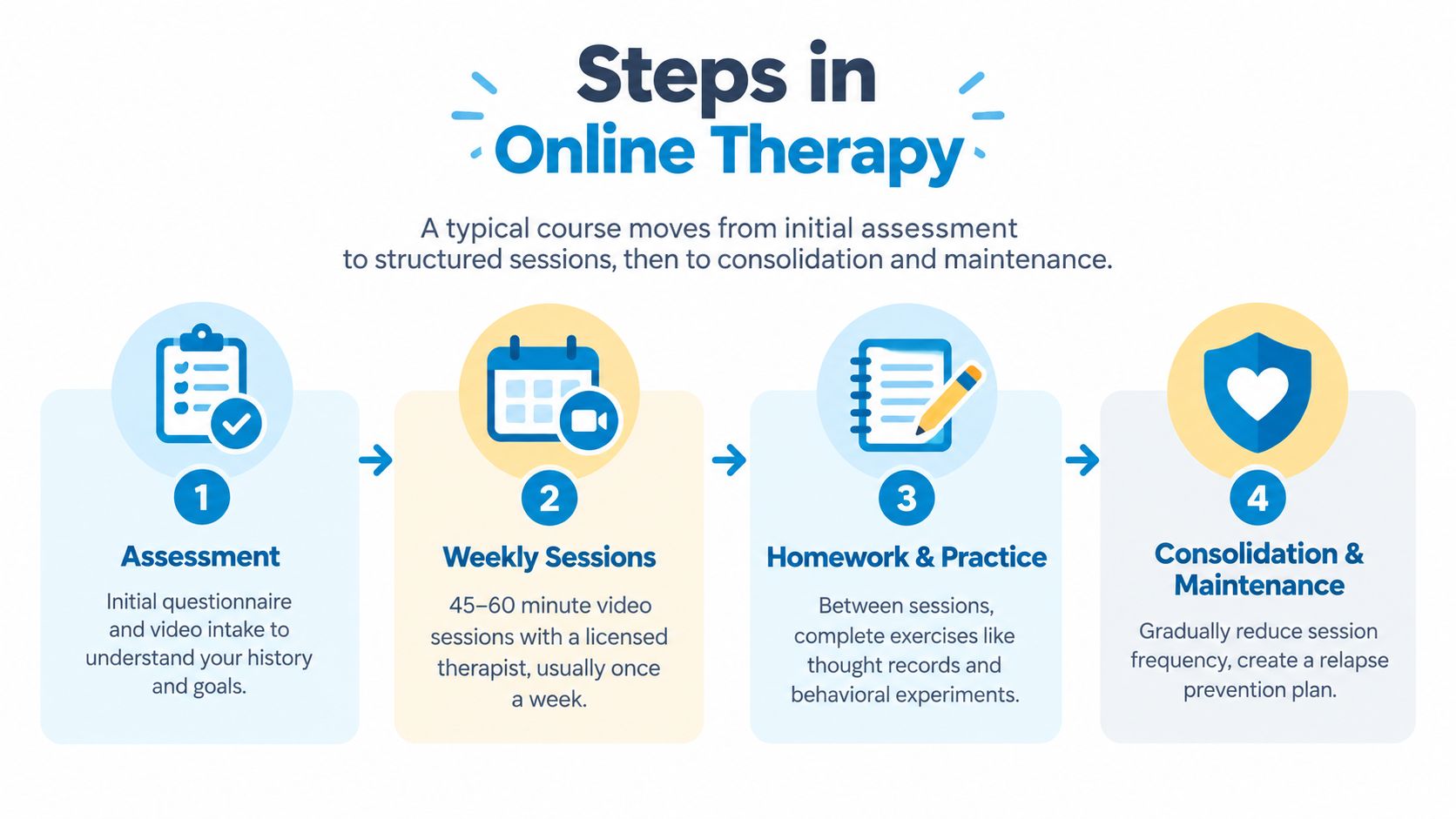
A common path begins with assessment, moves into regular weekly work, and then shifts into consolidation and maintenance. Good online therapy is tracked and adjusted, not left to drift.
The first phase usually clarifies how depression shows up in daily life. A therapist looks at energy, sleep, motivation, concentration, avoidance, and the situations that make symptoms worse. From there, client and therapist set a target that is specific enough to guide the work, because “feel better” is too vague to steer treatment.
What happens week by week?
Weekly sessions usually follow a simple rhythm. The therapist reviews the previous week, checks what helped, and chooses one or two actions for the next week. The homework may be small, but it matters, because depression often shifts through repeated corrective experiences rather than insight alone.
A client might be asked to step outside for a short walk, answer one avoided message, or compare an automatic thought with what happened. The goal is not performance. It is evidence. Each task gives the therapist and client something concrete to discuss, which is especially useful when someone is living abroad and daily routines keep changing.
Why is measurement-based care so important?
A score can show whether treatment is heading in the right direction. In a randomized study of internet-based CBT, the online group showed a 2.5-point greater improvement in PHQ-9 scores at 8 weeks, was 6.0 times more likely to show a response, and 5.2 times more likely to reach remission, although the gap narrowed by 24 weeks (randomized study of internet-based CBT).
That pattern matters because early improvement can fade if follow-up stops. Measurement-based care gives the therapist an early warning signal, so intensity, pace, or focus can be adjusted before momentum slips.
See how long therapy can take in practice.
What does maintenance actually mean?
Maintenance is the part many people forget until symptoms start to return. It means reducing session frequency gradually, reviewing the tools that helped most, and planning for relapse risk before the acute phase ends. For someone living between countries, that plan can also include continuity across travel, work changes, or temporary returns home.
Useful rule of thumb: if symptoms improve quickly, the therapist still needs to ask how the gains will hold up when routine, stress, or season changes.
Therapsy's clinical team treats continuity as part of the service, not an afterthought. That matters when a client's life is already split between calendars, languages, and locations.
Why Does Guided Support Matter and Who Is Most Likely to Drop Out?
A person abroad can start online therapy with a clear plan and still drift away after a few sessions if the work feels unclear, too hard, or too solitary. Guidance matters because it turns a self-help exercise into a supported treatment process, especially when someone is dealing with depression in another language or culture.
A major network meta-analysis covering 39 studies and 9,751 participants found that therapeutic guidance added little or no benefit for mild or subthreshold depression, but guided iCBT was more effective for moderate and severe depression, while both guided and unguided formats beat treatment-as-usual (network meta-analysis of iCBT guidance). Older evidence also showed a higher pooled effect in therapist-guided studies than in unguided ones.
The mechanism is straightforward. Guidance improves follow-through, helps people understand the homework, and gives the therapist a chance to notice confusion, avoidance, or worsening symptoms early. For an expat in Italy, that support can also catch culture-related misunderstandings, for example when a phrase sounds flat in one language but carries a different emotional weight in another.
Who is more likely to drop out?
A 2705-participant meta-analysis found higher dropout risk among men, people with lower educational attainment, older participants, and those with comorbid anxiety (meta-analysis of dropout predictors). Another clinical study reported roughly 55% attrition in both online and in-person CBT, which shows that attendance problems are not just a digital problem.
That is why “online is easier” can be too simple. Lower friction helps people start, but it does not remove shame, low energy, ambivalence, or the habit of avoiding painful feelings. It also does not solve language mismatch, which can make a client feel less understood even when the technical setup is fine.
When is unguided support enough?
Low-intensity self-help can work when symptoms are mild and the person already has strong self-management skills. It can also serve as a first step when the goal is to practise one or two techniques before moving into more intensive care. The fit matters more than the format.
How do therapists improve engagement?
Therapists keep the work visible through short check-ins, homework review, and direct discussion when someone has gone quiet. Measurement-based care helps here too, because a small shift in scores can show whether the current pace is helping or whether the plan needs to change.
A patient intake coordinator can help with logistics at the start, but follow-through still depends on a real therapeutic relationship and a clear structure. For expats, language and cultural matching are part of that structure, not a bonus feature. Therapsy uses human matching rather than an algorithm, which fits this clinical reality. When the match is better, the person is less likely to feel lost early on and more likely to stay engaged long enough for the work to help.
How to Choose the Right Online Therapist and When to Add Psychiatric Care?
A person looking for depression therapy online often needs more than a video link and a calendar slot. The better choice is the therapist who can work in the client's language, understand the cultural context of life abroad, and offer a level of support that matches the severity of symptoms.
For expats, language shapes clinical work. It affects how guilt, exhaustion, or loss are described, and whether the therapist can catch the emotional meaning behind the words. Therapsy's multilingual model, with 14 languages, matters for that reason, not just because it is convenient.
What should the therapist match include?
- Language and cultural fit: the person can talk about feelings without translating every sentence in their head.
- Evidence-based approach: the therapist uses methods such as CBT, interpersonal work, behavioural activation, or schema-informed care when appropriate.
- Credentials and licence: the therapist's professional status can be verified, and the person knows who is providing care.
- Online and in-person flexibility: the format can change when life changes.
- Clear crisis protocol: the therapist explains what happens if risk escalates.
Therapsy's matching process is done by the Clinical Director, not by an algorithm. Human review can weigh language, culture, and relational style together, which matters when the first task is helping someone feel understood rather than assigning the nearest available slot. See how therapist matching works at Therapsy.
When does psychiatric care belong in the plan?
Psychiatric care is added when symptoms point to a medication evaluation or when the presentation is more complex. That does not mean therapy has failed. It means the plan may need another tool, in the same way a care team may add a different lens when the problem has more than one part.
A useful way to think about the decision is to separate therapy from prescribing. A psychologist vs psychiatrist comparison helps here, because the two roles are related but not the same. One focuses on psychotherapy, the other can assess whether medication should be part of care.
How does the practical decision usually get made?
The safest choice is usually the one with the clearest process. The therapist explains the plan, the client feels understood, and there is a path to add psychiatric care if needed. When the care team is coordinated, the person does not have to hold every decision alone.
Therapsy also keeps pricing transparent, which helps people compare options without guesswork. Individual therapy starts from EUR 70, couple therapy from EUR 100, psychiatric consultation from EUR 110, and the first assessment call is free.
Frequently Asked Questions About Depression Therapy Online
The main questions usually involve privacy, practice between sessions, language shifts, and when online care is no longer the best fit. The answers below are meant to stand on their own.
Is online therapy private enough?
For many people, yes, if the platform is secure and the client joins from a private space. Privacy also depends on small habits, like using headphones, closing doors, and choosing a room where interruptions are unlikely. Therapy still depends on trust, so the clinician should explain how sessions are run and what happens to personal data.
What should someone do between sessions?
Between sessions, the useful work is usually small and specific. That can mean tracking mood, noticing avoidance, or trying one new behaviour in daily life. The point is to make the next session more concrete, because therapy changes more reliably when insight and action stay linked.
What if the client needs therapy in one language but lives with another?
That is common for expats and international students. Switching languages at home, at work, and in therapy can be mentally tiring, so many people do better when therapy is offered in the language that feels most natural for emotional work. For expats in Italy, language and cultural fit are clinical factors, not just comfort preferences. Therapsy is built around that reality, with therapy available in 14 languages and online or in person across Italy.
How can someone tell if online therapy isn't the right fit?
The format may not fit if the person cannot keep sessions private, cannot engage consistently, or needs a higher level of coordinated care. Fit also depends on whether therapist and client can build enough understanding across language or culture. If that match is weak, the answer is to rethink the setup, not force the format.
Therapsy helps expats in Italy find depression therapy online with human matching, therapy in the client's own language, and the choice of online or in-person sessions. The first assessment call is free, it is with the therapist chosen for that person, and there is no obligation to continue, so THERAPSY is a low-pressure place to start if the next step still feels unclear.