An expat who feels exhausted, withdrawn, unusually sleepy, or preoccupied with carbohydrates every winter may be experiencing seasonal affective disorder, but relocation stress can look similar. For expats in Italy, reduced winter daylight may interact with loneliness, language barriers, disrupted routines, and distance from family. A careful assessment can separate a seasonal pattern from depression, homesickness, culture shock, or a medical condition.
Therapsy is a multilingual psychotherapy service in Italy that connects expats with therapists who speak their native language.
Understanding Seasonal Affective Disorder for Expats
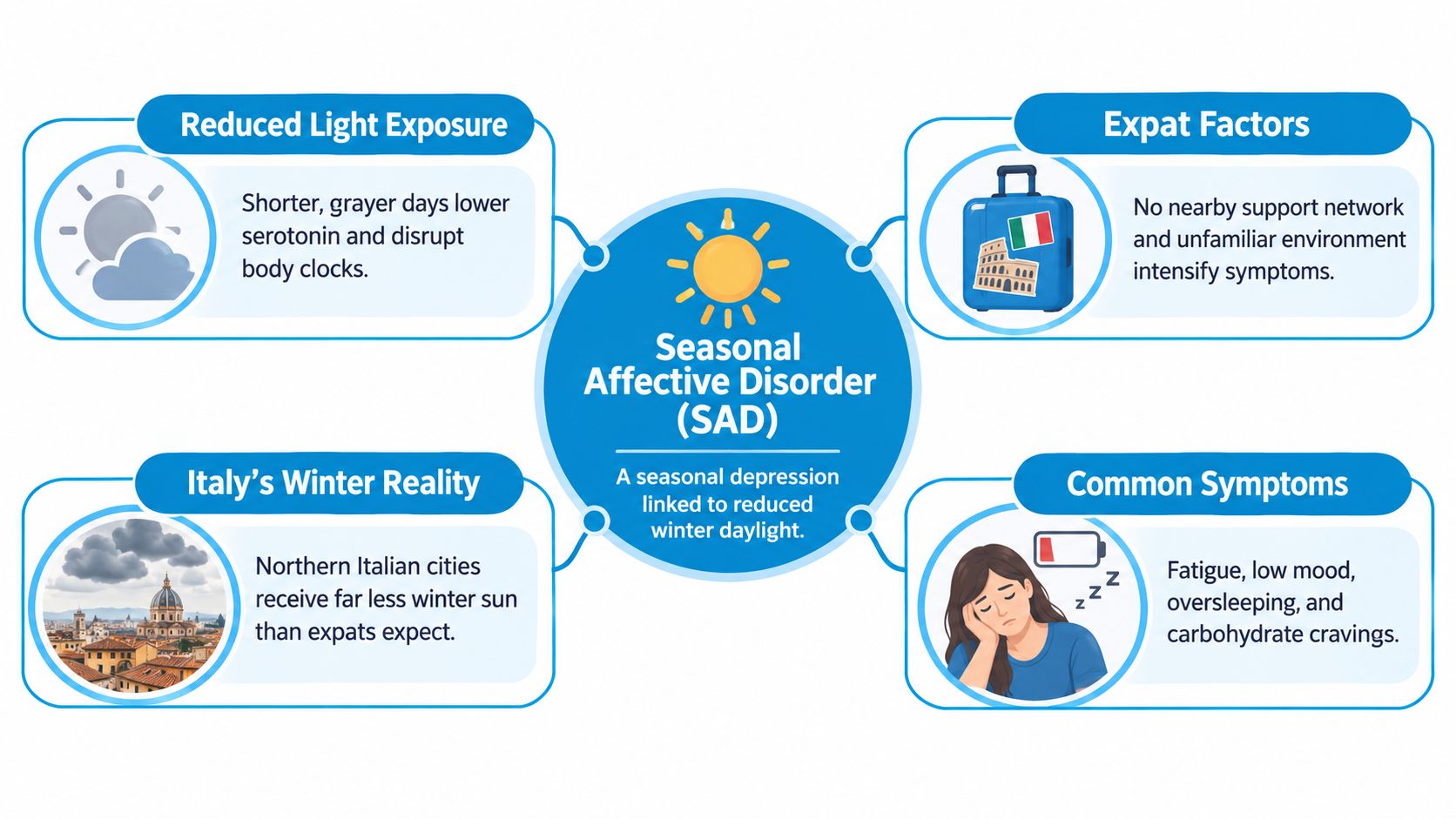
An expat may notice that winter changes more than the weather. A person who moved from a bright, low-latitude country to northern Italy might begin sleeping longer, avoiding friends, struggling to work, and craving carbohydrate-rich food as autumn progresses. The same person may feel substantially better when spring returns, which makes the pattern easy to dismiss as ordinary homesickness or a difficult adjustment.
Seasonal affective disorder, or SAD, is a form of depression linked to a recurring seasonal pattern. Winter-pattern SAD is associated with reduced daylight, which can affect circadian rhythms, melatonin regulation, and other biological timing systems. Research generally finds higher rates of winter SAD and subsyndromal SAD at higher latitudes, although latitude isn't a diagnosis and doesn't explain every person's experience (research on daylight, latitude, and seasonal mood).
A 2025 meta-analysis of 24 studies involving 32,866 participants estimated pooled prevalence at 5.01% for SAD and 9.37% for subsyndromal SAD. The analysis found that prevalence increased significantly with geographic latitude, while summer-type SAD showed no significant latitude association (PubMed-indexed meta-analysis of seasonal affective disorder). These figures describe populations, not an individual diagnosis.
Why can winter affect an expat differently?
Relocation can add psychological and social pressure to a biological seasonal vulnerability. An expat may have fewer trusted relationships nearby, less confidence using Italian, unfamiliar healthcare routines, and no established plan for dark or rainy months. A positive move can still involve grief for familiar places, food, family rituals, and everyday predictability.
Fatigue and concentration problems also have many possible explanations. Persistent or impairing tiredness and mental fog deserve clinical assessment.
A culturally responsive therapist won't assume that every winter difficulty is SAD. Some expats describe the problem as lost productivity, disrupted sleep, homesickness, irritability, or an inability to participate in Italian life rather than as depression. Therapsy's approach combines human matching by the Clinical Director, therapy in the client's language, and a choice between online and in-person sessions.
For a broader look at recurring low mood around seasonal change, an expat can also explore September blues in Italy. The important first step is observing whether symptoms follow a reliable seasonal rhythm and whether they improve when daylight and routine return.
Why Do Expats in Italy Face Higher SAD Risk
An expat can feel the winter shift in two ways at once, through less daylight and through the stress of building a life in a new place. That combination can make seasonal low mood more likely, even though migration itself is not the cause.
A move from a brighter, lower-latitude setting to a darker winter climate changes how much morning and daytime light reaches the eyes. That light helps set the body clock, shape sleep timing, influence melatonin activity, and support daytime alertness. If most daylight hours are spent indoors, autumn and winter matter even more.
Italy is not one uniform experience. Milan or Turin may feel very different from southern regions for someone used to stronger winter light, even when the change in latitude seems modest. A person who leaves home before sunrise, works inside, and returns after sunset gets less natural light in ordinary life than a map comparison suggests.
Is latitude enough to explain SAD after relocation?
Latitude matters, but it does not explain everything. Climate, genetic vulnerability, personal history, and social context also shape seasonal mood. A review of seasonal affective disorder research found no clear overall link between SAD prevalence and latitude, and migrant evidence is still limited (review of seasonal affective disorder and latitude).
A clinician should look beyond the phrase “the move caused SAD.” Useful questions include whether the expat has lost regular contact with friends, reduced exercise, changed sleep patterns, faced discrimination, or felt grief tied to migration. Seasonal light loss and cultural stress can reinforce each other, especially when loneliness grows in daily life. A practical overview of loneliness in Italy can help separate the need for connection from the question of depression.
CBT can help identify thoughts such as “everyone belongs here except me” and test whether withdrawal is keeping low mood in place. Cross-cultural psychology helps distinguish a change in light exposure from the strain of adapting to unfamiliar rules, habits, and expectations. Attachment theory also explains why winter, illness, or holidays can make distance from family feel sharper, because familiar support is less available.
The most useful assessment treats daylight exposure and cultural adjustment as linked possibilities. For expats in Italy, both can matter at the same time, and both deserve attention.
How to Distinguish SAD from General Depression or Adjustment Difficulties
SAD usually follows a recurring seasonal pattern, while nonseasonal depression and adjustment difficulties can occur across the year or follow a specific life event. Only a qualified clinician can determine which explanation fits an individual's symptoms.
A clinical conversation should compare symptoms across at least two seasons where possible. It should also assess reduced daylight exposure, sleep and appetite changes, functional impairment, previous depression, bipolar-spectrum symptoms, adjustment stress, and the person's migration history.
| Pattern | Timing and context | Features that may appear | What requires attention |
|---|---|---|---|
| Winter-pattern SAD | Symptoms recur during autumn or winter and improve in another season | Hypersomnia, low energy, carbohydrate craving, social withdrawal, depressed mood | Whether the pattern repeats and disrupts work, study, or relationships |
| Nonseasonal depression | Symptoms aren't consistently tied to daylight or a particular season | Low mood, loss of interest, sleep or appetite changes, hopelessness, reduced functioning | Severity, duration, previous episodes, and safety |
| Adjustment difficulty | Symptoms follow relocation, cultural conflict, loss, or major change | Homesickness, anxiety, irritability, loneliness, identity strain | Whether the distress is easing, persisting, or becoming disabling |
| Medical or nutritional problem | Symptoms may emerge independently of seasonal timing | Fatigue, sleep changes, concentration problems, physical symptoms | Medical evaluation for possible vitamin, thyroid, or other conditions |
Can homesickness and SAD happen at the same time?
Yes. An expat can have a seasonal biological response and significant homesickness, and each can make the other harder to manage. The presence of relocation grief doesn't rule out SAD, just as a winter pattern doesn't prove it.
A therapist may ask when symptoms began, what changed after the move, whether appetite and sleep shift during darker months, and whether functioning improves during brighter periods. A general practitioner may also consider medical explanations, especially when an expat hasn't had a recent health check or when symptoms don't follow a clear seasonal pattern.
A language-matched assessment is valuable because people describe impairment differently. One person may say, “There's no energy to attend Italian class.” Another may report sleeping through morning lectures, missing work deadlines, or feeling unable to answer messages from family. These descriptions can reveal severity without requiring the person to use a diagnostic label.
Anyone concerned about whether homesickness has developed into something more serious can read about homesickness versus depression in expats. The purpose isn't self-diagnosis. It's to help an expat bring clearer observations to a therapist or doctor.
What Treatment Options Work for Seasonal Affective Disorder
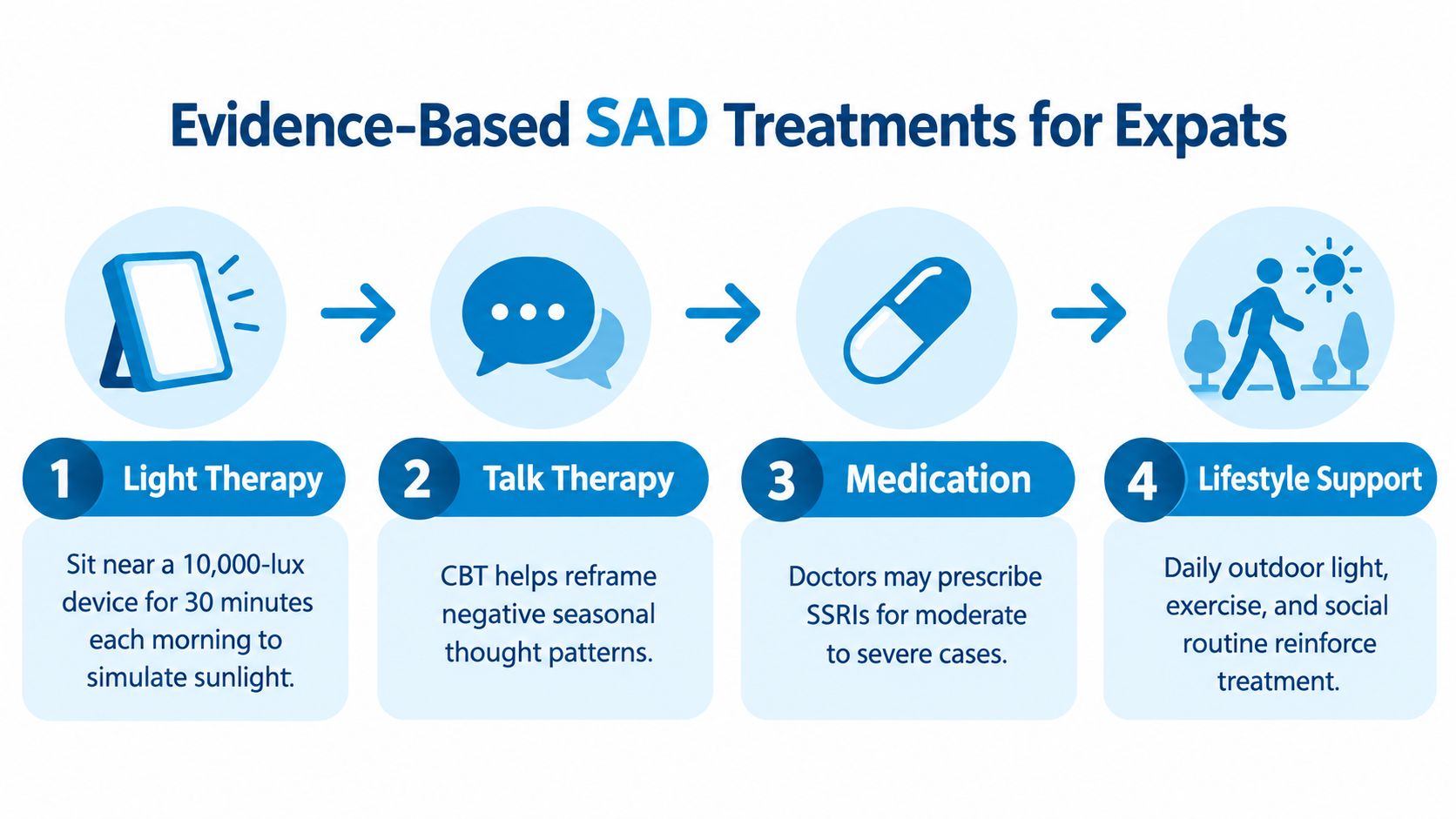
Treatment for winter-pattern SAD may include medically supervised light therapy, CBT, medication, and routine-based support. The appropriate combination depends on symptoms, medical history, bipolar-spectrum risk, eye health, medication exposure, and the practical realities of living between countries.
How does bright-light therapy work for winter SAD?
Bright-light therapy gives the eyes a carefully timed daylight-like signal, helping regulate circadian timing during the darker season. For many adults with winter-pattern SAD, the commonly defined protocol uses a medically screened 10,000-lux white-light device, positioned approximately 12 to 18 inches from the face, for about 30 minutes in the early morning (clinical guidance on bright-light therapy).
Clinical improvement commonly appears within one to two weeks, although symptoms may return after treatment stops. Continued use through the individual's usual high-risk season may therefore be recommended. A light box isn't interchangeable with ordinary room lighting, and an expat shouldn't assume that any bright lamp meets a clinically relevant specification.
Medical advice matters before starting. A clinician should review eye disease, photosensitising medication, and bipolar symptoms because light exposure can rarely contribute to agitation or mood elevation. Treatment planning should also account for travel between countries or hemispheres, where the season and timing of daylight may change.
Can CBT help with seasonal patterns?
CBT can address the thoughts, behaviours, and routines that maintain winter-related depression. It may help an expat notice how reduced energy leads to cancelling plans, how cancelled plans increase isolation, and how isolation reinforces the belief that belonging is impossible.
CBT-SAD can be used alongside light therapy rather than as a substitute for medical assessment. It can target seasonal predictions, avoidance, self-criticism, and the practical challenge of building meaningful activity when daylight is limited. CBT for depression may be a relevant starting point for understanding this approach.
Medication may be considered by a psychiatrist when symptoms are moderate, severe, recurrent, or not adequately addressed by other measures. An expat should bring a complete list of current and previous medication, including prescriptions issued in another country. Cross-border treatment requires coordination because prescribing rules, follow-up arrangements, and access to the same medication may differ.
The National Institute of Mental Health describes morning light-box use at 10,000 lux for about 30 to 45 minutes from autumn through spring and notes that CBT-SAD and light therapy can be similarly effective overall (NIMH information on seasonal affective disorder). Evidence-based reviews describe treatment trials lasting roughly two to four weeks for light therapy and four to six weeks for antidepressants, so immediate results shouldn't be expected.
How Can Expats Cope with SAD While Living in Italy
A winter morning in Italy can feel surprisingly dim for an expat who is used to stronger light, later routines, or a more familiar social rhythm. The simplest coping plan starts with three basics, daylight, structure, and contact with other people. These steps support treatment, but they do not replace assessment if symptoms are persistent or disruptive.
Begin with the home environment. Choose accommodation with good natural light if possible, open the curtains early, spend part of the morning outside, and place work or study near a window. Reflective surfaces and light-coloured furnishings can make a room feel brighter, but they are only background support. They do not replace outdoor daylight or prescribed light therapy.

What daily habits support an expat during darker months?
A fixed wake time helps anchor the body clock. A morning walk, a class after work, or a regular meal with someone else adds light, movement, and structure to days that can otherwise blur together.
Social contact needs to be planned, especially after relocation. Language exchanges, international student groups, neighbourhood activities, and regular video calls with family can all reduce the sense of living in a sealed room. A large social circle is not required. What matters is dependable contact, especially when low energy makes spontaneous plans harder to start.
Italian healthcare often works best when an expat begins with a general practitioner for medical assessment and referral guidance. A multilingual therapist can then explore mood, relocation stress, relationships, and identity in a language that feels workable. Those two paths can complement each other when fatigue has both physical and emotional sides.
Latitude by itself does not explain who develops SAD. Reviews suggest that climate, personal vulnerability, and social-cultural context can matter as much as geographic position. That is why an expat in Milan or Turin should think about housing, work hours, family ties, and expectations about winter, not only the forecast.
Small grounding activities can also help the season feel more manageable. Caring for a plant or learning a quiet, hands-on hobby may give the day some shape. These activities can steady mood, but they are support measures, not cures.
When Should Expats Seek Professional Help for SAD
Professional help is appropriate when seasonal symptoms persist, impair daily life, recur, or become difficult to distinguish from depression, bipolar symptoms, medical problems, or adjustment stress. An expat doesn't need to wait until functioning collapses before asking for support.
Warning signs include a marked decline in work or study, withdrawal from relationships, major sleep or appetite changes, hopelessness, or inability to maintain basic routines. A history of depression or bipolar disorder makes clinical guidance particularly important before using light therapy or changing medication. Thoughts of self-harm require prompt support through local emergency services or an urgent healthcare route in Italy.
If you or someone near you is in immediate danger, call 112, the emergency number in Italy and across the EU. Therapy is not an emergency service.
What should an expat do first in the Italian healthcare system?
A general practitioner can help assess physical contributors and identify an appropriate medical pathway, while a multilingual therapist can explore mood, relocation stress, relationships, and cultural identity. These routes can work together, particularly when symptoms include both physical fatigue and emotional distress.
Evidence for bright-light therapy is meaningful but doesn't guarantee that every person will respond. A meta-analysis of eight randomised controlled trials involving 228 patients found that bright light therapy and dawn simulation were effective for SAD, with an effect size of 0.84 (review of bright-light therapy for SAD). Group-level evidence can inform treatment, but it can't predict an individual outcome.
Therapsy supports expats who need care in a familiar language and cultural context. Its network includes therapists working in Italian, English, French, Spanish, German, Portuguese, Ukrainian, Russian, Greek, Arabic, Urdu, Hebrew, Hindi, and Persian (Farsi). The Clinical Director completes the human matching process rather than relying on an algorithm, and clients can choose online or in-person sessions across 24 Italian cities with 90 physical locations.
Therapsy has supported 1,600+ clients and completed 14,000+ sessions since 2023, with 50+ therapists in its network. The service reports a Trustpilot rating of 4.8/5, “Excellent”, and first contact within 12 hours. These service details can help an expat compare practical access needs, but they don't replace a clinical decision about the right treatment.
Where Can Expats Find Multilingual Therapy in Italy
Multilingual therapy can help an expat express seasonal distress, migration grief, and cultural conflict without translating every emotional nuance. A therapist who understands both the client's language and intercultural context can explore CBT patterns, attachment needs, EMDR where clinically appropriate, and Schema Therapy without reducing the problem to daylight alone.
At Therapsy, human matching by the Clinical Director considers the person's needs rather than assigning a therapist through an algorithm. Sessions are available online or in person, and the network works across 14 languages, including Italian, English, French, Spanish, German, Portuguese, Ukrainian, Russian, Greek, Arabic, Urdu, Hebrew, Hindi, and Persian (Farsi).
Individual therapy starts from EUR 70, couple therapy from EUR 100, psychodiagnostic assessment from EUR 255 for three sessions, and psychiatric consultation from EUR 110. The first assessment call is free, and it's with the therapist chosen for that person. Therapsy accepts less than 1 applicant in 100 into its network, reflecting a selective clinical process, while its online therapy in English in Italy offers a practical option for people living outside major cities or travelling frequently.
Approaches such as CBT, EMDR, Schema Therapy, attachment-informed work, and cross-cultural psychology can be adapted to the person's history and goals. The first call carries no obligation to continue, so an expat can ask about language, seasonal symptoms, treatment coordination, and online or in-person availability before deciding.
Therapsy offers human therapist matching, therapy in the client's own language across 14 languages, and online or in-person sessions for expats managing seasonal mood changes in Italy. The free first call is with the therapist chosen for that person, with no obligation to continue, so visit THERAPSY to explore a suitable next step.