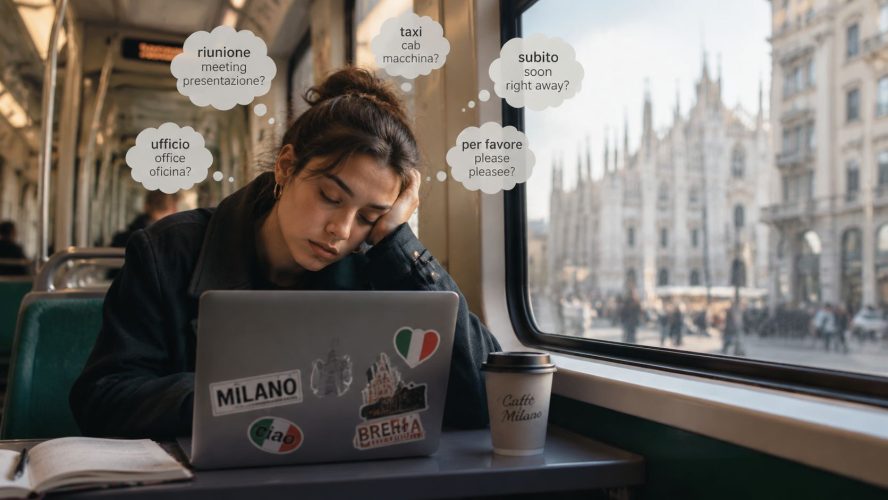
At 3pm in a Milan office, you may still be smiling through an Italian video call while your mind runs out of fuel. Second language exhaustion is the cognitive, emotional, and physical fatigue that builds when a non-native language becomes the medium for work, relationships, and daily decisions. It isn't laziness or poor motivation. It is the cost of sustained linguistic processing, often intensified by cultural adjustment and expat stress.
Therapsy is a multilingual psychotherapy service in Italy that connects expats with therapists who speak their native language.
What Second Language Exhaustion Actually Feels Like
You read the same Italian email thread twice, then once more because one sentence carries a social meaning you don't want to miss. On the video call, you follow the discussion, smile at the right moments, and search for a precise phrase when someone asks your opinion. On the tram home, your head aches and you have no words left for a message to a friend.
That experience has a name. Second language exhaustion is the measurable cognitive, emotional, and physical fatigue that develops when a person uses a non-native language for prolonged or demanding communication. The effort can affect attention, processing speed, recall, fluency, mood, and the willingness to keep engaging.
The difference between tiredness and language load
Ordinary tiredness usually follows a broad demand. You might feel depleted after travel, poor sleep, intense exercise, or a long day of meetings in your strongest language. Second language exhaustion has a more specific pattern. You may feel relatively capable in English, then become foggy, irritable, or silent after hours of Italian.
It also isn't the same as shyness or low proficiency. A fluent speaker can still need extra mental resources to understand indirect requests, monitor grammar, select an appropriate register, and interpret cultural cues. A less experienced learner may face the same demands with an even smaller margin for recovery.
Second language exhaustion isn't a character flaw. It is a signal that your communication system has been working under sustained load.
The experience can overlap with burnout, especially when work leaves no recovery time. But the immediate pressure may be linguistic rather than occupational. If you're unsure whether your afternoon crash reflects stress, low mood, or something more specific, you can use this guide to feeling depressed or simply tired as a starting point, not a diagnosis.
Why the emotional cost matters
Language is also tied to identity. In Italian, you may sound more formal, younger, quieter, or less humorous than you do in your first language. You may lose the ability to express warmth, disagreement, competence, or vulnerability with your usual precision.
That gap can create shame and self-doubt. The problem isn't only that conversation takes effort. It can feel as if other people are meeting a reduced version of you.
Why Your Brain Gets Tired in a Second Language
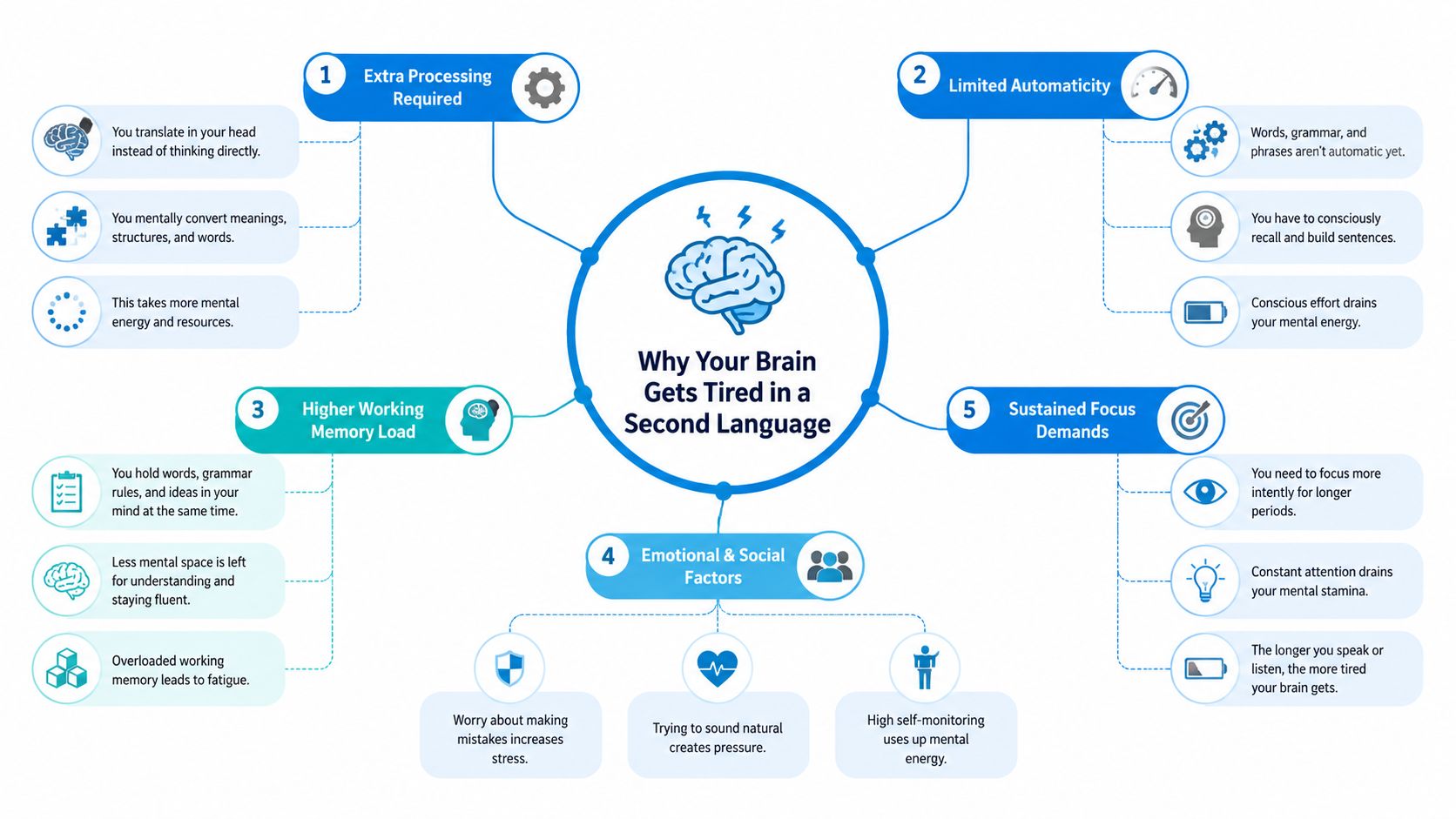
Your brain doesn't replace one word with another. It manages competing language systems, selects the language that fits the context, suppresses the one that isn't needed, and holds the meaning of the conversation in working memory.
Bilingual switch-cost research shows that reaction times are reliably slower on the first trial after a language switch, while neuroimaging findings show increased activation in executive-control regions. Research summarized by New York University explains that the cost comes from suppressing the non-target language and reconfiguring the language system.
The background laptop analogy
Think of your mind as a laptop running an important presentation. Your native language uses familiar automatic processes. In a second language, a translation, monitoring, and error-checking program may run in the background.
You can still send the email and participate in the meeting, but the battery drains faster. Add a noisy office, unfamiliar accents, fear of making mistakes, or a difficult conversation with a landlord, and the system has less capacity for everything else.
That extra work draws on executive resources also involved in attention and self-control. When those resources are occupied, you may have less patience with a child, less flexibility in a disagreement, or less ability to choose a nuanced emotion word.
Why fluency doesn't remove every cost
Fluency makes many processes faster and more automatic, but it doesn't erase switching or context demands. A voluntary switch in a natural conversation can be much less costly than a forced laboratory switch, where an external cue tells the speaker to change languages. The same person can therefore feel comfortable moving between languages with a close friend and exhausted by an unpredictable multilingual meeting.
Recent speech-production research also found more disfluencies, repairs, and simplification after demanding lexical items, particularly in a second language. The Interspeech research paper describes this as consistent with greater cognitive-resource recruitment and compensatory recovery.
For practical accessibility, voice dictation may reduce the burden of composing difficult messages when typing and language formulation compete for attention.
If your body remains tense after the language task ends, nervous system regulation therapy can help you understand how attention, stress, and recovery interact rather than treating the exhaustion as a personal failure.
The Most Common Signs Expats Notice First
At a dinner in Italy, conversation may begin comfortably. You tell a story, follow the jokes, and ask questions. Later, familiar words become harder to retrieve. You smile instead of answering, then use short replies because building a complete sentence feels physically heavy.
The pattern can continue into the next day. An Italian email creates dread before you open it. On the metro after work, you sit and postpone calling family, even in your first language, because your remaining attention feels limited.
Cognitive and emotional signals
The signs often arrive as a cluster:
- Word retrieval: You know the meaning but cannot reach the word quickly.
- Concentration: You reread messages, lose the thread of meetings, or miss small details.
- Fluency: You pause, repair sentences, simplify ideas, or abandon a point.
- Irritability: Small interruptions feel unusually difficult after a language-heavy day.
- Shame: A pause becomes evidence, in your mind, that you are unintelligent or failing to adapt.
- Avoidance: You postpone calls, invitations, appointments, or conversations in Italian.
Your body may register the load before you find language for it. Tension around the eyes, jaw clenching, a tight throat, headache, or a strong wish to lie down without conversation can follow prolonged attention and self-monitoring. These sensations reflect sustained cognitive effort and stress activation. They are useful observations, not proof of a personal weakness.
Noticing the shift during a meal can give you useful data about your cognitive load. It may show that your social capacity has been used up for the moment, while your interest in other people remains intact.
How it differs from ordinary tiredness
Normal tiredness usually improves after food, rest, or a change of activity. Language-related exhaustion follows a more specific trigger pattern, returning after phone calls, bureaucratic appointments, negotiations, or meetings that require you to interpret words alongside implied expectations.
You may still enjoy Italian in a slow, familiar interaction. That contrast helps clarify the pattern. A familiar film can feel relaxing, while an hour of spontaneous conversation leaves you depleted because you must plan, monitor, interpret, and respond continuously.
Second language exhaustion can overlap with depression, anxiety, sleep problems, or burnout. This resource on expat burnout symptoms may help you notice whether the difficulty has spread beyond language-related situations. A therapist can help examine these overlapping causes without forcing the experience into one label.
Practical Coping Strategies You Can Use This Week
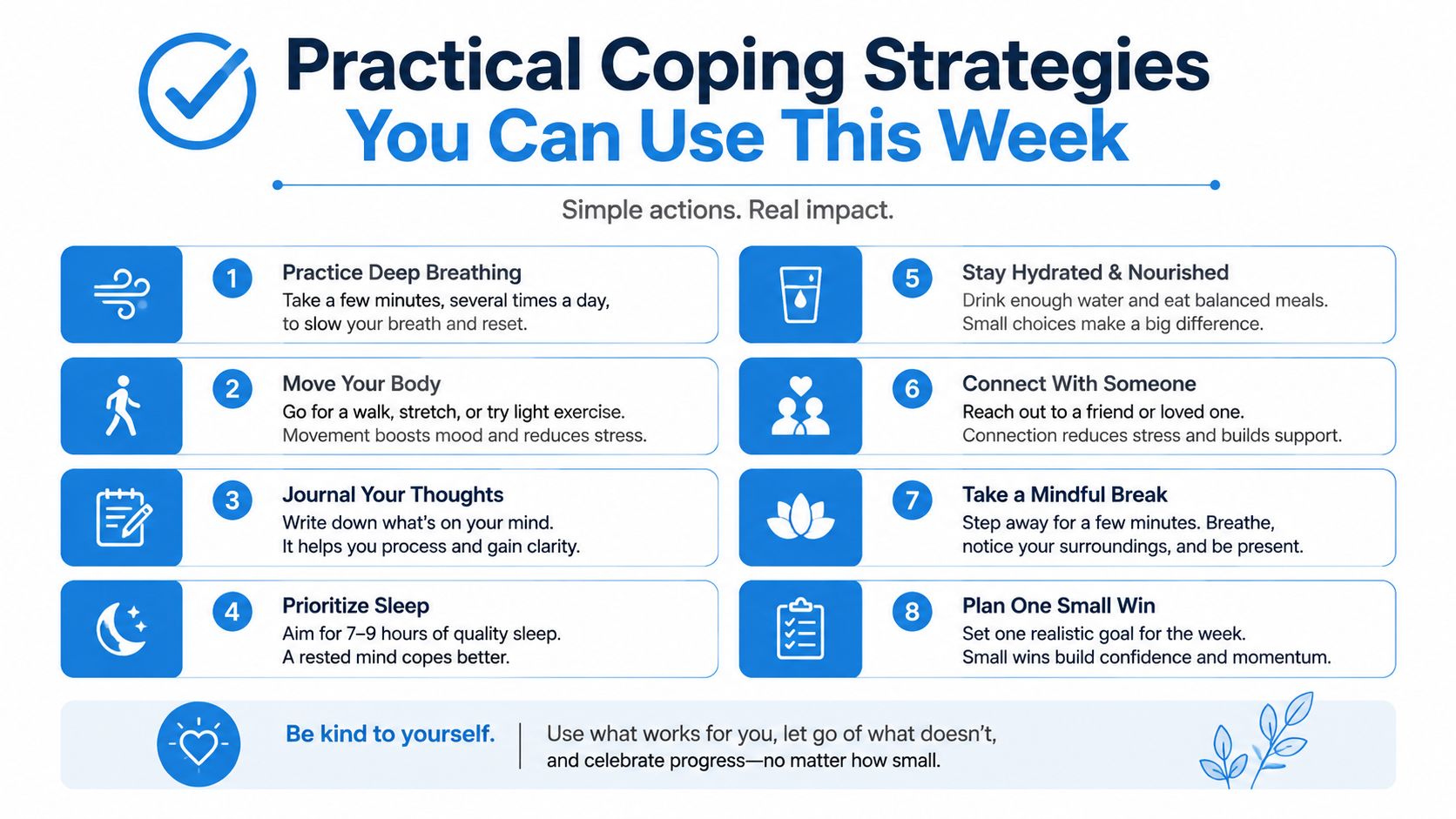
Willpower can't solve a cognitive-load problem by itself. The useful question isn't, “How can I force myself to function?” It is, “How can I reduce unnecessary load and create more recovery?”
Start with changes that make the day less linguistically continuous.
Create recovery without abandoning Italian
Build short monolingual recovery windows into ordinary routines. Your commute, lunch, or evening walk can happen in your strongest language, in silence, or with music that doesn't require comprehension. Recovery isn't the opposite of learning. It gives your attention a chance to reset.
Give yourself explicit permission to code-switch. You don't need to apologize every time an English word arrives first. A simple sentence such as, “I know the idea, but I need the English word for a moment,” protects the conversation and reduces the pressure to perform.
For meetings, ask for an agenda or key documents in advance. Prepare phrases for clarification, disagreement, and postponement, such as:
- “Could you repeat the last point more slowly?”
- “I understand the general idea. I need to check one detail.”
- “Can I send my response in writing after the meeting?”
Pace demanding tasks
Group heavy language tasks instead of scattering them across the entire day. You might handle emails, calls, and negotiations in one protected block, then take genuine rest rather than replacing the task with another form of language input.
Use learning material at a pace that supports comprehension rather than proving endurance. Audiobooks or Italian podcasts at half-speed can help you practise listening without the social pressure of a live exchange.
The most useful plan is small enough to repeat:
- Hydrate before the afternoon crash.
- Breathe with a slower exhale before a difficult conversation.
- Switch off unnecessary language input after work.
- Rest without treating recovery as a reward you must earn.
- Reconnect with someone who lets you communicate without performance.
If stress has become a wider pattern of tension, sleep disruption, and avoidance, these approaches to coping with stress offer a broader starting point. You don't need to wait until every Italian interaction feels impossible.
Adjusting Your Workplace, School, and Social Life
The best intervention is often environmental. Instead of asking an expat to try harder, colleagues, teachers, partners, and friends can help redesign situations so language remains usable without becoming overwhelming.
| Context | Typical Trigger | Concrete Adjustment |
|---|---|---|
| Workplace | Fast meetings, ambiguous requests, constant switching | Ask for written follow-ups, protect focus time, and use translation support for routine administration |
| School or university | Dense lectures, unfamiliar terminology, rapid discussion | Request recordings where available, rotate study-group languages, and discuss processing needs with professors |
| Social life | Long dinners, overlapping voices, pressure to be entertaining | Choose smaller gatherings, plan a language-free hobby, and decline invitations without overexplaining |
The workplace
You might negotiate hybrid language use rather than choosing one language for everything. Use Italian for relationship-building when that matters to you, and use written clarification or translation support for routine administrative details.
A protected focus block can prevent the day from becoming one unbroken sequence of switches. After an Italian meeting, written action points reduce the need to keep reconstructing what everyone meant.
School and university
Lecture fatigue often begins before the lecture ends. Your attention must stay active because passive listening is less reliable when the language is still being processed. Recorded material, vocabulary lists, and study groups that rotate languages can distribute the burden.
Students can tell a professor, “I understand the content, but I need extra processing time when discussion moves quickly.” That statement describes a learning need without framing bilingualism as a deficit.
Social life
A language-free hobby can restore a sense of self that isn't dependent on verbal accuracy. Running, pottery, swimming, drawing, or cooking with minimal conversation can offer connection without another performance test.
A direct refusal can be kind: “I've had a language-heavy week, so I'm going to stay home tonight. I'd like to see you when I have more energy.” The aim isn't to withdraw permanently. It's to choose social contact that leaves room for recovery.
Therapsy's multilingual model is relevant when a workplace, university, or social environment keeps demanding adaptation without providing a safe place to speak freely. Its therapists and language options allow expats to discuss the problem in a language that doesn't add another layer of effort.
Therapy, Professional Help, and the Bigger Expat Picture
Second language exhaustion rarely exists alone. It can sit alongside culture shock, homesickness, role changes, relationship strain, and the experience of becoming a different version of yourself in each language.
Cross-cultural psychology describes adaptation as an ongoing negotiation between familiar values and new social expectations. Attachment theory can help explain why distance from trusted people makes ordinary stress harder to regulate. CBT, or cognitive behavioural therapy, can identify thoughts such as “If I pause, everyone will know I don't belong,” then test whether that belief is accurate or helpful.
Schema Therapy looks at deeper patterns, including shame, perfectionism, or the belief that your needs inconvenience others. EMDR may be relevant when language-related situations connect with earlier experiences of humiliation, threat, or trauma. A therapist doesn't need to force one explanation. The work begins by understanding the whole pattern.
When self-help isn't enough
Professional support deserves consideration when you notice:
- Persistent sleep disruption that doesn't settle with routine changes.
- Withdrawal from all Italian contact, including activities you used to value.
- Physical symptoms that continue or intensify.
- Intrusive thoughts, hopelessness, or concern about your immediate safety.
- A widening loss of functioning at work, school, home, or in relationships.
A multilingual psychologist can offer sessions in your first language, while also helping you decide when and how to use Italian in daily life. Online sessions may be useful when you travel between cities, and in-person support can provide a stable place to decompress. Local health services and private clinics may also offer culturally oriented support, depending on location and eligibility.
Therapy for expats in Italy can focus on language fatigue without treating your wish for native-language care as a failure. Asking for a multilingual therapist is an adaptive decision. It gives you access to nuance, humour, memory, and emotion while you work on the challenges that brought you abroad.
Therapsy connects clients with carefully selected professionals offering online and in-person psychotherapy in 14 languages, including Italian, English, French, Spanish, German, Portuguese, Ukrainian, Russian, Greek, Arabic, Urdu, Hebrew, Hindi, and Persian (Farsi). The service uses human matching by the Clinical Director rather than automated questionnaires, and clients can discuss their needs in a free first assessment call before deciding whether to continue.
How exhaustion can become a longer cycle
A 2024 network analysis of language-learning burnout identified shame, emotional exhaustion, and avoidance as central and bridging factors. A meta-analysis also found a meaningful negative association between boredom and second-language achievement, with r = -0.30, as reported in the ERIC record for the research.
These findings help explain why “just push through” can backfire. Exhaustion may lead to avoidance, avoidance reduces meaningful language use, and reduced use can make future interactions feel more threatening. Over time, the issue can become emotional and relational as well as cognitive.
Long-term attrition research gives that cycle another dimension. A longitudinal study summarized by Cambridge found that eight of ten measured language variables declined exponentially between year three and year six after formal instruction ended, then remained relatively stable for several decades before a later decline. Learners at the lowest proficiency levels could become indistinguishable from a control group with no Spanish by six years after stopping instruction, while stronger learners retained about 62% to 80% of what they had known. The Cambridge summary of second-language attrition research also cautions that many studies cover only one to two years, and very few extend beyond five years.
The point isn't to frighten you into constant practice. It is to show why sustainable language contact matters more than heroic bursts of effort.
If your first language is Persian, you do not have to do this work in your second one: Therapsy offers therapy in Persian (Farsi), online across Italy and abroad.
Frequently Asked Questions About Second Language Exhaustion
Is second language exhaustion a recognized medical condition or just tiredness?
Second language exhaustion is a recognized cognitive-load phenomenon, but it isn't automatically a standalone medical diagnosis.
Research on bilingual switch costs links language alternation with slower reaction times and greater executive-control activity, while language-fatigue research describes reduced attention, slower processing, and recall difficulty. If the fatigue becomes persistent or affects daily functioning, a qualified professional can assess whether anxiety, depression, burnout, sleep problems, or another health issue is also involved.
How long does second language exhaustion typically last?
It can last for the rest of a language-heavy day, or continue longer when recovery is limited and demands remain high.
The 3pm office crash may improve after quiet, food, sleep, or a return to a familiar language. If symptoms keep returning despite reasonable recovery, or if they spread into weekends and relationships, professional assessment may be useful.
Is second language exhaustion different from culture shock or burnout?
Yes, although the three experiences can overlap.
Second language exhaustion is primarily linked to linguistic processing, culture shock involves adaptation to unfamiliar social norms and expectations, and burnout includes broader exhaustion, cynicism, or reduced efficacy. A therapist at Therapsy can help map where the pressure comes from instead of assuming every afternoon crash has the same cause.
When should I seek professional help for second language exhaustion?
Seek professional help when exhaustion persists, disrupts sleep, causes significant withdrawal, produces ongoing physical symptoms, or comes with intrusive or hopeless thoughts.
You don't need to wait until you stop functioning completely. Therapsy offers a free first assessment call, allowing you to describe the 3pm office pattern, the dinner-party fade, or the avoidance cycle without committing to treatment immediately.
Does learning Italian specifically worsen second language exhaustion?
Italian doesn't cause exhaustion, but demanding Italian use can increase fatigue when it requires sustained attention, rapid switching, or emotionally important communication.
The same applies to any non-native language. Italian may feel especially draining in Italy because it appears across work, bureaucracy, healthcare, friendships, and daily decisions, leaving fewer natural breaks from processing.
How can I tell my workplace that Italian communication is exhausting me?
Describe the functional impact and request a concrete adjustment rather than presenting it as a personal weakness.
You might ask for written follow-ups, advance agendas, protected focus periods, or permission to clarify complex matters in writing. A therapist familiar with expat work stress can help you prepare language that is direct, professional, and consistent with your needs.
What accommodations can help bilingual children at school?
Helpful accommodations can include additional processing time, written instructions, recorded material where available, and opportunities to demonstrate understanding without constant rapid speaking.
The appropriate support depends on the child's age, language history, learning profile, and school setting. Parents can begin by documenting when fatigue appears, such as after long lessons or social transitions, and discussing the pattern with teachers or a qualified child psychologist.
What does a therapist familiar with expat experience do in sessions?
A therapist familiar with expat experience helps you examine language load, cultural adjustment, identity strain, relationships, and broader mental health symptoms together.
Sessions may use CBT for anxious interpretations, Schema Therapy for shame and perfectionism, EMDR when trauma is relevant, or systemic and intercultural approaches for family and relationship tensions. With Therapsy, clients can request care in their native language and receive human matching based on language, needs, and therapeutic fit.
Therapsy offers online and in-person psychotherapy across Italy, with carefully selected professionals who work in multiple languages and understand the emotional complexity of expat life. Book a free first assessment call with the Clinical Director, with no commitment or payment, and visit THERAPSY to begin a conversation about finding the right support.