Trauma-informed therapy online is evidence-based trauma-focused care delivered through secure video, with safety, choice, pacing, privacy, and cultural sensitivity built into every session. It can include structured approaches such as Prolonged Exposure and Cognitive Processing Therapy, as well as online EMDR, when a trained therapist adapts the protocol responsibly.
A person living in Italy may be searching from a shared flat, a temporary room, or a new city where speaking about painful experiences in Italian feels impossible. Online care can remove distance, but the screen itself doesn't create safety. The therapist's training, the session setup, the pace of treatment, and the possibility of speaking in a familiar language matter more than the format alone.
Therapsy is a multilingual psychotherapy service in Italy that connects expats with therapists who speak their native language.
Trauma is common across countries and cultures. A review of U.S. literature reported that nearly 90% of adults in a national sample had experienced a traumatic event, while World Health Organization data across 24 countries found that 70.4% of respondents reported at least one lifetime trauma, with an average of 3.2 traumas per person. These figures help explain why online trauma care is a practical access channel, not a niche service. (Peer-reviewed review of global trauma exposure)
What Is Trauma Informed Therapy Online and How Does It Help?
Trauma-informed therapy online is structured trauma care by secure video that protects safety, autonomy, pacing, and cultural fit while adapting evidence-based treatment to remote sessions.
The phrase trauma-informed describes how care is provided, not one single technique. A trauma-informed therapist considers how past experiences may affect trust, attention, body sensations, relationships, and reactions to uncertainty. The therapist doesn't assume that a client should disclose everything immediately or follow a fixed path.
For an expat, this distinction can be important. Migration itself may involve separation, discrimination, language strain, relationship changes, financial pressure, or the loss of familiar support. A therapist using CBT, EMDR, Schema Therapy, attachment theory, or cross-cultural psychology can explore both the traumatic experience and the cultural context in which the person is trying to recover.
Trauma-focused therapy goes further by helping a client process traumatic memories, beliefs, emotions, or avoidance patterns. It may use cognitive techniques, emotional processing, behavioral exercises, or carefully paced exposure. The treatment channel is online, but the clinical work remains active and intentional.
Why can online care be useful for expats?
Online sessions can connect a client with a language-matched specialist even when the nearest suitable therapist is far away. A person in a smaller Italian town, a student moving between cities, or an Italian living abroad may be able to continue with the same therapist despite changes in location.
Speaking in a native language can also change the quality of therapy. Emotional vocabulary, family roles, shame, humor, and memories don't always translate neatly into a second language. Language concordance can make it easier to describe sensations and experiences before the client has found the perfect Italian word.
Trauma-informed care also includes the relationship around the treatment. Readers can learn more about the broader principles in this guide to what trauma-informed care means.
What makes this different from a normal video call?
A normal video call mainly solves communication. Trauma-informed online therapy adds a safety architecture around communication, including privacy checks, consent, grounding, pacing, technology planning, and emergency procedures.
That architecture helps the client stay oriented while difficult material is discussed. The therapist may pause, reduce intensity, return to the present environment, or change the exercise when the client becomes overwhelmed. The aim isn't to force disclosure. It's to create enough stability for meaningful therapeutic work.
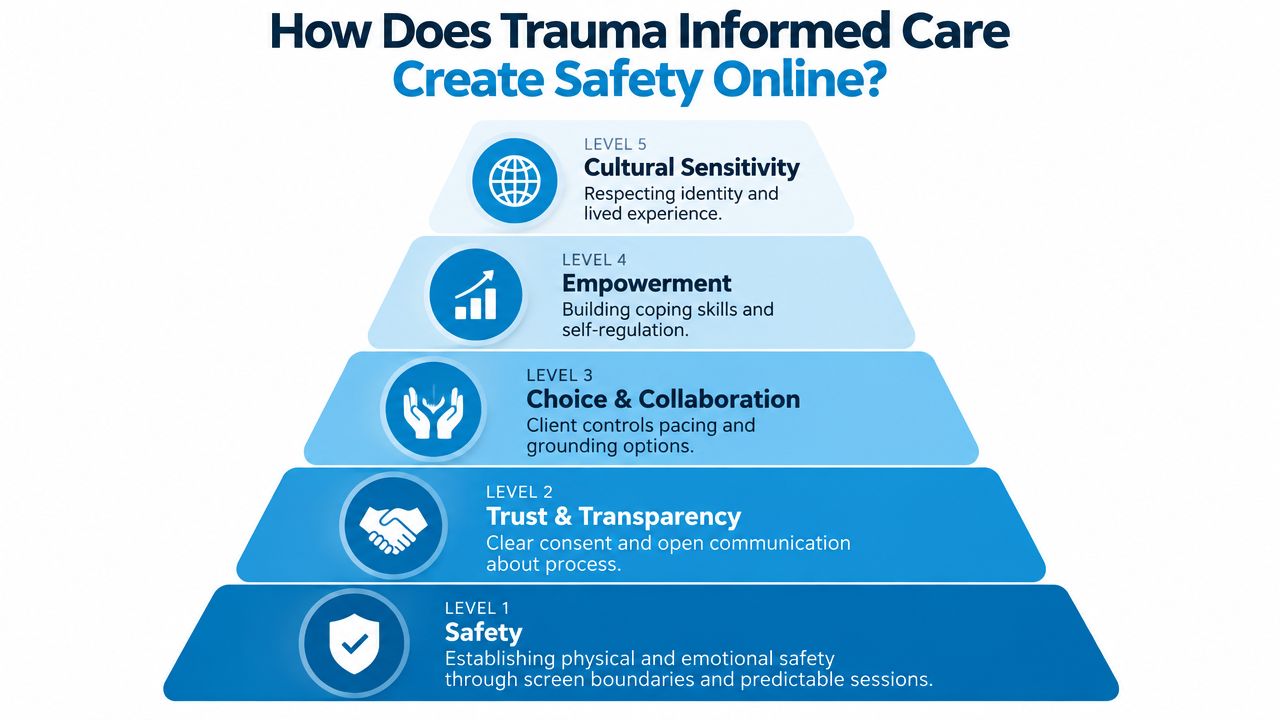
How Does Trauma Informed Care Create Safety Online?
Online trauma-informed care creates safety through predictable boundaries, explicit consent, privacy planning, grounding, client choice, and a clear response plan for emergencies.
Safety starts before trauma processing begins. The therapist confirms where the client is, whether other people can overhear, what happens if the connection fails, and who can be contacted if urgent support becomes necessary. Guidance for trauma-informed telehealth emphasizes a quiet private space, consent for sensitive discussion, and emergency planning before relying on emergency services. (Trauma-informed telehealth safety guidance)
For someone living with roommates or in temporary accommodation, privacy may require creativity. Headphones can help, but they don't solve every risk. A client might schedule the session when housemates are away, sit in a parked car, use a private office, or tell the therapist that privacy isn't available that day.
What does consent look like during an online session?
Consent is an ongoing conversation, not a form signed once. The therapist explains what an exercise involves, asks whether the client wants to continue, and makes it clear that stopping, slowing down, or changing direction is allowed.
Trauma can involve experiences of powerlessness. Offering meaningful choices restores control in the present. A client might choose whether to describe an event in detail, work with a belief first, use grounding, or postpone a particular memory.
How does grounding work through a screen?
Grounding helps the client reconnect with the present before, during, or after emotionally intense work. The therapist might ask the client to notice the chair, name objects in the room, feel both feet on the floor, take a sip of water, or describe the current date and location.
The mechanism is simple. Attention moves away from the trauma memory as an immediate threat and toward present sensory information. The therapist also watches for signs of dissociation, escalating distress, or loss of orientation, then adjusts the pace rather than treating intensity as proof of progress.
Practical rule: A private room, a backup phone, water, tissues, and an agreed pause signal are clinical preparation, not optional accessories.
Therapsy's online therapy service for expats can be considered alongside the same questions a client should ask any provider. The important issue is whether the service makes safety visible and collaborative from the first contact.
Which Evidence Based Modalities Work Online for Trauma?
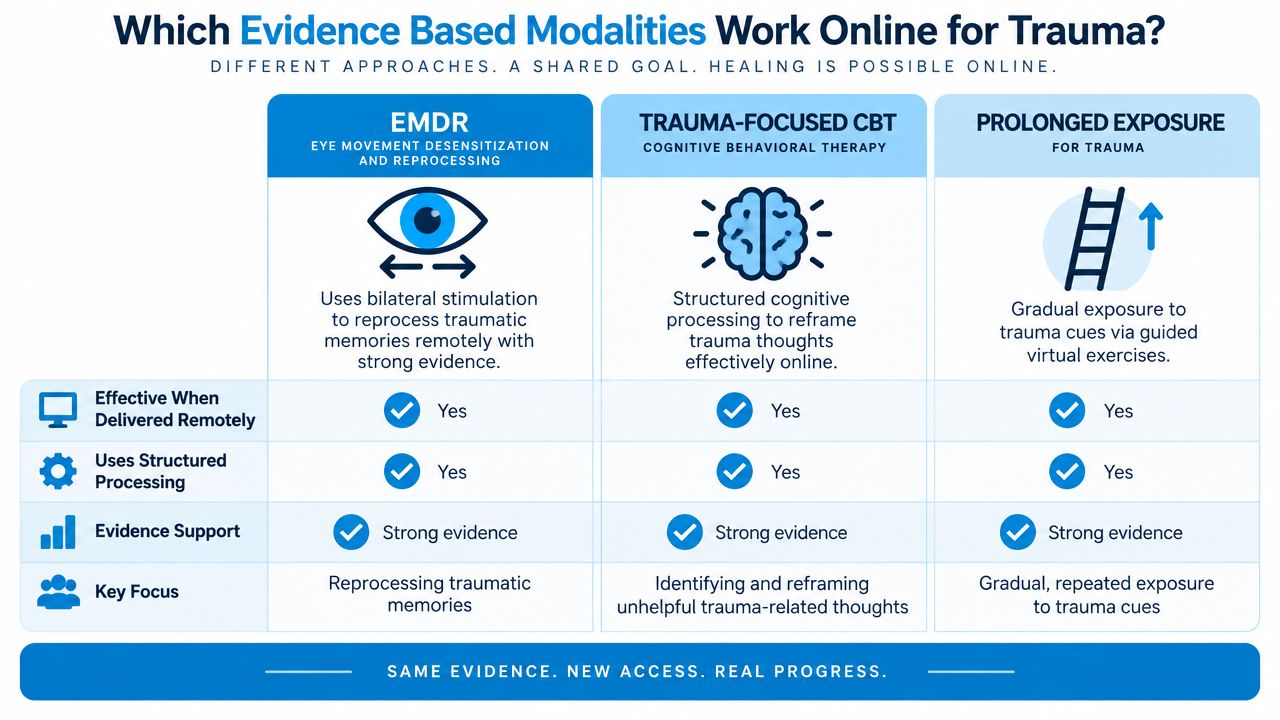
The strongest online evidence supports structured trauma-focused methods, especially Prolonged Exposure and Cognitive Processing Therapy, rather than supportive conversation alone.
Prolonged Exposure, or PE, uses gradual and guided contact with trauma memories or avoided situations. The mechanism is not sudden flooding. A trained therapist helps the client approach material in a planned way, allowing new learning to occur while the feared memory or situation is experienced in a controlled context.
Cognitive Processing Therapy, or CPT, focuses on beliefs that may have developed after trauma, such as guilt, shame, danger, trust, or control. The client and therapist examine how those beliefs affect current life and test whether they still fit the present. This can be particularly relevant for an expat whose trauma-related beliefs interact with migration stress, cultural expectations, or isolation.
Reviews and guidelines identify PE and CPT as safe and effective through videoconferencing. Written Exposure Therapy and Trauma-Focused CBT also have promising support for remote delivery. When face-to-face trauma-focused CBT or EMDR isn't available or acceptable, guided trauma-focused CBT through telehealth is conditionally recommended in PTSD guidance. (PTSD treatment recommendations for telehealth)
Does online delivery change the active treatment?
Online delivery changes the channel, not necessarily the active ingredients. PE still involves planned exposure, CPT still involves cognitive processing, and EMDR still uses bilateral stimulation within a structured protocol.
A 2025 meta-analysis found only a very small difference between video teleconferencing and in-person PTSD treatment, with an effect size of d = 0.06 and a 95% confidence interval from -0.17 to 0.28. That finding indicates near-equivalence in efficacy when the treatment is properly matched to PTSD, but it doesn't mean every client or every online setup will be suitable. (Meta-analysis of video and in-person PTSD treatment)
Why isn't generic supportive counseling always enough?
Supportive therapy can provide validation and stability, and it may be appropriate at certain stages. However, trauma-focused treatment usually requires a method for working with memories, meanings, avoidance, or conditioned fear.
A provider should explain which approach is being considered and why. A client doesn't need to choose a modality alone, but a clear explanation helps distinguish a structured trauma plan from a general conversation that never addresses the patterns keeping distress active. More information about therapy for nervous system regulation can help readers understand how stabilization may support trauma-focused work without replacing it.
How Does EMDR Work in an Online Setting?
Online EMDR uses structured bilateral stimulation through eye movements, touch, sound, or remote-compatible tools while the therapist monitors pacing, attention, orientation, and emotional safety.
A client may follow the therapist's hand across the screen, use a lightbar, tap alternately on the hands or shoulders, listen to alternating tones through headphones, or use a clinician-guided app or website. Self-tapping can be useful when the therapist believes it fits the client and can explain it carefully. (Remote EMDR methods described by the U.S. Department of Veterans Affairs)
The key point is that online EMDR isn't a conversation about trauma. Bilateral stimulation is introduced within an EMDR protocol, with the therapist managing the target memory, the client's attention, the pace of sets, and the return to present awareness.
What does a client need before an online EMDR session?
A stable internet connection and a phone fallback reduce disruption if the video connection drops. The camera should sit near eye level, background distractions should be limited, and the client should have a private space where interruptions are unlikely.
Physical preparation supports emotional regulation. Water and tissues should be nearby, and the therapist may ask the client to remain seated in a position that allows easy orientation to the room. A clear plan should cover what happens if strong emotions continue after the session.
Can intensive trauma care happen fully online?
Fully remote intensive programs have been described as feasible and safe, including programs combining PE, EMDR, physical activity, and psychoeducation. Earlier work also found no significant differences in satisfaction, acceptability, or symptom reduction between telehealth and in-person care in the settings studied. (Evidence on fully remote intensive trauma treatment)
That doesn't mean an intensive format suits everyone. A trained clinician must consider dissociation risk, current stability, physical surroundings, support after sessions, and the client's ability to use grounding strategies between appointments.
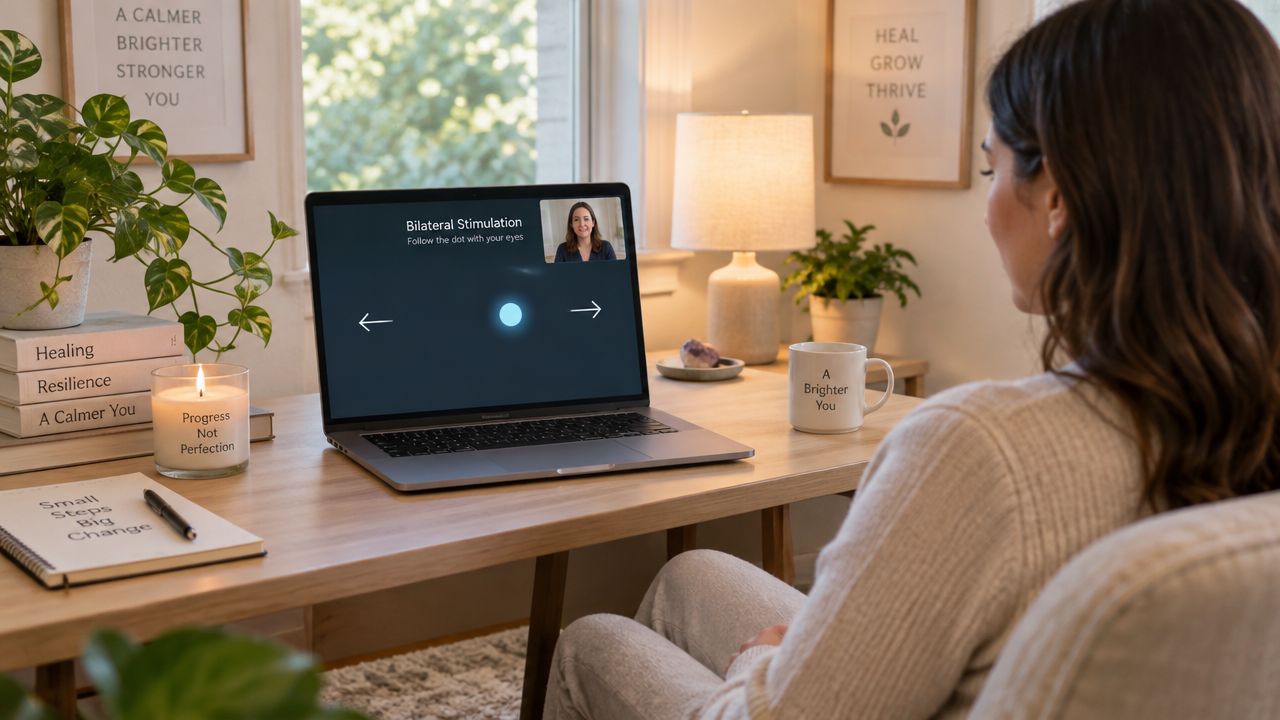
Online EMDR may be appropriate for some clients, but the decision belongs in a careful clinical assessment. A reader can explore the basics of what EMDR therapy involves before discussing personal suitability with a qualified therapist.
Is Online Trauma Therapy as Effective as In Person Care?
Online and in-person trauma therapy can both support structured treatment, but the better choice depends on privacy, clinical suitability, language, access, and the client's ability to feel grounded in the setting.
A national U.S. cohort of veterans receiving trauma-focused evidence-based therapy between April 2022 and April 2023 included 24,447 patients. Of those patients, 74.4% used video telehealth for at least one session, and 66.8% received at least half of their PTSD therapy sessions by video. (National cohort study of video telehealth for trauma-focused treatment)
This adoption data shows that remote trauma care is used in high-volume systems. It doesn't erase the need for clinical judgment. A client without a private room, with an unstable connection, or with symptoms that require more immediate in-person support may need a different arrangement.
| Feature | Online trauma-informed therapy | In-person trauma therapy |
|---|---|---|
| Access | Can connect a client with a language-matched therapist across distance | Depends on local availability and travel |
| Privacy | Requires a controlled room and a backup plan at home | The therapy setting provides the physical environment |
| Pacing | Pauses and grounding can happen in the client's familiar space | Therapist and client share the same physical setting |
| Language fit | Can widen access to therapists who speak the client's native language | May be limited by local language availability |
| Suitable for | Clients who can maintain privacy, connection, and emergency planning | Clients who feel safer with a shared physical setting or need local support |
Is language fit more important than the screen?
For many expats, culturally generic care can be a greater barrier than online care itself. A therapist may understand CBT or EMDR well, yet still miss how migration, racism, religion, family expectations, gender roles, or bilingual communication shape the client's experience.
Schema Therapy can help explore long-standing patterns and unmet needs. Attachment theory can illuminate how separation and unstable relationships affect trust. Cross-cultural psychology helps prevent the therapist from mistaking cultural difference for avoidance, resistance, or pathology.
Online access works best when the clinician also understands the client's language and context. A resource on technology-assisted CBT for social skills and autism illustrates a broader point, digital care still needs adaptation to the person, not only delivery through a device.
When might in-person care be preferable?
In-person sessions may feel more containing for a client who cannot create privacy at home or who becomes disoriented in a remote setting. Some clients also prefer the physical separation between home and therapy, especially when home is associated with conflict or constant demands.
Therapsy offers a choice between online and in-person therapy in Italy for expats, allowing the format to be considered as part of the clinical fit rather than treated as a universal answer.
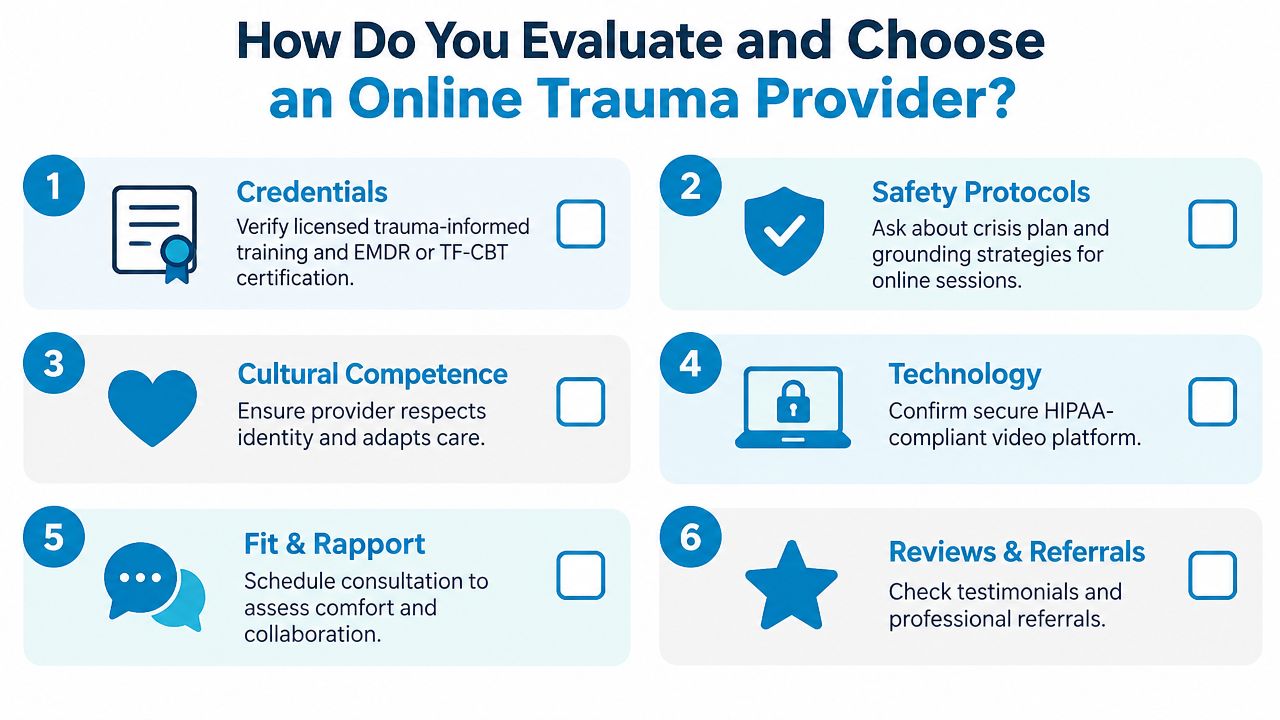
How Do You Evaluate and Choose an Online Trauma Provider?
A suitable online trauma provider should demonstrate trauma-specific training, cultural responsiveness, secure delivery, consent procedures, crisis planning, and a transparent matching process.
The first question is not whether a therapist offers video sessions. It's whether the therapist can explain how trauma work will be paced, how distress will be managed, and how the treatment will be adapted to the client's language and cultural background.
What should a client ask before starting?
A short consultation can clarify practical and clinical fit. Useful questions include:
- Training: Does the therapist have focused training in trauma-informed care and the specific method being proposed, such as EMDR, PE, CPT, or Trauma-Focused CBT?
- Pacing: How will the therapist know when to stabilize, pause, or begin trauma processing?
- Privacy: What does the provider recommend if the client lives with roommates, family, or children?
- Crisis planning: What information is collected about the client's location, emergency contact, and backup support?
- Measurement: Does the therapist use validated PTSD measures at baseline and follow-up to monitor change?
- Language and culture: Can the therapist work in the client's native language and discuss migration or cultural identity without assumptions?
Validated measures don't predict an individual outcome. They provide a shared way to track symptoms and discuss whether the current plan appears useful. A client should also be told that therapy doesn't replace medical care when medical or psychiatric support is needed.
Why does human matching matter for trauma therapy?
Trauma work depends heavily on trust, pacing, and the client's felt sense of safety. A questionnaire can collect preferences, but it can't fully understand the meaning of a client's language, migration history, identity, or reaction to a particular therapist.
At Therapsy, matching is handled by the Clinical Director rather than an algorithm. The service works with 50+ therapists across 14 languages, including Italian, British and American English, French, Spanish, German, Portuguese, Ukrainian, Russian, Greek, Arabic, Urdu, Hebrew, and Hindi. Clients can choose online or in-person sessions across 21 Italian cities and 80 physical locations.
Therapsy reports 1,500+ clients and 13,000+ sessions since 2023, with a Trustpilot rating of 4.8/5, “Excellent.” The service states that first contact happens within 12 hours, and the first assessment call is free. Individual therapy starts from EUR 70, while the final price depends on the therapist's experience and specialization.
How should the client prepare the room?
The client can check the door, headphones, camera position, connection, water, tissues, and phone fallback before the first trauma-focused session. If privacy changes unexpectedly, the client should tell the therapist immediately rather than trying to continue.
A calm setup doesn't need to be perfect. It needs to be predictable enough for the client and therapist to notice changes in distress, maintain communication, and return attention to the present when necessary.
Frequently Asked Questions About Trauma Informed Therapy Online
Is trauma therapy online private in shared housing?
Online therapy can be private in shared housing when the client uses a room where conversations cannot be overheard and agrees on a practical interruption plan. Headphones, scheduling, and a trusted signal can help, but the therapist should know if privacy isn't reliable so the session can be adapted.
What happens if a client becomes overwhelmed during a session?
The therapist can pause trauma processing and use grounding to reconnect the client with the present room, body, and surroundings. The session may then return to stabilization, end earlier, or continue only if the client is oriented and willing.
How long does it take to know whether online trauma therapy helps?
There isn't one timetable that applies to every person or every trauma history. The therapist can discuss goals, monitor symptoms with validated measures when appropriate, and review whether the pace, modality, language, and therapeutic relationship remain suitable.
Does a client need to speak Italian to access trauma therapy in Italy?
A client doesn't necessarily need to speak Italian if a therapist can provide care in a language the client understands comfortably. Therapsy's network includes 14 languages, so multilingual expats, international students, and Italians abroad can ask about language-matched support.
Can online trauma therapy replace psychiatric or medical care?
Therapy doesn't replace medical care, psychiatric assessment, or emergency support when those services are needed. A trauma therapist can coordinate recommendations with appropriate professionals, while the client should use local emergency services for an immediate emergency.
Is the first conversation a commitment to continue?
The first call can be used to discuss the client's needs, language, preferred format, and questions about trauma-informed care. At Therapsy, the first call is free and takes place with the therapist chosen for that person, with no obligation to continue.
Therapsy connects expats with human-matched therapists chosen by the Clinical Director, offers therapy in the client's own language across 14 languages, and provides both online and in-person sessions in Italy. Readers can visit Therapsy to request a free first call with the selected therapist and decide without obligation whether continuing feels right.