Some women arrive in Italy expecting relief and find themselves carrying more tension instead. You might be living in Milan or Florence, speaking English all day in a place that still doesn't quite feel legible, smiling through dinners, paperwork, and polite conversations while your body stays on alert. Sleep is light. Irritability comes fast. Certain interactions feel bigger than they should.
Sometimes that emotional weight is culture shock. Sometimes it's burnout. Sometimes it's grief. And sometimes it's trauma, including trauma that existed long before the move and only became harder to manage once your familiar supports disappeared.
Trauma informed therapy for women is a therapeutic approach that recognises how trauma affects the mind, body, relationships, and sense of safety, and then adapts care so healing happens without pressure, judgement, or re-traumatisation. For expat women in Italy, that care often needs one more layer: cultural understanding. The right therapist doesn't only ask what happened. She also understands what it means to recover while navigating immigration stress, language barriers, identity shifts, and a healthcare system that may feel unfamiliar.
I'm Dr. Francesca Adriana Boccalari, Clinical Director at Therapsy. In clinical work with international women, I often see the same painful pattern. A woman assumes she should feel grateful because she lives in a beautiful country, yet privately she feels more fragile, more lonely, and less like herself. If you're trying to make sense of that gap, this guide will help you understand what trauma-informed care looks like, what tends to help, and how to find support from an expat therapist in Italy who can meet you with both clinical skill and cultural sensitivity.
A Guide to Healing for Expat Women in Italy
An American woman relocates to Italy for work, love, study, or a fresh start. From the outside, her life may look enviable. Inside, she feels unsettled in ways she can't explain. She starts avoiding crowded trams. A routine medical appointment leaves her shaken for days. A partner's raised voice lands in her body like danger, even when she knows the context is different.
That doesn't always mean she's “overreacting”. It often means her nervous system is interpreting the present through the lens of past experience.
When Italy looks beautiful but doesn't feel safe
Trauma rarely announces itself neatly. Some women recognise a history of assault, abuse, or coercion immediately. Others only notice symptoms:
- Persistent hypervigilance that makes ordinary tasks feel effortful
- Emotional numbness that turns pleasure into distance
- Shame and self-doubt that grow louder after relocation
- Relationship strain because trust feels hard to sustain
- Body-based distress such as tension, exhaustion, or sudden panic
In expat life, those symptoms often become more visible. You're farther from your usual anchors. Friends and family may be in another country. You may not know how to seek help in Italian, or whether a local therapist will understand your cultural frame.
Healing often begins when a woman stops asking, “What is wrong with me?” and starts asking, “What happened to me, and what do I need to feel safe again?”
Why specialised support matters
General therapy can be helpful. But trauma informed therapy for women is different because it respects pace, consent, and context. It doesn't rush disclosure. It doesn't assume that insight alone will calm a dysregulated body. And it doesn't treat a woman's coping strategies as flaws when they may have developed for survival.
For many expat women in Italy, the most useful care is both trauma-informed and culturally attuned. That means the therapist can hold two realities at once. Your symptoms may be linked to trauma, and the move abroad may be amplifying them.
Understanding Trauma in the Female Expat Experience
Trauma is often misunderstood as a single catastrophic event. In practice, it can also come from repeated experiences that overwhelm your sense of safety, dignity, or control. For women, especially women living abroad, that distinction matters.

Trauma is not only one dramatic event
Some women can point to one clearly defined experience. Others carry the impact of many smaller injuries over time. Both can leave deep marks.
Common forms of trauma in the female expat experience include:
- Gender-based violence including harassment, coercion, assault, or abuse in intimate relationships
- Medical or perinatal trauma such as feeling dismissed, powerless, or frightened in a foreign healthcare setting
- Relational trauma from betrayal, chronic invalidation, or controlling dynamics
- Developmental trauma rooted in earlier family experiences that resurface under stress
- Identity trauma linked to the loss of role, competence, language, community, or financial autonomy after relocation
Globally, nearly 1 in 3 women have been subjected to physical or sexual intimate partner violence or non-partner sexual violence in their lifetime according to the World Health Organization fact sheet on violence against women.
Moving abroad doesn't erase that reality. For some women, distance from home can reduce support and increase confusion about where to turn.
Why expat life can intensify old wounds
Relocation changes more than geography. It changes how supported, competent, and visible you feel. Trauma symptoms often grow louder when the nervous system is under extra strain.
A few expat-specific pressure points stand out:
- Language vulnerability makes it harder to advocate for yourself, especially in medical, legal, or family situations
- Isolation reduces the casual protective presence of friends, relatives, and familiar institutions
- Different gender norms can create uncertainty about what is acceptable, expected, or safe
- Dependency shifts may leave a woman more reliant on a partner, employer, or local network than she wants to be
- Loss of professional identity can trigger shame, helplessness, or old beliefs about worth
Women who relocate for a relationship often describe another layer of difficulty. Their world can become smaller very quickly. If that sounds familiar, work around trailing spouse depression can overlap significantly with trauma treatment, because both involve grief, dependency, and a disrupted sense of self.
Signs your distress may be trauma-related
Trauma doesn't always look like flashbacks. It can also show up as patterns that seem unrelated at first.
You might notice:
- You feel unsafe without knowing why.
- You overprepare for ordinary interactions.
- You shut down when conflict appears.
- You minimise painful experiences because others “had it worse”.
- Your body reacts before your mind catches up.
If you recognise yourself here, that doesn't label you. It gives language to what your system may have been carrying for a long time.
What Trauma-Informed Care Actually Means
“Trauma-informed” is often used loosely. In therapy, it should mean something concrete. It's not a branding word. It's a clinical stance.
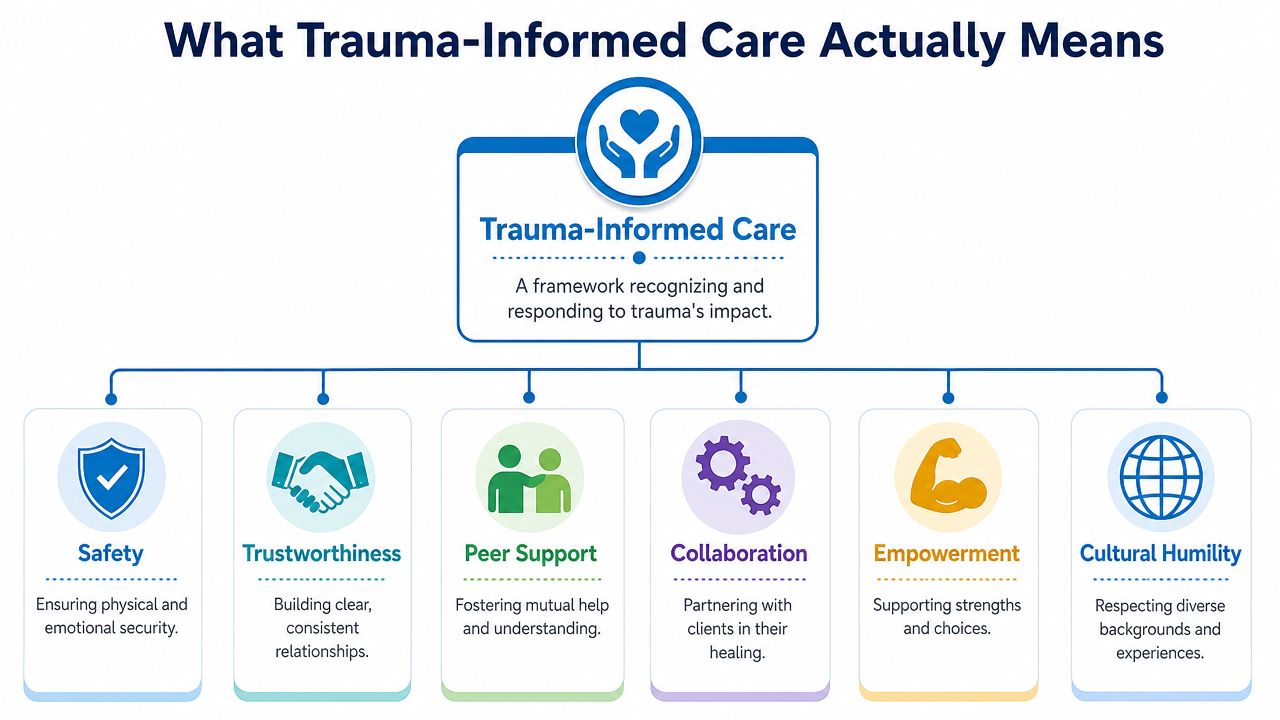
Trauma-informed care means the therapist understands that healing requires safety before depth, choice before exposure, and collaboration instead of control.
Dr. Francesca Adriana Boccalari
The principles you should be able to feel in the room
A therapist may not recite these principles aloud, but you should experience them.
Safety
Safety is emotional as much as physical. The therapist notices overwhelm, helps you slow down, and doesn't push for disclosure before you're ready.
In practice, that may mean pausing when your body tenses, grounding before difficult material, or deciding together what is and isn't discussed in a session.
Trustworthiness
Trauma often damages trust. Good therapy repairs it through consistency and clarity.
You should know how sessions work, what confidentiality means, how fees are handled, and what to expect if you become distressed between sessions. Ambiguity can feel destabilising for trauma survivors.
Peer support
Not every trauma process includes group work, and it doesn't need to. But the principle matters. Shame reduces when women realise their responses are understandable and shared by others with similar histories.
Sometimes this appears in psychoeducation. Sometimes in referrals. Sometimes in the simple relief of hearing that your reactions make sense.
Collaboration
A trauma-informed therapist doesn't position herself as the authority over your inner life. She brings training. You bring lived experience.
That changes the tone of therapy. Rather than “this is what we're doing to you”, the process becomes “this is what we're noticing together”.
Empowerment, voice, and choice
This principle is essential. You can say no. You can slow down. You can ask why a technique is being used. You can choose not to revisit a memory until you have more stability.
If therapy leaves you feeling repeatedly overexposed, confused, or coerced, the problem may not be you. The pace may be wrong.
Cultural humility is not optional
For expat women, trauma-informed care also needs cultural humility. A therapist may understand trauma well and still miss the impact of migration, language, race, religion, or intercultural relationships.
That's one reason body-based stabilisation work can be so valuable early on. Before trauma processing, many women benefit from support with grounding, pacing, and nervous system regulation therapy so they can stay present without becoming flooded.
What does not work well
Certain approaches tend to be unhelpful, especially at the start:
- Pressuring for the whole story before trust exists
- Treating coping strategies as resistance rather than survival responses
- Using generic reassurance when the body is in alarm
- Ignoring cultural context and assuming all women experience safety in the same way
A good trauma-informed therapist knows that insight matters, but regulation matters too.
Evidence-Based Therapies for Healing Trauma
Not every therapy helps trauma in the same way. Some approaches are supportive but too general for deeper trauma work. Others are specifically designed to reduce the emotional charge of traumatic memories, challenge trauma-linked beliefs, or help the body come out of survival mode.
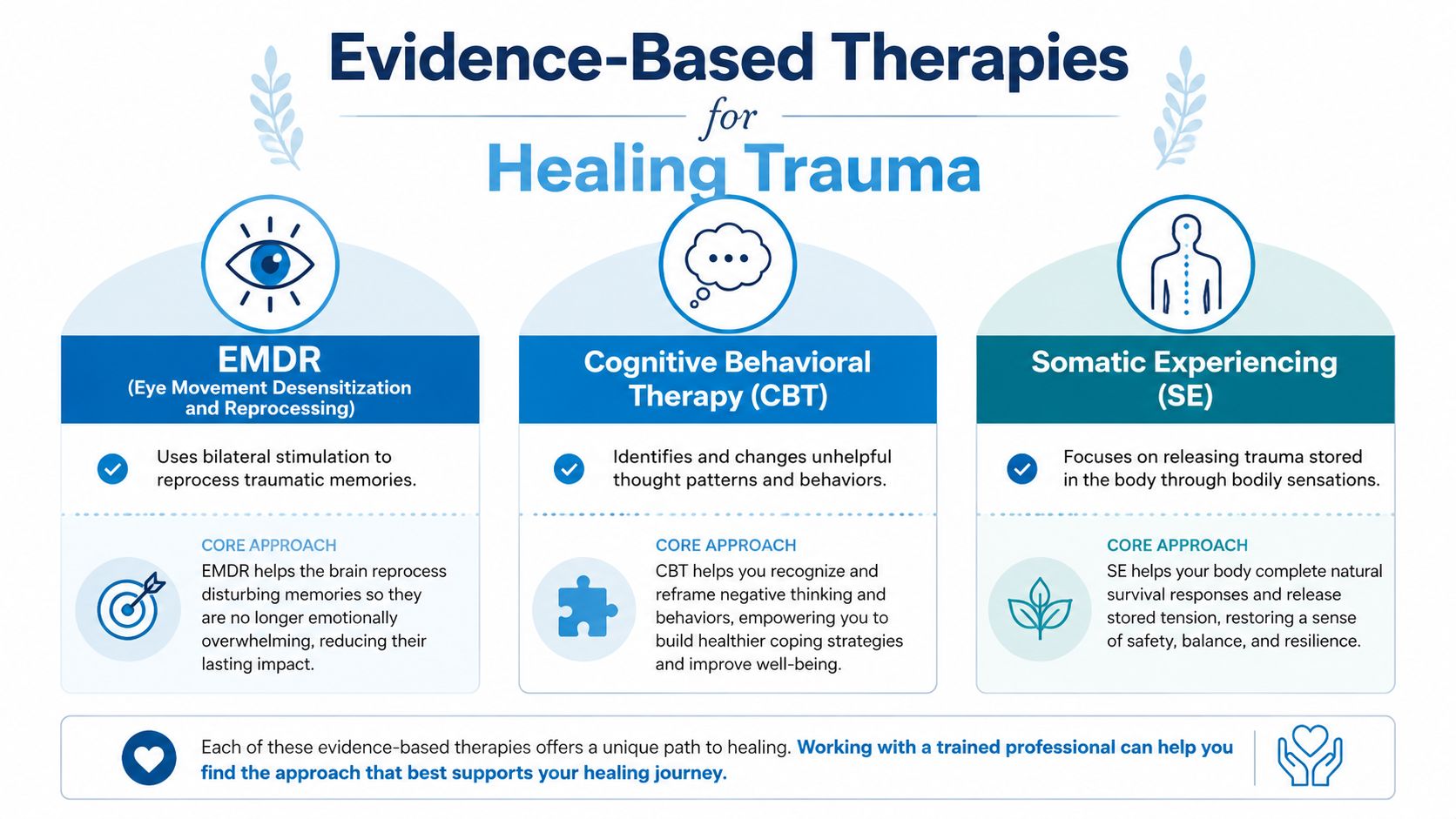
The American Psychological Association conditionally recommends several therapies for PTSD, including EMDR and Trauma-Focused CBT, as outlined in the APA guideline on PTSD treatments.
That matters because women looking for trauma therapy in Italy often want what many American clients already ask for. They want an approach with a clear rationale, not vague advice to “just talk about it”.
EMDR
EMDR stands for Eye Movement Desensitisation and Reprocessing. It helps the brain process disturbing memories that remain stuck in an emotionally raw form.
As a certified EMDR therapist, I often explain it this way. EMDR doesn't erase memory. It changes the way the memory is stored and experienced, so it becomes less overwhelming in the present.
A session typically includes careful preparation, identifying target memories, and using bilateral stimulation such as eye movements or tapping while the client notices thoughts, emotions, and body sensations. For many women, EMDR is particularly useful when:
- A memory feels vivid and intrusive
- Certain triggers produce a fast body reaction
- A painful experience still carries shame, fear, or helplessness
- Talking in detail feels too activating
For expats seeking this modality specifically, it can help to work with someone experienced in EMDR therapy for expats in Italy, because the treatment needs to account for both trauma history and current relocation stress.
Trauma-Focused CBT
Trauma-Focused Cognitive Behavioural Therapy helps clients notice how trauma shapes beliefs, emotions, and behaviour. It is structured, practical, and often reassuring for women who want a framework.
Trauma can create rigid conclusions such as:
- “It was my fault.”
- “I can't trust anyone.”
- “If I relax, something bad will happen.”
TF-CBT works by identifying these patterns and helping the client develop more accurate, compassionate interpretations. It also includes coping strategies that improve emotional regulation and reduce avoidance.
This approach tends to work well for women who appreciate clear tools, homework, and language-based reflection. It may be less suitable as a first step if someone is highly dissociated, severely dysregulated, or unable to stay within a tolerable emotional range without more stabilisation first.
Somatic therapies
Trauma lives in the body as much as in memory. Some women understand their story well but still feel trapped in physical alarm, collapse, or numbness.
Somatic therapies focus on bodily sensations, movement, tension patterns, breath, and the nervous system's incomplete survival responses. The work is often slower and less verbal than CBT. That can be a relief for women who are tired of explaining themselves but still feel activated.
Somatic work may help when:
| Approach | What it targets | What it can feel like |
|---|---|---|
| EMDR | Distressing memories and triggers | Structured reprocessing with careful pacing |
| TF-CBT | Trauma-linked thoughts and behaviours | Practical, organised, skills-based |
| Somatic therapy | Physical activation, shutdown, and body memory | Grounding, tracking sensation, restoring regulation |
What usually works better than generic talk therapy
Supportive talking helps many people. But trauma treatment usually needs more than empathy alone. Women often improve most when therapy includes:
- Stabilisation first before intensive processing
- A clear method suited to the type of trauma
- Pacing that protects the nervous system
- Attention to body responses, not only thoughts
- Room for cultural meaning, especially in migration and gendered experiences
If you want a concise outside overview of trauma modalities, EMDR and CPT for trauma recovery gives a useful summary of how structured trauma therapies differ.
Finding a Genuinely Trauma-Informed Therapist in Italy
The hardest part for many expat women isn't deciding they need help. It's figuring out who is reliably qualified to provide it. In Italy, that search can be complicated by language, differing professional titles, and websites that use the word “trauma-informed” without much substance behind it.
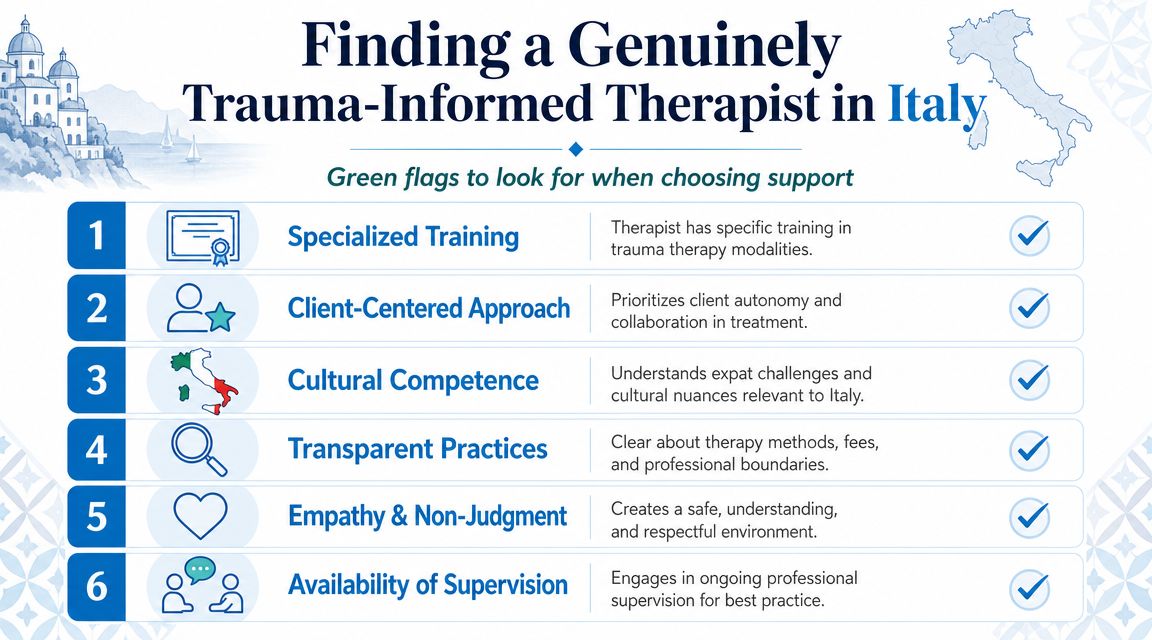
Green flags that matter
A strong therapist fit often becomes visible before the first full session. Pay attention to how the therapist describes her work and how you feel while speaking with her.
Look for these signs:
- Specific trauma training in approaches such as EMDR, CBT, Schema Therapy, or other recognised trauma modalities
- A clear explanation of process so you understand pace, confidentiality, and what early sessions will focus on
- Respect for consent including your right to pause, decline, or redirect the conversation
- Comfort with complexity rather than a rush to simple labels
- Awareness of expat realities including isolation, bureaucracy, relationship dependency, and identity disruption
- Ongoing supervision because trauma work benefits from clinical reflection and accountability
Questions worth asking in a consultation
You don't need to impress a therapist. You need to assess whether she can help you safely.
Useful questions include:
- What training do you have in trauma treatment?
- How do you help clients feel safe before going into difficult memories?
- How do you work with women living abroad or navigating cultural transition?
- What do you do if a client becomes overwhelmed in session?
- How collaborative is your approach?
Fluent English is helpful. Cultural understanding is equally important. A therapist can speak your language and still miss your lived context.
Why the expat context changes the standard
For American women in Italy, linguistic competence is only one part of the fit. Many women want a therapist who understands why US-based expectations around boundaries, consent, diagnosis, or evidence-based treatment may differ from what they encounter locally.
A multilingual service can reduce friction. One practical option is an English-speaking trauma therapist in Italy. Therapsy works with licensed multilingual therapists, offers online and in-person sessions across Italy, and uses human matching overseen by Dr. Francesca Adriana Boccalari rather than automated questionnaires. That kind of process can be especially useful when trauma history, language preference, and cultural fit all matter at once.
Red flags to take seriously
Be cautious if a therapist:
- Minimises your concerns because your life “looks good”
- Pushes disclosure too quickly
- Avoids answering questions about training
- Seems uncomfortable with power dynamics, abuse, or gendered experiences
- Treats cultural stress as irrelevant background noise
A good fit doesn't mean instant comfort. It means you feel respected, understood, and not hurried.
Your Safety and Well-being Come First
In trauma therapy, safety is not a soft extra. It is the treatment foundation. If you don't feel sufficiently safe, your nervous system will stay organised around protection rather than healing.
What psychological safety looks like
Psychological safety means you can speak, pause, disagree, or become emotional without fearing judgement or loss of control. It also means the therapist can help you stay within a manageable level of activation.
That often looks like:
- Predictable sessions with clear beginnings, endings, and boundaries
- A non-judgemental stance toward your reactions, coping patterns, or ambivalence
- Grounding tools when distress rises too quickly
- Permission to go slowly rather than diving into detail on demand
Many women know they're in the right room when they notice a simple shift. They stop performing competence. They start paying attention to what they feel.
Healing doesn't require you to recount every painful event immediately. It requires enough safety for your mind and body to stop bracing against the process itself.
The therapeutic relationship is part of the treatment
For trauma survivors, the relationship with the therapist often becomes one of the first places where trust is rebuilt. That doesn't happen through warmth alone. It happens through attunement, consistency, and repair when something feels off.
What tends to help:
- The therapist notices subtle signs of overwhelm
- Misunderstandings can be discussed openly
- You are not punished for needing time, distance, or clarification
- The therapist remains steady without becoming emotionally intrusive
What tends not to help:
- Interpretations delivered too early
- Pressure to be a “good client”
- Overidentification or blurred professional boundaries
- A pace that leaves you destabilised after session
Why supervision matters in trauma work
Trauma therapy asks a lot of a clinician. Good therapists need space to reflect on complex cases, monitor blind spots, and maintain high standards of care.
Clinical supervision supports that process. It strengthens judgement, protects clients, and helps therapists respond thoughtfully when trauma histories involve migration, attachment wounds, dissociation, abuse, or intercultural relationships.
At Therapsy, all therapists work under the supervision of the Clinical Director, Dr. Francesca Adriana Boccalari. For clients, that adds an extra layer of oversight and continuity, which can be especially reassuring when you're seeking help in a country that still feels unfamiliar.
How to Start Your Healing Journey
The first step doesn't need to be dramatic. It only needs to be clear enough to take. For many women, that means booking one consultation and noticing how their body feels during and after the call.
Questions you can bring to a first conversation
You don't need the perfect script. A few grounded questions are enough:
- What is your experience working with trauma survivors?
- How do you make sure sessions feel safe and manageable?
- What approaches do you use for trauma, such as EMDR or CBT?
- Have you worked with expat women or intercultural issues before?
- What happens if I'm not ready to talk about the most painful parts yet?
A simple way to judge the fit
After a consultation, ask yourself:
- Did I feel listened to without being pushed?
- Did the therapist explain things clearly?
- Did I feel safer, or more confused?
- Could I imagine telling the truth here, gradually?
Those answers matter.
If you're looking for support in Italy, a free first assessment call can make the process less intimidating. It gives you space to be heard, ask practical questions, and understand what kind of help may fit without committing before you're ready.
FAQ
Is trauma informed therapy for women different from regular therapy?
Yes, it is different in important ways. Trauma-informed therapy adapts the pace, structure, and relationship to account for how trauma affects safety, trust, and the nervous system. Regular therapy can still be helpful, but it may not always address trauma responses with enough care or precision.
Can I start trauma therapy even if I'm not sure what happened to me “counts” as trauma?
Yes, you can. Many women begin therapy with confusion rather than certainty, especially when their distress comes from repeated invalidation, coercion, medical experiences, or relationship patterns rather than one single event. A qualified therapist helps you explore the impact without forcing a label.
Do I need EMDR, or can another approach work?
No, you don't automatically need EMDR. EMDR can be very effective for many trauma survivors, but the right approach depends on your symptoms, stability, preferences, and goals. Some women benefit more from CBT, somatic work, or a phased combination of methods.
Is online trauma therapy effective for expat women in Italy?
Yes, online trauma therapy can work well when it is structured carefully. For many expat women, online sessions offer privacy, continuity, and access to the right language and specialisation even if they live outside a major city. The key issue is not only format, but therapist fit and clinical skill.
How do I know if a therapist in Italy understands American cultural expectations around therapy?
Ask directly. You can ask about their experience with American clients, how they explain treatment, and whether they use evidence-based modalities such as EMDR or CBT. Their answer should sound clear, respectful, and familiar with cross-cultural differences rather than defensive or vague.
What if I feel worse after a session?
That can happen sometimes, but it shouldn't become the norm without discussion. Trauma work can stir emotions, yet a good therapist helps you understand what is happening, adjust the pace, and build enough regulation so the process remains manageable. If you regularly leave feeling flooded or disorganised, raise it early.
Is it possible to find therapy in my own language in Italy?
Yes, it is possible. Many expats start with English, but some women feel safer processing trauma in their first language or in a language tied less strongly to painful experiences. Language choice matters because trauma work often depends on nuance, emotional precision, and felt safety.
Book your first free assessment call, no commitment, just a conversation with our Clinical Director who will listen and match you with the right therapist for you. Visit Therapsy.