Schema Therapy is an integrative therapy developed by Jeffrey Young in the mid-1980s and first introduced in 1990, designed to heal deep emotional patterns formed when core needs weren't met early in life. It combines cognitive, behavioral, attachment-based, and experiential techniques to change how a person reacts to current triggers, not just how they think about them.
Therapsy is a multilingual psychotherapy service in Italy that connects expats with therapists who speak their native language.
For many expats, the problem is familiar, even if the setting is new. Life looks stable on the outside, but the same reactions keep returning, like panic after a small disagreement, shutdown in relationships, or exhaustion that never fully lifts.
What Is Schema Therapy and Why Does It Matter?
Schema Therapy is a structured way to work on long-standing emotional patterns that keep getting activated in daily life. It matters because insight alone often isn't enough when someone can explain a pattern but still feels trapped inside it.
A person living in Italy might know they're safe, competent, and doing well, yet still feel rejected after a delayed reply, or guilty after setting a boundary at work. That gap between knowing and feeling is where Schema Therapy often begins. It looks at how earlier unmet needs shaped the emotional “rules” someone still follows in adult life, especially in relationships, self-worth, and stress.
Therapsy often meets people at exactly that point, when they're functioning but still not feeling free. For expats, the strain can intensify because language, culture, and identity are all under pressure at once. A therapist who understands both emotional patterns and cross-cultural adjustment can make the work feel more precise and less isolating.
Why do repeating patterns feel so hard to break?
They feel familiar, even when they hurt. Schema Therapy assumes that old emotional patterns can subtly steer what feels normal, safe, or expected.
That's why someone may keep overworking to avoid criticism, choose unavailable partners, or withdraw before anyone can reject them. The pattern isn't treated as a character flaw. It's understood as an adaptation that once made sense, even if it now causes pain.
Practical rule: if a reaction feels bigger than the situation, the trigger may be touching an older pattern rather than only the present event.
For readers who want a more direct clinical path, Therapsy also offers a dedicated introduction to Schema Therapy for anxiety and depression, which can help make the approach easier to place among other options.
How Do Early Maladaptive Schemas and Modes Work?
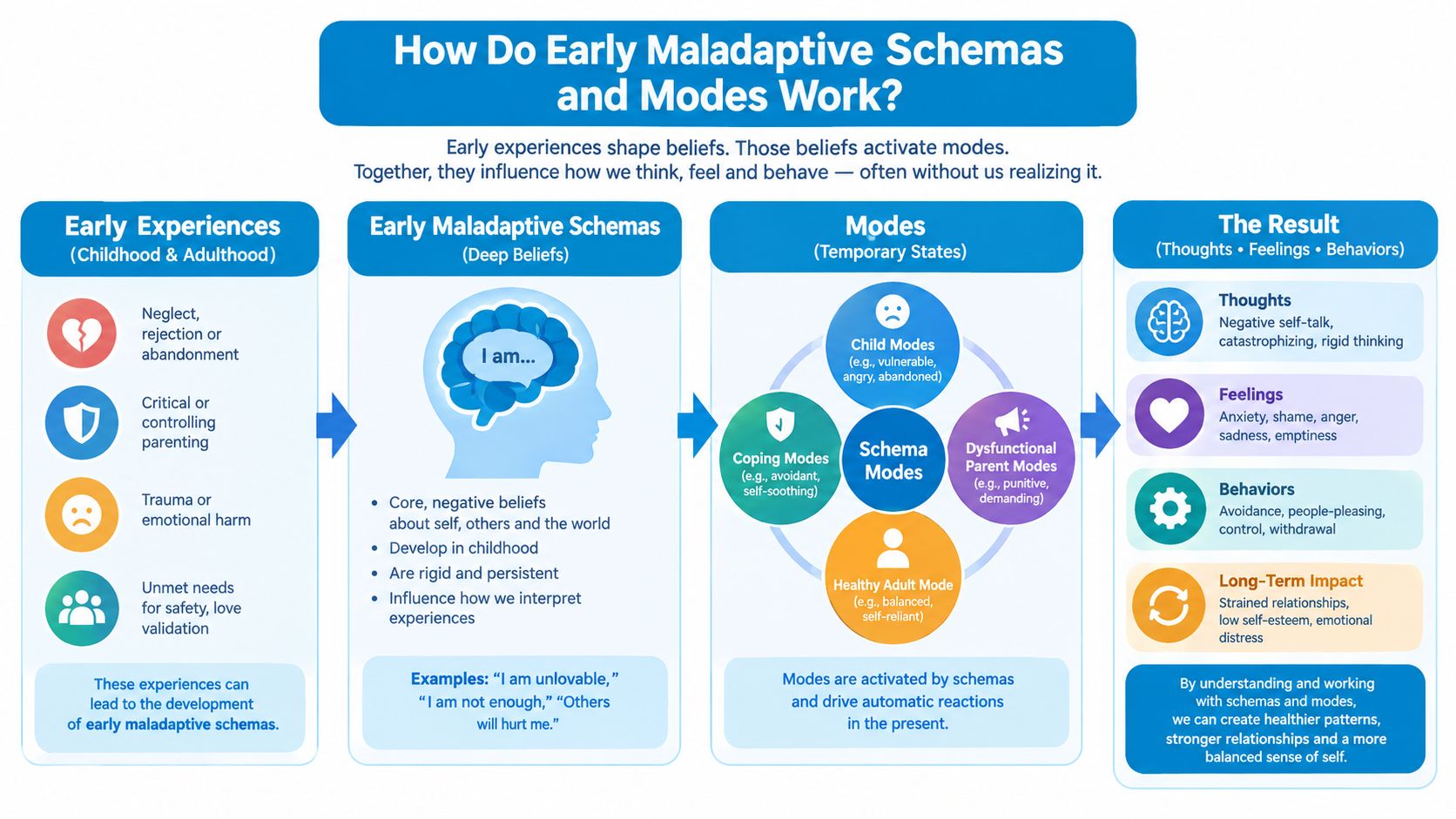
Schemas are deep emotional patterns, and modes are the momentary states that get activated when life presses the right button. That distinction is the core of the model.
Think of schemas like the operating system on a device. They run in the background and shape how new experiences get processed. Modes are more like the apps that open in the foreground during a stressful moment, the part that speaks, reacts, hides, pleases, or attacks.
The literature describes 18 early maladaptive schemas, grouped into five domains [https://www.schematherapyassociation.org/schema-therapy/]. These are long-standing patterns formed around unmet emotional needs, and they tend to organize how someone interprets closeness, criticism, rejection, and responsibility. The same person can carry several schemas at once, which is why reactions often feel layered rather than simple.
What happens when a schema gets triggered?
A trigger activates a state, and that state changes thought, feeling, and behavior in real time. The reaction can be fast enough to feel automatic.
A colleague's neutral comment can spark shame. A partner's silence can wake up abandonment fear. A crowded room in a new country can activate social exclusion, even when no one is excluding anyone. Schema Therapy treats those reactions as meaningful signals, not exaggerated drama.
That's why treatment works on both levels at once. It aims to soften the older schema, while also helping the person notice the current mode before it runs the whole response. Therapsy therapists who use this approach often describe it as learning to recognize what has been touched before the reaction becomes the whole story.
Why does mode language help?
Mode language makes inner experience easier to name without turning it into identity. A person is not “a mess,” they may be in a vulnerable, angry, detached, or overcompensating state.
That naming matters in therapy because it reduces shame and creates distance. It also helps the therapist and client work with the immediate crisis behavior without losing sight of the older wound underneath it.
If a reader wants to connect this with early emotional development, inner child work in therapy gives a useful bridge, especially for people who feel a strong emotional reaction but don't yet have the words for it.
What Happens During a Schema Therapy Session?
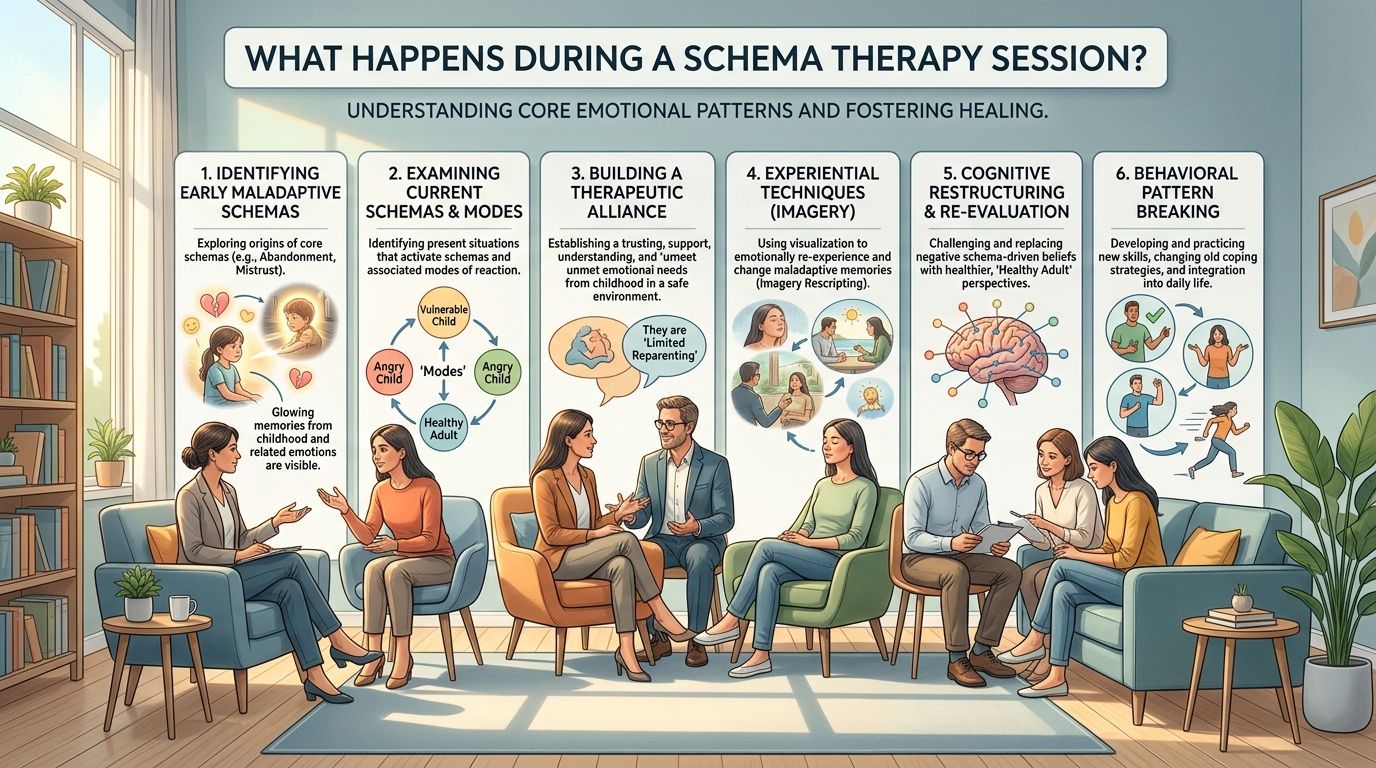
A schema therapy session usually moves between understanding the pattern, feeling it in the room, and practicing a different response. The work is structured, but it's not shallow.
A therapist might begin by tracking a recent trigger, then connect it to earlier experiences and the emotional needs that were missed. From there, the work can shift into experiential methods, not just conversation. The client may be asked to notice what the younger, hurt part of them feels, or to identify the inner critic that follows immediately after.
One useful method is imagery rescripting. The therapist invites the client to revisit a memory in a guided way, then helps bring in the care, protection, or validation that was missing at the time. Another is chair work, where different parts, such as the critic, the vulnerable part, and the healthier adult response, are spoken from separate positions.
Therapsy clinicians who use Schema Therapy often emphasize the relationship itself as part of the treatment. For expats, that can matter a lot, because the feeling of being understood in one's own language can lower the effort needed to stay emotionally present.
What does limited reparenting mean in practice?
Limited reparenting means the therapist offers a stable, caring, boundaried relationship that corrects old expectations. It doesn't mean acting like a parent in real life.
It means the therapist responds in a way that is emotionally reliable, especially when the client expects criticism, dismissal, or distance. Over time, that consistency can help the client internalize a steadier way of treating themselves. A lot of healing in Schema Therapy happens because the person experiences care while talking about exactly the places where care used to be missing.
Healing often starts when the client can stay with a painful feeling without being abandoned by the process.
For readers who are curious about the broader service context, Therapsy also offers therapy in Italy for expats, which can be a practical starting point for someone unsure how to begin.
Who Benefits Most From This Therapeutic Approach?
Schema Therapy tends to help people who understand their problems intellectually but still feel stuck emotionally. That's especially true when the same patterns keep appearing across work, friendships, dating, or family life.
The evidence base is strongest for complex, chronic presentations, especially personality disorders, and later reviews have expanded the picture. A 2023 meta-analysis found a moderate effect on personality disorder symptoms with g = 0.359, quality-of-life improvement with g = 0.256, and reduction in early maladaptive schemas with g = 0.590 [https://www.tandfonline.com/doi/abs/10.1080/08039488.2023.2228304]. The same review reported stronger effects for group schema therapy than individual schema therapy on personality disorder symptoms, with g = 0.859 versus g = 0.163 [https://www.tandfonline.com/doi/abs/10.1080/08039488.2023.2228304].
That kind of data matters, but the bigger story is practical. Schema Therapy is no longer useful only for severe diagnosis-centered cases. It's also being applied to younger adults dealing with identity strain, burnout, self-esteem problems, relationship conflict, anxiety, depression, and the pressure of starting over in a new culture.
A 2025 review of young people synthesized 12 studies involving 180 participants aged 12 to 30 and found symptom reduction and quality-of-life gains across studies [https://www.tandfonline.com/doi/full/10.1080/16506073.2025.2522375]. That broadens the picture considerably. It suggests the model can be relevant when the central issue is not a label, but a repeating emotional pattern that has outlived the context in which it began.
Why does expat life activate old patterns so easily?
Because relocation stresses the very systems that schemas tend to organize. Belonging, identity, and safety all get tested at once.
A person may arrive in Italy for work, study, or love, then find themselves exhausted by language effort, confused by social norms, or lonely in a crowd. Those conditions can activate schemas around defectiveness, social exclusion, abandonment, or unrelenting standards. What looks like simple adjustment can feel much deeper inside.
That's where a transdiagnostic lens helps. It doesn't force every struggle into one diagnosis. It asks what pattern is being triggered, what need is underneath it, and what keeps replaying across contexts. For people who want a clinically grounded but human explanation, Therapsy also offers therapy for complex PTSD recovery, which can be relevant when past stress keeps shaping present reactions.
The question isn't only, “What symptom is showing up?” It's also, “What familiar wound is getting activated?”
How Does Schema Therapy Compare to Traditional CBT?
Traditional CBT often helps with current thoughts and symptoms, while Schema Therapy goes deeper into the emotional templates underneath them. Both can be useful, but they work at different levels.
| Feature | Traditional CBT | Schema Therapy |
|---|---|---|
| Main focus | Present symptoms and thought patterns | Deep-rooted emotional patterns and relational templates |
| Core question | “What am I thinking right now?” | “What older pattern is this reaction repeating?” |
| Techniques | Cognitive restructuring, behavioral practice | Cognitive work, imagery rescripting, chair work, mode work |
| Time horizon | Often shorter and symptom-focused | Often longer and more exploratory |
| Best fit | Clear, current problems | Long-standing, repeating, emotionally loaded patterns |
The practical difference is simple. CBT can help someone challenge a thought like “I failed, so everything is ruined.” Schema Therapy asks why that thought lands so hard in the first place. If the person's emotional system has long treated mistakes as proof of defectiveness, the deeper pattern needs attention too.
That doesn't make CBT less valuable. It makes the match more specific. A person with a mostly current-life problem may do well with CBT tools, while someone whose symptoms keep circling back through shame, shutdown, or relationship repetition may need a broader lens.
For readers comparing approaches, cognitive behavioral therapy can be a useful reference point before choosing a path. Therapsy offers both CBT and Schema Therapy, which lets the matching process focus on fit rather than ideology.
When does a deeper approach make more sense?
When the same pain keeps returning in new forms, the pattern is often older than the symptom. That's the moment Schema Therapy tends to become more relevant.
If someone has already tried practical coping skills, short-term stress management, or symptom-focused work and still feels emotionally stuck, the problem may be less about awareness and more about depth. In that case, the therapeutic task shifts from controlling reactions to understanding why they recur.
How Can Expats Find a Qualified Therapist in Italy?
An expat in Italy may know exactly what feels off, but still struggle to explain it in a second language. That is why language fit matters so much in therapy. When the work touches identity, burnout, grief, or old relationship patterns, the therapist needs to hear more than the literal words.
Expats usually do best with a therapist who speaks their language, understands cultural transition, and can work with the full emotional story. Deep therapy gets harder when every feeling has to be translated first.
Schema Therapy can be especially sensitive to that issue. It often reaches early memory, shame, family roles, and the emotional habits people carry into adult life. If those experiences are filtered through a language that feels distant, the work can lose detail or emotional force. A therapist who works in the client's native language can reduce that distance and help the process stay precise.
At Therapsy, matching is done by a human, not an algorithm. The Clinical Director reviews the fit, and the first assessment call is free and with the therapist chosen for that person. The service also works across 14 languages, with sessions available online and in person in 23 Italian cities and 83 physical locations. For practical guidance on choosing a provider, see our guide to finding an expat therapist in Italy.
What should someone look for first?
Language fit, clinical training, and relational comfort are the first filters that matter most. Everything else comes after that.
A good first question is whether the therapist works with long-standing emotional patterns, not only immediate symptoms. It also helps to ask whether they are comfortable with expat stress, identity change, and cross-cultural relationships. Therapsy's model is built around that combination, which helps people who do not want to explain their whole migration story from scratch every time.
The process is intentionally low pressure. The first assessment call is free, and there is no obligation to continue. For many people, that makes the first step easier, especially when they are still unsure whether Schema Therapy is the right fit.
A clear match matters more than a fast one, especially when the work is personal and language-sensitive.
Frequently Asked Questions About Schema Therapy
How long does Schema Therapy usually take?
Schema Therapy is usually longer than brief symptom-focused work because it targets deep patterns, not only current distress. The pace depends on the issue, the person's goals, and how much history needs to be worked through.
Can Schema Therapy be combined with medication?
Yes, it can be combined with psychiatric care when needed. Therapy and medication often serve different functions, one helps with emotional patterns and the other may help with symptom management.
Is Schema Therapy only for personality disorders?
No, it's also used for anxiety, depression, trauma-related distress, burnout, and repeated relationship problems. That broader use is especially relevant for young adults and expats whose struggles don't fit one narrow category.
How does someone know if they're ready for this kind of work?
Readiness usually means the person can tolerate looking at emotions, memories, and patterns with support, even if it feels uncomfortable. There's no need to feel fully prepared before starting, only willing to begin carefully.
Why does language matter so much in this therapy?
Because the work often involves shame, fear, and early attachment experiences, and those are easier to express in a language that feels emotionally natural. For expats, speaking freely usually matters as much as the technique itself.
Therapsy offers multilingual, human-matched therapy in Italy for people who want this kind of deeper work in their own language. The first assessment call is free, it's with the therapist chosen for that person, and there's no obligation to continue. Anyone who wants to explore whether Schema Therapy fits their situation can visit THERAPSY and start from there.