Generalized Anxiety Disorder is persistent, excessive worry that affects daily life, not just the understandable stress of moving abroad. In adults, its 12-month prevalence is about 2.9%, and for some young expats in Italy, it can hide behind what looks like culture shock, overthinking, insomnia, or “just being under pressure”.
You might be in Milan, Rome, Florence, or a smaller city. Outwardly, life may look fine. You go to work or university, reply to messages, order coffee in careful Italian, and tell people you're “adjusting”. Internally, though, your mind may never switch off. You worry about paperwork, money, relationships, health, language mistakes, your future, and whether moving to Italy was a mistake. The worries don't feel temporary. They follow you into bed, into conversations, and into your body.
That's where Generalized Anxiety Disorder becomes important to recognise. Normal relocation stress tends to rise and fall with events. A clinical anxiety pattern is different. It becomes persistent, difficult to control, and starts interfering with concentration, sleep, work, and relationships.
As a clinical psychologist working with young adults and expats in Italy, I often see how easily this kind of anxiety gets dismissed. People tell themselves they're weak, dramatic, ungrateful, or bad at adapting. Usually, that isn't the truth. Often, they're dealing with a real and treatable anxiety condition shaped by an unusually demanding life context.
If you need support that speaks directly to life abroad, this guide on mental health support for expats in Italy can help you understand what kind of care is available and what to do next.
An Introduction to Generalized Anxiety Disorder for Expats in Italy
Living abroad can be exciting and destabilising at the same time. Many young adults arrive in Italy expecting some homesickness, some confusion, and a few difficult weeks. What catches them off guard is when worry becomes their constant background noise.
A common pattern looks like this. You solve one problem, then your mind immediately generates five more. You finally understand how to register with a local service, then start worrying about work performance, then your relationship, then your family back home, then whether your body feels “off”, then whether you're failing at adulthood. Even on calm days, your nervous system doesn't trust the calm.
A useful distinction: relocation stress usually feels linked to specific situations. Generalized anxiety disorder feels broader, stickier, and much harder to switch off.
For young expats, this matters because anxiety often gets mislabelled. It may look like perfectionism, digestive tension, procrastination, emotional exhaustion, or social withdrawal. In Italy, it can also be intensified by a second language, a new healthcare system, distance from familiar support, and the pressure to make the move “worth it”.
When anxiety becomes persistent, it's not a character flaw. It's a pattern that can be understood and treated. The most helpful next step is not to judge yourself more harshly. It's to get more precise about what you're experiencing.
What Exactly Is Generalized Anxiety Disorder?
Generalized Anxiety Disorder, often shortened to GAD, is a recognised mental health condition. It is not just “being a worrier” or “being stressed a lot”.
Generalized Anxiety Disorder is defined by DSM-5 criteria as excessive anxiety and worry occurring more days than not for at least 6 months, difficulty controlling the worry, and at least 3 of 6 associated symptoms: restlessness, fatigue, muscle tension, irritability, impaired concentration, or sleep disturbance.
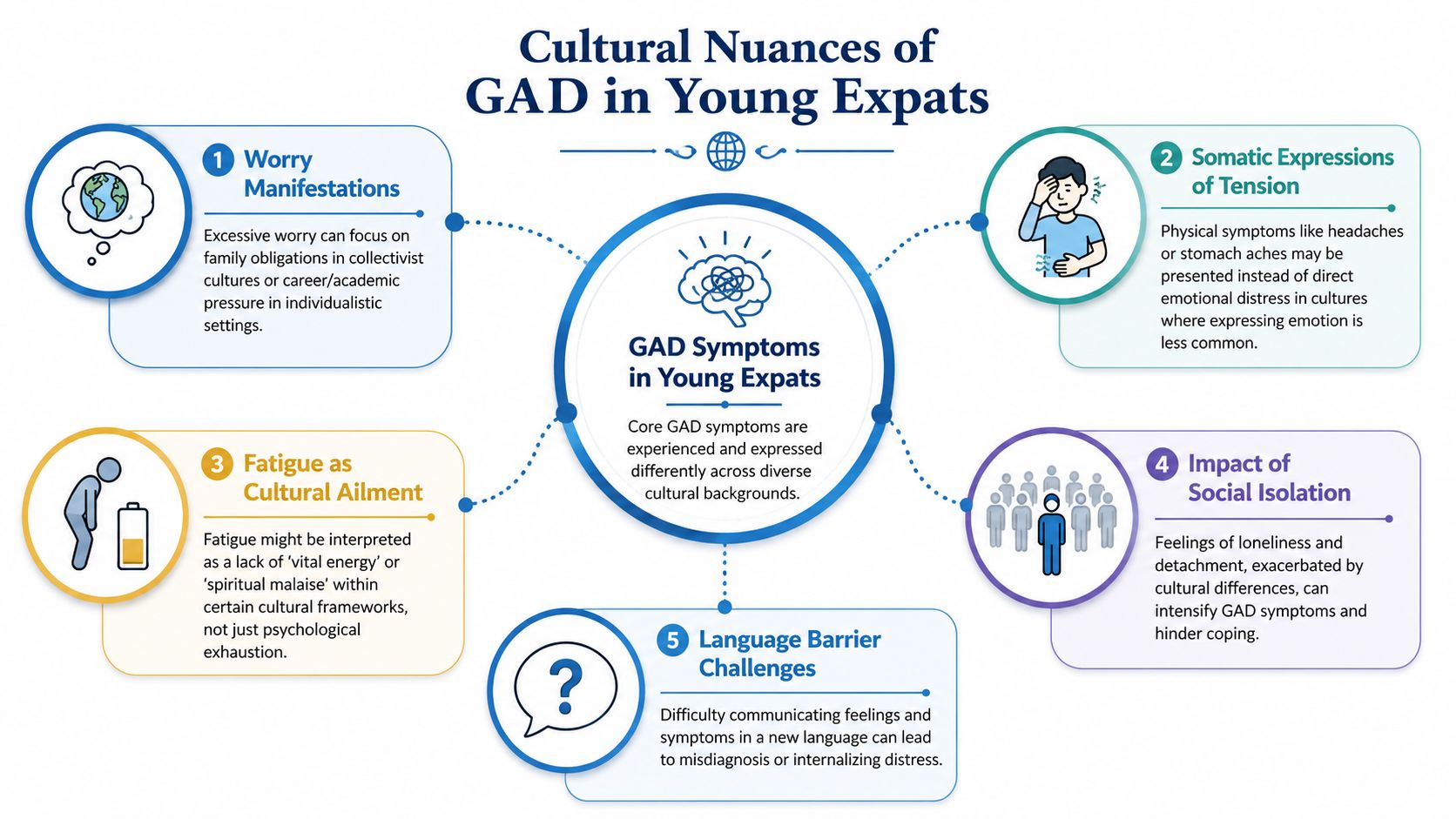
The three core parts clinicians look for
When I explain GAD to expat clients, I usually simplify it into three questions.
Is the worry excessive and persistent?
This means the worry shows up on most days and lasts for months, not just during one difficult week.Is it hard to control?
You may know your mind is spiralling, but you still can't seem to stop or redirect it.Is it affecting the mind and body?
GAD usually includes physical or cognitive symptoms, not just thoughts.
Common symptoms in everyday language
The DSM language is useful, but real life sounds more like this:
- Restlessness means you can't settle. Even when you sit down, your body feels alert.
- Fatigue means anxiety is draining you. You may feel tired and wired at the same time.
- Muscle tension often shows up in the jaw, neck, shoulders, stomach, or chest.
- Irritability can make small inconveniences feel disproportionately hard.
- Impaired concentration may look like rereading emails, forgetting simple tasks, or feeling mentally foggy.
- Sleep disturbance often means difficulty falling asleep because the mind won't stop reviewing threats.
Many expats first notice these symptoms physically. They think, “Maybe I'm just not sleeping well” or “Maybe this is burnout.” Sometimes that's partly true. But when the worry is the engine driving everything else, the treatment approach needs to reflect that.
What GAD is not
GAD is not the same as ordinary adaptation stress. It also isn't diagnosed from one symptom alone. Feeling anxious before a visa appointment or lonely after a move is human. The clinical issue appears when anxiety becomes chronic, hard to regulate, and disruptive across different areas of life.
For readers who want a broad consumer-friendly overview of symptoms and assessment language, this article on anxiety diagnosis information for UK adults can be a useful companion piece. If you want to compare what you're feeling with a more focused expat-informed description, this page on anxiety symptoms in adults may also help.
How GAD Presents in Young Expats Across Cultures
Generalized Anxiety Disorder does not look exactly the same in every person. The core mechanism is chronic, difficult-to-control worry. But the way that worry is expressed is often shaped by culture, migration stress, family expectations, and the reality of daily life abroad.
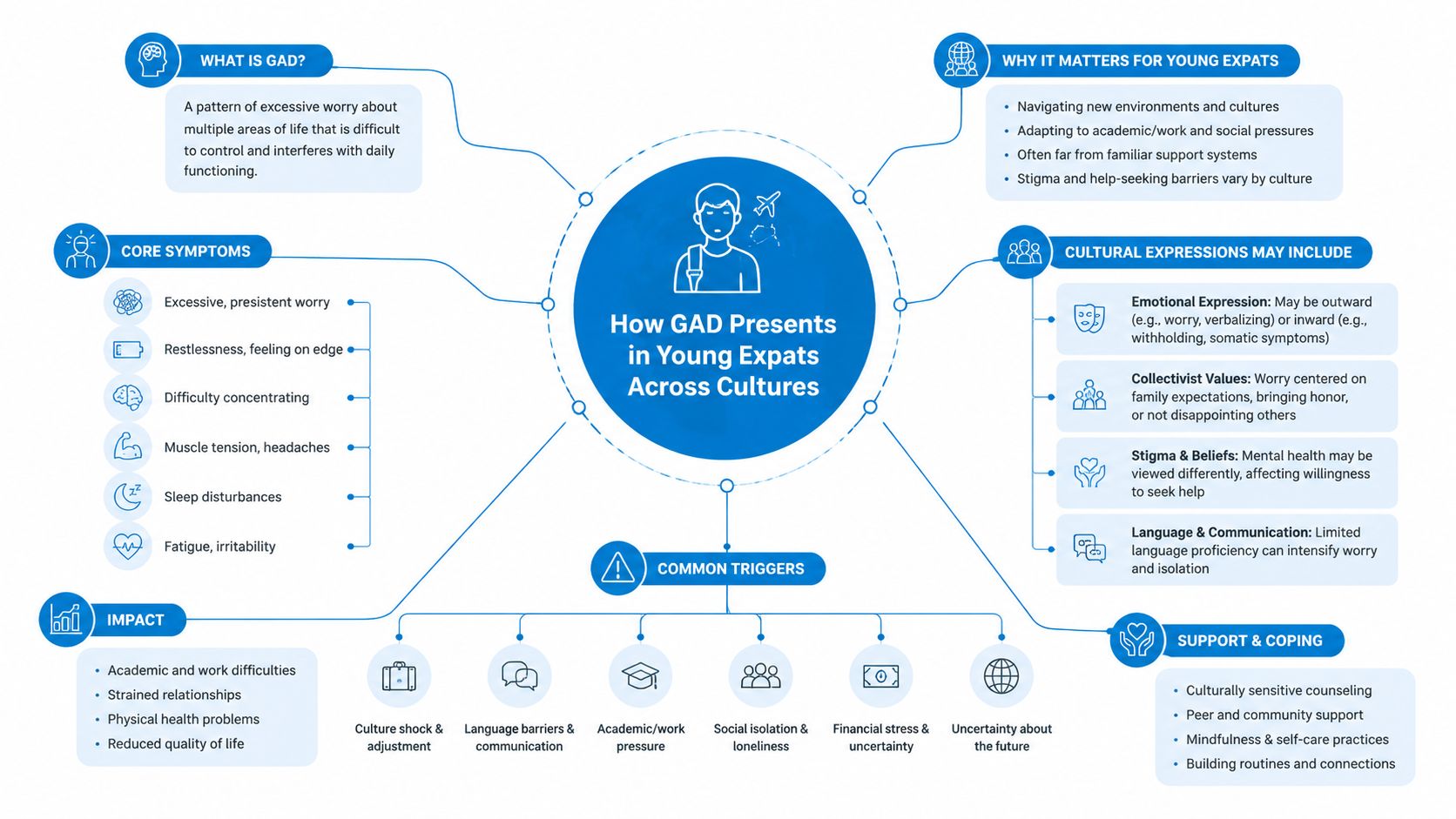
For expats in Italy, it is crucial to understand how GAD can be amplified by migration stress and language barriers. The key is to distinguish normal relocation anxiety from a disorder that persistently interferes with work, relationships, or daily life. The NIMH overview of generalized anxiety disorder also notes that effective treatments like psychotherapy and medication are available once the disorder is identified.
Emotional patterns that are common in expat life
A young professional from a highly achievement-oriented background may experience GAD as relentless performance anxiety. The thoughts often sound like: “I'm falling behind. I should be doing more. I've wasted this opportunity.” Even rest starts to feel threatening.
Someone from a more collectivist family system may worry less about personal success and more about letting others down. Their anxiety may revolve around family duty, guilt about being far away, or fear that something terrible will happen at home while they are abroad.
A student may look “high functioning” while unraveling. They attend classes, submit work, and keep up appearances, but they live in a near-constant state of anticipatory dread.
Physical symptoms can carry the message
In many cultures, distress is more likely to be described physically than emotionally. Instead of saying “I feel anxious”, a person may say:
- “My stomach is always tight.”
- “I can't breathe fully.”
- “My body never relaxes.”
- “I'm exhausted, but I can't switch off.”
This doesn't make the anxiety less real. It alters the language of presentation. For expats in Italy, this can be especially confusing when they're trying to explain symptoms in a second language or to professionals who may not understand the cultural meaning behind them.
The expat version of avoidance
Avoidance in GAD is often subtle. It doesn't always look like refusing to leave the house. It may look like overpreparing, endless checking, reassurance seeking, delaying decisions, or withdrawing socially because every interaction feels effortful.
I also see a specific expat pattern. People avoid situations where they feel linguistically exposed. They stop making calls, postpone appointments, and rely on others to manage practical life. That can reduce anxiety briefly, but it usually strengthens it over time.
If your world is getting smaller because you're trying to feel safer, anxiety may be organising your life more than you realise.
For many people who grew up between cultures or now live between languages, anxiety also connects to identity. You may feel more confident in one language, more emotionally expressive in another, and more alone in both. Support that understands this complexity can make a real difference. That is one reason some expats look for therapy for third culture adults rather than generic anxiety advice.
Common Causes and Risk Factors in the Expat Context
Generalized Anxiety Disorder is not caused by one single event. It usually develops through an interaction between vulnerability and prolonged stress. Expat life can supply that prolonged stress very efficiently.

Recent data shows a sharp increase in GAD, with one-year prevalence rising from 2.1% in 2012 to 7.4% in 2022, and key risk factors include pre-existing depression with an odds ratio of 5.06 and family problems with an odds ratio of 2.83, as summarised in this discussion of homesickness versus depression in expats in Italy.
Why Italy can feel uniquely demanding
Italy can be beautiful, warm, and rewarding. It can also be administratively exhausting. Young expats often face a stack of daily demands that local people may underestimate:
- Language load when every phone call, appointment, and form requires extra cognitive effort
- Bureaucratic uncertainty when procedures are unclear and rules seem to change depending on who you ask
- Social dislocation when friendships take time and family support is far away
- Identity strain when your competence in one country doesn't transfer neatly into another
- Relationship pressure when couples carry culture, language, and family differences at the same time
Any one of these is manageable for a while. Together, they can keep the nervous system in a near-continuous state of vigilance.
The hidden role of isolation
One of the biggest risk multipliers is isolation. You may be surrounded by people and still not feel known. Casual social contact is not the same as emotional support.
Distance from family can also intensify existing concerns. If there were unresolved tensions before the move, they often become louder, not quieter. Guilt, responsibility, and helplessness can all feed anxious rumination.
There's also a practical body-mind layer here. Sleep disruption, changes in eating patterns, reduced movement, or stress around body image can all complicate anxiety. For readers interested in that overlap, this piece on the link between weight and mental wellness explores how emotional and physical wellbeing often affect each other more than people assume.
When stress turns into a disorder
Not everyone under pressure develops GAD. But chronic uncertainty can overtrain the brain to scan for threat. Over time, worry stops feeling like a reaction and starts feeling like a default mode.
This is why “just relax” rarely helps. The anxious mind usually believes it is being responsible, prepared, and safe. In therapy, we often work not only with symptoms but with the underlying fear that if you stop worrying, something bad will happen.
If your anxiety escalated after the move, it doesn't mean you failed at living abroad. It may mean your system has been overloaded for too long. Many expats find it useful to understand that process through the lens of culture shock in Italy and how to cope, especially when anxiety and adaptation are tangled together.
Evidence-Based Treatments for Generalized Anxiety Disorder
The good news is that Generalized Anxiety Disorder is treatable. The most effective approaches are not mysterious. They are structured, evidence-based, and adaptable to the person in front of you.
The first-line management for GAD is typically Cognitive Behavioral Therapy (CBT) and/or SSRI/SNRI medication. Medication response rates are around 30% to 50%, and combined treatment often yields the greatest symptom reduction, according to the StatPearls review on generalized anxiety disorder treatment. That same source notes that CBT principles can be delivered in person or online, which matters for expats who need care in their native language.
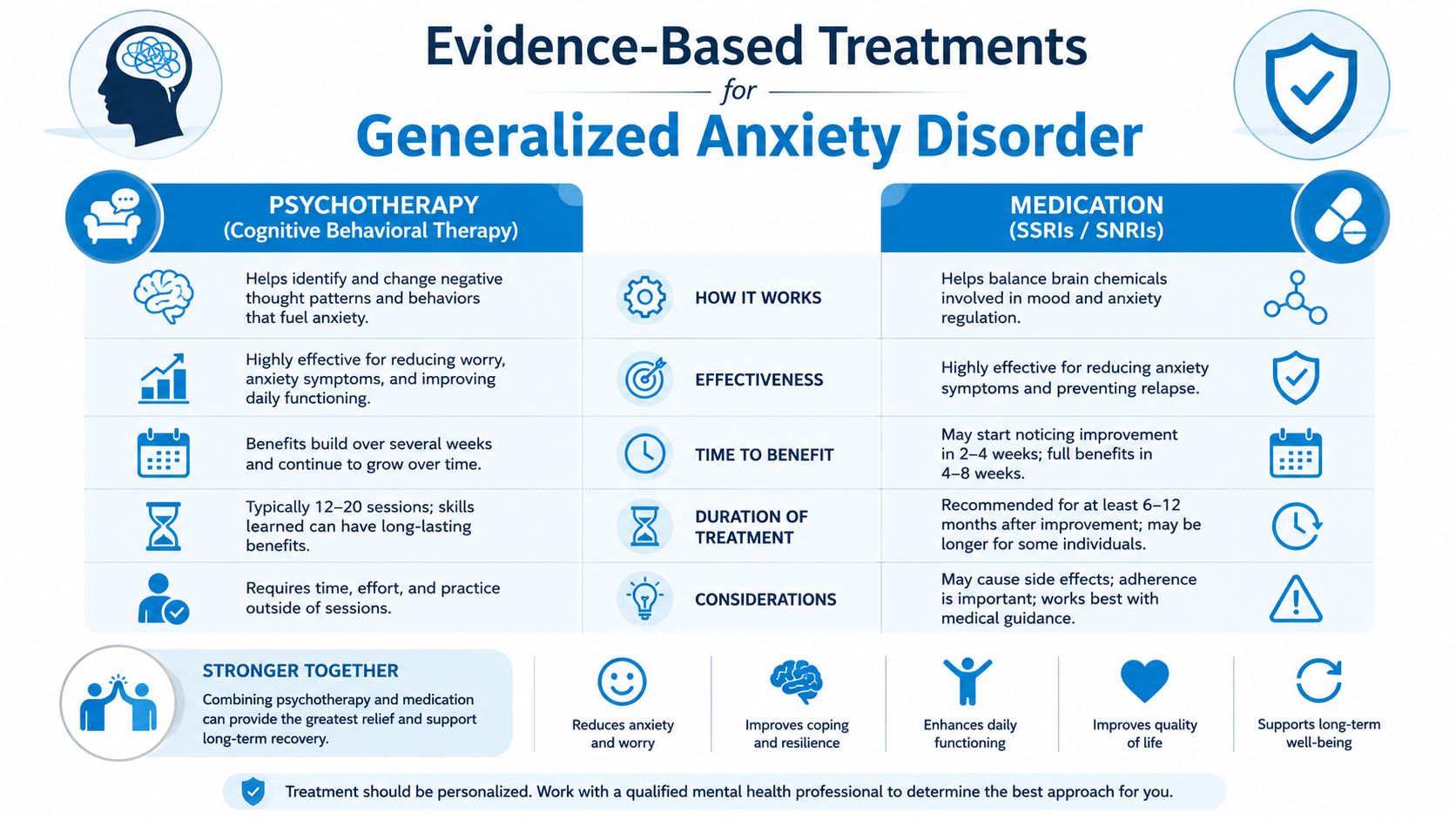
CBT for worry that runs all day
CBT is often the most practical starting point for GAD because it targets the habits that keep anxiety alive. In plain language, CBT helps you notice the link between thoughts, body sensations, emotions, and behaviours.
For example, you may have a thought such as “If I don't plan for everything, I'll lose control.” That thought increases tension. Then you overcheck, overprepare, or seek reassurance. You feel brief relief, which teaches the brain to repeat the cycle.
A CBT-based treatment plan may include:
- Worry tracking so you can identify patterns rather than drowning in them
- Cognitive restructuring to question catastrophic predictions
- Behavioural experiments to test what happens when you do less safety behaviour
- Tolerance-building so uncertainty becomes more bearable
- Sleep and routine work when anxiety has disrupted daily stability
CBT doesn't ask you to “think positive”. It asks you to think more accurately and behave in ways that reduce fear learning.
Medication when the nervous system is stuck on high alert
Medication can be very helpful when anxiety is intense, persistent, or interfering with therapy itself. For some people, medication lowers the internal volume enough that they can finally sleep, focus, and use psychological tools.
This is one of the most common trade-offs I discuss with clients. Medication can reduce symptoms, but it may also come with side effects, adjustment periods, and understandable ambivalence. Some people prefer to start with therapy. Others know they need broader support from the start.
Neither choice is morally better. The useful question is clinical. What will help you function, engage, and stabilise most effectively?
Practical rule: if anxiety is so constant that you can't absorb therapy, medication assessment may be worth considering alongside psychotherapy.
EMDR when anxiety is linked to distressing experiences
EMDR, or Eye Movement Desensitization and Reprocessing, is often associated with trauma, but it can also be relevant when GAD is fuelled by unresolved distressing experiences. That may include a humiliating period of instability, a frightening health scare, a painful breakup, or a relocation experience that overwhelmed your coping capacity.
EMDR is not a relaxation technique. It helps the brain process memories and triggers that still feel emotionally “live”. When those unprocessed experiences keep feeding present-day anxiety, EMDR can reduce reactivity and free up mental space.
A simple comparison
| Approach | Best suited for | What it targets | Common trade-off |
|---|---|---|---|
| CBT | Persistent worry, overthinking, avoidance, reassurance seeking | Thought patterns and behaviours maintaining anxiety | Requires active practice between sessions |
| Medication | High symptom intensity, sleep disruption, strong physical anxiety, difficulty functioning | Biological regulation of anxiety symptoms | May involve side effects and adjustment |
| EMDR | Anxiety linked to unresolved distressing experiences | Emotional processing of triggering memories | Not always the first tool if stabilisation is needed first |
What tends not to work well on its own
Some strategies help briefly but often keep GAD going when used as the main solution:
- Constant reassurance seeking from partners, friends, or the internet
- Overpreparation that makes every task feel like a threat
- Avoidance of calls, appointments, conflict, or uncertainty
- Lifestyle advice alone without addressing the anxiety mechanism underneath
Support can also be delivered flexibly. For expats who want online or in-person psychotherapy in multiple languages, one practical option is Therapsy, which offers CBT, EMDR, psychiatry, and clinician matching for people living across Italy. What matters most, though, is finding a licensed professional who understands both anxiety and the intercultural context shaping it.
Practical Coping Strategies to Manage Daily Anxiety
Professional treatment matters, but daily coping also matters. The goal of self-help is not to cure GAD on your own. It is to reduce escalation, create stability, and stop feeding the anxiety cycle between sessions.
Use a grounding method when your mind speeds ahead
When anxiety spirals, the mind usually jumps into future threat. Grounding brings attention back to the present moment.
One simple method is the 5-4-3-2-1 exercise:
- Name 5 things you can see
- Name 4 things you can feel
- Name 3 things you can hear
- Name 2 things you can smell
- Name 1 thing you can taste
This works because anxious thinking narrows attention. Sensory grounding widens it again.
Give worry a container
If you have GAD, trying to force yourself not to worry often backfires. A more effective CBT-style approach is to create scheduled worry time.
Try this:
- Choose one daily slot of about fifteen to twenty minutes
- Write worries down when they appear during the day
- Postpone them to the scheduled time
- Review them later and separate solvable problems from hypothetical fears
This teaches the brain that worry does not need immediate obedience.
Anxiety loves urgency. Most worries become less convincing when they're asked to wait.
Calm the body in ways that are realistic
You do not need a perfect wellness routine. You need repeatable nervous system cues.
Useful options include:
- Longer exhale breathing such as breathing in gently and breathing out more slowly
- Brief walks without your phone so your attention is not trapped in input
- Muscle release in the jaw, shoulders, hands, and stomach
- Predictable sleep cues like dim light and a consistent wind-down ritual
Some people also find comfort in small sensory rituals, including tea, warmth, and pauses that feel embodied rather than performative. If you enjoy exploring food and drink habits linked to stress regulation, this article on the benefits of kombucha for a calmer mind offers a gentle lifestyle perspective. It shouldn't replace treatment, but rituals can support it.
Reduce the behaviours that secretly maintain anxiety
These are the habits I'd pay attention to first:
- Reassurance loops such as repeatedly asking, “Do you think it's okay?”
- Checking rituals with messages, symptoms, money, or plans
- Decision paralysis caused by trying to eliminate all uncertainty
- Comparing your adaptation to other expats who seem more settled
Instead, aim for “good enough” actions. Send the email. Make the call. Attend the appointment. Anxiety usually shrinks when life becomes more lived and less mentally rehearsed.
Build anchors in a foreign environment
When you live abroad, routine is not boring. It is regulatory. Stable waking times, familiar food, movement, one trusted person, one repeatable weekend ritual, and one place where you feel recognised can all lower background threat.
If your anxiety is daily, don't wait for a total collapse before seeking help. Coping skills are most effective when they support treatment, not when they are used to postpone it indefinitely.
How to Find the Right Therapist for GAD in Italy
Finding help in a new country can feel harder than deciding you need help. For expats, the main obstacles are usually language, uncertainty about the Italian system, and fear of ending up with someone who doesn't understand the migration context.
Public and private routes in Italy
In general, you can access care through the public system or privately. Public services may be useful, but expats often find them harder to utilize because of waiting times, referral steps, language barriers, or limited flexibility.
Private care is usually more direct. It often makes sense if you want to choose the language of therapy, begin sooner, or work with someone familiar with intercultural stress.
What to look for in a therapist
For Generalized Anxiety Disorder, I'd look for four things:
- Clinical competence with anxiety disorders rather than generic “talk support”
- A clear treatment approach such as CBT, EMDR, or an integrated evidence-based model
- Linguistic fit so you don't have to translate your inner life awkwardly
- Cultural sensitivity so migration stress isn't minimised or romanticised
This matters more than people think. A therapist may be warm and well-meaning, but if they don't understand how bureaucracy, identity shift, bilingual strain, homesickness, and social isolation interact, the work can feel incomplete.
Feeling understood in therapy is not a luxury. For many expats, it is the condition that makes honest work possible.
If you're unsure how to evaluate options, this guide on finding the right therapist for expats in Italy can help you think through fit, language, and practical logistics.
When you're comparing services, ask simple questions. Can I have therapy in my native language? Is online care available? Is there psychiatric support if needed? Will someone help match me to the right clinician, or am I expected to choose alone from a directory?
For many young adults, the easiest first step is a free assessment conversation. It lowers pressure, gives you clarity, and helps determine whether your symptoms fit GAD, burnout, adjustment stress, or an overlapping difficulty that needs a more personalized plan.
FAQ
How do I know if it's generalized anxiety disorder or just relocation stress?
If the worry is persistent, hard to control, and interfering with daily life, it may be more than relocation stress. Normal adjustment anxiety usually rises and falls with clear triggers, while GAD tends to spread across many areas of life and continue for months.
Can generalized anxiety disorder cause physical symptoms?
Yes, GAD often shows up in the body as much as in the mind. Common signs include muscle tension, fatigue, poor sleep, restlessness, and difficulty concentrating, which is why many people first think they have a purely physical problem.
Is therapy enough, or do I need medication too?
Sometimes therapy alone is enough, and sometimes medication is a useful addition. The choice depends on symptom severity, how much anxiety is disrupting your functioning, and whether you can engage consistently in therapy tools.
What if my anxiety overlaps with depression or panic?
That is common and important to assess properly. According to the AAFP review on generalized anxiety disorder and panic disorder, 50% to 90% of people with GAD also have another condition, and continuing antidepressants for 6 to 12 months after improvement can reduce relapse, while stopping too early can lead to symptom return in up to 50% of patients.
Can I do therapy in English or another language in Italy?
Yes, many expats seek therapy in English or their native language because it makes emotional work more accurate and less tiring. This is especially helpful when anxiety already affects concentration, self-expression, and confidence.
When should I seek urgent help?
Seek urgent help if anxiety feels unmanageable, you cannot function safely, or you are having thoughts of harming yourself. In that situation, don't stay alone with it. Contact local emergency support, a trusted person, or an urgent medical service immediately.
If you're living in Italy and wondering whether what you feel is “just stress” or something more, book your first free assessment call with THERAPSY. There's no commitment, just a conversation with our Clinical Director, Dr. Francesca Adriana Boccalari, who will listen carefully and help match you with the right therapist for you.