You're in the car outside nonna's apartment, holding a small gift bag, trying to remember whether to say buongiorno or buonasera, and your partner is squeezing your hand like they know exactly how fast your pulse is going. Meeting your Italian in-laws can feel like a test of belonging before anyone has even opened the door. It isn't just a polite family visit, it's a cross-cultural milestone that mixes etiquette, family hierarchy, language, and identity all at once.
The cleanest way to think about it is this: the meeting has three layers. First, you prepare as a couple so you don't walk in divided. Second, you behave in the room with visible respect and calm. Third, you deal with the emotional aftermath together instead of letting the visit become silent stress. That is the work, and it's what most advice skips.
What Meeting Your Italian In-Laws Actually Feels Like
The first visit often lands harder than people expect because it isn't only about being liked. It's about being read correctly by a family that already has a shared history, shared references, and a rhythm you haven't learned yet. If you feel clumsy, exposed, or overaware of your accent and body language, that's normal.
The pressure is relational, not just social. You're not only meeting parents or siblings, you're stepping into a system where your partner has a pre-existing role and you don't. That imbalance is why a first dinner can feel so intense even when everyone is kind.
Practical rule: don't treat the first meeting like a performance. Treat it like a careful introduction into a family system that already exists.
The best mindset is simple. You're not there to be dazzling, funny, or perfectly fluent. You're there to show that you can be respectful, steady, and coordinated with your partner. That matters more than being impressive.
If your anxiety is already high, don't shame yourself for it. A family introduction is one of those moments where old fears show up fast, especially if you're living abroad and already carrying language fatigue, homesickness, or identity strain. In therapy terms, this is often less about the dinner itself and more about the meaning your mind gives it, approval, belonging, safety, and future.
The rest of this guide is built around that reality. It focuses on the couple first, etiquette second, and emotional recovery all the way through.
Why Italian Family Culture Makes This Meeting Matter
Italian family life still carries strong emotional weight, even though how couples meet has changed a lot. In a large study of 17,314 first marriages in Italy, meetings in public places such as neighborhoods, festivals, streets, and transport accounted for 45.4% of couple meetings overall, but that share fell from 56.2% for spouses married before 1970 to 31.0% for those married in 2010 to 2016. In the same research, school and university became a more lasting route into relationships, rising from 1.8% before 1970 to 7.2% in 2010 to 2016, while online dating rose from 0.4% in the 2000 to 2009 cohort to 2.5% in 2010 to 2016 Arosio 2022 study on couple formation in Italy.
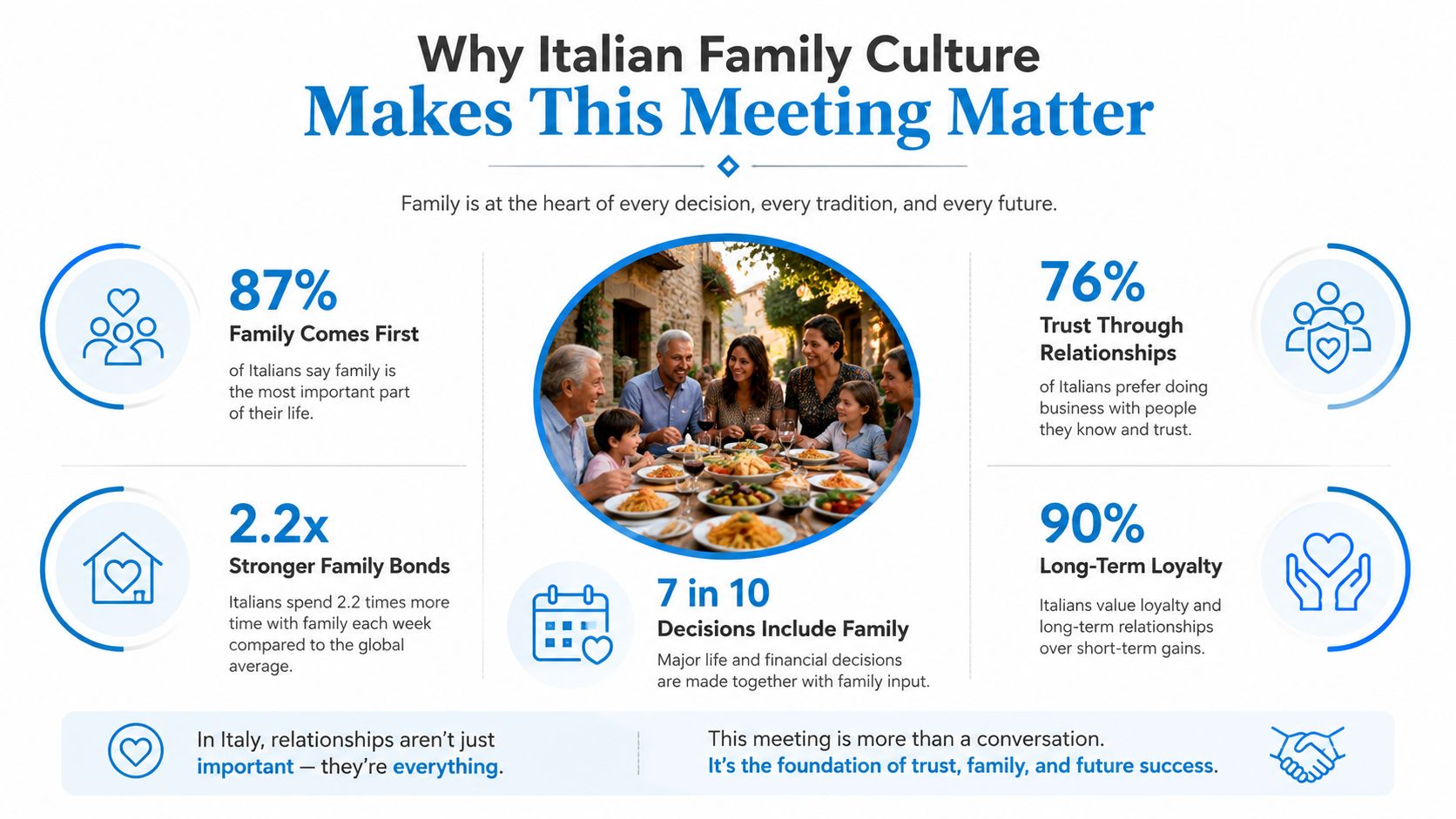
That shift matters because many couples now form in more private, networked, or digital settings, yet the family still expects to be meaningfully involved. So the first in-law meeting often arrives not as a casual introduction, but as a recognition event. The family is checking how you fit into the existing relational field, and they're doing it with the seriousness of a culture that still values closeness.
Italy's marriage patterns also tell the same story. In 2014, Italy registered 189,765 marriages, and the decline from 2009 to 2014 totaled nearly 57,000 weddings. The average age at legal separation was 47 for men and 44 for women, and the average age at divorce was 48 for men and 45 for women, which shows that family transitions often happen later in life than many outsiders assume ISTAT, Marriages, separations and divorces 2014.
Mixed marriages are now part of that picture too. By 2023, Italy recorded 29,732 marriages with at least one foreign spouse, equal to 16.1% of all marriages, and 21,211 of those were mixed marriages between an Italian and a foreign partner ISTAT, Marriages, separations and divorces 2014. In other words, cross-cultural family introductions are no longer unusual. They're part of normal Italian family life now.
That's why the meeting feels high-stakes. You're not entering a novelty. You're entering a family culture that expects closeness, loyalty, and visible respect.
Read more about cultural differences in Italy for expats
Preparing With Your Partner Before the Visit
Do the preparation together, or don't do it at all. If one of you walks in relaxed and the other walks in braced for impact, the family will feel that split immediately. The goal is not perfection, it's alignment.
Start with the practical pieces. Confirm arrival time with your partner, because Italian punctuality can be socially flexible in informal settings, and etiquette guidance notes that “on time” may be interpreted as 20 to 45 minutes late in casual contexts Italian etiquette guidance. That doesn't mean you should be late without asking. It means you should avoid assuming your own timing standard is the family's timing standard.
Best move: agree on the exact arrival window with your partner before you leave home. Guessing breeds tension.
Then decide the roles. Who introduces you to which relative? Who names the family members first? Who rescues the conversation if it stalls? That kind of planning sounds unromantic, but it prevents the awkwardness of both people waiting for the other to lead.
A simple pre-visit script helps:
- Greeting plan: who says hello first, and in what order.
- Topic plan: pick two or three safe subjects, like food, travel, work, or the local area.
- Exit plan: agree on a signal if one of you needs to leave early or pause a difficult conversation.
- Gift plan: bring a small, thoughtful item, such as wine, dessert, or flowers that aren't chrysanthemums.
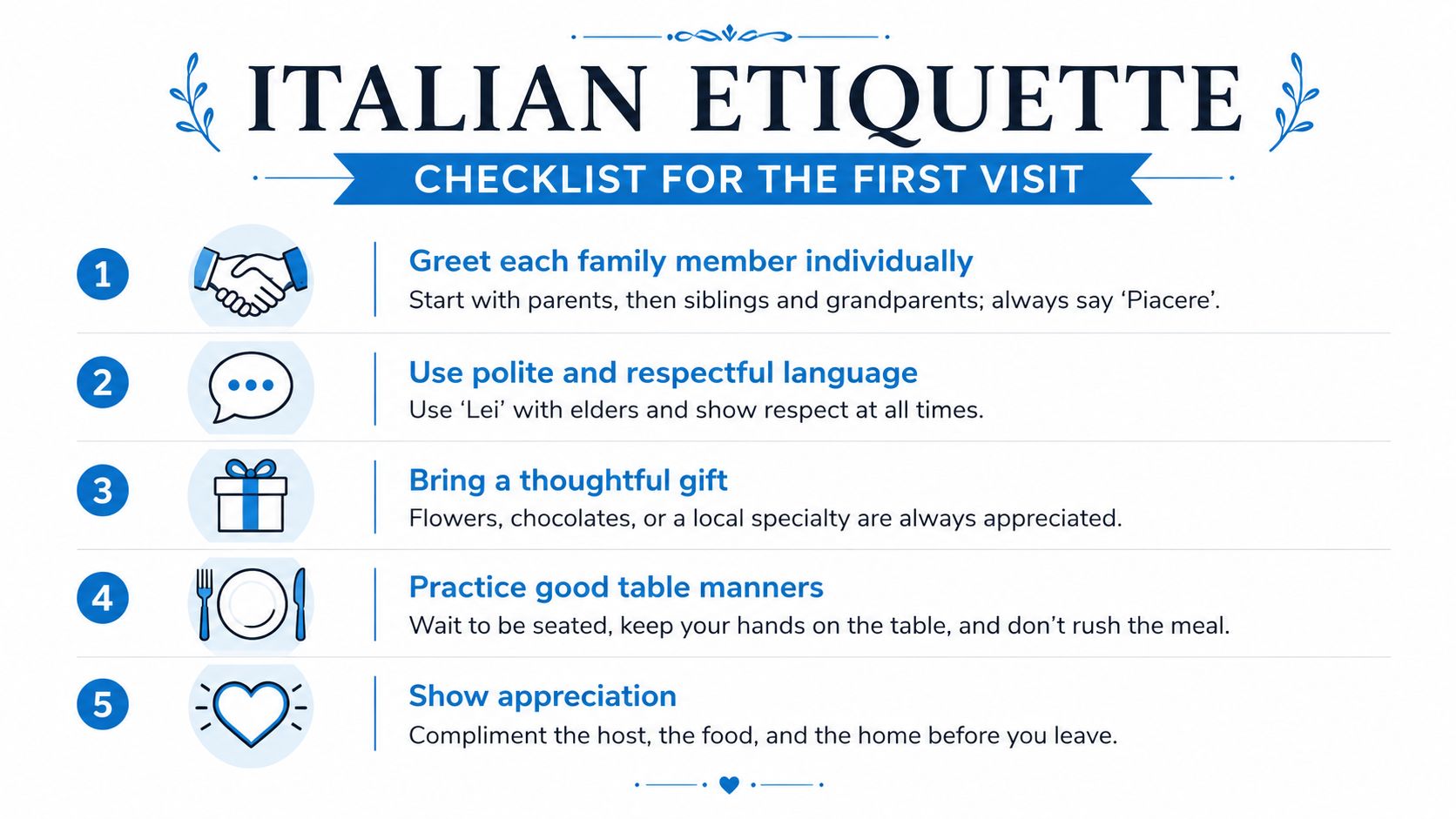
Learn a few phrases before you go. Use Lei with both parents until they invite you to switch to tu. That small choice signals respect immediately.

For couples dealing with deeper tension around family expectations, intercultural couples therapy at Therapsy is a reasonable place to start, especially if you're noticing that the same family topic keeps causing the same fight. The point isn't to pathologize the visit. It's to stop the visit from becoming a repeated injury.
Don't try to be witty if your language is shaky. The first job is clarity, not charm. Short sentences, warm eye contact, and a calm tone will do more for you than a rehearsed joke that lands badly.
Italian Etiquette and Conversation Starters That Actually Work
Your first job in the room is simple, greet everyone individually. Don't wave at the group and assume that covers it. Say hello to parents, siblings, and grandparents in a clear order, and make the greetings feel deliberate rather than rushed.
Formal address still matters. If you're unsure, use Lei. Formal-language guidance specifically recommends waiting for an invitation before switching to tu, and that invitation might come later as “Diamoci del tu” Italian etiquette guidance. If your partner already uses the informal form, that doesn't automatically mean you should too.
At the table, watch the host's rhythm. Don't start eating before everyone else if the family is waiting. Don't dominate the pace with your own habits. Italian family meals are often social centers, so the table is less about efficiency than about shared presence.
A few conversation starters usually land well:
- Food traditions: ask about family recipes or what dishes matter most in that household.
- Local culture: ask about the region, local markets, or seasonal foods.
- Family memory: ask how a dish or custom started in their family.
- Travel with care: ask about places they love in Italy, not about how Italy compares to your home country.
Avoid heavy topics on a first visit. Politics, religion, and blunt comparisons between Italy and your own country can shut down warmth fast. So can talking too much about your own achievements. A first meeting is not the moment to present your biography.
Good rule: compliment the home, the meal, and the effort. Don't overdo it, and don't make the praise theatrical.
People often worry more about saying the wrong word than about how they behave when the wrong word happens. If you mispronounce something, keep going. If a joke lands badly, smile and move on. If you knock over a glass, apologize once and clean up calmly. What shapes the impression is the repair, not the accident.
If speaking with strangers in Italian already makes you tense, Therapsy's guidance on talking with strangers can help you practice the kind of low-stakes language confidence that carries into family settings.
Setting Boundaries Without Triggering a Family Rift
Many couples find themselves in this situation. The family asks about marriage timing, children, work, money, or your plans to “settle down,” and suddenly the room feels like a courtroom. If you and your partner haven't agreed on limits, one of you will improvise, and improvisation usually turns into conflict.
The fix is a united-front script. Decide before the visit what you will and won't discuss, and agree on the exact wording you'll use if a topic crosses the line. Framing the boundary as a we-decision lowers the temperature because it doesn't sound like one person rejecting the family.
A useful structure is:
- Name the topic once.
- State the limit briefly.
- Return to a safe subject.
For example:
- On children: “We're not discussing that yet, but we'd love to hear about your weekend.”
- On work or salary: “That's private for us, but thank you for asking.”
- On repeated invitations: “We can't make every Sunday, but we'll let you know what works.”
The important thing is not to debate live in front of parents. Live debate turns a boundary into a loyalty test. It invites the family to choose sides, and that's exactly the dynamic you want to avoid.
If your partner tends to freeze, let them be the one who leads before the visit. If you're the newcomer, keep your responses short and neutral. If the family pushes back, don't escalate. Repeat the same line calmly and change the subject.
Non-negotiable rule: set the boundary in private, repeat it in public, debrief it in private again.
That debrief matters. Talk after the visit about what felt okay, what felt too much, and what should happen next time. If a pattern keeps repeating, that's not just etiquette trouble. It's relationship structure, and it deserves honest attention.
For couples who need help practicing that kind of boundary work, assertiveness training at Therapsy can be a practical support, especially when you need calm language that doesn't sound harsh or defensive.
The Emotional Load and When It Becomes Something More
The emotional part of meeting your Italian in-laws often gets mistaken for simple shyness. It isn't always shyness. Sometimes it's identity pressure, guilt toward family far away, fear of judgment, and the very real loneliness of being in a room where you only catch half the conversation.
That can feel especially sharp when you're already carrying expat stress. You may be adapting to a new language, a new social code, and a version of yourself that doesn't yet feel fully fluent. In that state, one dinner can carry far more weight than the event itself deserves.
If you're stuck in that loop, watch for a few signs that support could help:
- You replay the visit for hours or days afterward.
- You avoid future family contact because the anxiety feels too big.
- You and your partner keep fighting about the same family issue.
- You feel ashamed, isolated, or “less than” after seeing them.
That's the point where the problem stops being a one-off social event and becomes a mental health strain. CBT can help with the thought spirals, Schema Therapy can help with older patterns of shame or approval-seeking, and couples work can help when the main issue is alignment under pressure.
If the conversation is happening in a language you barely know, or if you feel cut off in a multilingual room, that isolation can hit harder than people admit. Some families are warm but fast, and warmth doesn't cancel exclusion. Your distress is still real.

If that sounds familiar, support for Italian in-laws stress is worth taking seriously rather than treating it like a personal weakness. Sometimes the issue is not that you're overreacting. Sometimes the family dynamic is too dense to manage alone.
A Practical Plan, Pointers to Support, and Common Questions
In the next 72 hours, do three things. First, sit down with your partner and write your shared boundary script. Second, decide on one follow-up gesture, like a thank-you message or a small reciprocal invitation. Third, schedule a private debrief for after the visit so the family pressure doesn't linger unspoken.
Within one week, send one kind, specific sign of appreciation if that feels appropriate. Keep it simple. Gratitude helps, but don't use it to erase any boundary you needed to hold.
Within one month, ask yourselves one hard question. Is the relationship with the family settling, or are you still bracing before every contact? That answer tells you whether this is a one-time adjustment or a repeating stressor.
When the load is too heavy to sort out on your own, Therapsy is a multilingual psychotherapy service in Italy with 50+ therapists across 24 Italian cities, offering sessions in 14 languages including English, Italian, French, Spanish, German, Portuguese, Ukrainian, Russian, Greek, Arabic, Urdu, Hebrew, Hindi, and Persian (Farsi), and it's rated 4.8 out of 5 on Trustpilot as Excellent Therapsy. For cross-cultural couples, expats, and anyone who needs to talk through family pressure in their own language, that kind of support can make the difference between surviving the visit and settling into the relationship.
FAQ
What should I do if my Italian in-laws invite me to use tu?
Use Lei until they clearly invite you to switch. That invitation may come verbally, and it often signals a real shift in closeness rather than a casual preference. If you're unsure, let your partner model the cue before you follow it.
What if only some family members speak English?
Keep your behavior calm and inclusive even if the language isn't shared. Short greetings, clear eye contact, and simple phrases go a long way, and you don't need perfect fluency to come across as respectful. If you can learn a few family-specific phrases, that usually helps more than trying to force a long conversation.
How do I talk to my partner about their family without sounding critical?
Speak in specific observations, not global judgments. Say what happened, how it affected you, and what you need next time, instead of turning the whole family into the problem. The strongest version sounds like a joint planning conversation, not a complaint.
Is it normal to feel anxious before meeting Italian in-laws?
Yes, it's normal, especially in a cross-cultural relationship. The anxiety usually comes from wanting to belong, not from any real failure on your part. If the fear keeps growing or spills into your relationship, that's a sign to get support.
What if I already made an awkward mistake at the dinner?
Repair it briefly and move on. A quick apology, a calm smile, and a return to the conversation usually matter more than the mistake itself. Most families care far more about how you handle discomfort than about a single awkward moment.
If meeting your Italian in-laws has turned into a source of stress, Therapsy can help you work through the pressure in the language that feels safest to you. Book your first free assessment call, no commitment, just a conversation with our Clinical Director who will listen and match you with the right therapist for you. Visit Therapsy and take the first step toward calmer family visits and a steadier relationship.