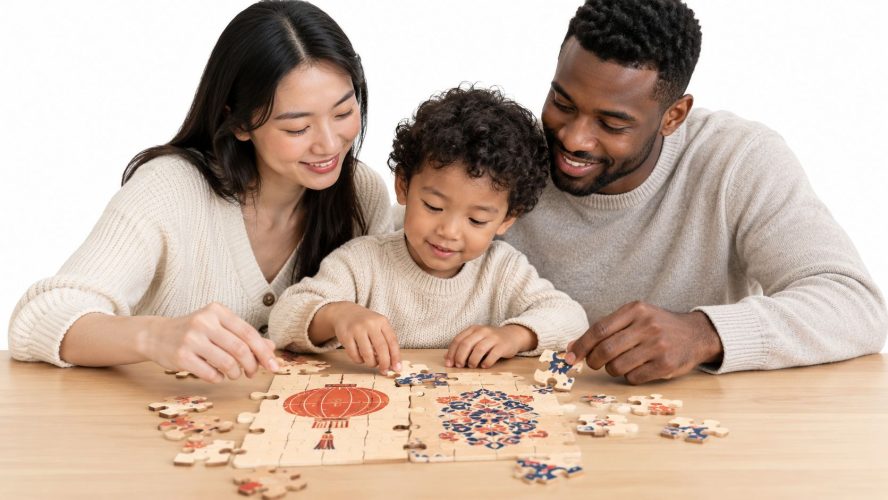
Cross-cultural parenting is raising children across two or more cultural traditions, and the core challenge is not choosing one culture but building a family system where both belong. A major study found bicultural parents scored 42.18 on child internalizing problems versus 47.60 for non-bicultural parents, while adaptive behavior scored 51.29 versus 43.77 in the comparison group.
A family may speak Italian at school, English at home, and another language with grandparents abroad. One parent may expect children to question adults openly, while the other sees respectful listening as a foundation of family life. These differences don't mean that either parent is wrong. They mean the family needs shared ways to translate values into everyday routines.
Therapsy is a multilingual psychotherapy service in Italy that connects expats with therapists who speak their native language.
What Cross-Cultural Parenting Actually Means
A child asks for a bedtime story in one language, a grandparent calls from another country, and the parents disagree about what respectful behavior looks like. This ordinary evening captures the central reality of cross-cultural parenting: the family is constantly integrating different assumptions about care, authority, belonging, and identity.
Cross-cultural parenting means raising a child within two or more cultural frameworks. It involves more than bilingualism, international food, travel, or celebrating cultural holidays. A family can speak two languages and still operate according to one culture's expectations about discipline, independence, gender, education, or emotional expression.

How is cross-cultural parenting different from bilingual parenting?
Cross-cultural parenting includes language, but it also requires negotiating values, routines, family roles, and ideas about childhood. Bilingual parenting may focus mainly on language exposure, whereas cross-cultural parenting asks how the whole family makes meaning together.
A parent who grew up in a highly individualistic setting may encourage a child to choose activities independently. Another parent may emphasize family obligations and collective decision-making. Both values can support healthy development when the adults explain them clearly and avoid making the child responsible for resolving the conflict.
Research supports this contextual view. A multinational Parenting Across Cultures project followed 1,417 eight-year-old children and their mothers and fathers across nine countries, and its researchers emphasized that parenting behaviors cannot automatically be interpreted as equivalent across cultures (Duke's Parenting Across Cultures project).
The practical question isn't which culture should win. It is how parents can create a predictable family system where the child understands when different practices apply and feels permitted to belong to every part of the family.
At Therapsy, a therapist who understands intercultural family life can help parents explore these differences without reducing them to national stereotypes. Families living in Italy can also read about culture shock and reverse culture shock when relocation has made familiar family roles feel less stable.
Why Do Mixed Families Feel So Much Pressure?
Mixed families often feel pressure because parents must negotiate identity, belonging, and family expectations while adapting to a new social environment. The strain reflects a demanding situation, not parental failure.
Consider a child starting school in Italy. At home, a parent uses a heritage language and expects deference toward older relatives. At school, the child hears Italian, encounters different classroom norms, and notices that classmates describe family traditions differently. The child may begin translating not only words, but also the emotional meaning of behavior.
A parent can feel pressure in the opposite direction. A mother may worry that her child is losing contact with her family abroad. A father may fear that the child is being pushed toward an identity that excludes his relatives. Both parents may become protective, especially when travel is difficult or grandparents participate mainly through video calls.
Why does cultural difference become more intense during transitions?
Starting school, moving country, entering adolescence, and forming friendships make cultural differences more visible because children compare family rules with the wider social environment. Developmental transitions increase the child's need to understand where each expectation comes from.
Attachment theory offers a useful lens. Children need a secure base from which to explore, and predictable caregiving helps them return to safety after unfamiliar experiences. Cross-cultural attachment research suggests that secure attachment is common across societies, with a review reporting approximately 50–70% of children securely attached except in settings facing extreme economic or social upheaval (cross-cultural attachment review).
This does not mean every family must behave in the same way. It means warmth, responsiveness, and dependable care can be expressed through culturally different routines. A grandmother's daily call, a shared meal, physical affection, or careful attention to a child's school experience may all serve a connecting function.
A useful clinical question: “What does this behavior communicate to the child in this family, and what does the child need to understand about it?”
Parents may also grieve what their children cannot fully experience. A child might not speak a grandparent's language fluently, visit a homeland often, or understand why relatives hold certain beliefs. That grief can easily turn into pressure, guilt, or criticism.
Cross-cultural psychology helps separate cultural values from assumptions about nationality. The Parenting Across Cultures project reports that families within the same country can differ more from one another than families across countries (Duke analysis of parenting around the globe). Class, migration history, neighborhood, religion, education, and family temperament may shape parenting as strongly as national background.
A child doesn't need parents to eliminate every difference. The child needs adults to stay emotionally available while differences are explained and negotiated.
What Are the Main Practical Challenges in Cross-Cultural Parenting?
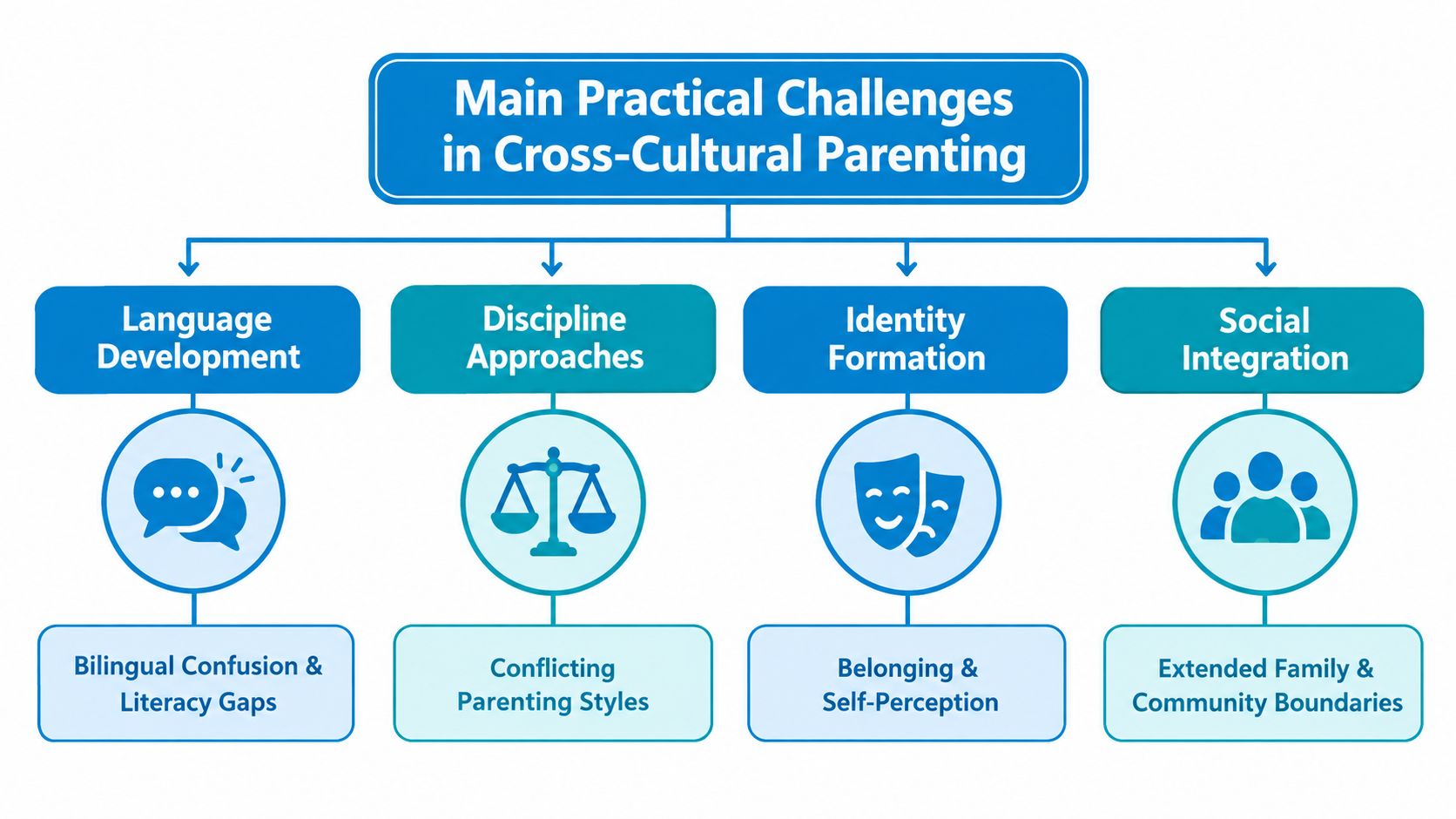
The main practical challenges are language balance, discipline, identity, and extended-family boundaries. Each becomes more manageable when parents identify the mechanism creating friction instead of treating the issue as a character flaw.
Which language problems create the most family tension?
Language tension grows when one language dominates school and public life, while the minority language receives less practice and becomes linked with correction or obligation.
A child may understand a heritage language but answer in the school language. The parent may interpret this as rejection, while the child may be choosing the language that feels easiest for complex ideas. Repeated pressure can make the heritage language feel like a test rather than a relationship.
A more helpful approach is to increase meaningful use. Cooking, jokes, songs, bedtime stories, family photographs, and conversations with relatives create emotional reasons to speak. Literacy can be supported through books and writing in both languages, but expectations should reflect the child's age, school demands, and available support.
Families can use an approach to the mental load of raising bilingual children when language planning has become another source of conflict.
Why do parents disagree about discipline?
Discipline becomes confusing when the same behavior carries different meanings for each parent. Speaking loudly may signal confidence in one family and disrespect in another; interrupting may show engagement in one context and poor manners in another.
Cross-cultural research cautions against assuming that parenting practices have identical effects everywhere. A six-country study found that corporal punishment was associated with more aggression and anxiety in all six countries, although the association was weaker where corporal punishment was more socially normative (cross-cultural review of discipline and parenting).
The practical goal is not to label one parent permissive and the other authoritarian. Parents can agree that discipline should be calm, proportionate, nonviolent, and connected to teaching the child what to do next. The adults can then discuss which culturally specific manners or responsibilities matter and why.
How does identity pressure affect children?
Identity pressure appears when a child feels expected to prove loyalty to one side of the family or perform a culture correctly. Children may hide a language, avoid discussing relatives, or feel responsible for protecting a parent's feelings.
Parents can reduce this pressure by describing identity as additive rather than competitive. A child may be Italian, Nigerian, and British, or belong to several linguistic, religious, and family communities at once. The child doesn't have to choose one label before the adults feel secure.
How should extended families be included?
Extended-family conflict often begins when relatives interpret different parenting decisions as disrespect, neglect, or loss of tradition. Distance can intensify this because relatives receive incomplete information through brief visits, messages, or video calls.
Parents need a shared boundary before responding to relatives. The boundary might cover language expectations, discipline, school choices, privacy, religious practices, or what relatives may say about the child's appearance and identity. Warmth and limits can coexist.
A major review of cross-cultural parenting research also warns that common parenting-style categories don't reliably capture cultural specificity. A 2026 systematic review found that authoritarian or indulgent approaches can be associated with positive outcomes in some collectivistic settings, including Asian, Arab, African American, and Latin American communities (systematic review of parenting styles across cultures). That finding doesn't endorse harsh parenting. It shows why context and function matter more than labels alone.
How Can Co-Parents Communicate Better About Culture?
Co-parents communicate more effectively when cultural decisions become regular, structured conversations rather than arguments held during stressful moments. The aim is shared understanding, not agreement on every tradition.
A weekly check-in works well for families managing immediate friction. Parents choose a calm time and discuss one recent event, such as a school rule, a grandparent's request, or a disagreement about bedtime. Each parent answers three questions: what happened, what the behavior meant in their upbringing, and what response would help the child now.
Which communication method fits a mixed family?
The best method depends on whether the conflict concerns values, recurring decisions, or relatives' involvement. A simple comparison can help parents choose a starting point.
| Communication method | Best for | How it works | Common pitfall |
|---|---|---|---|
| Weekly check-in | Recent disagreements | Reviews one event without assigning blame | Turning the meeting into a court case |
| Values mapping | Different ideas about childhood | Identifies values, fears, and desired outcomes | Treating a value as a fixed rule |
| Boundary agreement | Pressure from relatives | Defines decisions parents make together | Presenting boundaries as punishment |
Values mapping is particularly useful when parents argue about independence, respect, academic achievement, religion, or family duty. Each parent writes the value they want to protect, the fear underneath it, and one flexible behavior that could express it.
For example, “respect” might mean greeting every adult formally to one parent and listening carefully without interrupting to the other. The shared family value may be consideration, while the specific behavior can vary by setting.
How can parents disagree without escalating?
Parents can pause when a disagreement becomes a referendum on whose culture is superior. A statement such as “This rule mattered in my childhood because it protected belonging” invites curiosity more effectively than “Your family doesn't respect children.”
A family can also distinguish between essential safety rules, flexible cultural practices, and personal preferences. This prevents every difference from becoming a moral emergency.
Families living between languages can also explore relationship support in a second language.
Therapsy can support this process through therapy that considers family systems, attachment, CBT, Schema Therapy, and intercultural psychology. The work isn't about selecting a winning culture. It helps parents notice the emotional meaning attached to each position and build agreements that the child can experience as coherent.
Which Strategies Work for Bilingualism, Rituals, and Boundaries?
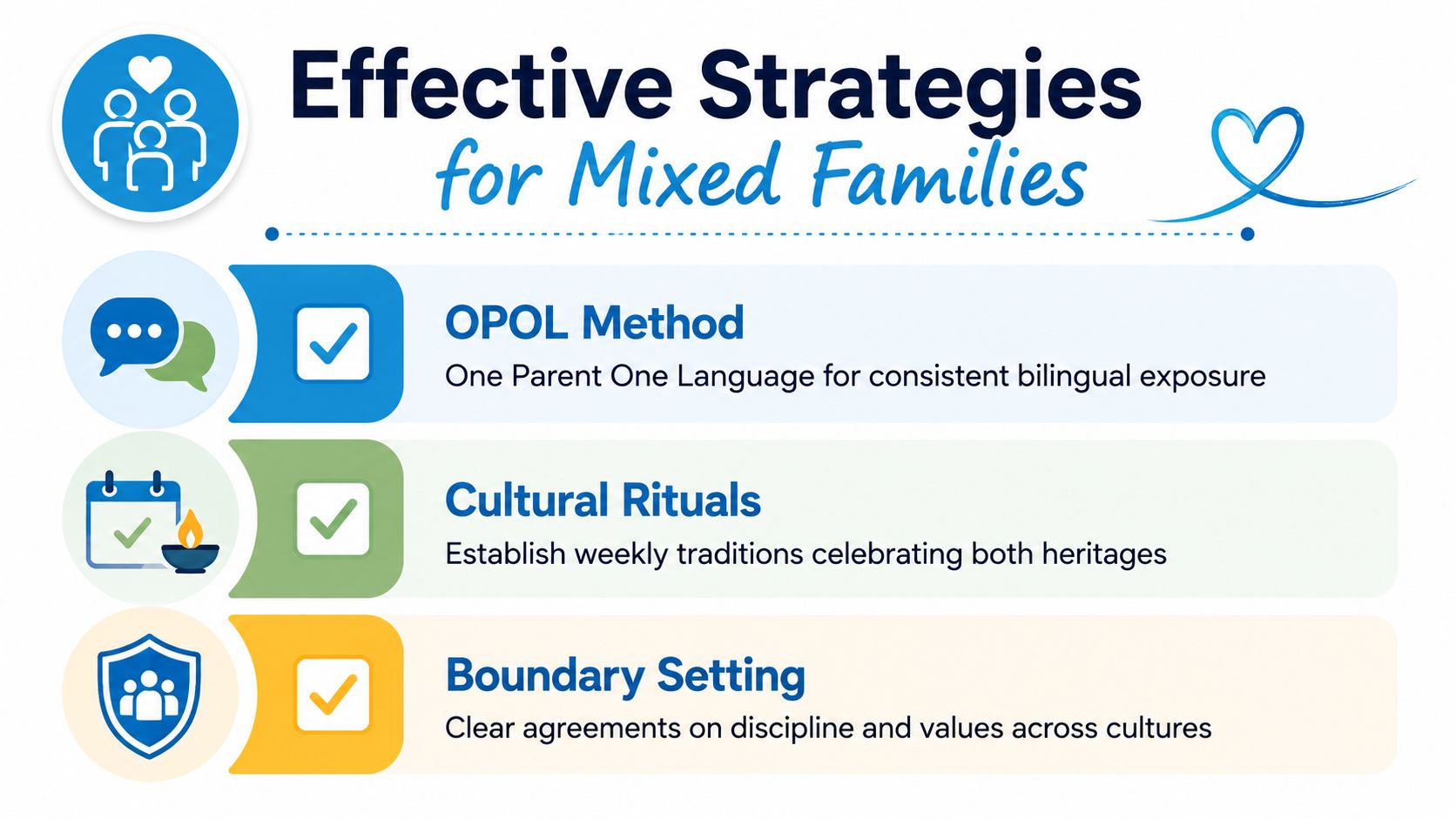
Mixed families benefit from flexible strategies that preserve connection without turning culture into a performance. Bilingual routines, shared rituals, and clear boundaries work best when they are adapted to the child's development and the family's actual life.
Which bilingual approach should a family choose?
No single bilingual method suits every family; the strongest plan is the one adults can use warmly and consistently without making language a source of shame.
The one-parent-one-language approach assigns a regular language to each parent. It can make exposure predictable, but it may feel artificial if the family naturally switches languages or if one parent has limited opportunities to communicate.
The minority-language-at-home approach reserves the less dominant language for family life and uses the community language outside. It can protect home-language exposure, though parents may need to support schoolwork in another language.
The time-and-place method connects a language to routines, such as reading in one language, speaking another during meals, or using a heritage language with specific relatives. This structure can be easier for families whose schedules or language abilities change.
The choice should be reviewed when the child begins school, a new caregiver joins the household, or a parent becomes exhausted. Practical bilingual child development tips can supplement, but not replace, observation of the child's actual responses.
How can families create meaningful cultural rituals?
A ritual becomes meaningful when it creates participation and connection, not when a child is required to perform a tradition perfectly. Families might prepare a familiar dish, tell a migration story, listen to music from both lineages, or mark important dates with a shared activity.
Parents can rotate responsibility so one heritage doesn't become the default and the other becomes an occasional display. A child might choose a song, ask a relative a question, or help adapt a traditional practice to the family's current home.
How can parents set boundaries with relatives?
Parents can state boundaries in practical language: “The adults will decide discipline together,” “Both languages are welcome,” or “Comments about the child's identity aren't acceptable.” The message should be repeated calmly rather than argued anew during every family interaction.
Digital contact also needs structure. Relatives abroad may join a regular call, share stories, or read books remotely, but they don't need access to every parenting decision. Parents can decide when calls happen, which topics are private, and how disagreements are handled away from the child.
Attachment research supports focusing on the quality of connection rather than copying one universal caregiving form. Warmth and predictable availability can be expressed through culturally different practices. Families dealing with fatigue from constant translation can consider support for second-language exhaustion.
Who works with intercultural families at Therapsy
Dr. Alessia Ranieri, a psychotherapist in Lucca and Pietrasanta, works with relocation, cross-cultural life and intercultural couples. Dr. Ivano Calaon, a psychotherapist in Turin with over ten years of practice, supports couples, families and parents.
Raising children between two cultures is easier with someone who knows both from the inside: a psychologist with a background between Italy and the UK offers parenting support in Padua, Venice and online.
When Should Mixed Families Seek Professional Support?
Professional support can help when cultural negotiation becomes a continuing source of distress, conflict, withdrawal, or fear for a parent, child, or couple. Families do not need to wait for a crisis, or prove that they have failed, before asking for help.
Useful signs include repeated arguments about discipline that never reach a workable agreement, a child feeling responsible for choosing between parents, ongoing anxiety about belonging, or relatives' expectations shaping household decisions. Support may also help when one language or heritage has become connected with shame, anger, or silence. These patterns are signals of strain, not evidence that either culture is the problem.
What does multilingual therapy add to family support?
Multilingual therapy offers more than translation. Language carries attachment memories, social rules, humor, shame, and beliefs about authority. A therapist who understands the family's languages and cultural contexts can examine whether a disagreement concerns the child's present needs, an earlier family experience, or fear of losing connection with a homeland.
The process works like mapping a family system. Each recurring conflict points toward a particular need: discipline disagreements may require shared decision rules, language conflict may call for protection from shame, and loyalty fears may need reassurance that connection with one heritage does not erase another.
Attachment theory can clarify a child's need for a secure base. CBT can help parents question rigid interpretations, such as, “If the child prefers the school language, the heritage is disappearing.” Schema Therapy can examine lasting beliefs about duty, rejection, or control. A qualified clinician may consider EMDR when trauma affects parenting or adjustment after relocation. These approaches cannot provide a diagnosis through an article, and therapy does not replace medical care.
How does Therapsy match intercultural families?
Therapsy's Clinical Director handles therapist matching with human judgment rather than an automated process. Families can seek therapy in their own language, with support available across multiple languages and cultural backgrounds.
Therapsy provides online and in-person sessions in Italy. Availability, locations, therapist capacity, and service details may change, so families should confirm current options directly. The first assessment call is free and takes place with the therapist selected for that person.
Families considering support for co-parenting can explore cross-cultural marriage counseling. The service may suit expat parents who need a clinician able to hold several cultural frameworks at once. The first call carries no obligation to continue, giving the family an opportunity to assess the therapist's language, approach, and understanding.
Therapsy offers human matching by its Clinical Director, therapy in the family's own language, and online or in-person sessions in Italy. Families can begin with a free call with the therapist chosen for that person, without an obligation to continue, by visiting THERAPSY.