A relationship without communication may continue temporarily, but it can't build dependable emotional closeness without some way to share needs, repair misunderstandings, and make decisions together. Research on couples found that a 15-minute conflict conversation predicted divorce with about 93%–94% accuracy over 14 years, while stable couples maintained roughly a 5:1 ratio of positive to negative interactions during conflict.
Can a relationship survive without communication?
A relationship can survive a quiet phase, but lasting closeness requires safe ways to express needs, understand differences, and repair ruptures.
A relationship without communication often involves more than not talking. Partners may still exchange messages about rent, work, travel, or dinner while avoiding fear, disappointment, affection, sex, money, family expectations, or the future. In expat and intercultural relationships, language processing, different conflict norms, distance from support networks, and migration stress can make that avoidance harder to recognize.
Communication quality has a measurable relationship with later outcomes. A 2024 meta-analysis summarized in this review of relationship communication research found that negative communication had a small-to-moderate association with relationship dissolution, reported as d = -0.41, p < .001. A separate peer-reviewed meta-analysis of 28 observational studies similarly found small links between positive or negative communication and later relationship quality, while persistent negative patterns mattered more than an occasional difficult exchange.
Therapsy is a multilingual psychotherapy service in Italy that connects expats with therapists who speak their native language.
The seven tools below address blame, silence, defensiveness, language differences, and cultural misunderstandings. They aren't diagnostic advice. Fear, coercion, abuse, threats, violence, or a severe power imbalance require safety-focused professional guidance rather than couple exercises.
1. Non-Violent Communication for speaking from the heart without blame
Non-Violent Communication helps partners describe behavior, feelings, needs, and requests without turning distress into character attacks.
NVC gives a conversation a practical sequence: observation, feeling, need, and request. Instead of saying, “You never listen to me,” a partner might say, “When you look at your phone during our conversation, I feel ignored. I need to feel heard and valued. Would you be willing to put the phone away when we talk?”
The difference is mechanical, not cosmetic. “You never listen” invites a debate about whether “never” is accurate. Naming the observable behavior gives the other person something specific to understand and change. Naming the need reveals the emotional meaning underneath the complaint.
How can NVC help an intercultural couple?
NVC reduces the number of cultural assumptions hidden inside an argument by translating accusation into observable experience and a clear request.
A British expat in Milan might say to an Italian partner, “When plans change without discussion, I feel anxious. I need predictability. Could we agree to check with each other before changing plans?” The issue may not be indifference. One partner may see flexible plans as normal, while the other experiences last-minute changes as instability.
For a long-distance couple, “I notice we haven't video called recently. I feel disconnected. I need to feel close to you. Would you be available for a call this weekend?” creates a path forward without claiming that the other partner doesn't care.
Useful practice includes:
- Draft before speaking: Write the four elements down before a difficult conversation.
- Start with a low-stakes issue: Fluency is easier to build before conflict becomes intense.
- Name behavior, not character: “I felt confused when the plan changed” is more workable than “You're selfish.”
- Ask for action: A specific request gives the partner a genuine opportunity to respond.
Therapsy's guide to improving communication skills can complement this exercise. Therapy can also help partners notice when a carefully worded request still triggers fear, contempt, or withdrawal.
Practical rule: A request isn't a demand disguised as politeness. The other person must be allowed to answer honestly.

2. Structured conversation protocol for restarting dialogue safely
A structured conversation uses a pre-agreed time, topic, turn-taking rule, and pause option to make difficult dialogue more predictable.
Silence often grows because every attempted conversation feels dangerous or unmanageable. A protocol lowers that uncertainty. Partners decide when to talk, what they'll discuss, how long each person can speak, and what happens if either person becomes overwhelmed.
A couple who haven't spoken about their relationship for several weeks might agree on a short conversation in a quiet café. The agenda could contain only two questions: how each person experienced the silence, and what each person needs going forward. Each partner speaks without interruption before the conversation shifts to responses.
What should a couple include in a structured conversation?
The strongest protocol is short, specific, and reversible. It should make engagement easier, not create another test that one partner can fail.
A couple can agree to:
- Choose one topic: Don't combine communication, finances, immigration, relatives, and household responsibilities in one meeting.
- Set a time boundary: A visible timer can reassure both partners that the conversation has an endpoint.
- Create the agenda together: Writing it in advance prevents one person from introducing unexpected accusations.
- Use a pause signal: A word or gesture can mean, “This is becoming too intense. Let's pause and return to the topic.”
- Allow language processing: A multilingual couple may need slower speech, written prompts, or time to find the right word.
An expat and an Italian partner in Florence might schedule a weekly connection conversation and rotate simple prompts such as what's working, one thing each person needs, and how they want to spend time together. Long-distance partners can answer a written prompt separately and discuss their responses later by phone.
The assertiveness training service from Therapsy may be useful when one partner struggles to state limits without apologizing, escalating, or disappearing. A therapist can model the protocol before the couple tries it alone.
This approach works best when both people can participate voluntarily. It doesn't make an unsafe relationship safe, and it won't solve a power imbalance through better scheduling.
3. Active listening and reflection before offering a defence
Active listening means reflecting the speaker's meaning and emotion before explaining, correcting, or defending the listener's own position.
In a relationship without communication, each partner often prepares a rebuttal while the other person is speaking. Reflection interrupts that cycle. It asks the listener to understand the experience first, then check whether the understanding is accurate.
A partner might say, “I feel like you're never interested in my day.” An active response could be, “It sounds like you feel disconnected from me, as if I don't care about what's happening in your life. Is that right?” The listener isn't agreeing with every interpretation. The listener is checking the emotional message before adding another perspective.
Why does reflection matter across languages?
Reflection gives multilingual partners a chance to correct meaning before a translation gap becomes a moral accusation.
An expat might say, “I don't know how to manage Italian bureaucracy and I feel lost.” The partner could respond, “It sounds like you're overwhelmed and perhaps helpless because you don't know where to start. Which part feels most confusing?” That response recognizes the emotional burden rather than treating the statement as a simple request for practical help.
A long-distance partner who feels anxious about reduced contact might hear, “When I don't hear from you, you worry that we're growing apart. You need to feel the connection is still there. Is that what you mean?”
How can couples practise active listening?
Use reflection starters such as “What I'm hearing is…” or “It sounds like you felt…” Then ask, “Is that right?” and wait for clarification before responding.
Body language matters, but it shouldn't become a performance. Uncrossing the arms, facing the speaker, slowing breathing, and putting the phone aside can communicate presence. A partner who feels defensive can ask a clarifying question rather than immediately explaining intent.
A conflict resolution session with Therapsy can help couples distinguish listening from agreement. That distinction is essential. A person can understand why a partner felt abandoned without accepting every conclusion about what happened.

Research on emotion communication during marital conflict found that partners could often encode and decode emotion, while softer emotions could sometimes be recognized even when they weren't clearly expressed. The PubMed-indexed study supports a useful caution: silence doesn't mean emotion is absent, but relying on subtle cues is riskier across languages and cultures.
4. The softened startup for reducing defensiveness
A softened startup begins with vulnerability, a specific observation, and an invitation to collaborate instead of criticism or accusation.
The first sentence can shape the emotional direction of the conversation. “You're always on your phone” attacks a person's presumed character. “I've been feeling disconnected, and I notice the phone is often out when we're together. I miss your attention. How can we work on staying connected?” describes the problem while keeping the relationship visible.
This isn't about using polite language to conceal anger. It's about identifying the core concern beneath the complaint. The partner who says, “You never help with anything” may be overwhelmed and afraid that responsibilities are becoming unequal.
What does a softened startup sound like in Italy?
A useful opening separates cultural difference from personal rejection and makes room for a shared experiment.
An expat could say, “I know we handle conflict differently. I tend to pull away, and I think that scares you. I want to work on smaller conversations before problems become overwhelming. Could we try that together?” An Italian partner might have learned a different norm around directness, family involvement, privacy, or emotional expression. Neither person has to be labelled uncaring for the difference to create friction.
A practical formula is:
- Begin with care: “I care about us, and there's something I want to handle better.”
- Name one behavior: “When my message went unanswered, I felt uncertain.”
- State the need: “I need reassurance and clearer expectations.”
- Invite participation: “What did that moment feel like for you?”
Writing the opening can help someone who becomes anxious in a second language. It also reduces the temptation to use absolute words such as “always” and “never.”
A softened startup can't guarantee cooperation. If one partner repeatedly responds with contempt, intimidation, or deliberate punishment, changing the opening may protect the conversation but won't address the wider safety problem.
5. Written communication and letter writing when voices fail
Writing can create a lower-pressure route into difficult communication when speaking feels too charged, distant, or linguistically demanding.
A written exchange gives the speaker time to find accurate words and gives the reader time to absorb them without an immediate demand for a defence. That can help an expat explain homesickness, migration stress, or loneliness when the feelings are difficult to express in a partner's language.
A partner might write, “When we argued last week, I felt hurt and scared. I'm sorry for the part I played. I want to find a way to discuss difficult things without pushing you away. I don't expect an immediate response. I wanted you to know what was happening for me.”
Can a letter repair a relationship without communication?
A letter can open a door, but it can't replace reciprocal engagement or become a one-sided substitute for accountability.
An expat might write, “I've been quiet because I didn't know how to explain how much I miss my family. I'm not saying I want to leave. I'm saying I need more connection with you.” That distinction matters when migration grief is being mistaken for rejection of the relationship.
Long-distance partners can exchange responses to prompts such as what they value in the relationship and what they fear losing, then discuss the letters by video. The written material gives the later conversation a shared starting point.
Good safeguards include:
- Write freely first: Edit later for clarity and tone.
- Use concrete observations: Describe what happened rather than assigning motives.
- Name needs instead of ultimatums: State the desired change without threatening abandonment.
- Read the letter aloud: Hearing it can reveal a harsher tone than intended.
- Pause before sending: A cooling-off period reduces impulsive wording.
- Choose the language carefully: Write in a native language first, then translate or explain key phrases.
A therapist may help review the emotional clarity of a letter, especially when translation could alter tone. Written communication should never be used to pressure a frightened partner into disclosing more than feels safe.

6. Therapeutic mediation when dialogue needs a third party
Therapeutic mediation adds a trained professional who can slow blame cycles, balance speaking time, and translate both language and cultural context.
A third party becomes useful when partners understand the tools but can't use them together. The therapist creates a contained setting where each person can describe the silence, conflict, or misunderstanding without being interrupted or forced into immediate agreement.
For an English-speaking expat and an Italian partner, linguistic competence can matter alongside clinical skill. “You shut me out” may gradually become “I felt abandoned and didn't know how to reach you,” but that shift usually requires careful pacing, clarification, and attention to each person's emotional state.
When is couple therapy more suitable than self-guided exercises?
Professional support makes sense when repeated attempts at calm conversation end in the same withdrawal, escalation, or unresolved confusion.
A therapist can hold separate preliminary conversations when one person is highly distressed, clarify whether the goal is repair or practical agreement, and identify whether joint work is appropriate. Approaches such as attachment theory, CBT, Schema Therapy, and systemic-relational therapy can offer different ways to understand recurring cycles without reducing either partner to a label.
Couples may begin with a practical objective, such as agreeing on contact during a long-distance phase, then decide whether deeper therapy is needed. A Therapsy guide to online couples therapy can help someone consider whether online sessions suit the couple's location, schedule, and language needs.
Mediation isn't appropriate for every relationship. Abuse, coercive control, threats, violence, or severe power imbalances can make joint disclosure unsafe. In those situations, individual safety planning and specialist support take priority over balanced dialogue.
Therapsy's clinical team supports multilingual and intercultural work through human matching rather than an algorithm. The right therapist needs to understand not only what language a couple speaks, but also how migration, family expectations, attachment patterns, and cultural meanings shape the conflict.
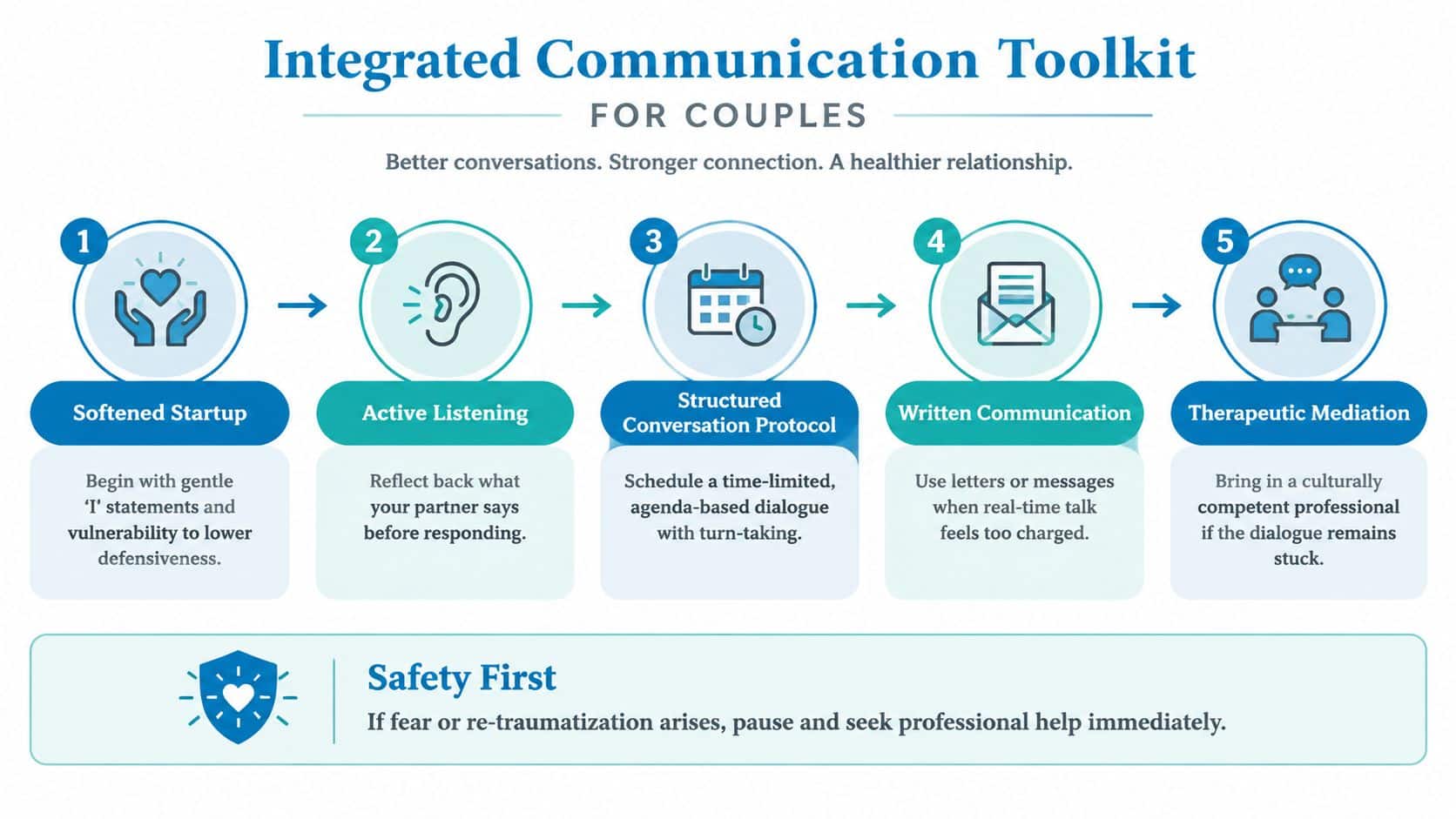
7. An integrated communication toolkit for multicultural couples
The most practical approach combines tools according to safety, emotional capacity, language needs, and the couple's ability to participate voluntarily.
A couple that can engage without intimidation might begin with a softened startup, use active listening, and keep the discussion inside a short structured session. A partner who is overwhelmed or avoidant may begin with a letter or carefully edited message instead of being pushed into an immediate face-to-face conversation.
Which communication tool should a couple try first?
Start with the tool that lowers threat rather than the tool that seems most advanced.
- Both partners are willing: Use a softened startup followed by reflection inside a structured conversation.
- One partner struggles to speak: Offer a written exchange with no demand for an instant reply.
- Language fluency is uneven: Slow the pace, allow native-language drafting, and clarify meanings instead of guessing.
- Conflict repeatedly escalates: Ask a culturally competent therapist to facilitate.
- Fear or coercion is present: Stop joint exercises and seek safety-focused professional guidance.
Digital communication deserves careful use. Research on mediated conflict found that positive conflict behaviors were lower in text-based interactions than in face-to-face interactions, while progress toward resolution and emotional outcomes didn't differ significantly between those channels. The peer-reviewed study on text and face-to-face conflict suggests that texting changes the balance of cues. It can preserve access across time zones, but it may also remove facial warmth, tone, and immediate repair.
Therapsy can support couples who need therapy in a shared or native language, online or in person. The service works with 50+ therapists, has served 1,500+ clients since 2023, and offers support across 14 languages, including Italian, English, French, Spanish, German, Portuguese, Ukrainian, Russian, Greek, Arabic, Urdu, Hebrew, Hindi, and Persian (Farsi).
For couples trying to communicate in a second language, Therapsy's resource on relationships in a second language offers a relevant starting point. Neutral language learning tips may also help with everyday communication, but language practice alone can't resolve contempt, fear, or an unsafe power dynamic.
7-Way Comparison: Strategies for Relationships with Communication Breakdown
What should you do when communication still fails?
When communication still fails, the next step depends on whether the problem is skill, emotional flooding, avoidance, or safety. Repeated silence, contempt, hostile exchanges, and an inability to discuss essential decisions justify considering couple therapy, but they don't establish a diagnosis or guarantee a particular outcome.
The distinction between restorative space and destructive withdrawal matters. A partner who says, “I'm overwhelmed and need time. I'll return to this conversation,” is communicating a boundary. A partner who uses unexplained silence to punish, control, frighten, or avoid accountability creates a different pattern.
A 2024 study of couples' everyday communication linked hostility, withdrawal, and vulnerability with same-day aggression, while vulnerability was also associated with lower concurrent relationship satisfaction. The peer-reviewed communication study supports a practical focus on observable behavior. Instead of asking only, “Why don't we communicate?”, ask whether the pattern involves hostility, withdrawal, or escalating conflict.
Which option fits the couple's current capacity?
Therapsy offers intercultural couples therapy for partners navigating language, culture, migration, family expectations, and distance. Its matching process is handled by the Clinical Director rather than an algorithm, followed by therapy in the client's own language where possible and a choice between online and in-person sessions across 24 Italian cities.
Is a relationship without communication always unhealthy?
No. Some quiet can be restorative when both partners understand it, consent to it, and remain emotionally available.
The concern is persistent silence that blocks repair, creates insecurity, or leaves one person responsible for all reconnection. A relationship can contain quiet companionship and still have strong communication, because the partners know how to discuss important needs when necessary.
Can texting help a couple reconnect?
Texting can provide a lower-pressure first step, especially for long-distance or multilingual couples, but it can also remove warmth and nonverbal context.
A short message such as “I care about us and want to talk when we're both calmer” may reopen contact without forcing a high-pressure discussion. For complex conflict, a scheduled call or facilitated session may provide more opportunity to clarify meaning.
When should a couple stop trying exercises alone?
A couple should seek professional guidance when repeated attempts lead to the same hostility, withdrawal, contempt, fear, or unresolved conflict.
Therapy can help identify whether the cycle reflects attachment insecurity, learned conflict habits, cognitive distortions addressed in CBT, schema patterns, cultural expectations, or circumstances that require practical support. It can also clarify when joint work is not appropriate.
Does therapy need to happen in Italian?
No. Language-concordant therapy can make it easier to describe subtle emotions, family experiences, migration stress, and cultural meanings without constantly translating internal experience.
Therapsy provides therapy across 14 languages, with online and in-person formats. The service has 50+ therapists, offers a first contact within 12 hours, and holds a 4.8/5 “Excellent” Trustpilot rating. The rating is presented here as a brand fact, not as a clinical outcome or guarantee.
How does Therapsy match an intercultural couple?
Therapsy uses human matching by the Clinical Director rather than an algorithm, considers language and intercultural needs, and connects clients with a chosen therapist for a free first assessment call.
Couples can explore online sessions or in-person appointments in Italy, depending on location and preference. Couple therapy starts from EUR 100, and the first assessment call is free. Prices depend on the therapist's experience and specialization.
What if only one partner wants therapy?
One partner can begin individual support without waiting for the other person to agree.
Individual therapy can help someone clarify needs, practise boundaries, regulate distress, and decide how to approach communication safely. It can't force the other partner to participate, but it can provide a grounded place to evaluate the relationship and available choices.
A therapist who collaborates with Therapsy can help a client consider whether self-guided tools are enough or whether structured support would be more appropriate. There's no need to arrive with a diagnosis or a perfectly explained story.
Therapsy's therapist matching service connects clients through the Clinical Director's human assessment, therapy in their own language across 14 languages, and a choice of online or in-person sessions. The first call is free, it's with the therapist chosen for that person, and there's no obligation to continue.
If communication has become difficult because of silence, cultural misunderstandings, or conflict in a second language, Therapsy offers human-matched therapy with multilingual therapists online or in person across Italy. Visit Therapsy to request a free first call with the chosen therapist, with no obligation to continue.