You're at a family dinner in Milan. Your partner is speaking Italian with relatives, you're following most of the conversation, and then someone asks a question that touches a sensitive subject. You know what you mean, but the English sentence arrives late. Your partner translates, simplifies, or answers for you. By the time you speak, the moment has moved on.
A relationship in a second language is a partnership in which the main shared language isn't the first language of one or both partners. It can be an Italian-English relationship, a Spanish-French relationship, or a couple who relies on English even though neither person grew up speaking it. The shared language may begin as a practical bridge, then gradually become part of the couple's identity.
That development matters. A second language can make affection feel less automatic, arguments harder to manage, and family conversations unequal. It can also encourage patience, creativity, careful listening, and a private style of speaking that belongs only to the couple. Language difficulty doesn't measure the depth of love. It changes the conditions in which love is expressed.
This is especially relevant for international couples living in Italy. Relocation adds bureaucracy, family expectations, homesickness, cultural adjustment, and language fatigue to everyday relationship work. Understanding the psychology can reduce unnecessary self-blame. Practical communication tools can make difficult conversations safer. Couple therapy can help when language differences repeatedly turn into loneliness, resentment, or power imbalance.
You can also explore the broader emotional patterns behind intimacy in the psychology of love. A relationship in a second language isn't a deficient version of a monolingual relationship. It's a developing interpersonal system with its own vocabulary, rhythms, and rules.
How Language Shapes Emotion Cognition and Connection
A partner may be emotionally articulate in their mother tongue and noticeably less precise in a second language. They might know they're hurt but struggle to explain whether the feeling is disappointment, shame, fear, or anger. That gap can feel frightening, especially when the other partner interprets hesitation as avoidance or emotional indifference.
The experience often reflects cognitive load, the mental effort required to understand, select, translate, and monitor language at the same time. During an ordinary conversation, this effort may be barely noticeable. During conflict, the brain has less spare capacity for nuance, turn-taking, facial cues, and repair.
Why feelings can sound quieter in another language
A second language may carry fewer childhood memories, family phrases, cultural associations, and embodied emotional habits. The words are understood, but they may not have the same resonance. Think of emotional resonance as a volume control. The feeling may be strong, while the available language turns the volume down.
This doesn't mean the emotion is less real. It means the person may need more time, examples, or contextual support to express it. Attachment theory helps explain why this matters. When people feel threatened by distance or misunderstanding, they often seek reassurance, withdraw, criticize, or become defensive. A language gap can intensify those attachment responses because each partner has less confidence about what the other means.
Cross-cultural psychology adds another layer. Partners may hold different assumptions about directness, silence, eye contact, apology, emotional disclosure, and the acceptable intensity of disagreement. Vocabulary alone can't resolve those differences. Couples also need to learn each other's emotional rules.
Emotional fluency grows through shared context
Research on intercultural couples supports a reassuring pattern. In a large study of 429 participants, about one-third reported no difficulty communicating emotions in a foreign language, while roughly half described reduced emotional depth or lower foreign-language skill as a difficulty. More than 75% said those barriers faded within months, suggesting that repeated relational exposure can build emotional fluency (study of intercultural couples).
The same research found that women were more likely to report early difficulty expressing emotions in a second language, but that difference diminished over time. This shouldn't be used to predict an individual couple's experience. Its more useful message is that early difficulty may reflect a stage of development rather than a permanent limit.
Over time, partners teach each other what words mean in context. “I'm fine” may come to mean “I need space but don't want to disconnect.” A pause may mean careful thought rather than anger. A particular nickname, grammatical mistake, or mixed-language phrase may become affectionate because of the story attached to it.
That process is sometimes called affective socialisation, learning how to feel, express, and interpret emotion within a relationship. One partner's language can become the couple's “language of the heart,” not because it replaces the mother tongue, but because shared memories give it emotional weight. Couples who want to strengthen this process can use resources on emotional intelligence in relationships while building their own examples and rituals.
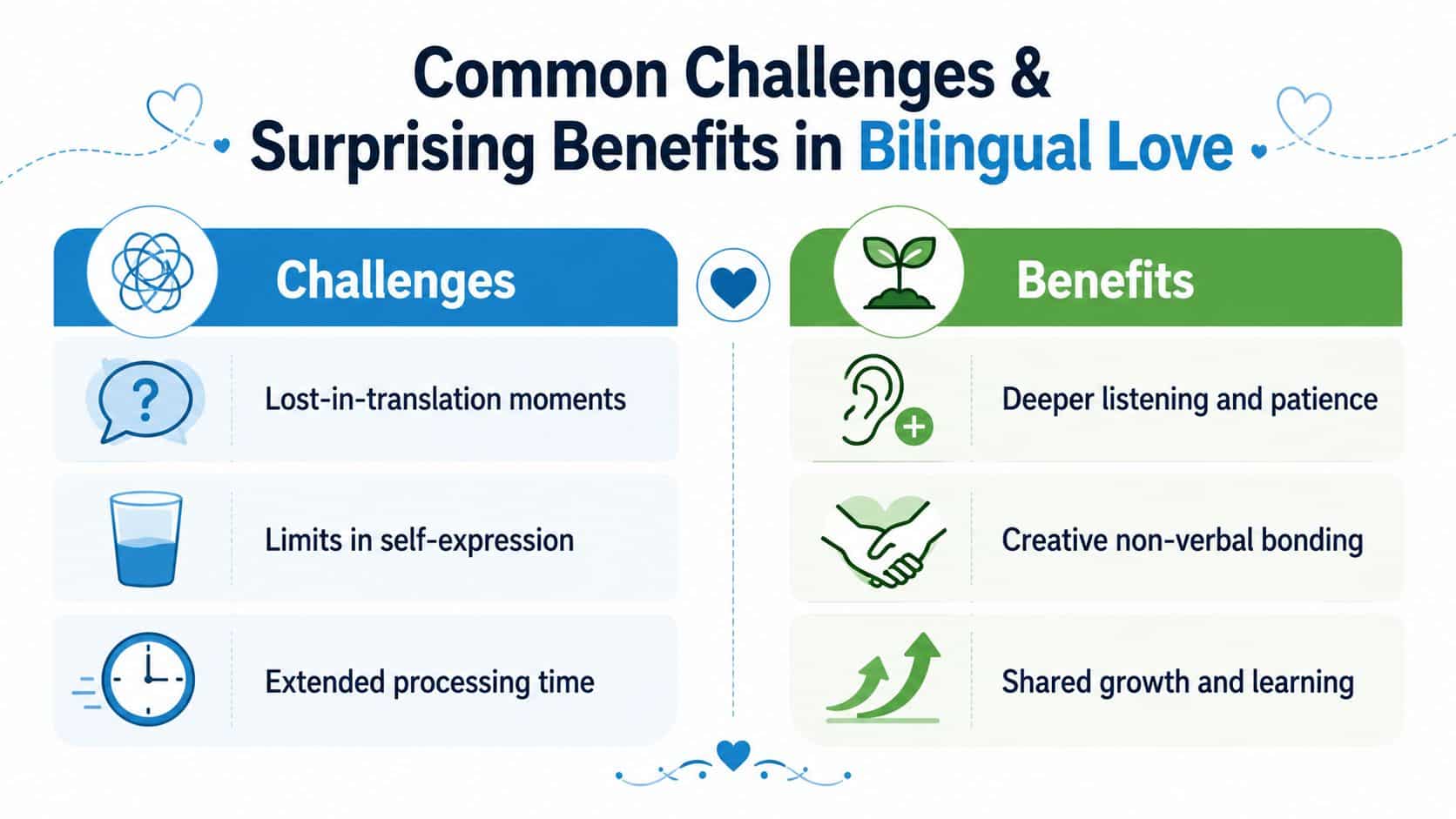
Common Challenges and Surprising Benefits in Bilingual Love
A couple may discuss dinner easily, then stall over a boundary, apology, or family expectation. Later, a mispronounced phrase becomes an inside joke that neither partner wants to translate. The same language arrangement can produce strain or closeness depending on the conditions around it. The shared language gradually becomes a developing couple identity, shaped by repeated choices, memories, and repairs.
Challenges that deserve attention
Several pressure points deserve attention:
- Lost-in-translation moments: A neutral sentence may sound cold, while a direct request may sound controlling.
- Limits in self-expression: A partner may shorten an idea because the precise word does not arrive quickly.
- Unequal conversational authority: The more fluent partner may lead decisions, correct pronunciation, or speak for the other person.
- Extended-family communication: Family gatherings can leave one partner reliant on interpretation and uncertain about what was discussed.
- Conflict escalation: Stress may bring longer pauses, interruptions, language switching, or withdrawal.
- Identity fatigue: A partner may feel that the self expressed in the shared language is smaller or less authentic.
Language becomes a source of inequality when one person controls access to relatives, institutions, finances, or important decisions. The risk grows when fluency is mistaken for intelligence, maturity, or credibility. A language mistake is never evidence that a partner has less to contribute.
Exclusion can also spread beyond the couple. Being unable to follow family conversations may create alienation and resentment, especially if interpretation is inconsistent or treated as a favor. Guidance on expat relationships and cultural gaps can help couples recognize how language and cultural belonging interact.
Benefits that couples often discover
Bilingual couples may develop strengths that monolingual couples have to build deliberately:
- More conscious communication: Partners check meaning instead of relying only on assumptions.
- Deeper patience: Waiting for a sentence becomes part of listening.
- Creative intimacy: Gestures, facial expressions, music, food, humor, and routines carry meaning when words are limited.
- Cultural expansion: Each partner gains access to family stories, traditions, and everyday interpretations.
- Protective distance: A second language can soften the first emotional impact of a difficult topic.
- A shared couple tongue: Repeated phrases, code-switching, private jokes, and borrowed expressions form a language belonging to the relationship.
A study of bilingual couples examined more than 20 hours of private dialogue, showing how long-term partners create a shared “couple tongue” through repeated interaction (research on bilingual couple conversation). This private language does not need to follow standard grammar. Its meaning comes from shared history.
A second language can create distance from an emotion, but it can also give a couple room to approach that emotion together.
That distance can protect or conceal. Discussing a painful subject in a second language may reduce emotional intensity enough for both partners to stay present. Using it to avoid accountability, hide meaning, or control access to information creates a different pattern.
Research on intercultural couples connects language problems with exclusion, alienation, isolation, and frustration. Longer relationships may support emotional socialisation in a partner's language, while mutual understanding still depends on language attitudes and individual skill (research on language and intercultural couple communication). Equal fluency is not required. Equal respect is.
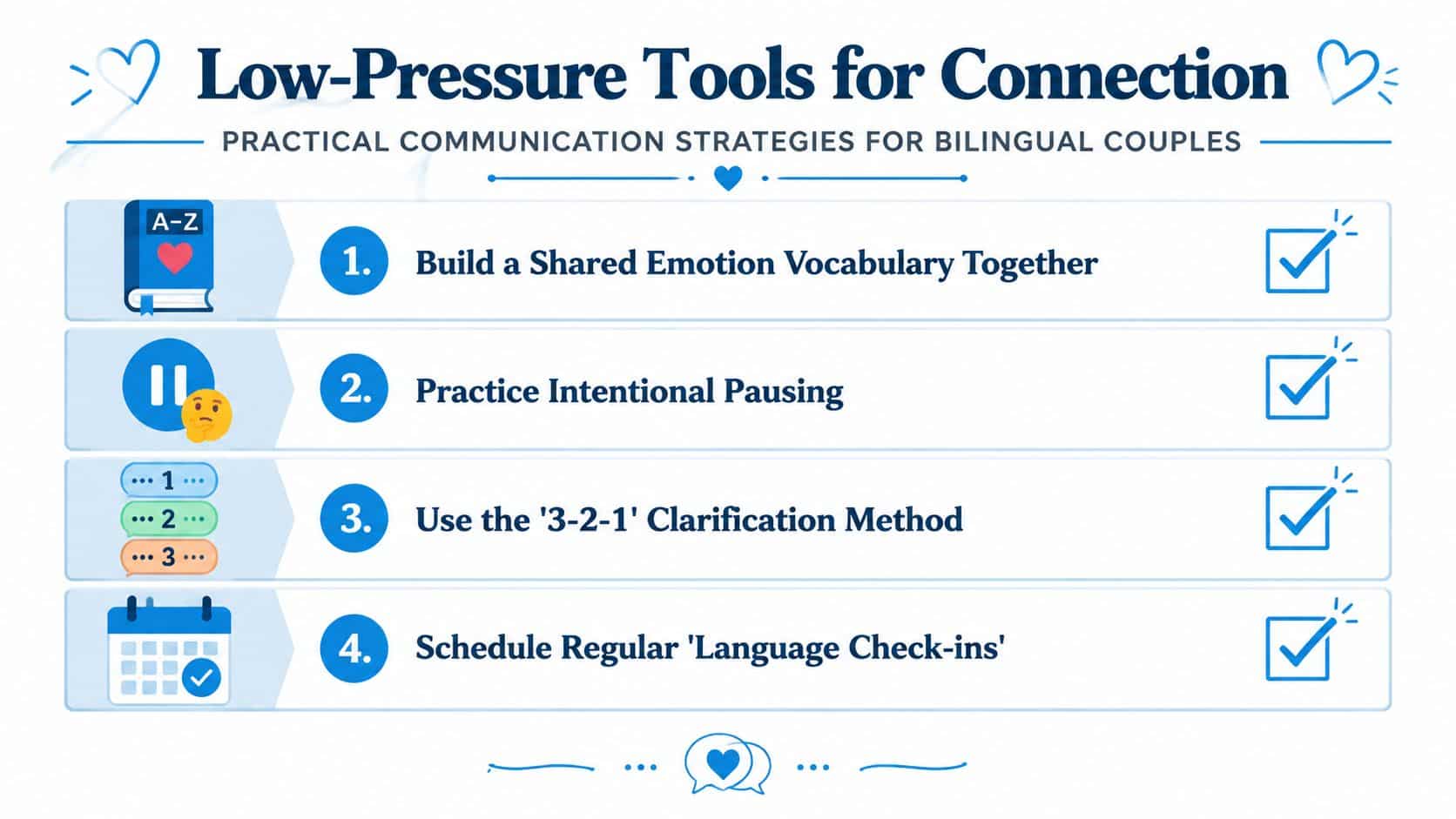
Practical Communication Strategies and Scripts That Work
Language learning becomes more useful when it serves a real relationship. You don't need to wait until both partners are fluent. Start by making communication slower, more explicit, and less threatening.
Build a shared emotion vocabulary
Choose a few feelings that regularly appear between you. Discuss what each word means, how intense it feels, and what kind of response helps. Don't translate only the dictionary definition. Translate the situation.
For example, the Italian word “preoccupato” may overlap with “worried,” but partners might use it differently depending on context. A shared definition could be, “I'm concerned about what may happen, but I'm not blaming you.” Add phrases for needs, such as “I need reassurance,” “I need time,” or “I want us to decide together.”
Use a pause without creating abandonment
A pause should have a clear beginning and return point. Instead of disappearing during an argument, say:
“I'm still here. I need a few minutes to find the right words, and I want to continue this conversation.”
The slower partner can ask for processing time. The faster partner can resist filling every silence with more questions. A pause is protective when it reduces overload. It becomes distancing when nobody knows whether the conversation will resume.
Choose the language according to the task
There isn't one correct language for every conversation. A practical arrangement might look like this:
- Daily logistics: Use the language that makes planning easiest.
- Emotional disclosure: Let the more vulnerable partner choose their strongest language.
- Apologies: Use the language in which accountability feels most precise.
- Boundaries: Allow either partner to write or rehearse the message first.
- Extended-family issues: Discuss the couple's position privately before anyone interprets.
- High-conflict conversations: Use a therapist or trusted interpreter when meaning and safety are repeatedly compromised.
The aim isn't to force equal language use. It's to prevent fluency from deciding who gets heard.
Try simple repair scripts
Keep the sentences short enough to use under stress.
- Clarifying intent: “I may have understood you incorrectly. Did you mean that you're disappointed with the situation, or with me?”
- Naming the language issue: “I know what I feel, but I can't explain it well in this language. Please give me time.”
- Repairing impact: “That wasn't my intention, but I can see that it hurt you. Can you tell me which part felt hurtful?”
- Requesting a switch: “I want to talk about this in my first language for a moment, then I'll explain it together with you.”
- Protecting equality: “Please don't answer for me yet. I want to try, and you can help only if I ask.”
- Checking the conclusion: “Before we decide, can we each say what we think we agreed?”
Meta-communication is communication about communication. It allows couples to discuss speed, vocabulary, tone, translation, and repair before those issues become evidence of rejection.
You can find additional guidance on improving communication skills, but the most important practice is mutuality. Both partners should sometimes be the learner, the slower speaker, and the person who needs clarification.
Real Life Examples When Language Choice Changes Everything
On a Tuesday evening, an Italian partner asks an English-speaking partner why they haven't replied to a message. The question comes out in English, but the Italian partner's intended concern sounds like criticism. The other partner hears accusation and switches into Italian to defend themselves, using sharper words than usual. The argument escalates because both people are speaking quickly in a language that gives them less control.
They stop and change the task. One partner says, “I'm asking because I missed you, not because I want to monitor you.” The other answers, “I heard blame. I need you to ask more gently.” The language switch didn't solve the disagreement. Naming the emotional meaning did.
In another couple, one partner discloses fear about losing their professional identity after moving to Italy. They speak in their second language because the distance makes the subject less overwhelming. Their partner initially assumes the calm tone means the fear isn't serious. Once they understand that the second language is acting as a protective buffer, they respond with curiosity instead of urgency.
A third couple is at a family dinner outside Florence. The Italian partner translates every sentence for the foreign partner, including jokes and side conversations. At first this feels caring. Later, the foreign partner realizes that important decisions about a future visit were discussed without them, and the interpreter has become the gatekeeper.
The couple agrees on a new rule. The Italian partner can explain unfamiliar words, but won't summarize or answer on the other person's behalf. They also create a private phrase that means, “I need the full context.” Over time, their repeated phrases and shared shortcuts become a couple tongue, much like the private interaction documented in research on bilingual couples. Stress-related emotion can also affect code-switching. Research involving 68 Chinese American parents and children found that negative facial emotion predicted more subsequent switching between languages, especially from a second language to a first language (research on emotion and code-switching). Switching under stress isn't automatically a failure. It's information about where the nervous system needs more support.
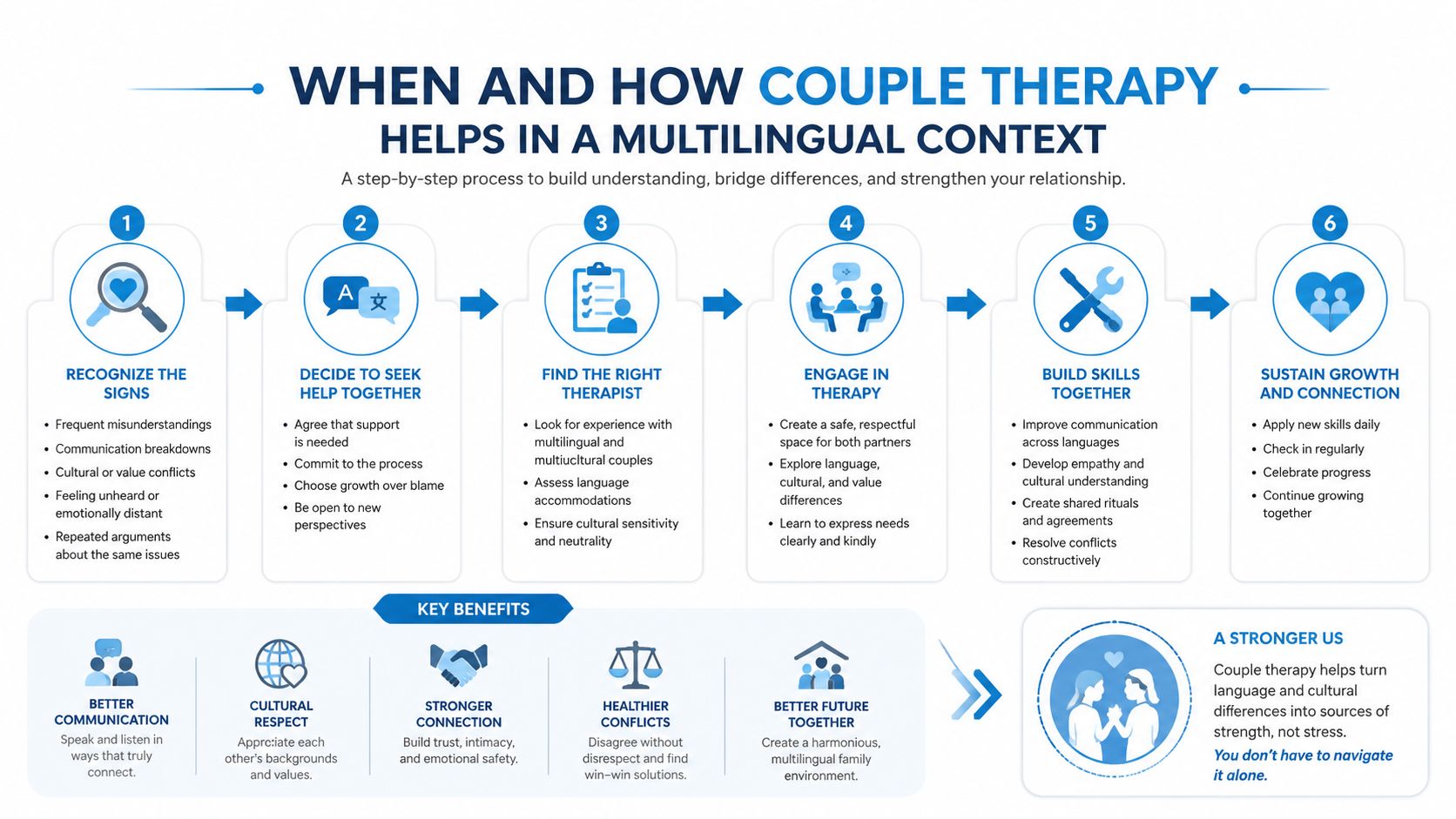
When and How Couple Therapy Helps in a Multilingual Context
Everyday tools may not be enough when the same language-related conflict repeats without repair. Consider professional support if one partner regularly feels invisible, arguments always become worse in the shared language, sensitive topics are avoided, or family communication leaves one person isolated.
Therapy can also help when language differences interact with attachment strain. A partner may feel they've lost their humor, authority, independence, or emotional identity after moving countries. The other may feel responsible for translating everything and become exhausted. These experiences can turn a practical language issue into a relationship pattern.
What multilingual couple therapy can address
A therapist can help partners:
- Identify whether the main problem is vocabulary, emotional safety, cultural expectations, or power.
- Decide which language is most appropriate for different conversations.
- Slow conflict without silencing either partner.
- Develop a shared emotion vocabulary.
- Separate language mistakes from character judgments.
- Negotiate extended-family boundaries and interpretation.
- Explore whether second-language distance is helping regulation or enabling avoidance.
- Repair attachment injuries connected to migration, exclusion, or identity loss.
Approaches may include CBT, which helps couples identify unhelpful interpretations and communication habits; systemic-relational therapy, which examines patterns between partners and their wider families; and Schema Therapy, which explores longstanding emotional expectations such as abandonment, defectiveness, or emotional deprivation. A therapist may also draw on humanistic, ethnopsychotherapeutic, or other evidence-based approaches according to the couple's needs.
What support can look like in Italy
Therapsy offers intercultural couples therapy for partners navigating different first languages and cultural backgrounds. Its clinicians provide therapy in 14 languages, with human matching by the Clinical Director rather than automated matching. Sessions are available online and in person across 24 Italian cities and 90+ physical locations, including Milan, Rome, Florence, Turin, Bologna, Bergamo, Padova, and Verona.
Couple therapy is available from €100 per session. The first assessment call is free and carries no commitment, giving partners an opportunity to explain their language arrangement and discuss what kind of support might fit.
A therapist doesn't need to make both partners speak the same language all the time. The clinical task is to create enough safety for both people to express themselves fully, understand the pattern they're caught in, and build a relationship language that doesn't privilege one voice.
Living and Loving in Italy as a Multilingual Couple
Italy can make language differences visible in very practical ways. One partner may handle residence documents, medical appointments, rental conversations, tax questions, and family calls because they speak stronger Italian. That division may be efficient at first, but it can gradually create dependence if the other partner never receives explanations or opportunities to participate.
Create a shared bureaucracy ritual. Read important documents together, keep a private glossary of recurring Italian terms, and agree that the fluent partner will explain decisions rather than just announce them. For high-stakes matters, use qualified professional language support when needed. Couples protect equality when both people understand the choices affecting their home and future.
Family life needs similar structure. Before in-law visits, agree on signals for fatigue, exclusion, and the need for translation. Decide which traditions belong to each person, which ones you'll combine, and which ones you'll create from scratch. A weekly meal, a bilingual playlist, or a private phrase for reassurance can turn cultural difference into a shared ritual rather than a test.
Language fatigue also affects intimacy. A partner who spends the day operating in Italian may not have the energy to discuss feelings in English at night. Another partner may have spent the day speaking English at work and feel depleted when asked to switch again. Schedule conversations when both people have enough attention, and allow affection to be expressed through touch, food, humor, music, and quiet companionship.
Support can be online or in person, whether you're based in Milan, Rome, Florence, or a smaller Italian city. For couples who feel stuck between cultures, a multilingual therapist can offer a neutral setting where neither partner has to serve as the permanent interpreter. Therapy in Italy can bridge local daily life with the emotional language that helps both partners feel at home.
Therapsy provides human-matched couples therapy for intercultural relationships, with support in 14 languages and online or in-person sessions across Italy. Book a free assessment call with the Clinical Director, with no commitment, and visit THERAPSY to begin a conversation about the language, culture, and connection patterns shaping your relationship.
FAQ
What is a relationship in a second language?
A relationship in a second language is a partnership in which the main shared language isn't the first language of one or both partners. The language may begin as a practical bridge and develop into a private emotional system shaped by shared memories, routines, and expressions.
Can a relationship in a second language be emotionally intimate?
Yes, couples can build deep emotional intimacy in a second language. Emotional fluency often develops through repeated conversations and shared context, even when one or both partners initially feel less expressive.
Why do I feel less emotional in my second language?
A second language may carry fewer childhood associations and require more mental effort, which can make emotions feel quieter or less immediate. The feeling itself may not be weaker, but finding precise words can take longer.
Which language should couples use during an argument?
Couples should use the language that gives the more vulnerable partner the greatest clarity and emotional safety. They can also pause, switch languages, write down key points, or seek professional support when the shared language repeatedly escalates conflict.
How can bilingual couples prevent a power imbalance?
Partners can prevent imbalance by sharing translation responsibility, explaining important decisions fully, and avoiding corrections that shame or silence the less fluent speaker. Both people should have opportunities to speak directly, make decisions, and use their strongest language when discussing sensitive subjects.
When should bilingual couples consider therapy?
Couples should consider therapy when language-related misunderstandings repeatedly cause loneliness, resentment, avoidance, or escalating conflict. A multilingual couples therapist can help identify whether the underlying issue involves language skill, attachment, cultural expectations, identity, or unequal power.