Defining EMDR Therapy
Eye Movement Desensitization and Reprocessing (EMDR) is a structured psychotherapy that enables people to heal from the symptoms and emotional distress that are the result of disturbing life experiences. It is a globally recognized, evidence-based approach for treating Post-Traumatic Stress Disorder (PTSD) and many other forms of psychological distress, making it highly relevant for expats and international students in Italy whose past traumas can be triggered or amplified by the stress of relocation.
Think of your brain as a vast, efficient library. Most daily experiences are processed and filed away neatly, becoming memories you can access without trouble. But when something traumatic or deeply upsetting happens, the brain's filing system can get overwhelmed. The memory doesn't get properly stored.
It’s like a corrupted file saved incorrectly. The file is fragmented and disorganized, and every time your brain tries to access it, the whole system glitches. This is what causes intrusive thoughts, emotional flashbacks, and physical reactions in the present – long after the actual event is over.
As Clinical Director at Therapsy, I see how EMDR acts as a specialist technician for your brain’s library. Using bilateral stimulation (like guided side-to-side eye movements), the therapy helps your brain safely access that stuck memory. It then guides your brain to reprocess the memory, "resaving" the file in an organized, non-disruptive way.
The goal is not to delete the memory but to take away its emotional sting. After successful reprocessing, you can remember what happened, but you no longer relive the intense fear or pain. This can be especially liberating for those dealing with the pressures of life abroad. If you are curious about how trauma can show up in more complex ways, you can learn more about healing from complex PTSD in our dedicated guide.

The Psychological Insight: Why Trauma Gets "Stuck"
To understand what EMDR therapy is, it helps to first look at how our brains handle life experiences. The therapy is built on the Adaptive Information Processing (AIP) model. This psychological framework suggests that our brains have an innate system for digesting information, learning from it, and filing it away correctly.
When a traumatic event occurs, that natural system can be completely overwhelmed. The experience is too much, too fast. Instead of being processed and stored as a past event, the memory gets “stuck” and is frozen in time within your nervous system.
Why do traumatic memories get stuck?
A stuck memory is not like a regular memory. It keeps all the raw, unfiltered emotions, physical sensations, and beliefs that were present during the original event. This is why a specific sight, sound, or smell today can suddenly throw you right back into that moment. Your brain isn't just recalling the past; it’s re-experiencing it as if it were happening all over again.
For expats in Italy, the background stress of adapting to a new culture can often trigger these old, unprocessed memories. A feeling of isolation, for example, might reactivate powerful feelings of abandonment from long ago, even if the situations are unrelated.

How bilateral stimulation unlocks the brain
This is where EMDR’s unique method comes into play. The therapy uses bilateral stimulation (BLS)– most commonly guided eye movements, but sometimes alternating sounds or hand taps. This gentle, rhythmic stimulation seems to do two crucial things:
- It dials down the intense emotional charge of the traumatic memory, creating a sense of distance and safety.
- It jump-starts the brain’s own information processing system, allowing it to finally integrate the stuck memory.
Think of it like a mental digestive aid. Bilateral stimulation helps your brain break down and absorb an experience it couldn’t stomach at the time. It doesn't erase what happened, but it shifts the memory from feeling like an immediate threat to being a finished story in your past.
The memory simply becomes a memory, not something that hijacks your present. This process is key to quieting a reactive nervous system. You can explore more strategies in our guide on calming your body through nervous system regulation therapy. By helping the brain correctly re-file these disruptive memories, EMDR frees you to live more fully in the here and now.
Who Can Benefit From EMDR Therapy?
When people ask "What is EMDR therapy for?", they often think of "Big T" Traumas. These are major, life-threatening events like a serious car accident, physical violence, or a natural disaster. While EMDR is incredibly powerful for these experiences, its real-world use is much broader.
A lot of our emotional pain builds up from experiences that, while not life-threatening, chip away at our sense of safety. These are often called "small t" traumas.
"Small t" traumas are deeply personal, distressing events that undermine your sense of safety and self-worth. Examples include persistent bullying, the emotional fallout from a painful breakup, the chronic stress of a toxic job, or the quiet turmoil of moving to a new country and losing your support network.
These experiences might not fit the classic definition of PTSD, but they leave their own scars. They can install negative beliefs about yourself and the world, becoming the fuel for anxiety, depression, and a constant feeling of not being "good enough."
A versatile tool for many kinds of pain
For the expat community in Italy, EMDR can be a particularly useful approach. Life abroad comes with unique stressors that can feel like "small t" traumas or can poke at unresolved issues from your past. While general trauma counselling offers valuable support, EMDR provides a specific structure for healing. For our readers in Canada, services like specialized trauma therapy in Vernon can be a similarly helpful resource.
EMDR has proven to be a reliable and effective approach for many challenges that expats and young adults face, including:
- Post-Traumatic Stress Disorder (PTSD) and Complex PTSD (C-PTSD): For processing both single-event traumas and the impact of long-term, repeated distress.
- Anxiety and Panic Attacks: By getting to the root memories and triggers that ignite overwhelming fear.
- Depression: To work through past events contributing to feelings of hopelessness and worthlessness.
- Phobias: To desensitize the intense fear attached to a specific object or situation.
- Complicated Grief: Helping you process loss when the natural grieving process feels stuck.
- Burnout: For addressing the cumulative emotional exhaustion from chronic professional or personal stress.
For international residents in Italy, this might mean processing the emotional fallout of a forced migration, the unresolved grief of leaving home, or the deep psychological toll of cultural isolation. The goal of EMDR is to help you see that your struggles are valid and treatable, offering a structured path to healing from any past experience that still holds you back today.
The Solution: An 8-Phase Journey to Healing
EMDR is not an improvised chat. It’s a highly structured, evidence-based process that unfolds across eight distinct phases. This methodical approach is one of its greatest strengths, especially for expats hesitant about therapy in a new country. It provides a clear, predictable roadmap, ensuring you feel in control.
Developed by psychologist Francine Shapiro in the late 1980s, this protocol is a cornerstone of trauma treatment worldwide. A typical session lasts 60 to 90 minutes. For expats in Italy, the focused nature of EMDR can feel much more manageable than unstructured talk therapy.
Phases 1 & 2: Building a foundation of safety
The journey begins not with trauma, but with building safety. These first two phases are essential for establishing a strong therapeutic relationship.
- Phase 1: History Taking and Treatment Planning. In this collaborative conversation, you and your therapist will pinpoint the distressing memories, beliefs, or symptoms you want to work on and create a treatment plan.
- Phase 2: Preparation. This is a critical step for feeling empowered. Your therapist will teach you techniques for self-soothing and managing difficult emotions. You’ll develop a “calm place” and other resources. No reprocessing happens until you feel completely ready and equipped.
Phases 3 & 4: The core reprocessing work
Once you have a solid foundation of coping skills, you move into the core of the therapy, where bilateral stimulation is introduced.
These phases are not about reliving trauma; they are about observing it from a safe distance. You are always in the present moment, in a safe room with a trusted therapist, simply noticing what comes up as your brain forges new, healthier connections.
- Phase 3: Assessment. For each target memory, you will identify a related image, a negative self-belief (e.g., “I am not safe”), and the associated emotions and physical sensations.
- Phase 4: Desensitization. While you hold the memory in mind, your therapist guides you through sets of bilateral stimulation. The goal is to lower the memory’s emotional charge until it no longer feels distressing. This is the “D” in EMDR – desensitizing the memory’s power over you.
The infographic below shows how many issues – from major traumas to the unique stressors of expat life – can be effectively treated with EMDR.
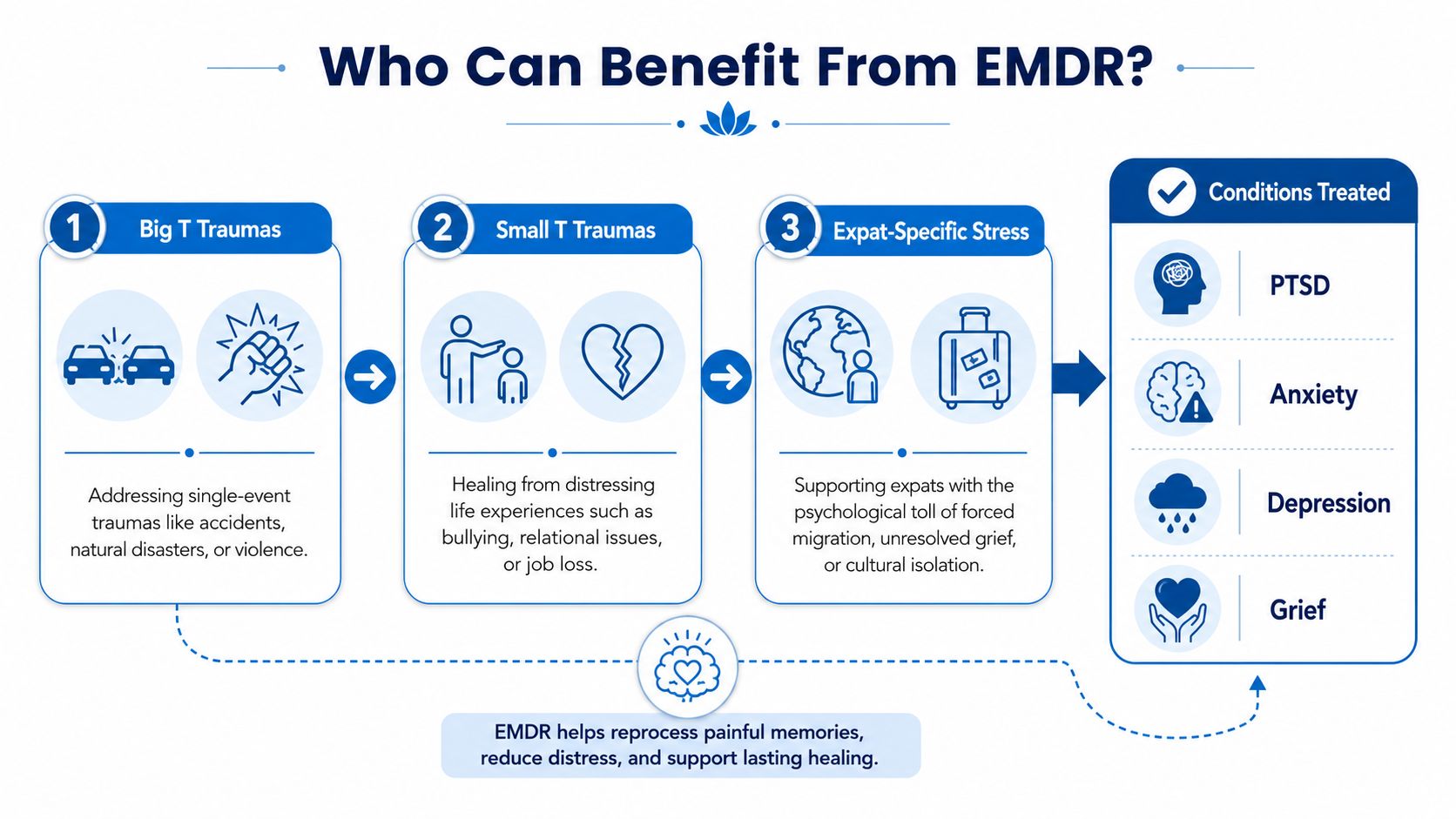
This process reveals that EMDR isn’t just for single, major traumatic events. It’s also a powerful tool for healing from the complex stressors of living abroad.
Phases 5 to 8: Integration and looking to the future
The final phases consolidate your progress, installing positive beliefs and ensuring your body feels calm.
- Phase 5: Installation. You’ll strengthen a new, positive belief (e.g., “I am safe now”) to replace the old negative one.
- Phase 6: Body Scan. You’ll scan your body for any lingering tension related to the memory, ensuring the distress is fully resolved. Our bodies often hold onto stress. You might find our guide on how somatic therapy can help release physical tension a useful resource here.
- Phase 7: Closure. Every session ends with closure, ensuring you leave feeling stable and grounded, often using the self-soothing techniques from Phase 2.
- Phase 8: Re-evaluation. At the start of the next session, you and your therapist will check in on the previous work, ensuring the positive changes are holding steady.
The Science Behind EMDR's Effectiveness
When considering therapy, especially while living in a country like Italy, the first question is always: does it actually work? When it comes to EMDR, the global scientific community has a clear and confident answer: yes.
EMDR is not an alternative or fringe therapy; it is recognized as a first-line, evidence-based treatment for PTSD by major health organizations, including the World Health Organization (WHO) and the American Psychiatric Association (APA).
This provides real assurance that the treatment meets the highest international standards of care. For expats from analytical or academic backgrounds, this scientific backing is crucial.
Compelling evidence and rapid results
The conversation among experts isn't just about whether EMDR works, but how efficiently it works. In many cases, EMDR can achieve results much more quickly than traditional talk therapies.
A major review of trauma literature found that seven out of ten studies showed EMDR to be more rapid and/or more effective than trauma-focused cognitive behavioural therapy. This is a powerful testament to its value.
The research also confirms its benefits beyond PTSD. Evidence from randomized controlled trials supports EMDR as a primary treatment for anxiety, depression, and even complex trauma. This clinical data helps explain why EMDR has become so vital in multilingual psychotherapy, including here in Italy. If you're interested in learning more about the role of trauma in a woman's life, our guide on trauma-informed therapy for women is a helpful resource.
This body of evidence shows that EMDR is a structured, reliable, and science-backed path toward healing. You can learn more about the research supporting EMDR's effectiveness and how it compares to other therapies.
Finding a Qualified EMDR Therapist in Italy with Therapsy
Finding the right therapist is a huge part of any healing journey, but for EMDR, it’s everything. Because the therapy is so structured, you need a professional who is officially certified.
Look for certification and experience
In Europe, the gold standard is certification from EMDR Europe. A therapist with this credential has completed rigorous training and proven their clinical skills. It's your assurance that they can guide you safely through all eight phases.
Your safety and trust are paramount. A certified EMDR therapist has committed to the highest standards of practice. This means your therapy will follow the evidence-based protocol that makes EMDR effective.
Therapsy: The solution for expats in Italy
For expats, the search often comes with language and cultural hurdles. Finding a professional who is not only certified in EMDR but also fluent in your native language can feel impossible.
Therapsy was created to solve this exact problem. As a multilingual psychotherapy service in Italy, our clinical team includes multilingual, licensed therapists certified in EMDR. We offer specialized trauma care in English, Spanish, French, German, Russian, and more, both online and in-person across 20+ Italian cities like Milan, Rome, and Florence.
We believe that finding the right therapist shouldn't be left to an algorithm. As Clinical Director, I personally speak with every new client in a free first assessment call. This human-led matching process ensures you’re paired with a therapist whose expertise and personality genuinely align with your needs. You can learn more about finding a trauma therapist for English speakers in Italy through our detailed guide.
The EMDR-trained therapists at Therapsy
EMDR is designed for memories that stay charged long after the event and do not settle through talking alone. These are some of the clinicians who use it, in English.
Dr. Paola Acca holds a master degree in EMDR and one in Mindfulness, and specialised in relational systemic psychotherapy. She worked for a long time alongside hospitals and public mental health services before moving to private practice in Milan.
Dr. Daniele Damiani works with trauma through EMDR alongside CBT, predominantly online, with patients in Italy, Australia, Canada, Germany, Peru, the United States and Switzerland.
Dr. Sofia Collatina has advanced EMDR training under Roger Solomon, one of the most recognised trainers in the field, and specialises in PTSD and complex PTSD. She holds her sessions in English, in Rome and online.
You do not have to work out who fits on your own. You tell Therapsy what you are looking for, a member of our clinical team reads your request, and they introduce you. The first call is free.
FAQ
Is EMDR therapy just for PTSD?
No, not at all. While EMDR first gained its reputation as a powerful treatment for trauma, we now successfully use it for anxiety, depression, phobias, chronic pain, and even performance anxiety. At its core, EMDR helps the brain process any distressing life experience that has become "stuck," whether it qualifies as major trauma or not.
Will I have to talk about my trauma in detail?
No, you will not have to describe what happened in exhaustive detail. Unlike some talk therapies where recounting the story is central, EMDR allows the brain to process the memory internally with minimal verbal retelling. This makes the process feel much more manageable and less distressing for many clients.
How many EMDR sessions will I need?
The number of sessions varies depending on the individual and the complexity of the issue. For a single, specific trauma, results can be remarkably fast, with some clients feeling significant relief in as few as 3-6 sessions. Complex or developmental trauma will naturally require a longer course of therapy, but the process remains focused and goal-oriented. You can explore more about these published clinical research.
Is EMDR therapy safe?
Yes, EMDR is considered very safe when conducted by a properly trained and certified therapist. A qualified practitioner always begins with a Preparation phase, ensuring you have the coping skills and resources needed to feel grounded before any reprocessing work begins. This foundational work is what makes the entire experience feel contained, manageable, and fundamentally safe.
Book your first free assessment call – no commitment, just a conversation with our Clinical Director, Dr. Francesca Boccalari, who will listen and match you with the right therapist for you. Visit therapsy.it.