A woman sits alone in a busy Milan café, close enough to hear three conversations and still feel completely outside all of them. She knows how to order coffee. She can smile. She may even have colleagues, a partner, or a full calendar. But she still goes home with the sharp, private ache of not yet belonging.
That experience is common for American women living in Italy. It isn't a sign that you're bad at friendship, too sensitive, or failing at expat life. It's often the emotional cost of relocation. Your old support system is far away, your social reflexes don't quite fit the local rhythm, and even simple interactions can start to feel high-stakes.
To talk with strangers is not just a social skill. In an expat context, it can be a mental health strategy. Brief, ordinary exchanges can reduce isolation, create familiarity, and help your nervous system register that you are not as alone as you feel.
In therapy, I often see how loneliness grows quieter before it grows heavier. People stop initiating. They wait to be approached. They tell themselves they'll try once their Italian improves, once work settles down, once they feel more confident. That waiting can become its own trap. If that's where you are, the experience described in this guide on expat loneliness in Italy may feel painfully familiar.
Talking with strangers won't replace close friendship. It won't solve homesickness overnight. But it is one of the most practical ways to begin building a life that feels more human, more rooted, and less emotionally airless.
Introduction
Why this matters more than people admit
Expat isolation often hides behind a beautiful backdrop. Italy can look warm, social, and full of life from the outside. That contrast makes many women feel guilty for struggling.
They think, “I live here. I should be enjoying this.”
But your brain doesn't care that the piazza is charming if your attachment system reads the environment as unfamiliar. In CBT terms, the problem is not only the external situation. It's also the meaning your mind gives it. A quiet café can feel peaceful one day and rejecting the next.
Clinical reality: loneliness abroad often begins as disorientation, then turns into avoidance, then starts to look like identity loss.
A more useful goal than being instantly sociable
Most advice about social confidence is too simplistic. It tells you to “just be open” or “put yourself out there.” That rarely helps someone who already feels exposed.
A better goal is smaller and more psychologically sound. Learn how to create low-pressure contact. That means short conversations, clear boundaries, and realistic expectations. You are not trying to charm everyone. You are practising safe, repeatable moments of connection.
Why Talking to Strangers Feels So Hard
Fear of rejection is not just shyness
Many expats describe the same internal script. “They'll think I'm awkward.” “My Italian is embarrassing.” “I'm interrupting.” “They can tell I don't belong here.”
That reaction often gets dismissed as shyness. Sometimes it is. But often it's closer to social anxiety, which is different. Social anxiety isn't just discomfort. It's a pattern where the mind overestimates social threat and underestimates your ability to cope with it.
If this pattern feels familiar, support for social anxiety in Italy can help put language around what's happening.
The CBT cycle that keeps you isolated
CBT is useful here because it breaks the experience into parts you can work with.
A common cycle looks like this:
-
Trigger
You're in a café, queue, dog park, coworking space, or language class. -
Automatic thought
“They don't want to talk to me.” -
Body response
Tight chest, dry mouth, racing heart, frozen posture. -
Protective behaviour
You look at your phone, avoid eye contact, leave early, or say nothing. -
Short-term relief
You escape the discomfort. -
Long-term cost
Your brain learns that avoidance was necessary, so the fear gets stronger next time.
This is why isolation can become self-reinforcing. The more you avoid contact, the less evidence you collect that contact can go well.
What feels like protection can become training. Every avoided interaction teaches your brain that social risk was too dangerous to face.
The expat layer makes everything louder
American women in Italy often carry an extra burden. They're not only managing ordinary social nerves. They're also translating themselves across culture.
That means asking questions such as:
- Language worry. “Did I say that too directly?”
- Cultural worry. “Was I too friendly?”
- Identity worry. “Am I becoming the needy foreigner?”
- Relational worry. “If this goes badly, where do I even try next?”
When you're far from your usual support network, a small social disappointment can feel much bigger than it would back home. One awkward exchange doesn't just sting. It can seem to confirm a fear that integration itself may be out of reach.
Rewiring Your Brain for Connection
Your prediction is often the problem
Anxiety loves prediction. It tells you what will happen before anything has happened. It says the conversation will be flat, awkward, pointless, or humiliating.
But our predictions are often unreliable. A 2022 PNAS study on conversations with strangers found that people systematically underestimated how much they would learn from talking with strangers. Participants expected to learn less than they reported learning afterwards.
That matters clinically because anxious thinking usually says, “This won't be worth it.” The evidence points in a different direction.
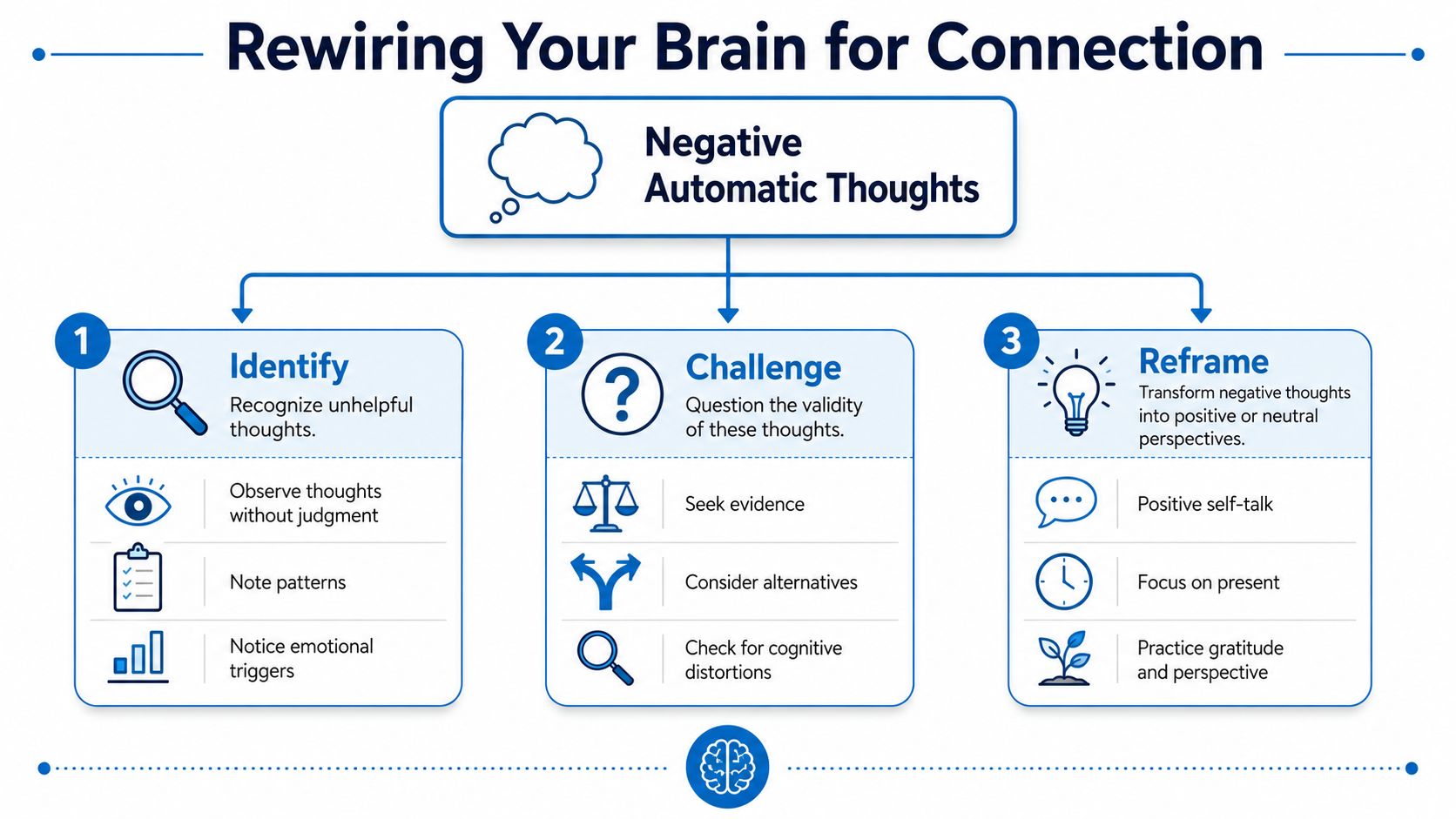
A CBT method that works in real life
Use this three-step process before you initiate contact.
Identify the thought
Catch the sentence your brain is offering. Not the whole spiral. Just the key line.
Examples:
- “She'll think I'm intrusive.”
- “My accent will make this embarrassing.”
- “If it's awkward, I won't recover.”
Challenge the thought
Ask questions a therapist would ask.
- What is the evidence for that belief?
- Is there another explanation?
- Am I confusing discomfort with danger?
- If this goes a bit awkwardly, what happens next?
Reframe the thought
The goal is not fake positivity. It's a more accurate, workable thought.
Try these instead:
- “I can't know her reaction in advance.”
- “A brief comment is not a major imposition.”
- “I don't need to impress anyone. I only need to be polite and present.”
- “Even a short exchange counts as practice.”
A useful reframe: “This is a small experiment, not a social verdict on my worth.”
Lower the activation first
Some people can challenge thoughts while calm but lose access to that skill when their body is activated. In those moments, regulate first.
Helpful options include:
- Longer exhales to reduce physiological arousal
- Grounding through the senses by noticing three things you can see and hear
- Loosening the jaw and shoulders so your posture doesn't signal threat to your own nervous system
- Placing both feet firmly on the floor before you speak
If your body tends to go into freeze or panic in social settings, work on nervous system regulation in therapy alongside conversation practice.
Field-Tested Conversation Starters
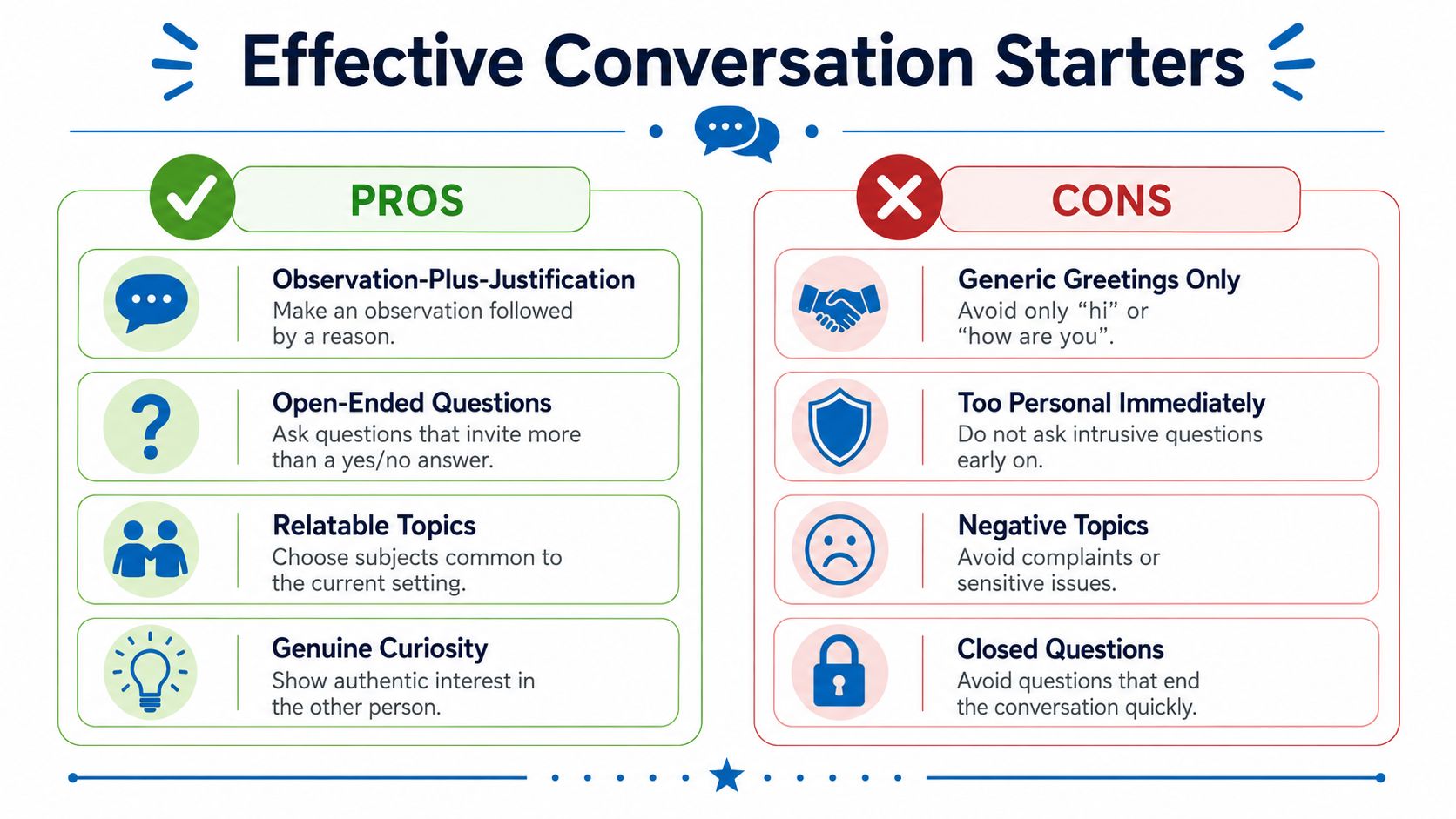
Use observation before interrogation
One of the most effective ways to talk with strangers is simple. Start with a comment about the shared situation, then briefly explain why you're speaking.
It works because it feels lighter than a sudden question. You are not extracting information. You are joining a moment.
At the café
Try comments that fit the setting.
- “That pastry looks amazing. I'm still learning what to order here.”
- “This place is always so busy at this hour. I'm trying to figure out the local timing.”
- “Your book cover caught my eye. I'm looking for something to read in Italian.”
What not to do:
- Lead with “So, what do you do?”
- Ask something personal immediately
- Force a second question if the first response is brief
In a queue or at the market
Queues are ideal because the conversation already has a natural time limit.
Good options:
- “I never know which cheese to choose here. Do you have a favourite?”
- “I've seen everyone buying that bread. I'm guessing I should try it.”
- “The market feels completely different on Saturdays. I'm still learning the rhythm.”
A closed question can still work if it opens into something else. The key is your follow-up. If they answer, don't abandon the thread.
Say:
- “What makes that one good?”
- “Do you cook it in a specific way?”
- “Is this a local favourite?”
At the dog park, museum, or neighbourhood event
These places give you built-in common ground.
Examples:
- “Your dog is very calm. Mine back home was the opposite.”
- “I'm new to this area, so I'm trying to find the exhibitions locals enjoy.”
- “I didn't expect so many people here. Is this event always like this?”
Short exchanges can become easier if you treat them as warm-ups, not auditions for friendship.
Good conversation starters are modest. They don't demand closeness. They invite response.
Speaking the Language of Italian Body Language
What your posture says before your words do
In Italy, people often read non-verbal cues quickly. That doesn't mean every Italian person behaves the same way. It means body language often carries more relational meaning than many Americans expect.
A woman may say very little and still communicate warmth, reserve, interest, impatience, or openness through eye contact, timing, facial expression, and physical orientation.
If you want to talk with strangers more naturally, pay attention to what your body is signalling before you speak.
Signals that usually feel more approachable
- Open posture. Keep your shoulders relaxed and your hands visible.
- Soft eye contact. Brief eye contact plus a small smile often works better than staring or looking away too quickly.
- A slight head nod or gentle ciao. This shows respect without forcing intensity.
- Body angle, not full frontal intensity. Standing at a slight angle can feel less intrusive than turning your whole body toward someone immediately.
- Calm facial expression. You don't need exaggerated friendliness. Quiet warmth is enough.
Signals that often close the door
- Headphones in both ears. This is often read as a clear wish not to be interrupted.
- Phone shield behaviour. Looking down continuously signals “I'm unavailable.”
- Rigid posture. A tense body can make both you and the other person feel less at ease.
- Overcompensating with excessive enthusiasm. In some contexts this can read as nervousness or pressure rather than friendliness.
- Backing away too fast. If someone stands slightly closer than you expect, it may reflect local conversational rhythm rather than hostility.
A useful cultural adjustment
Many Americans are used to managing warmth through words. In Italy, warmth is often communicated through pace, presence, and ease.
That's why some interactions may feel emotionally rich even when they are brief. You are not always trying to create immediate verbal intimacy. Often, you are showing that you can share space comfortably.
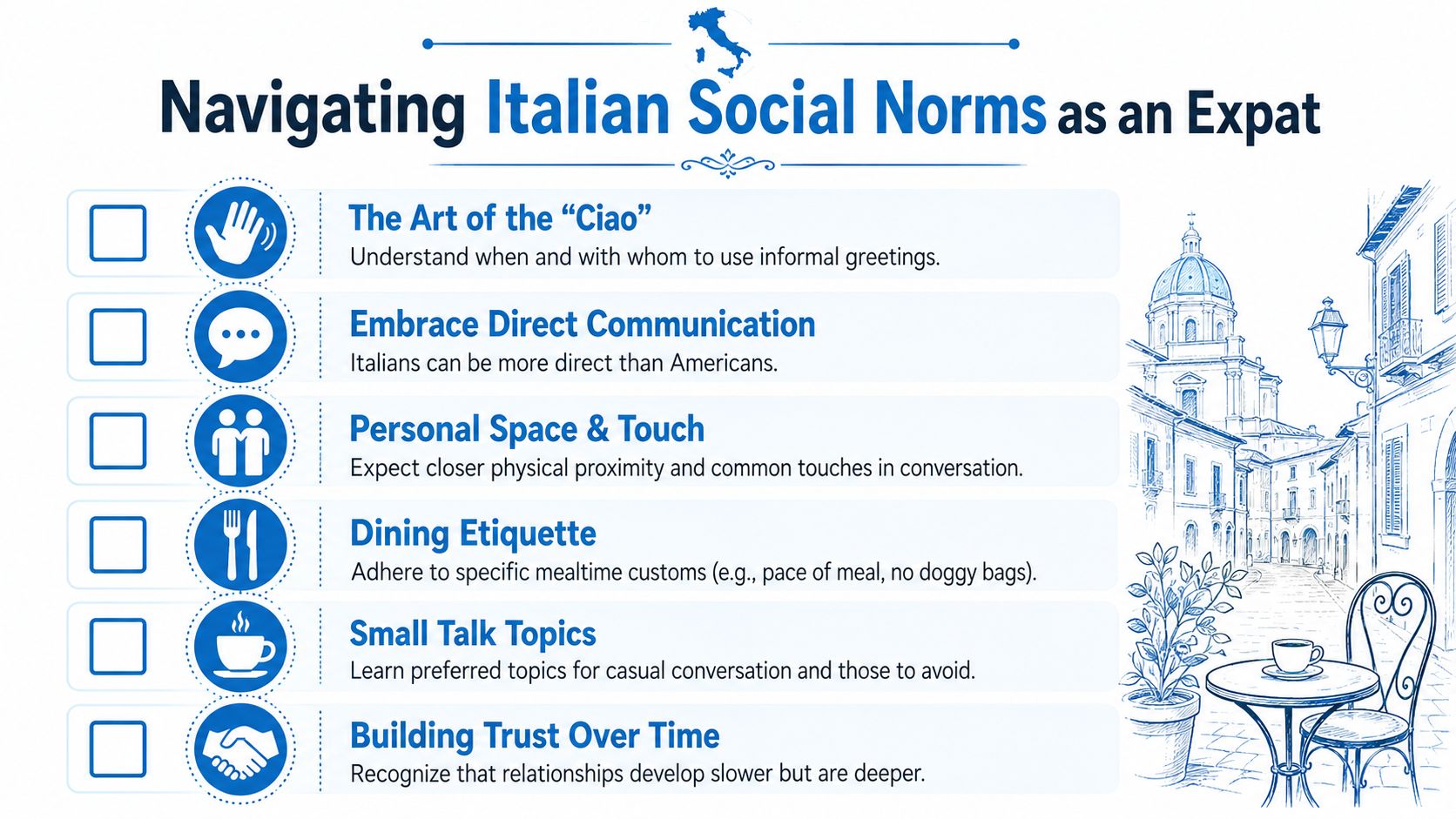
Navigating Italian Social Norms as an Expat
Why openness can misfire
Many American women have learned that connection begins with warmth, directness, and a bit of personal disclosure. In Italy, that same strategy can land differently.
Some American women in Italy feel they are perceived as oversharing or being too aggressive when they try to connect with locals. The problem is not that they are doing anything wrong morally. The problem is cultural timing. What feels open in one context can feel premature in another.
This is one of the core reasons generic advice fails. “Be yourself” isn't enough if your usual social style is being interpreted through a different cultural code.
Trust often grows sideways, not all at once
In many Italian settings, trust develops through repetition, shared places, and understated reciprocity. You see the same barista. You greet the same neighbour. You make a small comment at the same bakery each week. Familiarity builds before disclosure does.
That means these approaches often work better:
- Comment on the shared environment instead of your personal history
- Ask one follow-up question instead of telling a long story
- Return to the same places so recognition can accumulate
- Let pauses happen without rushing to fill them
- Allow warmth to build gradually
Talking to strangers can improve mood and increase connectedness, and shared-situation comments plus follow-up questions help sustain the exchange. That advice fits especially well in Mediterranean public life because it respects the social setting rather than trying to leap past it.
In Italy, closeness often begins with rhythm before it becomes disclosure.
What tends to work better than oversharing
Compare these two openings.
Less effective:
- “Hi, I'm American, I just moved here, I'm struggling to make friends, do you live nearby?”
More effective:
- “This neighbourhood changes completely in the evening. I'm still learning everyone's routines.”
The second one gives the other person room. It invites, rather than presses.
Follow-up questions matter here. People often lose momentum with strangers not because the opener was bad, but because they don't know how to continue lightly.
Try:
- “Do you come here often?”
- “Is that typical in this area?”
- “Would you recommend another place like this?”
- “How did you discover it?”
If culture shock is making every interaction feel more loaded than it is, support for coping with culture shock in Italy can help you separate normal adjustment stress from deeper anxiety.
When professional help fits
If this social friction is starting to affect your confidence, mood, or sense of identity, culturally informed therapy can be useful. A service such as Therapsy offers online and in-person psychotherapy in Italy, with licensed therapists working across multiple languages and with experience in intercultural adjustment. For some expats, having a place to process these micro-misattunements is what allows social confidence to return.
Staying Safe and Setting Boundaries

Confidence and caution can exist together
A healthy approach to talking with strangers includes boundaries. That isn't pessimistic. It's what makes relaxed contact possible.
This matters even more because stranger contact has very different meanings offline and online. In-person social openness and online safety are not the same skill.
Boundaries that keep you grounded
- Stay in public spaces if a conversation is new and you're unsure.
- Don't share your address, routine, or personal details too quickly.
- Notice pressure. If someone ignores your hesitation, pushes for contact details, or becomes invasive, that's useful information.
- Trust discomfort without overexplaining it. You are allowed to end an interaction because it doesn't feel right.
Useful exit lines:
- “It was lovely chatting, but I need to get going. Buona giornata.”
- “I'm heading to an appointment, but it was nice to meet you.”
- “I'm going to get back to my book now. Enjoy your afternoon.”
People who struggle with people-pleasing often know what boundary they want, but feel guilty enforcing it. If that sounds familiar, therapy for people-pleasing patterns can help.
Boundaries do not make you cold. They make connection safer, clearer, and more sustainable.
FAQ
Is it normal to feel anxious before talking with strangers in Italy
Yes, it's very normal. Anxiety often increases when you're navigating a new culture, a different language rhythm, and fear of misreading the situation. That reaction doesn't mean you're socially incapable. It means your mind is trying to protect you in an unfamiliar environment.
What should I say if my Italian is limited
Use simple language and shared-context comments. A short observation, a smile, and one follow-up question usually work better than trying to sound fluent. Many warm interactions begin with imperfect language and clear goodwill.
How do I know if someone wants to keep talking
Look for reciprocity. If they make eye contact, answer with more than one word, ask you something back, or keep their body oriented toward you, that's usually a green light. If their responses are brief and their attention turns away, let the exchange end gracefully.
What if the conversation becomes awkward
Awkwardness is survivable. Individuals recover from small social misfires much faster than anxious minds predict. A simple smile and a closing line such as “Nice chatting with you” is usually enough.
How can I build connection without seeming intrusive
Start with the setting, not your private life. Comment on what's happening around you, then ask one light follow-up question. In many Italian contexts, this creates trust more effectively than immediate self-disclosure.
When is social anxiety more than ordinary nervousness
It may be more than ordinary nervousness when fear consistently stops you from initiating contact, makes you avoid daily situations, or leaves you replaying interactions long after they end. If social fear is shrinking your life, affecting your mood, or reinforcing isolation, professional support can help you work on both the thoughts and the nervous system responses involved.
If talking with strangers feels much harder than it “should,” you don't have to figure it out alone. Book your first free assessment call with Therapsy for a no-commitment conversation with our Clinical Director, who will listen carefully and match you with the right therapist for you.