You're sitting in a café in Italy, the day looks ordinary, and then the tears start. Nothing dramatic happened. No obvious argument, no crisis, no headline-worthy loss. That's the strange part of crying for no reason, it can feel sudden, private, and embarrassing, especially when you're already trying to hold yourself together in a new country.
Psychologically, though, crying for no reason usually doesn't mean there's no reason at all. It often means the reason hasn't fully surfaced yet, or your mind and body have been carrying more than you realized. In expat life, that hidden load can include culture shock, language fatigue, isolation, sleep loss, grief, or the pressure to look like you're thriving.
Practical rule: If tears keep showing up when life looks “fine” on the outside, treat them as a signal, not a failure.
Why Am I Crying When Nothing Is Wrong
A young professional I might meet in therapy often says some version of this story. She's working in Milan, has a decent routine, maybe even a lovely apartment, and still finds herself crying after a normal grocery trip or while making dinner. She feels guilty because she knows other people have bigger problems, so she assumes she's being dramatic.
That assumption usually misses the point. Crying for no reason is rarely random, it is usually a sign that your system has been carrying more than it has had space to process. In expat life, that load often includes culture shock, language fatigue, identity strain, loneliness, sleep loss, and the pressure to look settled when you do not feel settled inside.

Tears are a message, not a verdict
Crying is one of the body's fastest ways of discharging pressure. That does not mean something is seriously wrong, but it does mean something in your system has become too full to stay quiet.
For expats, that often happens after days or weeks of holding yourself together in a new language, adapting to unfamiliar social rules, and trying not to burden the people back home. In that context, tears can reflect accumulated strain that finally found an opening.
Why the feeling of “nothing” can be misleading
When someone says nothing is wrong, they usually mean nothing obvious happened right before the tears. Emotional buildup often comes from what happened earlier in the day, earlier in the week, or even earlier in the season of life.
That is why it helps to treat crying as an output, not the whole story. The more useful question is what your nervous system was carrying before the tears arrived, especially if you have been pushing through culture shock or language fatigue and have not had much room to recover. If the crying feels tied to exhaustion, overstimulation, or a sense that your body never fully settles, a close look at nervous system regulation can give that experience a clearer frame, and nervous system regulation therapy is one place to start.
What to do when tears keep showing up
If this keeps happening, the goal is not to shame yourself out of it. The goal is to notice patterns, lower the load where you can, and get support when the crying starts to feel frequent, intense, or hard to explain.
For an expat in Italy, that may mean asking whether the tears come after long days of switching languages, after lonely evenings, after calls that leave you homesick, or after trying to keep up an image of competence that no longer feels sustainable. Once you can name the pressure, it becomes easier to choose the right next step, whether that is rest, a change in routine, or speaking with a multilingual therapist who understands the expat experience.
The Hidden Triggers Behind Unexpected Tears
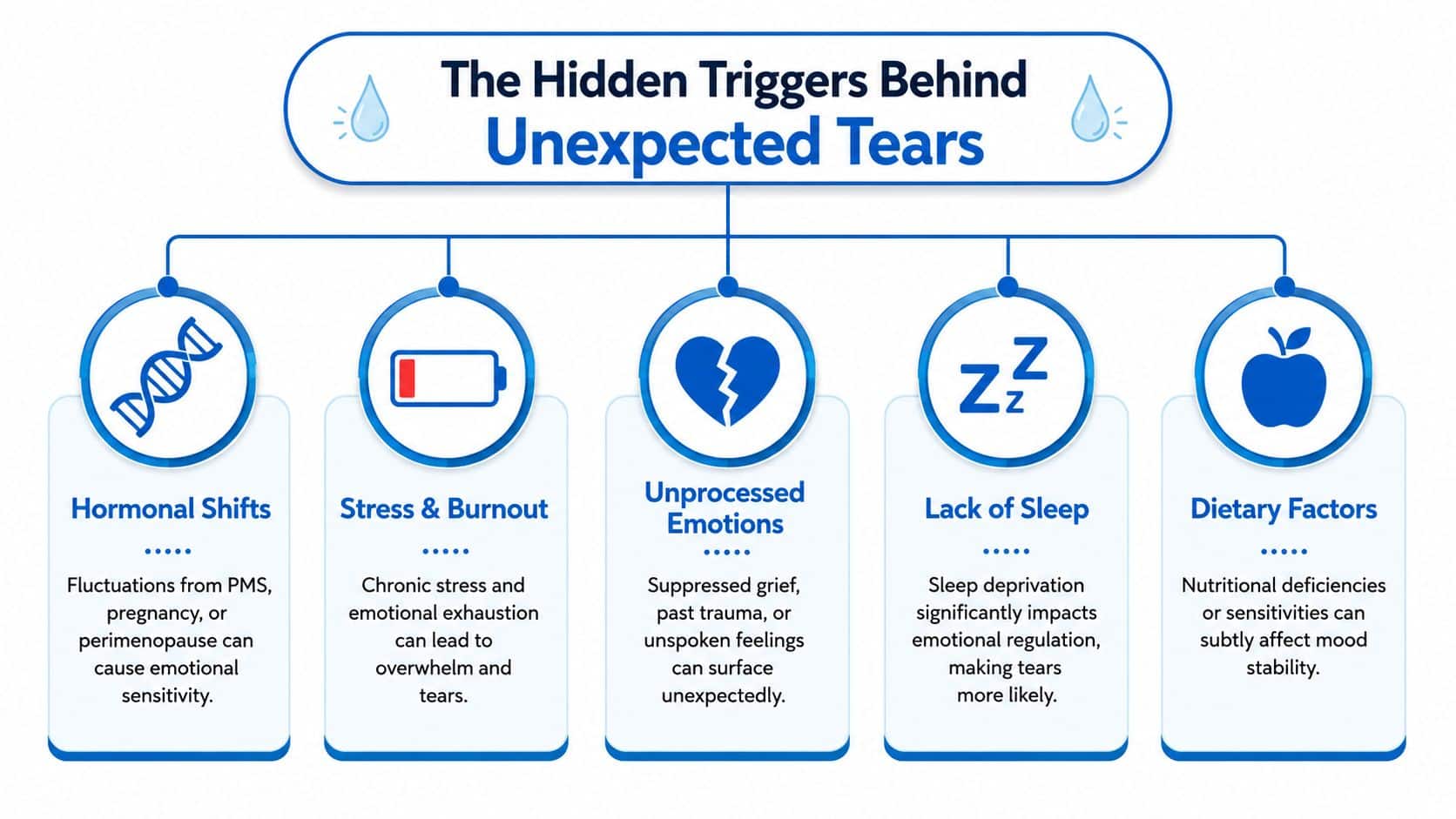
A crying spell in Italy often starts long before the tears arrive. The trigger may be a crowded tram after a difficult morning, a flat conversation in a second language, or the quiet shock of realizing that familiar routines no longer exist.
Stress, burnout, and emotional overload
Chronic pressure can sit under the surface until the body pushes back. Relocation, work demands, paperwork, relationship strain, and the constant effort of adapting to a new culture can all stack up until tears appear before you have even named what is wrong.
Ask a simpler question, what has been wearing you down without being called a problem? If you feel exhausted, overstimulated, or emotionally full, tears may be the point where your system refuses to keep going at the same pace. A closer look at nervous system regulation can make that pattern easier to understand, and nervous system regulation therapy is one place to begin.
Loneliness, grief, and unprocessed feelings
Loneliness does not always feel like sadness. It can show up as irritability, numbness, or being moved to tears by something small because there has been so little warmth or ease in the day.
Grief can work the same way. It does not need to be recent to stay active, and it does not need to be dramatic to matter. Tears often arrive when the pace slows enough for old losses, homesickness, or unresolved farewells to surface.
Sleep loss and physical sensitivity
Poor sleep reduces your margin for emotional control. When you are tired, a problem that felt manageable in the morning can feel much heavier by evening.
That is one reason crying often clusters after long days, late nights, or stretches of irregular routine. The reaction can feel sudden, yet the body has usually been carrying more strain than it could absorb.
Hormonal timing and body-based vulnerability
Some crying spells follow a clear pattern in the body. If they seem to appear around your menstrual cycle, perimenopausal changes, or other hormonal shifts, biology may be amplifying what you already feel.
That does not make the emotion less real. It means your body may have less buffer than usual, so ordinary stress lands harder. When the timing repeats, the pattern becomes useful information.
Useful distinction: A single tearful night after a brutal week is different from a repeated pattern of tearfulness that seems to track sleep, hormones, or rising workload.
When your environment is the trigger
A crying spell can look random from the inside and still have a clear context. A sad song, a video call home, a reminder of your old life, or a small moment of exclusion can be enough when your reserves are already low.
For expats, the trigger is often not just the moment itself. It is the moment plus culture shock, identity strain, and the pressure of keeping up. If you keep noticing the same emotional spike in similar settings, that pattern is telling you something about the environment you are carrying through.
Crying in an Intercultural Context The Expat Experience
Living abroad changes what a crying spell means. Back home, you probably had shorthand support, people who knew your routines, your humor, your family dynamics, and the version of you that does not need to explain everything. In Italy, especially in the early stretch of adjustment, that background support can be missing at the exact moment you need it most.
Many expats do not just feel sad, they feel disoriented. Culture shock and reverse culture shock can lower your tolerance for stress because ordinary tasks take more effort, social cues demand more attention, and your sense of competence can wobble. A conversation that would feel easy in your native language may suddenly leave you drained, and that drained state is often when tears show up. If you want a fuller explanation of that process, see culture shock and reverse culture shock.
Language fatigue and identity loss
Language fatigue is real. If every email, appointment, or casual interaction requires extra effort, your nervous system gets less recovery time between demands. Over time, that can make you feel fragile in a way that catches you off guard, especially if you were steady and high-functioning before the move.
There is also the quieter issue of identity loss. Many expats discover that the version of themselves that existed back home, capable, funny, social, professional, does not translate neatly into the new environment. That mismatch can hurt, even when the move is objectively good. It can also make tears feel confusing, because the emotion is not only about what happened today, it is about the gap between who you were able to be before and who you can access now.
The pressure to look grateful
Many expats privately decide they should be enjoying the experience. Maybe they moved for love, opportunity, study, or adventure, so they feel guilty for struggling. That guilt can make tears more likely, because it pushes emotion underground until it leaks out in private.
The body does not care whether your life looks enviable from the outside. If you have been suppressing homesickness, confusion, or resentment to protect the “I should be fine” story, crying may be the first honest moment your system gets. For expats, that tension can be sharper because every small complaint can feel like a betrayal of the move itself.
Why the expat nervous system reacts faster
When you live cross-culturally, your brain is doing more interpretation work all day. You are reading unfamiliar social norms, managing uncertainty, and trying to stay polite while you figure out where you fit. That constant effort can lower the threshold for tears even when there is no single dramatic event.
This is one reason the same person may cry more after moving abroad than she ever did at home. The problem is not that she got weaker. It is that her environment started asking more of her emotional regulation than it used to. The strain is often invisible, which is why it can feel so lonely.
When the whole day requires translation, reading, and self-monitoring, crying can become a release valve rather than a mystery.
How to Know When It's More Than Just a Bad Day
A bad day passes. A recurring pattern asks for attention. The difference usually shows up in how often the crying happens, how intense it feels, and how much it starts to interfere with ordinary life.
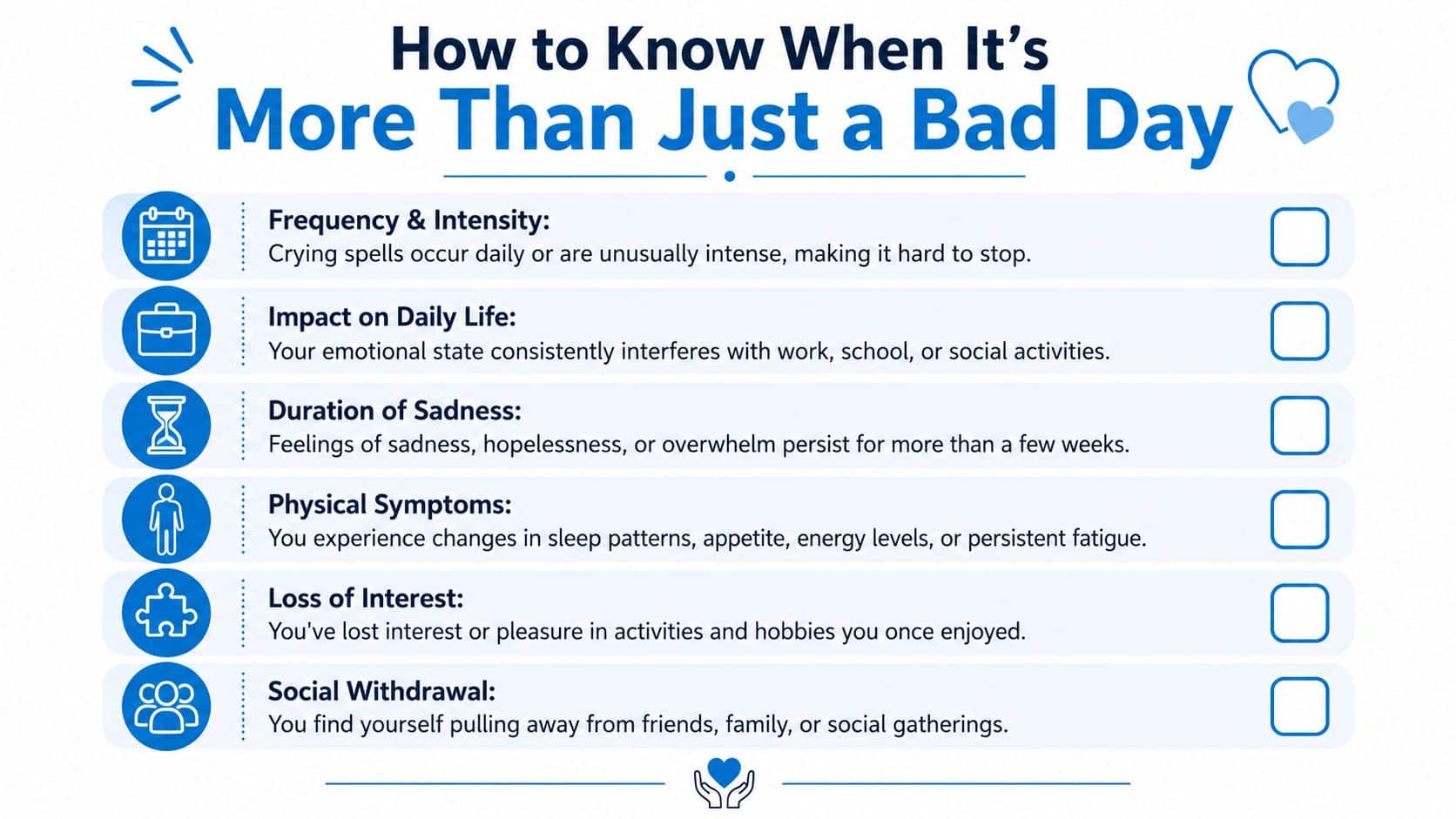
Signs the crying needs a closer look
A practical first filter is simple, are the tears brief and understandable, or do they keep returning and become hard to stop? If crying starts affecting work, school, relationships, or parenting, it deserves careful attention. Recurrent crying is a good reason to seek evaluation from a mental health professional, because the pattern can point to something more specific than stress alone.
A few useful markers are:
- Frequency and intensity: Crying keeps happening, or the episodes feel unusually hard to control.
- Impact on daily life: You're struggling to stay present at work, in class, or with people you care about.
- Physical shift: Sleep, appetite, energy, or motivation has changed along with the tears.
- Withdrawal: You're pulling away from friends or turning down more things than usual.
- Loss of pleasure: Things you normally like feel flat or meaningless.
- Mood symptoms: Sadness, worry, or hopelessness is sitting in the background more often than before. If that is part of the picture, it helps to understand what major depression symptoms can look like.
When to think beyond psychology
Unexplained crying is often emotional, but not always. It can also reflect medication effects, hormonal changes, or neurological conditions. Mayo Clinic describes pseudobulbar affect as sudden laughing or crying that the person can't control, and notes higher risk after stroke, ALS, multiple sclerosis, Alzheimer's disease, Parkinson's disease, brain tumors, dementia, or traumatic brain injury Mayo Clinic on pseudobulbar affect.
That is why it makes sense to think in two lanes at once. One lane is emotional health. The other is medical screening. If the crying is brief but stereotyped, disproportionate, or happening in someone with a known neurological history, a doctor's assessment matters.
Safe next step: If crying is frequent, intense, or paired with low mood, anxiety, sleep disruption, or neurological symptoms, don't self-diagnose. Get evaluated.
What the first decision point should be
The first question is not “What's wrong with me?” It is “What kind of support do I need first, emotional, medical, or both?”
That framing keeps you out of shame and toward action. It also helps you avoid treating a medical issue like a mood problem, or treating burnout like a mystery illness.
Immediate Coping Strategies for Emotional Overwhelm
When tears start in public, the goal isn't to become perfectly calm in ten seconds. The goal is to make the moment more manageable so your nervous system can settle enough for you to think clearly again.

Use the body before you argue with the mind
Start with breathing that slows the pace of the moment. A simple longer exhale helps more than forcing big, dramatic breaths, because the body often responds better to steadiness than intensity.
Then do one concrete sensory task. Name what you can see, hear, touch, smell, and taste. If you're in a café, this might mean feeling the chair under you, noticing the cup in your hand, and finding three neutral objects in the room.
Change the environment if you can
A small environmental shift can interrupt escalation. Step outside, wash your face, move to a quieter corner, or stand near fresh air for a minute. The point is not to escape your feelings, but to reduce stimulation long enough for the wave to pass.
This kind of practical reset pairs well with broader effective stress reduction techniques, especially when crying episodes tend to follow overloaded days.
Keep the response simple
Try this sequence:
- Pause the input: Put the phone down and stop scrolling.
- Lengthen the exhale: Breathe out a little longer than you breathe in.
- Orient to the room: Name five visible objects.
- Ground your body: Press your feet into the floor.
- Choose the next step: Leave, rest, text someone, or get water.
The value is in repetition. You're teaching your system that tears don't need to become panic.
What doesn't help in the moment
Shaming yourself, replaying every life decision, or demanding an instant explanation usually makes the episode worse. So does pretending you're fine when you're not.
Give yourself permission to be temporarily unsteady. That's often what lets the moment pass faster.
Building Resilience with Journaling and CBT Techniques
If the tears keep returning after a call, a train ride, or a day spent switching between Italian and your native language, the next step is to start observing the pattern instead of arguing with it. CBT, or Cognitive Behavioral Therapy, is useful here because it separates the event, the thought, the feeling, and the behavior, which is often what gets blurred when you are exhausted, lonely, or carrying culture shock.
A short log usually helps more than a long diary entry. Write the time, where you were, who was there, what happened right before the tears, and what you said to yourself in that moment. If you want a structured starting point, the cognitive behavioral therapy guide explains how these tools work in practice. Journaling also helps you notice patterns that change behavior, whether you are managing emotional overwhelm or trying to stop procrastinating with ADHD.
Track the pattern, not just the emotion
A few prompts usually reveal more than a polished narrative:
- What was happening right before I cried?
- How much sleep did I get the night before?
- Was I hungry, overstimulated, or lonely?
- Did I have to switch languages, settings, or roles quickly?
- What thought flashed through my mind?
For expats in Italy, that language and role-switching question matters a lot. Tears often show up after a day of translating yourself, staying polite in a system that feels unfamiliar, or carrying the strain of being competent in one language and uncertain in another. If sleep is also low, the pattern becomes even clearer. Analyses at Thriveworks on crying for no reason note that short sleep can make emotional regulation harder, and they recommend tracking what happened just before the crying so you can tell the difference between a one-off overload and a pattern that may point to burnout, anxiety, or a hormonal cycle.
Challenge the thought, gently
Once you spot the thought, do not attack it. Question it. If your mind says, “I can't handle this,” ask, “What exactly feels unmanageable right now?” If it says, “I'm failing here,” ask, “What evidence do I have, and what evidence do I have that I am adapting under strain?”
That small shift matters because crying often intensifies when thoughts become absolute. CBT works by making those thoughts more specific and less threatening, which can lower the sense of collapse that often follows an unexpected crying spell.
Use journaling to reduce guesswork
Journaling turns vague distress into something you can work with. “I cry for no reason” becomes, “I cry after back-to-back video calls in English,” or, “I cry when I get home and the apartment goes quiet.” For an expat, that level of detail can also point to practical fixes, such as protecting recovery time after social demands, reducing language overload, or arranging more regular support in a language that feels safe.
That specificity matters. Once the pattern is visible, self-help becomes more targeted, and if the tears keep interrupting daily life, it is easier to bring clear examples into professional support, including multilingual therapy in Italy when you need it.
FAQ Crying Spells and Mental Health
Is crying physically good for you?
Yes, crying can be a normal release, but it's not the whole solution. Tears may help discharge emotional pressure in the moment, yet frequent crying still deserves attention if it's becoming disruptive or hard to control. The useful question is not whether crying is “good” or “bad,” but what it's trying to signal.
Can medication make me cry more easily?
Yes, medication can sometimes affect tearfulness, and that's one reason recurrent crying shouldn't be dismissed too quickly. If crying started after a medication change, or if it feels unusually intense, a doctor should review it. That's especially important when the pattern is new, persistent, or comes with other physical symptoms.
What happens in a first therapy assessment for crying spells?
A first assessment usually focuses on your patterns, stress load, mood, sleep, relationships, and any medical factors that could be contributing. It's not about judging whether your crying is “serious enough.” It's about understanding what's driving it and deciding whether therapy, medical evaluation, or both make sense.
How can I support a partner or friend who keeps crying?
Start by staying calm and taking the crying seriously without overreacting. Don't push for a full explanation in the moment, and don't tell them they're overthinking it. If the pattern is frequent, intense, or affecting daily life, encourage a professional conversation rather than trying to solve it alone.
Could crying be a sign of depression or anxiety?
Yes, it can be. Recurrent crying often shows up alongside low mood, worry, fatigue, sleep changes, loss of interest, or withdrawal. If those signs are present too, getting evaluated is a wise next step, and if you're unsure, the page on how to know if you need a psychologist can help you decide whether support would be useful.
When should I see a doctor instead of starting with therapy?
See a doctor first if the crying feels sudden, uncontrollable, or neurologically unusual, especially after a head injury or with other physical changes. Medical causes and medication effects need to be ruled out before assuming it's only emotional. Therapy can still help, but the safest approach is to cover both psychological and medical possibilities when the pattern is unclear.
If you're living in Italy and crying has started to feel frequent, confusing, or too heavy to carry alone, THERAPSY offers multilingual psychotherapy with careful human matching, online and in-person sessions, and a free first assessment call. If you want a therapist who understands expat stress, culture shock, and the emotional strain of starting over, visit THERAPSY and take the first step with a conversation that doesn't commit you to anything.
Not sure whether what you are feeling is depression?
Our free online depression test takes two minutes. It is based on the PHQ-9, the screening questionnaire used by clinicians worldwide, and it is anonymous – no email required to see your result.
If the result suggests you could use support, the next step is a free first call with a licensed therapist who speaks your language, online or in person across Italy.