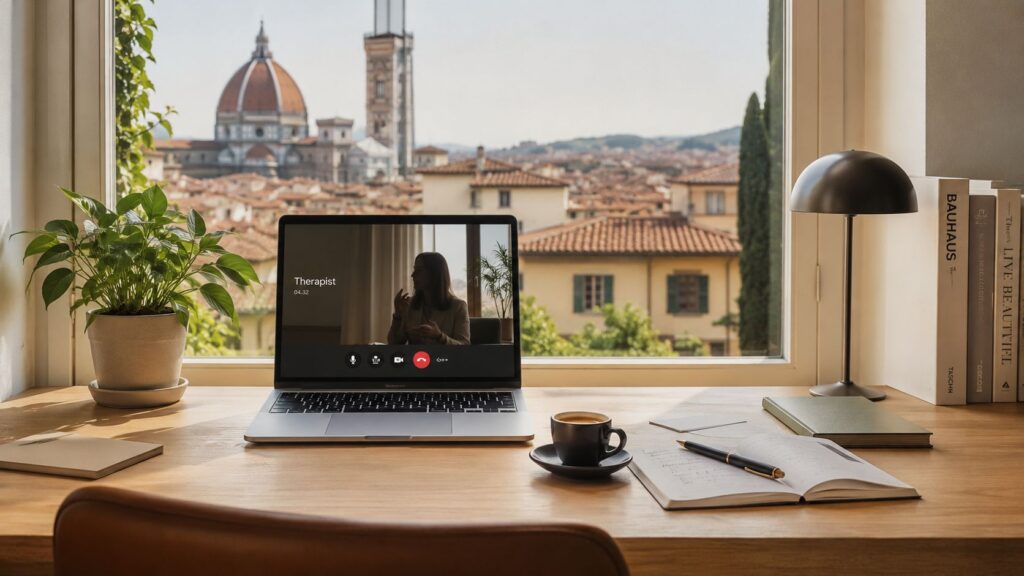
Quick answer: Therapy for depression in Italy is available privately within days and through the public system with longer waits. For most adults the evidence supports psychotherapy, antidepressants, or the two combined, and the choice depends on severity and history rather than preference alone. If you are a foreigner living here, the decision that changes the outcome most is the language you work in.
Therapsy is a multilingual psychotherapy service in Italy that connects expats, international students and Italians with licensed therapists in their own language, online across the country and in person in 23 Italian cities.
Key takeaways
- Depression abroad often arrives disguised as tiredness, irritability and loss of interest, not as sadness.
- A network meta-analysis in World Psychiatry compared psychotherapy, medication and their combination in adult depression: all three are studied treatments, not alternatives to rank by taste.
- In Italy the professions are distinct: psicologo, psicoterapeuta and psichiatra do different things, and only one of them can prescribe.
- Public care through the SSN is free or nearly free and slow; private care is fast and paid. Many people use both.
- Therapy in your own language matters more with depression than with almost anything else, because the symptom itself reduces the energy available for a second language.
- Therapsy works in 14 languages, and the first conversation with the Clinical Director is free with a reply within 12 hours.
How does depression show up when you live abroad?
What are the signs people actually notice first?
Rarely crying. More often waking at five and not getting back to sleep, losing interest in things that used to be automatic, finding ordinary admin impossible, becoming short with the people closest to you, and a flatness that does not lift on a good day. Appetite and concentration change. Many people describe it as being permanently behind.
Is it depression, or is it the move?
Both exist and they are treated differently. A reaction to relocation tends to be tied to identifiable stressors and improves as those resolve. Depression persists for weeks, is present most of the day nearly every day, and continues even when the practical problems are solved. The distinction is not something you are expected to make alone: it is one of the things a first assessment is for.
Why is it easy to miss in expats?
Because there is always an explanation available. The weather, the bureaucracy, the job, the distance from family. Each is real, and together they provide cover for months. People often seek help only when something breaks at work or in a relationship, by which point the episode has usually been running for a long time.
Does treatment for depression actually work?
What does the research compare?
It compares the options against each other, not just against nothing. A network meta-analysis in World Psychiatry of psychotherapies, pharmacotherapies and their combination in adult depression examined all three together. A later comprehensive meta-analysis of cognitive behavior therapy including 409 trials compared CBT with control conditions, other psychotherapies, medication and combined treatment.
Therapy, medication, or both?
The honest answer is that it depends on severity, on how long the episode has lasted, on what you have already tried and on what happened the previous times. Mild to moderate episodes are frequently treated with psychotherapy alone. More severe or recurrent episodes are where combined treatment is usually discussed. This is a clinical decision made with you, and a service that answers it before assessing you is guessing.
How long before something changes?
Weeks, not days, and the first thing that shifts is usually sleep or energy rather than mood. Ask your therapist at the end of the assessment what they expect and when they would revise the plan. A treatment with no checkpoint is difficult to evaluate and easy to continue out of inertia.
How does depression care work in Italy?
Psicologo, psicoterapeuta, psichiatra: who does what?
A psicologo is a licensed psychologist registered with the Ordine degli Psicologi. A psicoterapeuta has completed a further four-year specialisation and delivers psychotherapy. A psichiatra is a medical doctor and is the professional who prescribes medication. The register is public: ask for the registration number and check it, particularly when you are arranging care online from abroad.
Public or private?
The public system, through the local CSM, is free or nearly free and is the right route in severe cases and emergencies, but waiting times are long and the language is Italian. Private care starts within days, costs money and gives you a choice of professional and language. Many people combine the two, and there is nothing irregular about that.
Can you get therapy in English or in your own language?
Privately, yes, and this is where multilingual services exist. In the public system it is unlikely outside a few large cities. For depression specifically this is not a comfort issue: the illness reduces concentration and initiative, which is exactly what a second language consumes.
What does it cost?
At Therapsy individual sessions start from EUR 70 and a psychiatric consultation from EUR 110, with the same fee online and in person; the full list is on the pricing page. Psychological care in Italy is also generally deductible from income tax as a health expense, so keep every invoice, and ask your accountant how it applies to your situation.
What does treatment look like in practice?
The assessment
The first session maps the current episode, the history, sleep, appetite, energy, risk, what has already been tried and what helped. It ends with a proposal: an approach, a frequency, and a point at which you both review progress.
The work itself
Most evidence-based work on depression is concrete rather than reflective. Re-establishing activity before motivation returns, which is counterintuitive and is where a large part of the change comes from. Examining the conclusions the episode produces about you. Repairing sleep. And, where relevant, addressing the situation that keeps feeding it.
When a psychiatrist joins
When symptoms are severe, when there is a history of previous episodes, when sleep or appetite have collapsed, or when therapy alone has not moved things. At Therapsy this is arranged inside the same service, so you are not starting again with someone who does not know your history; our psychiatrists work alongside the therapist rather than in parallel.
What if you are in crisis?
If you are at immediate risk, call 112 or go to the nearest emergency department. Planned therapy is not the right tool for an acute crisis, and any responsible service will tell you so and help you find the right level of care.
How do you start?
Step 1: the free first conversation
At Therapsy you describe what is happening, the language you want to work in and your constraints. There is no charge, and the reply arrives within 12 hours.
Step 2: the match
The Clinical Director proposes a therapist and explains the reasoning, taking language, clinical focus and availability into account. You can see the network on our therapists page.
Step 3: the first sessions and the checkpoint
Assessment, plan, then a review after a handful of sessions. If the fit is wrong you can change therapist inside the service without starting your history again. Sessions are available online across Italy and in person in 23 cities.
Frequently asked questions
How do I find therapy for depression in Italy as a foreigner?
Privately, through a service that matches you with a licensed therapist who works in your language, usually within days. Through the public system you contact the CSM for your area, which is free or nearly free but has long waits and works in Italian.
Is therapy or medication better for depression?
Research has compared psychotherapy, medication and their combination directly rather than assuming one wins. The right choice depends on severity, history and what you have already tried, and it is decided with a clinician after an assessment.
How much does depression treatment cost in Italy?
At Therapsy individual sessions start from EUR 70 and a psychiatric consultation from EUR 110, online or in person. Public care through the SSN is free or nearly free, with longer waiting times.
Can I have therapy for depression in English in Italy?
Yes. Therapsy works in 14 languages, including English, online across Italy and in person in 23 cities, and language is part of the match rather than an extra request.
Can I claim therapy costs back in Italy?
Psychological care is generally treated as a deductible health expense in the Italian tax return, and some international insurance policies reimburse sessions with a licensed psychologist. Keep the invoices and check the exact wording with your accountant or insurer.
Do I need a diagnosis before I ask for help?
No. You need a reason to ask, and low mood that has lasted for weeks is a reason. Working out whether it is depression, exhaustion or a reaction to the move is part of the assessment, not a prerequisite for it.
Related reading
Written by Dr. Francesca Adriana Boccalari, Clinical Director at Therapsy and licensed psychologist (Ordine degli Psicologi della Lombardia n. 16241), and reviewed in September 2026.