You may be waking up in Italy with two parallel worries running at once. One is personal: “What if something is wrong with my fertility?” The other is painfully practical: “How do I even begin to check that here, in a language and system I don't fully know?”
Fertility anxiety living abroad is the emotional strain that develops when fears about conceiving collide with relocation stress, unfamiliar healthcare, disrupted support networks, and the uncertainty of building a life in a different country. It often doesn't feel like “just anxiety”. It feels like urgency, shame, confusion, obsessive Googling, sudden tears after a friend's pregnancy announcement, and a constant sense that time is moving while you are stuck.
For many American women in Italy, this experience is private and surprisingly isolating. You may look functional on the outside. You go to work, answer messages, try to improve your Italian, and keep up with daily life. Meanwhile, part of your mind is tracking every cycle, every birthday, every delayed appointment, and every story you hear about how hard it is to access care.
That combination matters psychologically. Fertility concerns are already emotionally loaded. Add bureaucracy, language friction, cultural differences, and distance from home, and worry can become more intense, more persistent, and harder to regulate.
Defining Fertility Anxiety in the Expat Experience

Fertility anxiety is not only fear about whether pregnancy will happen. It is also the mental and emotional burden of uncertainty around conception, reproductive health, timing, treatment decisions, and future family plans.
In expat life, that anxiety usually has two layers.
The first layer is universal. Fertility touches identity, partnership, family expectations, grief, control, and hope. The second layer is intercultural. Living abroad changes how you access care, how quickly you can act, who supports you, and how safe or alone you feel while making intimate medical decisions.
Clinical reality: When a high-stakes life goal meets chronic uncertainty, the nervous system often responds with vigilance, rumination, and threat-scanning.
That means fertility anxiety living abroad may show up as:
- Mental checking: Replaying timelines, symptoms, or past decisions.
- Compulsive research: Reading forums late at night and comparing yourself to strangers.
- Avoidance: Delaying appointments because the process feels overwhelming.
- Emotional swings: Feeling hopeful one day and convinced something is wrong the next.
- Relationship strain: One partner wants to act immediately, while the other shuts down.
This is an understandable response to uncertainty. It isn't weakness, and it isn't overreaction.
The World Health Organization infertility fact sheet estimates that about one in every six people of reproductive age worldwide experiences infertility at some point in life. That matters because many women living abroad assume they are alone in this fear. They are not.
Why Living Abroad Can Magnify Fertility Worries
A move abroad uses up psychological energy. Even when the move is wanted, your brain is doing more work than usual: translating, adjusting, interpreting social cues, handling paperwork, and rebuilding routine. When fertility worry enters that environment, it rarely stays contained.
The expat context changes how anxiety works
In clinical practice, I often see fertility fears become sharper abroad because the person has lost the ordinary buffers that help regulate stress. At home, you might have known exactly which doctor to call, which friend would come with you, and how your family would help after difficult news. In a foreign country, even booking an appointment can feel loaded.
That loss of predictability matters. Anxiety tends to grow when the mind cannot easily map a path from concern to action.
A useful way to think about this comes from cross-cultural psychology. Adapting to a new culture requires constant decision-making and self-monitoring. That leaves fewer internal resources for coping with uncertainty in other areas of life. Fertility worries then feel louder, not because you are less resilient, but because your system is already stretched.
If you're also feeling disoriented in other parts of life, the pattern may overlap with broader adjustment stress. The experience described in this guide on culture shock in Italy often sits in the background of fertility anxiety and makes it harder to feel steady.
Why waiting often makes it worse
A major clinical mistake is to treat fertility anxiety as vague stress and assume it will settle if you ignore it. That usually doesn't work.
A systematic review and meta-analysis on anxiety in infertile women found that anxiety symptoms were present in 36.17% of infertile women, with study-level prevalence ranging from 8.8% to 86.8%. The same review supports an important practical point: fertility-related anxiety should be treated as a measurable clinical issue, not a passing mood.
Practical rule: If thoughts about fertility are affecting sleep, concentration, intimacy, mood, or your ability to make appointments, it's time to respond actively rather than “watch and wait”.
Several expat-specific pressures intensify this:
- Time conflict: Your life abroad may still feel temporary, while your fertility concerns feel urgent.
- Support loss: Family and close friends may be far away, asleep in another time zone, or emotionally less available than you need.
- Identity disruption: Career changes, visa dependence, or being “the trailing partner” can make the question of parenthood feel more emotionally charged.
- Language barriers: A simple medical discussion can suddenly feel high-risk when you aren't sure you understood every word.
- Private grief in public isolation: You may be surrounded by beautiful Italian life and still feel profoundly alone.
Navigating Your Medical Options in Italy
Italy can offer good fertility care, but access isn't always straightforward. The stress often comes less from the existence of care and more from the route to it.
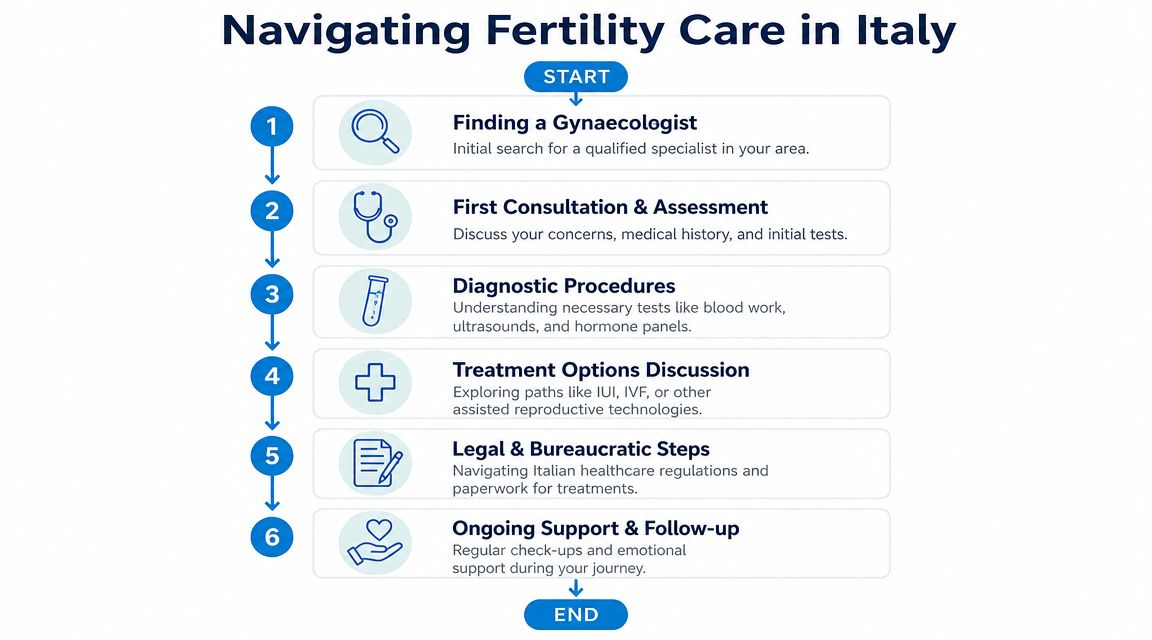
A useful starting point is this: you do not need to understand the whole Italian system before taking the first step. You need a sequence.
A review on infertility care in Italy notes that infertility affects an estimated 15% of couples in Italy, access to care is uneven, there are large regional differences in assisted reproduction availability and use, and public waiting times can be long in the national context described in this publication on infertility care in Italy. For expats, that often means uncertainty is amplified by referral pathways, delays, and language barriers.
Start with one clinician, not ten tabs
Your first concrete move is usually to identify a gynaecologist or fertility-focused clinic that can evaluate your situation and explain next steps. If you search too broadly, anxiety tends to take over. Narrow the task.
Use this order:
Choose location first
Decide whether you want care near home, near work, or in a larger city where English-speaking options may be easier to find.Decide public or private as an initial route
Public care may involve more bureaucracy and longer waits. Private care can feel faster and more direct, but costs may be higher. For many expats, a private first consultation provides clarity even if later steps happen elsewhere.Prepare a short medical summary
Bring cycle history, previous test results, medications, diagnoses, surgeries, and any prior pregnancies or miscarriages. A one-page summary is often more useful than a long story told while anxious.Write your questions before the appointment
Anxiety makes memory worse. Don't rely on recall in the room.
If you want a patient-friendly overview of why fertility care can feel fragmented and why clearer pathways matter, Hera Fertility for fertility insights offers a useful perspective.
What to ask in the first consultation
The first appointment does not need to solve everything. It needs to reduce ambiguity.
You can ask:
- What baseline tests do you recommend first?
- Do you think my concern requires urgent follow-up or routine evaluation?
- What can be done in this clinic, and what requires referral elsewhere?
- How long do results usually take?
- Can you explain the next step in writing if possible?
- Do you offer support in English, or can someone help translate key information?
Bring a notebook or use your phone to record key terms immediately after the visit. Patients often understand more than they remember.
Common next stages may include hormone blood work, ultrasound assessment, semen analysis for a partner, or referral to a clinic that handles assisted reproduction. Some women also want to ask about fertility preservation, including egg freezing, especially if partnership timing and reproductive timing are not aligned.
Reduce the bureaucracy before it reduces you
The Italian healthcare system often becomes less intimidating once you separate the medical task from the administrative task.
A simple split helps:
| Task type | What it includes |
|---|---|
| Medical | symptoms, cycle timing, test interpretation, treatment decisions |
| Administrative | referrals, booking systems, payment rules, insurance, document requests, language support |
Treat these as two separate checklists. Don't try to solve both in one exhausted afternoon.
If fertility concerns are affecting the couple as well as the individual, infertility counselling for couples in Italy can help partners coordinate decisions, discuss timing, and reduce blame or shutdown patterns while medical steps unfold.
Practical Coping Strategies for Daily Anxiety
Even when you are taking sensible action, daily anxiety can remain high. Fertility worry is sticky because it attaches to time, uncertainty, and cherished hopes. That is why coping strategies need to do more than “help you relax”. They need to interrupt mental spirals and restore a sense of agency.
The scale of the issue matters. The World Health Organization infertility fact sheet states that about one in every six people of reproductive age worldwide experiences infertility, and a 2020 systematic review found a pooled prevalence of anxiety symptoms in infertile women of 36.17%. This is not a niche emotional reaction. It is a common mental health burden that deserves structured coping, not self-criticism.
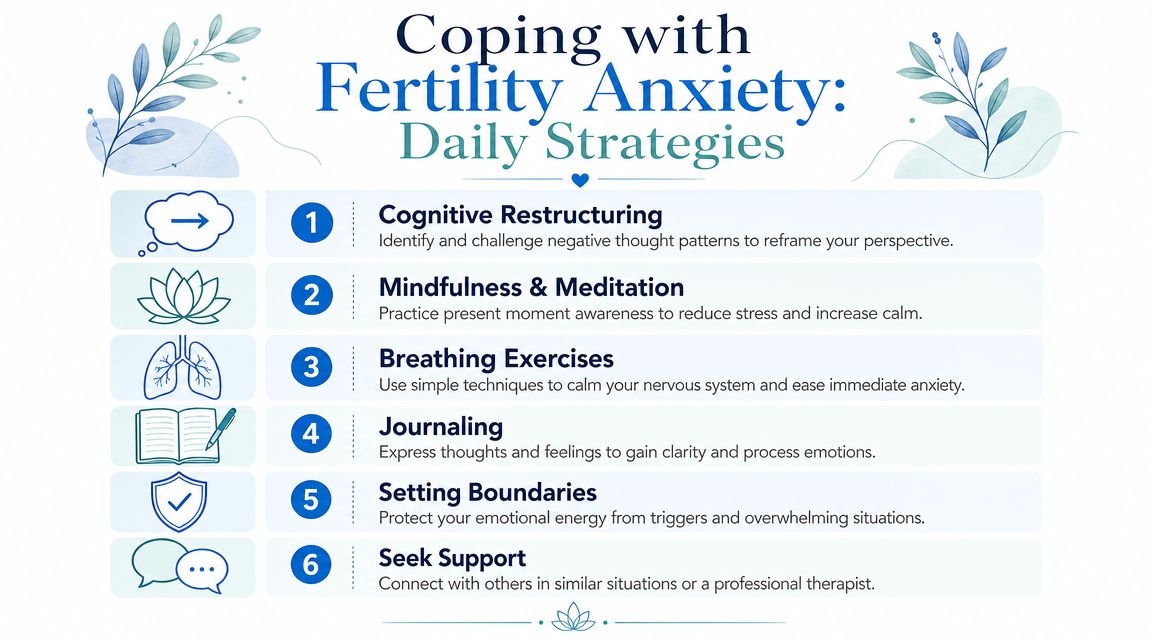
Use CBT to catch the spiral early
Cognitive Behavioural Therapy, or CBT, helps you identify the thought patterns that intensify distress. In fertility anxiety, the most common pattern is catastrophic prediction.
Examples include:
- “If this month didn't work, it means I'll never be a mother.”
- “Because I'm abroad, I've already ruined my chances.”
- “If I don't act immediately, it will be too late.”
These thoughts feel urgent and convincing. They are not always accurate.
Try this brief CBT exercise:
- Write the fear exactly as it appears in your mind.
- Name the thinking pattern. Catastrophising, mind reading, all-or-nothing thinking, or fortune telling.
- Ask what evidence you have today.
- Replace it with a steadier sentence.
For example: “I'm worried, and I'm taking this seriously. I do not have the full picture yet.”
For readers who want a deeper explanation of how CBT works in anxious thinking, this overview of cognitive behavioral therapy for anxiety is a helpful starting point.
Build a short routine for high-trigger moments
You don't need a perfect self-care plan. You need a repeatable response for the moments that usually set anxiety off.
Try a five-minute sequence:
One minute of orienting
Look around the room and name five objects. This helps shift the brain out of threat tunnel vision.One minute of slower breathing
Exhale longer than you inhale. Don't force deep breaths if that makes you more tense.Two minutes of fact-based journalling
Write what happened, what you felt, and what the next useful action is.One minute of boundary-setting
Decide what not to do for the next hour. No forum scrolling. No symptom checking. No comparing.
When anxiety is high, the goal is not to feel instantly calm. The goal is to become less flooded and more organised.
Protect the couple from becoming the battlefield
Fertility anxiety often enters the relationship through indirect routes. One partner asks practical questions and sounds cold. The other seeks reassurance and sounds intense. Both are usually scared.
A few rules help:
- Schedule fertility conversations. Don't let them hijack every evening.
- Use role clarity. One person can handle booking, the other can handle records.
- Say what the feeling is before the opinion. “I'm frightened” lands better than “You're not taking this seriously.”
Building Your Expat Support Network
Anxiety becomes harsher in isolation. Fertility anxiety living abroad often leads women to become more private just when they need more support. That makes sense emotionally, but it usually increases rumination.
A strong support network is rarely one person. It is layered.
Build support in circles
Think in circles rather than categories.
The inner circle might include a partner, one close friend, or a sibling who can tolerate uncertainty without giving unhelpful advice. The middle circle may include other expats, a trusted GP, or people who understand the cultural strain of living far from home. The outer circle can include online communities, practical helpers, and professional care.
Some women benefit from low-pressure community spaces that reduce social isolation even if they are not fertility-focused. Projects such as English conversations in Otaki illustrate how meaningful language-based community contact can lower the sense of being cut off from others.
Know the difference between comfort and containment
Friends can comfort you. A skilled therapist can also help contain the anxiety. Those are different things.
Comfort sounds like, “I'm here for you.”
Containment sounds like, “Let's slow this panic down, understand the trigger, and decide what action belongs to today.”
Professional support is especially helpful when fertility fear has started to affect sleep, intimacy, work functioning, or your sense of identity. In expat contexts, therapy also helps with the surrounding issues that often intensify the distress: loneliness, culture shock, couple conflict, and the strain of making important decisions in a foreign system.
For women who feel emotionally cut off while living in Italy, this article on expat loneliness in Italy often resonates because fertility distress rarely exists in isolation from the wider expat experience.
One practical option is Therapsy, a multilingual psychotherapy service in Italy that offers online and in-person sessions, including support in English and other languages, with approaches such as CBT, EMDR, and Schema Therapy. For expats, that kind of support can be useful when the problem is not only anxiety itself, but anxiety filtered through relocation, language, and intercultural stress.
Understanding Legal and Financial Considerations
Money and legal eligibility are two of the fastest ways to trigger panic. The antidote is not trying to predict every future cost. It is getting clear on the questions that define your choices.
Start with the system you are actually using
In Italy, the practical experience can differ depending on whether you use the public system, private care, or a mix of both. Public routes may involve referrals, waiting lists, and region-specific pathways. Private routes may be faster for consultations and diagnostics, but they require clear financial planning.
Create one document with these headings:
- Insurance
- Appointments
- Testing
- Possible treatment
- Travel to another city if needed
- Translation or interpretation support
- Time off work
This reduces the vague fear that “it's all too much” into concrete categories you can research one by one.
Questions worth asking early
Ask your insurer and clinic direct questions in writing where possible:
- Does my international policy cover fertility consultations, diagnostics, or treatment?
- Do I need a referral first?
- Are there exclusions related to assisted reproduction?
- What documents are required for reimbursement?
- Can pre-authorisation speed up approval?
If you are considering treatment pathways such as assisted reproduction, check current official information directly with the clinic and relevant Italian institutions rather than relying on expat forums. Legal access rules, required documents, and administrative procedures can change, and they may differ depending on personal situation.
When people feel intimidated by this part, I often suggest a simple principle: treat legal and financial research as planning, not as prophecy. You are gathering decision-making tools, not proving that every obstacle will apply to you.
Your Action Checklist for Moving Forward
Anxiety improves when the next step becomes visible. Not when everything is solved, but when the path is clearer than the fear.
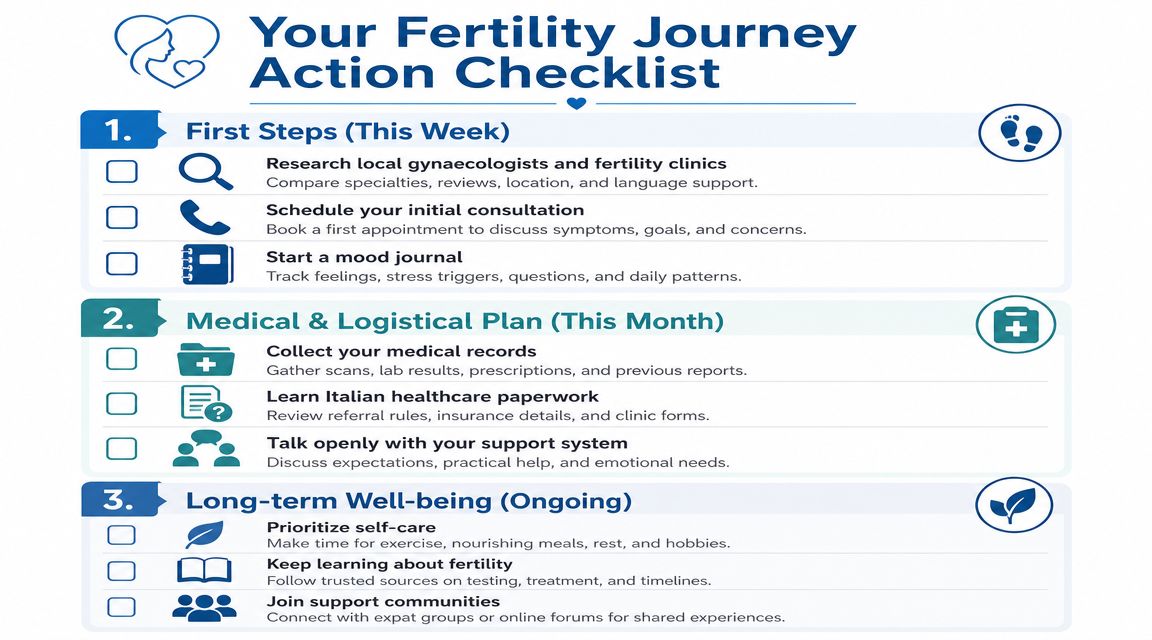
First steps this week
Name the problem clearly
Say to yourself, or to your partner, “This is fertility anxiety living abroad. It has both emotional and practical parts.”Book one medical starting point
Research a small number of gynaecologists or clinics and choose one first consultation.Write a one-page summary
Include cycle details, relevant medical history, medications, and your top three questions.Track your emotional triggers
Keep a brief note of when anxiety spikes. Common triggers include pregnancy news, late periods, clinic websites, or difficult conversations.
Medical and logistical plan this month
Gather records
Collect previous scans, lab results, prescriptions, and any records from your home country.Clarify the route
Decide whether you are starting in public care, private care, or a combination.Ask for the next step in plain terms
After each consultation, know exactly what happens next, who books it, and how long you may need to wait.Use support when the process affects the relationship
If discussions are becoming tense or avoidant, consider support from an expat therapist in Italy who understands both anxiety and the intercultural context.
Mind and body support ongoing
Use one CBT tool consistently
Don't collect ten techniques. Pick one and practise it daily.Set boundaries around fertility content
Choose when you will read or research, rather than letting anxiety decide for you.Protect non-fertility parts of life
Keep one activity each week that has nothing to do with trying to conceive or researching care.
The most stabilising move is often the smallest one that restores a sense of direction.
FAQ
Is fertility anxiety living abroad normal
Yes, it's a very understandable response to a high-stakes life question unfolding in an unfamiliar environment. Fertility concerns already involve uncertainty, identity, and hope. When you add language barriers, distance from support, and a foreign healthcare system, anxiety often becomes more intense.
When should I seek professional help for fertility anxiety
Seek help when the worry starts affecting sleep, concentration, mood, intimacy, work, or your ability to take practical steps. You don't need to wait until you feel overwhelmed. Early support often helps you organise both the emotional and logistical parts of the situation.
How do I start fertility checks in Italy if I don't speak much Italian
Start by finding one clinician or clinic that can communicate clearly with you and explain the sequence of care. Bring a written medical summary and your questions to the appointment. It also helps to separate the medical decisions from the administrative tasks so the process feels less chaotic.
What if my partner and I are coping very differently
That is common. One person often becomes action-focused while the other becomes avoidant, tearful, or preoccupied. Different coping styles do not mean the relationship is failing, but they do mean you may need more structured conversations and clearer roles.
Can therapy help even if I'm still waiting for tests or answers
Yes, therapy can help before a diagnosis, during testing, and during treatment decisions. The aim is not to remove uncertainty completely. It is to help you regulate anxiety, reduce spiralling thoughts, communicate better, and make decisions from a steadier place.
Is it reasonable to feel more distressed by the bureaucracy than by the medical issue itself
Yes, many expats feel exactly that. Unclear pathways, waiting, paperwork, and language friction can create a constant sense of threat. For some women, the loss of control around access is what intensifies the anxiety most.
Should I tell friends and family back home
Tell the people who can respond with steadiness rather than pressure. You do not need to make a broad announcement to get support. One or two emotionally safe people are often more helpful than many well-meaning but intrusive conversations.
Can I get support in English while living in Italy
Yes, English-speaking psychological support is available in Italy, both online and in person. For many expats, speaking in their strongest emotional language makes a real difference when discussing fear, grief, couple tension, or uncertainty around fertility.
If you're dealing with fertility anxiety while living abroad, you don't have to carry both the emotional weight and the bureaucratic confusion on your own. Book your first free assessment call with THERAPSY. There's no commitment, just a conversation with our Clinical Director who will listen carefully and match you with the right therapist for you.
Dr. Francesca Adriana Boccalari, Clinical Director at Therapsy