You open Google after a hard week in Malta. Work feels relentless. Your family is far away. Small daily frictions, language gaps, bureaucracy, social isolation, the pressure to “make this move worth it”, all of it can pile up fast. You type Rage Room Malta because smashing something sounds simpler than explaining how overwhelmed you feel.
That search makes sense.
A rage room promises immediate relief. You enter, put on protective gear, break objects, leave lighter. For an expat, that idea can feel especially seductive when stress has nowhere obvious to go. But if you're looking for a rage room in Malta, you also deserve a clear answer about what exists, what the activity does and doesn't do psychologically, and what tends to help more when anger is really stress, burnout, loneliness, grief, or culture shock in disguise.
I'm Dr. Francesca Adriana Boccalari, Clinical Director at Therapsy, a psychotherapist working with expats, international students, and intercultural couples. My work draws on CBT, EMDR, Schema Therapy, and intercultural psychology. When someone searches for a rage room, I don't only see an activity choice. I see a nervous system asking for relief.
The important question isn't only “Where is the rage room?” It's “What is your anger trying to solve?”
For some people, the answer is simple frustration. For others, it's homesickness, emotional overload, relationship strain, identity loss, or the cumulative stress of living abroad. If that stress is also affecting a partner, it can help to look at support that considers the relationship context too, such as couples therapy in Malta.
Searching for a Rage Room Malta You Are Not Alone
Searching for Rage Room Malta is often less about wanting destruction and more about wanting relief. Expats rarely say, “I need help regulating stress.” They say, “I need to blow off steam.” That's a more socially acceptable way to describe emotional overload.
Why this search makes sense for expats
Living abroad can intensify anger in subtle ways:
- Loss of control: Daily tasks take more energy when systems feel unfamiliar.
- Accumulated stress: Minor frustrations build because recovery time is limited.
- Isolation: You may not have your usual friends, routines, or language around you.
- Disappointment: The fantasy of life abroad and the actual experience don't always match.
Anger often shows up when a person feels blocked, unseen, overstretched, or alone. In cross-cultural psychology, this matters because relocation stress doesn't always look like sadness. It can look like irritation, impatience, conflict, numbness, or a constant wish to escape pressure quickly.
What I want you to know before you book anything
A rage room can look like a practical outlet. Sometimes it's marketed as “de-stress”, “release”, or “take out aggression”. That language is emotionally persuasive.
But two separate questions matter:
- Is there a functioning rage room in Malta to book?
- Is smashing things a healthy response to anger?
Both answers require more honesty than most search results give you. If you're considering this because life abroad feels emotionally heavy, the goal isn't to shame the impulse. The goal is to make sure you don't waste time, money, or emotional energy on something that may not deliver what you need.
What Is a Rage Room The Promise of Catharsis
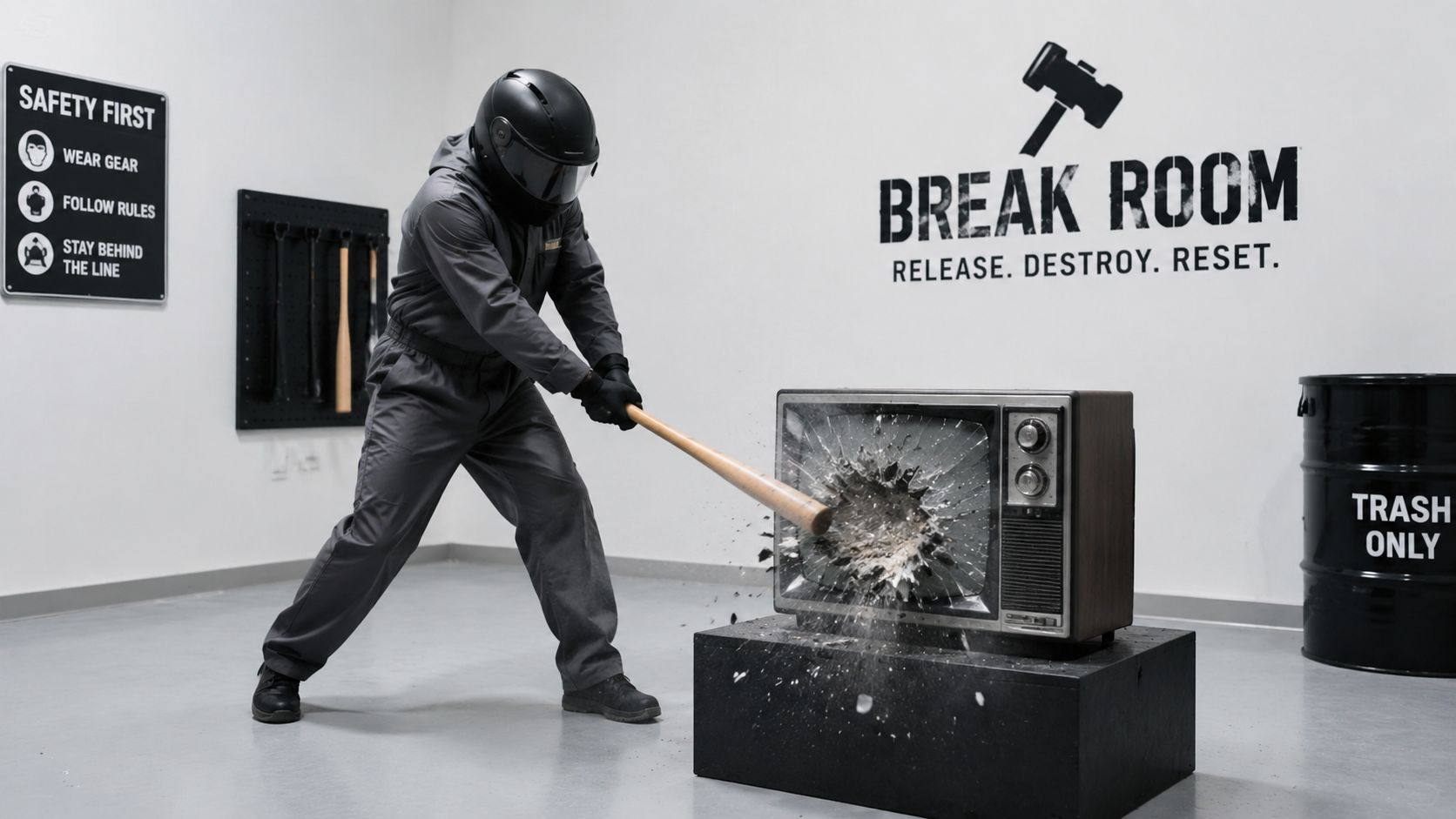
A rage room is a controlled space where people pay to smash objects such as plates, glassware, electronics, or furniture for recreation. A typical session includes protective equipment, a time limit, and a set of items to break.
What usually happens in a session
One might imagine the experience as straightforward:
- You arrive and sign a waiver.
- Staff give you safety gear.
- You choose a tool such as a bat or hammer.
- You spend a short period breaking assigned objects.
- You leave feeling “emptied out”.
Typical pricing elsewhere gives some context. Solo rage room sessions usually cost between $25 and $50 for 10–15 minutes, including a small box of breakable items, while group packages for 2–6 people can range from $50 to $160, according to this rage room cost overview.
Those numbers don't tell you whether the experience is clinically useful. They only tell you what this kind of recreation often costs in markets where it is operating.
Why the idea feels so appealing
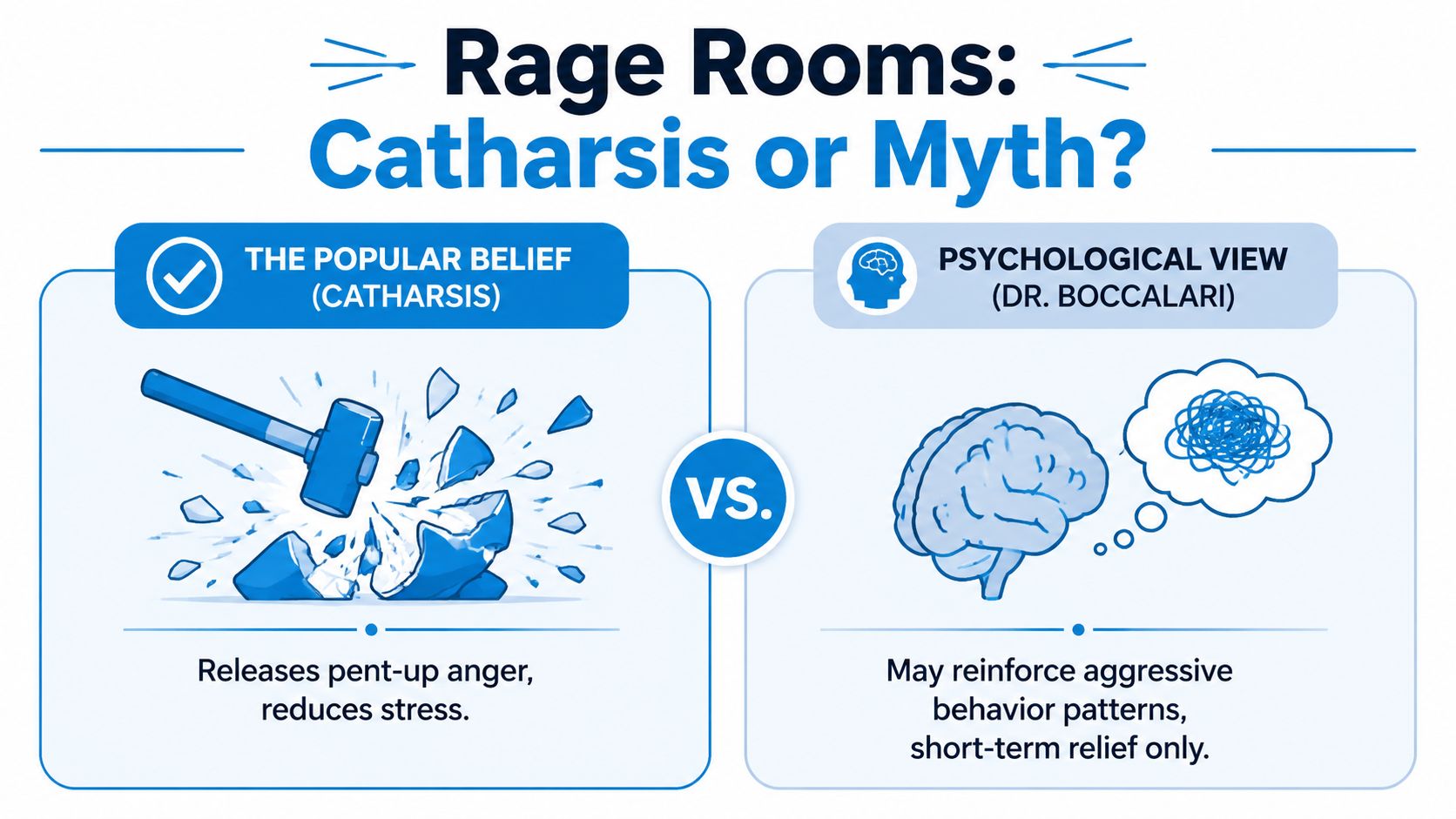
The psychological promise behind a rage room is catharsis. In everyday language, catharsis means getting pent-up emotion out so you can feel better.
Catharsis is the belief that expressing anger forcefully will discharge it and reduce emotional tension.
That belief is attractive because it matches how stress feels in the body. When you're angry, your system is activated. Your muscles tense. Your breathing changes. Your thoughts narrow. Action feels more natural than reflection.
For expats, this can be even more compelling. If your stress is tied to bureaucracy, work pressure, homesickness, or relationship strain, smashing an object can seem like a clean substitute for a messy emotional conversation.
The emotional logic behind it
The appeal usually comes from one of these inner narratives:
- “I need somewhere safe to put this feeling.”
- “I don't want to unload on my partner or colleagues.”
- “I'm too wound up to sit calmly and talk.”
- “I want fast relief, not another thing to analyse.”
All of that is understandable.
What matters clinically is that feeling appealing and being effective are not the same thing. Short-term discharge can feel satisfying while still doing very little to improve emotional regulation, recovery, or the underlying problem.
The Reality of Rage Rooms in Malta in 2026
For a commercial Rage Room Malta venue, the most important practical point is simple. The main listing found does not appear to be a reliable option.
The Attard listing appears defunct
The “Rage Room Malta” listed in Attard is objectively defunct and non-operational, yet remains visible on major tourism platforms with a misleading “Open Now” status, as evidenced by multiple reviews stating “The place doesn't exist” and “the phone number is non-existent”, according to the TripAdvisor listing and reviews.
That matters because searchers often assume visibility means availability. It doesn't.
A listing can stay online long after a business has stopped functioning. For someone already stressed, that creates a familiar expat frustration. You try to solve a problem, then meet another dead end.
If a venue shows “Open Now” but you can't confirm a booking, contact details fail, and reviews say it doesn't exist, treat it as non-operational until proven otherwise.
Why this is more than an inconvenience
In a rage room, administration is not a minor detail. It's part of safety.
The broader market context matters here. A report on the anger room market describes Rage Room Malta in Attard as operating on a 24-hour daily schedule (10:30 AM–10:30 PM) and notes that in high-demand European facilities, consistent availability can support operational margins of 30–45% on revenues of $15,000–$45,000 locally. The same source also flags critical verification issues, including a non-functional phone number and unresponsive contact channels, and notes that clear SOPs are mandatory for safety compliance in a viable rage room business, as outlined in the anger room market report.
The useful takeaway isn't the business model. It's the safety implication. If communication channels don't work, you can't assume the venue is properly staffed, monitored, or maintained.
What seems to exist instead
In Malta, the closest thing to rage-room-style stress release appears to be a trainee-led, clinically framed offering rather than a stable commercial leisure venue. A local Facebook post references trainee psychotherapists offering sessions and lists contact via +356 7782 0005, which you can see in the Facebook group post about trainee-led sessions.
That changes the category entirely.
This is no longer “book a fun activity”. It becomes “consider a psychologically framed intervention with unclear public expectations”. Those are very different decisions. Recreational destruction, harm reduction, and mental health support should never be blurred together casually.
Does Smashing Things Actually Help A Psychologists View
The short answer is not in the way one might hope.
The core myth behind rage rooms is that anger behaves like steam in a pressure cooker. The idea is that if you let it out physically, you'll have less of it afterwards. Modern psychology is far less confident about that story.
What current psychological thinking suggests
There is a significant public misconception that rage rooms provide therapeutic stress relief. Recent psychological discussion contradicts this, showing that “releasing anger” through smashing objects can reinforce aggressive neural pathways rather than alleviate them, with no evidence of long-term emotional benefit, as discussed in this summary of the catharsis debate.
That fits what many clinicians observe. Acting aggressively can sometimes increase aggressive readiness rather than resolve it.
A simple analogy helps. If you practise a musical instrument regularly, your brain becomes more efficient at that pattern. If you repeatedly pair anger with hitting, smashing, and impact, you may strengthen the pathway that says, “When I feel overwhelmed, I escalate physically.”
Short-term relief versus long-term regulation
Many people get confused about this. A person can feel better after a rage room and still not have done anything that improves emotional health.
Those are not contradictory facts.
Here's the distinction:
| Experience | What it may mean |
|---|---|
| Immediate release | Your nervous system discharged some activation |
| Sense of satisfaction | You completed an intense physical act |
| Reduced tension for a while | The body settled temporarily |
| Better anger regulation | Not necessarily |
| More insight into triggers | Usually no |
| Lasting change | Not guaranteed |
Smashing things may change your state for a moment. It usually doesn't teach you how to understand, interrupt, or regulate the pattern that created the anger.
What CBT would focus on instead
In Cognitive Behavioural Therapy, anger is not only an emotion to vent. It is a pattern to map.
A CBT lens asks:
- What triggered this reaction?
- What thought flashed through your mind?
- What meaning did your brain assign to the event?
- What did your body do next?
- What behaviour followed?
- What consequence reinforced the cycle?
If your anger in Malta is about loneliness, humiliation, chronic stress, or feeling trapped, breaking a printer or a plate won't address the interpretation underneath. It may even distract you from it.
A more useful starting point is understanding anger as a protective emotion, which is central to the clinical perspective explored in this piece on anger as vulnerability. Anger often arrives first because it feels stronger than sadness, fear, shame, or helplessness.
A Safety Checklist Before You Visit Any Rage Room
If you still want to try a rage room outside Malta or you find an alternative venue, approach it as harm reduction, not therapy. The safest version of the experience is still a physically risky activity involving sharp debris, overstimulation, and emotionally activated people.
Practical checks before booking
Use this checklist before you pay:
- Verify live contact channels: If the venue doesn't answer messages, confirm bookings, or provide clear instructions, walk away.
- Ask what protective gear is included: You want proper eye, face, hand, and body protection. “We give you goggles” is not enough detail.
- Clarify staff supervision: Ask whether staff remain present, observe sessions, and intervene if someone becomes unsafe.
- Check what can be smashed: Some items carry specific hazards. A serious venue should be able to explain what materials are allowed and why.
- Read the waiver carefully: A waiver should describe risks clearly. If it's vague, rushed, or missing, that's a red flag.
- Ask about clean-up and room reset: A professional operator should have a clear process for broken glass, sharp waste, and turnover between sessions.
- Look for rules on intoxication: If they allow highly activated or intoxicated clients to participate, that's poor risk management.
- Check whether the experience is represented accurately: If they market it as mental health treatment, be cautious.
Use price as context, not proof
Pricing can help you spot whether something looks credible, but it doesn't guarantee quality. As noted earlier, solo sessions typically cost between $25 and $50 for 10–15 minutes, and group packages for 2–6 people can range from $50 to $160 in the general market, based on this rage room pricing reference. A rate far outside that range may signal very different operating standards, but a familiar price still tells you nothing about safety culture.
Signs a venue is not organised enough
A poorly run rage room often gives itself away quickly:
- No clear booking confirmation.
- No written rules sent in advance.
- Casual language about injuries.
- No explanation of emergency procedures.
- Staff who treat overstimulation as entertainment.
If you already tend to become flooded when angry, choose environments that lower activation rather than intensify it. Learning nervous system regulation in therapy is generally far more transferable to real life than rehearsing controlled destruction.
Safety isn't only about helmets and gloves. It's also about whether the experience leaves your mind more settled, or more primed for the next explosion.
Healthier Alternatives for Managing Anger and Stress
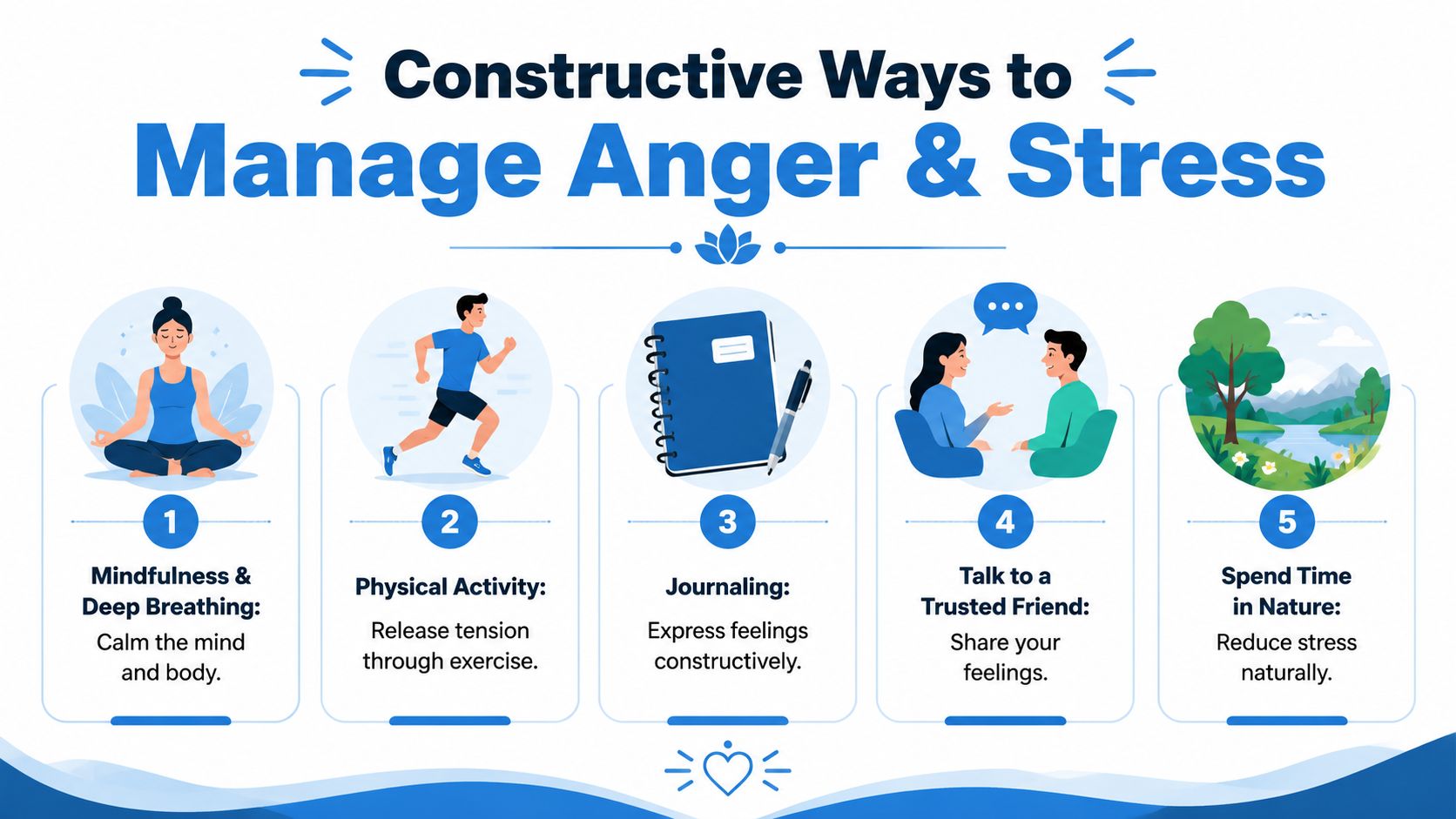
Those who search for Rage Room Malta aren't looking for broken objects. They're looking for a way to come back into themselves. That's why healthier alternatives work better. They don't only discharge tension. They build regulation.
Five alternatives that usually help more
Intense physical exercise: If your body is loaded with agitation, movement can help metabolise that activation without pairing anger with destruction. Brisk walking, intervals, swimming, boxing drills without interpersonal impact, or strength work can all help. If consistency is your challenge, this guide on how to build an exercise habit that lasts is a useful practical resource.
Grounding and breathing: These tools sound modest, but they work directly on the stress response. Slow exhalation, orienting to your surroundings, and naming what you feel can reduce the sense of internal threat that fuels explosive reactions.
Journaling with structure: Free-writing helps some people, but structured prompts work better for anger. Try: What happened? What did I tell myself? What did I need? What boundary felt crossed? That turns raw emotion into usable information.
Creative expression: Music, painting, movement, clay, or even vigorous cleaning can create release without reinforcing an aggression script. This matters when your nervous system needs expression but not escalation.
Nature and sensory reset: Malta's coast, open sky, sea air, and walking routes can support decompression. A dysregulated mind often settles faster when the body receives repetitive, predictable sensory input.
Why these options work better clinically
Anger is rarely just “too much anger”. It's often a mix of activation, interpretation, and unmet need.
Healthier coping methods tend to do at least one of these three things:
| Need | Better response |
|---|---|
| Physical discharge | Exercise, walking, stretching, shaking out tension |
| Emotional processing | Journaling, therapy, talking to someone safe |
| Nervous system down-regulation | Breathing, grounding, rest, nature, sensory calming |
The best response depends on your pattern. If you feel physically restless, movement may help first. If your anger comes after conflict, reflection may matter more. If you feel numb until you suddenly explode, routine regulation is often the missing piece.
For broader day-to-day support, it helps to learn practical strategies for coping with stress in ways that fit expat life rather than fight against it.
What doesn't tend to work
Some strategies feel relieving but keep the cycle alive:
- doom-scrolling while angry
- replaying the argument mentally
- texting in the heat of the moment
- drinking to come down
- treating every wave of frustration like an emergency
What works is usually less dramatic. It's also more repeatable.
When Anger Is a Signal to Seek Professional Support
Anger becomes clinically important when it stops being an occasional reaction and starts becoming a pattern that shapes your work, relationships, self-image, or sense of safety.
For expats, anger is often misread. You may think, “I'm just stressed” or “I'm just adapting.” Sometimes that's true. Sometimes anger is the visible surface of burnout, depression, unresolved trauma, grief, shame, or chronic overstimulation.
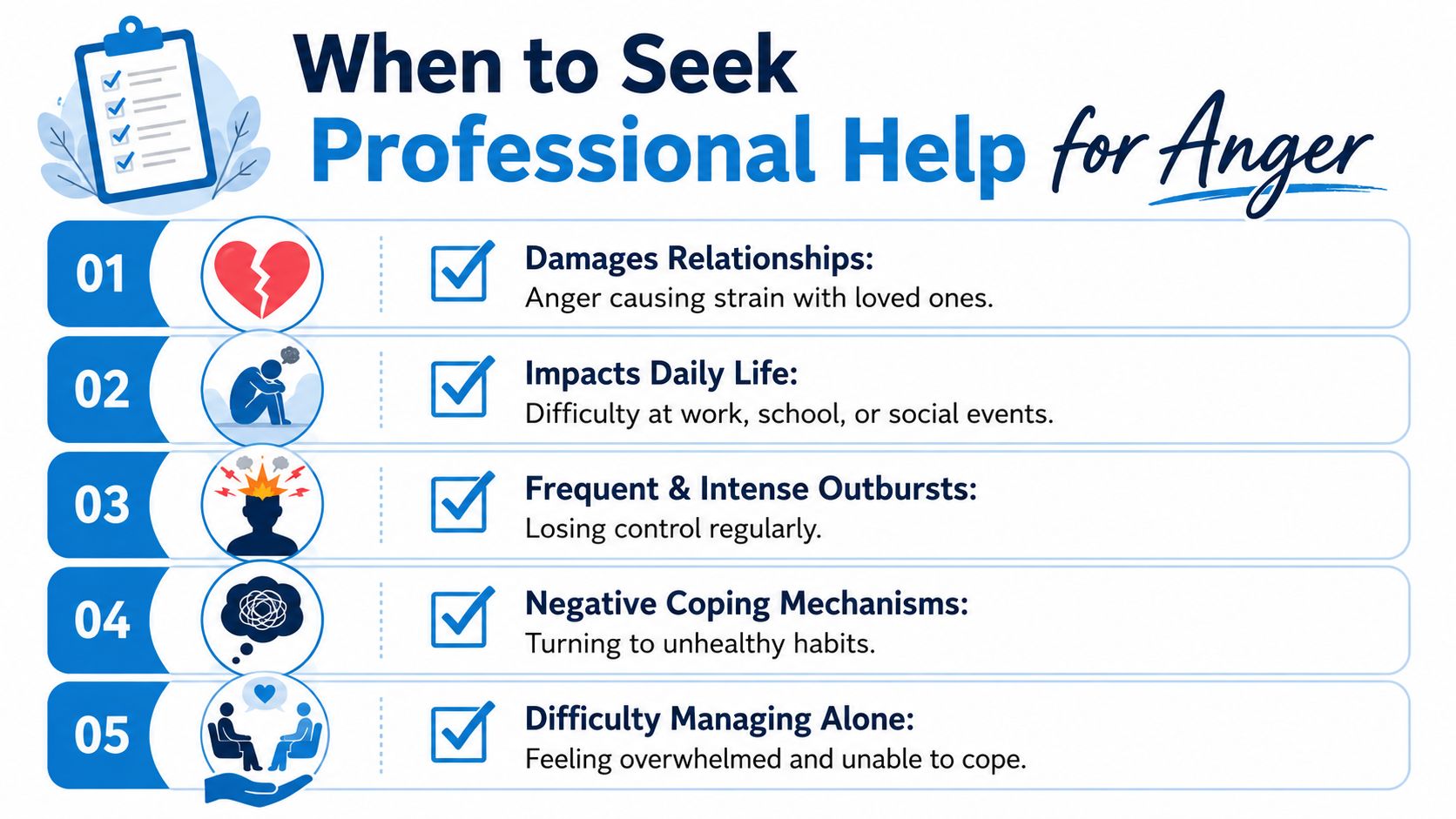
Signs it may be time to talk to a professional
Consider support if any of these feel familiar:
- Your relationships are feeling the impact: You snap more than you want to, avoid conversations, or carry resentment for days.
- Your work is changing: You're less patient, more cynical, more reactive, or constantly close to overload.
- You feel irritated most of the time: Not only during conflict, but in ordinary moments.
- You rely on unhealthy coping: Alcohol, withdrawal, compulsive scrolling, emotional eating, or repetitive conflict.
- Your anger feels bigger than the situation: The trigger is small, but your reaction feels immense.
- You don't feel in control of the cycle: You know the pattern and still can't stop it.
A good threshold is this. If anger keeps solving the wrong problem, it's time to look underneath it.
How therapy helps in a way a rage room can't
A rage room offers intensity. Therapy offers understanding, regulation, and change.
Different evidence-based approaches help in different ways:
CBT
CBT helps identify the thought patterns that turn stress into anger. It can show you how assumptions such as “No one respects me”, “I'm trapped”, or “Everything is on me” intensify reactivity. Then it helps you build alternative responses.
EMDR
EMDR is often useful when anger has a trauma component. Some people aren't “overreacting”. Their nervous system is reacting from old threat memories that current stress keeps activating.
Schema Therapy
Schema Therapy looks at deeper lifelong patterns. If your anger emerges around abandonment, control, unfairness, criticism, or emotional deprivation, this model can be especially valuable. It connects present reactions with older relational templates.
For readers who recognise themselves in these patterns, learning about anger management therapy can be a more useful next step than continuing to search for a dramatic outlet.
Why culturally sensitive support matters for expats
Expat anger is not always about temperament. Sometimes it is about context.
A therapist who understands relocation stress, intercultural identity, multilingual life, and the strain of functioning away from your usual support system can help you make sense of reactions that otherwise feel embarrassing or confusing. In practice, that means you don't only ask, “How do I stop exploding?” You also ask, “What is this life asking of me that I haven't fully processed yet?”
That's often where real relief begins.
FAQ
Is there a real Rage Room Malta currently operating?
The main venue commonly encountered appears not to be reliably operational. The Attard listing remains visible online, but the available evidence in the earlier section suggests it should be treated with caution unless you can verify current functioning directly and independently.
Are rage rooms good for stress relief?
They may offer short-term release, but they are not the same as effective emotional regulation. The clinical concern is that acting out aggression can feel relieving in the moment without improving the deeper pattern that drives repeated anger or stress.
Are rage rooms a form of therapy?
No, a rage room is not therapy. Therapy uses structured, evidence-based methods such as CBT, EMDR, or Schema Therapy to understand triggers, regulate emotions, and support longer-term change.
Why do expats feel so angry or overwhelmed abroad?
Relocation stress often shows up as irritability rather than obvious sadness. Culture shock, loneliness, administrative stress, language fatigue, identity strain, and disappointment can all increase reactivity even in people who don't usually think of themselves as “angry”.
What should I do instead of going to a rage room?
Choose a response that matches your actual need. If your body feels overstimulated, physical movement may help. If you're carrying resentment or emotional confusion, journaling, grounding, or talking to a therapist will usually help more than an intense but brief outlet.
When is anger a mental health concern?
Anger becomes a mental health concern when it starts affecting daily life, relationships, work, or your sense of control. If you're repeatedly reactive, constantly irritable, or relying on unhealthy coping, it's worth seeking professional support.
Can therapy help if I'm not “an angry person”?
Yes, therapy can help even if anger isn't your identity. Many people who seek support for anger deal with stress, burnout, grief, trauma, or adjustment difficulties that happen to emerge through irritation and conflict.
If life abroad has left you carrying more frustration, stress, or emotional overload than you want to manage alone, Therapsy is a trusted resource for the international community in Italy. We offer support in 11 languages through carefully selected licensed professionals, with online and in-person sessions across 20+ Italian cities and 50+ physical locations. Our team includes 50+ therapists, and we've supported 1,000+ clients since 2023, with Trustpilot rated 4.5/5 (“Excellent”) and a first contact within hours. Individual therapy starts from €70/session, couple therapy from €100/session, psychiatric consultations from €110/session, and psychodiagnostic assessment from €255. Book your first free assessment call, no commitment, just a conversation with our Clinical Director who will listen and match you with the right therapist for you. Visit Therapsy.