Therapy can feel suddenly expensive the moment you start looking for it in Italy. You may already be paying for a deposit, agency fees, visa paperwork, language classes, or trips home. Then you see private session fees and think, “I need support, but I'm not sure I can carry one more monthly cost.”
That reaction is common, especially for expats trying to build stability in a new country while managing anxiety, isolation, burnout, relationship stress, or culture shock. Financial stress often makes people delay care right when support would help most.
Sliding Scale Therapy is a fee structure where the cost of sessions is adjusted based on a person's income and financial ability. It isn't a trick, and it isn't something you need to feel embarrassed to ask about. It's one of the clearest ways mental health care tries to make room for real life.
If you're trying to understand what counts as income, how to ask without shame, or how this works in Italy when your finances span more than one country, you're in the right place. For a broader overview of private fees, this guide on how much therapy costs in Italy is a useful starting point.
Making Therapy in Italy Affordable
Moving abroad often creates a strange mismatch. On paper, you may look financially stable. In daily life, you may be juggling rent, relocation costs, irregular freelance income, exchange rates, and family obligations in another country.
That's why affordability can't be reduced to one simple number. A therapist may charge a standard fee, but that doesn't always mean every client is expected to pay the same amount.
A reduced rate request is not a sign that therapy is “too luxurious” for you. It's a sign that you're trying to make care sustainable.
For many expats, the hardest part isn't the paperwork. It's the feeling that asking for help with fees somehow says something negative about your competence, success, or adulthood. It doesn't. It says you're paying attention to your limits.
What Sliding Scale Therapy Really Means
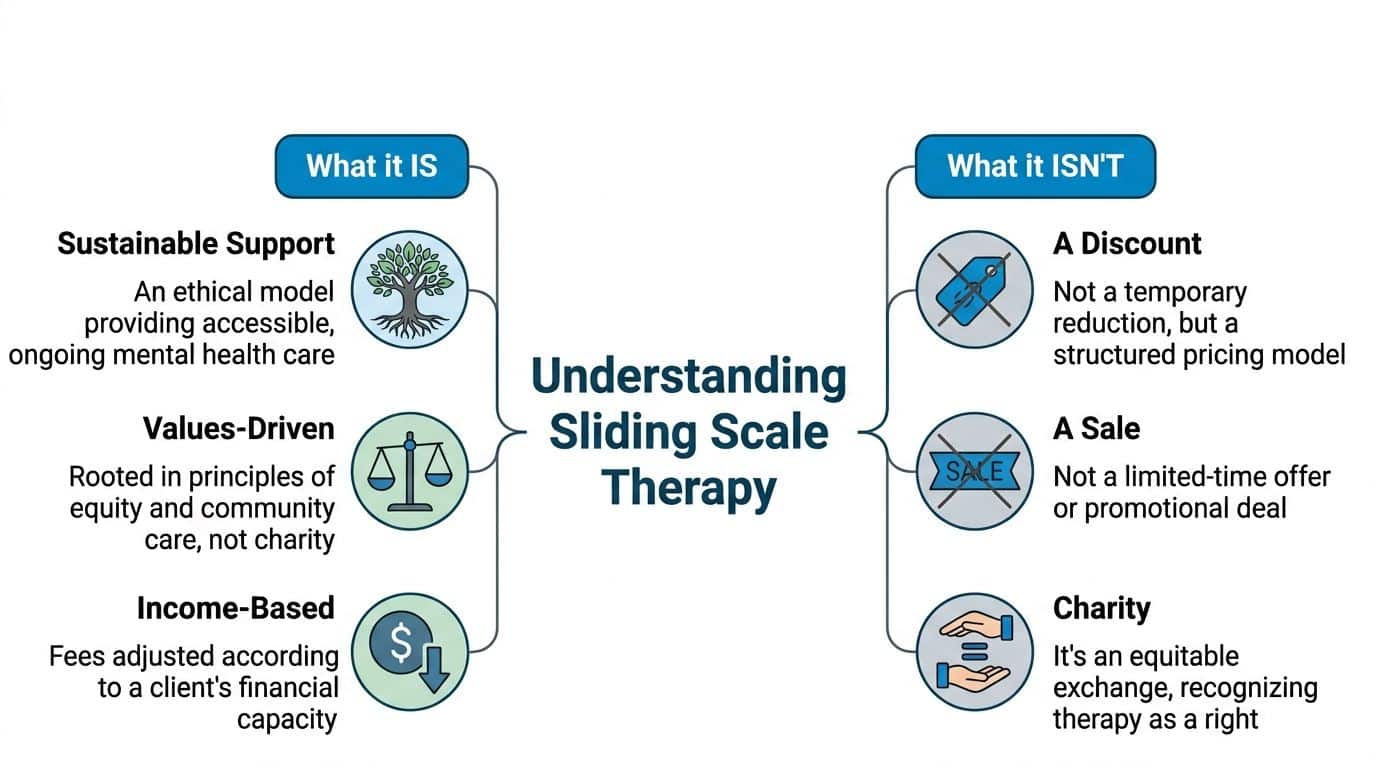
Sliding Scale Therapy is a structured, professional pricing model. The fee changes in relation to income and financial circumstances. It is not a sale, a coupon, or a personal favor.
A simple way to think about it is this: the price “slides” so that the cost is more proportionate to what a person can realistically afford. Someone with less available income may pay less. Someone with greater financial flexibility may pay the full fee.
Why this model exists
Therapy works best when it can continue over time. If the fee creates constant panic, shame, or stop-start attendance, the treatment relationship becomes harder to sustain. Sliding scale policies try to reduce that barrier while keeping the work professional and boundaried.
Sliding scale therapy is meant to increase access, not to lower the quality of care.
That distinction matters. Many people hear “reduced rate” and immediately think “lesser service.” In ethical private practice, that's not the idea. The session is still a therapy session. The therapist is still responsible for the same standard of care.
What it is not
Readers often get stuck here, so it helps to be very direct.
- Not a discount code. You're not bargaining the way you might for a retail service.
- Not temporary promotional pricing. It's usually based on a policy, not a limited-time offer.
- Not charity. The therapeutic relationship remains professional.
- Not automatic. A therapist may offer it, limit it, or have no current availability.
If you grew up with messages like “other people need help more than I do” or “I should be able to manage this myself,” asking can stir up guilt fast. In cross-cultural psychology, that makes sense. Money beliefs are often tied to identity, family expectations, and the pressure to look stable in a foreign environment.
A CBT lens can help here. CBT, or cognitive behavioral therapy, looks at the link between thoughts, emotions, and actions. If the thought is “asking for a lower fee means I'm failing,” the emotional result is shame, and the action is avoidance. A more accurate thought might be: “I'm asking a practical question about access to care.” That shift often lowers the emotional charge.
How Clinicians Set Sustainable Sliding Scale Rates
From the client side, it can seem mysterious. From the therapist side, it's usually math, policy, and boundaries.
A private practice has fixed costs whether a client pays full fee or reduced fee. Rent, administration, supervision, utilities, software, and taxes don't disappear because a therapist wants to make care more accessible. That's why sliding scale works best when it's planned rather than improvised.
What that means for you as a client
If a therapist says they don't currently have a sliding scale opening, that usually isn't a judgment of your worthiness. It may mean the available reduced-fee spots are already full.
That can feel personal, especially if you're already vulnerable. But it usually reflects capacity, not rejection.
A “no” to a reduced rate often means “not available in my practice right now,” not “your situation isn't valid.”
Why therapists need clear limits
Some clinicians decide in advance:
- how many reduced-fee spots they can offer
- who qualifies
- how long the reduced rate lasts
- when fees are reviewed again
That structure protects both people. The client knows the arrangement is real and intentional. The therapist knows they can continue offering care without building resentment or financial instability.
Here's the deeper point: good boundaries are part of good therapy. If a therapist offers rates they can't sustain, the relationship can become strained. If they have a clear policy, the conversation is cleaner and more respectful.
A more balanced way to frame the conversation
Instead of thinking, “I'm asking this therapist to make an exception for me,” try this frame:
- I'm asking whether they have an established option for lower-fee care.
- They are checking whether that option fits their policy and capacity.
- We are both trying to find a workable arrangement.
That mindset reduces the pleading dynamic many expats fear. It turns the exchange into what it is: a practical conversation about access.
Determining Your Eligibility and Preparing Documents
For many people, the words “income verification” immediately trigger anxiety. That's understandable. Money can feel intimate, especially when your life is spread across countries, currencies, and unstable timelines.
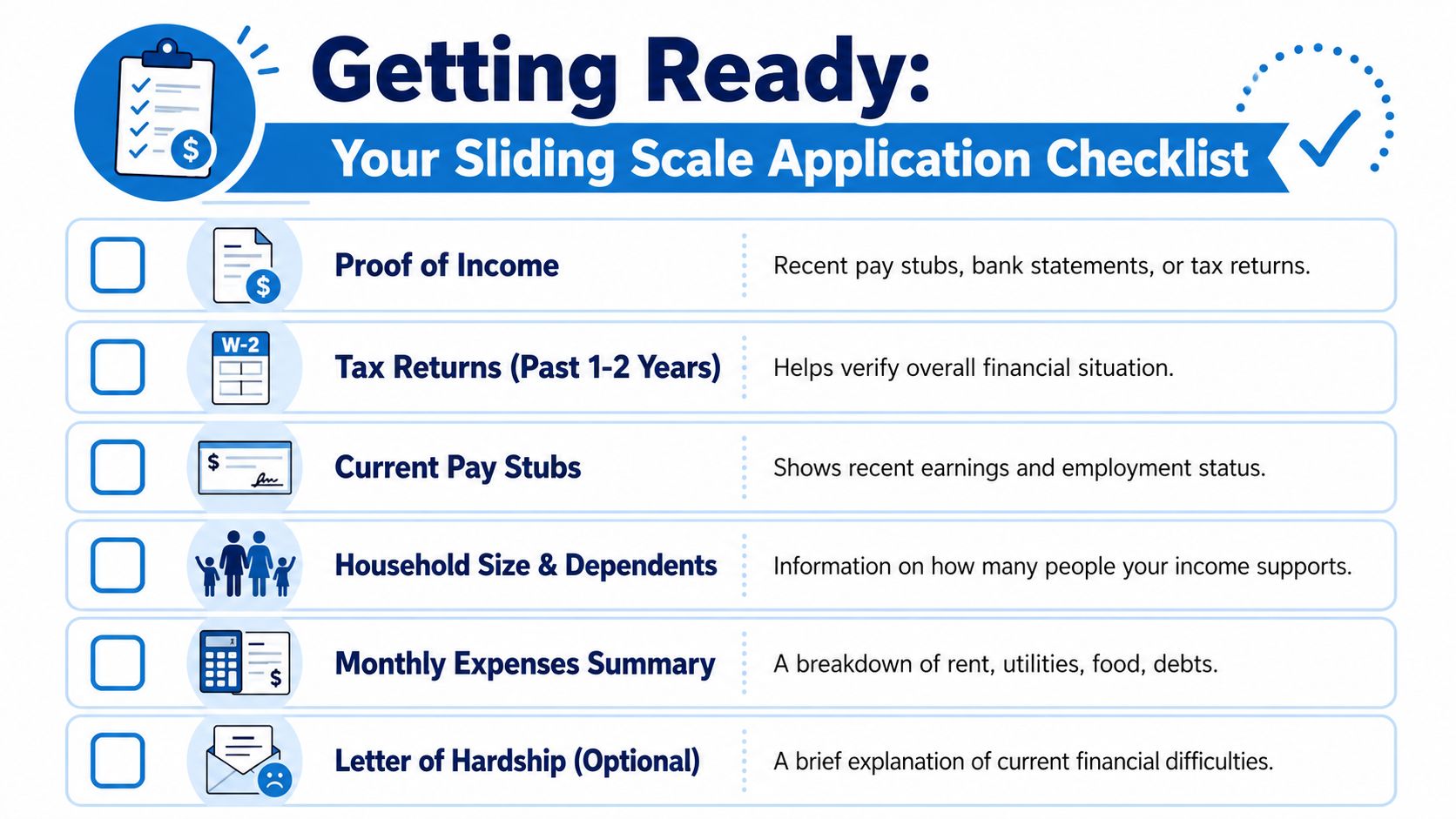
Still, preparation helps. Eligibility for Sliding Scale Therapy typically requires recent income documentation, and fee calculations are often tied to household size and income guidelines as explained in this overview of sliding scale eligibility.
What therapists usually want to understand
Most therapists aren't trying to audit your entire life. They're usually trying to answer a smaller question: what fee would be fair and sustainable based on your current financial reality?
That often includes:
- Recent income proof such as pay slips, invoices, or bank records
- Tax documentation if relevant and available
- Household context including dependents or a partner
- Current pressure points such as relocation costs, debt, or a sudden income drop
- Residency details if the service has local eligibility requirements
A simple preparation checklist
Bring together the documents that best reflect your present situation.
-
Current earnings
If you're employed, recent pay slips are usually the clearest option. If you freelance, recent invoices or bank records may show a more realistic picture. -
Tax information
If your previous year was stronger than your current one, be ready to explain that difference briefly. -
Household size
A therapist may look at how many people your income supports, not just your salary in isolation. -
Essential monthly costs
Rent, utilities, child-related expenses, debt repayments, and visa or relocation costs may all matter when describing financial strain. -
Currency context
If part of your money is in dollars, pounds, or another currency, write it out clearly in one place so the conversation doesn't become confusing.
What expats often worry about
Expats in Italy commonly ask questions like:
- Does foreign income count?
- What if my salary is paid in another currency?
- What if my family helps me sometimes, but not regularly?
- What if I have savings, but my monthly cash flow is tight?
These are valid questions. In practice, the cleanest approach is honesty plus clarity. Don't try to guess what “should” count. Show what money is available to you now, and explain any major cross-border factors clearly.
Clear information matters more than perfect paperwork. A short, accurate explanation is usually more helpful than oversharing.
If you're exploring public support in Italy as well, this page on the Bonus Psicologo 2026 for expats gives relevant context.
How to describe a mixed financial picture
A short script can help:
- “My income is paid in euros, but I still have obligations in my home country.”
- “Last year's tax return doesn't reflect my current situation after relocation.”
- “I have some savings, but my monthly disposable income is limited right now.”
- “My household finances are shared across countries, so I'd like to explain the full picture clearly.”
That's enough. You don't need to defend your right to care. You only need to describe your circumstances in a way the therapist can understand.
A Guide to Asking for a Reduced Rate
This is the part many people avoid for weeks.
Not because they don't know the words, but because the request touches something deeper. Pride. Fear of being judged. Fear of sounding dramatic. Fear that the therapist will think, “You live abroad, so you must be fine.”
Those fears are especially common among high-functioning expats. You may be managing work, speaking another language, solving bureaucratic problems, and looking composed from the outside. Inside, you may be doing constant financial triage.
Why asking can feel so emotionally loaded
Attachment theory helps explain this. Attachment theory looks at how early experiences shape the way we seek support. If you learned that needing help led to criticism, distance, or guilt, then asking about fees may feel riskier than it objectively is.
In intercultural contexts, there's often another layer. You may already feel like an outsider in the system. Asking for accommodation can stir up the fear of being “too much,” “difficult,” or “not really entitled” to support in a country that isn't your own.
That doesn't mean the request is inappropriate. It means the request is emotionally activated.
When to ask
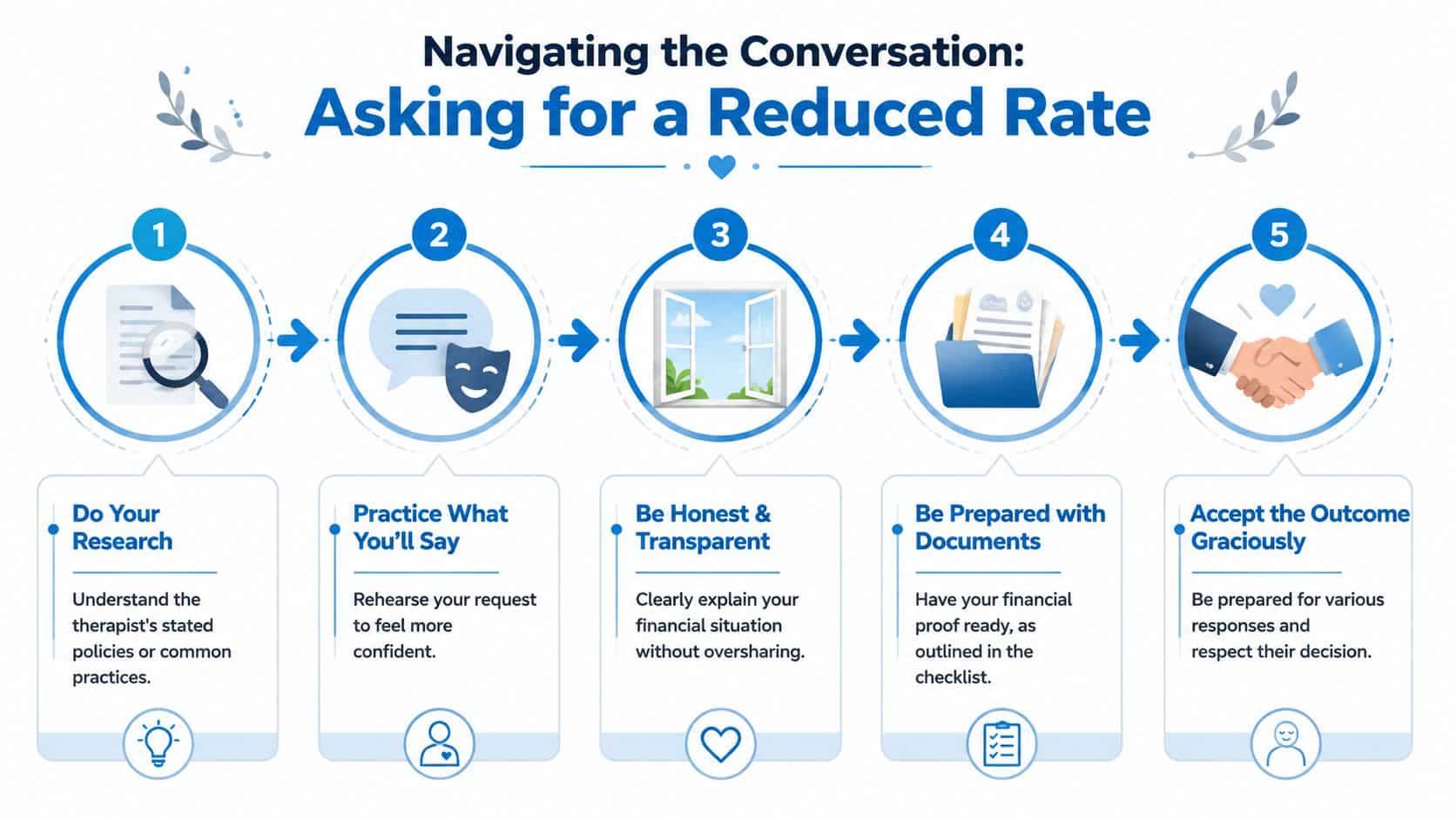
The best time is usually early. Ideally, ask in the first email, intake exchange, or consultation stage.
That helps you avoid two painful outcomes:
- getting attached to a therapist whose fee won't work
- delaying the conversation until you're already stressed about payment
What to say
Keep it brief, respectful, and direct. You don't need a dramatic explanation.
Here are scripts you can adapt:
- “I'm interested in working with you and wanted to ask whether you offer sliding scale options.”
- “I'd like to start therapy, but I need to be mindful of my budget. Do you have any reduced-fee availability?”
- “My financial situation is a bit complex due to relocation. Would it be possible to discuss whether a sliding scale rate might apply?”
- “I want to find something I can sustain consistently. Can I ask about your fee flexibility, if any?”
If speaking feels easier than writing, you can practice the sentence aloud first. That small rehearsal often lowers shame.
What not to do
You don't need to apologize repeatedly. You also don't need to present your suffering as proof that you deserve care.
Try to avoid:
- Overexplaining every financial detail before the therapist has even said yes to the conversation
- Minimizing your need by saying “It's probably silly to ask”
- Assuming judgment before you receive a response
- Treating the request like negotiation instead of asking about policy and availability
Asking about a reduced rate is a normal part of exploring therapy. It is not rude, manipulative, or unprofessional.
If the answer is yes
If the therapist says they offer sliding scale, you can move into logistics calmly.
A simple response might be:
- Thank them
- Ask what information they need
- Clarify how long the rate applies
- Confirm what fee would feel manageable for you
This is also a good moment to ask how often the arrangement is reviewed.
If the answer is no
A no can sting. Especially if you already worked up courage to ask.
But a no doesn't mean you asked wrongly. It may only mean:
- there are no reduced-fee spots available
- the therapist doesn't use that model
- the practice structure doesn't allow it
You can still respond with dignity:
- “Thank you for letting me know. If you have any referrals for lower-cost options, I'd appreciate them.”
- “Thanks for the clarity. I'm trying to find a sustainable option, so that helps me know what to look for.”
If you feel frozen about how to start any therapy conversation at all, this guide on how to talk to a therapist can make the first contact feel more manageable.
Sliding Scale Therapy for Expats in Italy
Italy adds a few extra layers to this topic. Cost is one part of it. The bigger challenge is often interpretation.
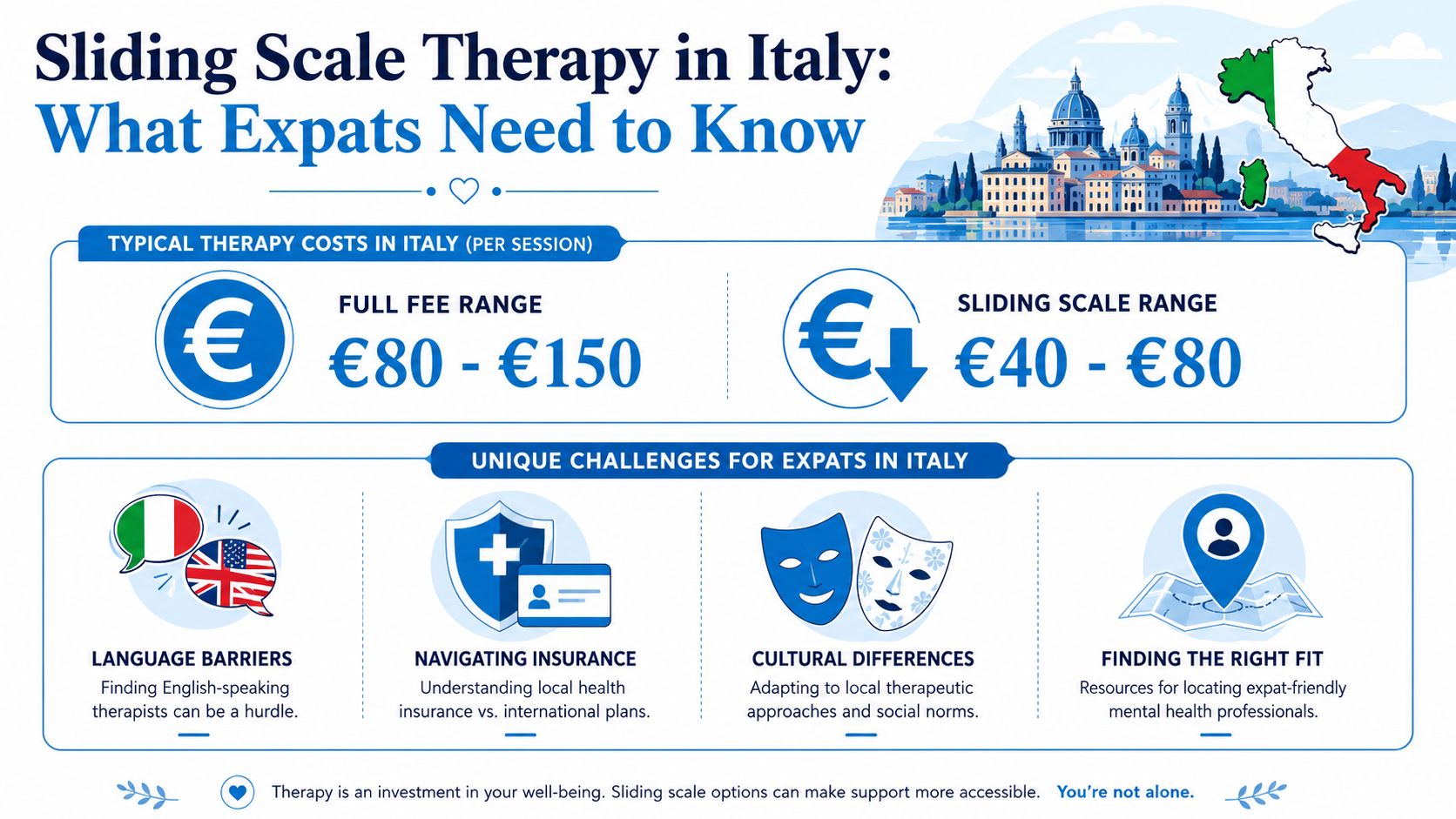
For expats in Italy, one of the main difficulties is understanding how reduced-fee eligibility works when income comes from abroad or is split across countries. That confusion matters because private therapy in major cities such as Milan and Rome is a recurring cost.
Why Italy can feel confusing
Many online explanations assume a single-country financial life. Expats often don't have that.
You may be:
- paid by a foreign employer
- earning in euros while supporting family elsewhere
- using savings from another country
- switching from student status to work status
- trying to understand whether local or foreign financial benchmarks apply
That's why generic advice often falls short. The issue isn't only “Do I qualify?” It's “Which financial reality are we using?”
Public support in Italy
Italy also has a public funding route worth knowing about. The Bonus Psicologo can provide up to €1,500 for residents with an ISEE under €15,000, up to €1,000 for ISEE €15,000 – €30,000, and €500 for ISEE €30,000 – €50,000. Eligibility can include foreign residents with a permesso di soggiorno and a valid ISEE.
For expats, that's important. It means support may depend less on citizenship than many people assume, and more on residency and the right administrative documents.
A more realistic way to approach it
Instead of trying to solve the entire question alone, it often helps to treat fee eligibility as a conversation rather than a puzzle. Bring your documents, explain the cross-border pieces, and ask how the provider interprets them.
This matters even more if you're dealing with culture shock, anxiety, depression, or burnout. When your nervous system is already overloaded, unclear administrative rules can feel much bigger than they are.
From a cross-cultural psychology perspective, that's normal. Uncertainty raises stress. A human conversation lowers it.
If you're specifically looking for support that understands relocation, language, and the Italian context, this resource on finding an expat therapist in Italy may help you narrow your options.
Alternatives When Sliding Scale Is Not an Option
Sometimes the answer is simple and disappointing: no reduced-fee spots are available.
That doesn't mean you're out of options. It means you may need a different route into care.
Public mental health services
Italy's public system can be a meaningful option for some people. Depending on where you live, local services may offer psychological or psychiatric support through the public health network.
The tradeoff is usually speed and flexibility. Public pathways may involve waiting, referrals, and less choice about language or therapeutic style. Still, for some expats, this is the most realistic first step.
University clinics and training centers
If you're a student or living near a university city, training clinics can sometimes offer lower-cost support with supervised therapists in training.
This option may suit people who:
- need a lower fee
- are open to working with a newer clinician
- can tolerate a more structured academic setting
The main limitation is fit. If you want a therapist with strong intercultural experience or a very specific modality, availability may be narrower.
Community and nonprofit settings
Local associations, consultori, and community-based services may offer support at reduced cost. These settings can be particularly helpful if your needs are connected to family stress, migration, identity issues, or practical social strain.
The challenge is that access can vary a lot by city, language, and local infrastructure. Some services are welcoming and easy to reach. Others require persistence.
Affordable care is still real care. Lower cost does not automatically mean lower value. It may simply mean a different setting, funding model, or level of flexibility.
Lower-frequency private therapy
If weekly therapy isn't realistic, some people do better with a sustainable rhythm than with a plan they can't maintain.
That might mean:
- every other week instead of weekly
- a short period of focused support
- combining therapy with self-monitoring and structured reflection between sessions
This isn't right for every concern, but for stress, adjustment, mild anxiety, or decision-making support, it can be a useful bridge.
Online therapy in English
For expats outside major cities, online therapy can widen your options, especially for language fit. It may also reduce travel time and make scheduling easier around work, childcare, or commuting.
That doesn't automatically make it cheaper, but it often gives you a broader pool of therapists and more practical flexibility. If you're exploring that route, this page on online therapy in English in Italy is a good place to start.
What matters most when choosing an alternative
Don't focus only on the lowest fee. Focus on whether the option is workable enough that you'll use it.
A useful checklist is:
- Can I afford this for more than one session?
- Can I communicate comfortably in the language used?
- Do I understand how to book and attend?
- Does the setting feel emotionally safe enough for me to return?
The best therapy arrangement is not always the ideal one on paper. It's often the one you can realistically begin, continue, and benefit from now.
FAQ
Is sliding scale therapy the same as cheap therapy
No, sliding scale therapy is not the same as “cheap therapy.” It's a structured fee model based on income and circumstances, not a sign of lower-quality care. The aim is to make therapy more accessible while keeping the work professional and consistent.
Can expats in Italy ask for a reduced rate even if they look financially stable on paper
Yes, expats can still ask for a reduced rate if their real monthly situation is tighter than it appears on paper. Relocation costs, exchange-rate issues, shared cross-border obligations, and unstable freelance income can all affect affordability. What matters is presenting your current reality clearly.
What documents do I usually need for a sliding scale request
You usually need recent proof of income and a clear picture of your current financial situation. That may include pay slips, tax documents, bank records, and information about household size or dependents. If your finances are spread across countries, a short written explanation can also help.
What if a therapist says no to sliding scale
If a therapist says no, it usually reflects policy or availability, not a judgment about you. Many clinicians limit reduced-fee spots so their practice remains sustainable. You can thank them, ask for referrals, and keep looking for an option that fits.
Does Italy have any public support for therapy costs
Yes, Italy has public support mechanisms in some cases, including the Bonus Psicologo for eligible residents. Access depends on administrative criteria such as ISEE and residency documentation. For expats, it's worth checking eligibility rather than assuming you won't qualify.
Is it better to ask about fees before the first session
Yes, it's usually better to ask early. That saves you from starting with someone whose fee won't be sustainable and makes the conversation more practical. Early clarity often reduces anxiety for both you and the therapist.
Can online therapy make support more affordable in Italy
Sometimes, yes, but not always. Online therapy may widen your options, especially if you need support in English or another language, and it can remove travel costs and scheduling strain. The main advantage is often flexibility and fit, not just price.
If you're looking for support that understands expat life in Italy, Therapsy is a trusted resource for the international community, offering therapy in 14 languages, online and in person across 24 Italian cities and 90+ physical locations. A therapist who collaborates with Therapsy can be matched through a human conversation, not a chatbot or automated questionnaire, and the first assessment call is free with no commitment. Book your first free assessment call – just a conversation with the Clinical Director who will listen and match you with the right therapist for you. Visit Therapsy.