In early September, Italy can feel subtly unfamiliar. Shutters close earlier, August aperitivo routines disappear, and your inbox, paperwork, study schedule, or work responsibilities return at once. September blues describes this temporary dip in mood, energy, and motivation after summer. For expats, it can combine seasonal light changes, post-vacation stress, homesickness, language friction, and the pressure of rebuilding routine abroad.
Therapsy is a multilingual psychotherapy service in Italy that connects expats with therapists who speak their native language.
What September Blues Really Means
A young professional in Milan may notice the change before naming it. In July, evenings seemed expansive. Friends were available, streets felt lighter, and dinner could begin late without feeling like a disruption. By early September, the same person may wake tired, postpone simple tasks, and feel a vague dread about returning to a demanding routine.
That experience is commonly called September blues. It generally refers to a mild, situational drop in mood and motivation connected to the end-of-summer transition. It isn't a formal psychiatric diagnosis. It's better understood as a temporary adjustment response, especially when the change involves reduced daylight, disrupted sleep, renewed work or study demands, and separation from familiar people.
September blues is usually a transition response, not a diagnosis.
The experience also has a seasonal foundation. The NHS has estimated that seasonal affective disorder affects about 1 in 15 people in the UK between September and April, approximately 6.7% of the population according to the BBC's reporting on seasonal affective disorder. That doesn't mean everyone with low energy in September has SAD. It does show why early autumn can matter for people who are sensitive to seasonal changes.
September blues is often limited and self-correcting. A difficult week after returning from travel, a few restless nights, or reduced enthusiasm for social plans can reflect ordinary readjustment. The distinction becomes more important when symptoms persist, intensify, or interfere with work, relationships, sleep, appetite, or safety.
Expats may also confuse homesickness with depression. The two can overlap, but they aren't identical. This practical guide on homesickness versus depression in expats in Italy can help you notice whether your feelings are focused mainly on missing home or have become more pervasive.
Why September Hits So Hard for Expats
September often brings several manageable pressures together. For someone living abroad, each pressure can activate the others, so the final experience feels heavier than any single trigger would suggest.
Circadian drift
Summer light helps anchor the body's daily rhythm. As mornings and evenings become darker, light exposure changes the timing of sleep, alertness, and mood regulation. The National Institute of Mental Health explains that seasonal affective disorder is connected with changes in daylight, circadian rhythms, and serotonin-related processes in its guidance on seasonal affective disorder.
A person who has been sleeping late, eating at irregular times, and spending long evenings outdoors may feel unsettled when September requires earlier starts. The body isn't failing. It's recalibrating.
Post-vacation return
Returning from a holiday can produce an abrupt increase in cognitive load. The mind moves from recovery and spontaneity to inbox triage, meetings, commuting, relocation administration, and deadlines.
Guidance on acclimating to the workplace after vacation recommends a gradual return where possible. Lighter first tasks and a buffer before full workload can make re-entry less reactive.
Social and work pressure
September is a major reset month for families, students, employers, and institutions. A University of Alberta occupational-health summary described a September “trifecta” involving time pressure, school-or-work demands, and finances. CBC has also reported that roughly 6 million students would normally return to school in September in Canada, while Google's Misery Index showed stress peaking in September and October, as described in the seasonal mood review published in Translational Psychiatry.
For expats, the social calendar can change quickly. Friends may return from travel with new schedules, colleagues may become less available, and a relaxed summer network may suddenly feel scattered.
The expat layer
Moving countries adds practical and emotional work. September can bring visa queues, permesso di soggiorno appointments, school administration, unfamiliar workplace expectations, and conversations where you understand the words but miss the cultural meaning.
Distance from home also becomes more noticeable when summer novelty fades. An international student in Bologna may miss family rituals visible through social media. A professional in Rome may realise that a stressful workday can't be processed easily with friends who live in another time zone.
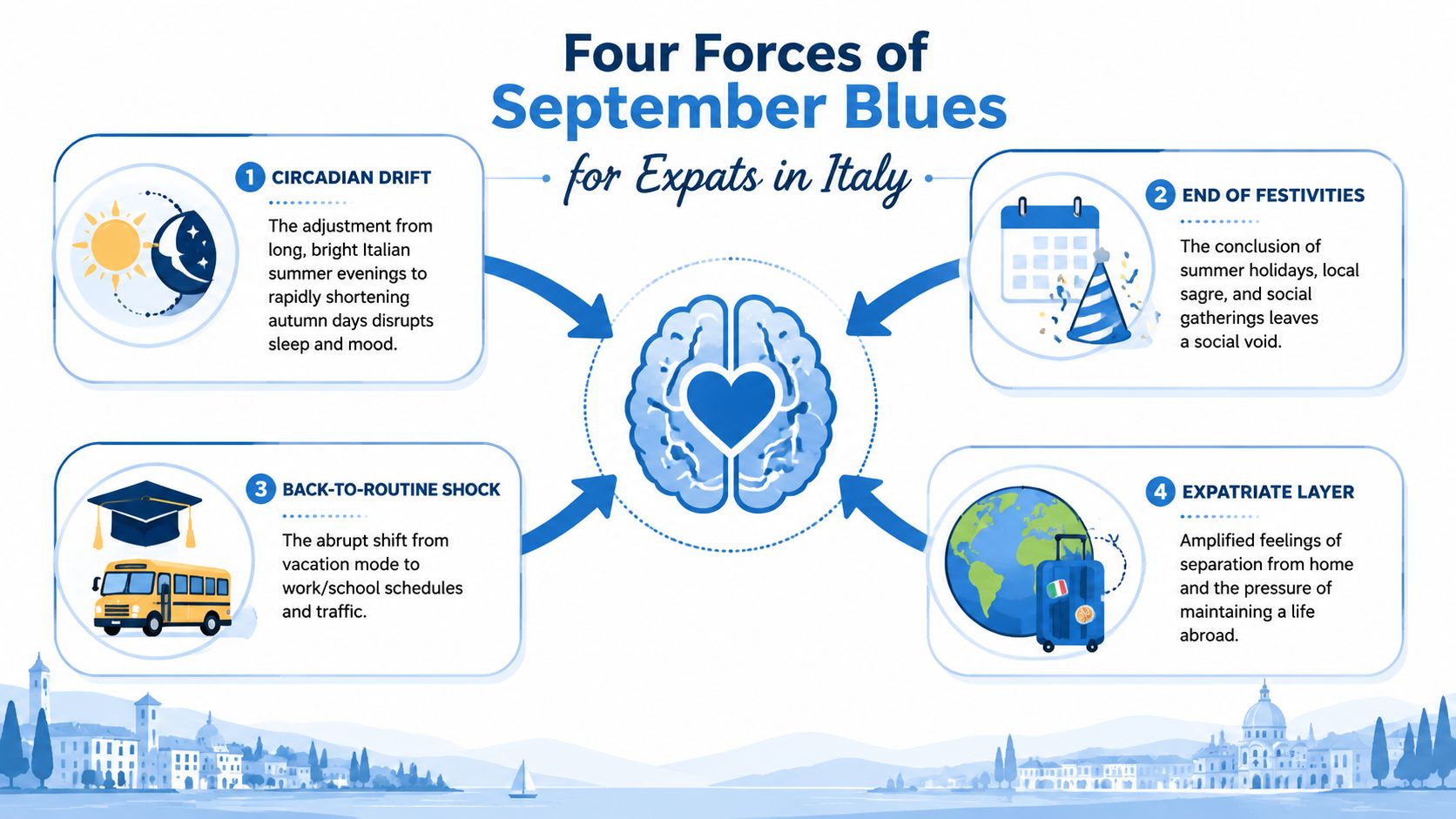
These factors interact rather than operate separately. A late-night call home can delay sleep. Poor sleep can make Italian bureaucracy feel more intimidating. That stress can lead to withdrawal, which increases loneliness. Support for expat loneliness in Italy can help interrupt that cycle.
Common Signs You Should Not Ignore
September blues often begins. You may not feel sad. Instead, ordinary tasks require more effort, and activities that usually restore you seem less appealing.
Common signs include:
- Morning fatigue: You wake feeling unrefreshed, even after what seems like enough sleep.
- Lower motivation: Emails, errands, language practice, or coursework feel unusually difficult to start.
- Irritability: Small delays, noisy neighbours, or administrative problems provoke stronger reactions.
- Restlessness: You scroll, refresh messages, or move between tasks without settling.
- Homesickness: Thoughts about family, familiar food, or home traditions become more frequent.
- Eating changes: You lose appetite or snack more in response to stress.
- Reduced enjoyment: You feel that the enjoyable part of the year has ended.
One or two of these signs for a short period can be part of normal adjustment. The important question isn't whether you feel different. It's whether the change is lasting, worsening, or narrowing your life.
Notice patterns rather than judging yourself. Keep a simple record of sleep, energy, appetite, social contact, and interest in activities. This can show whether your mood improves as routine returns or whether symptoms are becoming more persistent.
If low mood comes with hopelessness, major sleep disruption, loss of interest, or difficulty functioning, seek professional guidance. The overview of major depression symptoms can help you prepare for that conversation, but online information can't provide a diagnosis.
A temporary dip deserves kindness. A persistent decline deserves attention.
Therapsy can offer a free assessment conversation when you're unsure whether you're experiencing ordinary readjustment, burnout, depression, or a seasonal pattern.
September Blues vs Seasonal Affective Disorder vs Depression
The following comparison is a practical orientation tool, not a way to diagnose yourself. A therapist or doctor can assess the full pattern, including previous episodes, medical factors, safety concerns, and the effect on daily life.
| Feature | September Blues | Seasonal Affective Disorder | Major Depression |
|---|---|---|---|
| Typical pattern | Linked to the end-of-summer transition and renewed routine | Recurrent mood episodes follow a seasonal pattern | Persistent depressive symptoms that aren't limited to one transition |
| Intensity | Usually mild or moderate | Can be clinically significant | Can range from moderate to severe |
| Duration | Often short and improves as routine stabilises | Symptoms typically recur during a season and may last about 4 to 5 months each year, according to the National Center for Biotechnology Information | Duration and course vary, but symptoms persist and affect functioning |
| Main experience | Fatigue, reduced motivation, mild dread, homesickness | Seasonal low mood, energy changes, sleep and appetite changes | Pervasive low mood or loss of interest, alongside other symptoms |
| Functional effect | You can usually continue daily responsibilities, though they feel harder | Work, study, relationships, and self-care may be affected | Daily functioning may be substantially impaired |
| Safety concerns | Suicidal thoughts aren't expected | Can include serious safety concerns | Suicidal thoughts require urgent support |
If you or someone near you is in immediate danger, call 112, the emergency number in Italy and across the EU. Therapy is not an emergency service.
Seasonal affective disorder usually begins in late autumn or winter and remits by spring or summer, although some people notice symptoms earlier. Estimates vary by location and diagnostic method. The American Academy of Family Physicians has summarised estimates ranging from about 5% annually in the United States to lower strict-diagnostic estimates of 1% to 2% in the United States and about 2% in Canada in its clinical review of SAD.
Depression is broader than a difficult September. It can affect identity, concentration, pleasure, appetite, sleep, self-worth, and hope across settings. If you're having thoughts of harming yourself or feel unable to stay safe, contact emergency services or an urgent local crisis resource immediately.
For expats, uncertainty is common because adjustment stress and clinical symptoms can overlap. You don't need to decide which label applies before asking for help. Therapsy's human matching process can connect you with a licensed professional for culturally aware assessment in your preferred language.
Practical Coping Strategies That Actually Work
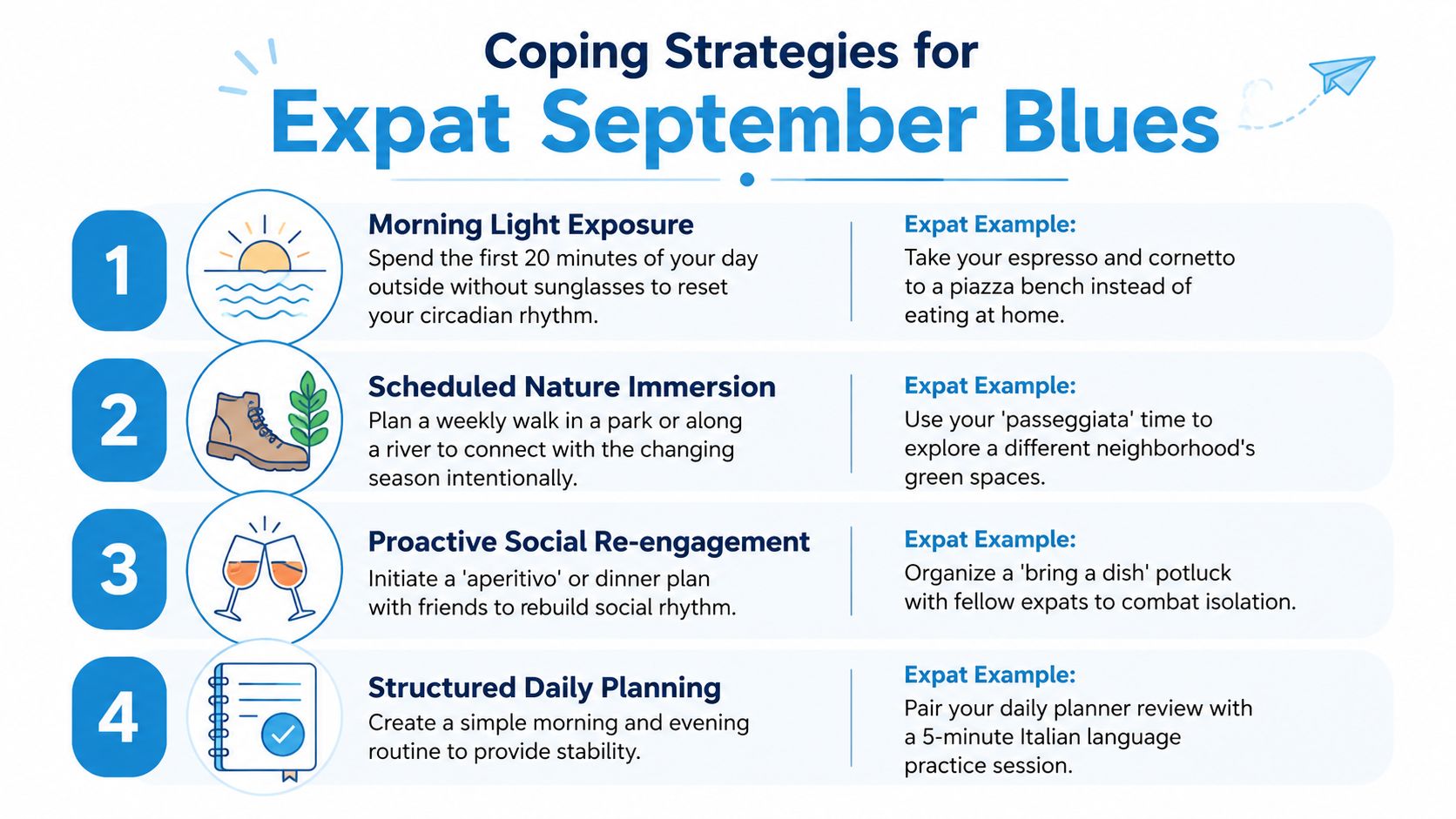
The most useful response combines light, routine, movement, social connection, and realistic boundaries. You don't need to redesign your life. Small repeated cues can help your nervous system recognise that September is a new rhythm, not a personal failure.
Start with morning light
Get outside early in the day, ideally before work or study. A walk through a Milan park, coffee on a Rome piazza, or a short passeggiata near your home can provide a consistent morning cue.
The aim isn't to force happiness. Morning light helps anchor circadian timing, while movement creates a manageable transition into the day. If you have an eye condition, take medication that increases light sensitivity, or are considering a light box, ask a healthcare professional for guidance.
Protect sleep without abandoning Italian life
Late dinners and evening socialising can be part of life in Italy. Sleep hygiene doesn't require rejecting that culture. Choose a stable wake time, keep your bedroom suitable for sleep, and reduce stimulating work close to bedtime.
Try preparing tomorrow's clothes, bag, or breakfast before dinner. That small decision reduces morning friction, especially when your Italian commute or university schedule is changing.
Rebuild connection deliberately
Don't wait for social energy to return before contacting people. Send a voice message to someone at home, arrange coffee with a colleague, or attend a language exchange or local association.
An expat may need both kinds of connection. Contact with home provides continuity, while local contact builds belonging. If you want a broader set of wellbeing ideas, these practical ways to improve mental health can help you choose manageable actions.
Add sensory anchors
A familiar scent can become part of a calming evening ritual, alongside breathing, stretching, or a warm shower.
Create boundaries around work
Remote workers often carry international schedules into every evening. Set a clear time to stop checking messages, silence non-urgent alerts, and tell colleagues when you'll respond.
You can also plan one small future pleasure, such as a weekend walk, an October day trip, or a meal with friends. Anticipation gives the calendar something other than deadlines.
Therapsy's therapists may use approaches such as CBT, Schema Therapy, EMDR, systemic-relational therapy, humanistic approaches, or ethnopsychotherapy, depending on the person's needs. CBT can help identify unhelpful thought patterns, while intercultural approaches can make space for identity, belonging, language, and relocation stress.
The Expat and Student Experience in Italy
An international student in Bologna may open a syllabus written in Italian and understand the academic content only after translating the instructions. The task itself is manageable, but the language effort adds strain. When classmates reconnect with established friends, the student may also feel pressure to build a social life quickly.
A remote worker in Florence can face a different version. Their colleagues may still be on holiday, while the worker is expected to restart projects, manage video calls across time zones, and handle everyday Italian administration alone. The city remains beautiful, but beauty doesn't remove loneliness or cognitive fatigue.
September can also expose cultural differences in work rhythm. People who have relocated to Italy may experience a rapid shift from August's slower pace to full schedules, traffic, university deadlines, and renewed workplace expectations. Newcomers may not know whether to ask for a gradual return, and they may interpret ordinary cultural differences as evidence that they're failing.
Social media can intensify the pressure. Back-to-school photographs, family gatherings, and holiday recaps may trigger grief for traditions that are difficult to recreate abroad. Comparison becomes sharper when you're already asking yourself whether you belong in your new country.
Practical organisation can reduce some of the mental clutter. Students and remote workers may benefit from a simple personal knowledge system for syllabi, appointments, language notes, and tasks.
The compassionate interpretation is often the most accurate: your reaction may reflect several simultaneous adjustments. You're not merely missing summer. You may be rebuilding structure, relationships, identity, and confidence in a foreign environment.
Your 14-Day September Reset Plan
Use one small action each day. If your September includes relocation, exams, or a work transition, adapt the plan rather than abandoning it.
Week one and stabilization
- Day 1: Choose a consistent wake time.
- Day 2: Spend time outside in morning light.
- Day 3: Prepare tomorrow's plan before bed.
- Day 4: Make one nourishing meal and drink water regularly.
- Day 5: Schedule a call with someone at home.
- Day 6: Practise Italian for a short, manageable period.
- Day 7: Take a genuine rest day with a slow meal and gentle movement.
Week two and re-engagement
- Day 8: Visit a local shop, café, or street you haven't explored.
- Day 9: Plan the coming week, including recovery time.
- Day 10: Join a class, sport, volunteer activity, or local group.
- Day 11: Invite an acquaintance for coffee and check your mood.
- Day 12: Take a short trip or walk somewhere new.
- Day 13: Visit a museum, gallery, park, or cultural space.
- Day 14: Review what helped and acknowledge the effort you made.
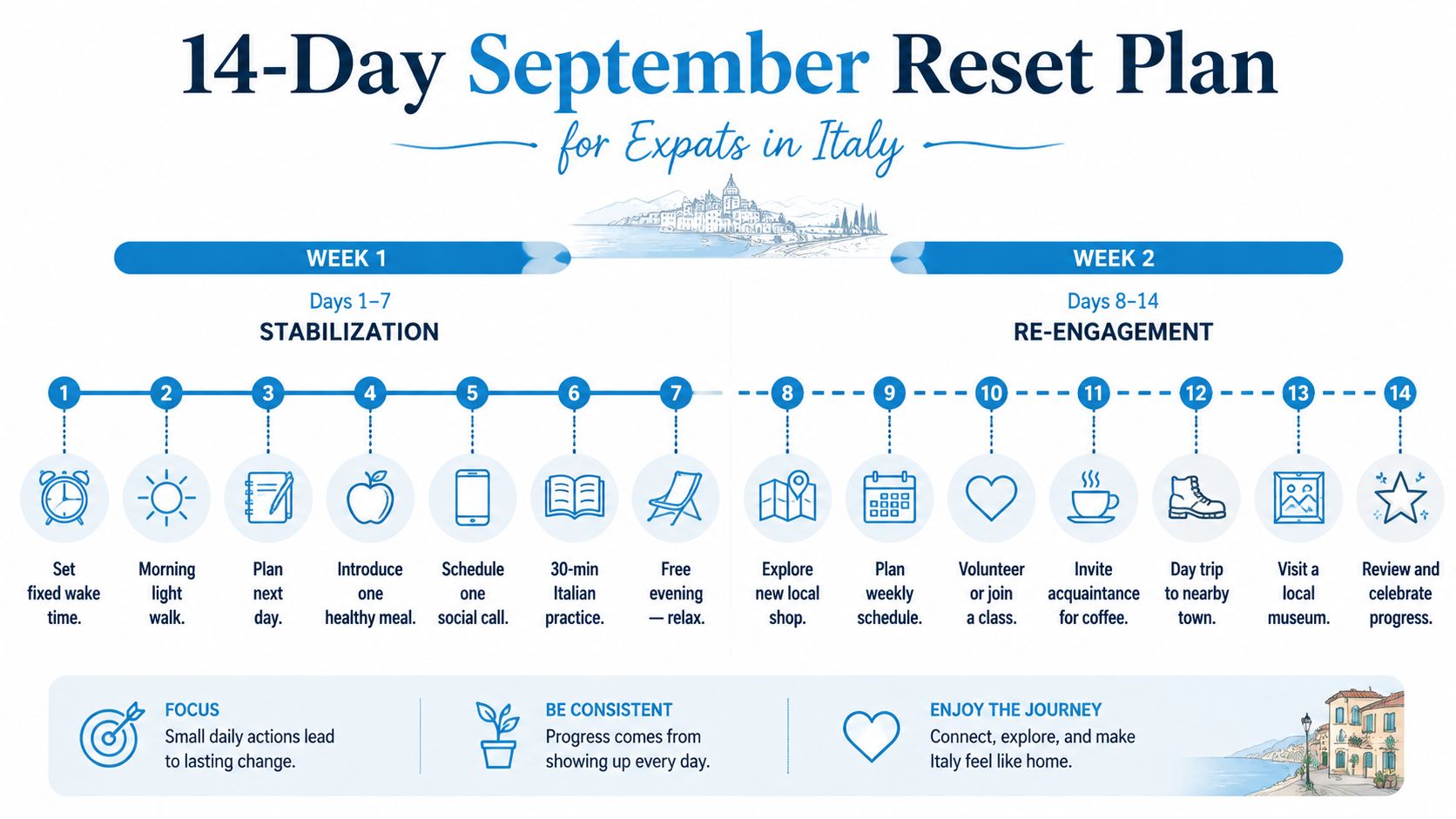
The plan is successful if it gives you clearer information about your needs. If your mood remains low or your functioning continues to deteriorate, don't treat that as a failure of discipline. It's a reason to seek personalised support.
When to Seek Professional Help and What to Expect
Expats often pride themselves on managing everything independently. That resilience can help with relocation, but “just push through” becomes unhelpful when symptoms persist or your daily life starts shrinking.
Consider professional support if you notice:
- Persistence: Low mood or exhaustion continues beyond a short adjustment period.
- Sleep or appetite disruption: Your basic rhythms change and don't settle.
- Loss of interest: Activities that normally matter no longer feel rewarding.
- Withdrawal: You stop answering messages or avoid people who usually support you.
- Intrusive thoughts: Distressing thoughts become difficult to control.
- Reduced functioning: Work, study, hygiene, relationships, or administration become difficult to manage.
- Safety concerns: You experience hopelessness or thoughts of self-harm.
Seasonal symptoms can sometimes respond to early intervention. Cleveland Clinic notes that people who know their symptoms usually begin in October may start preventive treatment in September, as explained in its guidance on seasonal depression. Treatment decisions should be made with a qualified clinician, particularly when light therapy or medication is being considered.
In Italy, you can begin through the public system by speaking with your medico di base and asking about an impegnativa where appropriate. Private psychologists and psychotherapists may offer another route, including online care for people in smaller towns, international students, and remote workers.
A first session usually includes your history, current concerns, goals, relevant cultural or relocation experiences, and an explanation of confidentiality. You don't need perfect Italian to describe your inner life. A therapist who understands your language can reduce the additional burden of translating emotion while you're already under stress.
Therapsy offers online and in-person psychotherapy across 24 Italian cities and 90+ physical locations, with 50+ therapists working in 14 languages. Its Clinical Director personally matches clients with licensed professionals, and the service has supported 1,600+ clients since 2023, according to the publisher's service information. Therapsy also reports a 4.8/5 “Excellent” Trustpilot rating, institutional relationships including Cigna, the World Food Programme, FAO, MUR, InterNations, IED, Istituto Marangoni, and EAP providers, and first contact within 12 hours.
You can read more about how to know if you need therapy before deciding what kind of support feels appropriate. A free assessment call is designed for uncertainty. It doesn't commit you to treatment, and it gives you space to explain what has changed.
FAQ
How long does September blues typically last?
September blues often improves as sleep, routine, and social connection stabilise, but the duration varies by person.
A short adjustment period may settle with practical changes. If symptoms persist, intensify, or impair daily life, consider professional assessment rather than waiting indefinitely.
Can September blues return every year?
Yes, recurring autumn mood changes can happen, particularly when reduced daylight and annual transitions affect the same person repeatedly.
A repeated pattern may be worth discussing with a clinician because seasonal affective disorder is a recurrent depressive disorder with a seasonal pattern. Therapsy can help you explore that history in a multilingual assessment.
How can I distinguish September blues from homesickness?
Homesickness is mainly focused on missing home, while September blues can also involve seasonal fatigue, reduced motivation, sleep changes, and work or study stress.
The two experiences often overlap for expats. Notice whether connection with home brings relief or whether low mood remains pervasive across settings.
What should I do if language barriers make therapy intimidating?
Choose a therapist who can work in the language in which you express emotions most comfortably.
Therapsy offers therapy in 14 languages and uses human matching rather than automated questionnaires. A free first assessment call can help you discuss language, cultural background, and preferences before beginning.
Does this reset plan work for remote workers and students?
Yes, the plan can be adapted to remote work, university schedules, relocation, and different energy levels.
The core elements are consistent wake time, morning light, manageable planning, social contact, and regular self-checks. For students, that might mean a campus walk and language exchange. For remote workers, it may mean a defined workday and an afternoon connection outside the home.
When should I seek help for September blues?
Seek help when symptoms persist, worsen, disrupt functioning, or include hopelessness, intrusive thoughts, or safety concerns.
You don't need to wait for a crisis. A therapist can help distinguish adjustment stress from burnout, depression, or a seasonal pattern and can suggest an appropriate next step.
Therapsy can connect expats, international students, and multilingual residents in Italy with carefully selected professionals for online or in-person sessions. If September feels heavier than a normal transition, book a free assessment call with the Clinical Director, with no commitment, and explain what you're experiencing.
Book a free assessment call with Therapsy, where the Clinical Director will listen to your September concerns and match you with a therapist in your preferred language. You can choose online or in-person support across Italy, with no payment or commitment for the first conversation.