You've accepted an invitation in Italy, but the thought of being photographed, wearing summer clothes, or eating in public makes you want to cancel. Body image therapy is a focused psychological treatment that helps you change the thoughts, emotions, sensations, and behaviours connected to your body, so appearance becomes less powerful in your daily life. It can address shame, checking, avoidance, comparison, reassurance seeking, and body dysmorphic concerns through structured, evidence-based therapy.
Therapsy is a multilingual psychotherapy service in Italy that connects expats with therapists who speak their native language.
What Body Image Therapy Is and Why It Matters
Body image therapy isn't a makeover project, a diet plan, or general confidence coaching. It focuses on the relationship you have with your body, including what you think when you see yourself, what you feel physically and emotionally, and what you do to manage appearance-related distress.
A therapist may help you explore questions such as:
- Do you avoid mirrors, photographs, swimming pools, intimacy, or particular clothes?
- Do you repeatedly check your body, compare yourself with others, or seek reassurance?
- Does appearance occupy so much mental space that work, study, friendships, or dating suffer?
- Do shame and fear stop you from asking for help?
General self-esteem work may discuss confidence across several areas of life. Body image therapy uses a more specific assessment and treatment plan, with attention to appearance triggers, avoidance, checking, shame, intrusive thoughts, and behaviours that keep distress going.
Body image therapy isn't about learning to love every part of your appearance. It's about building enough freedom to live without constantly negotiating with it.
Why body image distress deserves attention
Persistent body dissatisfaction can connect with disordered eating, depressed mood, social withdrawal, and reluctance to seek support. The problem becomes especially painful when someone believes they must change their body before they're allowed to participate in ordinary life.
A major 2015 meta-analytic review examined 62 tests involving 3,846 participants. It found a small-to-medium improvement in body image, with d = 0.38, a small-to-medium reduction in beauty-ideal internalisation, with d = -0.37, and a large reduction in social comparison tendencies, with d = -0.72. When unpublished and adequately powered studies were included, the overall body-image benefit narrowed to a smaller but still reliable range of d = 0.13 to 0.19 (peer-reviewed meta-analysis).
That result is useful because it sets a realistic expectation. Therapy can help, but improvement is usually measurable and gradual rather than instant.
The expat layer
Moving to Italy can intensify body distress in ways that aren't obvious at first. You may be adapting to unfamiliar beauty ideals, different clothing expectations, or social settings where you feel watched because you're still learning the language and local customs.
Speaking about shame in a second language can also make emotional detail harder to access. You might know the words for “anxious” or “uncomfortable”, but struggle to explain the bodily sensations, memories, or cultural meanings underneath them. Distance from family, a previous therapist, or familiar community rituals can remove important sources of reassurance and belonging.
If you're wondering whether your concerns have reached the point where professional help would be useful, this guide to recognising when you may need therapy can help you reflect without judging yourself. A multilingual therapist can support both symptom reduction and the wider experience of creating a life abroad.
How Body Image Distress Works and What Keeps It Going
Body image distress often follows a self-reinforcing loop. A trigger appears, such as seeing yourself in a shop window, receiving an invitation, scrolling through idealised images, or trying on clothes. Your mind interprets the trigger as evidence of a problem, anxiety or shame rises, and you use a behaviour that promises quick relief.
The relief usually doesn't last. Instead, the behaviour teaches your brain that the trigger was dangerous and that you need the behaviour again next time.
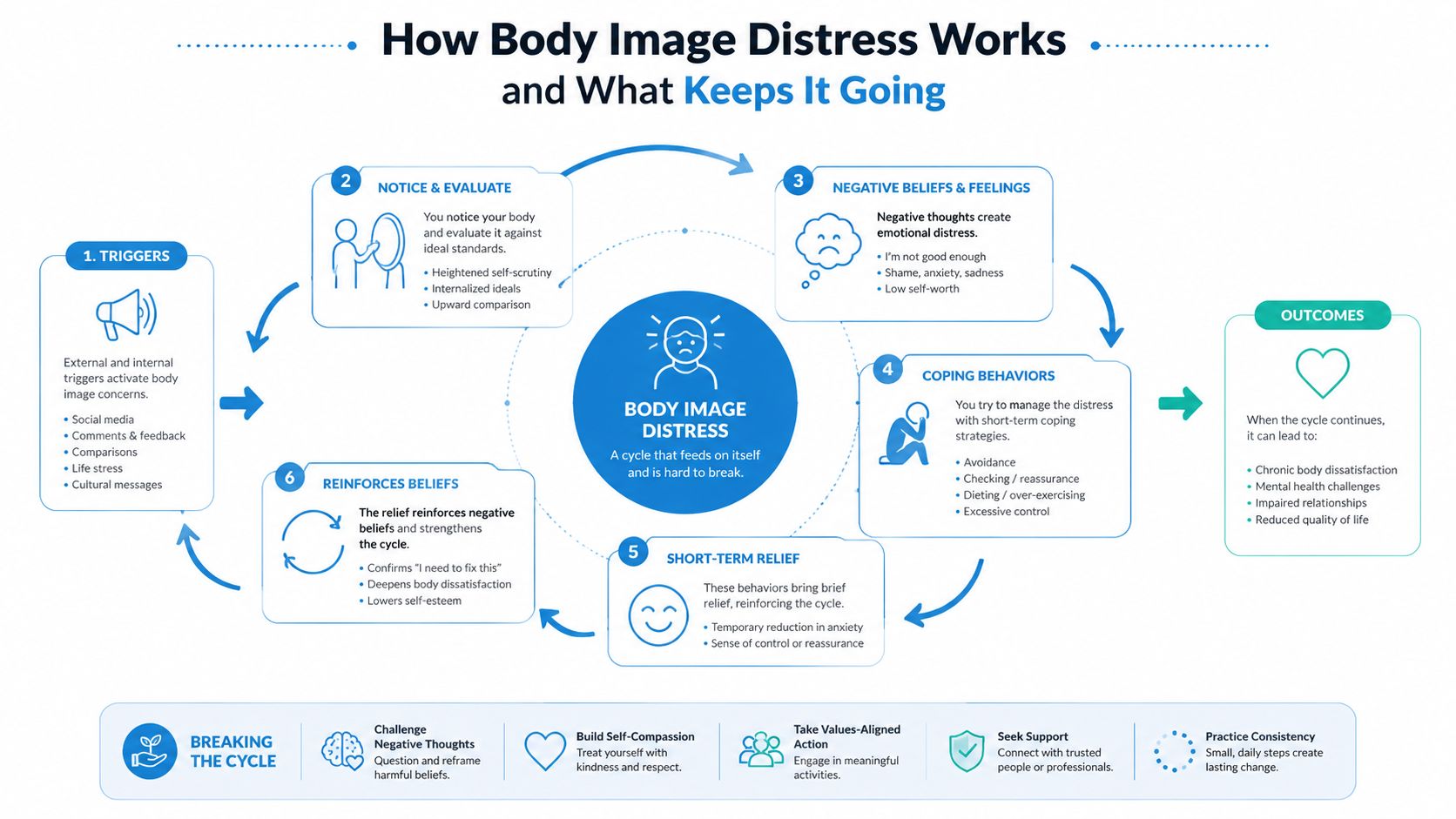
Four patterns therapists commonly map
Body checking includes repeated mirror gazing, weighing, measuring, pinching, prodding, photographing, or scanning for perceived flaws. Checking feels like information gathering, but it often directs attention toward tiny details and makes neutral observations feel threatening.
Avoidance can look like skipping a beach day, refusing photographs, wearing only certain outfits, avoiding intimacy, or staying away from the gym. Avoidance lowers anxiety briefly, but it prevents new learning. You never get the chance to discover that participation may be possible even while discomfort is present.
Social comparison happens when you measure your body against people online or around you. You may compare yourself with Italian peers at the beach, people in a piazza, colleagues at work, or carefully selected images on social media. Comparison also creates a distorted memory bias, because your attention searches for evidence that confirms inadequacy.
Reassurance seeking includes asking a partner whether you look acceptable, fishing for compliments, or repeatedly requesting confirmation that a feature isn't noticeable. Reassurance can soothe you for a moment, but the next doubt then demands another answer.
These behaviours are understandable attempts at self-protection. They aren't character flaws. Perfectionism, early teasing, appearance-related trauma, and the stress of adapting to another culture can make the loop more persistent. A psychiatrist's discussion of looksmaxxing risks is also relevant for understanding how appearance-focused strategies can become increasingly rigid.
The treatment target isn't your body. It's the cycle that teaches you your body must be monitored, hidden, corrected, or approved before you can feel safe.
A cognitive-behavioural model identifies distorted thinking alongside body checking, mirror gazing, avoidance, social comparison, and reassurance seeking as maintaining mechanisms (cognitive-behavioural model of body image). In therapy, you and the therapist can map the sequence, identify the moment where choice narrows, and practise a different response. If perfectionism is central, this resource on perfectionism and anxiety may provide useful context.
Main Therapeutic Approaches Compared
There isn't one universal form of body image therapy. The most appropriate approach depends on whether your main difficulty is checking, avoidance, intrusive thoughts, shame, trauma, perfectionism, dissociation, or pressure connected to identity and belonging.
Cognitive-behavioural therapy, or CBT, is one of the most studied approaches. It helps you identify appearance-related predictions, test them, and change behaviours that maintain distress. For body dysmorphic disorder, treatment may include exposure to avoided situations, response prevention, and reducing checking. A randomized trial focused on intrusive appearance thoughts, overvalued beliefs, exposure, and eliminating checking reported symptoms were eliminated in 82% of cases immediately after treatment and 77% at follow-up (randomized CBT trial).
Acceptance and commitment therapy, or ACT, takes a different route. Rather than debating every appearance thought, it teaches you to make room for discomfort while choosing actions connected to your values, such as meeting friends, travelling, exercising for enjoyment, or being intimate. A review of ACT interventions found a medium effect for body dissatisfaction overall, with particular relevance to high body dissatisfaction and online self-help formats, while also calling for larger and more diverse trials (review of digital ACT and psychosocial interventions).
| Approach | Best targets | Key techniques | Trade-offs |
|---|---|---|---|
| CBT | Checking, avoidance, comparison, intrusive thoughts | Cognitive restructuring, exposure, response prevention, homework | Structured and active, which can feel demanding |
| ACT | Mental struggle, rigid self-judgement, restricted life | Defusion, values work, willingness, committed action | Gentler in tone, but practice between sessions matters |
| Mindfulness and body-focused work | Disconnection, body anxiety, difficulty noticing sensations | Grounding, interoceptive awareness, mindful movement | Experiential exercises may feel unfamiliar at first |
| EMDR | Teasing, bullying, migration-related or appearance trauma | Bilateral stimulation, memory processing, present safety | Useful for trauma memories, but not a complete standalone plan for every body concern |
| Schema and compassion-focused therapy | Long-standing shame, self-criticism, defectiveness beliefs | Schema exploration, imagery, compassionate responding | Can reach deeper roots, but may require sustained work |
Research on CBT suggests that the behavioural dimension of body image improves most, while investment in appearance improves least. Therapist-assisted formats also outperformed self-directed formats, and gains were maintained at follow-up (CBT meta-analysis). That supports a practical point: insight alone may not be enough. Structured exposure, response prevention, and between-session practice often matter.
For a broader, accessible discussion of body image therapy approaches, consider how each method fits your own pattern. Therapsy therapists may work with CBT, EMDR, Schema Therapy, Humanistic approaches, and other evidence-based models, with the choice shaped by your history and goals. The CBT guide explains the approach in more detail.
What a Course of Body Image Therapy Looks Like
The first month usually feels more structured than people expect. You're not asked to arrive with a perfect explanation, and you won't be pushed into the most difficult situation immediately.
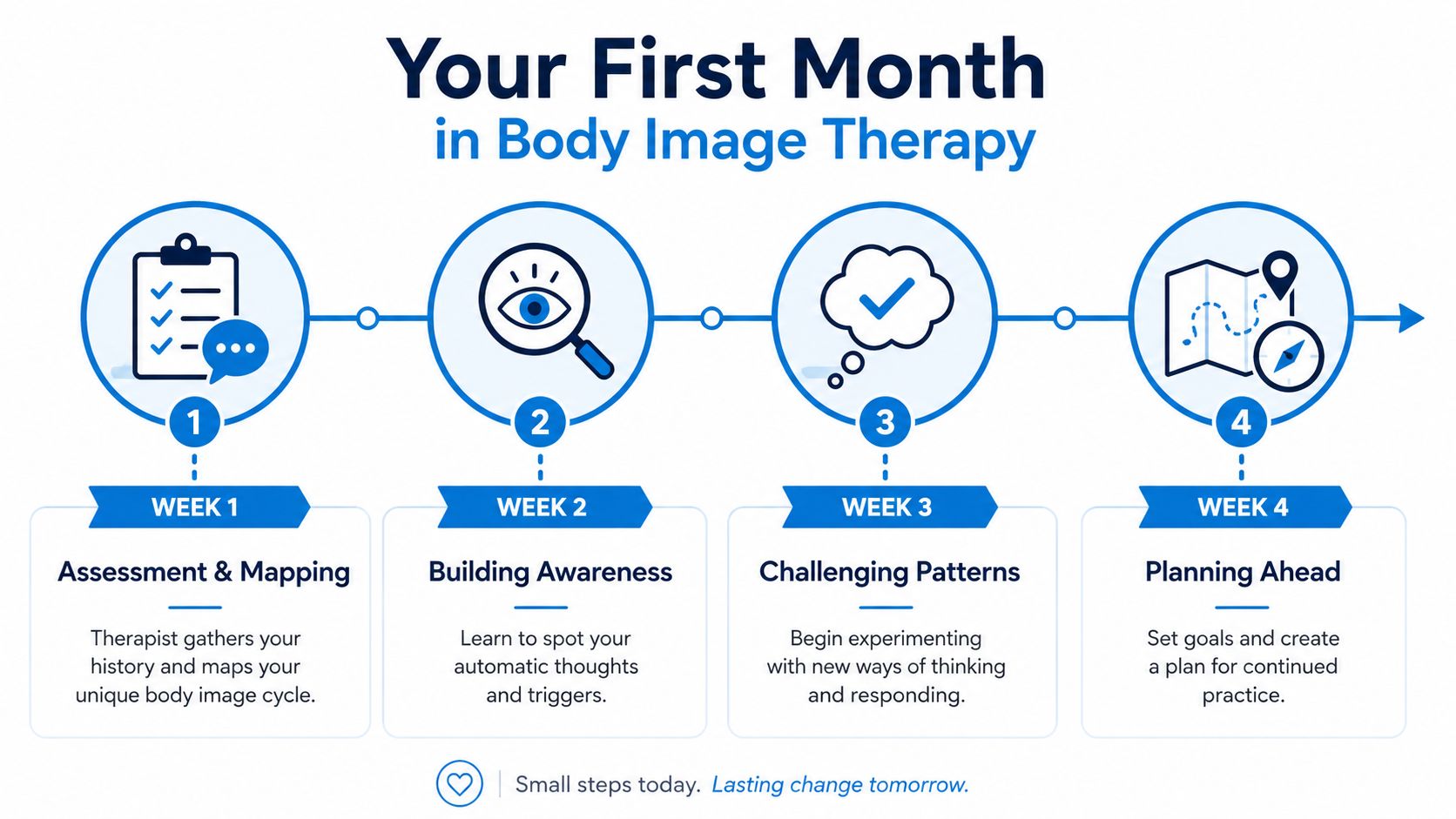
Week one and assessment
The first session is an information-gathering conversation. The therapist may ask about when body distress began, what triggers it now, how you respond, and how it affects food, clothing, relationships, work, study, or social life.
You'll also discuss your experience in Italy. Perhaps body-related comments from your home culture differ from what you hear locally. Perhaps you're navigating a new relationship, a different wardrobe, or the loneliness of living away from familiar people. The therapist turns these details into shared goals, such as attending dinners, reducing checking, or feeling more present during intimacy.
Week two and awareness
Psychoeducation introduces the cognitive-behavioural cycle. You might keep a brief log with four columns:
- Trigger: What happened?
- Thought: What did your mind predict?
- Feeling: What emotions and sensations appeared?
- Response: What did you do next?
The purpose isn't to monitor yourself perfectly. It's to notice patterns without adding another performance standard.
Weeks three and four and active practice
The active phase may include behavioural experiments. You could wear a previously avoided item for a short period, reduce a checking ritual, leave your phone away during a social event, or practise looking at your whole body rather than scanning for defects.
Mirror exposure is graded. The therapist helps you approach the task at a tolerable pace, using neutral and compassionate attention rather than forced praise. Values clarification can reconnect you with activities you've postponed, such as swimming, dancing, dating, or taking photographs with friends.
Sessions are often around 50 minutes, and many people begin with weekly appointments, although frequency depends on the clinical plan. Online therapy can be practical when you're travelling between Italian cities or feel safer starting at home. Therapsy can explain what to expect in a first psychological session and help you find a suitable format.
Who Body Image Therapy Often Overlooks
Body image content frequently assumes the reader is a young woman worried about thinness. That leaves many people without language for their actual experience.
A 2024 systematic review found that most youth intervention studies benefited girls, while evidence for boys was inconclusive (systematic review of youth body image interventions). Boys and men may experience pressure to become more muscular, lean, athletic, or physically imposing. Compulsive exercise, restrictive eating, repeated flexing or measuring, and shame may be hidden behind socially approved ideas of discipline.
LGBTQ+ readers may face minority stress, gender-expression pressure, and appearance norms within both mainstream and community spaces. Trans people may experience body distress that overlaps with gender dysphoria, but the two concerns shouldn't be treated as identical. Competent care should be gender-affirming while also using appropriate body image treatment.
Questions that reveal cultural competence
Ask a prospective therapist:
- Relevant experience: Have you worked with muscularity concerns, compulsive exercise, dysphoria, or LGBTQ+ clients?
- Language and identity: Can I discuss body experiences in my preferred language and use the name and pronouns that feel right?
- Treatment style: How do you approach exposure, checking, avoidance, or eating-related concerns?
- Respect for bodies: How do you avoid making weight loss the default goal?
- Safety and scope: How would you coordinate care if medical, nutritional, or psychiatric support became useful?
Therapsy's multilingual team includes therapists working in 14 languages, including Italian, American and British English, French, Spanish, German, Portuguese, Ukrainian, Russian, Greek, Arabic, Urdu, Hebrew, and Hindi. The right therapist won't make you translate your identity before they can understand your distress.
How to Choose the Right Body Image Therapist
Start with professional registration. In Italy, check whether the psychologist or psychotherapist is registered with the relevant Ordine degli Psicologi. Then ask about post-master training in CBT, ACT, EMDR, body-focused therapy, eating-related concerns, or another approach that fits your needs. Ongoing clinical supervision is another useful sign of responsible practice.
Language is part of treatment
A therapist who speaks your mother tongue can often hear nuances that disappear in a second language. Words related to shame, sexuality, attractiveness, family criticism, gender, and food may carry memories that are difficult to express in Italian or English.
A multilingual therapist can also help you integrate cultures rather than forcing you to choose one. You may want to understand both the beauty messages you grew up with and the expectations you're encountering in Italy.
Online and in-person options
Online sessions may suit you if you travel, live outside a major city, need privacy, or feel more able to discuss your body from home. In-person work may feel preferable if you want a stronger separation between therapy and your living space, or if body-focused exercises benefit from a shared physical setting.
Neither format automatically creates a good treatment. What matters is the therapist's experience, the safety of the setting, and whether the format allows consistent participation.
Use an initial call to ask:
- Training: What specific training do you have in body image concerns?
- Experience: Have you worked with people whose concerns resemble mine?
- Methods: How do you use exposure, response prevention, or trauma treatment?
- Setbacks: What happens if I miss practice or symptoms increase?
- Practical terms: What are the fee, cancellation policy, session format, and language options?
Within two or three sessions, you should have a clearer sense of whether the therapist listens carefully, respects your identity, explains the plan, and allows disagreement. You don't need instant comfort, but you should feel that difficult topics can be discussed without ridicule or pressure.
Therapsy uses human matching by the Clinical Director rather than automated questionnaires or chatbots. You can explore the available therapists and language options and discuss whether online or in-person care fits your life in Italy.
Realistic Outcomes Timelines and Next Steps
Progress in body image therapy is rarely a straight line. You might have a good week, attend an event you once avoided, and then feel pulled back into checking after a stressful day. That doesn't erase progress. It gives you material to understand and practise with.
Research supports modest, meaningful gains rather than instant transformation. A 2015 review found that benefits became smaller when unpublished and adequately powered studies were included, while remaining reliable (body image intervention meta-analysis). A 2025 meta-analysis of randomized psychosocial interventions in nonclinical women reported reductions in body dissatisfaction, thin-ideal internalisation, weight and shape concerns, and behavioural avoidance, alongside improved body satisfaction (2025 meta-analysis).
The pace varies by the problem, treatment fit, support around you, and whether trauma, eating difficulties, depression, or obsessive symptoms are also present. General dissatisfaction may respond differently from body dysmorphic disorder, which often calls for specialist assessment and a more thorough plan.
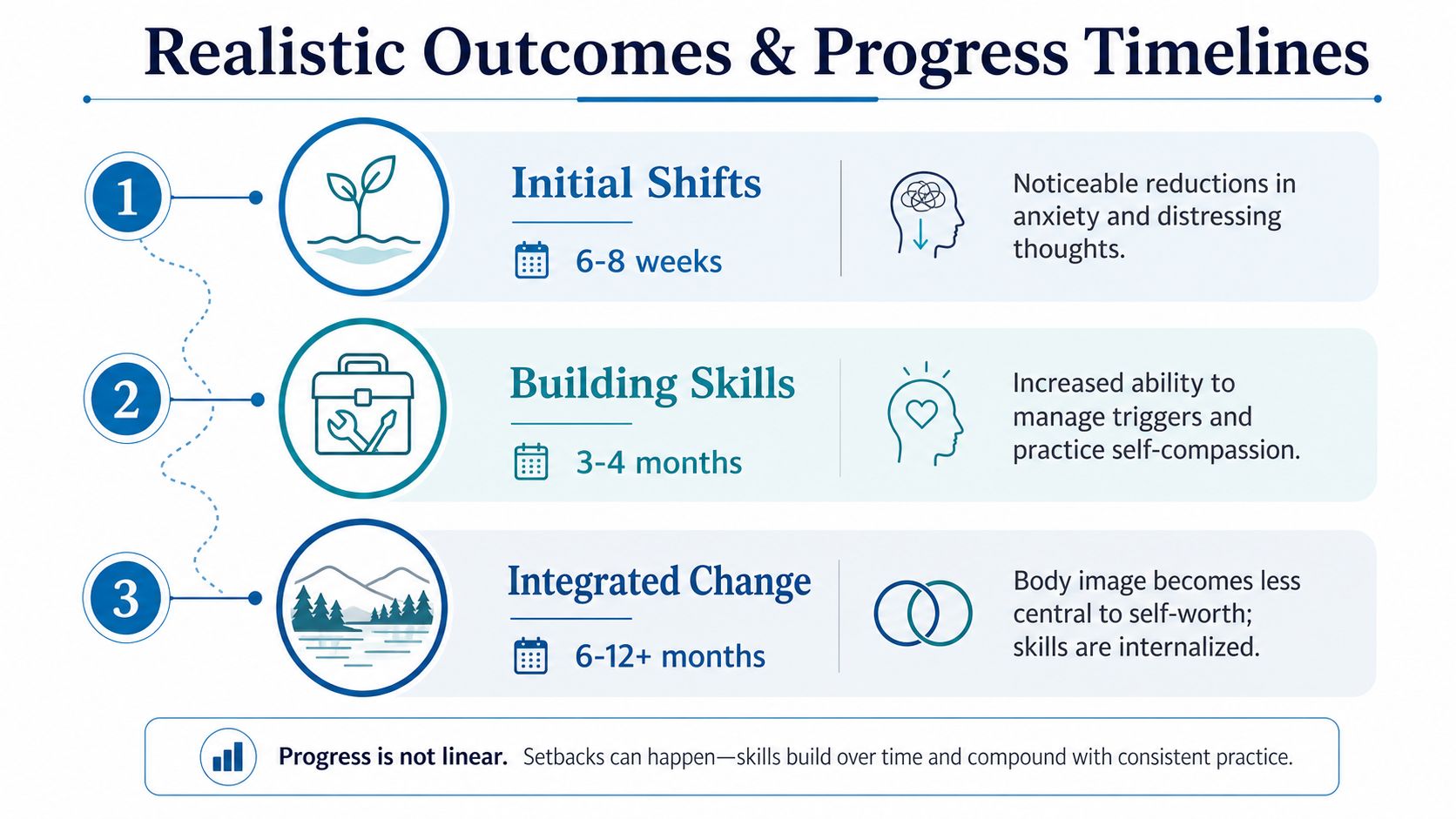
Progress markers that matter
Look beyond whether you feel attractive on a particular day. Useful changes may include:
- Less checking: You spend less time inspecting, measuring, or photographing your body.
- More participation: You accept meals, invitations, photographs, clothing, or intimacy despite discomfort.
- More mental space: Appearance occupies fewer conversations and fewer private thoughts.
- Greater flexibility: You can respond to a difficult image or comment without changing your whole day.
- Stronger connection: You stay present with people instead of monitoring how you look.
A nutrition professional, medical review, psychiatric consultation, or peer support may complement therapy when appropriate. Therapsy can help you identify a suitable starting point, and its guide to how long therapy takes offers further practical context.
Take one small step this week. Write down one avoided activity, notice what prediction keeps you away from it, or arrange a conversation with a multilingual therapist. You don't need to wait until your body feels acceptable or until you've found the perfect words.
Frequently asked questions about body image therapy
How do I know if I need body image therapy or general self-esteem support?
You may benefit from body image therapy when appearance-related thoughts or behaviours interfere with eating, clothing, relationships, social life, or daily choices.
General self-esteem work can be helpful when concerns are broad. Body image therapy is more targeted when checking, avoidance, comparison, reassurance seeking, shame, or intrusive appearance thoughts maintain distress. A free assessment call with Therapsy can help clarify which kind of support fits.
Does online body image therapy work as well as in-person therapy?
Online body image therapy can be effective for some people, especially when the therapist can guide structured practice between sessions.
Online work may also make it easier to attend consistently while living or travelling in Italy. In-person therapy can be preferable when you need stronger separation from home or want body-focused exercises in a shared setting. Therapsy offers both online and in-person appointments, depending on location and therapist availability.
How long does body image therapy take?
The length of body image therapy varies, because progress depends on the concerns, their history, and the treatment plan.
Some people notice early changes in how they respond to triggers, while deeper shame, trauma, or body dysmorphic symptoms may require more sustained specialist care. Progress is better measured through reduced checking and avoidance, greater participation, and improved flexibility than through a fixed timetable.
Can body image therapy help with body dysmorphic disorder?
Body image therapy can help with body dysmorphic disorder, particularly when it includes specialist CBT techniques such as exposure and response prevention.
Treatment may target intrusive appearance thoughts, overvalued beliefs, avoided situations, mirror checking, and reassurance seeking. A clinician should assess the full picture and coordinate additional support when needed. Therapsy can help expats discuss their concerns with a therapist in a familiar language.
How can an expat in Italy find multilingual body image therapy?
An expat can begin by checking professional registration, relevant training, language ability, experience with similar concerns, and the therapist's approach to weight, identity, exposure, and setbacks.
Therapsy connects expats with carefully selected licensed professionals in 14 languages, with online care and in-person sessions across 20+ Italian cities and 50+ physical locations. The matching process is human, and the first assessment call with the Clinical Director is free and without commitment.
Will therapy make me love my body?
Body image therapy doesn't require you to feel positive about your body every day.
The aim is often more practical: less fear, less checking, fewer avoided activities, and more freedom to live according to your values. You can work toward neutrality, respect, compassion, or acceptance without forcing yourself to repeat statements that don't feel believable.
The therapists who work with body image and eating at Therapsy
Several of our therapists work specifically in this area, in English and in other languages.
Dr. Silvia Vitello worked for years with anorexia, bulimia and obesity at Niguarda Hospital in Milan, one of the largest hospitals in the country. Hospital work with eating disorders is where the severe presentations go, and it changes what a clinician recognises early.
Dr. Camilla Ballerini works with eating disorders alongside gender identity and burnout, in English and Italian, in Rome. She works with people from 16 years old and with parents trying to understand what is happening to their child.
Dr. Svetlana Loginova specialises in eating disorders and body dissatisfaction and offers sessions in Russian as well as English and Italian, in Milan and Bergamo.
You do not have to work out who fits on your own. You tell Therapsy what you are looking for, a member of our clinical team reads your request, and they introduce you. The first call is free.
What should I do if body image distress is affecting eating or safety?
Seek professional support promptly if body image distress is affecting eating, self-care, mood, relationships, or safety.
A therapist can help assess what's happening and decide whether coordinated medical, nutritional, or psychiatric care is appropriate. If you're in immediate danger or unable to keep yourself safe, contact local emergency services or an urgent healthcare service in Italy rather than waiting for a therapy appointment.
Therapsy offers online and in-person psychotherapy for body image concerns, with carefully selected professionals, human matching by the Clinical Director, and support in 14 languages. Book a free assessment call with no commitment, just a conversation about what you're experiencing and which therapist may fit you, then visit Therapsy.