Assertiveness training is a form of behavioral therapy that teaches people how to communicate their needs, feelings, and boundaries clearly and respectfully, without being either passive or aggressive. It has been linked to meaningful mental health benefits, including significant reductions in stress, anxiety, and depression, and one meta-analysis found a stress reduction effect size of d = 0.52 in college students.
You might be reading this after a conversation that left you frustrated. Maybe your landlord in Milan kept postponing a repair, your colleague spoke over you in a meeting, or a new friend assumed you were always available because you didn't know how to say no politely in Italian. Many expats know this feeling well. You want to speak up, but you also don't want to sound rude, dramatic, or culturally tone-deaf.
That tension matters. What felt normal in your home country may feel too blunt in Italy, while staying quiet can slowly build resentment, anxiety, and self-doubt. Assertiveness training helps you protect your boundaries without abandoning warmth, respect, or cultural sensitivity.
For expats in Italy, this skill isn't just about communication. It's often about identity, safety, belonging, and emotional balance. If you're also feeling stretched by adaptation stress, this broader guide on coping with culture shock in Italy can help connect the dots.
How Assertiveness Training Helps Expats in Italy
Assertiveness training helps people say what they mean without attacking, apologizing excessively, or disappearing into silence.
For an expat, that principle can feel simple in theory and much harder in daily life.
Why It Feels Harder Abroad
Living in another country often changes your communication confidence in subtle ways:
- Language pressure – You may know what you want to say, but not how to say it naturally.
- Fear of misreading the culture – You may worry that directness will be seen as disrespect.
- Isolation – Without your usual support network, even small conflicts can feel bigger.
- Identity strain – You may start wondering whether you're “too much” or “not enough.”
Assertiveness is not about winning a conversation. It is about staying connected to yourself while staying respectful toward someone else.
That's why assertiveness training can be so grounding for expats. It gives you a structure. Instead of guessing your way through every difficult interaction, you learn repeatable skills you can adapt to real life in Italy.
What Changes With Practice
As people practice assertiveness, they often notice shifts like:
- They speak earlier, before resentment builds.
- They say no with less guilt.
- They recover faster after awkward conversations.
- They stop confusing politeness with self-erasure.
Those changes may sound modest. They're not. In everyday expat life, they can improve work relationships, friendships, housing stress, dating, and family dynamics.
Assertiveness and Other Communication Styles
Individuals often don't need more advice to “just be confident.” They need a map. Assertiveness training works best when you can spot the style you fall into under stress.
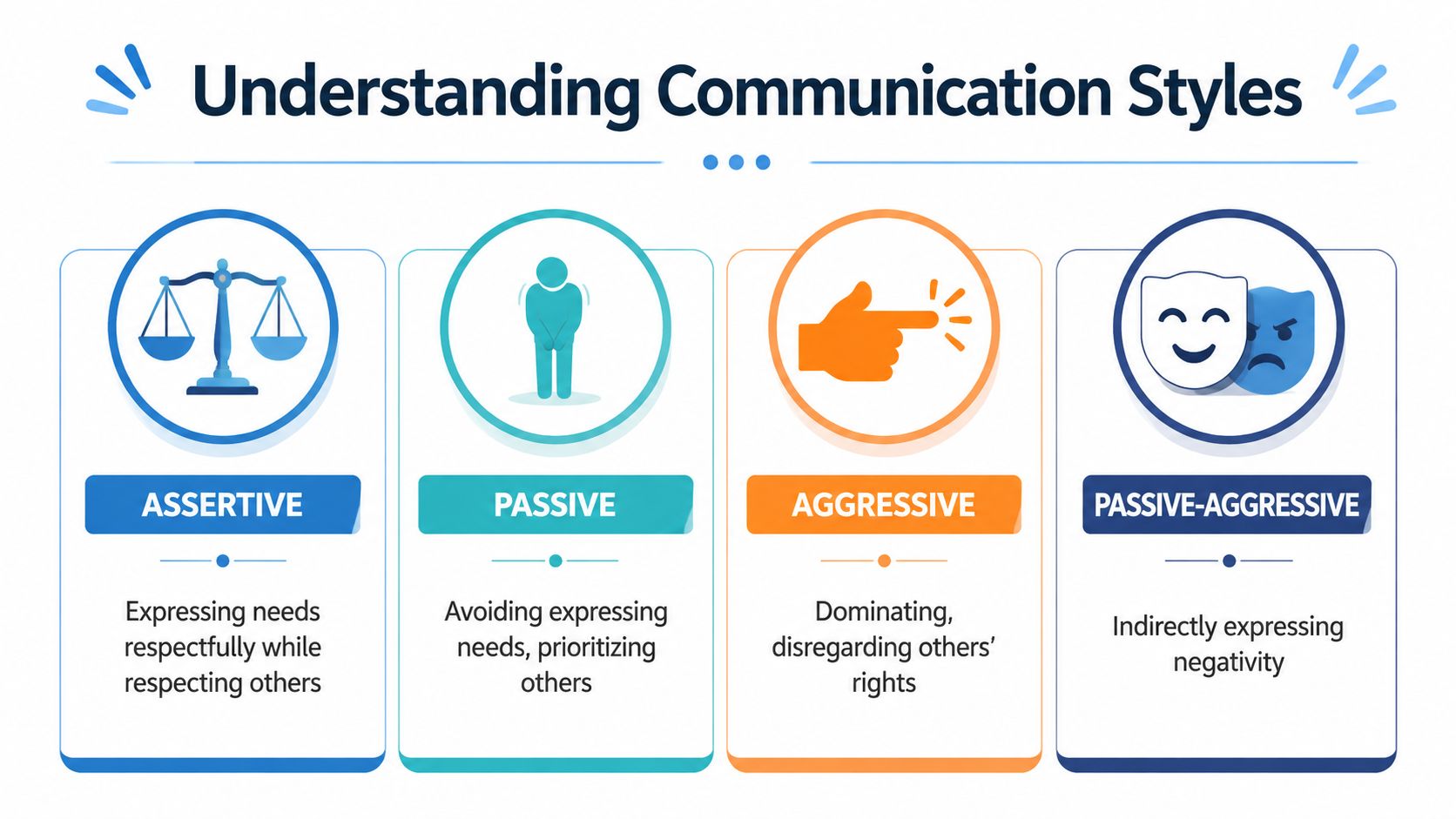
If speaking up in meetings also makes you freeze, these communication habits often overlap with presentation anxiety. Some readers also find this short resource on how to improve public speaking skills useful because it focuses on calm delivery and clarity under pressure.
The Four Common Styles
| Style | What it sounds like | What happens next |
|---|---|---|
| Passive | “It's fine, don't worry.” | Your need stays unmet. Resentment grows. |
| Aggressive | “This is unacceptable. Fix it now.” | The other person may become defensive. |
| Passive-aggressive | “No worries, I'll just do everything myself.” | Tension becomes indirect and confusing. |
| Assertive | “I need a clearer plan. Can we agree on a date?” | Your message is clear and respectful. |
Assertiveness is the healthy middle ground. It protects your needs without trampling someone else's.
Italy Specific Examples
A style becomes clearer when you see it in ordinary situations.
At a restaurant
- Passive – The order is wrong, but you eat it anyway.
- Aggressive – You raise your voice and shame the waiter.
- Passive-aggressive – You say nothing, then leave an angry comment later.
- Assertive – “Sorry, I ordered something else. Could you please change it?”
With a noisy neighbor
- Passive – You lose sleep and never mention it.
- Aggressive – You bang on the wall and threaten to call the police.
- Passive-aggressive – You leave a hostile anonymous note.
- Assertive – “Hi, I wanted to mention the noise late at night. Could we find a solution?”
At work
- Passive – You accept extra tasks even when you're overloaded.
- Aggressive – You snap in a meeting and say nobody respects your time.
- Passive-aggressive – You agree, then delay the work out of resentment.
- Assertive – “I can take this on, but I'd need us to move another deadline.”
If you want more direct communication exercises for daily life, this guide on how to improve communication skills offers a helpful companion.
A Useful Self Check
Ask yourself these questions after conflict:
- Did I say what I actually needed?
- Did I respect the other person's dignity?
- Did I leave the conversation feeling clear, not secretly angry?
If the answer is no, assertiveness training gives you something much more practical than confidence slogans. It gives you language, structure, and repetition.
The Psychology Behind Assertiveness
Assertiveness is a communication skill, but it's also a psychological shift. Many people don't stay silent because they lack vocabulary. They stay silent because their mind predicts danger.
A common thought pattern sounds like this:
- If I say no, they'll reject me.
- If I complain, I'll seem difficult.
- If I correct someone, I'll create conflict.
- If I need something, I'm being selfish.
These beliefs are exactly where Cognitive Behavioral Therapy, or CBT, becomes useful. CBT looks at the link between thoughts, feelings, and behavior. If your automatic thought is “speaking up is unsafe,” your body will often react with anxiety, your voice may shrink, and you'll avoid the conversation. That avoidance brings short-term relief, but it teaches your brain that silence was necessary.
How Behavior Changes the Mind
Assertiveness training interrupts that cycle through practice.
Instead of only talking about fear, you test a new behavior in a manageable way. You rehearse a sentence. You role-play a difficult conversation. You speak up in a low-risk situation. Then your brain gathers new evidence: “I survived that. I was uncomfortable, but not destroyed.”
A clinical review published on PMC describes assertiveness training as a clinically validated technique that produces significant reductions in stress, anxiety, and depression. That review also reports a meta-analytic effect size of d = 0.52 for stress reduction in college students, supporting the idea that assertiveness training can directly weaken the link between passive behavior and internal distress.
Passive behavior often looks calm from the outside. Internally, it can be full of stress, anger, and fear.
Why Role Playing Helps
People sometimes dismiss role-playing as awkward. In therapy, it's often one of the most effective tools.
Here's why:
- It slows the moment down – You can practice without the pressure of a real confrontation.
- It gives your body a rehearsal – Your nervous system learns the tone, posture, and pacing.
- It builds self-trust – You stop waiting for perfect confidence before speaking.
This matters for expats because many situations in Italy are layered. You may be managing language differences, hierarchy, politeness norms, and your own anxiety at the same time.
Assertiveness Is Not Just Verbal
The psychology of assertiveness also includes:
- Self-esteem – Believing your needs are valid.
- Emotional regulation – Staying grounded enough to speak calmly.
- Boundary awareness – Knowing where your responsibility ends.
- Attachment patterns – Noticing whether you fear displeasing others or being controlled by them.
That's why assertiveness training often helps with more than one problem at once. The skill may begin with a sentence, but it often changes your whole relationship with conflict.
Practical Assertiveness Exercises and Scripts
Assertiveness gets easier when you stop trying to improvise under pressure. A few simple tools can carry you through many situations.
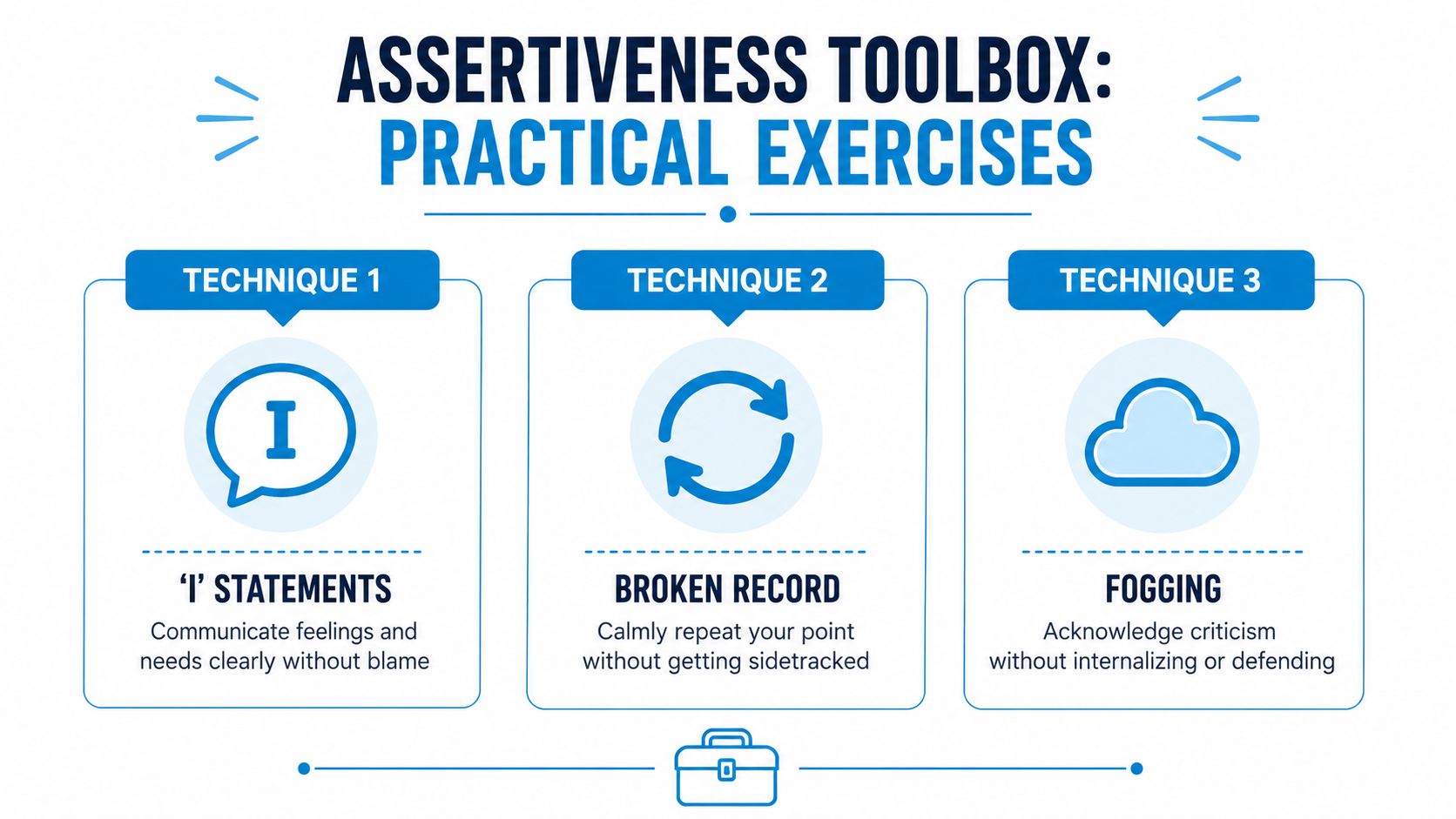
Research on adolescents shows that assertiveness training programs can increase assertiveness while also reducing anxiety, stress, depression, and bullying victimization, according to this PubMed review on assertiveness training outcomes. The setting is different, but the practical lesson is relevant: learning these skills can reduce psychological distress, not just improve conversation style.
Use I Statements
An I statement helps you express your experience without immediately putting the other person on the defensive.
A simple formula is:
- When X happens
- I feel Y
- I need or would prefer Z
Examples:
- “When plans change at the last minute, I feel stressed. I'd appreciate more notice.”
- “When I'm interrupted in meetings, I feel dismissed. I'd like to finish my point first.”
- “When messages arrive late at night, I feel pressure to reply. I'd prefer to keep work communication to daytime.”
This works well in Italy because it can sound firm without sounding combative.
Try the Broken Record Technique
Some people will ignore your first no. They may not be malicious. They may be persistent, persuasive, or used to flexible boundaries.
The broken record technique means calmly repeating your position without adding extra apologies or getting pulled into side arguments.
Example with a friend who keeps pushing you to attend a dinner:
- “Thanks for inviting me, but I can't come tonight.”
- “I know, but I still can't come tonight.”
- “I understand it's important, and I'm still not available tonight.”
Calm repetition is often more effective than a long defense. The more you over-explain, the more people may treat your boundary as negotiable.
Use DESC for Harder Conversations
When a situation is more emotionally loaded, the DESC model can help:
- Describe the facts
- Express how it affects you
- Specify what you want
- Consequences or outcome you hope for
Example with a landlord:
- Describe – “The heating has not been working for several days.”
- Express – “I'm finding it difficult to stay comfortable at home.”
- Specify – “I need a clear date for the repair.”
- Consequences – “That would help me plan and avoid further stress.”
Example at work:
- Describe – “The project scope changed after we agreed on the deadline.”
- Express – “I'm concerned about quality if we rush.”
- Specify – “I'd like to revisit the timeline.”
- Consequences – “That gives us a better chance of delivering good work.”
Practice Fogging
Fogging is a less well-known skill, but it's useful when someone criticizes you and you don't want to either collapse or fight.
You acknowledge part of what they said without surrendering your whole position.
Examples:
- “You may be right that I sounded tired.”
- “I can see why that was frustrating.”
- “That's a fair point, and I still need more notice next time.”
Fogging is especially helpful in cultures where preserving the relationship matters. It reduces escalation.
Make Practice Small and Specific
Start with low-stakes situations:
- Correct a small mistake – A wrong coffee order is a fine place to begin.
- State a preference – “I'd rather meet at six than eight.”
- Delay your answer – “Let me check and get back to you.”
- Say a brief no – “I can't this week.”
Small successes matter. They teach your nervous system that assertiveness doesn't always lead to disaster.
Navigating Assertiveness as an Expat in Italy
Generic assertiveness advice often assumes one cultural norm. Expats know that life isn't that simple.

In Italy, communication can be warm, relational, and highly context-sensitive. Tone often matters as much as content. Timing matters. Rapport matters. In some settings, a very blunt style that might feel efficient elsewhere can land as harsh or socially clumsy.
A culturally sensitive angle is badly needed here.
What Bella Figura Can Mean in Real Life
Many expats hear terms like bella figura and assume it means they should never upset anyone. That's not the healthiest interpretation.
A more useful way to think about it is this: in many Italian settings, people value social grace, mutual respect, and presentation. That doesn't mean you have to be passive. It means your delivery may matter more than you expect.
In Italy, assertiveness often works best when it sounds respectful, composed, and relational, not abrupt.
Culturally Tuned Assertiveness
Here are practical adjustments that often help:
- Lead with courtesy – A polite opening can reduce defensiveness.
- Name the relationship – “I value working well together” can soften a firm request.
- Be direct, but not sharp – Clear language usually works better than forceful language.
- Choose timing carefully – Some conversations go better after brief rapport, not as a cold demand.
- Stay steady – Volume and repetition matter less than calm consistency.
Examples:
- Instead of “This is unacceptable,” try “I'd like to find a solution because this is creating a problem for me.”
- Instead of “You never tell me anything,” try “I'd appreciate earlier communication so I can organize myself.”
- Instead of a confrontational no, try “I'm sorry, I won't be able to do that, but I can offer this instead.”
For interpersonal tensions at work or home, these skills overlap strongly with conflict resolution skills for expats in Italy, especially when active listening and clear boundaries need to happen together.
You Don't Need to Become Italian to Communicate Well
That's an important point. Cultural adaptation isn't self-erasure.
You're allowed to keep your own values around honesty, consent, time, personal space, and emotional clarity. Assertiveness training helps you express those values in ways that are more likely to be heard in your current environment.
The goal isn't to become louder, tougher, or more polished. It's to become more congruent. Your words, tone, body language, and boundaries start matching each other.
Overcoming Common Internal Barriers
Even when you know the right words, something inside can still block you. For many people, the hardest part of assertiveness training isn't the technique. It's tolerating the feelings that appear when they use it.

Guilt
Guilt often shows up when you start saying no, asking for reciprocity, or disappointing someone's expectations. That doesn't automatically mean you've done something wrong.
Many people were taught that being kind means being endlessly available. If that's your history, boundary-setting may feel selfish at first.
A healthier reframe is simple:
- Guilt can be a sign of change, not a sign of harm.
- Discomfort doesn't prove that your boundary is unfair.
- A respectful no is often more honest than a resentful yes.
Anxiety
Anxiety is common because assertiveness creates uncertainty. You can't fully control how the other person will respond.
Your body may interpret that uncertainty as danger, especially if you've had past experiences of criticism, rejection, or volatile conflict. Consequently, gradual practice matters. You don't need to jump into your hardest conversation first.
Try this sequence:
- Write the sentence you wish you could say.
- Say it aloud alone.
- Practice it with a trusted person.
- Use it in a lower-stakes real situation.
- Reflect on what happened, not just what you feared.
The aim is not to feel zero anxiety. The aim is to act with self-respect even while some anxiety is present.
Fear of Conflict
Some readers confuse assertiveness with conflict escalation. In reality, passivity often delays conflict rather than preventing it. The issue stays unresolved, pressure builds, and eventually the conversation comes out sideways.
Fear of conflict is especially common in people-pleasing patterns. If that's familiar, support around people-pleasing therapy for women may resonate, even if the label feels broader than assertiveness alone.
A Gentler Inner Script
When you're about to speak up, try replacing old thoughts with these:
Old thought – “I'm being difficult.”
New thought – “I'm being clear.”
Old thought – “They'll think badly of me.”
New thought – “Healthy relationships can handle respectful honesty.”
Old thought – “I should just let it go.”
New thought – “If it matters to me, it's worth naming calmly.”
That shift won't erase fear overnight. It does reduce the feeling that your own needs are somehow illegitimate.
Measuring Progress and When to Seek Help
Progress in assertiveness training is easy to miss if you only measure it by whether every conversation ends well. That standard is too harsh and not very realistic.
A better question is this: are you relating to yourself differently?
Signs You're Making Progress
Look for small internal and behavioral changes:
- You notice your needs sooner instead of after resentment builds.
- You pause before automatically agreeing.
- You recover faster when a conversation feels awkward.
- You use shorter, clearer sentences.
- You feel less ashamed for having preferences or limits.
These are real signs of growth. The goal isn't perfect wording. It's a steadier relationship with your own voice.
When Self Help Isn't Enough
Sometimes assertiveness attempts trigger intense anxiety, panic, shutdown, or relationship patterns that feel too entrenched to shift alone. That doesn't mean you've failed. It usually means the issue is connected to something deeper, such as trauma, chronic people-pleasing, attachment wounds, burnout, or low self-worth.
That fits what many therapists see in practice. Structured guidance often helps people turn insight into behavior.
If you're exploring mental health support online, you may also be interested in how educational material is shaped for digital audiences. This guide for making AI-powered content is useful for understanding how advice gets packaged, though personal therapy is still the place for individualized work.
Good Reasons to Reach Out
Professional support may help if:
- You understand assertiveness intellectually but freeze in real life
- Every boundary brings overwhelming guilt
- Conflict triggers panic or dissociation
- Your relationships repeatedly swing between silence and explosion
- You're asking yourself whether your stress has reached the point where you need professional support
If that last question feels familiar, this page on whether you might need a psychologist can help you reflect more clearly.
FAQ
Is Assertiveness Training the Same as Being More Confident
No, assertiveness training is not exactly the same as confidence. Confidence is a feeling, while assertiveness is a learnable skill you can practice even when you still feel nervous. Many people become more confident after practicing assertiveness because their actions start matching their values.
Can Assertiveness Training Help With Anxiety
Yes, assertiveness training can help reduce anxiety for many people. It's especially useful when anxiety is tied to people-pleasing, fear of conflict, or difficulty expressing needs. The benefit often comes from reducing avoidance and building a more grounded sense of self-respect.
How Can I Be Assertive in Italy Without Sounding Rude
You can be assertive in Italy by being clear, calm, and courteous at the same time. In many situations, warmth and tone matter as much as the actual words, so a respectful opening and steady delivery often work better than blunt intensity. You do not need to become passive to be culturally sensitive.
What If I Feel Guilty Every Time I Say No
Feeling guilty is common when you first start setting boundaries. Guilt often reflects an old habit of over-accommodating others, not proof that your boundary is wrong. With repetition, many people learn to tolerate that feeling without abandoning themselves.
How Long Does It Take to Learn Assertiveness
It depends on your history, your environment, and how often you practice. Some people notice changes quickly in everyday situations, while deeper patterns take longer when anxiety, trauma, or attachment issues are involved. The most important factor is consistent practice in real conversations.
Can Therapy Help If I Know the Scripts but Still Freeze
Yes, therapy can help when insight alone isn't enough. Freezing often means your nervous system still experiences speaking up as threatening, even if your rational mind understands the skill. Guided practice, role-playing, and work on the underlying fear can make a big difference.
Is Assertiveness Training Useful for Relationships and Work
Yes, assertiveness training is useful in both personal and professional settings. It can help with boundaries, conflict, clarity, and emotional honesty without pushing you into aggression. The same core skills often improve friendships, romantic relationships, housing issues, and workplace communication.
Book your first free assessment call – no commitment, just a conversation with our Clinical Director who will listen and match you with the right therapist for you. Visit THERAPSY.